

What do you think?
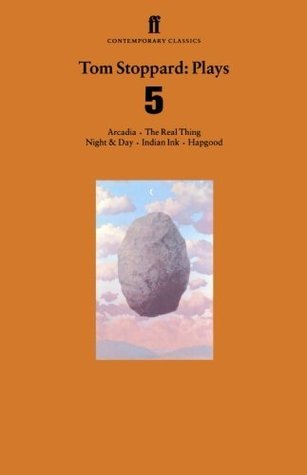
Plays 5: Arcadia / The Real Thing / Night and Day / Indian Ink / Hapgood
Plays Five:
Arcadia
The Real Thing
Night & Day
Indian Ink
Hapgood This fifth collection of Tom Stoppard's plays brings together five classic plays by one of the most celebrated dramatists writing in the English language. Arcadia received the Evening Standard, the Oliver, and the Critics Awards and The Real Thing won a Tony Award.
Arcadia
The Real Thing
Night & Day
Indian Ink
Hapgood This fifth collection of Tom Stoppard's plays brings together five classic plays by one of the most celebrated dramatists writing in the English language. Arcadia received the Evening Standard, the Oliver, and the Critics Awards and The Real Thing won a Tony Award.
608 pages, Paperback
First published January 1, 1999
About the author
Tom Stoppard
159 books1,036 followersSir Tom Stoppard was a Czech-born British playwright and screenwriter. He has written for film, radio, stage, and television, finding prominence with plays. His work covers the themes of human rights, censorship, and political freedom, often delving into the deeper philosophical thematics of society. Stoppard has been a playwright of the National Theatre and is one of the most internationally performed dramatists of his generation. He was knighted for his contribution to theatre by Queen Elizabeth II in 1997.
Born in Czechoslovakia, Stoppard left as a child refugee, fleeing imminent Nazi occupation. He settled with his family in Britain after the war, in 1946, having spent the previous three years (1943–1946) in a boarding school in Darjeeling in the Indian Himalayas. After being educated at schools in Nottingham and Yorkshire, Stoppard became a journalist, a drama critic and then, in 1960, a playwright.
Stoppard's most prominent plays include Rosencrantz and Guildenstern Are Dead (1966), Jumpers (1972), Travesties (1974), Night and Day (1978), The Real Thing (1982), Arcadia (1993), The Invention of Love (1997), The Coast of Utopia (2002), Rock 'n' Roll (2006) and Leopoldstadt (2020). He wrote the screenplays for Brazil (1985), Empire of the Sun (1987), The Russia House (1990), Billy Bathgate (1991), Shakespeare in Love (1998), Enigma (2001), and Anna Karenina (2012), as well as the HBO limited series Parade's End (2013). He directed the film Rosencrantz and Guildenstern Are Dead (1990), an adaptation of his own 1966 play, with Gary Oldman and Tim Roth as the leads.
He has received numerous awards and honours including an Academy Award, a Laurence Olivier Award, and five Tony Awards. In 2008, The Daily Telegraph ranked him number 11 in their list of the "100 most powerful people in British culture". It was announced in June 2019 that Stoppard had written a new play, Leopoldstadt, set in the Jewish community of early 20th-century Vienna. The play premiered in January 2020 at Wyndham's Theatre. The play went on to win the Laurence Olivier Award for Best New Play and later the 2022 Tony Award for Best Play.
Born in Czechoslovakia, Stoppard left as a child refugee, fleeing imminent Nazi occupation. He settled with his family in Britain after the war, in 1946, having spent the previous three years (1943–1946) in a boarding school in Darjeeling in the Indian Himalayas. After being educated at schools in Nottingham and Yorkshire, Stoppard became a journalist, a drama critic and then, in 1960, a playwright.
Stoppard's most prominent plays include Rosencrantz and Guildenstern Are Dead (1966), Jumpers (1972), Travesties (1974), Night and Day (1978), The Real Thing (1982), Arcadia (1993), The Invention of Love (1997), The Coast of Utopia (2002), Rock 'n' Roll (2006) and Leopoldstadt (2020). He wrote the screenplays for Brazil (1985), Empire of the Sun (1987), The Russia House (1990), Billy Bathgate (1991), Shakespeare in Love (1998), Enigma (2001), and Anna Karenina (2012), as well as the HBO limited series Parade's End (2013). He directed the film Rosencrantz and Guildenstern Are Dead (1990), an adaptation of his own 1966 play, with Gary Oldman and Tim Roth as the leads.
He has received numerous awards and honours including an Academy Award, a Laurence Olivier Award, and five Tony Awards. In 2008, The Daily Telegraph ranked him number 11 in their list of the "100 most powerful people in British culture". It was announced in June 2019 that Stoppard had written a new play, Leopoldstadt, set in the Jewish community of early 20th-century Vienna. The play premiered in January 2020 at Wyndham's Theatre. The play went on to win the Laurence Olivier Award for Best New Play and later the 2022 Tony Award for Best Play.
Ratings & Reviews
Friends & Following
Create a free account to discover what your friends think of this book!
Community Reviews
Displaying 1 - 30 of 45 reviews

August 31, 2019
Aug 6 ~~ Technically I am not exactly finished. I have read two of the five plays and started the third, but real life has been making reading challenging these days, especially the type of reading that demands the reader pays super close attention to every word. I haven't been able to do that, so I am setting this one aside for now. I will return to it next year on the author's birthday and pick up where I left off.
I can brag a little about understanding the insanely clever play Arcadia a little better this time around, so that's a big yay for me!
July 3, 2026 ~~ Tom Stoppard passed away in November of 2025. I own two of his books. I reread Rosencrantz and Guildenstern Are Dead as my first book of 2026 and decided to start my reread of this one on what would have been Stoppard's 89th birthday.....today, July 3rd.
~~~~~~~~~~~~~~~~~~~~~
Original Review ~~ August 2019
When I finished reading this collection of five Tom Stoppard plays, I rated it a four star book, but I've had some time to think about it a little so I've bumped the rating up to five.
Because it is not my fault if I cannot follow easily where Mr. Stoppard leads. He is so wickedly intellectual that a normal person like me needs more than one reading of his work to grasp his ideas. And besides that he talks about math, at least in Arcadia, the first of the collection. By the time we get to the final offering, Hapgood, we are talking about physics. (Oddly enough, I was better at that in school than I was in the pure math classes. Weird, init.)
Anyway, I first came across Stoppard when I saw the movie Rosencrantz And Guildenstern Are Dead. I watched it many times in order to be able to follow the lightning fast dialogue exchanges and also to keep track of the story itself. When I found the book I was glad I was already familiar with the plot, but I still read it many times for pure enjoyment.
This book of plays will definitely be read again. It needs to be, since so much of what was happening went over my head. I would also get lost in thinking how in the world certain scenes could have been staged, because Stoppard plays with time: in both Arcadia and Indian Ink there are characters from different eras on stage, quite often in the same scene. And Hapgood, with its spy versus spy versus spy versus spy trickery, must be a stage manager's nightmare!
The plays are so clever, yet also there is a depth to them that I could not pick up completely on this first time around. I was a bit blinded by the light of Stoppard's wit. Next time I read I will be prepared for what is here and I hope I won't be constantly taking myself out of the play to marvel at the talent of the playwright.
I can brag a little about understanding the insanely clever play Arcadia a little better this time around, so that's a big yay for me!
July 3, 2026 ~~ Tom Stoppard passed away in November of 2025. I own two of his books. I reread Rosencrantz and Guildenstern Are Dead as my first book of 2026 and decided to start my reread of this one on what would have been Stoppard's 89th birthday.....today, July 3rd.
~~~~~~~~~~~~~~~~~~~~~
Original Review ~~ August 2019
When I finished reading this collection of five Tom Stoppard plays, I rated it a four star book, but I've had some time to think about it a little so I've bumped the rating up to five.
Because it is not my fault if I cannot follow easily where Mr. Stoppard leads. He is so wickedly intellectual that a normal person like me needs more than one reading of his work to grasp his ideas. And besides that he talks about math, at least in Arcadia, the first of the collection. By the time we get to the final offering, Hapgood, we are talking about physics. (Oddly enough, I was better at that in school than I was in the pure math classes. Weird, init.)
Anyway, I first came across Stoppard when I saw the movie Rosencrantz And Guildenstern Are Dead. I watched it many times in order to be able to follow the lightning fast dialogue exchanges and also to keep track of the story itself. When I found the book I was glad I was already familiar with the plot, but I still read it many times for pure enjoyment.
This book of plays will definitely be read again. It needs to be, since so much of what was happening went over my head. I would also get lost in thinking how in the world certain scenes could have been staged, because Stoppard plays with time: in both Arcadia and Indian Ink there are characters from different eras on stage, quite often in the same scene. And Hapgood, with its spy versus spy versus spy versus spy trickery, must be a stage manager's nightmare!
The plays are so clever, yet also there is a depth to them that I could not pick up completely on this first time around. I was a bit blinded by the light of Stoppard's wit. Next time I read I will be prepared for what is here and I hope I won't be constantly taking myself out of the play to marvel at the talent of the playwright.

April 17, 2025
There's always a risk that several works by the same author meant to be enjoyed separately in a compilation become... less? The sum is smaller that the parts? "Plays 5" is exactly in this predicament as each play looses a little of its uniqueness when presented in a sequence.
Starting with "Arcadia", all 5 plays follow the same theme of perception, deception, reality, of overlapping time-lines, concepts, and attitudes. In "Arcadia" the plot revolves around the characters of the 20th century trying to decipher the events of the 19th century involving Lord Byron no less, with the reader/spectator looking at objects inhabiting both eras and serving as both puzzles and clues. Characters from both eras seem to converse, and when Thomasina of the 19th century muses on determinism - "If you could stop every atom in its position and direction, and if your mind could comprehend all the actions thus suspended, then if you were really, really good at algebra you could write the formula for all the future; and although nobody can be so clever as to do it, the formula must exist just as if one could" -, Chole of the 20th concludes that determinism doesn't work "because of sex".
"The Real Thing" and play-within-play mercilessly toys with the reader, there are at least two distinct "wait, what?!" moments. Speed of the dialogues filled with wit, puns, one-liners, and double meanings, complexity of characters and their relations place "The Real Thing" among my favourites, even if some bits of it have not aged exactly well since 1982. "Night and Day" about the journalists in a fictional war-torn African country feels the most sarcastic, but the character of Ruthie also makes it the most tender, even raw, especially in the moment where after having told one of the characters "if I had fancied you at all when you chatted me up in the visa office, I would have run a mile. That’s what we honourable ladies with decent husbands do", she talks to another character and is compelled to say to herself "Run. Run, you stupid".
"Indian Ink" seems to be the least convincing, once again same objects inhabit two timelines, a painting from the India of 1930s appears in the UK of 1980s bringing along bittersweet sentiment and nostalgia, inky blue-black colour was "the colour he looked by moonlight." And, finally, "Hapgood" that I read twice and still don't follow - espionage and motherhood, interchanging twins and may be triplets in something akin to shell game. I might need to read "Hapgood" again. All the other Stoppard's plays, too.
"/../ Words /../ are innocent, neutral, precise, standing for this, describing that, meaning the other, so if you look after them you can build bridges across incomprehension and chaos.
But when they get their corners knocked off, they're no good any more, /../ I don't think writers are sacred, but words are. They deserve respect. If you get the right ones in the right order, you can nudge the world a little or make a poem which children will speak for you when you're dead."
Starting with "Arcadia", all 5 plays follow the same theme of perception, deception, reality, of overlapping time-lines, concepts, and attitudes. In "Arcadia" the plot revolves around the characters of the 20th century trying to decipher the events of the 19th century involving Lord Byron no less, with the reader/spectator looking at objects inhabiting both eras and serving as both puzzles and clues. Characters from both eras seem to converse, and when Thomasina of the 19th century muses on determinism - "If you could stop every atom in its position and direction, and if your mind could comprehend all the actions thus suspended, then if you were really, really good at algebra you could write the formula for all the future; and although nobody can be so clever as to do it, the formula must exist just as if one could" -, Chole of the 20th concludes that determinism doesn't work "because of sex".
"The Real Thing" and play-within-play mercilessly toys with the reader, there are at least two distinct "wait, what?!" moments. Speed of the dialogues filled with wit, puns, one-liners, and double meanings, complexity of characters and their relations place "The Real Thing" among my favourites, even if some bits of it have not aged exactly well since 1982. "Night and Day" about the journalists in a fictional war-torn African country feels the most sarcastic, but the character of Ruthie also makes it the most tender, even raw, especially in the moment where after having told one of the characters "if I had fancied you at all when you chatted me up in the visa office, I would have run a mile. That’s what we honourable ladies with decent husbands do", she talks to another character and is compelled to say to herself "Run. Run, you stupid".
"Indian Ink" seems to be the least convincing, once again same objects inhabit two timelines, a painting from the India of 1930s appears in the UK of 1980s bringing along bittersweet sentiment and nostalgia, inky blue-black colour was "the colour he looked by moonlight." And, finally, "Hapgood" that I read twice and still don't follow - espionage and motherhood, interchanging twins and may be triplets in something akin to shell game. I might need to read "Hapgood" again. All the other Stoppard's plays, too.
"/../ Words /../ are innocent, neutral, precise, standing for this, describing that, meaning the other, so if you look after them you can build bridges across incomprehension and chaos.
But when they get their corners knocked off, they're no good any more, /../ I don't think writers are sacred, but words are. They deserve respect. If you get the right ones in the right order, you can nudge the world a little or make a poem which children will speak for you when you're dead."

October 25, 2014
Stoppard is one of the greatest dramatic artists of the 20th and 21st centuries. His plays are absolutely amazing. I've read at least seven of his plays now and I don't think there's been one I disliked--not all of them are my favorite plays ever, but some of them Are just spectacular, especially Arcadia, Hapgood, Indian Ink, and Rosencrantz and Guildenstern are Dead.
What I enjoy most about Stoppard's dramaturgy is how he plays with uncertainty, providing clues about mysterious events, then negating those clues and providing other, and then leaving the ends of these strings of clues open, but not incomplete. It's difficult to explain, but, for instance, in Indian Ink we get the hint that Flora slept with someone during her time in Jummapur, and at various times there are hints that it might be one of three people (though it is also suggested that she might have had an affair with a person unknown), but we never find out which one of the three (or who else) or if Flora actually had an affair at all because the reference in her letter was vague. But at the end of the play it doesn't feel like this uncertainty is a problem or a plot hole or anything like that. The play feels complete though the questions remain open.
This playing with contradictions, revisions, and so on characterizes how Stoppard uses history--Stoppard probably sets a higher percentage of his plays historically than any other contemporary British dramatist. But his history is always problematic and always open to revisions from the present. (I have a paper about this, which is out being considered by a journal for publication. Fingers crossed.)
What I enjoy most about Stoppard's dramaturgy is how he plays with uncertainty, providing clues about mysterious events, then negating those clues and providing other, and then leaving the ends of these strings of clues open, but not incomplete. It's difficult to explain, but, for instance, in Indian Ink we get the hint that Flora slept with someone during her time in Jummapur, and at various times there are hints that it might be one of three people (though it is also suggested that she might have had an affair with a person unknown), but we never find out which one of the three (or who else) or if Flora actually had an affair at all because the reference in her letter was vague. But at the end of the play it doesn't feel like this uncertainty is a problem or a plot hole or anything like that. The play feels complete though the questions remain open.
This playing with contradictions, revisions, and so on characterizes how Stoppard uses history--Stoppard probably sets a higher percentage of his plays historically than any other contemporary British dramatist. But his history is always problematic and always open to revisions from the present. (I have a paper about this, which is out being considered by a journal for publication. Fingers crossed.)

May 13, 2026
As I continue my education in Stoppard, this is the big daddy. Arcadia and The Real Thing are the honest-to-god masterpieces of his mid-period, where the ideas and the heart are perfectly in balance. The other three here are interesting and it's not their fault they're not masterpieces in comparison to the other two in this volume, but there's a reason all three are seldom revived.
---
Arcadia: 5/5 - "And everything is mixing the same way, all the time, irreversibly..." "Oh we have time, I think." "...till there's no time left."
The Real Thing: 5/5 - Pretty fucking sensational.
Night and Day: 3.5/5 - A... peculiar play. Hopelessly naïve take on the British press, very odd post-colonial commentary, reads as an excellent thriller with a wonderful creation in Ruth, played variously in the original production by Diana Rigg and Maggie Smith. Also, does the on-stage jeep here in some way anticipate the helicopter in Miss Saigon? Much to consider.
Indian Ink: 3/5 - Yes, second rate Stoppard, and yes, that would be wonderful for everyone else. But *very* talky, even for him.
Hapgood: 3/5 - I would love to be like "unappreciated masterpiece! What do you all mean it's unintelligible!?" but unfortunately I found about 35% of this incomprehensible on the page. Great fun though.
---
Arcadia: 5/5 - "And everything is mixing the same way, all the time, irreversibly..." "Oh we have time, I think." "...till there's no time left."
The Real Thing: 5/5 - Pretty fucking sensational.
Night and Day: 3.5/5 - A... peculiar play. Hopelessly naïve take on the British press, very odd post-colonial commentary, reads as an excellent thriller with a wonderful creation in Ruth, played variously in the original production by Diana Rigg and Maggie Smith. Also, does the on-stage jeep here in some way anticipate the helicopter in Miss Saigon? Much to consider.
Indian Ink: 3/5 - Yes, second rate Stoppard, and yes, that would be wonderful for everyone else. But *very* talky, even for him.
Hapgood: 3/5 - I would love to be like "unappreciated masterpiece! What do you all mean it's unintelligible!?" but unfortunately I found about 35% of this incomprehensible on the page. Great fun though.
November 17, 2010
The Empire is long gone, but its humor remains evidence of Britain's superiority. And Tom Stoppard has to be one of the top practitioners, if one of the more highbrow, of British comedy. I am slowly working my way through the five or six volumes of his collected plays, and it's about the best reading I've had in a long time. I know next to nothing about theater, but you can (and you should!) read these plays like novellas or short stories. They are absolutely entertaining, funny, witty, deep, marvelously constructed things and I cannot recommend them highly enough. So far this volume (Volume Five) is my favorite. How does one even go about writing a play like ARCADIA or INDIAN INK? I can't even summarize or explain them. Stoppard's dialogue and setups are so excellent, I am curious how a live production could possibly match up to the experience of reading his pages. Kinda makes me wanna get out to the theater at some point, I haven't been since I fell asleep at FIDDLER ON THE ROOF in Arizona State auditorium when I was 9.

Read
August 12, 2009Arcadia cleverly moves back and forth between the early eighteen hundreds and the present, as two historians try to reconstruct the past. Lot's of spicy dialog between the protagonists. The effect is similar to Thornton Wilder's Our Town without the heart-rending sadness that made first-nighters at the Wilder play sob uncontrollably at the graveyard scene in the third act.
The Real Thing, the second play in the Stoppard anthology, is a breezy look at love and faithfulness (or its lack) in the world of actors and writers. Despite the verbal pyrotechnics we have come to expect from its creator, I think the playright got this one wrong: he idealizes lovers and their foibles in a way that demeans good old normal, everyday monogamy, which, by implication, he sees as sexless and dull.
The Real Thing, the second play in the Stoppard anthology, is a breezy look at love and faithfulness (or its lack) in the world of actors and writers. Despite the verbal pyrotechnics we have come to expect from its creator, I think the playright got this one wrong: he idealizes lovers and their foibles in a way that demeans good old normal, everyday monogamy, which, by implication, he sees as sexless and dull.

March 19, 2012
My favorite play is Rosencrantz and Guildenstern are Dead. I had read a few of Stoppard's earlier works, but I hadn't gotten a chance to read these until just recently.
Stoppard's greatest strength as a playwright is his innovative way of using space and time to tell a story. These shows (especially "Arcadia" and "Hapgood") are exemplary in this sense.
My biggest critique of Stoppard is that he doesn't seem to be able to create interesting and realistic female characters. Out of all of these plays, all of the women seemed to be plot devices, even when they were the main characters.
Stoppard's greatest strength as a playwright is his innovative way of using space and time to tell a story. These shows (especially "Arcadia" and "Hapgood") are exemplary in this sense.
My biggest critique of Stoppard is that he doesn't seem to be able to create interesting and realistic female characters. Out of all of these plays, all of the women seemed to be plot devices, even when they were the main characters.

September 23, 2013
Plays 5 (or Plays FIve), a compilation of five of Tom Stoppard plays, published by faber and faber in 1999. Also, Lord Malquist and Mr. Moon, by Tom Stoppard, from Grove Press, published first in 1966 and with an introduction in 2005.
Note that I have recently reviewed Rosencrantz & Guildenstern Are Dead, Stoppard’s most famous work, as part of a study of Shakespeare’s “Hamlet” and that is why I took this diverting route into some of the further works of Stoppard. I also reviewed the incredible movie (directed by Stoppard), Rosencrantz & Guildenstern Are Dead.
Stoppard is not your typical playwright, in career. He has exactly the type or career that I would love to have, in that he is never satisfied just sticking to one thing. His production includes not only many plays (and many celebrated plays, beginning with radio plays and expanding to the stage), but also screen plays (some original and some adaptations), movie direction, translation, and even acting, libretto, and a novel. It would take me an entire “semester,” as it were, to cover Stoppard in his entirety, hitting on all his best plays and watching his movies. Here are some of the most famous (far from comprehensive):
Lord Malquist and Mr. Moon (novel, 1966)
“Rosencrantz & Guildenstern Are Dead” (play, 1966)
“The Real Inspector Hound” (play, 1968)
“Jumpers” (play, 1972)
“Travesties” (play, 1974)
“Every Good Boy Deserves Favour” (play, 1977)
“Professional Foul” (TV play, 1977)
“Doggs Hamlet” and “Cahoot’s Macbeth” (companion plays, 1979)
“The Real Thing” (play, 1982)
“Arcadia” (play, 1983)
Brazil (screenplay, 1985)
Indiana Jones and the Last Crusade (screenplay rewrite, 1989)
Rosencrantz & Guildenstern Are Dead (movie, 1990)
Shakespeare In Love (screenplay, 1998)
“The Coast of Utopia” (play trilogy, 2002)
Parade’s End (adapted TV miniseries, 2012)
Anna Karenina (adapted screenplay, 2012)
Stoppard is a Czech-born British playwright. His career and works have been applauded and revered since the 60s, and he continues to be an artistic force. He was knighted in 1997. Under his belt, he has an Academy Award and four Tonys, as well as many other awards. He outperforms almost every other living dramatist, and in the words of Wikipedia, Stoppard’s “themes [include] human rights, censorship and political freedom… along with exploration of linguistics and philosophy.” He is also recognized as a comic and satirical master.
Plays 5 or Plays Five:
When deciding on a book of plays to read for Stoppard, I was confronted with many, but none with all his plays, and not one with his best or most famous. In other words, you just have to pick a random or chronological grouping of up to five of his plays and begin there. I really think a Complete Works or Best Of is much needed. So, somehow I ended up choosing from the definitive series of books (titled Plays 1, Plays 2, Plays 3, Plays 4, and Plays 5), the compilation Plays 5. I would have liked to also read “Travesties” and “Jumpers,” but my pocketbook could not afford two more books, nor could my reading schedule absorb it.
Stoppard’s most lauded play from Plays 5 is “Arcadia,” and I have to whole-heartedly agree with that standing. It is debatable which is better: “Arcadia” or “Rosencrantz & Guildenstern Are Dead.” (I emphatically vote the latter.) One of the best things about Stoppard as a playwright is his inventiveness. In “Arcadia,” the action takes place in the same house, 180 years apart, so Stoppard chooses not to change sets between scenes and props become part of the unfolding story on two levels. It is quite cool. Other than that, the play is enjoyable because of the many thoughts and one-liners. The play is ultimately about order and disorder and true knowledge versus conviction, and feature two generations of academics, artist, and scientists.
The rest of the plays in Plays 5 range from almost great to pretty darn good. All of them include that Stoppard inventiveness, quick wit, and complicated meta-narrative (which went over my head more often than not, I am afraid). “The Real Thing” unfolds at first very straight-forwardly, then the reader (viewer) becomes confused, only to be pleasantly surprised by the revelation of a play-within-a-play. From then on, the reader doesn’t know what to expect, and the plot twists and turns back on itself several times, making difficult scenes poignant. The theme is fidelity and infidelity, especially when coupled with fame. “Night and Day” is my least favorite in the book, partly because of its themes of colonialism and journalism, but also because Stoppard’s device of having a second “Ruth” character speak for her thoughts was–in my opinion–a complete flop. It was too random and convoluted, let alone confusing, to work well. Perhaps in the hands of a capable director… “Indian Ink” covers yet another favorite British topic, India and its relationship with England. Also included: artists. (See a theme? I’m not sure Stoppard ever writes about anything but the artists, rich, famous, or aristocratic.) Stoppard also used a device similar to that in “Arcadia,” where scenes move back and forth between the last months of the main character’s life and her sister’s telling of the story to a biographer, although these scenes do not take place in the same setting and props do change, at least sort of. The characters are interesting, but it lacks a compelling plot line. “Hapgood,” I hate to say, is just too confusing. I think it is about twins, but there is something there below the surface that we are supposed to get. Actually, it reminded me a lot of “Fringe,” which is a J. J. Abrams TV show about alternate universes and double agents, so yeah, they have similarities. If I had ever understood what was going on or which character was whom, I believe the twists and turns would have been fun.
Lord Malquist and Mr. Moon:
From the plays, I went on to read Stoppard’s only novel, Lord Malquist and Mr. Moon. As to whether or not I liked it, I am going to have to answer two times. One: no. It was just too crass and filled with sex and sexual innuendo and it also pokes fun at my religion. Two: yes. It is exactly the kind of fantastical story that I look for and enjoy, complete with twists and turns and fast-paced plot and interesting characters and a giant mess of strings that come banging together at the end to create a satisfying explosion. I am saddened by the fact that this novel has never received much attention or sales or awards. As I often feel with Stoppard, I am likely missing a whole lot of satire wound up in his story, but what I do catch I find great fun. An awesome book, if you don’t mind crassness or religious satire, and especially if you are British. Just check out the other two reviews that exist on Amazon. They are so few but they are glowing. On the other hand, a quick look at GoodReads leads you to a hundred-person mash between disappointed fans and people–like me–who love it and wish he would write more novels.
Movies:
Indiana Jones and the Last Crusade (1989). Stoppard wrote the final draft of this screenplay, which just means that taste is… um… magnetic. In other words, I have liked Stoppard for much longer than I have realized. The Last Crusade is one of my most favorite movies of all time. I can’t imagine there are many of you who have not seen it. It is not high-minded or anything, but it is a truly classic adventure movie, the best of the trilogy. Be prepared for some gore.
Shakespeare In Love (1998). This movie has a lot of fans, and had a lot of buzz when it came to Oscar time in 1999. (It took some home.) As a teenage Shakespeare fan at the time, I recall being quite disappointed. According to IMDB, though, people who liked this movie also like Love Actually, About a Boy, and Sliding Doors, three of my other favorite movies. (They are all on my shelf, as you read.) Perhaps I should give this another view?
Anna Karenina (2012). I already reviewed this in a month recap, so here is the old review: “This one was the opposite of Les Miserables in that it impressed me when I did not expect to be impressed. I was honestly expecting it to be sort of sordid, but it wasn’t as bad as it looked on the previews. So then why was I watching? In the mood for something sordid? I consider Anna Karenina, the book, to be like a Russian cousin to the Jane Austen-esque novels, and while I have enjoyed those over the years (and many of their movies), I have never been able to get through Anna (the novel). I seem to get bored reading Russian lit. So I wanted to like it and to get a feel for the Karenina story. What I was happy to discover–contrary to where I thought the novel was headed when I have tried to read it–was that the movie did not simper around Anna’s liberation as a sexual being and a woman. Sure, she’s passionate and strong-willed and part of a restrictive society, but she is also selfish and stands in stark contrast to the calmer, more sacrificial love of Levin and Kitty. We aren’t convinced, in the end, that she is the best mom (understatement) and we also agree with Anna that her husband, the forgiver and loyalist, is the better person. Also… the movie is done so that you are acutely aware of the movie as creation; plenty of times the acting takes place in a theater set, characters passing between acts. I’m not really sure why the director took this direction [I do now; Tom Stoppard wrote it], but it was beautiful and reminded me a lot of Baz Luhrman.”
Stay tuned for reviews of Parade’s End by Ford Maddox Ford along with Stoppard’s TV adaptation, and also Samuel Beckett’s “Waiting for Godot,” which is supposed to be related in style and theme to Stoppard’s works.
***REVIEW WRITTEN FOR THE STARVING ARTIST BLOG.
Note that I have recently reviewed Rosencrantz & Guildenstern Are Dead, Stoppard’s most famous work, as part of a study of Shakespeare’s “Hamlet” and that is why I took this diverting route into some of the further works of Stoppard. I also reviewed the incredible movie (directed by Stoppard), Rosencrantz & Guildenstern Are Dead.
Stoppard is not your typical playwright, in career. He has exactly the type or career that I would love to have, in that he is never satisfied just sticking to one thing. His production includes not only many plays (and many celebrated plays, beginning with radio plays and expanding to the stage), but also screen plays (some original and some adaptations), movie direction, translation, and even acting, libretto, and a novel. It would take me an entire “semester,” as it were, to cover Stoppard in his entirety, hitting on all his best plays and watching his movies. Here are some of the most famous (far from comprehensive):
Lord Malquist and Mr. Moon (novel, 1966)
“Rosencrantz & Guildenstern Are Dead” (play, 1966)
“The Real Inspector Hound” (play, 1968)
“Jumpers” (play, 1972)
“Travesties” (play, 1974)
“Every Good Boy Deserves Favour” (play, 1977)
“Professional Foul” (TV play, 1977)
“Doggs Hamlet” and “Cahoot’s Macbeth” (companion plays, 1979)
“The Real Thing” (play, 1982)
“Arcadia” (play, 1983)
Brazil (screenplay, 1985)
Indiana Jones and the Last Crusade (screenplay rewrite, 1989)
Rosencrantz & Guildenstern Are Dead (movie, 1990)
Shakespeare In Love (screenplay, 1998)
“The Coast of Utopia” (play trilogy, 2002)
Parade’s End (adapted TV miniseries, 2012)
Anna Karenina (adapted screenplay, 2012)
Stoppard is a Czech-born British playwright. His career and works have been applauded and revered since the 60s, and he continues to be an artistic force. He was knighted in 1997. Under his belt, he has an Academy Award and four Tonys, as well as many other awards. He outperforms almost every other living dramatist, and in the words of Wikipedia, Stoppard’s “themes [include] human rights, censorship and political freedom… along with exploration of linguistics and philosophy.” He is also recognized as a comic and satirical master.
Plays 5 or Plays Five:
When deciding on a book of plays to read for Stoppard, I was confronted with many, but none with all his plays, and not one with his best or most famous. In other words, you just have to pick a random or chronological grouping of up to five of his plays and begin there. I really think a Complete Works or Best Of is much needed. So, somehow I ended up choosing from the definitive series of books (titled Plays 1, Plays 2, Plays 3, Plays 4, and Plays 5), the compilation Plays 5. I would have liked to also read “Travesties” and “Jumpers,” but my pocketbook could not afford two more books, nor could my reading schedule absorb it.
Stoppard’s most lauded play from Plays 5 is “Arcadia,” and I have to whole-heartedly agree with that standing. It is debatable which is better: “Arcadia” or “Rosencrantz & Guildenstern Are Dead.” (I emphatically vote the latter.) One of the best things about Stoppard as a playwright is his inventiveness. In “Arcadia,” the action takes place in the same house, 180 years apart, so Stoppard chooses not to change sets between scenes and props become part of the unfolding story on two levels. It is quite cool. Other than that, the play is enjoyable because of the many thoughts and one-liners. The play is ultimately about order and disorder and true knowledge versus conviction, and feature two generations of academics, artist, and scientists.
The rest of the plays in Plays 5 range from almost great to pretty darn good. All of them include that Stoppard inventiveness, quick wit, and complicated meta-narrative (which went over my head more often than not, I am afraid). “The Real Thing” unfolds at first very straight-forwardly, then the reader (viewer) becomes confused, only to be pleasantly surprised by the revelation of a play-within-a-play. From then on, the reader doesn’t know what to expect, and the plot twists and turns back on itself several times, making difficult scenes poignant. The theme is fidelity and infidelity, especially when coupled with fame. “Night and Day” is my least favorite in the book, partly because of its themes of colonialism and journalism, but also because Stoppard’s device of having a second “Ruth” character speak for her thoughts was–in my opinion–a complete flop. It was too random and convoluted, let alone confusing, to work well. Perhaps in the hands of a capable director… “Indian Ink” covers yet another favorite British topic, India and its relationship with England. Also included: artists. (See a theme? I’m not sure Stoppard ever writes about anything but the artists, rich, famous, or aristocratic.) Stoppard also used a device similar to that in “Arcadia,” where scenes move back and forth between the last months of the main character’s life and her sister’s telling of the story to a biographer, although these scenes do not take place in the same setting and props do change, at least sort of. The characters are interesting, but it lacks a compelling plot line. “Hapgood,” I hate to say, is just too confusing. I think it is about twins, but there is something there below the surface that we are supposed to get. Actually, it reminded me a lot of “Fringe,” which is a J. J. Abrams TV show about alternate universes and double agents, so yeah, they have similarities. If I had ever understood what was going on or which character was whom, I believe the twists and turns would have been fun.
Lord Malquist and Mr. Moon:
From the plays, I went on to read Stoppard’s only novel, Lord Malquist and Mr. Moon. As to whether or not I liked it, I am going to have to answer two times. One: no. It was just too crass and filled with sex and sexual innuendo and it also pokes fun at my religion. Two: yes. It is exactly the kind of fantastical story that I look for and enjoy, complete with twists and turns and fast-paced plot and interesting characters and a giant mess of strings that come banging together at the end to create a satisfying explosion. I am saddened by the fact that this novel has never received much attention or sales or awards. As I often feel with Stoppard, I am likely missing a whole lot of satire wound up in his story, but what I do catch I find great fun. An awesome book, if you don’t mind crassness or religious satire, and especially if you are British. Just check out the other two reviews that exist on Amazon. They are so few but they are glowing. On the other hand, a quick look at GoodReads leads you to a hundred-person mash between disappointed fans and people–like me–who love it and wish he would write more novels.
Movies:
Indiana Jones and the Last Crusade (1989). Stoppard wrote the final draft of this screenplay, which just means that taste is… um… magnetic. In other words, I have liked Stoppard for much longer than I have realized. The Last Crusade is one of my most favorite movies of all time. I can’t imagine there are many of you who have not seen it. It is not high-minded or anything, but it is a truly classic adventure movie, the best of the trilogy. Be prepared for some gore.
Shakespeare In Love (1998). This movie has a lot of fans, and had a lot of buzz when it came to Oscar time in 1999. (It took some home.) As a teenage Shakespeare fan at the time, I recall being quite disappointed. According to IMDB, though, people who liked this movie also like Love Actually, About a Boy, and Sliding Doors, three of my other favorite movies. (They are all on my shelf, as you read.) Perhaps I should give this another view?
Anna Karenina (2012). I already reviewed this in a month recap, so here is the old review: “This one was the opposite of Les Miserables in that it impressed me when I did not expect to be impressed. I was honestly expecting it to be sort of sordid, but it wasn’t as bad as it looked on the previews. So then why was I watching? In the mood for something sordid? I consider Anna Karenina, the book, to be like a Russian cousin to the Jane Austen-esque novels, and while I have enjoyed those over the years (and many of their movies), I have never been able to get through Anna (the novel). I seem to get bored reading Russian lit. So I wanted to like it and to get a feel for the Karenina story. What I was happy to discover–contrary to where I thought the novel was headed when I have tried to read it–was that the movie did not simper around Anna’s liberation as a sexual being and a woman. Sure, she’s passionate and strong-willed and part of a restrictive society, but she is also selfish and stands in stark contrast to the calmer, more sacrificial love of Levin and Kitty. We aren’t convinced, in the end, that she is the best mom (understatement) and we also agree with Anna that her husband, the forgiver and loyalist, is the better person. Also… the movie is done so that you are acutely aware of the movie as creation; plenty of times the acting takes place in a theater set, characters passing between acts. I’m not really sure why the director took this direction [I do now; Tom Stoppard wrote it], but it was beautiful and reminded me a lot of Baz Luhrman.”
Stay tuned for reviews of Parade’s End by Ford Maddox Ford along with Stoppard’s TV adaptation, and also Samuel Beckett’s “Waiting for Godot,” which is supposed to be related in style and theme to Stoppard’s works.
***REVIEW WRITTEN FOR THE STARVING ARTIST BLOG.

April 8, 2023
this is THE read if you're comfortable wallowing in confusion before it suddenly clicks and then you realise everything you've read was pure genius (but you really have to be okay with not knowing what is happening for a good 75% of the play)
brief summaries of the best plays and why they were incredible
- arcadia: a play about 19c country house and 21c historians trying to figure out the connection between mathematical and literary sources like YES please this play contains everything i love and adore in this life. maths BEAUTIFULLY represented in a way where insight isn't necessarily connected to algebraic and technical understanding, element of vision to the innovation process. wouldn't and couldn't improve this play
- hapgood: 95% confusion till it clicked right as i rolled into my station with about 50 very crucial pages to go (of course). themes of physics (particularly quantum issues!) and spying, as we follow a group of intelligence agents and their various twins. i think what i loved about hapgood and arcadia was this mixing of like really good narrative work with really cool maths and science but it doesn't feel forced. this one was tricky to keep hold of everyone but GOD the plot and the end scene, beautiful in a twisted way.
- night and day: a play about an indian artist painting a english girl who is visiting the country on doctor's orders (to summarise it crudely and unjustly), i can't quite pin point why i loved it so much, but just the various traces of this painting that are referenced throughout the piece worked so nicely, and it all just weaved together well
could have skipped the real thing (covers themes of love + codependency in 21c setting, really liked the parallel/reflective nature of the two parts) but i think it'll speak to me at another point in my life. night and day was definitely a persevere and it gets better play (themes of journalism and freedom of information in a fictional african country on the eve of civil war)
let me finish with the MOST relatable quote from arcadia
brief summaries of the best plays and why they were incredible
- arcadia: a play about 19c country house and 21c historians trying to figure out the connection between mathematical and literary sources like YES please this play contains everything i love and adore in this life. maths BEAUTIFULLY represented in a way where insight isn't necessarily connected to algebraic and technical understanding, element of vision to the innovation process. wouldn't and couldn't improve this play
- hapgood: 95% confusion till it clicked right as i rolled into my station with about 50 very crucial pages to go (of course). themes of physics (particularly quantum issues!) and spying, as we follow a group of intelligence agents and their various twins. i think what i loved about hapgood and arcadia was this mixing of like really good narrative work with really cool maths and science but it doesn't feel forced. this one was tricky to keep hold of everyone but GOD the plot and the end scene, beautiful in a twisted way.
- night and day: a play about an indian artist painting a english girl who is visiting the country on doctor's orders (to summarise it crudely and unjustly), i can't quite pin point why i loved it so much, but just the various traces of this painting that are referenced throughout the piece worked so nicely, and it all just weaved together well
could have skipped the real thing (covers themes of love + codependency in 21c setting, really liked the parallel/reflective nature of the two parts) but i think it'll speak to me at another point in my life. night and day was definitely a persevere and it gets better play (themes of journalism and freedom of information in a fictional african country on the eve of civil war)
let me finish with the MOST relatable quote from arcadia
Hannah: He's my peg for the nervous breakdown of the Romantic Imagination. I'm doing landscape and literature 1750 to 1834.
Bernard: What happened in 1834?
Hannah: My hermit died.
Bernard: Of course.

October 24, 2016
The masterful touches of chaos and uncertainty staged in Arcadia are a tough act to follow, being perhaps the most Stoppardian play of them all and the best thing staged in the 20th century - wish I had been there then! - but the other plays in this collection do a decent job of representing the author's divergent thinking. Hapgood plays with quantum theory, while The Real Thing reproduces theatrical illusion as reality. Indian Ink and Night and Day take the familiar rom-com female lead and places her in the exotic lands with political upheaval about to break loose. While much of the stagecraft is specifically spelled out in lengthy description, it is really the dialogue that transports the reader into the audience, sitting on the edge of one's seat so as to not miss another word.

August 21, 2007
This collection was gifted to me by an ex of mine, when we were both living in London (though we were not, at the time, together) -- he wanted me to have a copy of The Real Thing, which remains my all-time favorite Stoppard play. Arcadia is ridiculously gorgeous, of course, and Indian Ink and Hapgood certainly serviceable with some excellent lines, but, oh, The Real Thing. "Exclusive rights isn't love, it's colonization." Heartbreaking and gorgeous play about love, fiction and music.
For the record, my copy of this is inscribed "there is a light that never goes out". Which still breaks my heart all these years later.
For the record, my copy of this is inscribed "there is a light that never goes out". Which still breaks my heart all these years later.

February 1, 2008
Arcadia is my favorite in this collection. In fact, that play really skews the rating average, it is a five and the others can hover in the three area. The stage directions are so amusing that I almost think they should be included as close captions to any performance of the play. I love the way that Stoppard integrates mathematics into his work. His stories simultaneously make me feel clever and make me laugh. I productions of some of his other plays but nothing from this book. Can't wait. It took me about ten years from the time I was given this book until the day I read but I am so glad that I did. Thanks, Stephanie!

February 10, 2009
Stoppard's plays are simply brilliant, and this is only a smattering of his outstanding theatrical works (he is also author to some excellent screenplays as well, including "Brazil" and "Shakespeare in Love"). While most are familiar with "Rosencrantz & Guildenstern Are Dead" (which has perhaps the longest "heads" coin toss in history), "Arcadia" is phenomenal and not to be missed. Combining mathematics, thermodynamics, literature, English landscape gardening, and the unending quest for knowledge, it is Stoppard at his best.

February 9, 2016
Ever since watching the Hard Problem at the Wilma Theater, I've made it my mission to read all of Tom Stoppard's plays. I really enjoyed the plays in this collection - they are all thought provoking, artful and intelligent. I love Stoppard's dialogue and in my opinion, these plays are much better than some of the screenplays he writes. My favorite was Arcadia (no surprises there) and perhaps least favorite was Night and Day, which was perhaps a bit underwhelming for the material it tries to process. I enjoyed Indian Ink more than The Real Thing or Hapgood, purely due to my personal empathies though all plays are sharp and satisfying.

October 26, 2010
Tom Stoppard's drama is complex and full of witty wordplay. It can be confusing, especially upon first reading or viewing, but all of that is just a part of what makes his work so beautiful and appealing to the reader or playgoer who, caught up in the wordplay and fireworks of the complexity experiences the brilliant result. This collection has two, maybe three, of his best works - or at least my favorites. Like all great works of literature they are worth returning to; the levels of meaning continue to unfold a reveal the worth of each play.

April 26, 2012
Tom Stoppard is quickly moving up the ranks as one of my favorite playwrights, perhaps writers in general. Besides Arcadia- which pretty much rests on its own laurels- I especially enjoyed "The Real Thing," for its intellectually satisfying and ultimately heartbreaking character play, and Hapgood, which was just this incredible combination of physics, philosophy, and high-pace spy thriller (without being over the top, unbelievably). Night & Day and Indian Ink as were enjoyable but perhaps a bit less brilliant.

August 19, 2007
Since I am trying to read more plays, I decided to revisit this collection because 1)I own it, and 2)I just finished reading a few of his earlier works and wanted to see his development as a playwright. Most of his earlier work was very intellectual, playing with philosophical ideas and language. In this collection, he still presents intelligent ideas and debates, but fleshes out his characters so there are real emotional stakes involved.
April 22, 2018
I've only read The Real Thing from this selection so far but it was one of the best plays I saw that year. The play itself isn't surreal but it plays with the watcher's perception of truth, while being clever and witty. It's almost 40 years old at the time of writing but you still struggle to find this much invention on the modern stage. One of the plays that you want to read on the page afterwards.
Hoping for a revival of Arcadia in the near future.
Hoping for a revival of Arcadia in the near future.
June 10, 2009
Hapgood is one of my favorite plays ever. If I were to take up acting again, Hapgood is high up on the list of roles I'd want to play, along with Mme de Tourvel in Dangerous Liaisons. It's a clever treatment of the cold war, and duality in science and people. I want to read it again so I can write a thorough review, but have to get my copy back from a friend who borrowed it 5 years ago!

July 31, 2009
This anthology has Arcadia, which is probably my favorite play, and it's not for everyone but it's for me;
and The Real Thing, which, if you were wanting instruction as to how to start Act I, Scene i by swinging for the fucking rafters, will enlighten;
and also Indian Ink, Night & Day, and Hapgood, which are interesting plays to read even if I wouldn't want to try and stage them.
and The Real Thing, which, if you were wanting instruction as to how to start Act I, Scene i by swinging for the fucking rafters, will enlighten;
and also Indian Ink, Night & Day, and Hapgood, which are interesting plays to read even if I wouldn't want to try and stage them.

June 14, 2007
An impressive selection of plays from genius Tom Stoppard. Arcadia, in particular, is just one of those "stops your heart it's so good" works. The scene of Thomasina and Septimus dancing feels like an immortal literary event.

February 20, 2011
I read this after going to see Arcadia in London in 2009. Arcadia is a great play . It haunted me for months after I saw it. Many of the other plays in this collection are great too. The kind of plays you could read over and over again and enjoy them more and more.

May 6, 2012
Tom Stoppard is one of my favorite modern playwrights, and Arcadia perhaps my favorite modern play. I'm really enjoying reading it again. It has perhaps the best opening lines in history (but you must read it for yourself!)
August 15, 2007
Arcadia might just be the most beautiful play ever written...

August 30, 2008
I especially liked Hapgood and Indian Ink (of course, I always love Arcadia).

Read
September 14, 2009Tom Stoppard: Plays 5 : Arcadia, The Real Thing, Night & Day, Indian Ink, Hapgood by Tom Stoppard (2000)

May 14, 2010
The Real Thing was EXCELLENT, and the rest was pretty good too.

October 8, 2011
What I could say about any play or set of plays that appeal to me: One wishes it were possible, at will, to witness these performed.
March 18, 2012
A gem. This is definitely the Stoppard to have on your book shelf.
May 6, 2012
Oh, Arcadia is the very best. Some mystery, plenty of humor, the teensiest bit of romance. A math genius. A hermit.
Displaying 1 - 30 of 45 reviews