Jump to ratings and reviews
Rate this book

Jeeves and the Wedding Bells

Rate this book
Bertie Wooster (a young man about town) and his butler Jeeves (the very model of the modern manservant)—return in their first new novel in nearly forty years: Jeeves and the Wedding Bells by Sebastian Faulks.

P.G. Wodehouse documented the lives of the inimitable Jeeves and Wooster for nearly sixty years, from their first appearance in 1915 ("Extricating Young Gussie") to his final completed novel (Aunts Aren't Gentlemen) in 1974. These two were the finest creations of a novelist widely proclaimed to be the finest comic English writer by critics and fans alike.

Now, forty years later, Bertie and Jeeves return in a hilarious affair of mix-ups and mishaps. With the approval of the Wodehouse estate, acclaimed novelist Sebastian Faulks brings these two back to life for their legion of fans. Bertie, nursing a bit of heartbreak over the recent engagement of one Georgina Meadowes to someone not named Wooster, agrees to "help" his old friend Peregrine "Woody" Beeching, whose own romance is foundering. That this means an outing to Dorset, away from an impending visit from Aunt Agatha, is merely an extra benefit. Almost immediately, things go awry and the simple plan quickly becomes complicated. Jeeves ends up impersonating one Lord Etringham, while Bertie pretends to be Jeeves' manservant "Wilberforce,"—and this all happens under the same roof as the now affianced Ms. Meadowes. From there the plot becomes even more hilarious and convoluted, in a brilliantly conceived, seamlessly written comic work worthy of the master himself.

A Kirkus Reviews Best Fiction Book of 2013

243 pages, Hardcover

First published November 5, 2013

152 people are currently reading
3162 people want to read

About the author

Sebastian Faulks

63 books2,577 followers
Sebastian Faulks is a British novelist, journalist, and broadcaster best known for his acclaimed historical novels set in France, including The Girl at the Lion d'Or, Birdsong, and Charlotte Gray. Alongside these, he has written contemporary fiction, a James Bond continuation novel (Devil May Care), and a Jeeves homage (Jeeves and the Wedding Bells). A former literary editor and journalist, Faulks gained widespread recognition with Birdsong, which solidified his literary reputation. He has also appeared regularly on British media, notably as a team captain on BBC Radio 4's The Write Stuff, and authored the TV tie-in Faulks on Fiction. Honored as a Fellow of the Royal Society of Literature and appointed CBE for his services to literature, Faulks continues to publish widely, with The Seventh Son released in 2023.

Ratings & Reviews

What do you think?
Rate this book

Friends & Following

Create a free account to discover what your friends think of this book!

Community Reviews

5 stars
1,181 (27%)
4 stars
1,767 (40%)
3 stars
1,082 (25%)
2 stars
226 (5%)
1 star
72 (1%)
Displaying 1 - 30 of 883 reviews
Profile Image for Cecily.
1,320 reviews5,334 followers
will-not-read
March 17, 2025
Why has Faulks written this?
He doesn't need the fame or money: he's successful in his own right, with his own characters and plots.
Wodehouse was an incredibly prolific writer, so there's no shortage of genuine Jeeves and Wooster stories.
And if he'd waited a few more years, he could have got a chatbot to write it for him (see below)!

It's one thing for novice writers to practise their art by writing fan-fic of authors who didn't write much, but that doesn't apply here.

Jean Rhys wrote an original enough prequel to Jane Eyre to justify The Wide Sargasso Sea. Just. See my reviews HERE and HERE, respectively.

And another thing: Faulks' hijacking seems closer to Eoin Colfer's bad and unnecessary sixth Hitchhiker's, And Another Thing, which was, bizarrely, written at the request of Douglas Adams' family. I read and reviewed it, HERE.

I won't read this.

But I have loved and reviewed some genuine Wodehouses:
* The Mating Season, HERE
* Mulliner's Buck-U-Uppo, HERE
* Blandings Castle, HERE
* The Great Sermon Handicap, HERE

The next morning

My ire has subsided a little and I found a Guardian review, HERE, that makes this sound not totally awful - except for the fact that Faulks doesn't need to piggyback on Plum's work, even with the consent of the Wodehouse estate. I rather wish I'd bought the book now, as it was a charity shop, so doing so wouldn't have lined Faulks' pocket. I expect it would have made me more indignant, but with more ammunition for it!

A week later

I decided that as long as my money didn't go to Faulks, I would read a little more of the book than when I first spotted it. I went back to the charity shop, but the book had been sold. I'm not going to seek it out again, but if I do spy a second hand copy again, I'll buy it.

And then NigeyB found another good Guardian article, HERE, and discussed in comments below.

ChatGPT's turn

How easy is it to write a Jeeves and Wooster story? I asked the AI chatbot, ChatGPT to outline a story. (For more about this Large Language Model, see my review of Manny Rayner's work, HERE.)

Q: Can you write the outline of a Jeeves and Wooster story. Please include some clever metaphors, as Wodehouse always did.

For some reason, ChatGPT divided it into acts, rather than chapters, but for a first attempt, this has potential, despite American spelling, the fact duelling was a male pursuit, and the lack of witty metaphors. Here's what it wrote, in mere seconds:

Certainly, here's an outline for a Jeeves and Wooster story with some clever metaphors:

Title: Jeeves and the Perilous Potentate


When I asked it to add some witty metaphors, all it did was change the final sentence!

"Wooster muses that life is like a fencing match, where success depends not on brute force, but on the grace and subtlety of a well-executed feint. He compares Jeeves to a master strategist, always one step ahead of his opponents, and himself to a nimble dancer, darting and weaving to avoid the thrusts of fate."

Then I told it women don't fight duels, Wodehouse wrote almost exclusively about British and American people, and it needed metaphors scattered throughout the story. That generated a new story, with more metaphors, and a surprising gay subtext.

Title: Jeeves and the Curious Case of the Foppish Fiancée


It would be possible to use either as the basis for composing something more plausibly Wodehousian, but there's no need. This is just messing around with a bot. For Jeeves and Wooster, stick with the Master.

Two years later March 2025

I gave it exactly the same prompt:
Q: Can you write the outline of a Jeeves and Wooster story. Please include some clever metaphors, as Wodehouse always did.

Here's it's immediate response:

Title: Jeeves and the Case of the Mismatched Engagements


This is more convincing, which is worrying in some ways, but less original, which is worrying in others.
Profile Image for Leah.
1,732 reviews290 followers
November 9, 2013
Spot on, Faulks, old chap! Simply spiffing!

Those of you who kindly read my reviews on a regular basis will know that the thing that is most likely to make me spit, splutter and curse is someone messing with an author I love. And yet somehow, I can’t seem to resist. So when I heard that Sebastian Faulks was about to publish a new Jeeves book, I knew I had to read it as soon as it came out – and polished up both my spittoon and my curses in preparation…

‘And what was his attitude towards Georgiana?’
Jeeves considered. One could almost hear the cogwheels of that great brain whirring as he selected the mot juste. It was a pity that, when it came, it was one with which I was unfamiliar.
‘I should say his attitude was complaisant, sir.’
‘Complacent, do you mean?’
‘I fancy either adjective might apply, sir.’
‘Hmm.’ While unsure of the difference, I was fairly certain neither was quite up to snuff.


I’m delighted to admit I was wrong! Faulks has come up with something so close to perfect that I’m left with almost nothing to criticise. So let’s get my minor quibbles over straight away. Once or twice, Faulks brings us into the real world with a mention of deaths in WW1 or of Bertie’s loss of his own parents when he was very young – as we know, Wodehouse’s world rarely, if ever, impinged on the real one, especially in the Jeeves books. The plot has lots of things I loved, but one aspect is so far from the premise of the originals that, while enjoyable, it doesn’t ring completely true. And the story dips just a little in the middle, I felt.

‘ “Dear as remembered kisses after death, sir. And sweet as those by hopeless fancy feign’d On lips that are for others.”’
‘Is that helpful?’
‘It was intended by the poet Tennyson as a consolation, I believe, sir.’
‘Well, you tell him from me what to do with his consoling.’


BUT – Faulks has got the overall tone completely right and the dialogue, especially between Bertie and Jeeves, is wonderful! Scarcely a false note, throughout. The plot is suitably convoluted, we meet some old friends and the special sunshine of Wodehouse’s world is back to warm us all again.

Meanwhile I sprang from the bench like the fellow in his bath when inspiration suddenly struck him.
‘Bazooka!’ I cried.
‘What?’
‘It’s what that Greek chap said when – ‘
‘You mean “Eureka!”’
‘Do I?’


When Bertie’s old chum Woody Beeching asks for Jeeves’ advice on how to patch things up with his fiancée, Bertie and Jeeves set off to Kingston St Giles to render assistance. A motley crew are collected under the roof of Melbury Hall – not just Woody, his girlfriend and her parents, but also Georgiana, a lovely young popsy Bertie had met before on the Côte d’Azur and, of course, fallen in love with. Add in Georgiana’s fiancé, a cast of servants, a couple of old school chums of Aunt Agatha, and a forthcoming village entertainment, and all the ingredients are there for a perfect Wooster stew. For typically Bertie-ish reasons, the situation is further complicated when Jeeves is mistaken for a Lord and Bertie has to play the part of Jeeves’ valet…

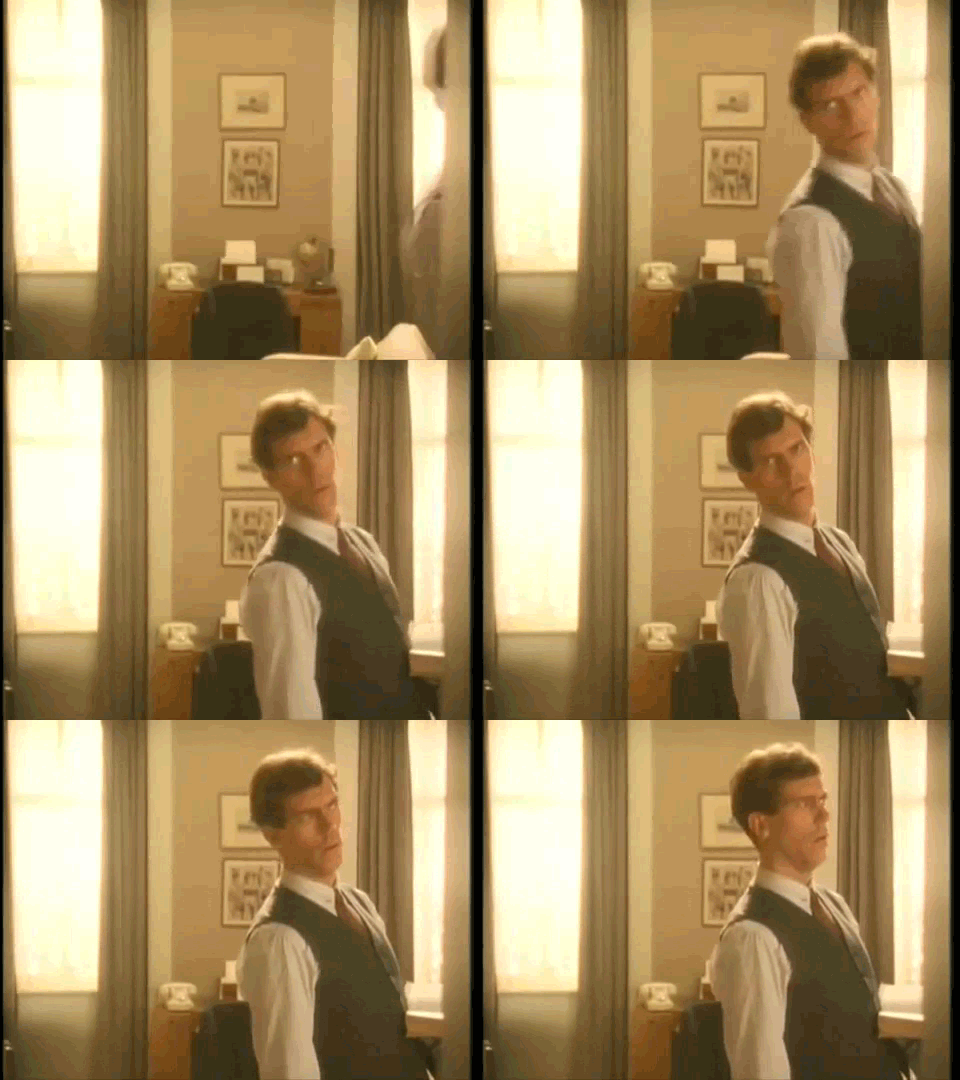
It was perhaps a mistake to remove one hand and try to steady the bowl from beneath, as it may have been this manoeuvre that caused the wretched thing to flip over. It was certainly, on reflection, an error of judgement to attempt to remove approximately five helpings of gooseberry fool from Dame Judith Puxley’s lap with a Georgian tablespoon.

In the introduction, Faulks explains that it is hoped a ‘new’ Jeeves will tempt new readers to read the originals. I’m happy to say that I would also heartily recommend this to the most die-hard Wodehouse fan – there may be tiny bits that jar, but the overall effect is totally wonderful – in fact, top hole, spiffing and really quite oojah-cum-spliff! The hardback is a lovely quality, with a good-size font and spacing, and the dustjacket is beautifully designed and nicely tactile. All-in-all – close your ears, Scrooges – a perfect Christmas gift. Enjoy!!

www.fictionfanblog.wordpress.com
Profile Image for Berengaria.
958 reviews192 followers
August 30, 2024
3 stars

short review for busy readers:
It's been a while since I've read one of those delightful Wodehouses, so my memory of details isn't the best. In this decently done fan fic, though, there seems to be

1. far more plot than in the originals, and a more confusing one

2. far less time spent on Wooster B.'s personal observations in that beautifully slangy 1930s English he uses. That is to say, the word-art is rather lacking in quantity (although it is there).

3. the ending dissolves into rank sugary sentimentality, which I don't remember there being any of in the originals.

4. I don't remember Bertie thinking Jeeves was jealous of him, nor Jeeves being such a Latin-spouting intellectual Oxbridge don. Very intelligent, yes, but not annoyingly so, as he is here. And Bertie not nearly as stupid as he is here, just thoughtlessly silly.

I've never been a fan of Faulks' writing nor stories, and this one rather seals it for me. He does a decent job of re-creating the feel of Wodehouse's world and the characters, but with his own twist of lemon. That may have been the real idea behind doing a fan fic in the first place, but since it's not a lemon I'm particularly fond of, it was just an okay read for me.

3 stars.
Profile Image for James Beech.
122 reviews28 followers
February 13, 2014
Mechanically, Faulks does a very good job of capturing Wodehouse's style. He pulls from the same eclectic lexicon of british slang and biblical allusion. He writes his sentences with the same ponderous grace. His humor relies on the same sort of witty, situational comedy.

However, Faulks also makes several choices that are at odds with the traditions of the Jeeves and Wooster novels. For one thing, he makes direct references to World War I, which Wodehouse would never do. He also discusses the political upheavals of the day (such as Women's Suffrage and the beginning of the Indian independence movement) without leavening his discussion of these topics with humor, as Wodehouse unfailing did. Finally and most seriously, Faulks has Bertie fall truly and deeply in love.

Now, love--sometimes even centered on Bertie--is the prime mover and shaker in Wodehouse's plots. However, Wodehouse's view of romantic love is closer to what we see in Shakespearean comedies than what we expect of a typical romantic narrative. For Wodehouse, love is a volatile force: powerful but fleeting. His characters go to great lengths for the sake of love, but fall in and out of love at the drop of a hat. This is the reason for Bertie's perpetual bachelorhood, and perhaps one of the reasons Bertie and Jeeves value their own, more dependable connection so highly.

For Faulks however, romantic love is something both gentler and more enduring, making the story he tells in his homage fundamentally different from Wodehouse's own novels. Whereas the emotional resolution of Wodehouse's stories hinges upon the careful unsnarling of a complex plot, the emotional resolution in Faulks' piece is instead tied to Bertie's romantic hopes, while the snarled plot is resolved with a clumsy wave of the hands.

The end result is a book that is entertaining, but sentimental in a way that the dry, wry, and irrepressible witty Wodehouse would never have written.
Profile Image for Jon.
1,456 reviews
January 31, 2014
I feel like a curmudgeon giving only two stars to this homage. I admire Faulks a great deal, but I think this attempted copy was a mistake. Many other Wodehouse fans on Goodreads disagree with me. They were able to overlook all the little irritations and appreciate the fun; I was so irritated by the little irritations that I gave up after about 15 pages. The essence of Wodehouse is his apparently effortless, whimsical style; but here it seemed as if Faulks was working very hard and not quite getting there. The names weren't silly enough. Reference to the sinking of the Lusitania was too unpleasant and specific. He recognized but overused "the" in such sentences as "Pausing only to rub the shoe on the back of the trouser..." He allowed Jeeves to use the modern "untriggered reflexive" as in, "However, Mr. Beeching felt it improper to say more until he had properly renewed his acquaintance with yourself, sir." And then again a few pages later, "Might I inquire, sir, as to Sir Henry's attitude in general to the engagement of yourself to his daughter?" I doubt if I've read even half of Wodehouse's Jeeves/Wooster stories, but I'd be surprised if that usage appeared in any of them, at least on the part of Jeeves. It was at that point that I decided I'd rather read the real thing. So I guess in my case Faulks sort of accomplished his purpose of trying to get readers to do just that.
Profile Image for Mark.
83 reviews5 followers
September 20, 2024
This is a perfect read for those want to escape the dramas of the modern world and immerse themselves instead in a 1920/30s world of upper class English eccentrics with their own silly language. Jeeves the man servant of Bertie Wooster is perhaps one of the greatest characters in English literature - up there with Sherlock Holmes. If you’re tempted to read this I would suggest you read one or two of the other books that feature Jeeves and Wooster as this is probably the last book. Note the other books were written by the original author PG Wodehouse. Note 2, the British did an excellent tv series based on the Wodehouse books which can be found on YouTube.
Profile Image for Richard Derus.
4,194 reviews2,266 followers
Read
November 10, 2013
Rating: 3.9* of five

I am so very happy to be back in the Woosterverse! Sebastian Faulks, of august reputation and titanic talent, is here shown at his wittiest best and his most playful.

As always, I'm unwilling to post a review or give a star rating that a site which censors its users' reviews can then monetize. My review is at Expendable Mudge Muses Aloud. The novel's not perfect, but it's as welcome as spring rain and a wonderful gift idea for anyone you know who might need to laugh.
Profile Image for H (trying to keep up with GR friends) Balikov.
2,125 reviews819 followers
April 11, 2016
Who prefers imitation vanilla extract over the real Madagascar stuff? Who wants everything made of polyester rather than natural fibers? It’s with that skepticism that I approached reading Jeeves and the Wedding Bells, knowing it was not a story crafted by the master, P.G. Wodehouse. But, I had exhausted all of Wodehouse’s, so I was willing to take the plunge.

Jeeves of the title is a “gentleman’s personal gentleman” not a butler, but a valet. Wodehouse spun his stories for well over a half century beginning shortly after 1900. How the world has changed. But we still flock to see Downton Abbey.

This is British humor, my friends with an occasional bit of farce thrown in. Bertie is not quite an upper-class twit: he navigated his way through Eton and Oxford without falling on his face; he does recall some significant bits of his education (the most mentioned is his prize for Scripture Knowledge); but, it’s his use of his faculties that is often in question. Baldly stated: Bertie gets himself into complicated situations and Jeeves often anticipates the worst and saves Bertie from it.

For my money, Faulks gets this right. Maybe a sample or two will give you the flavor.
“Jeeves?”
“Yes, sir?”
“You know Miss Meadowes?”
“I have that pleasure, sir.”
“Do you think…I wonder…You know what you said earlier? About those feelings of hers?”
“Yes, sir.”
“I’ve decided to pretend I never heard you. I don’t like what it does to the pit of my stomach. It’s as though I’d swallowed a whole jar of cocktail olives from the bar at the Drones.”
“A most disagreeable sensation, one would be disposed to imagine, sir.”
“Well ‘one’ would be absolutely spot on. So let’s hear no more about it. And if in some ludicrous fairy story these ‘feelings’ you talk of became reality and some sort of match took place … Well, I mean … imagine!”
“Imagine what, sir?”
“The offspring. Suppose they had my brain and not hers!”
“It may not be a matter of inheriting the qualities of one parent or the other, sir.”
“What? Are you saying it’s sort of a cocktail?”
“A Moravian monk by the name of Mendel produced some remarkable results using peas or beans in his monastery garden. In the question of the colour and shape of the pod, he deduced that – “
“Jeeves, are you comparing the Wooster offspring to a broad bean?”
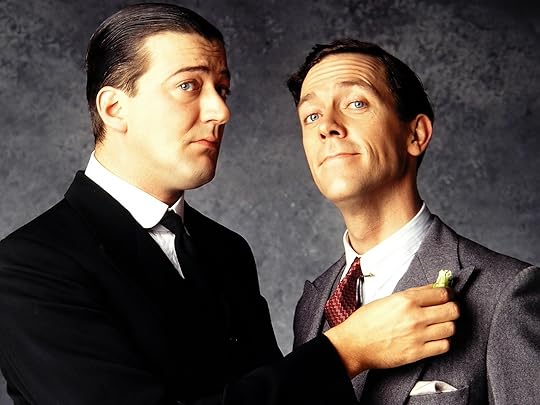
And so forth….(For better or worse, I find that, having watched Stephen Fry and Hugh Laurie portray the two, my imagination cannot go beyond.)

“It was a pensive Bertram who strolled through Berkeley Square an hour or so later. From the day I had returned from my spring holiday on the Cote d’Azur I’d felt a bit like the side-kick in one of those detective stories – the fellow who’s always one step behind the famous sleuth and whose function is to ask questions on behalf of the dimmer class of reader. It was almost as though some master-criminal was orchestrating something in which I was a hapless pawn – if a pawn can be orchestrated. But perhaps you see what I’m driving at: a lurking sense that there were Forces at Work of which I Understood Little.”

“I wasn’t sure why in the rather awkward circs, I was having these bosky thoughts. Ask anyone in the Drones and they’ll tell you that Wooster, B. is essentially a boulevardier – a man of pavement, café, and theater. I may be possessed of half a dozen decent tweed suitings, even the odd plus-fours and deerstalker, but mine is not – au fond, a I believe the French say – a rustic soul.”

If I were one of Bertie Wooster’s snooty relations, I would say that these stories are “an acquired taste.” But let’s just say that either you like them or you don’t. If you liked the ones written by P. G. Wodehouse, you (almost assuredly) will be grateful for Faulks recent effort.
Profile Image for Spiros.
962 reviews31 followers
October 26, 2013
A nice try, but not quite the article. Aside from a certain (inevitable) tone-deafness in trying to replicate Bertie's inimitable narrative voice, this story lacks the Master's genius for plotting. Also jarring were a very un-Wodehousian setting of the story in a very specific time (the 1926 General strike) and reference to Georgiana's parents dying on the Titanic (Bertie normally would have said something along the lines of "handed in their dinner pails"). I wonder why, if he wanted to produce an homage to Wodehouse, Faulks didn't choose to set it in Blandings, where he could have used a third person voice.
Profile Image for Gaby.
649 reviews22 followers
October 10, 2013
I was raised in a family of staunch Wodehouse fans and have a deep affection for Jeeves and Bertie Wooster. When I learned that a new Jeeves novel was coming out, authorized by the Wodehouse estate, I signed up to read it immediately. I worried that it wouldn't have the same flavor as Wodehouse's earlier novels.

In this new adventure, Jeeves and the Wedding Bells, we have Sebastian Faulks' homage to the original. We find the same level of absurd twists that characterize Bertie Wooster's adventures. There is the search for deep pockets to help bolster failing estates, references to old beloved characters such as Aunt Agatha and her tartars of friends as well as many of the women of Bertie's past and his fellow Drones men.

Jeeves is called upon by Bertie's aristocratic friends to help them find a way out of their dilemmas. Bertie gamely takes on all sorts of challenges and comes upon unexpected obstacles - all with good humor and all sorts of bad luck.

I wish I could say that Jeeves and the Wedding Bells was just like coming across a hidden Wodehouse manuscript. There were all sorts of obscure British expressions that while similar to Wodehouse's turns of phrase somehow didn't have the same humor or clarity. It may be that I'm sufficiently well versed in British witticisms and cricket, but these didn't bring out the chuckle that accompanies Bertie Wooster's strange expressions.

Also, Jeeves and the Wedding Bells gives us a Jeeves that seems more flawed than the old Jeeves. He comes across as less respected, less certain, a little pompous, and makes mistakes which I never remembered Jeeves doing in the past. The depiction of a flawed Jeeves, however small the flaws, kept me from fully losing myself in Jeeves and the Wedding Bells. If you're reading this review, you're likely a fan of Wodehouse and of Jeeves and Bertie Wooster, I'm sure that you'll take the time to revisit these old friends. I hope that you enjoy the escape - a Jeeves story is a rare treat. Congratulations to Sebastian Faulks for bringing the old characters back, even if in slightly different form.

ISBN-10: 1250047595 - Hardcover $14.94
Publisher: St. Martin's Press (November 5, 2013), 256 pages.
Profile Image for Isa.
619 reviews312 followers
September 8, 2016


arc provided by Random House UK through Netgalley

I was so incredibly happy to have been approved to review this title! P.G. Wodehouse is my absolutely favourite author and I do not allow a year to go by without rereading a few of his works, they really brighten up your day.

Faulks, in an author's note, made clear that he, "didn’t want to write too close an imitation of that distinctive music for fear of sounding flat or sharp." In my opinion this was a mistake.
It's absolutely jarring to read these beloved characters sounding as not quite the real thing. Yes, Wodehouse's style is far from easy to imitate - but if you search the vastness that is the internet you'll find plenty of tributes (viz.: fanfiction) which, despite portraying unlikely scenarios, manage to perfectly capture the tone in which the books were written.
Then again, this too is fanfiction, so when non-published fanfiction is doing it better... well.

Faulks chose to place the action is a very specific time: the 1926 General Strike, something Wodehouse avoided, and with good reason - reading a Wodehouse book is leaving the real world behind and entering a world where your major concerns should be avoiding aunts and how to get your valet to approve your latest sartorial faux pas. If you ready yourself to read about Bertie Wooster's latest imbroglio you do so expecting levity, not the reminder that 800,000 coal miners were fighting for their income not to be further diminished.

The plot was not up to Wodehouse standards. There is romance in the Jeeves books, there is comedy. But there is no romantic comedy, which is what this book turned out to be.

I'm being too harsh, I do realise it, and it must be said that I do it only because these characters are so dear to me.
The book, on its own, is quite enjoyable - had it featured other characters and not have been published as "Jeeves #16" I would have given it a higher rating. Faulks can write, and he can spin a good yarn. ...It's just not up to Wodehouse standards but, then again, what is?

I see this book intends to entice a new audience to experience Wodehouse and I wish it all the success in that endeavour but, to be honest, the best way to entice someone to read Wodehouse is to direct them towards the master's work itself, there is no short supply of it, for he was a marvellously prolific writer.

I'd like to express my most heartfelt gratitude to the publishers for accepting my request to review this book! My review may, sadly, not be the best one to promote the book, but it was still a treat to get to read it!
Profile Image for Helle.
376 reviews452 followers
May 5, 2015
This is Sebastian Faulks’s modern take on Jeeves and Wooster, as approved by the Jeeves and Wooster Estate. I was moved already in the foreword (sheesh!) where Faulks says that he has written this as a tribute to P.G. Wodehouse; he is, in his own words, not an expert in things Wodehouseian, but a fan.

It was light entertainment in the Wodehouse spirit, and I recognized many references to words, characters, slip-ups etc. from the originals, but I suspect I missed as many as I haven’t read them all yet. But Jeeves once again shimmers into a room with a cup of tea; Bertie sallies, sprints and legs it hither and dither and says a fair amount of What ho!, Right-o!, Pip-pip etc.

There were some fine specimens of humour in language. Take the following:

I’ve encountered many types of silence in my time: the silence funereal, the silence pregnant, the silence that lets you know you’ve laid an egg.

Later:

There are few silences more poignant than the one left for unforthcoming laughter.

And finally after having put on a brave performance of a scene from A Midsummer Night’s Dream, and B. Wooster having said something shocking:

The pause that followed had a silence that felt Bottomless.

I appreciated this tribute to Woodhouse. I loved all Jeeves’s little literary references and Latin quotes as much as I loved Bertie’s non-comprehension of them (and was taken by surprise as much as Jeeves when he finally recognized (as did I, thankfully) a line from Keats). Faulks took the story a bit further than in the originals in a way which might be said to steer away from Wodehouse proper. It was enjoyable nonetheless and served as a kind of finale. Without having read anything else by Sebastian Faulks (a lack I shall remedy some day), I am left with the impression that this is more in the spirit of Wodehouse than Faulks, which was surely the intention. Good fun, even if I had no clue about all the cricket talk.
Profile Image for Nigeyb.
1,475 reviews404 followers
November 2, 2018
Sebastian Faulks, in the book's introduction, describes this book as a tribute by a fan and not an imitation.

For my money, and as an avid P.G. Wodehouse fan, I'd say Jeeves and the Wedding Bells is every bit as good as the real thing. Sebastian Faulks is to be congratulated for pulling off the perfect homage.

I smiled, chuckled and on a couple of occasions guffawed, through this charming Jeeves and Wooster story.

P.G. Wodehouse would have approved I'm sure. Jeeves and the Wedding Bells reminds me how much I love the work of P.G. Wodehouse and inspires me to get reading and rereading his books. There is no higher praise.

As you may now, P.G. Wodehouse won the Mark Twain Medal in 1936 for "having made an outstanding and lasting contribution to the happiness of the world". Sebastian Faulks has now further added to the happiness of the world with Jeeves and the Wedding Bells.

4/5
Profile Image for Ian.
173 reviews17 followers
January 17, 2014
What ho, Good Readers!
I hadn't ventured far into this jolly tome before wondering if dear old Plum had checked out of death's dark vale for long enough to rattle off a sporting yarn before heading off for his daily helping of nectar and ambrosia, or whatever they dish up at the better class of celestial watering hole.
It turns out that some imposter must have been pretending to be Plum but got rumbled (probably due to laying on the literary allusions thick enough to have me crying 'Hold, enough!' long before the last act). Instead of spending time as a non-paying guest of Her Majesty for forgery, he has called the book 'an homage' to Plum, doubtless hoping to collect a Royalty or two once the publishers get round to settling accounts.
As I hear the tinkle of ice on glass it must be snifter time. I shall terminate my brief career as a book reviewer by describing it as the literary equivalent of Anatole's peerless chocolate mousse, leaving the diner sated and happy but unable to countenance second helpings.
Pip, pip!
Profile Image for Anna.
1,021 reviews41 followers
February 28, 2015
Some hits, some misses; but I will accept it at face value as an homage -- if it points someone in the direction of the real deal, it will have served its purpose.

I would however like to read one of Faulks' original stories.
Profile Image for Madhulika Liddle.
Author 22 books545 followers
November 9, 2015
Disclaimer: My rating of this book has absolutely nothing to do with the fact that a ‘bone-lazy shirker’ of an ex-footman in it is called Liddle!

To get on to the plot itself. Bertie Wooster, on a holiday in the south of France, meets the gorgeous Georgiana and is pretty much in love when the damsel drops a bombshell: she is the ward of her uncle, who is in such dire financial straits that for the family to keep its estates (and one assumes dignity) intact, it is essential that either she, Georgiana, or her cousin – her uncle’s daughter – marry a moneyed man.

Exit Georgiana, and back in London, Bertie is visited by his childhood friend and blood-brother Peregrine ‘Woody’ Beeching. Who, it turns out, is engaged to a certain Amelia… who (coincidence), is none other than Georgiana’s cousin. Things are not going well, though; this betrothal is not looked upon favourably, since Woody isn't wealthy (which is why Georgiana, for the sake of the family, is now being bullied into marrying a moneyed travel writer named Rupert Venables). What’s more, some innocent chumminess between Woody and two sleeve-stroking village girls has led to Amelia wanting to break it off with him.

This leads to that, and we end up with Jeeves masquerading as a certain Lord Etringham at the country manor inhabited by Georgiana, Amelia, and the latter’s parents – and Bertie ends up pretending to be Jeeves’s valet, Wilberforce.

Till now, all good, and all fairly standard Wodehouse fare: the country house, the sundered lovers, the impostors. And it continues, with more Wodehouse staples: village cricket, village entertainment, amateur theatricals. Aunt Agatha and her old school friends. The dog Bartholomew. Stinker Pinker, Stiffy, Esmond Haddock, the Drones.

By itself, this may have been a good, frothy read. The problem lies in the fact that it’s a Wodehouse homage – and, not unnaturally, invites a comparison with Wodehouse.

Does Faulks manage to pull it off? Not quite. For one, the plotting is awry, with a lot of extraneous things happening that have little impact on the main storyline. Wodehouse’s books, if you read them carefully, are very taut when it comes to plotting – just about every little detail fits in somewhere or the other. Here, there are too many things, too many incidents that have either little or no relevance to the plot or are just described in too much detail (the cricket match, for instance). The motives, too, are flimsy – for example, the reason for Jeeves’s suggestion that Wooster pretend to be a gentleman’s gentleman is frightfully lame, and anybody would've thought that the risks associated with such an impersonation would far outweigh what Wooster hoped to achieve.

There are anachronisms (I will let the fictional and idiotic place name of Chanamasala pass, but Uttar Pradesh – at a time when even the United Provinces had not been so named – rankles, as does the word ‘bazooka’ - which didn't appear till World War II). There are other things that set this book apart from Wodehouse’s world: mentions (in a serious tone) of everything from war to the death of parents, to well, true love of the sappy kind. Somehow one can't imagine Bertie actually being so deeply and seriously in love. And sneaking in a mention of the real Jeeves (the cricketer Percy Jeeves, on whom Wodehouse modelled his character) was a little contrived.

Also, there are times when one gets the distinct impression that Faulks is trying too hard to be Wodehousian funny. This one, as an example: “Plan A laid an egg. And I thought it was going to be the goose that … But it was a turkey. Do you catch my drift?’ ‘The poultry metaphors are painting a lively picture, sir. Am I to take it that you were out for a duck?”

But yes, this I will say: there are plenty of times when the turn of phrase is definitely worthy of Wodehouse. “No one would have wished – or dared – to call him corpulent: there was no suggestion of spare flesh beneath that mighty waistcoat; but it would have been unwise to attempt a circumnavigation without leaving some sort of forwarding address or poste restante.” or “‘If you think I am come hither as a lion, it were pity of my life,’ said Bottom with about as much bravado as the curate announcing the hymn at evensong.”

On the whole, an amusing book (if tending to meander plot wise). Do not expect Wodehouse, though.
Profile Image for Lauren Stoolfire.
4,771 reviews297 followers
Want to read
May 25, 2019
Sebastian Faulks does an excellent job capturing Wodehouse's tone and it was brilliant to see both Jeeves and Wooster back on the scene in top form!

Bertie is a very generous soul willing to do practically anything to help out his friends, but he doesn't quite have it all when it comes to the brains department. It's a good thing he has Jeeves to back him up! Here he tries his best to help both Georgiana Meadows and "Woody" Beeching out in love - they're not a couple but are in two separate relationships. Well...Woody actually goes to Jeeves, but either way this leads to an awesomely hilarious role reversal with Jeeves as "Lord Etringham" and Bertie playing "Wilberforce," Etringham's gentleman's gentleman.


You, like me, might be wondering how Bertie pulls that off since he's never so much as made a cup of tea in his life. Let's just say as usual, Jeeves has quite a few tricks up his sleeve to make sure things turn out alright.


Faulks actually works in a few real world references and, although Wodehouse rarely if ever does this, he managed to make it work. The most important part for me was if he could pull off the dialog, sense of humor, and overall tone of the original stories. Faulks gets it to a tee for all of the characters, but most importantly Bertie and Jeeves are dead on and that's exactly what I was hoping for in this brilliant homage.

Finally, as much as I loved the ending and felt warm fuzzies all over, I'm not quite sure what to make of it. Maybe Faulks will write another installment for us! By the way, if you couldn't tell, I pictured a young Hugh Laurie and Stephen Fry reprising their roles while reading.


Profile Image for Emma .
23 reviews5 followers
April 8, 2015
It's very rare that I won't finish a readable book, normally if the prose doesn't give me a headache I will stick it out until the end.

I'm a huge fan of Jeeves and Wooster and, as a fangirl, a little judgemental of 'published fic'. Still, Sebastian Faulks found in me a reader prepared to go in open minded. If he took a fair stab at some funny prose and had an enjoyable little plot I would have been happy.

Unfortunately, it soon became clear that Sebastian Faulks, though a well known and presumably excellent author, is NOT a comic writer. The brilliance of Wodehouse is that there's a laugh on every page. Not just a laugh, a huge whoop of laughter that bubbles out when you're on the bus or on your lunch break. I didn't crack a smile for entire first 20% of the book.

Still, I thought, the plot is bound to save it. A bit of role reversal will do the trick.

Except it soon became very clear that Bertie was falling in love (and not with Jeeves). Whatever you think of Bertie as a character, anyone will agree that sticking romance in a series of stories that almost uniformly deal with the main character trying to avoid marriage is a risky business.

Still, I thought, it will be a red herring. That sort of thing is for fic writers.

But it nagged me until I committed the one crime I would never normally do: I skipped to the end.

Suffice to say I haven't bothered reading the rest. It's possible that something happens in that unread 40% that will make me look like a fool for doubting. But to be honest I'd rather read the real thing. Or even a funny fic.
Profile Image for Peter Tillman.
4,038 reviews476 followers
May 1, 2022
A delightful Wodehouse pastiche, that reads pretty much like the real thing. Blue skies, trips in the two-seater, true love blooms, wedding bells chime.... Author Faulks catches the spirit of the long-gone Bertie and Jeeves remarkably well. Recommended for all Wodehouse fans.
Profile Image for Marta.
1,033 reviews123 followers
May 30, 2022
Sebastian Faulks set himself an impossible task: to live up to the genius of P.G. Wodehouse and write a Jeeves and Bertie sequel. It was an interesting experiment, and I had the opportunity to compare it to Joy in the Morning, which I have just listened to.

So did he succeed? Yes, and no. He is pretty good at imitating the language, with only an occasional hickup - he almost sounds like Wodehouse, but does not always get the smoothness and ease of his genius. He gets Bertie and Jeeves’s dialog spot on, but his descriptions sometimes try too hard. He borrows liberally from existing books - especially from Joy in the Morning: the weather here is “exceptionally clement” - an expression I am adopting from now on.

His plot retains the usual elements of having to break up one engagement and fix up another, madcap plans, having to convince an uncle to agree to a marriage plot. Faulks, however, makes his own takes on this, most of which is refreshing. Bertie and Jeeves exchange places, which gives occasion to comment on the status, conditions and invisibility of the serving staff. And the main focus of the book is to get Bertie hitched, instead of unhitched: this allows actual romantic moments and real feelings, something Wodehouse quite avoided.

I rather enjoyed most of the book, as it was similar enough but different enough, too. So why only the three stars? Mostly because of the extensive inclusion of cricket, and a few cringe-worthy scenes. A large part of the plot depends on a cricket match, something that Wodehouse never would have written about. This would have been still fine, as we don’t expect the same: however, the match is lengthy and requires detailed understanding of cricket rules and an appreciation for a game pretty much only known in Britain and India. I was bored and only vaguely understood what happened and why it was embarrassing. This is an egregious mistake: Wodehouse never required any outside knowledge to be understood, quite the contrary. It is supposed to be mindless entertainment.

Bertie is significantly altered and not for the better. He devises plans involving making unwanted advances on a young woman, something that is certainly against The Code of the Woosters. He has a low opinion of himself, and does not understand what a beautiful, smart girl like Georgina could see in him. This is quite the contrast to original Bertie, who is aware of his limitations yet is pretty self-satisfied.

The ending is rather sweet, which is quite refreshing. Overall, this is quite enjoyable, and would have been four stars if not for the long cricket match.
Profile Image for Gerry.
Author 43 books118 followers
January 8, 2021
I feel slightly disappointed to be giving 'Jeeves and the Wedding Bells' just three stars for not only do I love the Jeeves and Wooster duo but it began very well with Sebastian Faulks capturing the Jeeves/Wooster relationship well enough and the repartee had that connection that Wodehouse gives us.

But as it progressed it loses that little bit of fizz and, particularly when the roles are reversed in that Wooster is the butler by name Wilberforce and Jeeves is his master Lord Etringham. It is then that the dialogue comes across as somewhat forced and rather than be naturally amusing it comes across as always trying, sometimes too hard, to be funny ... a state that is not always achieved.

Yes, it has those components familiar to Wodehouse fans, the country house setting, the mix-up with the girls and their intended fiancées, the dilly-dallying of the prospective bridegrooms, the disapproval of some of the girls' guardians/parents/relations. And all along Bertie, or in this instant, Wilberforce, is trying to smooth troubled waters in his usual bungling way by working on each in turn, But in this instance it is Jeeves, or Lord Eltringham as he is, who is the main character in that respect. It just doesn't work for me and the reference to the aunts here and there does not come across as authentic, again it seems forced, perhaps just to let the reader know that we are reading Wodehouse-type fiction.

In addition the plot wanders too much and at times gets plain boring but, having said that, there are some amusing moments that keeps the book above the dreaded two-star rating.

If any reader is expecting Wodehouse I can only say, 'Don't', for it is quite clear that nobody does Wodehouse like Wodehouse, try as they might or excellent novelists though they may be in other genres.

I can't wait to get back to an original Jeeves and Wooster to restore my faith in the master and his work.
Profile Image for Ана Хелс.
897 reviews85 followers
December 26, 2020
Сякаш всички истории за Джийвс и Устър си приличат като две капки вода, но когато видиш уж същото без магическото докосване на Удхаус - някак се разочароваш и не можеш да оцениш текста, както подобава.
Profile Image for Chris.
1,202 reviews31 followers
April 11, 2016
I was raised on P.G. Wodehouse. My mother loved him--to the point we often read Jeeves stories to one another aloud to raise our spirits. Sebastian Faulks is one of my favorite authors. But I never, ever would have thought of putting the two together.
Mr. Faulks, you have done Sir Plum proud.
At the beginning of the book Faulks makes clear that he's trying to pay homage to Wodehouse and not just "copying" him. He also notes that he was invited by Wodehouse's family to write this book in hopes of attracting new readers to the series, most of which were written in the 1920s. And he does a great job of bringing "newbies" into the fold by introducing them to the basic personae while throwing in a few inside jokes for the old-timers. The inclusion of Aunt Dahlia and Aunt Agatha and references to previous stories will make the reader in the know snicker but won't spoil it for those who aren't.
Bertram "Bertie" Wooster, our narrator, is a young gentleman in 1920s London with more money than brains. Fortunately, Jeeves, his "gentleman's gentleman" has more than enough brains for the two of them with enough left over to take care of pretty much everyone else. The basic set up of almost all Bertie and Jeeves books is that Bertie, or one of his friends, gets involved in some hilarious pickle, usually of a romantic nature and usually at a country house, and Jeeves sorts the whole thing out.
Faulks sticks to the basic formula but with a great twist. A trip to the country to try to help out a chum with romantic difficulties goes seriously awry, forcing Jeeves to become Lord Etringham and Bertie to become his valet! Bertie's attempts to set things right make things progressively worse - although he does get an eye-opener (and we're not talking Jeeve's usual morning-after hangover remedy) of life "below stairs."
There's never any doubt that Jeeves will save the day, but the manner in which he does it is also a quite clever departure from the Wodehouse line, and again Faulks makes it work. As Jeeves himself would have said,
"Very good, sir."
Profile Image for Lori.
303 reviews
October 18, 2014
Faulks writes in the introduction to this book that it is intended to be a homage to Wodehouse, and his love for Plum and his characters shines through. He imitates the narrative style of the originals very well and the dialogue between Jeeves and Wooster is done particularly nicely. I liked the way that Faulks refers back to incidents and characters of earlier Wodehouse stories. For me, the 'action' scenes (e.g. Bertie spilling the pudding over Dame Judith) lacked punch and spark - Faulks' doesn't have the comic timing or wit of Wodehouse here and I couldn't help but think that those scenes would have been a lot funnier had it been Wodehouse himself writing them. I felt that the story lost a bit of its energy and vim towards the end, and was a little pipped by the ending itself - I felt that Faulks was taking too much of a liberty by marrying off Jeeves and Wooster, and that Wodehouse would never have let the book end with such a soppy final line.

I've rated this as a 3 out of 5 but really it's a 3.5 out of 5. Overall, this book is a very good impersonation of Wodehouse - plus it's amusing, light-hearted and will cheer you up - but it doesn't have the spark of the real thing.
Profile Image for Kwoomac.
968 reviews46 followers
March 25, 2014
While this wasn't written by Wodehouse, it was a lot of fun being reunited with Bertie and Jeeves. It's like a restaurant bringing back your favorite meal. You had adjusted to it not being an option anymore but still missed it. And now, here it is, another taste of Bertie and Jeeves. Bertie was spot on. Spot on! Not as happy with Jeeves. I felt like he was a little over written, more of a caricature. He said something in French on every page. I went and read a couple of actual Wodehouse stories to see if I had just forgotten this detail. In the three stories I read, there was not a single French word. Also, the real world intrudes much more than happened in the original stories. Faulk also used a lot of foreshadowing about the future. It felt like cheating. Sure you're writing about characters in the 1920's and hinting at things to come in their future. But you're not writing in the 1920's so it wasn't nearly as clever as you wanted it to be.
Profile Image for E.T..
1,031 reviews295 followers
July 10, 2022
3.5/5 A delightful read ! I am not a Wodehouse fan per se but I have enjoyed the 6-7 Jeeves books that I have read. And read a Jeeves book after a few years so didnt notice the differences/faults (if any). I lost the allusions to “Midnight Summer’s dream” in the end else the rating would have been higher.
I was totally averse to reading pastiches and am not comfortable with “homage” / “legacy extensions”. But read Horowitz’s books featuring Holmes and Lagercantz’s featuring Salander (Dragon tattoo) and enjoyed them. So picked this one up too.
Profile Image for John.
2,154 reviews196 followers
December 13, 2013
I felt the plot and dialogue were fairly true to the original books, and perhaps a bit easier to follow as they were a tad less slapstick; although, there's a cricket-based subplot in the middle that caused to story to drag a bit. Not mentioned often in reviews, but I wasn't thrilled with the ending - saying much more would be a spoiler, but it doesn't fit with the series at all IMHO.
Narration is a terrific fit!
Profile Image for Ronna.
514 reviews62 followers
October 29, 2013
Though I've never really found that authors can truly "Do" another author, I found that Faulks did a grand job in his ode to P G Wodehouse's Jeeves and Wooster. I'm a big fan of the books and the BBC TV shows based on these novels, so I was thrilled to see the upcoming release of this book. Getting an advanced copy to read and review was a special added treat, and it did not disappoint.

Bertie and Jeeves are at it again, off to save the day, causing more confusion than solutions but giving this reader a jovial masterpiece of a reading ride in the process! Bertie's old chum, Woody Beeching is in a pickle. His true love, Amelia, has put off their engagement because of his flirtatious actions with another woman. Off go Bertie and Jeeves to save the day. How, you might say. Well, it's all very simple you see, Bertie will become the manservant to Jeeves at the fair lady's house. Jeeves , as Lord Etringham has become very chummy with his host because of his mastery of picking winning horse races---and money was always in the need to keep their estates in the black. Many twists and turns later, and happy solutions were found all around.

I thoroughly enjoyed returning to the always strange lives of Bertie, the bumbling master, and his always humble genius manservant, Jeeves! The characters remained those I so fondly remember. Perhaps more adventures are waiting to tell themselves in our future---hope prevails!
Profile Image for Michael Kerr.
Author 1 book10 followers
March 5, 2014
Wodehouse has widely been quoted as describing his novels as "musical comedies without the music." Faulks manages to capture this tone and sustain it throughout this novel. If you liked the originals, you'll sail through Jeeves and the Wedding Bells.

Bertie Wooster's voice is spot on, though Jeeves sometimes sounds a bit more like Stephen Fry's version than the Wodehouse original. In one marked departure from Wodehouse's usual reality-avoidance, we discover that Jeeves had a distant relative - a cricket pro - who died at the Battle of the Somme.

PLOT SPOILER:

In one way, the book is a sad read, because the ending is definitely not in the Wodehouse playbook. The plot advances like so many of the Bertie and Jeeves stories, with the popsy (and the threat of marriage and growing up) being dodged at the last possible moment.... That this story follows another trajectory underscores the fact that the Wodehousian garden has definitely closed. At least for me, the ending of this book is the ending of the idyl. That none of it was ever real is kind of beside the point.

Displaying 1 - 30 of 883 reviews

Join the discussion

Can't find what you're looking for?

Get help and learn more about the design.