This novel is an analytical study of the feeling of kinship as it is manifested in the Timberlake family, decayed aristocrats living in a southern city. The story of how two marriages are wrecked and a great wrong done to an innocent Negro boy, is told largely as it is viewed by Asa Timberlake, sixty years of age, husband of a hypochondriac wife, father of two daughters, one utterly selfish and feminine, the other courageous and gailant but confused and unhappy." Book Rev. Digest Pulitzer Prize, 1942
American writer Ellen Anderson Gholson Glasgow won a Pulitzer Prize for In This Our Life (1941), her realistic historical novel of Virginia.
Born into an upper-class Virginian family, Glasgow at an early age rebelled against traditional expectations of women and authored 20 bestselling novels. Southern settings of the majority of her novels reflect her awareness of the enormous social and economic changes, occurring in the South in the decades before her birth and throughout her own life.
I think the Pulitzer committee awarded this novel for two reasons: First, I would guess they were impressed by the central tension in the novel which is the conflict between a person's obligations and his or her desire to be free. The book also looks at whether true freedom is even possible. The other notable feature is a strong racial consciousness. It's the first Pulitzer I've read where racism is seen in a very negative light and the problems facing African American people are explored with a progressive eye for the time. Those two qualities--a questioning of life and looking at racism--are why I gave it two stars instead of one. The writing is melodramatic, angst-ridden and repetitive.
My first Ellen Glasgow, of which I was very unsure at the outset, but which ended up leaving me bowled over. Parts of it went exactly where I expected, but there was a major twist that I had not expected, and that one told me everything about who these characters really were.
It was a very hard look at one family and how they affected one another, their struggles for happiness against the odds, and the different ways they brought on or dealt with suffering. What looked like a side story in the beginning of the novel became a major element, and it was this that propelled it from a mediocre look at these people to a work of worth and substance. I’d deem Ellen Glasgow as clever indeed.
Published in 1941, Glasgow also paints an excruciatingly vivid picture of the complicated race relations of the time. If I have ever encountered a realistic picture of how double-sided and confusing the Southern relationship between blacks and whites could be, I found it here. Asa Timberlake is not Atticus Finch, but he is a man of conscious who feels genuine love and respect for the women who have served his family for generations and is unwilling to discount a black life as if it had no value. The attitudes of the others around him are often disgustingly apathetic if not downright evil.
There is every kind of human emotion portrayed in these pages: greed, lust, mendacity, betrayal, self-sacrifice, resentment, and destructive indulgence. There are characters you cannot help despising, some you cannot help wishing better things for, and some who are too small and mean to even merit your concern. Mostly you root for escape for those who deserve it, but how does one escape a family, or a society, or a time such as this? Would you believe the hope that seems to loom is the beginning of a World War that will rock the foundations? The characters do not know, but we do, that this world is about to change...and not a moment too soon.
This novel written by Ellen Glasgow won the Pulitzer Prize in 1942.
Here the level of the city appeared to be sinking slowly, little by little, from a state of former affluence to the bare features of poverty. Houses were crumbling, fences were sagging, window-sashes were empty, weeds and crab-grass were sprouting among the sunken bricks and over the fallen steps. But if the background had dwindled away, the human elements had strengthened and multiplied. People swarmed everywhere.
This story is about a dysfunctional family where everyone wishes their lives were better but no one can quite figure out a way out of their unhappiness. The writing is quite good although at times a little overwrought. Nearly the entire story is set within the confines of the family house and there is a large amount of dialogue. The emotional energy has the feel of an extended August Wilson or Eugene O’Neill play. There may be one stable person in the family trying to hold it all together.
The central character in this story is 59 year-old Asa Timberlake. His grandfather was once the owner of a wealthy tobacco firm in eastern Virginia but eventually sold the family business. Over time Asa experiences a steep decline in wealth, the dilapidated Tobacco Factory building haunts him. He is seen about town in old clothes.
Asa takes care of his hypochondriac wife, Lavinia. The couple have two young adult daughters, Roy and Stanley, who have fraught relationships with men. It is not clear why the young women have boys names. At different periods in the story the women live at home adding to the drama and tension within the house where frequent arguments ensue. Son-in-law Peter, who had romantic relations with both daughters begins drinking and soon kills himself although the situation is a little murky as to whether it is suicide. This is the first major plot development.
Asa also has a lady friend, Kate, who he visits regularly. It is not entirely clear if the relationship is anything more than platonic since his wife knows of the “affair”. But Asa and Kate go to some lengths to keep it hidden from others.
The final climax in the story is when Stanley the youngest daughter kills a pedestrian with the family car. There is a young African American man, Parry, who works for the family who is accused by the police of the crime. He is having a tough time of it in the jail. Stanley tells her father what happened but will not go the police for fear of being arrested but Asa goes to the police himself and tells the story. The police release Parry. Stanley is never charged.
4 stars. Both the family and the story seemed very genuine to me. The writing has some racist overtones common in the South in the pre Civil Rights era.
Asa Timberlake, 60, was born into a prestigious family in the South. He has two grown daughters, Roy and Stanley, that live at home and a wife, Lavinia, a hypochondriac who has rarely emerged from her bedroom for the last 12 years. Roy, the eldest daughter for whom Asa feels a strong affinity and love, works successfully as an interior decorator and is married to Phillip, a surgeon. Stanley, Asa’s beautiful younger daughter, is scheduled to be married in a week to Craig, a lawyer. Many years ago Asa’s father squandered the family’s wealth and then committed suicide, forcing his wife and Asa into a very different lifestyle. Asa currently works in the factory that his family used to own; he only earns enough to pay for the basics that his family needs. For anything else his daughter Stanley and wife Lavinia turn to Lavinia’s uncle, William Fitzroy, who provides those extras but makes sure everybody knows from where the support comes. At the beginning of the novel, a rather tenuous world begins to fall apart.
This story is written in three sections. I found the first section engaging, but much the second section and some of the third section really dragged. There were certain of life’s challenges on which the author focused, one of them being the search for happiness: she spent a lot of time on this topic and came back to it repeatedly. At 467 pages this novel felt like it would have been more effective at 2/3’s of that length. The description of the town and surroundings was good, but more than needed. The novel also addresses relations between blacks and whites in the South in the 1930-40's. It asks the question: if blacks are treated this way more than 70 years after the end of the Civil War, how can we expect much change in the future?
I thought Ellen Glasgow tried to accomplish a lot with In This Our Life. I thought the effort was admirable, but the results were mixed. However, this novel won the Pulitzer in 1942 so clearly others thought the novel accomplished more than I did.
We are all in an incessant search for happiness. True happiness is only possible with complete freedom. And yet complete Freedom is impossible. This is how Glasgow portrays the human condition. Her book explores this conundrum through allegory. All of the characters represent certain aspects of human nature. She shows how those aspects wrestle with each other as they confront this conundrum. Thematically the book is admirably ambitious. The book suffers, however, from her letting her theme interfere with the flow of her story. Some of her points are maddeningly belabored. Were this novel published today, probably an editor would shorten it by a quarter or a third. This would strengthen the plot without compromising her philosophical exploration one bit. She didn’t have to make the same point through different characters a dozen times.
This was published in 1942 and makes the argument that our inability to escape this conundrum is what drives humanity to create and indulge in things like war. Her ascribing the cause of immense self-inflicted societal catastrophes to something deeply psychological in the individual reminded me of Saul Bellow's Dangling Man.
One of the social things she addresses, repeatedly, is the conflict between the generations. I'm in my mid-50s and the 'young people' being described in this book are of my grandmother's generation, who died a few years ago in her 90s. It is interesting to me that the same complaints leveled against my grandmother in her youth are the same being leveled at millennials now, and which were also leveled at my 'generation x.' Rowdy, disorderly, selfish, short-sighted. Are people ever going to get over this and just realize that that's what it is to be young? None of the traits attributed to any certain generation belong to that particular generation if they are repeated in all subsequent generations. It makes me wonder if these criticisms are concocted for no other reason than to give each generation a feeling of cohesiveness, so that they can be more easily targeted by marketers.
I found this book to be very similar in spirit to Ernest Poole's His Family in that it is the story of a family patriarch who sees his family slowly disintegrate over successive crises which parallel the changes in the US (industrialization, WWI, etc.) Our protagonist has two very different daughters (with strange masculine names) Stanley and Roy (the protagonist's favorite) who are of marrying age. He is working for his father-in-law who is filthy rich, whereas he is very middle class and rather estranged from his wife.
"A great tradition is an expensive luxury...Falling back on the past may lend inspiration, and it may also lead to gradual hardening of the arteries. (p. 44)
The book underlines issues of class, of social status, and of societal change. In terms of racism, there was some interest in showing the injustice against PoC objectively, but this is not a militant anti-racist text.
I wasn't completely sold by the book personally, and I noticed that there were several other interesting books that could have won the 1942 Pulitzer, but I have not read The Colossus of Maroussi, Delilah, or The Real Life of Sebastian Knight yet, but I wonder whether one of these wasn't better written than this one.
My votable list of Pulitzer winners which I have read (only have the 40s, 50s, and 60s to finish!):
So glad to be finished with this bloated, ponderous, repetitive novel. It was like spending almost a week with your least favorite older relative who complains and lectures and never stops talking. More favorable reviews call Glasgow's Pulitzer winner "analytical", but it feels more like the author wallowing in self-indulgence.
Skip it and instead watch the 1942 film of the same title starring Bette Davis and Olivia de Havilland. Three cheers for Hollywood. It's truly a case of talented and competent screenwriters knowing what to emphasize and where to trim the fat. Also kudos to the casting department who worked magic bringing these dreary, willfully unhappy, unlikable characters to life.
Pity Has Preferences in Ellen Glasgow’s “In This Our Life” A Southern family tragedy where tenderness becomes an alibi, beauty becomes evidence, and the bill comes due to someone outside the room. By Demetris Papadimitropoulos | May 23rd, 2026
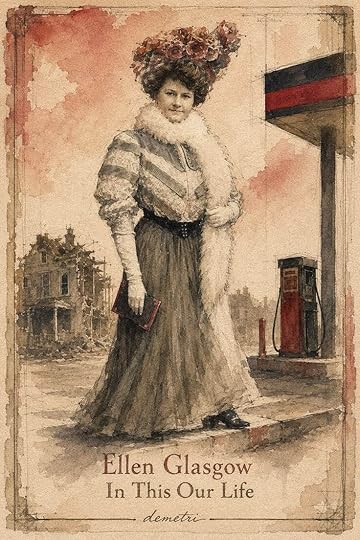
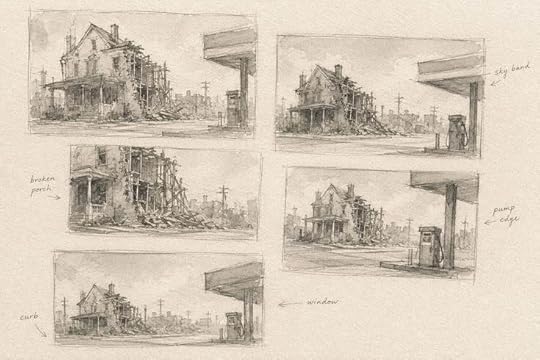
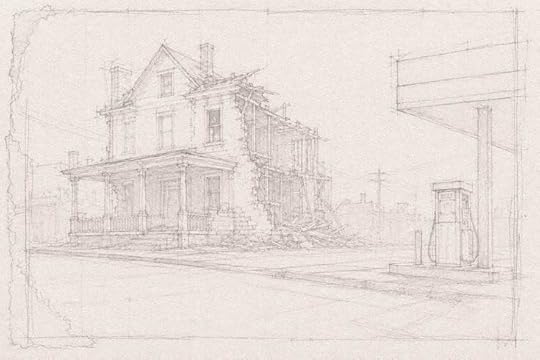
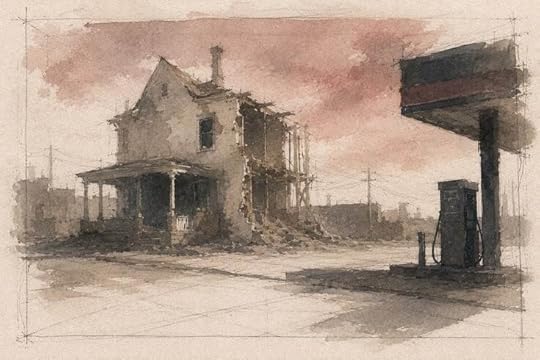
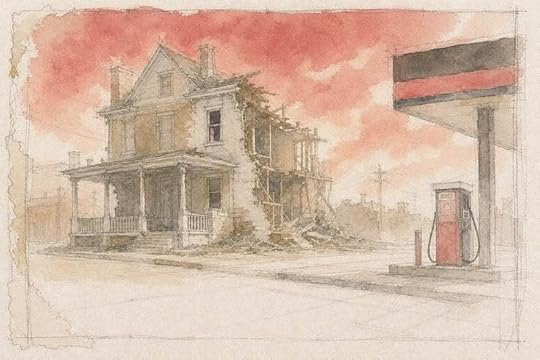
The House at the Curb – The Timberlake house stands half-erased as progress arrives without absolution.
Pity has preferences in “In This Our Life.” It does not descend, impartial as a church window, on the wounded. It chooses. It leans toward beauty, money, pallor, family resemblance, a tremor in the voice, an illness placed where argument ought to be. Ellen Glasgow’s novel is most unsparing when it sees how tenderness can forge its own receipts. Care may be the last coal in a cooling house. It may also be the softest way a family practices its alibis indoors.
Ellen Glasgow Portrait – Ellen Glasgow appears as maker and witness inside the novel’s red-black-beige world.
Stanley Timberlake has learned the trick before she has learned to call it one. She is the cherished younger daughter of Asa and Lavinia Timberlake, beautiful in the way that changes the temperature of a room before anyone admits the window has opened. Her sister Roy is built for endurance and punished for it: intelligent, proud, loyal, too useful and too upright to pity properly. Roy has married Peter Kingsmill, a glamorous, reckless young surgeon; Stanley is engaged to Craig Fleming, an idealistic lawyer whose principles are sincere and not always attached to the floor. Then Stanley runs away with Peter, leaving Roy and Craig to inspect the damage from opposite sides of the same explosion.
A lighter book might have stopped there, satisfied with a parlor calamity and the wedding china rattling nearby. Glasgow borrows melodrama’s furniture and refuses its flattering light. Peter and Stanley’s flight curdles into debt, drink, miscarriage, erotic disenchantment, and suicide. Roy, denied the luxury of collapse, begins to move toward Craig. Asa, trapped in a dead marriage to Lavinia, imagines a late-life door opening toward Kate Oliver, whose farm offers dogs, air, food, and the pleasure of being understood without being managed. For a while, second chances are portioned out like a thin supper: carefully, hopefully, with no promise of seconds.
Then a child is killed by Stanley’s car, and Parry Clay, a young Black man trying to educate himself out of the life assigned to him, is arrested for the crime. The family does not need certainty; it has enough knowledge to begin drawing the curtains against knowledge. It also knows, with a speed that has nothing to do with proof, that Stanley must be screened. The earlier betrayals were rehearsals. Stanley first takes Roy’s husband. Later, she nearly takes Parry’s future. Around both acts, the house performs its practiced little miracle: it closes ranks, lowers its voice, and calls the arrangement mercy.
Flowers at the Roadside – Flowers by the curb turn private indulgence into public evidence.
The novel begins with Asa watching the old Timberlake house being demolished for a service station. Glasgow plants the symbol at the curb: the old house, the lost tobacco fortune, the ruined father, the corporation that swallowed the family name, the car-lit modern world of speed and efficient ugliness. Asa has lived on irony, duty, and exquisitely managed disappointment. He is not heroic. He is more useful to the book than that: a witness worn nearly transparent, noticing houses, kitchens, daughters, dogs, shoes, servants, cars – almost everything – and acting, when he acts, too late.
Through Asa, decline becomes less an idea than an odor. Old wood. Bad coffee. Damp shoes. Invalid medicine. Cut flowers. Glasgow’s prose is crowded with class, use, and old resentment. Her sentences begin with domestic proof and widen into obligation: a sink becomes aspiration and dependence; a car becomes youth, money, velocity, escape, then a body in the road; flowers become the proof Stanley cannot keep out of speech. The furniture is on the witness stand.
Glasgow does occasionally arrive carrying her own examiner’s pencil. Asa and Roy see so keenly that the reader is sometimes left with little to discover unaided. Some scenes have already convicted everyone present before the prose turns around to read the verdict aloud. Still, this weight is rarely inert matter. In Glasgow’s world, no act travels alone; each one arrives trailed by money, manners, race, sex, shame, and the old human wish to appear nobler than one has behaved.
The floor plan looks conventional; then each room removes a layer of excuse. The three parts – “Family Feeling,” “Years of Unreason,” and “All Things New” – begin with the faint sound of a sermon, then acquire a bitter aftertaste. “Family Feeling” is loyalty, but also the warm fog in which Stanley’s claims become everyone’s business and Roy’s hurt becomes her own problem. Houses fall. Cars replace carriages. Divorce becomes possible. Women work. Yet the old permissions learn new addresses: protect the charming, doubt the vulnerable, make scandal manageable, and call the bill unfortunate when it is sent outside the family.
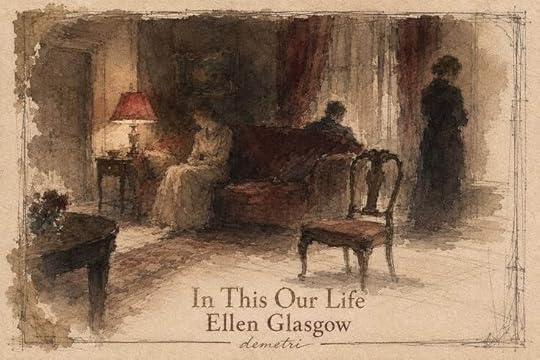
The Parlor Closes Ranks – In lamplight and averted bodies, family feeling becomes choreography.
The illuminating neighbor here is “The House of Mirth” by Edith Wharton, another novel in which rescue proves to have a guest list. Glasgow’s rooms are heavier and her comedy more upholstered, but both writers know society does not merely punish wrongdoing; it decides which person can be dropped from the story without spoiling dinner. “The Magnificent Ambersons” by Booth Tarkington also shadows the opening, though Glasgow is harsher: the car-lit future speeds old evasions to the next available body.
Parry is the person the novel makes available for payment, and his story is both its strongest accusation and its most troubling bargain. Glasgow gives his family, especially Minerva, a dignity the Timberlakes keep mistaking for something they possess rather than something they lack: order, labor, faith, self-command, an ordinary domestic grace that needs no Fitzroy money to announce itself. Parry wants to study law. He wants not luxury but recognition, the right to become legible as more than the role his town has prepared for him. When he is arrested, the horror lies not only in his innocence. It lies in how quickly his guilt becomes plausible to the authorities, while Stanley’s guilt becomes almost rude to mention.
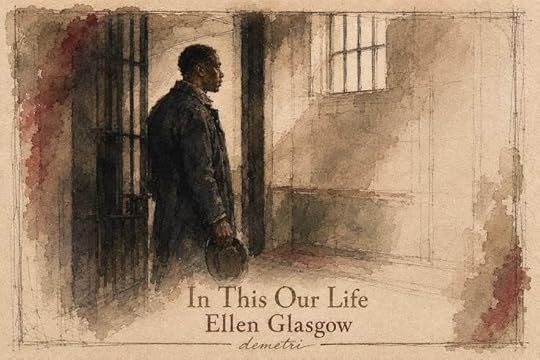
Parry at the Threshold – Framed by shadow and bars, Parry stands inside a world prepared to misread him.
Here the novel falters, though the faltering is bound to its insight. Parry is kept near the center of judgment without being placed at the center of inner range. Asa and Roy receive long, searching interiors; Stanley is watched with fascination and dread; even Craig’s weakness is given room to blush. Parry, though indispensable to the final meaning, does not receive the same inward scope. Glasgow sees the unfairness clearly and makes it structural, not decorative. Still, the imbalance matters. The novel condemns a town that cannot fully see Parry, but it does not entirely escape the angle of that town’s looking.
This is also where “In This Our Life” keeps breathing past its period manners and racial assumptions. Its language belongs to the Virginia it depicts; no useful review would polish that away. But the book’s understanding of selective sympathy remains painfully durable. Unfairness does not require melodramatic hatred. It can flourish through habit, embarrassment, affection, fatigue, and the wish not to upset a delicate person after dinner. Who is called fragile? Who is called difficult? Who gets believed because fear makes them prettier? Who is expected to be noble because no one has made room for their pain? The jail is only the last room in a house that has been preparing its verdict for years.
Roy is the finest needle in that weather. She is not arranged for easy rescue. She has too much pride for display, too much intelligence for ornamental injury, and too little helplessness to attract reflexive care. When Peter leaves her for Stanley, Roy refuses to become the family’s tragic centerpiece. She works. She endures. She sharpens. Her dry wit is half courage and half splint. The movement toward Craig is touching because it is so wary, almost embarrassed by hope. She knows that one does not simply walk out of a pattern. One carries it in the body, like a limp no one else remembers causing.
Stanley, meanwhile, is frightening because she is not wicked in capital letters. She trembles, wants, suffers, forgets, reaches. Her advantage gathers in the blur between need and excuse. Lavinia needs her beautiful daughter as a second, more successful self. William Fitzroy likes discovering his generosity where beauty makes gratitude decorative. Men mistake Stanley’s need for depth. Even Roy, after Peter’s suicide, pities her. Stanley has been trained by everyone around her to treat wanting as innocence.
Craig is weaker in a more familiar way. His ideals are sincere enough to make him appealing and soft enough to be bent by the nearest breakable-looking woman. He wants justice and reform; he also wants Stanley, then Roy, then Stanley again: pity, desire, nostalgia, self-excusing helplessness, all wearing the same overcoat. Glasgow mocks not ideals, but the man who mistakes intensity of feeling for steadiness.
Asa’s longing for Kate gives the novel its one clear window: proportion, humor, dogs, food, air, the blessed absence of theatrical complaint. His wish to leave Lavinia is not simple liberation. Their marriage contains no living love, but duty has sedimented into character. Asa’s goodness is real, but delayed, timid, compromised, sometimes useless.
Glasgow’s feat is to keep every scandal from becoming merely scandalous. Adultery, suicide, miscarriage, hit-and-run, false accusation: packed this densely, the disasters could clang. Instead, each asks the same question from another angle: who pays? Stanley takes what Roy loves. The house excuses Stanley’s taking. Craig knows the right thing until feeling makes another thing seem more urgent. Asa sees clearly and hesitates. Parry works to rise and is shoved back down by a town that calls suspicion common sense. The pattern repeats because repetition is the book’s accusation. A rehearsed permission. Respectable life is not one bad decision after another. It is a ledger of allowances.
Even the sentences seem to inherit the household’s habits: circling, qualifying, returning to the thing no one wants to say. Glasgow creates suspense not by hiding simple facts but by delaying admission. We suspect Stanley and Peter before the family can name it. We suspect Stanley’s guilt before Lavinia can bear it. We suspect Craig’s renewed desire for Stanley before he has the decency, or indecency, to confess it. The question is not “What happened?” It is “Who will pay for the thing everyone knows?”
The tonal control is one of the novel’s durable pleasures. It can be bitter without curdling, tender without sugaring, witty without preening. Asa’s irony saves the early chapters from becoming a museum tour of disappointments. Glasgow’s wit is not decorative sparkle. It is survival varnish, thinly brushed, with the grain still showing.
The book does not fail by thinness; when it falters, it falters from weight. It presses too firmly on meanings already visible, and its final racial indictment, though grave and essential, remains filtered through an unequal allocation of inner range. The costs are written in the main text. They do not undo the book’s force; they define its temperature.
For my final evaluation, I place “In This Our Life” at 88/100, or a Goodreads-compatible 4/5 stars: searching, slightly over-explicit, and sharpened by insights too earned and too uncomfortable to rate lower.
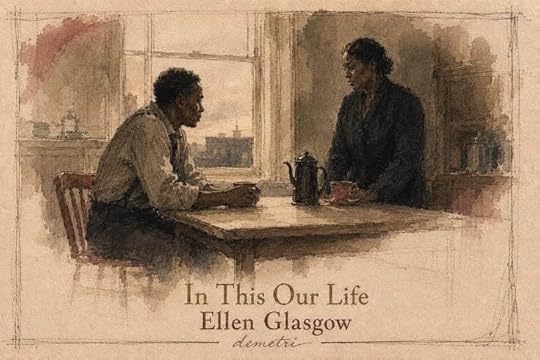
Coffee Before Morning – Roy and Asa sit with coffee, dawn, and exhaustion after easier rescues fail.
The ending refuses the courtesy of repair. Roy returns after a night of flight, stripped of most illusions and still wanting something good to hold by. Asa gives her coffee and steadiness, which are not salvation but are not nothing. Parry is released, but not restored. Stanley remains caught by the web that has always caught her. Kate and freedom stay visible to Asa, like a field glimpsed through weather. The old house is gone; the gasoline-bright lights are on; the new world has arrived with its pumps, cars, and efficient excuses. Yet the most durable architecture in “In This Our Life” is the one left standing inside the household: the architecture that calls protection love, then sends the bill.
Compositional Thumbnail Sheet – Early studies reduce the argument to curb, house, shadow, and angle.
Faint Pencil Underdrawing – Porch, roof, window, curb, and pump geometry before atmosphere.
Value and Light Study – Dark window, station block, and dusk sky set the hierarchy of exposure.
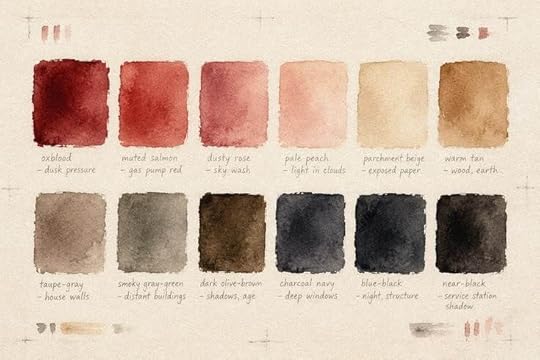
Color Swatch Sheet – Oxblood, parchment, taupe, charcoal, and blue-black form a grammar of decline.
Watercolor Border Study – Torn edges and interrupted rules make the frame argue too.
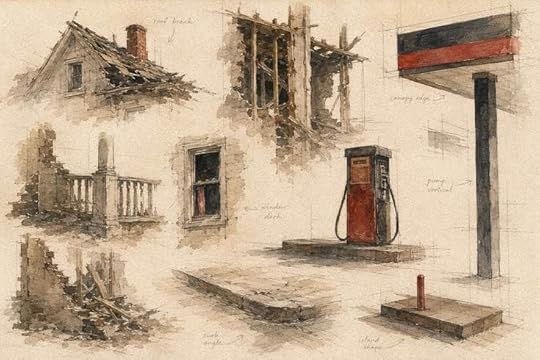
Architectural Fracture Study – Roof breaks, beams, pump edges, and canopy stripes become shape against shape.
First-Wash Stage – Pale red, beige, and shadow let the book’s weather enter.
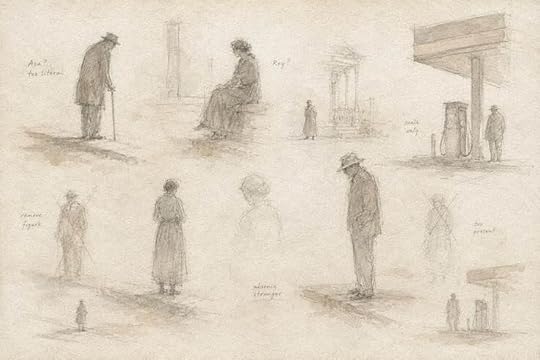
Character Scale Study – Faint figures show why absence carries the final image’s human burden.
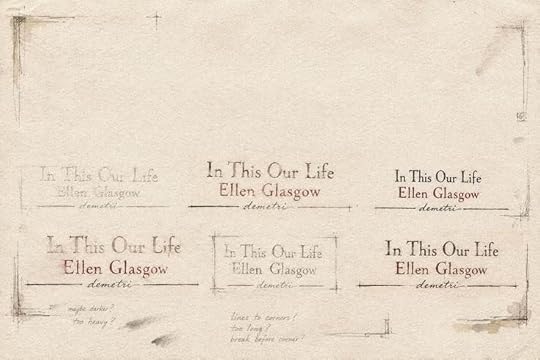
Hand-Lettering Study – Lettering trials turn title, author, and signature into hand-built marks.
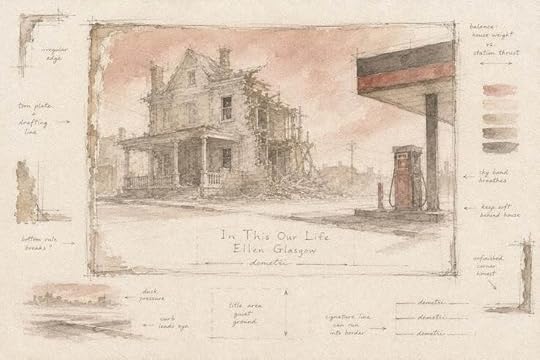
Final Layout Mockup – The working page maps house, station, curb, sky, border, title, and signature.
All watercolor illustrations by Demetris Papadimitropoulos. Watercolors are done on 140lb vellum and then scanned using an Epson scanner. From there, they are finalized in Procreate. All art and opinions are my own.
This book won the Pulitzer Prize for literature in 1942. I read it as part of the 2009 Spring Challenge. in This Our Life takes place at the end of the Depression (or the beginning of the reader's depression, brought on be reading it). The characters are hopeless, the situation is hopeless, the dialogue is hopeless. Let's put a black binding on it and call it quits. I didn't like this book!
What is the nature of human weakness, love, pity and the response to physical beauty? Whether Glasgow is answering that or even attempting to ask that question, I am not sure. However, those questions come to my mind reading this story.
Asa Timberlake is a man who feels like a failure in life. Stuck in 30 years of loveless marriage where he is a prisoner to his hypochondriac wife and somewhat dependent upon her wealthy and selfish uncle, he longs for a life that is simple and untroubled. He looks forward to the day when his wife's uncle will pass away and leave her with enough money that he will not feel obligated to stay by her side any longer and can then find his own freedom to marry his dear friend Kate and spend the rest of his life on her farm, walking the fields with her and her dogs. But in the mean time, he must stand by his duty...and he does, diligently. Working tirelessly, taking care of his wife, and being their for his adult children. Adding to his misery is his children, 2 daughters: one who is plain but of a strong and noble character and one that is beautiful but selfish and weak, and a son he doesn't think much of. The author never explains why the two girls are given masculine names (Stanley and Roy), or why the son is almost completely ignored, and yet I think that it is significant. The main trouble is that the selfish beautiful daughter never gets reprimanded in any way for any of the evil she does (and she pretty much destroys every life she touches) because she is beautiful and everyone pities her because of her beauty. And the oldest daughter's strength and self identify is challenged perhaps beyond repair, being chief among those whose life has been damaged by the beauty of her sister.... This book is beautifully written, at times poetic in Glasgow's descriptions and musings on the human condition. And it asks interesting questions that it doesn't seem to attempt to answer. I found it not completely satisfying because of that, and also because, as I reader, I came to despise the pretty and selfish daughter, however none of the characters in the story seemed to be able to. No one ever thoroughly calls her to task for the pain she causes. This may be some of Glasgow's point, however, I don't believe that physical beauty is stronger, ultimately than moral repugnance...though initially it might be, but the eyes can only see so much and eventually character is deeper than the skin.
This book had such a great plot and such great potential! The events happened unexpectedly and it could have been a real page-turner, if only it hadn't been for the terrible writing. The narrator, as well as every single character, were hysterical, neurotic, tedious and full of pathos. Everyone tried to philosophize and failed miserably (you too, Mrs. Glasgow!) The characters make you want to punch them, because they speak like this: 'Do you know what's wrong with us?' he demanded abruptly. In the first place, we ought never to have learned to think, nor to read and write, though that makes less difference. We're not simple enough.' And the narrator is equally annoying, trying to sound deep by saying absurd things like The only way to hold love is to destroy it. or he was [...] an atom without a universe. The spoiler-free summary of this book is: "Oh why can't I be happy? I want love more than anything, but do I even know love? Do I know myself? Does anyone know anything? No, I must escape love, I must find something hard to hold on to. I hate how my parents are so soft. Have they always been so tender-hearted? I will never be old and unhappy like them. Oh, but happiness in youth is so rare! I must drink some whiskey." What a waste of a good idea!
Good lord. This book was weak. I might say there's at least a semi-happy ending, but a really happy ending would have been if 75% of the characters died in the end. What a slog.
PULITZER PRIZE WINNER: 1942 === Not a fan. Took me twice as long to read as it should of because I just didn't care. Kind of a boring plot, with a cast of characters that is basically entirely unlikable and/or sort of pathetic. Also
This novel won the Pulitzer Prize in 1942. There was a movie based on it the same year with Bette Davis and Olivia de Havilland as the two sisters and Charles Coburn as the grandfather. Unfortunately this is the sort of novel that gives Pulitzer Prize novels a bad name. Set in the South just prior to WWII, the novel features the romantic and existential dramas of two sisters named Stanley and Roy (those really are their names). Their father Asa is a sad sack, from decayed Southern gentility, who thinks that the world is an unhappy place and has to work hard at a factory once owned by his family. It's now owned by his wife's brother (magnificently played in the film by Charles Coburn) who is rich and greedy for more. He occasionally gives money to his sister's family, especially because his sister is a hypochondriac who stays in bed all the time. Stanley, the younger sister, is amoral, anxious for excitement, and apparently appealing to all men. Grandfather spoils her and gives her a car and lots of money, even after she has dumped her nice lawyer fiancée and stolen her sister's husband. She causes lots more trouble, is still bored, but because of her family doesn't get punished even for an awful crime (the film give her just deserts but not the novel). Poor Roy mopes a lot and is depressed since her sister keeps stealing her men. There is a secondary plot about a young African American man, Parry, who wants to become a lawyer, but becomes discouraged when arrested for Stanley's crime. An example of the depressive state of the characters. "Last year, when she looked back, was as blank as all the other years and the days and the hours that had gone by and were now blotted out.... Do I hate love, because it can ravish your heart while it wrings the blood from your veins?"
This is a Pulitzer Prize Winner for 1942. I suppose it shows the schism between the older generation following their duty and the younger generation searching for their own way to be happy. It doesn't have any really likeable characters. I almost stopped reading when the duty bound father, Asa, said he never had one happy moment in his life. Really? Not even one? That seems hard to believe. I guess I developed my patience as I read about the two daughters, Stanley and Roy (why they had masculine names was never explained) I disagree totally with the idea that Stanley could not help being so appealing to men that she had to run away with her sister's husband. Are you kidding me? She couldn't help herself, she was just looking for happiness. Right. And Roy so strong that she couldn't let her father (the only one who really loved her) help her. A little crazy. There was a promising ending, Asa and Roy were going to keep seeking for happiness. "In seeking and in finding there is not ever an end, nor is there an end in seeking and in not finding." One idea that I had wondered about too, "...he found himself wondering why marriage should so frequently develop a grated instead of a softened edge?"
This is apparently a bit of a classic and I had to order it from a Baltimore library from Annapolis. I found myself reading very quickly, skimming here and there, which tells me that the writing could have been tighter. We seemed to go over old ground repeatedly, but the novel is about Asa, a 60 year old man who is facing his life and hoping for some freedom. He's devoted to his family although his wife is ill and pretty sour; one daughter is selfish beyond belief and the other is only emerging in her own life.
Therefore, much of the story is inward looking, about his dreams and hopes and frustrations. His patience requires a little patience to read about -- endless coffee making for the wife, endless grumpy conversations, and lots of repeated description about his torn and worn clothes. It's the Depression and life is raw.
However, the plot unfolds well. THere are some good twists. The characters live into their destinies, in some ways. It'll be a good book for a book club discussion.
In This Our life was the Pulitzer for 1942 and is about an upper-class family in the Virginia, The Timberlakes. The father Asa and mother Lavinia have a emotionless marriages. Lavinia is a hypochondriac and spends most of the book in bed. They have two daughters with male names, Stanley and Roy. Roy is the oldest, sensible, her father's daughter and is married to Peter a surgeon. Stanley is a weak but pretty girl who has had everything done for her her entire life - given what she wants, protected and coddled. When the book opens Stanley is engaged and days away from her wedding with Craig a forward thinking man in the south. Stanley ends up running away with Peter leaving Roy and Craig to find themselves together. The patriarch of the family is their uncle William who has all the money but not kids of his own. he has a particular soft spot for Stanley that she exploits. The book is fairly well written and a quick read for nearly 500 pages. The real theme of the book as many of these early pulitzer's are is about the difference between duty to the family and one's station in life and the desire of the self. Asa in particular feels that he has wasted his life and in fact is seeing an old friend on the side. William is the embodiment of the old guard in the south - the family is everything protecting them and keeping the name is all that matters. Roy is the embodiment of a new way of thinking - that you can have your own life. There are a few black characters in the books that are largely treated as filler with the exception of parry - a young ambitious black boy who dreams of being a lawyer but the odds are stacked against him. Several other reviews here focus on an unresolved ending - I think the ending left that way because life is often unresolved and never wrapped up neatly.
In This Our Life is one of the last Pulitzers I had left to read. It’s taken me this long because the book is out of print and there aren’t a ton of copies available. Really, this is not surprising given how utterly boring the book is.
There’s both a lot going on in the story and also not much of anything. I really just couldn’t muster two licks of giving a shit about these privileged, whiny characters. They did seem to be even more bored with their own lives than I was, which is saying something because god damn was I bored with them.
Each of the characters had their own internal struggles, most of which revolved around reconciling what one wants to do with what one must or should do. Certainly not a new theme, but one that is interesting and universal enough. That is, if you are at all interested in the characters.
Really what best demonstrates my experience with this book is when I realized there were about 20 pages missing from the middle of the book and apparently nothing of import happened in those pages, because it picked up pretty much in the same place it was before the pages went missing.
Well, it got better in the third part. At least the story became a bit more interesting. But the writing was problematic and the editing of the version I read was atrocious. There was not a single character I liked. Not one. And I utterly loathed Stanley. Everyone in the novel was pathetic and unhappy. It was a depressing story.
Winner of the 1942 Pulitzer for Novel. The book starts out slow and finally gets interesting in the last 100 pages. The book has an ending that leaves you asking for a few more details. What ultimately happened to the characters?
In This Our Life by Ellen Glasgow won the Pulitzer Prize in 1942, and inspired a John Huston movie starring Bette Davis and Olivia de Havilland. I will be giving a few thoughts on the movie at the end of my review.
The story revolves around one dysfunctional family with two very different sisters. One -- Stanley -- is selfish and thoughtless but still somehow the light of all their lives, doted upon by the mother and uncle. The other -- Roy -- is kind and giving, married and completely overlooked. The father of the family -- Asa -- is a formerly-wealthy, now-struggling financially man, who wears ragged clothing and usually appears to be dejected. His wife is a hypochondriac, and Asa cares for her.
The movie followed the story fairly closely until the end, when Huston gave it the happy holiday ending which was more likely to satisfy the desires of those sitting in darkened cinemas. But, although the acting was good, and I would have enjoyed it had I not first read the book, I much preferred the darker, sadder story that Glasgow wrote.
“In my day, we didn't talk much about happiness. If it came we were grateful for it. But we were brought up in the belief that there were other things more important. Old foogy fantastic notions such as duty and personal responsibility.”
Notes for my future-self ———————————— Engaging 3 Story 3 Structure 3 Writing 3 Pace/Flow 4 Characters 4 Dialog 3 Imagery 3
Won the Pulitzer for Fiction in 1942. Glascow lived her entire life in Richmond, VA. She was born at an interesting time in our history and her writing was obviously shaped by her experience. As a southerner she was embarrassed by the southern reconstruction. As a progressive she was passionate about women's suffrage and equal rights. As an American she was fearful of the coming war. As a woman she was mournful that her one true love was a married man. All of her experience contributes to this story of a twisted, dysfunctional family. A kind, self-sacrificing father trying to hold his family together while a narcissistic mother and two daughters, Roy (kind and patient) and Stanley (beautiful and self-centered) break under the pressure of living modern life. Strange names for daughters, right?
As a story this one was just "ok". While some of the story held my attention and even caused an "edge of my seat" feeling, most of it was overly melodramatic, angsty and repetitive. The dialog was often like listening to a teenager explain the meaning of life!
For a good story about a man trying to keep his splintering family together, try "His Family" by Earnest Poole instead!
I only found out after reading this that there was a movie version with Bette Davis and Olivia De Havilland, and it makes perfect sense... the melodramatic dialogue, the careening tragedy, and you can so easily imagine Davis' delivery, complete with dramatically swelling violins as she tearily collapses in the arms of a lover.
This is why it kind of sucks as a novel.
I wanted to read Ellen Glasgow as a forgotten writer of 1930s America in the hopes that I'd find a dusty gem. No, I just found the sort of story that's better suited to Hollywood, and especially the Hollywood of that era -- I loved Hitchcock's film version of Rebecca, but I have no interest in reading Rebecca, and I can't say I know anyone under the age of 50 who has read Rebecca. Maybe I'll watch the In This Our Life movie though.
In This Our Life by Ellen Glasgow won the Pulitzer Prize in 1942. The story is set just before WWII and chronicles the drama of a southern family. It was interesting that two of the female characters were named Roy and Stanley which are not typical female names. The family in this story continually hurts and lies to each other led by a domineering mother. The story was told well and I enjoyed this book, but many of the characters I did not like. I give this book 4 stars.