Freewill, love, death, revolution - a student has the themes for his creative writing PhD. He pins them to Elsie Stewart and embarks on her biography. Love takes Elsie to the Spanish Civil War while the story hurtles off into the maelstrom of Ukrainian twentieth century history. Can Professor Thrub's post-structural guidance haul the project back on track? Will love and surgery redeem our student's struggles for a good life, significance and a doctorate? This biting comedy of love, desperation and existence offers a thrilling ride into the world of a major new writer. Praise for earlier D.D.Johnston: The Sunday Herald: 'Funny as all hell. And it's got morally ambiguous people in it.' The Morning Star: 'A very urgent relevance now and for the immediate future.'
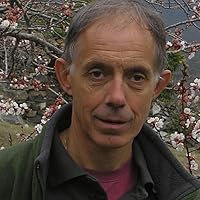
D.D. Johnston is a Scottish author, who now lives in Cheltenham, England, where he works as a lecturer in Creative Writing at the University of Gloucestershire. His first novel, Peace, Love, & Petrol Bombs (AK Press), was a Sunday Herald Books of the Year for 2011 and has been translated into Spanish as Paz, amor y cócteles molotov.
His second novel, The Deconstruction of Professor Thrub, was a 2013 book of the year in the Morning Star, where it was described as 'determinedly extraordinary.'
His third novel, The Secret Baby Room, is a tense psychological thriller:
"As her own life falls apart, Claire risks everything in her quest. It’s an investigation that leads her not only towards the dark knowledge of past crimes but towards an understanding of the damaged lives of those around her. Johnston offers us a wonderfully gripping read, but also a compassionate and moving story of people struggling to survive at the margins of a rapidly changing city." - Crime Culture
This book is hilarious in parts and very clever. It purports to be the PhD. thesis of a graduate student in Creative Writing. Professor Thrub is the student's supervisor, and even the acknowledgements page at the front of the book is hilarious in the way it portrays Thrub. Apparently this book really was the writer's thesis, although clearly Thrub and other characters are entirely fictional. Or maybe not entirely fictional. Rather there are plenty of places where the author really does capture, with good humour, the nature of academia.
A case in point was the chain of emails regarding kettles in offices. These were both darkly funny but also very authentic. I was put in mind of the memo sent out to staff in the novel Snow Crash. Different type of memo, but the passage was as funny and well observed.
Being a thesis, the work jumps off into some philosophical discussion, and does it well by placing the summary of philosophical ideas in the mouth of an unlikely expert with a very novel approach to the discussion.
There is another story, apparently being studied by the writer, as well as his own memoir of the period of writing his PhD. in this book. It is all a very clever idea and in places just brilliant.
Having said all that, I did feel that this book was a little too clever in places. It was trying to be everything, and so there was a very nasty assault in there, which was also good writing, but was not in the least humorous (and an attempt to make some humour about the after effects drifted into the disgusting - I use the word advisedly. It triggered my sense of disgust). Some humour was too in your face and fell flat for that.
The philosophy too, and the linkage of the various sub narratives were all very clever but almost too much.
It is a good book, worth reading and hilarious in places, but I can't say I loved it, despite that.
Go online and see if you can get a sample of this ... even the Acknowledgment page at the front had me laughing. The whole book is written as though it's a PhD in creative writing, a hapless writing student chasing down a woman who vanished from her London cleaning job to chase her true love through the Spanish Civil War. He, in the meantime, has been recruited to fly over a Ukraine that is in total ferment in a sequence of early 20th century revolutions. Our student tracks his story through Scotland (some beautiful nature writing here) and to a terrific drunken bar-room chat about Kant in Belfast. Meanwhile his supervisor Professor Thrub rises into being one of the great comic creations of fiction. And as for love and medical emergencies ... This book surges all over the place but it kept taking me with it. Stick with the journal articles, even if it takes some skim reading to do so, because there's some fun embedded in them. I loved the stream of crazy intelligence as well as the writing. Don Delillo and David Foster Wallace run through a politicized Scottish filter? [That last sentence may not make sense ... but if it does AT ALL then this book may well be a joyride for you.]
The book has an overarching theme related to the question of whether a transcendental self could ever be free in a deterministic world. This is dealt with by means of three main threads which highlight the forces which might influence the course of a life.
One such life is that of Elsie and those connected with her and events in the first half of the twentieth-century, particularly related to Spanish anarchists and Soviet Russia. This a moving story and relates to the author's PhD research.
Another thread is that of the author's work on his PhD thesis, including his relationship with a seemingly disillusioned Professor Thrub and his infatuation with big-breasted Leski, an MA student. It's very funny.
A third thread is that of the academic-like serious philosophy of a PhD thesis. It is condensed but actually interesting and informative, if you have some knowledge of Western philosophy. There are also humourous parts to it, when, for example, a person using coarse language explains and dismisses such philosophers as Kant, Satre, and Foucault.
You catch the tragedy of life in these pages, but also the humour in it. I laughed out loud quite a few times.
Thoroughly enjoyed this one... perhaps because of the resonances of doing a PhD, but also I think because of the historical avenues it took me to to reflect on different occurrences as well.
D D Johnston’s second novel sees the Spanish Civil War meet a creative writing programme and the challenges of theorising fiction, all told in an engagingly unsettling deconstruction of the supervised writing process. It is politically sharp, entertaining, savvy and a damned good novel. Much of the actions turns around the novelist in the novel researching his character’s stories – be that in Belfast or Ukraine – and experiences in Spain, alongside the perils of supervision and negotiating the university system within which this novel is being written, as a PhD. All of this adds to its deconstructive power – this, after all, in the novel written as part of Johnston’s PhD programme, presented here as a PhD about writing a PhD.
Fabulously illustrated with theoretical source material and archival documents, this is both witty and incisively politicised, including supervisory debates about the writing process and effective supervision/advice, and sharply critiquing the neo-liberalisation (read, financialisation and marketization) of the University. Johnston has clear insight to the dynamics and machinations of power, be that in the academic programme or the war where in the latter ‘allies’ served their own interests rather than those of the people with whom they allied (Johnston has a very good sense of objectives of Soviets and others in their support for Republican forces). Equally, or more, importantly this prioritisation of the view from below means that he is able to paint these big picture stories using individuals narratives – and that’s what makes this a fine, very enjoyable, novel.
Unfortunately, I couldn't finish this book. I tried very hard to go as far as possible but there are so many stories at the same time, it's not very easy to follow what happens to who. Sometimes, there is a chapter coming out of nowhere and I really did not understand why it was here and how it was useful to the story or the characters. So if you don't have trouble reading stories that has so many characters at different ages and with no regular order in the chapter, you may enjoy this book. But I just found it very hard to follow and that is the reason why I dropped it after page 260.
Johnston does excellent work melding philosophy with history, history with humanity and humanity with absurdity. Beautifully written. The Deconstruction of Professor Thrub scales the topographic heights of free will and determinism, and the comic depths of academic bureaucracy, soiled pyjamas and unrequited love.
Deeply funny if you’ve ever had to survive a PhD. I would recommend this to any creative writing research student producing a creative artefact and exegesis. Includes some accessible and cogent explanations of big critical theories.