Combining humour and surreal fantasy, Shaun Tan pictures a summer in the lives of two boys. Each spread tells of an event and the lesson learned. By turns, these events become darker and more sinister as the boys push their games further and further.
Shaun Tan (born 1974) is the illustrator and author of award-winning children's books. After freelancing for some years from a studio at Mt. Lawley, Tan relocated to Melbourne, Victoria, in 2007. Tan was the Illustrator in Residence at the University of Melbourne's Department of Language Literacy and Arts Education for two weeks through an annual Fellowship offered by the May Gibbs Children’s Literature Trust. 2009 World Fantasy Award for Best Artist. In 2011, he won his first Oscar in the category Best Short Animated Film for his work The Lost Thing.
Using his inimitable Salvador-Dali-meets-Hieronymus-Bosch-meets-Doctor-Seuss style, Tan produces another apparently effortless masterpiece. Surely the best children's book author/illustrator in the world. I can't think who else is even in the running.
This guy is a genius. Author and illustrator extraordinaire. His stories have real meaning, his drawings have a life of their own. Short and concise, two boys have a fun summer full of all good things and games to be played.. but the longer the summer spans.. the darker things turn.
I love "Never wait for an apology" and "Always bring bolt cutters", and the climbing of the ladder where friends reach out and help each other.
I believe it is more difficult to describe a Shaun Tan book than it is to feel a Shaun Tan book. They are a mood conveyed through otherworldly pictures and contrasting ideas. This Shaun Tan book is a book for children.
I boy describes the rules he learns over a summer with his brother. The artwork is unique. I do get a little element of Dali in there.
I did read this to the niece and nephew and the response was interesting. The nephew was both scared by the imagery and amazed by the ideas in the book and he couldn't look away. He gave it 4 stars. The niece thought it was a weird story and it didn't make sense to her. She gave it 2 stars. She kept asking "what does it mean?"
When I was a young teen my favorite book was Ray Bradbury’s Dandelion Wine. Steeped in Bradbury's nostalgia for his youth, I was in the throes of adolescence, probably on some level nostalgic for my own younger days. In this book I reveled in a childhood that was not my own but felt personal just the same. Summer seemed like the perfect time to set such a tale, what with its long days and capacity for equal parts mischief and magic. I loved my summers, even as I failed to know what exactly to do with them. I think of Bradbury’s novel from time to time, though its use for me has long since passed. I found myself going back to it after seeing Shaun Tan’s Rules of Summer. Encompassing a full summer season, Tan indulges his capacity for the odd and extreme while also managing to delve deeply into a relationship between two brothers. The family story is this book’s heart and soul meaning that when all is said and done this is a book for big siblings and little siblings. Miraculously both will see themselves reflected in the pages of the text. And both, if they approach it from the right direction, will find something to pore over in here for years and years to come.
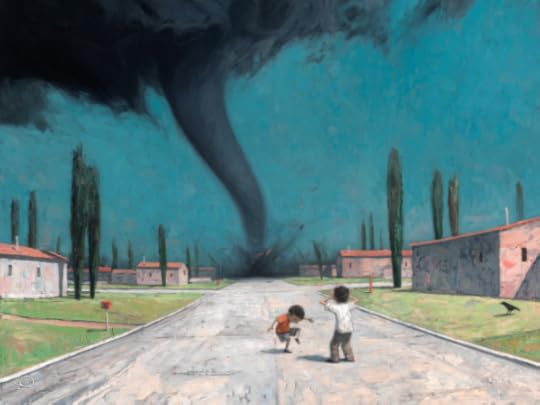
“This is what I learned last summer,” says the book. It’s the kind of statement you might expect to find in an essay on How I Spent My Summer Vacation. Instead, what follows is a series of imaginative, wholly original extremes. Two brothers live in a world of fantastical creatures and gizmos. The younger continually breaks the rules as the elder either berates him or tries to save him from himself. A dinner party of well-dressed birds of prey contains the sentence, “Never eat the last olive at a party” as the older brother pulls his younger away from the potentially deadly entrée. “Never leave the back door open overnight” sees them both facing a living room awash in vegetation and giant lizards, the older boy clearly put out and the younger carrying a bucket and shovel. As the book continues you realize that the younger boy is often at odds with the rules his elder is trying to instill in him. The final straw comes after a massive pummeling, after which the elder brother sells his little bro off to a flock of black birds (“Never lose a fight”). Fortunately, a rescue is made and the book subtly shifts from admonitions to positive statements (“Always know the way home”). The final shot shows the two boys sitting on the couch watching TV, the walls of their living room wallpapered with drawings of the out-of-this-world creatures encountered in the rest of the book.
As a general rule I try to avoid reading other reviews of the children’s book in my hand until I’ve read the stories myself and gotten a sense of my own perspective. In the same frame of mind I avoid reading the bookflaps of books since they’ve a nasty tendency to give away the plot. Usually I’ll even avoid looking at them after I’ve read the book in question, but there are exceptions to every rule. After reading Rules of Summer I idly turned the book over and read this one on the back cover: “Never break the rules. Especially if you don’t understand them.” Huh. Oddly insightful comment. Aw, heck. I couldn’t resist. I looked at the bookflap and there, lo and behold, the book started to make more sense. According to the flap the rules are those seemingly arbitrary ones that younger siblings have to face when older siblings come up with them. Slowly a book that before had seemed to have only the slightest semblance of a plot began to make a lot more sense. Had I not read the flap, maybe I would have come up with an entirely different interpretation of the pages. Not sure. Whatever the case, I like where the flap took me, even as I suspect that some kids will have entirely different takes.
Tan’s strength here lies partly in the fact that these brothers command your equal respect. When I read the book through the first time I thought that the younger brother was the hero. A couple more reads and suddenly the older one started to get more and more sympathetic. Consider, for example, that very first shot of the two after the endpapers. The text reads, “Never leave a red sock on the clothesline.” There, hunched against a fence, the two brothers huddle while a scarlet-hued red-eyed rabbit eyes the sock in question. The older brother has one arm protectively around the younger’s back and his other hand gently cupping his mouth. In later images the younger will mess something up and the older won’t bother to hide his frustrations. The lack of parents in this book is the only way to make it work. When kids deal with one another in the absence of adults, they make their own rules. Even when the elder sells his brother to a flock of birds for a dented crown (his least likable moment) you’re almost immediately back on his side when he rescues his little brother with a pair of bolt cutters a couple pages later. And honestly, what older brother and sister hasn’t fantasized at some point about selling off their annoying little brothers and sisters (see: The great Shel Silverstein poem “Brother for Sale”)? Tan is capable of seeing both sides of the sibling equation. Few picture books even dare.
Tan’s always had a bit of a fascination with the surreal world of middle class life. Suburbia is his Twilight Zone, and he hardly has to add any mechanical monsters or sentient birds to make it unusual. In Tales from Outer Suburbia it was language that primarily painted suburban Australia’s canvass. Here, words are secondary to the art. As I paged through I began to take note of some of the mechanics present on a lot of the pages. Water towers, oilrigs, and even the occasional nuclear power plant. Most beautiful and frightening were the extremely large structures holding the power lines. In one picture the younger brother plays a paddle-based game against a robot opponent while his older brother arbitrates. The sky is an overcast slate gray with these unnerving grids of line and metal towering over them in the background. Extra points if you can find the single black bird that makes an appearance on almost every spread until that climatic moment when it no longer appears.
Even the endpapers of this book have the power to make you sit and stare for long periods of time. They inspire a feeling that is just impossible to put into words. The endpapers are also the place where Tan makes it clear that he’s going to be playing with light quite a lot in this book. For a fun time, try to figure out where the light source is coming from in each and every one of the book's pictures. Sometimes it’s evident. Other times, the answer could well be its own little story.
The thickness to Tan’s paints also marks this as significantly different from some of his other books. Nowhere is this more evident than the cover. Look at the Picasso-like grassy field where the older brother scowls at his younger sibling. The midday sun, the paints so thick you feel like the cover would feel textured if you stroked it, and even the pure blue of the noonday sky has a different Tan tone than you’re used to.
I don’t know if Tan has sons of his own. I don’t particularly care. For all I know the inspiration behind this book came from a relationship with his own brother at an early age. Wherever it might have appeared, one cannot help but feel that Tan knows from whence he illustrates. Thanks to films like Frozen we’re seeing an uptick in interest in stories about siblings of the same gender. Brothers have a tendency to tricky to render on the page (see: the aforementioned Dandelion Wine) but it can be done. Tan has perfectly rendered one such relationship with all its frustrations, betrayals, fights, complaints and deep, enduring love. This book sympathizes with those kids, regardless of their birth order. The rules of childhood are built on shifting sands, causing children everywhere to look longingly at the seeming sanity of adulthood. It’s only when they cross over that these kids will find themselves nostalgic for a time of outsized rules and their overblown importance. Without a doubt, the best book about what summer means to child siblings I’ve ever read.
When you are a child, anything can happen. At least that's what it feels like, as your expectations are not yet based on a whole lot of sobering experience. Who knows what would happen if you did something you are not supposed to do?! Say, if you left the back door open overnight! Or if you gave your keys to a stranger! Or if you forgot your way home!! Just imagine all the crazy things that could happen...
Rules of the Summer illustrates the child's boundless imagination, while at the same time tracing its still rather clumsy attempts to make our seemingly unpredictable world more manageable by creating a set of basic rules to live by: "Always know the way home," for example.
As you would expect from a book by Shaun Tan, Rules of the Summer is nothing if not thoughtful and gorgeous. The concept has its limitations, though, and in the absence of a real plot, things started to feel a little empty and repetitive to me towards the end. Not quite on the level of Tan's masterpiece Arrival, I'd say, but certainly worth checking out.
Umm….There is really no other way to say this. I do not get this book. But that’s also not a bad thing.
Rules of Summer by Shaun Tan has big, dreamlike pages filled with rules and pictures. Two inseparable brothers trying to…I don’t know. Survive, play, and dream? I’m scratching my head in wonder for the meaning behind each picture, but I’m coming up empty. No, not empty. The pages evoke fear, isolation, and fierce protectiveness in me. Mr. Tan’s vivid and breathtakingly gorgeous illustrations and words feel alive, dark, strange, and powerful.
“Never wait for an apology.”
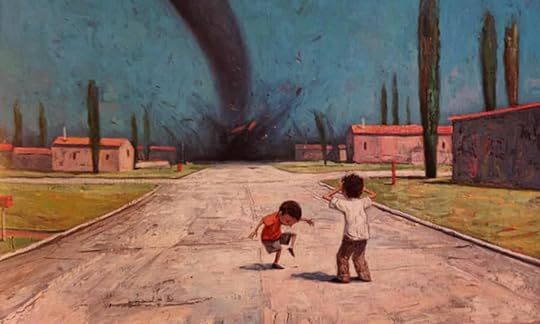
I might not know what’s going on page by page, but my gut feels fear and my heart wants to hope. There are so many ways to interpret the blue sky, approaching twister, creatures and dark, dark clouds of birds though. Every single reader probably sees and feels something different. It’s amazing! I find myself returning again and again to search for something new. Something more. Every “Never” or “Always”, color, and corner makes me think and look closer.
“Always know the way home.”
Recommended for readers of all ages to experience. It’s something special.
This story makes absolutely no sense! The illustrations are weird. All my 4 year old sun did was say why after every sentence. I would give it no stars but I'm not allowed. Don't waste your time!
How do you review a Shaun Tan book? Each time I open Rules of Summer I find a different book. I remember my excitement on being offered a sneak peek a few months ago. I was left feeling a little bewildered. Did I like it? I don’t think I did on that first look. Then a few months later I was given an advance copy. I flicked through the pages and found a completely new book. Or so I thought. But no, the preview was exactly the same as the finished copy. Had I changed? I read through it time and time again. The book bewitched me. I then stood it on my desk in the office so that I could look at it during the day. Rules of Summer is dark comedy. Or tragedy. It is a self-help book. It is a graphic novel. A child’s picture book. A nightmare. A warning. A guide. A fun way to pass half an hour. Ten minutes. A minute. It is art. It is entertainment. What the hell is it? It’s a bizarre thing, and I love it. Shaun Tan’s Rules of Summer is something you must own.
3.5 stars. Two boys make up rules for games, silly, fun and dangerous games, the sort of games children used to play when they were left to roam about for the summer with some exaggerated fantasy elements thrown in. An important message at the end 'never miss the last day of summer' - the last day of your summer holidays should be special and give you memories for the future.
Wow. This book is wonderful. I knew it would be because it's Shaun Tan and his work is always challenging, inventive, mysterious and deep. My initial reaction to Rules of Summer has been one of joy and wonder. The colours, the images, the feeling of something dark on the outer edges that pervades every page. A boy recounts his summer and what he learned. We see him with his brother and it is clear they are close and spend a lot of time together. The first illustration shows them sharing a secret. The light Tan produces in this illustration is amazing - it feels like summer, an Australian summer, with that clear, glaring sunshine that only happens here. Then we start learning the rules. I won't post them all, but my favourites are both towards the end of the book and one of them is "never wait for an apology". These are not rules just for summer, these are rules (and metaphors) for life and living it.
This book is an emotional, colourful, vibrant experience. This book could and should be read by all children from 8 to 80. Everyone, I suspect, will see something different in Rules of Summer and THAT is the absolute best thing about it.
My Shaun Tan retrospective continues with this book, one I had collected but never studied closely. I was delighted with this weird little tale of the last day of summer. This is more a suggestion of a story with exquisitely drawn vistas of a vaguely threatening, oddly peopled, industrial, Daliesque world.
The style of this book will feel quite familiar to those acquainted with Shaun Tans work. A little bit like The Red Tree it gets quite dark in this story before the light of the last pages. I am never entirely sure if children would really take to this imagery, it might even scare them. As an admirer of beautiful illustration I love this and I keep idly flicking through the pages and taking in new aspects. The giant red eyed red rabbit feels like something lifted from Margaret Atwoods Oryx and Crake
I am slowly running out of Shaun Tan's to review !
Beautiful. Evocative. Enough so to deserve 5 stars.
But it's literally not just a book of images; very brief statements of what to do or not do are on most facing pages, such as, "Never step on a snail." Is this a story? About the fun of youthful summer? The season of transition? Out of youth? For two brothers? Two friends? Who discover something? About adulthood? The danger of emotion? Of estrangement? What's important? Love?
Rules of Summer is a children's picture book that teaches about the rules a little boy learns over the summer with what appears to be his older brother.
Each illustrated page has a short sentence to go along with it, but once again Shaun Tan's fascinating illustrations say so much more and leave your brain contemplating it all. I'm amazed at how children can decipher just as well if not better than adults when it comes to books like these.
Random rules created by a little boy's older brother, increasingly sinister, random, almost non-sensical, seemingly amusing exempt for the supporting illustrations… but the mood changes, too… toward end of summer…. Much of this book defies expectation re: summer and kids, and Tan's illustrations are as always wonderfully strange and inventive, not sweet and cloying, which is why I like it more.
Bu kitabın diğer adının " Rules of Summer" olmadı öyle mantıklı ki...
Bu yazın başında okuduğum bu eserle birlikte yıllar sonra yaz tatiline girdim sanki. Çalışan bir insan olarak unuttuğum hislere geri döndüm. Sanki benim de okulum bitmiş de şimdi aylarca, güneşin altında ve bitmeyecek bir enerjiyle sürecek maceralara yelken açıyordum.
Shaun Tan'in o harika çizimleri bu kitapta da bizlerle. Her sayfada birer cümlelik "Yaz Kuralları" ile biz büyüklere unuttuğumuz o tadı hatırlatıyor. Şahsen bu kitabı bitirdikten sonra camdan güneşli havaya baktım ve sonra da dışarıda oynayan çocuklara. Onları delicesine kıskandım :).
Asla Neden Diye Sorma isminin biraz yanlış yönlendirici olduğunu düşünüyorum. Çocukları sorgulatmaya şu günlerde, bu ülkede daha çok ihtiyacımız var. Elbette kitabın adının bu şekilde olmasının cevabı kendi içinde saklı. Ama ben yine de bunu düşünmekten kendimi alamıyorum.
Bu kitabı yazın okuyun. İster ailenizin küçükleri, ister kendi çocuklarınız, isterseniz tek başınıza okuyun. Ama okuyun :). Ne olurdu şimdi bizim de yaz tatilimiz başlamış olsaydı?
3.5★s Rules of Summer is a book for young readers by award-winning Australian illustrator and author, Shaun Tan. It begins “This is what I learned last summer”. What follows is a collection of clever illustrations augmented by a set of rules. Those rules might be a bit confusing. Rules like “never drop your jar” will, in conjunction with the illustration, seem to make perfect sense; “never step on a snail” seems less intuitive. Maybe this simply demonstrates that in childhood, many rules seem arbitrary, made by who knows?, displaying little logic but to be followed at threat of some unnamed peril. Perhaps the back cover says it all: “Never break the rules. Especially if you don’t understand them.”
The text pages are already marked with scribbles in coloured pencil, smudges, creases, mildew spots, blotches, stains and crinkles – an ideal book for young readers as it really won’t matter if they add a few of their own. Observant readers will note the bird on every page and soon be checking for its location. All a little bizarre, but with Tan’s excellent artwork.
قوانين الصيف.. قصة مصورة للأطفال.. للكاتب والرسام الأسترالي "شون تان". قدم فيها نصائح للأطفال كعدم ترك الابواب الخلفية مفتوحة وعدم دعوة شخص غريب، ومعرفة طريق المنزل والابتعاد عن القطارات وغيرها. أحببت الرسومات كثيرا..
Shaun Tanas - šiuolaikinis australų iliustratorius; keliolikos labai žymių knygų autorius, bet iki The Arrival nebuvau skaičius nė vienos knygos ir tik šiaip probėgšmiais girdėjau vardą. Ačiū Linai ir Mariui, kad rekomendavo :)
"Atvykimas" buvo labai rimtas ir skausmingas; nuostabus emigracijos, svetimumo, buvimo praktiškai vien savo galvoj, kai ir nori, ir nelabai pavyksta konektinti su aplinka, pavyzdys. "Vasaros taisyklės" - daug lengvesnės, šviesesnės.
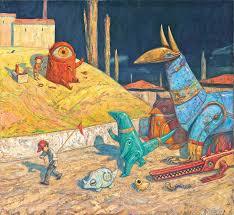
Siužetą, kaip "Atvykime", reikia labiau išmąstyti ir perkąsti, jis nėra paraidžiui išdėstytas, ir tame - ir knygos grožis, ir sudėtingumas (matau, kad komentaruose žmonės pyksta, jog "kaip vaikams paaiškinti???"). Aš tą siužetą perskaičiau taip (daugmaž tas nurodyta knygos atvarte): berniukas leidžia vasarą su vos vyresniu savo broliu, o tas primoko jaunėlį visokių keisčiausių taisyklių. Pvz: niekada vakarėlyje nesuvalgyk paskutinės alyvuogės; niekada nepavėluok į paradą - ir t. t. Kiekvieną taisyklę iliustruoja nuostabios tapytos iliustracijos, ir tų iliustracijų grožis nenusakomas - industrinis, tuščias ir nykus miestas, tik tie vaikai kažkur vis susiduria su gigantiškais triušiais, didžiuliais mechaniniais dinozaurais, kitom boschiškom būtybėm. Šita tuštuma, kuri vis dėlto jauki, nes sava, - nuostabiai perteikta vasara mieste, kai dar neturi super produktyvaus darbų tvarkaraščio, nuveiktinų dalykų / knygų sąrašo, tik reikia kažkaip išbūti tose tuščiose erdvėse be nieko. Gražu.
Gražiausia knygos vieta - jos kulminacija, kur taisyklę "Niekada nelauk, kad tavęs atsiprašytų" lydi keli puslapiai berniuko, užsirakinusio spyna kažkokioj katilinėj, visiškai vieno visam mieste (ir tą miestą pamažu užneša smėlis), vaizdo. O paskui atvažiuoja brolis su replėmis, turbūt spynai nugnybti, ir paskui jau visos taisyklės - tik su "visada" (visada prisimink paskutinę vasaros dieną).
Mind-blowingly inspirational. The illustrations, or more accurately, paintings, are so masterly, each one very different. They all have an incredible light and are very painterly. The story, a single line on a page tells what the boy learnt last summer. Each line is distinct but would open a conversation, to say nothing of what conversations the paintings would start. This book is not only for kids, the story and the paintings will intrigue any age.
This book is way too dark for children! The pictures are really scary and children will have nightmares. There is not a good message. It does not make any sense. Adults may like it but it should be an adult picture book--not for kids! It gives bad advice telling children to fight and always bring bolt cutters!? As a child, I would have found this to be scary and would not want to read this to a young child.
48 pages of rules! Never do this, never do that. Illustrations are dark and sinister, implying something deeper than the text leads on. As the inside flap reads: Author/ilustrator Shaun Tan shows us the strange truth of ordinary things. The book delves deep into the mind and soul of the MC, which I find creepy and twisted. Not child-friendly at all.
Yine güzel bir Shaun Tan resim albumü. Fakat bu kez oldukça kısa, oldukça tadı damakta bıraktırıcı. Özellikle çocuklarınızın hayal gücü için biçilmiş kaftan. Tabi yetişkinler için de öyle. İyi okumalar.