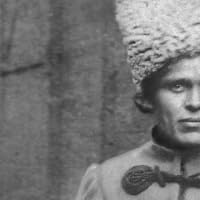
"[...] la Makhnovschina es un fenómeno de un inmenso alcance, de una grandeza y de una importancia extrema, un fenómeno que se ha desarrollado con una fuerza completamente excepcional, que ha desempeñado un papel extraordinario y excesivamente complicado en la continuación de la Revolución Rusa, que ha sostenido una lucha titánica contra la reacción de toda especie y que más de una vez ha salvado a la revolución misma del desastre; es además un fenómeno extremadamente rico en episodios brillantes y que atrajo la atención y el interés general, no sólo en Rusia, sino también más allá de sus fronteras. Al mismo tiempo la Makhnovschina despertó en los diferentes partidos, revolucionarios y reaccionarios, los sentimientos más diversos; comenzando por el odio y la hostilidad feroces, pasando por el asombro, por la desconfianza y la sospecha y acabando por la simpatía y la admiración más profunda."
"Proletarians of the world, look into the depths of your own beings, seek out the truth and realise it yourselves: you will find it nowhere else." (p. 261)
The essence of the Makhnovschina is summed up by the above quote. It seems to be one of history's greatest mass movements of people that sought emancipation from all forms of oppression they noticed: property, state bureaucracy, and religion. At core, a peasant movement, a class that society—and even leftist intelligentsia—has deemed unable of self-determination has shown the world that it encompasses the greatest revolutionary potential; and the Makhnovschina is not the only example of this.
This book has many flaws, mainly that it cannot be used as a serious scholarly work. One can easily attribute this to the fact that semi-complete drafts have been lost several times (due to war conflicts), and original sources destroyed. On top of which the need to have something published that would counter-act the Bolshevik oppression undoubtedly led to this book to be mostly polemic structured around anecdotal evidence. The author themselves acknowledges that more complete and better documented histories of the movement have to be written; but that he is incapable of doing so.
Nonetheless, the story it tells is striking; and ignoring the potential inaccuracies, you get an absolutely beautiful story about the triumph of the human spirit, against almost all odds. Taking into account inaccuracies, but still realizing that many of the things presented here have probably happened as such, this book offers hope beyond measures to the oppressed masses, all the while offering insight into what can doom such large scale experiments.
Was the Makhnovschina perfect? Of course not, and the author themselves acknowledge this:
"When the popular masses engage in a struggle of large dimensions, they inevitably start by committing errors, they allow contradictions and deviations, and only through the process of this struggle do they direct their efforts in the direction of the ideal for which they are struggling.
It has always been so. And it will always be so." (p. 232)
But the tendency of anarchists to dismiss the movement because it didn't conform to an ivory tower view of how revolution should occur is a worrying tendency amongst anarchists. One which is seen today in anarchists' condemnations of the struggle of the Kurds in Rojava on extremely similar grounds as the anarchists of old.
I urge anyone who has naive inclinations about how the world should work to read this book, and get some perspective on what can be accomplished, and what other problems need to be solved.
"Wherever the working masses do not let themselves be subjugated, wherever they cultivate the love of independence, wherever they concentrate their class will, they will always create their own historical social movement, they will act on their own. This is the essence of the Makhnovshchina."
There have been few attempts in the modern era to create a stateless society, on a large scale and defended with arms. The Makhnovshchina represents one of the most impressive, lasting three years. Engaged in bloody struggle with Austro-German invaders, "Petliurists" (national bourgeois movement), the White generals Denikin and Wrangel, as well as the Red Army headed up by Trotsky, the anarchist-Makhnovists had little opportunity for creative social experiments, and much of this is military history. But whether they were dynamiting prisons, facilitating peasant congresses, executing landlords, or putting on theater for the people, the Ukrainian insurgents everywhere planted the idea of social revolution and a "free soviet system." Exhausted by war, the Black Army was finally doomed by Trotsky's final betrayal in Crimea, and the Cheka and commissars imposed murderous dictatorship in the name of their "scientific socialism."
The original overview of the Makhnovist anarchist peasant movement in Ukraine, written by one of its protagonists. It's a shame so many materials were lost/destroyed by the Bolsheviks, but a lot of great details remain here.
Peter Arshinov was originaly a bolshevik who turned to anarchism. He met Nestor Makhno in prison and joined the insurrectionary army of the Ukraine. In 1921, he left the country. After breaking ties with the anarchist movement, he returned to the Soviet union in 1935. He was executed in the purges in 1937.
This is a very interesting book on a subject that has not often been treated. It has to be said that it is not an "objective" historical study. The author makes no excuses as to which side he is on. You also get a sense that he is trying to present a defense for the Ukrainian anarchist insurrection. As this movement was vilified by both white and red factions, it is not surprising.
The book covers the campaigns against the German invaders, the fight against Petliura and Denikin and the various offensives by the red army against Makhno's army.
The prose is a little heavy-handed at times, with Makhno sometimes appearing as a mythical hero. At the same time, the book does explain that the movement was much more that just one man.
The book also has a whole chapter dealing with the accusations of antisemitism. It seems clear form the documents that these accusations are false. The examples of swift, and capital, justice handed to those that were found guilty of violent acts (or even inciting hatred) against the jewish population are pretty eloquent.
It's a book I would recommend to anyone with an interest in the subject. As it deals with only a small part of the Russian revolution and Russian civil war, it wouldn't be a book I would recommend to those unfamiliar with the subject.
The action here is relentless and sometimes shocking, especially when the battles end up in hand to hand fighting, what the participants termed 'hacking'! What's most interesting is the Makhnovist concept of revolution... let's get straight to stateless communism. And guess what, that's not so hard to do. Easier than organising private ownership of land and buildings, easier than setting up a complicated state bureaucracy and most people can immediately see that it makes sense. Problem for the Ukrainians was that ideas like this weren't just opposed by capitalists and imperialists; the bolsheviks and other state-worshipping parties saw the example of liberated communities as a threat to their own efforts to control all life in post-tsarist Russia and Ukraine.
Think Anarchist Robin Hood. Anarchist cavalry movement that fought both the old regime and the bolsheviks in Ukraine. Very cool.
There's a part a part where one of the rival insurgent armies is causing them trouble. The guy's turned on the bolsheviks when they still have a common cause, and he's either permitting or actually carrying out pogroms against the Jewish peasants. So Makhnov sets up a public 'debate' which is really just an opportunity to list this guy's crimes in public, get him irrational, and then put one in the back of his head. Very cool.
Later when the Bolsheviks start to turn on the Makhnovists, they demand he turn over his army so it can go fight in the Crimea. It's a bad call because they're doing it to take control of these anarchist troops and arrest Batko Makhno. So he turns over his army to spare the fighting and then raises a new one from peasants armed with pitchforks and hunting guns and has them attack barracks and stuff until they can supply themselves. Wild.
And there's a really cool bit where they get into a desperate three way war against the Petliurists and Denikin's cavalry. It's too long to get into here, but an uneasy truce with the Petliurists collapses, the Makhnovists are surrounded and beat a hasty retreat, but seize the opportunity for an insane ambush to finish off Denikin's group. Makhno disappears at nightfall around the start of the battle and things get desperate. The enemy is at the outskirts of the village. The Makhnovists are preparing for street fighting, arm the women and children, don't say your prayers because we're atheists now, etc. But then the enemy machine gun fire changes direction. Makhno's cavalry has crossed a gorge and flanked the enemy, and he's attacking them now with his sabre! It's called 'hacking,' hand-to-hand combat, fighting armed men without firearms. Get in close and get vicious. They push Denikin's troops to the river, some drown, but most are able to cross – only to find Makhno waiting for them! They surrender and are taken prisoner, a luxury they didn't give even to the women on the other side.
Peter Arshinov’s 'History of the Makhnovist Movement (1918-1921)’ is the first book to provide an overview of Makhnovist movement (originally published in 1923) and the only overview written by someone who actually participated in Makhnovist movement. Arshinov met Makhno in prison 1911 and both were released during the 1917 February revolution. He returns with Makhno to Ukraine to participate in the revolution there becoming Makhno’s secretary in April of 1919. In 1920, he stopped fighting in order to write the history of the Makhno movement. He leaves Russia after bolshevik victory is certain, but returns to the Soviet Union in 1933/4 after denouncing anarchism. Despite his denunciation, he is later accused of anarchist organizing and executed for it.
Arshinov’s account is important for a number of reasons beginning with the fact that he participated in the Makhnovist movement, he had a close relationship with Makhno during the revolution, and he covers the period from 1918-1921. Makhno’s three memoirs only cover from March 1917-December 1918 ('The Russian Revolution in Ukraine: March 1917-April 1918’, 'Under the Blows of the Counterrevolution: April-June 1918’, and 'The Ukrainian Revolution, July-December 1918’); he planned to publish more volumes but died before he could do so. In addition to Arshinov own voice as a primary source, he provides access to other primary source materials from the movement and its participates including letters, telegrams, Makhnovist proclamations, which are difficult to obtain if they haven’t been lost to history forever. He also has a section of biographical information on other lesser known participates Makhnovist members.
A great book for those looking for a general summary or a crucial book for those like me that feel the need to read everything they can on the Makhnovist movement. Someone looking for a more in-depth, complete history of the Makhnovist movement should check out Alexandre Skirda 'Nestor Makhno Anarchy's Cossack: The Struggle for Free Soviets in the Ukraine 1917-1921’.
Arshinov's history of the brief flowering of the Ukrainian anarchist movement, originally published in 1923, provides and important first look at this founding organisation which deserves the name 'freedom fighters' far more than any other who bare the name. Unfortunately, it is as much hagiography as history, and even the later chapters which detail some of their mistakes don't compensate for the worshipful tone of the rest of the volume (retained by the translators, Lorraine and Fredy Perlman).
Also unfortunately, the anarchist communities did not have much time to theorise or to formally organise their societies, as they were under constant military attack, both by the departing Ukrainian autocrats as well as the Russian Bolsheviks, and the book spends almost no time exploring how the Makhnovist society managed itself.
A very interesting piece of history that shows how a small anarchist society functioned in Ukraine during and after the Russian revolution. The author points out the inconsistencies of communism and how it suppressed the workers and how anarchy could be a solution to giving power to the people. While I found the book particularly intriguing, I also found it quite disturbing in the way the author describes the murder of various people as almost no incidence whatever, while only disgracing the murder of the people that were trying to make Makhnovism work.
I think this book is really worth reading, especially now in a time where communism is trying to gather support in western society.
The Russian Civil War is one of the most interesting wars in history, and Nestor Makhno and the Makhnovist movement were some of its most interesting elements.
If that interests you, read this book. It's a slog at times, but it's worth it for an insight into a man, a movement and a world that existed for the briefest of moments. What Makhno and the movement did has never been replicated. This book is the best window into this history, and, tragically, many of Arshinov's documents and manuscripts were lost in the carnage of war.
Makhno's life story is beyond belief and would make for an excellent movie.
A gripping yarn about the most neglected chapter in the history of the Russian Revolution and Civil War, written by a prominent member of the Ukrainian anarchist organisation The Makhnovists.
For the many problems this book has as a scholarly source, it makes up for it with it's vivid narrative and it's critiques of Anarchists who dismiss popular movements and prefer to stick to small circles and unintentionally "sleep through" revolutionary moments. Nestor Makhno is a very engaging figure and this work does a good job in making his legend legible while also situating him in a much larger mass movement. I am frequently impressed by the ability of the Makhnovist movement to shift and resettle after getting battered throughout almost it's entire 3 year existence by reaction. Arshinov clearly looks highly on the movement and is less critical of it's course than Jose Pierats was of the Spanish Revolution in his book I recently read + reviewed. The Makhnovists made mistakes but, were still able to hold their own against multiple numerically superior foes before being routed by the Red Army. This book without trying to ultimately answered the age old question of how "anarchy can defend itself"; a mass movement of industrial and agricultural workers who maintain their autonomy while fighting against any entity trying to reimpose authority on them is able to retain revolutionary momentum that is always suffocated by dictatorship.