Jump to ratings and reviews
Rate this book

The Race Underground: Boston, New York, and the Incredible Rivalry That Built America’s First Subway

Rate this book
In the late nineteenth century, as cities like Boston and New York grew more congested, the streets became clogged with plodding, horse-drawn carts. When the great blizzard of 1888 crippled the entire northeast, a solution had to be found. Two brothers from one of the nation's great families-Henry Melville Whitney of Boston and William Collins Whitney of New York-pursued the dream of his city digging America's first subway, and the great race was on. The competition between Boston and New York played out in an era not unlike our own, one of economic upheaval, life-changing innovations, class warfare, bitter political tensions, and the question of America's place in the world.

The Race Underground is peopled with the famous, like Boss Tweed, Grover Cleveland and Thomas Edison, and the not-so-famous, from brilliant engineers to the countless "sandhogs" who shoveled, hoisted and blasted their way into the earth's crust, sometimes losing their lives in the construction of the tunnels. Doug Most chronicles the science of the subway, looks at the centuries of fears people overcame about traveling underground and tells a story as exciting as any ever ripped from the pages of U.S. history. The Race Underground is a great American saga of two rival American cities, their rich, powerful and sometimes corrupt interests, and an invention that changed the lives of millions.

416 pages, Hardcover

First published February 4, 2014

151 people are currently reading
3350 people want to read

About the author

Doug Most

4 books11 followers
Doug Most is a lifelong journalist, storyteller, editor and three-time author of non-fiction books. He lives outside Boston, Massachusetts, and now works as the Executive Editor and an Assistant Vice President at Boston University.

Ratings & Reviews

What do you think?
Rate this book

Friends & Following

Create a free account to discover what your friends think of this book!

Community Reviews

5 stars
283 (16%)
4 stars
722 (42%)
3 stars
539 (31%)
2 stars
122 (7%)
1 star
20 (1%)
Displaying 1 - 30 of 287 reviews
Profile Image for Hana.
522 reviews369 followers
December 6, 2016
I love trains and I love urban history so this history of the Boston and New York underground railroads was tailor made for me, especially since the two subway systems have been part of my life for over 50 years.

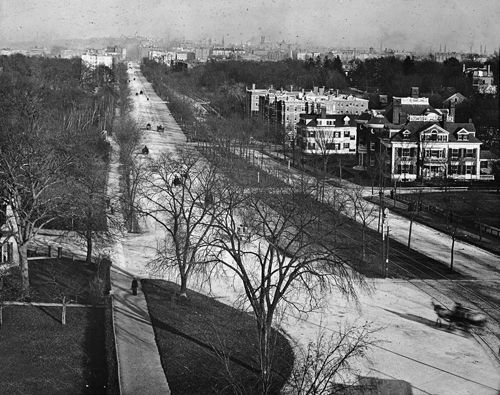
The Race Underground is not just a story of railroads, it's also a mini-history of Boston and New York packed (perhaps too closely for comfort) with memorable characters like Henry Melville Whitney who ran his father's Metropolitan Steamship Company. In the late 1860s Henry began buying up property in the suburb of Brookline about five miles away from downtown Boston. By the 1870s he was the largest property owner in Brookline and began to dream big about real estate development. Whitney realized that trolley lines would help the town grow so he began buying up those as well and convincing the town Selectmen to lay out streets ideal for streetcar routing.


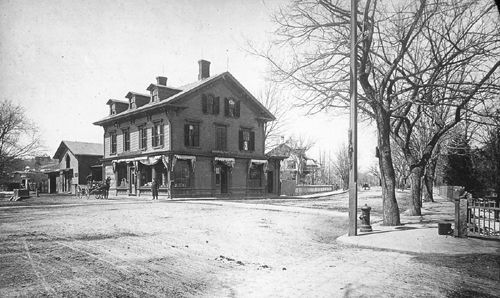
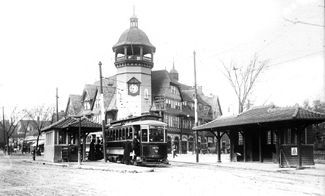
By 1898 the once bucolic intersection of Beacon and Harvard Streets...


...had become a transportation hub and the town's center, renamed Coolidge Corner.


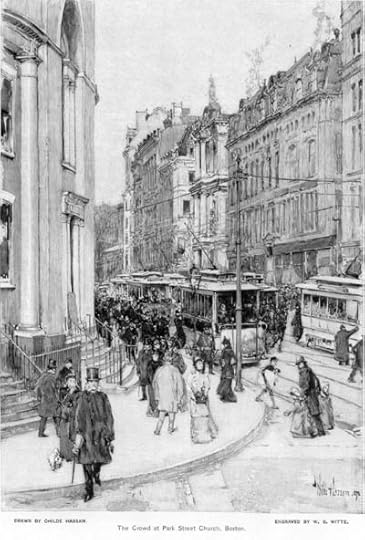
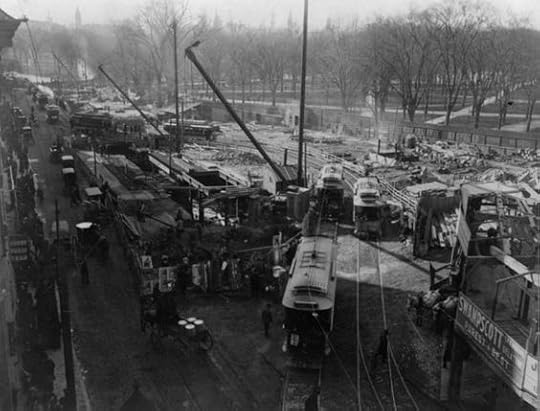
Meanwhile, five miles away in downtown Boston, the problem was too much traffic. Competing streetcar lines made the twisting maze of streets hazardous for horses and pedestrians alike. Nowhere was the problem more acute than where Tremont and Boylston Streets crossed, at the southeast corner of Boston's Commons.


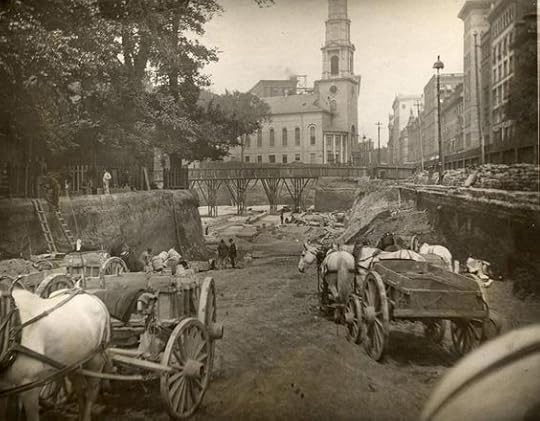
It took technical breakthroughs, plenty of sharp-elbowed Boston-style politics and sheer desperation on the part of Boston's citizenry but eventually the city opted to create America's first underground trolley system. Less than a mile of track went underground at first yet it was a massive undertaking. A team of visionary engineers used cut-and-cover excavation combined with a water-tight tunnel system of steel-reinforced concrete. This is Boylston Street looking towards Tremont and the Park St. Church.


Hundreds of corpses buried in the Central Burying Ground were disinterred and reburied in the new cemetery. Dozens of giant elms in Boston's cherished commons were relocated. And naturally traffic got much worse before it got better.


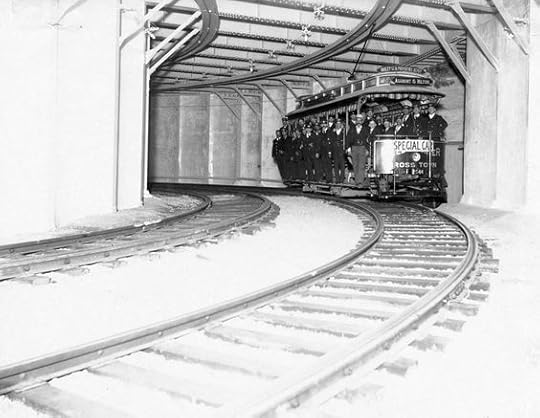
But by August 1897 Boston's underground electric trolley was ready for it's first trial run and was an instant hit.


There is lots more and students of urban and transportation history should not miss this book.The photographs were wonderful but it is rather shocking that the editors failed to include maps of either the Boston or the New York routes. For readers who are not natives of the two cities it gets pretty hard to follow unless you do a Google map and the author has not mastered the narrative drive that makes David McCullough such a powerful force among popular historians. The story got chopped up with too many minor digressions and I would have liked more depth on how the two projects were financed.
Profile Image for Josh.
134 reviews24 followers
February 26, 2014
I won this book as a Goodreads "first reads" giveaway and was excited to get into this one as I thought it would be to my likings; an interesting subject, a competitive backstory with political innuendo, a host of turn of the century power broker types all with an angle to work. Unfortunately for me, the book just never hit on all cylinders. There were places I found interesting tidbits but as a whole I wasn't captivated to the level of enthusiasm I had for the Eric Larson books that the marketing blurb shipped with my copy billed it as being comparable to.

I think for me, a little different structure and flow might have made this hum a little more. The main criticisms I would offer are:

1) There was no doubt about the fact that this author did a painstaking amount of research (which I appreciate) but it did at times feel as if he worked too hard to get pieces in that weren't needed for the work. Kind of like a senior research paper where you press to get all your sources quoted. I am sure the edit down process was intense, but I think one more pass through might have accomplished more with less.

2) Somewhat related, I found it a little painful that new folks were continually introduced all the way through the book. Just as many in the tail end as the front end and for me the impact was you never fully grasped the "who is who" that Larson is always able to accomplish in his works. Sometimes these characters would later appear and other times they would be in for five pages for a seemingly connective reason that only later seemed like an afterthought.

3) The first 100 pages, while they did set the tone for the drama that could play out in the end, in my view were a bit overdone. I think a lot of this could have been handled through a condense prologue setting the tone and moving on. It in a way distracted from the point that the author was trying to make of two brothers with some connection to the subway debate and process in two rival cities that never really reached the crescendo I think he was going for. It petered out.

4) While mine was an advance readers' copy, I would hope that the final print edition contains a section of photos which might more fully translate some of what's in play.

So, in final, it was an interesting concept. There were places I got antidotal pieces that I will hang on to, but to say it was captivating would be false for this reader.
Profile Image for Nancy.
346 reviews
February 14, 2014
I won this book in exchange for an honest review.

I unfortunately could not bring myself to finish this book.

I found several challenges with this book. Of what I have read, I have found this book to be fraught with convoluted chapters, a multitude of secondary characters who appear for no more than one chapter and absolutely no flow. The author will begin a chapter and I would find myself saying, what does this have to do with anything? In a way I can applaud Mr. Most's use of detailed historical information but I just felt it did not help the story move along.

I was more than half way into the book and had still not gained a sense of the 'rivalry' between the two Whitney brothers. I did not even think there was a rivalry between the two cities of New York and Boston. I felt as if the author imposed that opinion onto the reader.

An extremely tedious writing of a very interesting and unknown subject matter.
Profile Image for Kristi Mast.
69 reviews43 followers
November 5, 2024
Super fun and informative “read” (I listened to the audiobook) as a Boston resident. So so crazy how complex and multi-charactered the background is to something that is such an accepted and normal part of my everyday life. Perfect audiobook for me—story driven, lots of learning, and a good reader. Got me through a lot of household work 😅
Profile Image for Scott  Hitchcock.
796 reviews261 followers
April 23, 2018
3.5*'s

This was really well done and very educational. I really loved how the author incorporated all of the human elements into the story and created a sense of tension by doing so. Being from the Boston area and also being very familiar with NYC it was fun trying to picture the turn of the 19th into the 20th century culture, landscapes of both cities and the technological levels they were dealing with.

I would read Mr Most again.
Profile Image for Rachel Jackson.
Author 2 books29 followers
February 14, 2014
The marketing blurb for The Race Underground, a book I won in a Goodreads advanced reading giveaway, sets up a historical thriller nonfiction novel, almost, on par with Erik Larson and his reporting and narration of important historical events with a flair for creating interesting characters. Well, I hated what little of Erik Larson I have read, and I was disappointed by Doug Most's book in the exact same way. Like Larson, Most's book has a general disconnect of events, shoddy writing and poor punctuation and a general sense of "what's next?", a question that was never answered the whole book through.

Having lived in cities where the underground subway system powers its transportation, I am deeply interested in how they work. How is possible to power an entire infrastructure underground? How is it possible to build one under already existing cities? These questions have always baffled and fascinated me, and when I heard about Most's book, I was eager to learn how these subways were created in the United States.

But the book was a major effort to get through. At the end, I feel no wiser about subway systems — their inner workings and engineering — than I would about cars after reading a biography of Henry Ford. The book is a political tedium, creating conflict among political and societal players when there is none. Most sets up the book in the beginning as a rivalry between not only two cities, but two brothers, and he mentions the infamous Boss Tweed as a huge impediment to the projects. In reality, the brothers barely communicated with each other on their respective projects — and they honestly weren't even pivotal to the final projects themselves — and the apparent corrupt villains of the story came and went without so much as an afterthought. It read like a gossip tabloid of the 1890s when it came to the wealthy players in society and their sneaky scheming tactics.

What's lacking the most in this story is a conflict. Clearly both the Boston and New York City subway systems had their fair share shortfalls and disasters, some financially and some paid in human lives. And of course the political problems funding it would be a major part of the story. But Most does not focus on any of these problems long enough to really develop a sense of timing about the whole story; he breezes by a full forty years of subway building in some 330 pages, and jumps around chronologically so I didn't know what I was supposed to find most important. It was as if Most, having done clearly an admirable amount of research for the book, simply forgot how to synthesize it and just threw it into some garbled organization on a page and said, "Here, this is everything." Without a clear villain or conflict, one that plagues the action throughout the entire book, nothing in the narrative takes precedence over anything else. In my view, the entire engineering of a subway is what is the most mind-boggling, and the mere idea of building such a structure is the most fascinating part of the whole thing. I would have loved to read more about the engineers' points of views, and how they were able to develop a feasible design for an underground transportation system. But Most clogged up the whole narrative with petty political and societal squabbles that didn't even end up being relevant to the ultimate success of the subways.

Finally, and perhaps the most galling, if I'm being completely honest, I can't comprehend why such a poorly written book like The Race Underground would ever be allowed for publication. The writing is appalling — even Erik Larson has the upper-hand on this. Most writes like a middle-school student desperate to learn how to churn out his first research paper: short, choppy sentences with little to no connection to what comes before and after them; a complete lack of understanding of transitions, which makes each section less and less interesting; and an apparent inability to use any punctuation other than periods and commas. (The first time I saw either an em-dash or a colon, the only other punctuation marks in the whole book, didn't come until about page 240.) As a result, the book was an utter chore to read, and I didn't even feel like I learned something from it.
Profile Image for Rick.
425 reviews4 followers
July 29, 2014
Doug Most tried to tell what could have been an epic story but turns it into a muddled story which focuses more on the politics of building the first subway then on the great engineering story which it was. He says in one sentence what he misses when he says how the great failure of the London subway was that it was not copied for 30 years. This makes for a weak story from could have been epic. It does make some great points along the way which raised my hope, for example when he talks about the colonial era graves found in Boston or the unique challenges of the Manhattan geology but in each case he seems to find talking about obscure engineers in epic detail is what make the story go round not the advances in engineering which dominated this field.

All-in-all this is a good book but I think it is so much potential wasted. If you're a hard core subway or train person you may like this but I found it disappointing in the long run!
Profile Image for Dylan Martin.
49 reviews3 followers
September 6, 2024
A fascinating deep dive into the invention and creation of the modern day subway systems. Pioneered by two brothers in NYC and Boston, it's a fascinating brain exercise to think about the absolute chaos of these two cities prior to this invention and the modernizing effect it had on communities and people. And also, as a Bostonian plagued by the shortcomings of the MBTA, to think how much better it can get.
Profile Image for Sam.
258 reviews
August 3, 2014
Doug Most's history is solidly founded, but The Race Underground is burdened by unnecessary pretensions to tension and superfluous human-interest flourishes that seek to emotionalize a titanic tale of infrastructure but just get in the way.

Firstly, the incredible rivalry advertised in the subtitle doesn't stand up over the book's 416 pages. New York City and Boston both sought solutions to overcrowded, polluted streets. In the same roughly 60-year span they made halting progress towards the day when each inaugurated its subway system. That said, apart from the occasional newspaper headline, there isn't competition of any meaningful form.

The Whitney brothers are brought into this narrative at an early age and readers are treated to the major events of each man's life from birth to death. That said, neither man winds up being central to the construction of the subway systems in question. They're played up to bring humanity to what could devolve into an index of figures and reports, and they do each play a role, but their back stories would have been well served by stricter editing.

Other vignettes include the pages-long anecdote of young Sam Strong, who got caught in the horrific blizzard of 1888—an event that tangentially advanced subways when it froze and shut down all of New York's existing transit systems. In Strong's case, we're treated to a blow-by-blow dramatization that concludes with the heartwarming revelation:

"Sam Strong's determination that day was no fluke. Later, after studying at Columbia, he was Dr. Samuel Meredith Strong, and, as a surgeon living in Queens and practicing in Brooklyn, he built and used the first airplane ambulence."


This is either padding or pandering, and it doesn't drive the subway any closer to completion. These are lovely stories for the historian to discover in the archives, but most are also best left there.

In numerous meandering sections, a thesis or theme is reinforced repeatedly in nearly identical terms mere paragraphs apart. Doug Most has found a compelling period, but he wanders into everything from the Wright Brothers to a catalog of the shops on the Ladies' Mile in Manhattan in ways that drain rather than contribute to the strength and momentum of his account.
Profile Image for Chelsey.
707 reviews
April 11, 2018
There's some fascinating information in here, but it's bogged down by insignificant details about people minorly involved in transit developments. I also feel a bit misled by the title - there didn't really seem to be that much of an actual rivalry.
Profile Image for Viridian5.
944 reviews11 followers
February 3, 2015
The book was an interesting read but I felt that its title really misrepresented its contents. A race? It took decades for each city to get its subway from its first public statement to its first shovel in the ground, and each city, especially New York, tried several other options before they basically reached a point where an electric subway was the only option to fix their traffic and population growth problems. Various obstacles mostly came about through someone or group's greed, self-interest, politics, and/or ignorance. Boston and New York have long had rivalries of various sorts but that didn't get either of their subways built any faster. The subways built can't even really be considered equivalent since one city's was far longer and a far more complicated engineering problem than the other's.

I've read many books about New York's subway but still found out things about it here that I hadn't run into before. It's also fun to read some more, deserved bashing of Thomas Edison. Sometimes the author shows too much more of his research than he necessarily had to, and don't come into this book expecting a heated competition between two cities to get a subway in faster.
286 reviews1 follower
March 22, 2014
I really enjoyed this well researched and well written look at the development of the subway as the primary means of transportation in the late 19th century. Most has done a great job of portraying the problems, the solutions, and all the people and politics involved. The book was well written and flowed well. I often dislike nonfiction because it tries to follow too many threads unsuccessfully, but not so here. I read an advance readers copy-i hope the final edition has maps and photos! That would make the book really great! (Originally written for Bookbrowse.com who provided me with the copy)
Profile Image for Jim Yarin.
Author 1 book5 followers
April 4, 2021
In perspective, it may seem petty, but I think the main reason I did not give this book five stars is because the title and subtitle are not even close to describing the through line or any of the main themes of the book. There is no race, and there is no rivalry. Yes, there exists, in reality, even back then, a rivalry between the two east coast cities, which is mentioned a few times in the book but never dwelt upon. But said "rivalry" did not build America's first subway.
The author uses his sources well, and does what appears to be a good amount of original research (e.g., into newspapers) to uncover the history of public transportation efforts in the NY and Boston ca. the late 19th century. His reportage appears to be top notch, so I'm going to assume that the fault of the book's titling lays with the publisher and editor. WAY TOO often I find that editors can so get in the way of the hard work, precision and clear thinking of an author, even to the point where one reads a beautifully written news article ruined by a disastrous title applied by an editor. Alas.
But more substantively, one might ask, what is this book about if not a race between two rival cities to build a subway? It is about the congestion problems facing large cities at the time in question, the churning industrial age of the 1870s and 1880s--people and horses and horse-drawn conveyances. And. let's face it, a lot of horse hockey (I think that implies manure, but just to be sure, let's say "horse sh*t"), and the public transit solution of subways applied to those problems.
It is the story of how large cities, or frankly any government, must contend with competing interests against improving the public good, and the risks inherent in trying new technologies and new solutions to old problems. It is about "groupthink," political will (and inertia), corruption, ignorance, and fear, all mixing up against each other to solve or not solve a serious problem, in this case, overcrowded streets. It is also the story of the development of new technologies, specifically electric motors and electrified railways and digging underground.
I enjoyed the format utilized when the narrative goes away from current motion of the story to tell some anecdote or lesser-known history tangential to the main through line. This is done by sectioning off the off-topic-ish sub-narrative, and it tells the reader, "hey, by the way, here's something interesting about that something just mentioned which you may be curious about or find interesting, but not pertinent to the story of subway building." Many history writers will not do the extra work to bring this type of information forward. It may be a previously unwritten history or little known history, and some writers will sink it into an endnote, which will likely be unread, or go on at length in a set of paragraphs (at which point a reader might ask: "what were we talking about, again?"), or just leave it out because it requires extra work and they are afraid it will muck up the main narrative.
The writer does a great job in explaining things at the correct level, and not assuming a lot of background by the reader, therefore making this book highly readable. I would be remiss not to mention that in many respects this book is about the men (all males, a function of the time) who were involved in the politics, financing, technology, and labor of building the transportation systems involved.
I found few, if any typos, and I usually find some. If I did find any, they were so minor that I could reread the sentence and find it so minor it was not worth dwelling on. Well written.
One thing I did find odd, was at one point there is a discussion of overcrowding in the Lower East Side. There was included what looked like a summary of the the classic and popular work of Riis, "How the Other Half Lives," but no reference at that point to that seminal work, or mention of the Eastern European Jews as the primary ethnic group suffering those deprivations. This seemed odd, considering the author's non-hesitation to identify every other ethnicity of an individual or group of people in the book, even to the point of calling one person an Irish-American although he was born in the U.S. Query whether there is some bias or prejudice, possibly unconscious and likely without any malice, to avoid discussions of Jews. My interest in Jewish history may have skewed my thinking on this, but I'm always on the lookout for Jewish history and personages, and for that reason the aforementioned failure to describe that part of humanity as mostly Easter European immigrants stuck out to me.
Another criticism, one which anyone reading this book would notice, is the lack of maps. The author must have assumed that the publisher would include maps. It is a glaring failure of the book, but still the book stands up on its own many merits as an enjoyable, informative read.
Profile Image for Richard.
202 reviews1 follower
September 22, 2017
This is the true story, not so much about THE building of the Boston and New York subways, but about HOW they were able to be built. Politics, greed and corruption put up many struggles against the city planners who had their visions of solving the horse-drawn streetcar traffic above the surface, as well as overly supersticious citizens who shuttered at the idea of having to ride their own Underground.

This book goes into greatly detailed biographies of the characters at play, which would be a better thing if the author explained up front what their role in building the subway was, rather than assume that we could go by name recognition and get thrown right into their childhood with no context.

Also, what is with the title and cover? This book makes NO mention of there being any race or other competition between the two cities, as if it were the Red Sox vs Yankees. It's no secret that New York didn't even break ground until 3 years after the Boston T was up and running, and aside from the two Whitney brothers each working for one system, there was virtually no interaction at all between the two projects!
Profile Image for Julia.
774 reviews26 followers
August 3, 2017
Whenever I travel to a city with a subway system, I marvel at how in the world such a thing could have been built over a century ago. This book gives so many amazing insights into how it was done, and lots of anecdotes about the politics and financing that went into several of the major cities' history of building their own subway systems. My only criticism is that the time-line bounces around a lot, and jumps from city to city so much that it was hard to keep track of what was happening where and when. Published in 2014.
Profile Image for Sarah Cohen.
28 reviews
May 21, 2025
I thoroughly enjoyed reading this book. The author has clearly researched this information so incredibly well, and also has written this story in a way that is so engaging and exciting to read.

Super interesting story, and especially fun to read as someone who grew up in Massachusetts, visiting NYC many times growing up. To learn the history of the subway systems alongside the history of the country and New York and Massachusetts as well, was really fun.

Definitely recommend!
25 reviews
July 4, 2025
(Audiobook) thoroughly researched and full of history. Kept my attention, and I learned about Boston and NYC politics.
Profile Image for Howard.
84 reviews2 followers
February 20, 2014
Growing up in Boston, I spent the better part of my youth riding the "T" - starting in the early 50's right until I graduated college in the mid-60's. I loved the subways and found the maze of underground, elevated and surface lines a fascinating way to get around and see different parts of the city. For a pittance (a dime I think) I could ride around all day and go from bus to elevated to subway to trolly and back again. Wow. A lot of fun for a 10 year old exploring on his own (if only my parents knew). During those explorations I always wondered how they actually built it, but could never get an answer. Moving to NYC to pursue a career in finance, I found that most of my adult life was spent using public transportation in NYC (riding the Lex to Wall Street in the early 70's was not a lot of fun but essential) and found myself similarly fascinated with the intricacy and engineering marvel that was/is the NYC underground. I also wondered how they built it and did so without destroying the city above. Now that I am retired, with no need to commute, I still find the subway to be an efficient way to get from point A to point B - plus we now have air conditioning. Yet I still find my self fascinated by the vast underground that comprises the NYC subway system.

Now I have my answer to both questions in a well written, fascinating account of invention, engineering, politics and finance and, to a lesser extent, sibling rivalry. I highly recommend this book to anyone with an interest in how we - Americans - actually got something done and perhaps use it as an example of what we CAN get done again. If only we have the will to do so.Perhaps this book should be sent to every member of congress to be read as they commute back and forth - give them some ideas as to actually doing something productive.

This is a wonderful book, well-researched, well written/edited and it definitely should be required reading as part of any history course where the objective is to teach students of any age how to learn from our past. It is also a definitive guide to names that can be found on buildings all over Boston and New York and answers the question - who are these people? The answer is, they were truly amazing in what they were able to accomplish. If you love history, as I do, buy it and enjoy. Also, contrary to other reviewers, I loved the digression into multiple characters. It humanized the project and brought it into a reality that is easily relatable.

For providing such an entertaining and informative read I thank Doug Most. Great job.
Profile Image for Richard.
312 reviews6 followers
December 20, 2015
I was pretty disappointed with this book. I find the subject matter very interesting (the development of the subway systems in Boston and, especially, New York) and really wish this had been a better book. The book includes excerpts from reviews (as many books do) and one reviewer from The New York Times compared it to David McCullough's The Great Bridge and Erik Larson's Devil in the White City. Unfortunately, it's more Larson than McCullough.

Author Doug Most seems too interested in letting us know how colorful the 19th Century was and not enough in addressing his subject matter. We get a detailed description of President Grover Cleveland's White House wedding, But then a couple of pages later, there is a single paragraph about "New Yorkers being enraged" about plans for their local transit system, which led to a lawsuit and an investigation and people fleeing the country, and finally the sale of a local railroad. A proper historian would have fleshed this out, telling us more about this "public ire" and how it manifested itself. But Doug Most is more interested in telling us about the color of the flowers that the First Lady wore. Very frustrating.

And then there's this:
There was only one obstacle. Boss Tweed was enraged. Not only had Beech snuck around him to complete his subway, he had done it directly across the street from him.

"New York needs a subway," Beech said after learning of Tweed's reaction.

Tweed was unmoved. The two men were poised to go to battle. It would not be a fair fight"


Doesn't that almost read like something out of a children's book? It's sort of like saying, "The king put a tax on the colonist's tea. The people were not happy, so they threw the tea into the harbor." There were passages like this where I felt that the text was pulled from a book for second graders, only omitting the colorful full-page illustrations.

I probably should only give this book two stars, but I gave it three because, despite its flaws, I did learn a lot about the origin of New York City's subway system (and Boston's too). I imagine that there are better books on this subject, and maybe one day I'll seek them out.
Profile Image for Gary Van Cott.
1,446 reviews8 followers
March 5, 2015
This book was mentioned in an Alumni magazine I get. I was surprised to find that our library system had several copies. It is the first non-fiction book I have read in ages (I usually read mysteries set outside the US). This book is ok, but has several deficiencies. The principal one is the lack of any maps or graphics. How you can exclude them from a book which includes street railways, elevated trains and finally the subways is a real mystery. They are easy to produce these days. I also found the language in the beginning of the book to be at perhaps an eighth grade level. I either got used to the author's writing style or he evolved as he wrote as it didn't bother me after a while.

There are a lot of subjects that really aren't covered at all. During the 1890s there was a big rivalry between producers of DC vs AC electricity (AC won of course). While even today a majority of transit systems run on DC, I couldn't help wondering if this conflict affected the subway in any way. As far as I can tell the Boston system had single cars while the New York system had trains of cars. This seems significant but it was never addressed. Also there are no photos at all of the NY subway cars.
Profile Image for Brian .
976 reviews3 followers
January 6, 2014
The race underground covers the history of the first subways in America which centers around Boston and New York. A rivalry of two brothers growing up at the height of the gilded age would bring for the luminaries in public policy, urban revitalization and science to develop an electric based mass transit system to improve life in both cities. From the crowded world of horse drawn streetcars, elevated rail lines and carriages came the vision for a public funded (but privately administered) subway system that would speed people underground. Amazingly the fear that should have come from being underground quickly abated and the subways (bothersome turnstiles and all) were quickly embraced in both cities. Most tells the story of how the key players interacted, the challenges that were faced and the harrowing disasters (more so in NY) that came to represent the building of this project. The book is well written and moves at a quick pace giving just enough detail without getting bogged down in any one area. For those interested in either of these cities, the gilded age or urban development a great book to take a look at.
80 reviews3 followers
January 20, 2015
As a fan of Boston history, I looked to this book for its Boston-centric content, and as such, I may be different than the average reader. I have to agree with the negative reviewers here, in that the book is a jumble of stories, not all particularly well told. I did learn something about the building of Boston's subway, but I was left with the feeling that I had missed much of the story. For instance, a map of the downtown Boston horsecar system would have been nice, at a minimum. Little was said about the troubles horses produced, including both the stink of the waste and the large number of dead horses left on the streets.

Given that the author has worked for the Boston Globe (at least three of the five blurbs on the back cover come from Globe colleagues), I suspect that he intended to write a book about the building of the Boston subway, and found that either he didn't have enough content for a book, or that editors didn't think that a Boston-focused wouldn't sell sufficiently.

This is a book I'd recommend only as a library borrow.
Profile Image for Brandi.
686 reviews35 followers
December 30, 2014
Doug Most's "The Race Underground: Boston, New York, and the Incredible Rivalry That Built America's First Subway" covers an interesting period in history, when major cities were looking to find other modes of transportation to serve their citizens due to congestion and limited places to leave carts. The two Whitney brothers decided to look underground for a solution, and the subway was born.
The book almost felt disconnected at times. It could have flowed better, as it was choppy and hard to follow in many places. Overall, though, I could tell that the author put a lot of time and research into compiling information for this book. The book is excellent for educational purposes and would make an excellent resource for students or other individuals who may be researching transportation or urban history.
This book was won from Goodreads.com
Profile Image for Tony.
512 reviews12 followers
August 14, 2014
The Race Underground is a highly enjoyable account of the origins of subways with a strong focus on the New York and Boston systems. The author employs a somewhat unusual narrative tool whereby he tells the story through an extensive series of short biographies. For example, when he wants to talk about an engineering advance, he will give a very short bio of the key inventor and then describe the person's relevant work. This technique generally works quite well as the story is filled with lively and interesting characters. However, towards the end of the book, it is a bit hard to keep track of all the individuals covered.
Profile Image for Shawn.
Author 12 books23 followers
February 22, 2014
Full disclosure: I received a free ARC of the book from the publisher.

It's a competent book, but not necessarily an engrossing one. I never really got any sense of sustained dramatic tension. This is partly a result of the structure, which is somewhat jumbled. But more than that, it just isn't a fundamentally dramatic story. There weren't apparently insurmountable engineering problems in either city, and in no sense did they "race" each other to finish a subway first. (In fact, the process in both Boston and NYC seemed to drag on forever.)
Profile Image for Robert Melnyk.
404 reviews27 followers
March 19, 2014
Fascinating story about the building of the Boston and New York City subways. The book deals with the history leading up to the construction of the subways, including all the technical/scientific battles waged as to what was a better way to go, subway, vs. elevated trains, vs. cable cars, etc. It also details all the political infighting that goes on with these types of decisions, and describes all the various people involved in making such a massive undertaking a reality. Very interesting book, and well worth the read.
Profile Image for Michael.
219 reviews24 followers
March 24, 2015
Ever read a good book that just seem to be all over the place.
If not and you wold like to then this is the book for you.
I did enjoy the story but it felt like it was not focused, as if threw everything and everyone that was a thing at the time in to the story. I felt like I was in mid 1800's late 1800's and the 1902 from sentence to sentence.
I enjoyed the pace and the story but really felt like it could have been better at focusing on the main story.
Profile Image for Jennifer Marie.
350 reviews25 followers
March 8, 2015
I found this book totally fascinating and very interesting. I rarely read nonfiction, but when I do it tends to be this type a historical book. This was even more fascinating for me because I live in Boston. Worth reading if you like history!
Profile Image for Amanda.
436 reviews
didn-t-finish
July 13, 2016
Interesting material, but too dry. Even by my standards.
Profile Image for Sara.
96 reviews1 follower
January 11, 2017
Interesting book and I learned a lot but it got really slow at certain points
Displaying 1 - 30 of 287 reviews

Can't find what you're looking for?

Get help and learn more about the design.