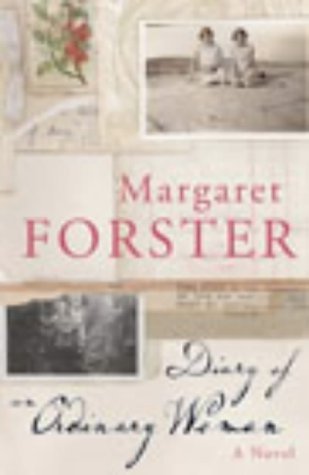
In this novel written as diary, the quintessential twentieth-century woman is seen in close-up -- independent, vulnerable, determined, coping with the large and small tragedies and upheavals of the century. A clever piece of "memoir" writing which could fool everyone.
Margaret Forster was educated at the Carlisle and County High School for Girls. From here she won an Open Scholarship to Somerville College, Oxford where in 1960 she was awarded an honours degree in History.
From 1963 Margaret Forster worked as a novelist, biographer and freelance literary critic, contributing regularly to book programmes on television, to Radio 4 and various newpapers and magazines.
Forster was married to the writer, journalist and broadcaster Hunter Davies. They lived in London. and in the Lake District. They had three children, Caitlin, Jake and Flora.
Millicent King was a woman ahead of her time. Feisty and independent from a very young age, she refused two proposals of marriage because she wanted to do something "important" but nonetheless embarked on a long-term, secret, and passionate affair with one of her suitors -- a very "liberated" woman for the early 20th century.
After having abandoned short-lived jobs as "shop-girl" and school teacher, Millicent trained for employment as a social worker, a profession still in its infancy at that time, and embarked on her career filled with both optimism and trepidation. Through this work, she met Robert, the only man she ever loved and wanted to marry. Sadly, he was a married man whose wife refused to divorce. Nonetheless, their professional relationship evolved into a long love affair and eventual open co-habitation.
Millicent bore the scars of two world wars. Millicent was fiercely loyal to those she loved and, during the Second World War, her career in social work was sacrificed in favour of service to her country and her family.
Although a self-described "ordinary woman", Millicent lived life in a most extraordinary way. She, of necessity, spent many years doing the traditional "women's work" of homemaking and child-rearing, but her radical spirit survived the drudgery. Her horrific war-time experiences fostered her embryonic sense of social justice and, from mid-life through to old age, she surprised even herself by participating in peace marches and demonstrations along with her "career activist" niece, Connie.
As the story of Millicent's life progressed, I found myself wondering if this was really historical fiction, or perhaps biography. Millicent is a truly fascinating and inspiring woman and at the same time truly human, with a full range of moods and emotions. Her story is so uniquely-presented, so exciting, so convincing that I found it difficult to believe that this "diary" was imaginary.
This book is a serious contender for my own personal "best book read in 2016" award and is highly recommended!
Sometimes when you buy a book, it turns out that you're setting aside a gift for your future self. I bought this book almost two and a half years ago in a Charing Cross Road bookshop during my first trip to London and it's sat on my bookshelves ever since then. I don't know what pushed me to pick it up a few days ago but I could almost instantly tell that it was a case of right book, right time. I was deeply moved by the opportunity to follow one ordinary woman through her life as it spans the 20th century - from her girlish observations of the Great War to the restless, roaring Twenties and on to the growing unease of the 30s and the life-changing experience of living through World War II. This is historical fiction at the foundational level - all of the messy details of life played out large and the big historical events in the background.
This the kind of book that has a narrative that consumes you and a strong voice that leads you to turn pages. You do need to suspend disbelief since the "diary" conceit requires the entries to have more explanation that I think a real person would include in their diary but Forster manages to neatly sidestep most of the historical background by providing herself as the "editor" of the diaries. She occasionally comes in to skip over dull years or to provide perspective on the events of Milicent's time. The interaction between historical events and real life becomes a bit heavy-handed during Milicent's later years when she fights with her niece/adopted daughter over the growing Feminst movement. All of their conversations feel stilted as if Forster had to find a way to play out the central questions of Milicent's life in the last quarter of the book.
This is a very small flaw in an otherwise deeply textured novel that clearly illustrates how quickly we forget the dramas of the everyday and how soon all the moments of life can become something written in a journal or an email. The diary conceit works beautifully for Forster to say a great many things about how we chose to live our lives and - in particular - how womens' lives in the 20th century were shaped by the historical events. As the pages of the diary go by, the reader lives a life along with Milicent, seeing and understanding things that perhaps she herself has not yet understood. Diary is a fascinating experience that I would urge every lover of historical fiction to seek out and read.
I absolutely adored Margaret Forster's Have the Men Had Enough? when I read it back in 2017, and think that her biography of Daphne du Maurier is superb. It has been a surprisingly long time since I picked up another of her novels, but I selected the rather chunky Diary of an Ordinary Woman as my next Forster because it sounded splendid. It sounds, on the face of it, as though it has rather a lot of themes in common with Have the Men Had Enough?, and I was intrigued to compare the two.
Diary of an Ordinary Woman spans an entire century, from the birth of its protagonist in 1901, to her old age in 1995. It is presented as the 'edited' diary of Millicent King, who takes the decision to keep her journal just before the outbreak of the First World War. In it, she 'vividly records the dramas of everyday life in a family touched by war, tragedy, and money troubles.' Of Forster's decision to include such a vast time period in her novel, The Guardian writes: 'Not only is the background of social and political change meticulously accurate... but there is everything one would expect from a well-kept diary. This is fiction, yet it is true.'
The 'diary' begins with an introduction written by an overseer, an anonymous author who has been asked to read Millicent's many diaries by her great-niece by marriage, and assess their literary worth. The author comments: 'I pointed out that it is quite dangerous letting a writer loose in a field of very personal material - I might run amok and trample on sensitive areas.' However, upon reading the earlier diaries, they note: 'The writing was fluent and lively, and seemed driven by some sort of inner energy which, though the content was mundane enough, gave it a sense of drama... If she could write with such vigour at 13, how would she write at 23, 33, right up to 93?'
Millicent shows her diaries with some satisfaction: 'Inside [a cupboard], there were three shelves packed with hardback exercise books, most of them red but some black. She stood back and surveyed them, telling me that whenever she looked at them like this, she felt her life must, against all the evidence, have amounted to something after all.' The introduction of this anonymous author-cum-editor ends as follows: '... there was nothing ordinary about this woman. Indeed, I now wonder if there is any such thing as an ordinary life at all.'
To continue with this idea of Millicent's diaries being edited, entries are sometimes interspersed with comments from the anonymous author, which give more background to the social climate, or which explain why several months - or sometimes years - have been omitted from the 'edited diary'. From the beginning, one really gets a feel for Millicent's quite prickly character. As a young lady, she certainly feels hard done by, particularly with regard to her position in the family: 'I am most unfortunately placed in this family, coming after Matilda and before the twins and Baby. I am special to nobody, and that is the truth.' Her humour, which is not always deliberate, comes through too in the earliest entries. When she stays in Westmorland for a family holiday in 1915, she comments: 'There is no place or time to read and in any case I must be sparing with what I have to read because there is no hope of getting to a library. I have made Lorna Doone last for ages and I do not even like it.'
I found Diary of an Ordinary Woman immediately compelling. Forster has perfected an intelligent but accessible writing style, which seems to give us access to Millicent's every thought, however dark. Due to the span of almost the entirety of the twentieth-century, Forster has allowed herself to engross one in the details, creating such depth for Millicent and the changing world in which she lives. There is little which is remarkable in Millicent's life, but the very fact that such a huge chunk of it has been recorded by herself, is remarkable.
One is really given a feel for the huge shifts which occurred during the twentieth century, and the impacts which this could, and would, have upon one individual. Her life unfolds against the century; her childhood lived in the First World War, the role of fascism in Italy where she later works as a teacher, the Mass Observation Project which she takes part in, and the Korean War, amongst others. In many ways - having a career, deciding not to get married or have children, and even wearing trousers in the early 1930s - Millicent subverts what was expected of a well-bred woman.
The element which I found a little tiresome in this novel is the emphasis placed upon Millicent's romantic conquests. Whilst mildly interesting at first, these soon begin to follow the same pattern, and the men whom she falls so wildly for become quite similar figures. This detracted somewhat from my enjoyment of the novel. Had this part been more succinct, or less spoken about, I imagine that I may well have given Diary of an Ordinary Woman a five star rating.
Millicent King is a singular woman, but she is also presented as Everywoman here. Forster makes it clear that Millicent shares a lot of her concerns with women living within the twentieth-century. Of Forster's protagonist, the Independent on Sunday stresses the 'whole-hearted' belief which we have in Millicent, and the element of heroism within her 'that George Eliot would recognise.' Whilst there were some later decisions in which I found myself questioning Millicent's judgement, I could not help but warm to her. She feels realistic, particularly for all her foibles and complaints.
In Diary of an Ordinary Woman, Forster has created something quite remarkable. Whilst in some respects the novel does feel rather long, there is so much within it which both fascinated me, and sustained my interest. Evidently, to span an entire lifetime, there must be a lot of detail included, and the novel is certainly richer for it.
I picked up a used copy of this in the UK (in Blackwell's in Oxford, I think), solely on the basis of having liked Lady's Maid and Forster's biography of Elizabeth Barrett Browning. I'm glad I picked it up, because it's very good and happened to hit exactly the mood I was in.
The novel is in the form of a diary kept by a woman born in 1901, whose life spans almost the entire twentieth century; Forster writes a long introduction in which she meets Millicent King and agrees to edit her diary for publication. (This is so convincing that apparently some readers haven't realized that the book is fiction rather than non-fiction until they reach the author's note at the very end.) Millicent begins her diary as a teenager, just before WWI, and stays with it through her whole life, until 1995, when she can't physically write any more. The characterization is excellent, of Millicent and also of her friends and family, as seen through her eyes; Forster shows us just how unordinary an "ordinary woman" can be.
A life chronicled in a lovely way. Covers the two momentous world wars and life in an independent English woman during these times. Covers the whole of the nineteenth century. A life well lived and well told.
Like many other readers I initially thought Diary of an Ordinary Woman was a real diary and I was disappointed to discover that it is in fact a novel. After I recovered from this disappointment I enjoyed the book a lot but as it got closer to the end it started to drag for me. The author has done a wonderful job of tracing the major events of the twentieth century through the experience of one woman, and she explores many of the issues and changes that women faced over this time convincingly. The futile destruction and devastation of war is a major theme running through the book and the final sentence sums up what Ms Foster was attempting to do, which was to give voice to the ordinary people who live and die in quiet obscurity: "To me, she is as symbolic, in her way, as the unknown solider: The Unknown Woman of her times."
Millicent King has a very engaging voice at the start of the novel and I think her childhood entries are among the strongest. As she ages her voice changes accordingly and she always seems realistic, but there was one glaring problem with this character that I found it difficult to get past: her lack of personal relationships. If she is meant to represent the ordinary woman then I feel it was vital to capture the full gamut of emotions and ties that most ordinary people experience over a lifetime, and this book doesn't do that. Daphne is Millicent's only close female friend throughout her entire life and she doesn't even like her much of the time! It was inconceivable to me that someone could have so many interesting life experiences and not meet any other like-minded people to form friendships with.
Daphne herself is a problematic character because when Millicent meets her she is very serious about study and interested in politics and social justice, but then for no apparent reason she metamorphoses into a party girl who wishes the war had never ended because she was having so much fun! She becomes merely a foil to show how responsible and self-sacrificing Millicent is in comparison to her. Although she's involved seriously with Robert, Millicent can never decide if she really loves him and the two children she raises after her sister's death both eventually lose touch with her despite the fact that they'd adored her so much growing up. This lack of warm relationships really marred the book for me, and Connie does make reference to this when she points out that maybe Toby became so unsociable because of Millicent's influence. I wondered if the author is trying to show how Millicent's aloofness has hurt those she loves the most?
I also didn't like the fact that it became all about Connie rather than Millicent towards the end, and again I was left with questions about the author's intention: Was she implying that older people's lives are so uninteresting so they have to live through others, or was it Millicent's own fault for refusing to take part in life? I found Connie's turn to radical feminism to be heavy-handed, and the final message seemed to be that independent women like Millicent, Connie and Daphne got it all wrong and it's really those with a traditional family life like Harry and his wife who are happiest.
If Toby took on Millicent's anti-social tendencies then it could be argued that Connie took her independence and ambivalence towards marriage to an extreme. The book reflects on the changes of the past century and the freedoms women have gained and in my interpretation decides that they haven't really been worth it. It's almost as if the author is saying: "See girls this is what happens when you value your freedom and independence so highly, you end up alone (as Millicent would have if Harry hadn't stepped in) and bitter, or in Daphne's case dead from lung cancer as a result of her irresponsible lifestyle. It was a very conventional ending for an unconventional woman in my opinion, but it's still an interesting book and well worth reading despite its flaws. 3.5 stars
This entire review has been hidden because of spoilers.
It started off well but after the diary passes the second world war years it quickly peters out. There are lots of family members who feature prominently for long periods and then are rarely mentioned again. Whilst this may happen in real life it was unsatisfactory in a novel as there were lots of things left unexplained. The central character came across as very cold and unfeeling, I didn't warm to her really.
I thought this story was more based in fact than it turned out to be. I had managed to convince myself that it was mostly true due to the introduction. About 20 pages from the end I flicked forward to the acknowledgements only to find that Margaret Forster never actually meet Millicent King, I felt cheated.
I did not have high expectations of this book: the title and the author's reputation persuaded me in advance that it would be light reading. And indeed it was. However, I have to admit to enjoying it far more than I expected.
The author claims at the start that she met the diarist, Millicent King, at her request so that she could re-write the diaries she'd kept throughout most of the twentieth century. From then on we get edited highlights of the diaries interspersed with summaries or commentaries from the author.
As the title suggests, Millicent is in some ways an "ordinary woman" but in other ways unique as all humans are. We are taken through many of the "big" events of the century in England as witnessed by our hero from her teenage years during World War One to the Greenham Common demonstrations and beyond. Some hardly affected her whereas others changed her life totally. There were love affairs [some shocking for their time], compassion and tragedies, and Millicent's personalty shines through and develops as time goes on and she is shaped by events. We [well, I] are hooked by the suspense formed by her character and the desire to know how she survives or thrives events we know are approaching.
Her family provide the heart of the relationships [with her father at the start, her mother soon after and her siblings and their children after that] but there are love interests, regrets and poignant losses too.
Another quality of the book is the way the writing style reflects Millicent's age at the time: the totally self-centred attitude as a teen, the ambition to "make her mark" in her twenties and thirties, her independence in middle age, all the way to curmudgeonly grumpiness near the end.
I felt this was an easy read - I got through the 400 pages of small print much faster than I expected - perfect for on holiday, but interesting for all that and I am glad it was our Book Club's choice or I would never have read it.
I dove into this book, ignoring the prologue, the reviews and anything else that mentioned it.
It was an easy read I could sit down with for a few chapters or a couple diary entries whilst waiting for the kettle to boil. It tells the life of a perfectly ordinary woman with a difference. It starts when she's a teenager full of fire for life and ends as an 80-something enjoying the peace and quiet of her later years. In between, you follow her life through loves and losses, proposals and living in sin, being dependable whilst following her spirited sense of adventure and purpose. A couple of events brought me to tears, and I did get a bit bored with the militant feminist neice's activities, but all in all, I thoroughly enjoyed the book. I was swept back to the '20s and the wartime England (other periods, such as the swinging sixties, weren't covered), touched with a feeling of desperation and sadness.
I fell in love with Millicent. I admired her even if I thought she was in the wrong or being unfair. I admired her sense of get up and go, and the chances she took at a time when women didn't have the rights, freedoms and other things I can rely on. I admired her strength, courage and determination to carve her own path in life. She was the heroine she didn't ask to be.
The postscript? Not so much. It knocked me for six and took me a while to get over.
Is there anything worse than lying to your readers? The introduction of this book tells us how the author met the lady who wrote these diaries and how she wanted to do justice to her life through a fictionalised account of the diaries to protect the original author.
Flicking through the book to the back to check something in the historical references whilst about 170 pages in I discovered the author note which states that actually she never actually met Milicent as the lady cancelled their meeting so thought she would make it all up!! DNF. I feel cheated and annoyed and will now spend time searching for an actual diary!!
It was, exactly as it is entitled, a diary of an ordinary woman. In this case you can judge a book by its cover. I was restraining myself from criticising it while I was reading it because it felt rude to criticise someone's personal thoughts- edited or otherwise. So I was really disappointed to find out at the very end that it is all fictitious. At least now I don't feel so bad pulling it apart.
I somehow didn't notice the word 'novel' on the front cover and assumed the story was real. This only slightly changed my opinion on the book - still an interesting book but I would have loved her to have been real.
I inhaled this book and absolutely loved it. I bought it on a whim, reading the first entry of it in a bookshop - that one in which an young Millicent decided to start her diary in November, though all reasonable people do it on New Year’s Day. I was laughing aloud because it was exactly what I did two years ago (with only difference of I wasn’t alas 13 years of age). I thought at first this is a real diary but then noticed there was an author note in the end which explains that this is a fictional one. This saved me from disappointment in the end as it happened to many readers here as I can judge by some reviews. I literally couldn’t put it down, I had so many recollections of my own experiences I can relate to those of Millicent’s and I appreciate that it made me reflect on some things and gave me some new perspectives as well.
My mom recommended this and I absolutely loved it. It's the diaries of a woman growing up through the wars in England, and spanning (like 'Any Human Heart') her whole life. Clearly there's something about the diary/memoir style that I really love! Anyway, this book really showed me what things were like to be an ordinary person experiencing the wartime, the depression and all the cultural changes that followed 100 times better than a history lesson. It really gets you to understand the values and how communities worked together that got people through the wartime experiences, their resilience and strength, having to get by on hardly any food or luxuries, how people had to survive being separated from loved ones and without any communication from them for years and years - and just showed so well the differences between then and now. It's so realistic and such a lovely read.
Is this a joke? I struggled to get through this book as it is because quite frankly it was just about an "ordinary woman" during the great war and the second world war. But when I finally got to the end to find out none of it was real and the author just made up this person... Well I've never been so frustrated in my life! So really I know nothing about Millicent King👍🏻
This entire review has been hidden because of spoilers.
This book was a real delight, and one I suspect will stay with me for quite some time. Forster treads the line between biography and fiction in a very perplexing and convincing way. It is the diaries of a twentieth century woman - Millicent, a British woman born in 1901 and who begins to keep a journal on the eve of the First World War, and continues with almost daily entries right up until the final years of her life. Forster has come into possession of these diaries after Millicent’s daughter-in-law writes to her explaining the diaries and believes them to be significant enough to be compiled and published. Indeed they are, because Millicent’s diaries, spanning almost a century, chronicle the life on ordinary woman who experiences two world wars, significant loss and hardship, massively-shifting socio-political landscapes, and just genuinely very human thoughts and emotions. Forster ‘edits’ these entries and provides context to the historical moments within which Millicent is writing. It is intimate, it is heavy, it is sometimes frustrating, it’s cringey and cute, and it is relatable. It makes me wish I’d kept a more consistent journal. I really recommend.
albeit my initial disappointment that the novel was not the actual diary of a real woman, but fictional, i loved this book and found it hard to put down. It gave me a greater knowledge of the everyday life of women during the 20th century, whilst also being an entertaining story. I found the character of Millicent one i was rooting for throughout, this may be due to the diary form of the novel, but also because of the relatability of womanhood that she presents in her “diary”. A must read for all interested in the life of women during influential historical events.
This book should be renamed “Diary of an Extraordinary Woman”. Millicent King was lightening years ahead of her time. What an amazing life she led. I must admit, like other reviewers, I was really disappointed to find that this book wasn’t based on a true story. A gripping novel nonetheless!
Forster starts out the book, and also describes it on the back cover, as if she is truly compiling the diary entries of a real person who lived almost a century. Therefore, as a reader, I took this as a biographical work. I read it completely different than I would fiction, which it turned out to be, which threw me off and felt quite deceitful. I know I and others have picked up the book and started reading it out of curiosity to see what a person who lived in the 20th century actually experienced, felt like, and thought. We thought we were reading the words of an actual person, who had no agenda, was not aware of any future readership, and truly did write from each of these ages. There were many points I was quite frustrated with "Millicent," and undoubtedly would not have wasted any more time reading about her if I'd known she was a figment fashioned for entertainment. But I thought she was real and these were her real diaries. I read the whole thing, over three months, out of almost a respect to hear her out the whole way. Except there was no her. There were such major flaws, and such extreme-for-the-time affairs. There was such unfounded disinterest in religion even as so many events that would clearly trigger more interest or thought happened to her. I could go on with the issues. And I did go on reading, to the end, because I thought I was just seeing the full real life of somebody who lived this long. To read only at the very end, even after a fake epilogue, that everything was invented by the author...well I really don't have words for it. I'm just incredibly disappointed. I don't think I would ever read her writing again, both cause I feel she disrespected her readership and because I now know what she'd like to imagine an "ordinary woman" to be like and it is far from any woman I hope to befriend.
This is presented as being a real diary, with a (fictional) account of how Margaret Forster came by it, but it is a novel, the life of a woman through the twentieth century (which seems to be a theme which appealed to writers, as we approached and passed the millennium). Millicent does not marry, so this encompasses the world of work and what opportunities were available for women, and her life is touched of course by the events of the day. I have to say I found it a bit difficult to believe that every single member of a family of seven would be killed / bereaved / traumatised in an occupied country during the second world war (apart from the one who had shell shock in the first) - it just seemed a bit too many! However there is an anti-war theme throughout which takes in Korea and Greenham Common as well, so perhaps one can suspend one's disbelief for the sake of the point. Much sadness, and it's rather good at the perspective (e.g. some people disappearing from view although they were very important at one time, and then maybe heard of again years later, but not in every case) and shifting relationships within families. However it becomes a bit ponderous towards the end, perhaps because Millicent doesn't really seem to have formed any friendships throughout her life and is rather isolated as a result, and her niece Connie who is the closest to her drifts away. Notional 3.5 stars.
Millicent King was just an ordinary woman who lived through two world wars and the devastating loss that entails, into the age of anti-nuclear, anti-war, feminist protests and marches of the 1960's and 1970's and even beyond. She was an early feminist, in her own way, who lived an unconventional, independent life, having a few lovers, and a long-term relationship outside the bounds of marriage. She seems to have been an incredibly strong woman. In other words, not so ordinary, but extraordinary.
This is a novel, yet feels completely authentic. According to the author, it is based on a set of actual diaries that captured her imagination, yet, which she never got to see. The way the book reads, it's very hard to believe that she never did see the diaries.
I think that one reason that I loved this book so much, and one reason it feels so real and authentic is that it was written entirely in the character's voice. The author never forced her own voice into the writing.
I absolutey loved this book! I definitely want to read more of Margaret Forster's work, and have added this to my rapidly expanding list of favorites.
I have a dim recollection of really enjoying Private Papers by the same author, but was not as impressed by this. The notion that is the edited diary of a real person, introduced by a fictional prologue with the author narrating as herself, was unconvincing, and the editorial notes throughout seemed merely a means of avoiding the more emotionally complex elements of the text (to which the fictional diarist always responds with silence).
There is something unintentionally Pooterish about the diarist, and attempts to make the narration realistic - the self-obsession of the teenage entries, the sexual repression and familial bickering - fall rather flat. The Mass Observation exercise was the book's apparent inspiration, but there is no sense of an ordinary woman on the edges of extraordinary events, rather an unconvincingly limited one with events bolted on clumsily. The familial/romantic plot would have worked well enough as a straight historical novel.
I loved this book and have been reading more Margaret Forster since including her non-fiction books. I find the theme of women and marriage in the early to mid 20th century and indeed in today's society a fascinating subject and this novel just gave me another aspect of these themes to consider. I found myself frustrated that the main character didn't do more at times and then had to remind myself to consider the social, cultural, political and educational context for women at the time something I feel Forster did so well. I found it particularly interesting having also just read 'The Paying Guests' by Sarah Waters, both characters were interesting and I could sympathise with their situation but I didn't entirely like them.
This book so skilfully tells the story of an 'ordinary' woman living through the 20th century. Margaret Forster's ability to give a voice to Millicent over her entire life is incredibly impressive. Whilst there is something disconcerting about reading someone's entire life over the course of a book (and how it consequently makes you question the passing of time in your own life...), this story does make the journey of women in the 20th century something to really question. Women like Millicent really lived in extraordinary ordinary times, and they sacrificed and were wounded in different ways to their make counterparts. A great read.
First half of the book I couldn't put it down, second half really dragged out too much and I found myself skimming pages towards the end. The first half was all about Millicent herself as it should have been, but towards the end it was all about Connie and others and got quite boring. Really enjoyed the earlier descriptions of life in the early part of the century, and especially wartime, but it was almost as if - once the war was over- Millicent had no life worth reporting so it was padded out with the lives of others. Also found no empathy at all with Millicent's character.
4.5 for this wonderful novel about a woman’s life that the author invented and cleverly wrote in diary form. So authentic some readers are taken in and others are upset when they find out it’s a novel - as it says on the front cover. I have written a review which has disappeared. I could identify with CND marches and embracing the base at Greenham. I read it for a group and some people didn’t like the fact that it’s fiction. No doubt it would have trigger warnings nowadays due to some subjects.
Compelling (Forster is such a good writer), & of course the woman is not very ordinary. I wss reduced to tears a couple of times and inspired to re-visit the little hotel in Pigalle where I stayed on my first trip to Paris. Compare this with Colm Toibin's Brooklyn and it comes out on top. Same sort of details but with engagement and soul. Some weakness near the end, but hey,that's life!