The great unknown of the Southwest is conquered by a one-armed man and his crew of adventurers, placing the Colorado River and the Grand Canyon on the map of the American continent. It is a journey no human being had ever made before. Dangerous rapids, narrow canyon walls offering no escape, terrifying river waterfalls, capsized boats, near drowning, lost equipment and disillusioned men are dramatically described by John Wesley Powell, leader of this adventurous party. In this first recording as an audio book, Powell powerfully describes the spectacular beauty of the landscape, the fascinating lives of the indigenous people and the courageous efforts of the expedition party.
John Wesley Powell (1834-1902) was a U. S. soldier, geologist, and explorer of the American West. He is famous for the 1869 Powell Geographic Expedition, a three-month river trip down the Green and Colorado rivers that included the first passage through the Grand Canyon. He studied at Illinois College, Wheaton College, and Oberlin College, acquiring a knowledge of Ancient Greek and Latin but never graduating. He was elected to the Illinois Natural History Society in 1859. Due to his deep Protestant beliefs, and his social commitments, his loyalties remained with the Union, and the cause of abolishing slavery. He enlisted in the Union army as a topographer and military engineer. In 1881 he became the second director of the U. S. Geological Survey, a post he held until 1894. He was also the director of the Bureau of Ethnology at the Smithsonian Institution until his death.
I often find myself in despair over three things: (1) that I shall never again view Breaking Bad with fresh eyes; (2) the discovery of an empty milk carton after pouring a bowl of Chocolate Frosted Sugar Bombs; and (3) that there is no part of the world left to discover and explore.
There are very few people who can truthfully write: "We are now ready to start on our way down the Great Unknown." (And it should be explicated to the reader that I am intensely envious of anyone who can claim knowledge of the otherwise unknown.) Indeed, "unknown" is a ubiquitous word in this book. As the title implies, this book is John Wesley Powell's matter of fact record of his exploratory mission down the Colorado River, a region previously untouched by white men.
Bearded, grizzled, and singly armed (old Civil War wound), Powell and a crew of nine men set out in May, 1869 from Green River, Wyoming. With four boats between them and enough food to last them ten months, they travelled downstream, in search of whatever they might find. Powell was a faithful recording angel, transcribing the landscape into his (assumedly) large, ruled, black hardcover Moleskine notebook. He took copious photographs of canyon walls, Pueblo dwellings, standing rocks, et cetera. There were close calls in the white water rapids, peaceful encounters with Indians, but mostly the journey was full of beauty and awe.
For that reason, Powell's account may not be a riveting one for readers. This is not an "adventure" book in the Robert Louis Stevenson/Alexandre Dumas sense. There is little action or intensity. As for me, however, in reading I was transported entirely to a time, place and situation for which I would give any of my limbs to experience. Gladly would I strike off this arm to teleport into this book. Imagine us, John Wesley Powell and James Christopher Winters, two arms between the two of us, mirror images of each other, embarking on our journey into the Great Unknown.
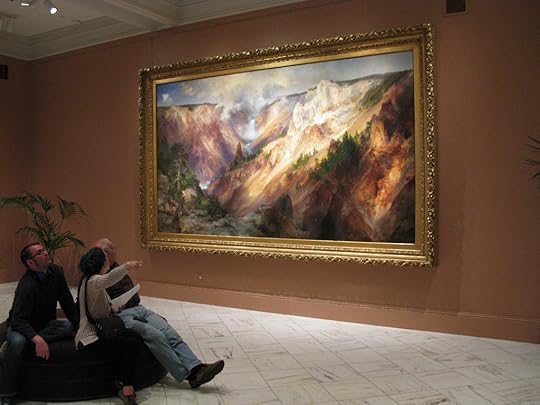
The Chasm of the Colorado (1873-74) by Thomas Moran National Portrait Gallery, Washington, DC
Page 328 (my book)
Years later I visited the same spot with my friend Thomas Moran. From this world of wonder he selected a section which was the most interesting to him and painted it. That painting, known as “The Chasm of the Colorado”… If anyone will look upon that picture, and then realize that it was but a small part of the landscape before us…The landscape is too vast, too complex, too grand for verbal description.
With all due respect to the very intrepid explorer, John Wesley Powell, this record of his travels is on the dry side – it is devoid of emotion and introspection.
There are a few pages that express exhilaration on what must have been a tremendous passage through these canyons. I have visited the southwest U.S. and the Grand Canyon, and can vouch for the overwhelming and staggering beauty of the land. The diversity and vastness of the landscape can literally knock the wind out of you!
This narrative may be of interest to one who is intimately familiar with the landscape and the Grand Canyon basin. The first part of the book (100 pages) is devoted to geographical descriptions. The second part (200 pages) is the Grand Canyon expedition; a significant portion of what he traversed has since been radically modified by Glen Canyon Dam. How much has the flora and fauna changed? The last part is a trip, taken at a later date, is to areas surrounding the Grand Canyon.
There are many encounters with different tribes. John Wesley Powell outlines some of the “rituals” performed. So the book also has an anthropological slant to it. Ancient ruins were often sited. Likely these ruins were pilfered over the years so now hardly exist.
Even though the book is almost 400 pages, half is taken up by sketches and reproduction of photos in my Penguin edition. Many are wonderful. But absolutely no credit is given! Who made the sketches, who took the photos? And sometimes these illustrations have absolutely nothing to do with the surrounding text!
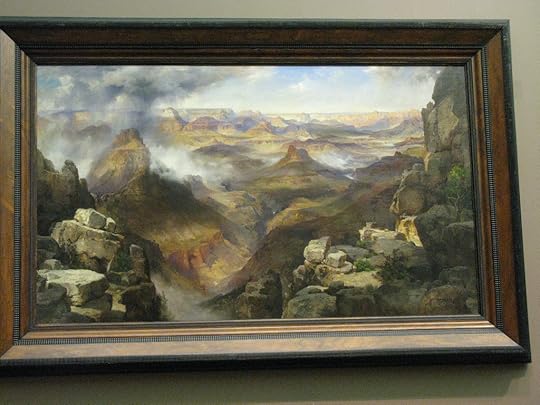
Philadelphia Museum of Art Grand Canyon of the Colorado River by Thomas Moran
I read this because I was planning a trip down the Colorado, and it was worth reading to learn about Wesley's expedition - his was the first group of "white" people to explore this territory and it was such a dangerous trip. So for those planning to do the Grand Canyon, I recommend it.
But his writing style is so ponderous (everything is in the passive voice) that I can't really recommend it just for reading if you are not planning to go there, unless you are into the exploration genre.
While reading this epic adventure, you are forced to remind yourself that John Wesley Powell had lost his right arm at the Battle of Shiloh. You have to keep reminding yourself, because I believe that he only references the fact once or twice, as he's scrabbling up sheer rock faces, and frantically paddling to keep his small boat free of boulders and cliff walls as it's careening through rapids. The entire mad expedition, to map the unnavigable Green River to its confluence with the Grand River, which form the even more unnavigable Colorado River, was made with no financial incentive, and was virtually unsubsidized. It was made simply to acquire knowledge of the region's geography. I had a few problems with this edition. The first problem is the book's first hundred pages, in which Powell gives an overview of the geography, ethnography, and archaeology of the Colorado River Valley: he should have had an editor. He jumps all over the place, up and down the river, from subject to subject. For a while you try to reread passages, then discover you're becoming motion sick, and just decide to put your head down and work through it, letting all of the facts wash over you; but at that, it's still a struggle. The book is lavishly illustrated, mostly with prints, but the illustrations are rarely congruent with the text you are reading, so they mainly serve as a distraction. And surely somebody at Penguin could have thought to append a couple of maps to this book? All in all, even with these minor annoyances, this is a journey I would recommend anybody to take (unlike the actual boat journey, which you'd have to be mental to take).
The first few chapters were a bit dry, but I really enjoyed the meat of his journal entries exploring the Green and then the Colorado rivers. He really inspired me to want to one day experience myself, in some degree, via the river. I read this book in tandem with a road trip to Lake Powell and the Grand Canyon and it really made several experiences come alive by having certain descriptions in my mind. I also really appreciated getting the back story on why they chose to name things the way that they did. It took me much longer than I anticipated to actually read the story because I was so often looking things up. His second trip to this area was less interesting to me, but I did enjoy some of the Native American mythologies he collected and found it so fascinating how the gospel stories shared by some of the early Spanish missionaries informed some of their stories. Overall, very glad I read.
The journals from John Wesley Powell going down the Colorado. Incredible stories, but also a whole lot of geology. I had trouble putting the places he was talking about down on the map inside my head as he was telling the story. So, kind of dry.
Pretty great. The whole thing is good... as an adventure story, as history, as a look at the geography and people of the Grand Canyon and environs circa 1870. The last chapter, ostensibly on the geology of the Grand Canyon, but also a poetic reminiscence by a one-armed Civil War veteran about the place he loved more than any other, is worth it on its own. I doubt there's another geological treatise quite like it.
...
I should add that the illustrations (photographs, drawings, and woodcuts dating from the 1800s) are fantastic. There must be over a hundred of them, depicting the landscapes, the geology, the native people, their homes, and their crafts.
What is it: a survey first and foremost, literary work second. ---- Why 3 stars: depending on what you're looking for, I suspect Powell's Exploration of the Colorado would be polarizing.
There are the briefest glimpses of Powell's skill as a writer, moments of bright prose on the page, as when he describes his team prepared for their survey "ready to measure mountains once more" or remarks upon the moon over the canyon as "a jewel set on the brink of the cliff, but as it moves out from the rock I almost wonder that it does not fall" or in leveraging consonance to image the river for the reader with "waters waltz their way through the canyon, making their own rippling, rushing, roaring music," or even a poetic remark on his own task as a geologist: "all about me are interesting geologic records. The book is open and I can read as I run."
And there are passages that are quite personal, intimate even, revealing of both Powell and the team of men who joined him on his survey, as in the humorous description of the hunter Dunn--"his raven hair falls down to his back, for he has a sublime contempt of shears and razors"--or in an insight regarding army lieutenant Bradley's temperament--"scrupulously careful, and a little mishap works him into a passion [...] a great difficulty or peril changes the petulant spirit into a brave, generous soul"--or a confession on reviewing the last months of the survey's difficult passage--"the memories of grand and awful months spent in their deep, gloomy solitudes come up, and I live that life over again for a time."
And narrative of the journey itself, perhaps what you'd most expect to find here, is present in certain passages. Descriptions of navigating rapids. A daring rescue of a boat loose in the rush of the river. Attempts to scale cliffs and canyons. Encounters with native tribes local to the regions traversed.
But the fact is that the vast majority of Powell's text is none of the above. The vast majority of Powell's text is a survey of the land. He's a geologist first and foremost, anthropologist of the native tribes almost by necessity, and he's writing this text as an extension of a report he provided the federal government and national scientific institutions regarding the land of the southwest around the Colorado River. So while you'll find moments as those listed above, you'll find them scattered among long stretches of relatively reserved, careful, methodical description of a long river passage through mountains, canyons, and deserts. In those stretches, Powell is generally quite intentional to keep his prose stable and unembellished, deliberate in noting times and distances, relating aspects of the survey team's experiences only insofar as they are relevant for how an assessment was made or a part of the landscape reached. Within these sections, too, there are brief analyses of the geologic processes that may have formed the landscape, but Powell seems reluctant even to go into much depth there. Instead, he seems content at least on the initial passage down the river, to observe and describe and save the analysis for later or for others, perhaps for the reader themselves, to conduct.
The reading experience isn't necessarily better or worse for what's described above. But it is inconsistent, or irregular. Powell's survey is of course an astonishing feat in and of itself, and to write a document of it that can encompass several aspects of why that survey would interest readers is impressive, but the juggling of those aspects leaves all of them feeling a little less important or impactful to the reader than they clearly were to Powell himself. ---- You might also like: going and visiting these landscapes yourself! A lot of the regions Powell journeyed through are recreation areas, state and national parks, or designated wilderness areas.
You definitely need to have just been to the region described in this 'travel journal' to fully appreciate it. The descriptions of the rocks are pretty lengthy and scientific, as Powell was a geologist. However it is a wonderful 'holiday' read if you've only just travelled through these places, and despite the dry science, Powell often waxes lyrical about the beauty of the wilderness. The conditions these men endured to charter the Colorado river are impressive. As is his enlightened view of, and communication with, the Native Americans. And he's funny! I loved this book, and would have loved to have known Powell.
The book deserves a 5 star rating for the adventure/accomplishment. But, only 1 star for the prose. So, "3" it is. John Wesley Powell was an amazing adventurer. many times I had to remind myself that as he was describing what he was doing, he never included the fact that he only had one arm. I'm still uncertain as to how he lived through this trip. Unfortunately, his writing is not on par with his other skill sets. So, the book is much less enjoyable than it could've been.
Although a bit dry, it is undeniably interesting to read the hardships the Powell's crew endured to explore the Colorado river. While it may be difficult to visualize some of the descriptive moments, it still left me yearning for a desert trip. The passages containing descriptions of the local native tribes, though highly ethnocentric, were also a fascinating bonus to read through, as they stood out from the physical geography and day-to-day journal entries.
Such a neat read! Actual diary log doesn’t start until page 134. Prior to that is a geographic description of the region, not too interesting. But the log itself of the famous 1869 Colorado river rafting journey is incredibly descriptive! Such amazing stories of this incredibly bad-ass explorer. The log ends on 287, and the rest is a quick description of his adventures in the same area in following years, lots of cool encounters with native Americans. The images are also worth noting…amazing!!
An interesting account of two explorations shortly after the Civil War. The geological sections can frankly be skimmed or even skipped for those who are not serious enthusiasts, but the accounts of the expeditions are interesting if somewhat sparse. The accompanying woodblock prints, often from photographs, are a little difficult to see in this printing.
I'm only reviewing it as an audiobook. The story was very interesting but I couldn't get past the terrible narration. Unfortunate because it's a great story.
There is a reason this book is classic of natural history.
I didn't think I was going to like it though. This book was written under a direct order from congress that threatened to pull JW Powell's funding if he did not write a book detailing for the general public the history of this historic trip to map for the first time, the course of the Green and Colorado Rivers and the Grand Canyon. The result of that direct order from congress is The Exploration of the Colorado River and Its Canyons. Written by John Wesley Powell, a maimed civil war veteran and geologist whose primary task in exploring the Grand Canyon and running the Green and Colorado rivers was scientific in nature. His plan was to map the canyon (the last unmapped portion of the contiguous US at the time) and take readings of canyon depth, rock type etc... There were some portions of the book that are dry--in that you get his descriptions of the rocks themselves and the height of the walls, the color and type of rock and so on, but this being the Grand Canyon, even the scientist is moved by the sheer beauty of the canyon. He is frightened by the seemingly never ending rapids. He has no idea if there is a major, non-navigable water fall around the next bend. He is concerned for the safety and the welfare of his men, and he is heartbroken when three of his men abandon the expedition (and are never seen again). He is mystified by many aspects of Native American culture and he is awed by their knowledge of the details of the canyon topography, their tracking, their ability to procure food. He is fascinated by their religion and he learns as much of their language as possible.
This book gets a 5 stars because if you want to plop yourself into the world of the Wild West and into the Grand Canyon in 1869, there is no better portal into that world than this book. Yes, it is true that there are a lot of readings from various devices used for measurements, but the prose is actually excellent in the parts where you are getting the author's thoughts, and it is a treasure to all of us that he shares those thoughts with the readers.
I am an outdoorsman that has backpacked and climbed throughout the Western US and the Northeast. I often wonder what were the thoughts of the first men native or others that set eyes on some of the wilderness areas I have traversed. John Westley Powell does exactly that by writing in vivid detail feelings and descriptions of the Colorado River Expedition.
In 1869, Powell set out to explore the Colorado River and the Grand Canyon. Gathering nine men, four boats and food for 10 months, he set out from Green River, Wyoming, on May 24. Passing through dangerous rapids, the group passed down the Green River to its confluence with the Colorado River, near present-day Moab, Utah, and completed the journey on August 30, 1869.
Powell was a scientist, geologist, and Civil War veteran whose right arm was shot off by a cannonball; he was the man who named Glen Canyon, and the man Lake Powell was named for. He didn't worry about all the details like a knowledgeable crew, funds, both arms, having an experienced crew, not knowing if there was a Niagara-sized waterfall around the next bend or not, and so on--he just went. He and his crew paid for their inexperience by nearly drowning, nearly starving, and by misadventure after misadventure but in the end, most of their group emerged from the southern end of the Grand Canyon with stories, experiences, and first-hand knowledge of a part of the world that few people had ever seen before.
Three of the crew left the expedition and their fate is in dispute. Either killed by Indians or Mormon's being mistaken as Federal Agents at the height of the Federal Government's pursuit of Mormon leaders.
If you are interested in the geology, ethnology, and exploration of the American West you'll enjoy this book by the one-armed civil war veteran John Wesley Powell. What I found particularly amazing was JWP's detailed geologic explanations in the first few sections. It shows what a memory the guy had as well as his ability to take great field notes despite the growling stomach and constant threat of death. If you don't care at all about rock formations, then skip the section on geology and enjoy the adventure story and history lesson that follows. It's well worth it. My only gripe is I wish he would have spent a few more sentences on his travel companions.
This book, published in 1875, is the travel journal of John Wesley Powell, a professor of geology at a small college in Illinois. It tells his story of two trips through the canyons of Colorado River in the 1860s and 1870s. It is no literary masterpiece but Powell does rise to feats of descriptive beauty from time to time as he relates the adventures of his 9 person party boating down the Colorado. The man had uncommon stamina and courage. A civil war veteran whose arm was amputated after a battle wound, he pushed, pulled, rowed and climbed his way down a visciously dangerous river valley at a time when adventure gear was primitive to say the least. I bought the book at a gift shop near Bryce Canyon Utah during a trip through some the National Parks. I had walked along the south rim of the Grand Canyon in Arizona; rocks were on my mind and this book seemed to offer a unique view of the geologic history of what I was seeing daily during drives and hikes. Powell vividly describes the country he explored and the hardships and perils his team faced. He records a few fascinating and largely sympathetic (for a white man of his time) visits with the native people of the area. Considering the river stretches he ran in his wooden row boats, we are lucky he lived to tell the tale: there are several incidents along the trail where he could easily have died. Here is one lovely passage that struck me as a glimpse of a lost time conveying a sentiment close to what I have heard some First Nations people say about the land. Powell has climbed up the canyon into a valley running into it. "The little valleys above are beautiful parks; between the parks are stately pine forests, half hiding ledges of red sandstone. Mule deer and elk abound, grizzly bears, too, are abundant; and here wildcats, wolverines and mountain lions are at home. The forest isles are filled with the music of birds and the parks are decked with flowers. Noisy brooks meander through them; ledges of moss covered rocks are seen; and gleaming in the distance are the snow fields and the mountain tops are away in the clouds". You can almost feel a breeze on your face and smell the pines. This is not a book with a compelling plot that demands attention. Rather, it feels more natural to dip into a few days of travel, put the book down and come back later to pick up the thread of the tale. I am not sorry I read the book but it was a bit slow and repetitive at times. Not for everyone.
One armed Civil War veteran and geographer/scientist/anthropologist floats the heretofore unexplored and unmapped canyons of the Colorado/Green Rivers on wooden boats in 1869. There is adventure galore here, although it is sometimes understated: canyons roaring with spring runoff, the mammoth rapids of a truly untamed river, flash floods, the specter of starvation, and the constant fear about what might be found around the next bend of the canyon.
Descriptions of the scenery and overall lay of the land are unbelievably accurate and reveal Powell's attention to detail and grasp of the geologic process. The book starts with a few chapters explaining the geography of the ENTIRE Colorado/Green River watershed, from the mountains of Wyoming and Colorado all the way down to Mexico (encompassing lands of 7 states). These descriptions are fascinating and detailed, and amazing considering the fact that Powell had no access to satellite images, good photos or even maps of much of that land, yet he lays it all out accurately.
Chapters at the end detail additional explorations of the region a year later and offer first hand accounts of the Ute, Hopi, Zuni and other tribes...again, very detailed source material offered up by someone who is paying close attention to it all.
If you've spent time in the southwest, and especially if you know a bit of geology, this book is amazing. If not, then this book will paint a good picture for you but will, at times, probably be a bit hard to follow, although the illustrations are helpful.
The story of the 1869 expedition down the Colorado River of John Wesley Powell and his crew is quite gripping. He started from what is now Green River, WY, and ended up in what is now Lake Mead, AZ at the confluence of the Virgin River and Colorado. The party started with 10 months of supplies, assuming they would have to winter over somewhere, but ended up 3 months later with almost nothing. They lost two of their four boats to the river. Along the way, Powell and his men were able to make scientific measurements of the geological features of the area. There are several accounts of him climbing to the top of the canyon walls (he only had one arm, having lost the other in the Civil War) to measure the height above the river. In some of these, he almost loses his life by getting trapped high up on cliff.
I really enjoyed the description of the expedition, but that is only about half of the book, pages 117-287. The beginning is a relatively dry description of the country of Colorado, Utah and Arizona. The last part is about some further expeditions Powell undertook among the Indian tribes still living in the regions. Powell clearly had a great love for these tribes and their customs and lifestyles. These first and last sections showcase Powell’s talents as a geologist and ethnographer, but do not make as gripping a tale as the river expedition.
John Wesley Powell, one handed explorer, gives a dry description of his adventures in his notes that were published because of the lack of exploration of the geographic areas where he ventured to. Does it mean he is a great writer? Probably not so much. Is he a pioneer in his own right. I agree with this statement. I definitely felt that English is my second language while reading this book. For the first time since forever I had to look up words in the online dictionary. It teaches you verbal humility and probably sparks ones interest in learning (of not lazy enough to search). Two things made this read interesting for me. First thing first is my visualization of what he describes and what I have seen with my own eyes during the trip. It took me back to the full day of hiking to the Colorado river and back, hours of exploration and admiration for the nature. Second thing that helped me to finish the book faster is the description of Native Americans, their traditions, myths, and ways of life. The part about Native American tribes' cultures, even though author's feeling of superiority was sensed throughout the book, pushed me to learn more. Anything that motivates for discovery is priceless in my opinion.
After reading "The Exploration of the Colorado River and Its Canyons" by John Wesley Powell, I view the book more as a priceless historical reference than a casual read. I think this is confirmed by Powell's long reluctance to publish a popular narrative of his pioneering transit of the Grand Canyon on the Green and Colorado Rivers. Powell never claimed to be a popular writer. He was intensely interested in the geology and geography of the Canyon and the entire Southwest, as well as the native inhabitants of the area. The writing is dry and humorless. But Powell's love for the Grand Canyon comes through strongly: "The wonders of the Grand Canyon cannot be adequately represented in symbols of speech, nor by speech itself. The resources of the graphic art are taxed beyond their powers in attempting to portray its features. ... The elements that unite to make the Grand Canyon the most sublime spectacle in nature are multifarious and exceedingly diverse." For anyone preparing to visit the Grand Canyon or float the Colorado River, I would think Powell's book would be one among a handful of excellent books to read prior to a visit. But it is not a book to curl up and get lost in.
I love the eloquence with which this is written. “We have an unknown distance yet to run, an unknown river to explore. What falls there are, we know not; what rocks beset the channel, we know not; what walls rise over the river, we know not” (p. 247). Powell opens with a survey of the general features before collecting his notes into a narrative of the journey down the River. The last portion covers some details of returning to the region in the next year after they had to give up the journey but focuses more broadly than recounting each canyon through which they passed. Powell’s writing does reflect the Manichaean-esque belief of civilized versus savagery that sometimes surfaces when he describes how the native groups of the area live, but his writing also feels honest and enthusiastic about learning about these groups.
I believe I have followed this trip in its entirety from Flaming Gorge to the Grand Canyon; albeit, I have done so by car on different trips. I enjoyed revisiting the brutally desolate yet exhilarating stimulative region which fascinated me to no end. Powell concludes his survey of the area with what I must say is one of the most beautiful love letters I have read as he describes the Grand Canyon; it was truly a masterpiece.
I enjoyed reading John Wesley Powell's chronicle of his first journey down the Colorado River through the Grand Canyon, in preparation for my own trip to the Grand Canyon later this year. The first 100 pages of this book are a description of the various geographical features of the American Southwest (with drawings and photos but no maps!), but things get truly interesting when Powell starts detailing the journey. Powell's recollections were made after the fact, and are more focused on the scientific knowledge they are trying to accumulate as they go than on the day-to-day drama of a perilously under-resourced group of men undertaking an insane expedition, but this is nevertheless an engaging read. Unfortunately there are a few disconcerting passages regarding Powell's racist perceptions of the American Indians he encounters, but he does attempt to understand (and relay to his readers) the cultures and lives of the current and historical indigenous people in this area of the country. From a historical perspective, especially considering how much our relationship with this area has changed in only 150 years, I highly recommend The Exploration of the Colorado River and Its Canyons for anyone interested, or anyone traveling there themselves.
Really cool to read about the first exploration of this region by the white man from the man himself. John Wesley Powell is a badass. I kept forgetting he was missing an arm because he never lets that hinder him. Dude literally climbed cliffs and paddled through rapids that have killed plenty of able bodied people. Thought the book was formatted a little weird. Love the pictures but a lot of them didn’t really fit. Lots of Zuni Pueblo pictures in chapters that have nothing to do with it. And most of the pictures didn’t have a paragraph or sentence break to view them. There is also some interesting views of Native Americans. Like he thinks some tribes are more “civilized” than others. But hey, at least he felt they had a right to exist in this land, unlike most other people of the time like Roosevelt. Thought the descriptions at the beginning and the end of the Colorado River were cool but could have been organized better. Just kinda all over the place. It is fascinating though, from a Coloradan, that all these places used to have different names when the Colorado River was the Grand River. Glenwood Canyon was Grand River Canyon??? Really interesting historical read though. Classic of American, especially Western American literature. Makes me want to plan a raft trip.
Not sure what to rate this one. I am fascinated by the subject matter, but I was bored by a lot of the details especially the first four chapters. They thoroughly detailed the geography of the south-western United States, and were very slow. Overall the book had a fair bit of monotony, and I listened to the audiobook on Librivox, and sometimes I had a tough time paying attention to the volunteer readers.
I read the book after rafting on the Colorado this spring through Cataract Canyon. Powell's journey was incredible and it was cool to hear him talk about all these places in Utah where I have been or where I have seen on maps, or how the Bright Angel trail in the Grand Canyon got its name. I thought the journey was kind of amusing, it seemed like every day they lost an oar, or lost some food, or their flour got soaked. I thought the theatrical presentation the Native Americans put on towards the end of the book was fascinating.
I would recommend this book if you are interested in some of the wilder parts of Utah and Arizona, but other than that I'm not sure I would.
I am so happy I was able to read this book, thanks to a friend for sending it over!
The first part of the book goes into depths summarizing the type of landscapes in and surrounding the Grand Canyon area. Powell does not start talking about his journey until after around 100 pages in. The first part were filler, to me personally, but the art that fills those pages (and the whole book) is incredibly beautiful and helps the reader start to visualize just what these brave men experienced.
As a lover of the desert and the southwest, it’s inspiring to think about what these places once were, before they were dammed up and civilized. Seeing the Grand Canyon from up top is amazing in and of itself, but to travel through its entirety and experience the anxiety, excitement, and unsettlement is wild to think about.
That said, near the end of the book, I was ready for it to be over. Powell was a wonderful writer, but after awhile the words became dry, and I found myself feeling like it was redundant.