

What do you think?

The Last Centuries of Byzantium, 1261-1453
The Byzantine empire in the last two centuries of its existence had to rebuild itself after its conquest and dismemberment by the Fourth Crusade in 1204. Its emperors in exile recovered Constantinople in 1261 and this book narrates their empire's struggles for survival from that date until its final conquest by Ottoman Turks in 1453. First published in 1972, the book has been completely revised to take account of recent scholarship. It remains the best synthesis of the political, ecclesiastical and historical events of the period.
496 pages, Paperback
First published September 1, 1972
About the author
Donald M. Nicol
17 books23 followersDonald MacGillivray Nicol was an English Byzantinist.
Ratings & Reviews
Friends & Following
Create a free account to discover what your friends think of this book!
Community Reviews
Displaying 1 - 10 of 10 reviews

Read
April 14, 2014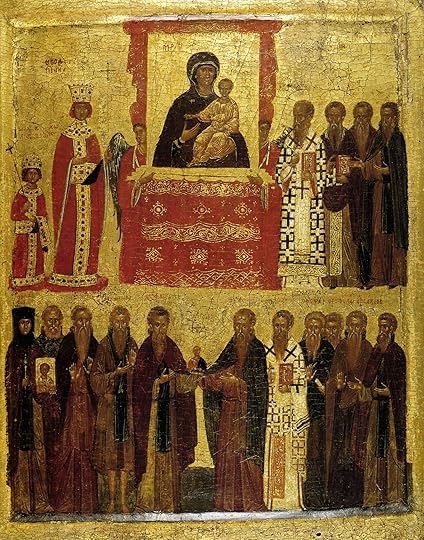
Late Byzantine copy (c. 1400) of lost Byzantine icon commemorating Empress Theodora's victory over iconoclasm
Constantinople's swan song: the final two centuries of the fabled city's long, long history, from the time it was recovered from the "Latins" till when the gunpowder and cannon of the Turks had grown too powerful for the massive but ancient city fortifications to withstand. Thereafter, it remained a great city serving as the capital of the Ottoman Empire, but more than just its name was changed.
Donald M. Nicol begins The Last Centuries of Byzantium, 1261-1453 (second, revised edition 1993) with a brief recounting of the fall of Constantinople to western European "crusaders" in 1204 and a summary history of the brief existence of the Latin Empire of the East. This Latin empire produced some very interesting hybrids, particularly the Frankish kingdom of the Morea whose cultural influence on the renascent Greek Byzantium was significant (but I've discussed this in earlier reviews). After the fall, the Greek resistance disintegrated and then reformed about three essential condensation points - Arta (in the Epiros), Nicaea and Trebizond, all of whom proclaimed their own "Emperor of the Romans". (Actually, Trebizond didn't quite: their rulers were called the Grand Komnenoi, but then Trebizond was exceptional in many respects.) Nicol's second chapter describes how the Nicaeans ultimately dominated their rivals and recovered Constantinople in 1261 under the leadership of Michael Palaiologos. This complex story is further complicated by the alliance of some of the Greeks with the Latins against the other Greeks (with the former abandoning their Latin allies on the field of battle!) and the alliance of the Genoese with Michael against the Latins (primarily Franks and Venetians) in Constantinople.(*)
But how is it that an empire, which according to most historians of medieval Europe consisted of an hypertrophic head on a weak, spindly body, survived this decapitation and even experienced a cultural flowering? Nicol does not even ask this question, and in view of his title, which signals that he is primarily interested in the history after the Latins were ejected from Constantinople, one can hardly hold it against him. Judith Herrin does ask the question, but only hints at the answer(s) in her enthusiastic popularization.(**) Clearly, the mentioned view is wrong - as important as Constantinople was to Byzantium, the empire was not quite as centralized as I have seen it represented. In the provinces it had the educational, military and cultural resources to generate, in a very short span of time, three new capital cities, all with administrations, courts, etc., that were smaller copies of those in Constantinople and then give the boot to the interlopers, towards whom the people of Byzantium bore a deep resentment, not least because the Latins tried to change their religion and customs.
The Greek "Empire of the Romans" was thus re-established, and the customary up-and-(then mostly)-down history of Byzantium recommenced with the usual internecine conflicts and wars with its neighbors. Epiros and the Morea had to be reconquered from the Latins and rival Greeks,(***) the meddling and plotting Italians and Franks had to be shaken off, and, as usual, the Bulgars, Slavs and Turks had to be dealt with.
Of particular interest to me throughout the history of Byzantium are the multiple attempts made by Byzantine emperors under especial pressure to forge a reconciliation with the Pope in order to obtain some help from the Latins. Even if a pope were willing to compromise (rarely the case), the task was made nearly impossible by the purists on both sides. On the rare occasions such a reconciliation was attained, both the pope and the emperor were made to pay.
The new emperor, Michael VIII Palaiologos, had more motive than most for reconciliation, since the Latins still held a large portion of his empire and were preparing a new crusade against the Greeks. An agreement of union was made at the Second Council of Lyons in 1274, which ended the preparations for the crusade but did not stop various Western aristocrats from carrying on the war against the Greeks anyway. Michael had to depose two patriarchs before he could find one to support the agreement, and he put a significant fraction of his own family in prison because they, too, disagreed. He became the target of vitriolic attacks - first verbal and then more dangerous kinds - in the East, but the purists in the West were not satisfied and demanded more and more "proofs" that he was implementing the agreement.(4*) The pressures from both sides induced the Emperor to commence what a contemporary historian called a reign of terror. Nicol, leaning on that historian (Giorgios Pachymeres) and other evidence, argues that though Michael VIII bought himself some time to regain some of the empire in the short run, the bribes and special arrangements he made with the Italians and this "union" with Rome ultimately ruined the Byzantine economy and envenomed the attitudes of the Byzantine people against the Latins to the point that it was 50 years after Michael VIII's death that a Byzantine emperor could even mention the possibility of a reconciliation with the West.
In the face of its many enemies and the growing power of the Ottoman Turks, it was a miracle that Constantinople survived for nearly two more centuries. In the 14th century there was a cultural flowering in the doomed city which yielded colorful blooms of literature, art and architecture - such as the gorgeous painting imaged above and the Three Medieval Greek Romances I discuss elsewhere - which we can still enjoy and admire.
In 1354 a massive earthquake destroyed the entire coastline of Thrace, along with the fortifications of all the cities there. The Turks just walked right in. Constantinople was soon a Greek cork bobbing on a Turkish sea. The Emperor became the Sultan's vassal and was even obliged to help the Sultan in his mopping up actions against other Christians in the Balkans and Near East. Despite armed resistance and desperate diplomatic efforts which included lengthy, repeated attempts to reconcile the eastern and western churches, ever so briefly (once again) successful in 1439, the inevitable occurred on May 29, 1453. The final "Roman" emperor, Constantine XI Palaiologos, was last seen on the city walls. His body was never found, and the Greeks say that he waits within those walls for the day that Byzantium will again rise...
(*) The Genoese were in a war against the Venetians, who were the primary instigators and beneficiaries of the fall of Greek Constantinople during the Fourth Crusade. This alliance was fateful, as it resulted in two Italian leeches draining the economic blood of the Byzantine Empire until it was too weak to resist the Turks. (Actually, there were at least three - the Pisans soon joined in the feast.) In the event, the alliance proved to be unnecessary, because Constantinople fell into the hands of one of Michael's generals - the aptly named Strategopoulos - almost by accident. Learning that the bulk of the garrison was raiding with the Venetians in the Black Sea and also of a weakness in the defending system of walls, he sneaked in his men and had the city in his power within a day. The last Latin emperor, Baldwin II, was so surprised that he wasn't even able to save his crown and sceptre during a hasty escape to a Venetian-held island.
(**) For those looking for a popularization of Byzantine history which is heavy on anecdotes, illustrations and culture while much lighter on details, dates and analysis than one would expect from an impeccably academic expert (she writes in the introduction that she is trying to answer the question "What is Byzantium?" posed to her by two workmen curious about what the hell she did), I would like to draw your attention to Judith Herrin's very readable overview Byzantium: The Surprising Life Of A Medieval Empire, whose very title signals the target audience.
(***) Trebizond maintained a kind of independence and was still standing after Constantinople fell to the Ottomans in 1453. Trebizond was the last remnant of the "Empire of the Romans" to succumb. As one learns in Anthony Bryer's The Empire of Trebizond and the Pontos, this was due to very special circumstances in the Pontos, circumstances which subsequently assured the survival of Pontic Greek culture till the beginning of the 20th century, when the failure of the Greeks' Asia Minor campaign of 1919-1922 resulted in the forced emigration of nearly all Greeks out of Turkey.
(4*) Sounds familiar, doesn't it?
Rating
http://leopard.booklikes.com/post/110...
May 12, 2012
I was required to read this for class, otherwise the price of the book (around $50) would have been prohibitive. However, I was in for a pleasant surprise. This is by far one of the most riveting history books I've ever read, added to the fact that even its price suggests that it was not for the general reading public. Scholarly books are not made to entertain, and entertaining history books are known to dumb the material down. But the prose in here is clear, arresting and does a great service to the study of Byzantium, fully delineating the complexities of the events that followed the recovery of Constantinople in 1261. I still cannot recommend this to the general public unless you know a thing or two about Byzantine history and bear with the sad, pathetic decline of this once-great state, because alas, there are cheaper histories out there for the interested layman. If you can get hold of a library copy, though, go for it. Byzantine history is highly underrated and many influential primary sources untranslated into English, and you might just fall in love with this unjustly ignored segment of history.
January 30, 2019
Great read on the dramatic final two centuries of the Byzantines. A somewhat dense book that reads easily owing to a smooth writing style that does not often find itself hung up on minor details or historiography, i.e. suited to the layman. This is for the best as the era itself is dramatic enough to simply let the material shine through, which Nicol does. Includes a good treatment of the 1204-61 exile period and the Nicaean-Epirote competition to 'inherit' Constantinople as well.
Only thing I would improve: would have been nice to have a little more on how exactly Asia Minor totally slipped from the Empire's grasp, but a minor gripe. Well recommended.
Only thing I would improve: would have been nice to have a little more on how exactly Asia Minor totally slipped from the Empire's grasp, but a minor gripe. Well recommended.

April 9, 2020
A great book, although the author seems a little confused about the title (he starts in 1204 and alludes to the fact that is when the book starts in the end, rather than the 1261 in the title), and there are an annoying number of spelling mistakes (Ocrober, Feburary, Euorpe, etc.)

November 8, 2023
Nicol focuses on the denouement of Byzantine history. This is a period when the empire was past the point of no return and was living on borrowed time. There is a deep sense of dread and foreboding as the years inch closer to 1453. It is a tragically pathetic final chapter in Roman history.

October 11, 2024
Nostalgic and sad. No one wrote Byzantium like Nicol.
April 29, 2025
Buku yang menceritakan abad terakhir kehidupan Kekaisaran Romawi. Bacaan yang ngenes dan bikin elus-elus dada. Menurutku ini buku yang sangat detil sih, kalo memang gak tertarik secara khusus ke Kekaisaran Romawi mending jangan dulu. Lebih baik baca yang lebih general & introductory, baru kalo emang masuk baca nih perang saudara, kudeta, kaisar ngutang, perang salib & Turki di sini.

July 22, 2014
Excellent book about the last and turbulent centuries of the Byzantine Empire with a lot of details and vivid memories. Fully recommended.

December 3, 2014
One of the first books that made me a History lover. It's very readable even though it covers a lot of subject area, and really conveys the tragedy of Byzantine collapse.

October 1, 2014
Very dense, but without a doubt one of the best books on the topic in English.
Displaying 1 - 10 of 10 reviews