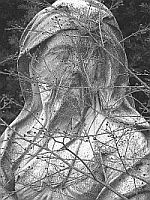
Ariadne's Thread takes the reader from the evidential basis of the Minoans in history, through to a reconstruction of their possible spiritual beliefs relating to the Great Goddess - Ariadne and her many faces; the second part of the book provides a practical and beautifully written collection of Minoan style rituals, from seasonal events to rights of passage, for the modern practitioner.
This is a book of two halves the first being founded on archaeological interpretation of the evidence - Linnear A, the script of the Minoans, remains a mystery to archaeologists to this day, so for now, the Minoans cannot speak to us directly. Hence since the discovery of the 'palaces' of Knossos and Phaistos et al by the Victorian archaeologist Sir Arthur Evans, the ruins and frescoes have been subject to the prevailing ideas and prejudices of the dominant culture. Initially chauvinistic, imperialistic Victorians who saw martial palaces run by macho kings, later by more feminist interpretations.
Perry argues strongly for the interpretation of Minoan culture as a peaceful mercantile society ruled not by kings, but by a clergy: both male and female, which created a more balanced and equal society. The focus of this society, she argues, was the Great Goddess or Ariadne (and the many faces of Ariadne: Rhea etc). 'Palaces' are reinterpreted as temples in which priestesses/priests and community gathered to engage in a very personal relationship with the goddess (the priestess and priest actually becoming the deities for the duration of the rituals). I found Perry's interpretation very appealing but perhaps that was the flaw. She succeeded in creating an almost idealised, if not matriarchal, then certainly female oriented society where men and women were equals. However, I am not so sure that simply because the presiding deity was female that necessarily equates with equality amongst the sexes.
Perry carried out a lot of research for the historical section of the book, which for anyone wishing to embark on the spiritual path of Ariadne and the Minoans is vital. However, I think that this section of the book would have benefited from footnotes to allow the reader to understand how the author drew her conclusions, and perhaps follow-up with some independent research of their own.
Perry provides a very comprehensive guide to the deities of the ancient Minoans and their associations with later Hellenized Greek gods - and even finds parallels within the Celtic tradition all of which is extremely helpful. My one bug-bear here is that there is an awful lot of repetition throughout this section: the story or Rhea's milk spurting out to create the Milky Way, and Romulus and Remus and the Wolf, being cases in point. Granted this repetition does mean that by the end of the book you have pretty much memorised large chunks of the Minoan Pantheon, nevertheless it was also a tad irritating.
The second part of the book concentrates on the practical aspects of carrying out Minoan-style rituals. Perry clearly explains that because the archaeological evidence does not tell us what went on during actual Minoan rituals, the ceremonies within her book are not Minoan, but Minoan-style. This is an important distinction, the rituals are a modern interpretation of ancient traditions and draw on some familiar neo-pagan ritual practices; however this does not diminish the power and beauty of the ceremonies and rituals that Perry presents. At times her writing is almost lyrical and her passion for the healing nature of Ariadne and her practices shines through the whole book. Some of the rituals do suggest a lot of preparation, access to (private) open spaces and the participation of numerous individuals so may not be practical for solitary practitioners or those who do not have easy access to open spaces.
Although this book could have done with less repetition and a few more historical notes, it was an enjoyable read and contained a wonderful, if idealised, interpretation of the ancient world of the Minoans and their lost religion of the Great Goddess; as well as offering a practical guide to experience those rituals and connecting with Ariadne, the Great Goddess herself.