This classic volume introduces the mild-mannered Dr. Donald Blake and his amazing alter ego, Thor, the Norse God of Thunder! Through the course of these awesome adventures, the Asgardian Avenger battles everyone from the Stone Men of Saturn to the Radioactive Man to his own half-brother Loki! Collects Journey Into Mystery #83-100
Stan Lee (born Stanley Martin Lieber) was an American writer, editor, creator of comic book superheroes, and the former president and chairman of Marvel Comics.
With several artist co-creators, most notably Jack Kirby and Steve Ditko, he co-created Spider-Man, the Fantastic Four, Thor as a superhero, the X-Men, Iron Man, the Hulk, Daredevil, the Silver Surfer, Dr. Strange, Ant-Man and the Wasp, Scarlet Witch, The Inhumans, and many other characters, introducing complex, naturalistic characters and a thoroughly shared universe into superhero comic books. He subsequently led the expansion of Marvel Comics from a small division of a publishing house to a large multimedia corporation.
When Dr. Donald Blake strikes his cane upon the ground, he becomes Thor, God of Thunder!
Marvel Masterworks: The Mighty Thor, Volume 1 contains the Thor stories from Journey into Mystery #83-100. I nabbed this for around $20 after compulsively watching it for a year or so.
I'm not going to sugar coat this one. Jack Kirby's art was the best part of this and it's not Kirby's best work. Not only that, only about a third of the book features Jack Kirby's pencils. The rest are by Joe Sinnott, Don Heck, and Al Hartley. While Sinnott's art is up to the task, the Al Hartley issue has terrible art and Don Heck's issues are lackluster.
The Tales of Asgard segments near the end of the volume hit at future Thor greatness but the stories flounder before then. Other than Loki and Radioactive Man, Thor's enemies seem beneath him. You don't use a shotgun to kill a mosquito, after all. I like a snake-themed villain like Cobra but for Daredevil, not for a demigod. I'm not even going to get into Carbon Copy Man or the Stone Men of Saturn.
I get the feeling Stan Lee said "How about a God for a main character?" and didn't think much beyond that. Aside from the Tales of Asgard segments, these are pretty pedestrian super hero stories for the time period, complete with the unrequited love between Donald Blake and Jane Foster.
I'm giving Marvel Masterworks: Thor volume 1 a 3 but mostly because of the Jack Kirby art. This volume nicely illustrates how the Marvel Universe probably wouldn't have survived the early years without the contributions of The King.
Ein enttäuschendes Wiedersehen. Vor allem in den ersten Heften ist die Handlung extrem dünn und macht wirklich überhaupt keinen Spaß, und selbst Kirbys Artwork fällt schwach aus. Schwer zu glauben, dass THOR trotz des schwachen Beginns es bis heute geschafft hat. Aber die Reihe war eben Teil des Marvel-Sogs, der die Comicwelt der frühen 60er erfaßt hatte. Egal ob Fantastic Four oder Spider Man, Avengers oder Hulk, nach heutigen Standards waren Figuren und Handlung nicht durchdacht. Man ging nicht davon aus, dass man sich eines Tages Gedanken um continuity machen müsste, weil die Heftreihen die Jahrzehnte überdauern würden. Die Hefte richteten sich an jugendliche Leser, da kam es auf Logiklöcher und seltsam agierende Protagonisten nicht an. Im Unterschied zu den anderen Reihen finde ich aber, dass THOR weniger Charme hat, da hilft auch meine Retro-Reise nichts.
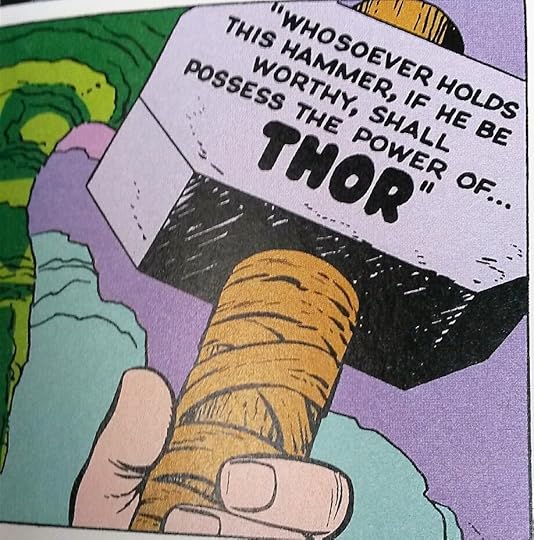
Ein kleines Gedankenspiel regt Donald Blake trotzdem an. Er findet einen knorrigen Stock, der sich in Thors Hammer verwandeln kann. Auf dem Hammer findet sich folgende Inschrift:
Es gibt hier also keine geheime Identität im eigentlichen Sinne, Blake und Thor scheinen nicht identisch. Nur die "Macht" von Thor soll sich auf den Würdigen, also den veranwortungsbewußten Arzt Don Blake, übertragen.
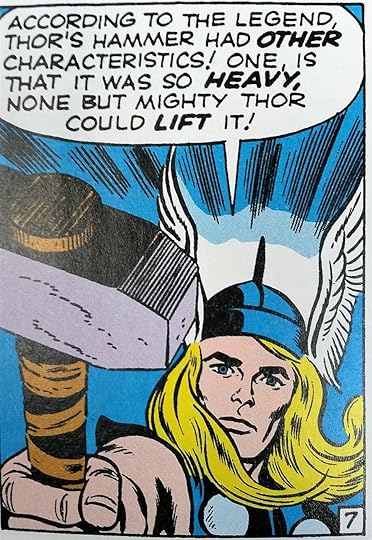
Zugleich kann aber nur Thor selbst den Hammer anheben:
Ein so unbeabsichtigtes wie herrliches Paradox! Praktisch allerdings, dass Don Blake schon am Stock ging, bevor er den Knüppel fand, der sich in den mythischen Hammer verwandeln lässt. So hat er künftig Mjölnir immer griffbereit, ohne dass es auffiele. Wer ist überhaupt Thor, wo befindet er sich? Und wie kann sich Blake, wenn er sich in Thor verwandelt (seltsam, nicht wahr?) an Asgard erinnern? Später wurde dann an diesem Konstrukt herumgeschraubt, um es sinnhafter zu machen, aber dieses Paradoxon schien mir noch das Interessanteste an den frühen Thor-Heften.
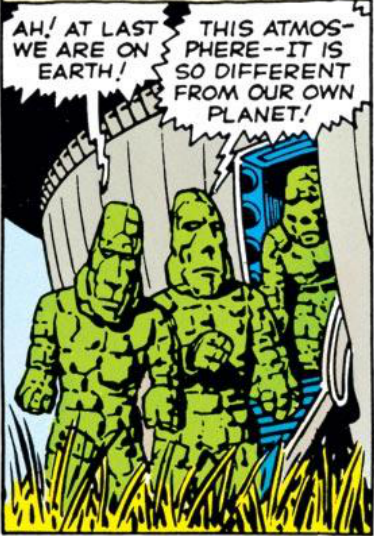
In seiner neuen Identität (?) als Thor muss Don Blake (kein alliterativer Name, was war los, Stan Lee?) gleich mal eben die Erde gegen die Steinmonster vom Saturn retten. Die sind auf der Erde mächtig stark, nicht etwas, weil die Gravitation geringer wäre, sondern: "On Saturn, we are mighty beeings. But here, in this oxygen atmosphere, our strength is even greater!" Aber Thor macht kurzen Prozeß mit ihnen und die Erde ist bis zur nächsten Woche gerettet.
First off, I am a fan of the Marvel Masterworks series and generally enjoy the cheesy goodness that Marvel’s early comics bring to the table. So it is with a heavy heart that I must saddle poor Thor with one measly star. But this was pretty rough. Stan Lee and Jack Kirby only teamed up for one of the 18 issues included in this collection, and the series suffered in their absence. The writing is generally uninspired, the plots repetitive, and the villains mostly yawn-inducing. There is a lot of Loki in this collection, possibly because the writers were having real trouble coming up with other memorable foes. They certainly didn’t strike gold when they rolled out The Rock Men of Saturn:
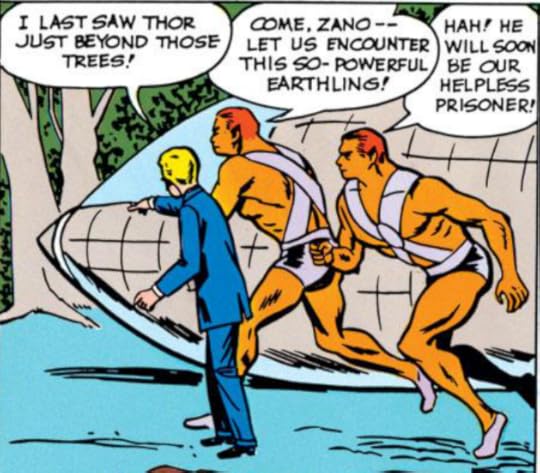
“Now wait just a darned minute!” you may exclaim. “Those losers are from the first issue! It gets better from there!!” First of all, calm down! But also it really doesn’t. If Thor’s not tussling with Loki, he’s generally either thumping commies, busting two-bit hoodlums or defending earth from speedo-wearing alien warriors:
When Thor is not busy saving mankind from these dire threats, he is usually trying to sleep with ”get with” his assistant. Suffice to say this will-they-or-won’t-they tale did not have me on the edge of my seat. Really, the reason to read this collection is the novelty factor: these are the very first Thor stories. If you are a fan, you will at least find these issues to be interesting, if not enthralling. Personally I find the whole Thor thing very confusing. At least in this first version of the story, Thor is “created” when some random guy comes across a magic stick (and even this is inconsistent…later it is revealed that only particularly heroic humans receive the gift of immortality, and what’s so heroic about fleeing from the stupid rock people). Then, Odin starts treating Dr. Blake, AKA Thor, as his own son. Which in itself is weird…Blake and Thor are clearly the same person, sharing the same consciousness, and Blake is not Odin’s son so that really makes no sense.
But even more brain-blowing is the fact that, for all intents and purposes, Thor is a god. A god! In the Marvel Universe, it becomes pretty clear to mankind that the Norse pantheon is very, very real and that the Scandinavians had it right all along. In my opinion that would be about the most massive event to happen on planet earth in some time. For one thing, it would effectively disprove any religion that maintained there was one (and only one) god…including a rather famous religion that starts with a C. For another, you’d think people would be flabbergasted by this. There is a guy running around the city who has all the answers! He ascends to heaven regularly! But the dullards of the Marvel Universe are only interested in how Thor can help them minimize street crime and take care of petty thugs. What a waste! And is this really godly behavior? Marvel, I am willing to suspend belief and accept radioactive spiders and adamantium skeletons and all sorts of crazy shit. But I cannot accept that people just putter on, business as usual, when the curtains are pulled back and the mysteries of the heavens are unveiled.
Anyway, my ravings aside these stories simply aren’t very good. I suspect that even most Thor fans would find this collection to be a slog. 1.5 stars.
Šie metai man yra komiksų metai. Pasiėmiau vieną, antrą ir įsitraukiau. Vienas iš pirmųjų į rankas pateko komiksas apie Thorą. Filmų apie jį nežiūrėjau, komiksų iki šiol neskaičiau. Žinojau tik tai, kad tai vyrukas su dideliu kūju. Tai va, šis komiksas yra Thoro pradžių pradžia. 1954 metais pradėti leisti komiksai apie šį herojų. Ir šioje knygoje dvi dešimtys pirmųjų istorijų. Kas pasirodė įdomiausia? Istorinis fonas. Šiame komikse turbūt kaip jokiame kitame jaučiamas istorinis laikmečio pulsas. Pats Šaltojo karo įkarštis. Thoras veikia aplinkoje, kurioje blogio pusėje yra raudonasis komunizmas, žmogėdriškas Kubos vadovas, blogieji kiniečiai. O jei kas nors nutinka bloga, į pagalbą tuoj pat atlekia šauniosios NATO pajėgos. Ir, aišku, Thoras, kuris išgelbės ir paprastus gyventojus, ir tuos pačius šaunius NATO vyrukus. Labai įdomu skaityti šiuos komiksus būtent iš istorinės pusės. Nes nei scenarijus, nei piešimo stilius šiais laikais neatrodo įspūdingai. Ai, ir dar patiko komikse vaizduojamų personažų ir pašalinių veikėjų šukuosenos ir apsirengimas. Puikus retro.
On vacation in Norway, American doctor Donald Blake becomes trapped in a cave during an alien invasion. Striking a boulder with a walking stick he finds there, Blake is transformed into the mighty Thor, Norse god of thunder. In these first 17 issues, Thor takes on Calvin Zabo, the Radioactive Man, the Stone Men from Saturn, the wizard Merlin, and others, with some plots kicked off due to scheming by his half-brother, Loki. The last four issues feature short tales that give background on Thor's mythical home of Asgard and its inhabitants.
I'd never been a fan of Thor until the first film came out, mostly because it seemed like he lacked personality and was hard to sympathize with. This initial volume lends him a little complexity as he spends his time split between being Thor and Blake, retaining his memory as Blake in both cases but also possessing all of Thor's knowledge when in his form. The concept of becoming a mythological figure and using their power to fight street crime and invading aliens is odd, but it works here in Kirby's colorful style. I didn't quite understand why Lee and Kirby gave Thor such a restrictive secret identity; not only does Blake have a hard time getting out of his doctor's office, but he's also reliant on a cane and watched over closely by his admiring nurse, Jane Foster. Thor himself is more fun here than in a lot of his more modern appearances, mostly helped by the absence of his trademark Middle English word choice. The short backup stories about Asgard are probably the best primers on those elements I've read.
Of all the books in Marvel Masterworks series, this one was the most unimpressive.
Most of the stories are like: Loki causes trouble-Thor doesn't know what to do- Thor asks for Odin's help- Thor defeats Loki - repeat
The characters also felt very one dimensional. There doesn't seem to be any real depth in any of them. The art is decent but far from being eye-catching.
The introductory book of mighty Thor doesn't stand very mighty in the aspect of quality.
Yeah...it's painful to give this one two stars. Thor is one of my very favorites. But I have to give my reviews room to grow, because I know how good it's going to get when the title hits its stride. These first stories ain't it.
I hate to keep picking on Hank Pym, but he's really the gold standard for the Boring White Guy Superhero trope in early Marvel history, and the first few Thor stories fit that mold. Don Blake is a very upright do-gooder, the only interesting thing about him being his handicap, which is sadly under-developed and used as a limitation rather than an engine for interesting storytelling; then he turns into a Norse god and is just sort of another very upright do-gooder, now with long hair and hammer. There's no texture given to why this ancient, ultra-powerful being would care about mortals, or crime, or, like, America. Is it because he's Don Blake in Thor's body? That gets kind of hazy. Thor and Blake aren't treated as separate people; when Blake becomes Thor, he just takes for granted that Odin's his dad, Loki's his bothersome brother, that he's immortal and ancient. But, like I said, he still cares about Mom and Apple Pie, and seems to think stopping muggings and commies is a good use of his time. Methinks Stan didn't think through the existential crises that would come with transforming into a Thunder God and being accepted into a Pantheon with a millennia-old set of histories and relationships. I guess this all gets cleared up eventually (maybe?), but it's very sloppy and puzzling at this stage.
Also oddly handled, to my mind, is the introduction of the rest of the Gods of Asgard. I know that later on, Odin and all the others are treated very grandly, with a lot of nobility and vast, unknowable wisdom. I figured the gods and their home, and especially Odin, would get a fitting introduction, maybe not even in these, the corny early days--but, yeah, they appear, and they're just kind of...there. Odin first appears in a small corner panel, his figure tiny and indistinct, and, while imbued with impressive abilities, he's a pretty bland Viking dad. Only by the end of the collection do we start to see hints of the dramatic tension between him and Thor, between his plans and expectations for his heir and the affections the Thunder God develops during his time on Earth.
There's Jack Kirby artwork here with more of the vim that I expect from him; I think he took a shine to this character before Stan did, but still, there aren't many issues with his stamp on them yet. Don Heck returns for another respectable run, but the balance of the issues feature unremarkable artwork.
And Stan chose to pass the writing duties off to lesser mortals here too. There are more underwhelming Larry Lieber stories, and a few from a newcomer for me, R. Berns, who showed some initial promise but then degraded into the flat, half-baked style of the rest. Lots of re-treads of the standard alien invasions, impostor aliens, and communist warlords. There's nothing quite as bad as Ant-Man's evil jazz musician issue, but the telepathic magician is almost there. (And, oh lord, I almost forgot about the thing with the replicator gun and the epically silly twist ending; that one actually is as bad as Deadly Jazz.) There is an interesting issue centered on a mob boss coming to Don Blake for medical help--also almost the only interesting use of Blake's status as a doctor in the run--that had some potential for some commentary on the nature of crime and the obligation to serve, but it pretty much loses steam and ends of standard 60s comics moralizing fare.
Stan returned late in this run, and, much like the moment when he brought the Wasp into Ant-Man's life, gave Thor something that made him stand out: intergenerational conflict, and an impetuous, almost tantrum-like reaction to his father's disapproval for his love interest. The scene of Thor trashing Don Blake's office in a full-page splash is momentarily arresting, but ultimately, impetuousness alone can't carry a character; I yearn for the epic grandeur to come, when Lee decides that Thor can mostly shed the need for earthly concerns and give himself completely to flowery pronouncements about gods and the cosmos.
I will say that, as with Pym's size-changing tablets, the externality of this hero's source of power lends some interest. There's always the danger of the hammer getting too far from Thor's grasp, and the question of how he'll get it back, and how he'll transform without witnesses. I like Marvel's tendency, so far, to tie a character's strength up inextricably with his weaknesses. (But I am left wondering why Thor bothers with a secret identity. It's hand-waved late in the collection that Odin forbids his revealing himself, but there's no compelling reason for it before we learn that; it's just a trope to be fulfilled.)
Also, I think there are another few stories here with Stan's name on them that someone else wrote. Just a feeling I get, especially in the sub-standard final two issues (seriously, the two-parter--while ambitious, I'm sure--never bothers to explain the crucial plot point the drives the cliffhanger). I dunno, I guess a guy writing 600 titles a month is bound to turn in some clunkers a not-insignificant number of times, but it really doesn't feel like the same guy.
Ultimately, I think Thor was meant to be Marvel's early answer to a Superman figure, a super-strong, larger than life hero soaring through the air with zero shades of grey. He begins to take on hints of greater complexity, but it won't be until Stan delves fully into the mythic realm that this character will become truly worthy.
BRING ON THE BAD GUYS: This collection has the distinction of introducing one of Marvel's most significant and popular villains--that's right, ZARRKO, THE TOMORROW MAN! Just kidding, it's Loki. And he is delightful. There are at least four or five issues featuring his perfidy in this collection alone, and while they're sort of formulaic, they're also fun to see how Loki twists himself inside out every time to try and get one over on his half-brother (which, again, never mind how Dr. Blake just kind of accepts this relationship, and seems to have full memories of it, or whatever...) Loki also begins to talk the way mythic Marvel characters would all come to talk, in that pseudo-elevated register that's so delicious to read. Other notable villains found here include communist scientist Radio Active Man, the Cobra, the Lava Man, Mr. Hyde, and the aforementioned Zarrko (Marvel's first time traveling villain, I believe, not counting Dr. Doom, who just does a little bit of everything). Decidedly unremarkable villains: Ugarth and Xano, the father-and-son carbon copy duo! Merlin, the Inaccurate! And Sandu, who might have been a mutant prototype (his issue ran the same month the X-Men premiered).
LADYWATCH: I've avoided mentioning Jane Foster at all until now. Oh, Jane Foster. I know she's awesome now. But here, she might be Stan Lee's worst-written female character. She's Don Blake's nurse (of course), and she loves him (of course), but they can never confess their feelings for each other (of course), and she's also into Thor (of course). This is all pretty standard and boring, but what makes it actually troubling is that one of her big objections to confessing her feelings for Blake is because of his handicap; she seems to have some internalized sense that he's not fully a man as a result (a prejudice Blake himself demonstrates, stating at one point that he regrets that it made him unable to serve in the Korean War [so he...still has Don Blake's memories, even though he's Thor now and also remembers Odin and Loki and stuff? Argh]). You'd think a nurse, of all people, would know that Don Blake's leg makes him no less a man than anyone else. To her credit, later issues imply that her objection is less about the leg than originally seemed to be the case, but the damage was done. What I like about her, though, is that there's room for her to grow into the special being that recent years' stories bore out; Odin allows Thor to hope an eventual blessing on their love if she can prove worthy of immortality--so Stan Lee seems to be laying the groundwork for just such a development. This could be a good arc. (And yet, there's this: "And then, because she IS a female: she fainted!")
BACKUP BONANZA: "Tales of Asgard" backup features begin toward the end of this collection, and I think I can sense Stan really getting a feel for the mythology. The four- or five-page stories are highly simplified, and some are just total fabrications, but it's kind of cool to think of little 60's kids learning about an unfamiliar cultural heritage this way.
CONTINUITY NOTES: Thor joins the Avengers during this time, but there's no mention of that or any other superhero. Also, when "Thor goes bad" and the whole city is on alert, no other heroes are depicted as investigating.
My reread of the entire Kirby run keeps getting interrupted, so it seems like every year I start this again. Will I make it through all of Kirby this year... stay tuned.
As a kid, I remember the prospect of Thor as a superhero initially sounded like a fusion of things taken separately I like but would not cohere when combined. If I were to only read this volume these expectations would have stood confirmed, and I would have sadly missed out the uncanny (I suppose here it should be mighty) imagination of Kirby in full stride. You watch mythology seize the mind of Kirby and he builds a fusion unlike anything before. Fully acknowledging the American Super Hero genre as tapping myth, Kirby cracks a boundary here. Well, it starts to crack it here. The wall takes years to come down in full.
This volume still really struggles.
———————————————
Fell into this one again. The below review still stands. I should clarify that the second star is for the glimmer of hope at the end of the volume.
First appearances: Donald Blake Thor Jane Foster Loki Odin Heimdall Zarrko Cobra Mr. Hyde Radioactive Man
And in Tales of Asgard (the good stuff) Ymir Surtur
-----------------------
A review before: Thor’s 60s run may turn out to be my favorite comic run of the 60s, but that may very well be magnified as it beginning as the worst of the new Marvel Age of Comics in the creative boom between 1961 and 1964. This volume takes you from the mediocre beginning of our gnarly Norseman to the very bottom of the pit by issue #96, ending at the foothills of its incredible ascent at #100.
The Liebers and various artists struggle with Superman gimmicks and ridiculous powers in a world they’ve been spawning which has no place for them. But the Phoenix is all the more beautiful for its ashes.
I’m still confused about our lead character. After discovering Mjolnir, Donald Blake is able to access the appearance, power, and memories of Thor. When he goes to Asgard, Loki, Odin, Heimdall, and the rest treat him exactly as the Thor they know. But he’s not the real Thor! Eventually Odin even acknowledges he’s Donald Blake… but still treats him as Thor.
Elsewhere, in #92 Thor goes to Hollywood like the Fantastic Four and Sub-Mariner before him, in #95 Donald Blake goes from skilled surgeon to Reed Richards-level genius inventor, we get two straight issues of “evil Thor” plus another later, and in #96, President Kennedy appears a mere two months before his assassination.
MCU notes: In Thor: Ragnarok, The Grandmaster belittles Thor by calling him Lord of Thunder. Multiple times (#88, 89, 91), Odin calls Thor that!
In Jane’s daydream (#89) she gives Thor a haircut. In Thor: Ragnarok, Stan Lee himself gives Thor a haircut.
#91 features Thor’s Belt of Strength, which is mentioned in Spider-Man: Homecoming.
And I believe #94 inspired the episode of What if…? where Thor’s partying damages famous Earth landmarks.
Read Issues 83-90 in 2020 - 2 stars Read Issues 91-94, January 10, 2021 -2 stars Read Issues 95-97, February 13, 2022 - 2 stars Read Issues 98, February 13, 2022 - 2 stars
As much as I like later Thor these were just run of the mill early 60's Marvel Comics. The plots were simplistic, the villains boring and forgettable and there is no consistency to who Thor is. One minute he is a mortal who discovers a stick that turns him into the Thunder God and the next he is being treated by Odin and Asgard as if he always was Thor. The romantic angle between Don Blake and Jane Forster is just awful. Jane is just pinning over Blake like a schoolgirl with her first crush and Don is just a wilting flower that refuses to state his feelings out of fear of revealing he is the Hammer Wielder. In the end unless you are interested in the origins of one of Marvel's premiere characters or the early hstory of the Marvel Universe there is not much here worth your time.
According to the introduction, back in the early 60s, Stan Lee was asked whether the Marvel superheroes were the new mythology. Apparently it was this simple question that gave him the idea for Thor.
Many of the early plots center on Thor's encounters with strange creatures, multiple altercations with Loki, and his alter ego, the lame Doctor Don Blake, pining for Jane Foster, his beautiful nurse.
The stories themselves are extremely text heavy and a little too much like early Superman comics - Doctor Blake must run off to change into Thor, explain his sudden departure from the action, and compete with his superhuman self for the love of his life.
Although it was interesting to see the introduction of these mythological figures into the Marvel Universe, the stories did become repetitive and this collection felt like a very long read.
Tremendous! Just tremendous fun! From the days before events, crossovers, 30 page comics that had 1-3 panels per page, and every issue ending on a cliffhanger were the rule. From the time when the stories were just a superhero, a struggle with a secret identity, and a battle or two with a super villains. If you're a fan of the modern comics, or have any interest in the hippy of the medium, pick up some of these kinds of books, and start here! Next stop: The early adventures of Iron Man!!!
The Marvel Masterworks volumes are fantastic reprints of the early years of Marvel comics. A fantastic resource to allow these hard to find issues to be read by everyone. Very recommended to everyone and Highly recommended to any comic fan.
Read for my independent study over Norse Mythology in young adult literature.
There is only one god in New York, and it isn’t Jesus Christ — it is the Mighty Thor, God of Thunder and protector of democracy! He fights evil communists, aids the good U.S. government as they test experimental weapons, and even helps the common folk of town as he wards off crime and takes down gangsters!!! In all seriousness, though, Thor represents the exaggerated ideal of American exceptionalism in the early 1960s, when these stories were published. Communists are represented as evil, and Thor defeats them every time — in Journey Into Mystery #93, he’s referred to as “protector of democracy”, creating a purposeful binary between the goodliness of democracy and the evil communists. He’s also continually friendly with the U.S. government and doesn’t ask any questions about their motives. And at a smaller scale, in issue #98, he battled The Human Cobra, who tried to kill his boss because he was fed up with not getting any credit and not being paid enough; the implication being that good guys work hard and don’t complain about what they’re given, even if it seems unjust.
On the flip side of the coin, we have Loki. While he is described as evil, he’s a much more dynamic character than many modern depictions of the god, including his MCU equivalent. He has a disregard for human life, but he doesn’t care about taking over he world or killing for no reason; when he does run amok on his own he performs acts of wild, harmless pranks, and when he does harm mortals it’s to enrage Thor. He’s smart, tricky, creative and he gives Thor a challenge that he can’t simply solve with his hammer. His motivations are also very reasonable; he was imprisoned by the gods, and he wants revenge. That’s a very common theme in Old Norse literature, and makes a lot of sense here. One could argue that his obsession with constant revenge even after being defeated fairly is irrational, but I think it serves to develop his sense of alienation. He wants the glory that Thor has, perhaps to show the gods that he is still as great as he once was. Later on, he embraces the title “god of evil”, which I believe supports his pursuit of glory; good and evil don’t matter, only awe-inspiring actions and feats of amazement do.
From a broader literary perspective, Thor seems to embody the values of the modern American reader, while Loki embodies the ancient and archaic values of Old Norse society. While Thor is an Old Norse figure, his status as an ancient god is being used to drive a modern message, which is entirely inaccurate and even offensive to the mythological culture, but interesting nonetheless.
In terms of the writing, it’s pretty stale until Stan Lee starts writing the script. When he does, the characters seem to have much more depth and the world starts to seem much more full. Jack Kirby’s art is simply phenomenal — nothing beats it.
The “Tales of Asgard” stories are incredibly fun, but insultingly inaccurate. While Loki is interesting in the mainstream story, the whole “good vs evil” thing simply doesn’t work when applied to the broader mythological stories.
Overall, not the greatest of the Marvel classics, but still pretty good. It’s very historically interesting, but other than that it’s not really worth it.
Hands down the second worst Silver Age series I've ever read after the unreadable Silver Surfer run by Stan Lee and John Buscema. There is absolutely NO VALUE WHATSOEVER in these stories, even for the Thor or Silver Age fans. The artwork is ugly and uninspired, the writing is as abysmal and uninteresting as the artwork, and there is almost zero camp/imagination elements you could possibly search for here, meaning the main selling points of silver age comics. Marvel also, in the "house of ideas" fashion, shows its true colors here in the hamfisted, ridicoulous stealing...sorry, I meant "borrowing" of every single Superman thing you could possibly think of, meaning characters relations (Jane Forster doing her best Golden Age Lois Lane impersonation in particular), images (like Thor posing as Superman holding Jane Forster in air), even enemies in the figure of a typical silver age one-and-done enemy fashioned on the tycoons the man of steel fought at the start of his career during the Golden Age. Oh, and they also recycled situations from other Marvel Books, in particular the Skrulls being forced to become cows in the first Fantastic four issues are "reimagined" here as aliens forced to turn into trees because again, "house of ideas" AMAIRAIT?! I'll give half star more (hence, it's a 1.5 stars rating) ONLY because it made me laugh a couple of times and because the tales of asgard mini stories (easily the best aspect of this Masterwork) are adequately written and well drawn, but other than that there is NO REEDEMING QUALITY HERE. Go directly to the full-on Stan Lee-Jack Kirby stories of later Silver Age Marvel if you want this one in both art and writing and skip this dreck alltogether. It's absolutely, totally not worth it.
The first few years of Marvel, they blew everyone away with Spider-Man and Fantastic Four (Dr. Strange was brilliant but underappreciated). The rest of their early output was pretty much coasting on the success of the big guns. Reading this TPB, it's obvious how much of early Marvel was improvised. Thor starts out as Don Blake, a mortal man gifted with the power of the Asgardian god. A few issues later, Loki and the other gods show up and accept him as the real Thor (we wouldn't get an explanation until the end of the decade). Thor routinely pulls powers out of his butt — need his hammer to blast someone with anti-matter? Not a problem! The villains are mostly second string; Loki's A-list but often written like Mxytptlk. The relationship between Blake (who depending on the story is either a competent GP or a brilliant neurosurgeon — he can also build androids) and Jane Foster is a mess. He can't speak his love because he's disabled (bad leg)! How could she ever love him? Don was the first of several Marvel characters to embrace this disability cliché. Jane fits the nurse stereotype I saw a lot in that era: rather than a skilled caregiver, they're nice girls who take your temperature and fall in love with their boss. This gets two stars because a couple of Lee/Kirby stories show the power and energy the book would eventually develop. But this volume's more for historic interest than anything else.
This collects the first appearance of Thor in Journey Into Mystery #83-100. We're very much in that prime Silver Age Stan Lee mode, which is pretty charming but also very formulaic. The superhero trope of secret identities and the hero unable to profess his love is in full force and it weighs down the story completely. The whole Donald Blake persona is very confusing- at first he's just a normal guy who gets the powers of Thor, but then suddenly without any explanation he is Thor with all Thor's memories. I'm sure this all gets explained and tied together at some later point, but as it is it's very strange.
In this early stage, Thor has yet to find its identity. Asgard is yet to be developed into the Neo-Mayan sci-fi/fantasy blend that Kirby is known for, and most of the action is restricted to Earth. Aside from Loki, Thor is battling typical mad scientists and racist caricatures of communists.
Artistically, there's some good Kirby stuff here, especially in the "Tales from Asgard" sections that retell more straight-forward Norse myths. The issues drawn by Joe Sinnot and Don Heck are decent, but nothing spectacular. Even some of the Kirby art is a little lackluster depending on who's inking him.
All in all, this is pretty decent but I guess a little disappointing. I think in my head I was thinking of late Kirby's brilliant weirdness and expecting that from this is a little unfair.
I read the first four issues of this because I'm giving the My Marvelous Year podcast a try, and two of them are on the reading list. I found the first one kind of interesting as I didn't know anything about this character's origin (in fact, it's the first time I've read a story he had the lead role in). However, it wasn't really a great comic beyond that.
I found the second issue really boring and skipped through it pretty quickly.
As for the third issue, which introduced Loki, I found the story itself to be really pretty boring and stupid, although I did quite like the opening, in which Loki frees himself by dropping a leaf into the eye of a passer-by, which causes him to shed a tear and free Loki from his predicament, purely because it really sounds like the kind of thing that would be in one of those ancient folk tales so it fit in well with the theme.
The fourth issue was about as boring as the others and I decided to give up.
Overall, I wasn't really into Thor before and this didn't excite me enough to want to keep reading and possibly change my mind.
"Marvel Masterworks: The Mighty Thor" is a thoroughly enjoyable collection that showcases Thor’s early adventures in all their mythic, cosmic, and sometimes delightfully over-the-top glory. Jack Kirby’s and other less known artists dynamic artwork bursts with energy, full of grandeur and strange otherworldly designs that perfectly capture the scale of Asgard and its warriors. Stan Lee’s scripts are exuberant and dramatic, blending Shakespearean flair with classic Marvel humor. The stories can feel a bit formulaic at times, and the dialogue is very much of its era—sometimes melodramatic, sometimes unintentionally funny—but that’s part of the charm. What really shines here is the sense of scope: battles with Loki, cosmic journeys, and the rich weaving of Norse mythology into superhero comics. As a historical collection, it’s a fascinating window into the evolution of Thor as a character and Marvel’s storytelling style in the Silver Age. For fans of classic comics or those curious about the roots of the Marvel Universe, this volume is both entertaining and essential.
Well, the lead stories were not as good as either Fantastic Four or Amazing Spider-Man. Dr. Donald Blake is simply not very interesting, and his relationship with Jane Foster is a snooze. That whole aspect of the book is hackneyed formuala.
However, the Tales of Asgard backups, already collected in a hardcover in my collection, are excellent, and as good as anything from the classic Marvel era. The early Thor stories are essentially second-rate Superman tales (and the Superman stories of that era were pretty second-rate on their own!), but once Lee takes over scripting (Larry Lieber and Robert Bernstein handle most of the early scripts) and Jack's full-time on art (Joe Sinnott and Don Heck among those who handle an issue in the early going), the series definitely kicks up a notch. Still not quite great, but the more the Norse mythology takes over, the more memorable the series becomes.
Like the other early iterations of the now classic Marvel superheroes, this volume of Thor’s early adventures is a mixed bag. For the most part, the stories rely on the conflict between Thor and his evil half-brother, Loki, who, while imprisoned in Asgard, has the ability to cause problems with his magic. Some of these stories are inspired; others, like the one where Thor gets knocked in the head in a certain spot that turns him evil, are not. The soap opera aspect that Stan Lee added to the genre is here in the unrequited love that Thor and his alter ego, Dr. Don Blake, have for his nurse, Jane Foster. Because Odin has ordered Thor never to reveal his true identity to a mortal, Thor/Blake cannot tell Foster his secret, and she, like so many others before her (I’m looking at you, Lois Lane), can’t figure out the tie between Blake and Thor. Other than Loki, the villains here are mostly forgettable.
Estoy orgullosa de mi por haber logrado leer todos los issues, porque son un embole.
Se nos presenta al Doctor Donald Blake, una persona normal hasta que, un día en una cueva, encuentra un bastón que, al golpearlo contra el suelo, lo convierte en Thor.
Me gusta que acá Thor sea un manto, un título, y que Don pueda ser Thor porque es digno de blandir Mjolnir. Pero más allá de eso, todo es super repetitivo.
Entiendo que esté escrito en plena guerra fría, pero me da mucha risa Thor peleando contra los comunistas. Y también entiendo que al estar escrito en los 60 los personajes femeninos no van a ser muy buenos, ya lo vimos con Sue en FF, pero dios pobre Jane, que personaje de mierda que es. La hicieron boluda y superficial, con solo uno o dos momentos más o menos buenos.
Excellent original comics from The Beginnings of Marvel comics. I enjoyed the reprinted comics in this collection a lot. But its more of a snap shot of comics from Marvel comics’ original era of the early 1960s.
Subtracted 1 star for those of us who started reading comics in the 1980’s. The style is very different from comics published after the 1990s through the early 2000’s. In fact, fans who got into comics after the 2010’s might not enjoy the old style of the Marvel Masterworks. Younger fans who are curious should check them out from their local library.
The early issues share the early X-Men problem, in that they're all basically fighting the same enemy over and over ( Magneto & Loki, respectively). Once it enters The Marvel Age, it improves by introducing non-Loki enemies that amount to more than Another Alien Threat. My favorite being The Cobra, a supervillain who gained powers by being bitten by -you guessed it- a radioactive cobra. Oddly enough, the boss he was attempting to murder during his origin story was also bitten by the radioactive cobra, but gained nothing. Such are the vagaries of fate.
Great read... I had read some of these during their original run but had forgotten much. Here is Thor before the Viking thunderer spoke in Old English. Fun to see some of the thinking as they got a better handle on the character. Nice to read stories without the politically correct claptrap of some of today's writers. In fact, there is a strong American patriotism exhibited in these stories and a cameo by JFK and his daughter Caroline.
As an adult, I can't say I enjoyed this as much as more recent comics, but it was interesting seeing the first appearance of Loki and the forward by Stan Lee was just adorable, so funny and full of character.
The backstory of Thor as a weak doctor who turned into mighty Thor only when holding the hammer was unfortunate, though. And didn't make any sense at all when they brought it Odin & Loki and called Asgard his home.
Thor's early adventures are often silly, and with the exception of Loki, the villains are mostly foregettable. Towards the end of this first volume, Lee and Kirby begin to delve more into Norse mythology; Kirby's art has yet to become as bold as it could be. A volume more for completists and those interested in the evolution of comics.
Thor’s early adventures with Odin, Loki, Jane Foster, and battling The Tomorrow Man, The Cobra, the Lava Men, and Mr Hyde. Also a few backup stories featuring the early days of Odin and the boyhood of Thor.
Fun to read about Thor and his secret identity Dr Blake and all the drama with nurse Jane Foster.
These comics are the introduction of Thor to the Marvel universe. I somehow missed the memo that the origin story here began with a doctor - Don Blake - discovering Thor’s hammer, which enables him to transform into the Norse god, and then back again. Crazy stuff. The only worthy villain in this collection is Loki, but at least we find out why he is nicknamed the god of mischief.