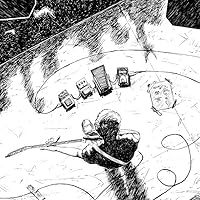
A medic is sent to the front lines in the trenches of World War I. There he writes a letter to his young son describing in careful words what he does, the people he meets, and what he sees. Stark and beautiful drawings depict more fully what the letter only hints at. The Letter Home is a fable of war for all time. It marks the debut of a startling new talent.
Hm... I once used this space for pithy remarks to sell the work of a young illustrator ready to conquer the world.
Now, I'm going to go with:
Hi! If you found my work, congratulations! Glad to have you pop in. I write and draw esoteric stories because as an artist I am at war with human ignorance and the avarice-ridden class that profits from it. I fight this cultural battle with high art done lo-fi... taking complex concepts, like compassion and nobility, and making them concrete with pen and ink.
Not quite sure where this second round of storytelling will take me, but somewhere. Glad you are here for the ride.
5/2011 Memorial day is perhaps the most appropriate day to re-read this incredible book. I love it so very much that I fear I have no objectivity regarding it. You should read it too, whoever you are, wherever you are. It's the best anti-war book I've ever read, and is in my top 5 books of all times. If my house was on fire, this is the book I'd dive for.
4/2006 Stunning book, one I picked up at the library for no particular reason. I'd never heard of it, I mean, and saw the cover and was intrigued. The text of the book is the text of a letter home from WWI, written by a medic to his young son. In simple prose, the letter unwinds with the accompaniment of spare black and white drawings which are both powerful and unsettling. DH was chatting with his favorite librarian, so I went and sat in a corner and opened the book and fell in. Headfirst. By the end, my face was wet and my world was different. This is a quiet book that reverberates down through the day, and I predict it will be with me for a long, long time. I made my son read it tonight at dinner. After he read it he was speechless for a minute (if you can imagine!), and then he asked if he could take it in to school for his teacher to read. DH read it and was nearly as moved as I was. I was teary-eyed just watching them read it. I even emailed the author to tell him how great this book is. Don't be fooled by finding this in the Picture Books section of your library. Unreservedly recommended, in fact, emphatically pushed.
Thank you, Melody! This book is indeed worth pushing!
This is an anti-war book and while it didn’t devastate me quite as much as Johnny Got His Gun or maybe even a few others, memories of which are now escaping me, it is one incredibly powerful book. And it packs its punch in a very small package. The text is a relatively short letter home from a medic at war to his young son, written toward the end of WWI, and the illustrations are wonderfully done black and white drawings that tell the real story that the letter cushions.
This is a picture book but I’d say this is not for preschoolers; I would hope they wouldn’t fully understand it. For school aged children though, and ages all the way up through adulthood years, it’s a terrific book.
This is the author-illustrator’s first book. He has his degree in fine art with a concentration in drawing. It shows. The drawings are superb. What he does with them is amazing.
All parents (and anyone who has loved a child) will no doubt be very emotionally affected by this story.
While this story pertains specifically to WWI, it (gently?) shows the horrors of war. I’d like to send a copy of this book (and a few others) to every world leader.
I’ll be on the lookout for other books illustrated and written by Decker.
There is a certain kind of narrative - one which appears calm and matter-of-fact on the surface, with simple words used sparingly, and a distinct lack of exclamation points, whether textual or punctuational (I tend to abuse the exclamation point myself), but that is, on some level shouting, raging underneath it all, full of deep and hidden emotion, all the more powerful for being obliquely expressed - that I find intensely moving. Whether that tension between calm exterior and tumultuous interior is created through the contrast of tone and content, with terrible realities being calmly described, or, as is the case here, through the contrast of word and image, the resultant experience can be an astonishing one, as a reader.
Timothy Decker, whose work has been enthusiastically recommended to me by my friend Melody (thanks, Melody!), has created that kind of narrative in The Letter Home, ostensibly written by a WWI medic who is describing his wartime experiences to his young son back home - a son with whom he will soon be reunited. His carefully neutral, sometimes even deceptively cheerful words, contrast sharply with the painfully beautiful illustrations that depict the fuller reality behind them. These drawings (pencil, I assume?) have a fine detail that puts me in mind of old-fashioned etchings (high praise from me), and requires minute examination. I could pore over them for far longer than I had leisure to do, this morning on the train. Suffice it to say, they're beautiful, and, taken together with the text, terribly sad.
I really loved this book, but I don't know, despite its status as a picture-book, just who I'd recommend it to. Younger readers might miss some of the depth of emotion lurking behind the simple text, and some of the significance of the artwork, while older readers might want "more," in the way of story. Perhaps I'm doing both a disservice, though, and underestimating them? I think graphic-novel readers of all ages will probably appreciate it, particularly with the way it is formatted, in panels. It's just an unusual and lovely book... a troubling book.
This is a serious telling about World War I in a letter from a father to his son. With black and white drawings, the war is shown in its stark realities, the barren war zone, the loneliness of the front line trenches. It begins and ends with the journey over the ocean, to war and back again. I believe it might be useful to help students examine how much about war they learn by examining this simple story and the illustrations, which actually tell more than the words.
While this touching book has spare text and black-and-white drawings, it tells its story beautifully. A medic is writing a letter to his son back home during World War I. The drawings work to show the bleakness of war, not necessarily the violence of war, but it definitely is a contrast to the glamorization of war.
Among my favorite lines: "We must have looked like schoolboys playing in the mud. But we didn't really play much. We just read letters, looked at our watches, slept when we could for as long as we could with our heads down and our ears open."
Among the lighter moments: "Hendricks found a woman's coat. We all laughed at him. We said that he must have just arrived from Paris. He said that it kept him warm."
This would be good to share with students as an opening to further study about war.
On the front lines during World War I, a medic writes a letter home to his son. The images and text of the book work in harmony to create the message that things are not always as they seem. The man's letter is carefully crafted with optimism while the surrounding imagery suggests a much harsher reality. The boy to whom this letter is addressed will never see what his father has gone through, and the man wishes to keep it that way. He is able to craft a subtle anti-war sentiment through a letter of love written to his son.
A man at war describes what he does during the day in a letter to his family. He doesn't write until he knows he can say he is coming home.
I really enjoy Decker's illustrations. This book felt a little flat to me. He began comparing the war to school then that metaphor just kind of died. It might have been better if he'd carried that metaphor through. I still enjoyed it, but wished it had a little more to it.
The drawings of this book depict the brutality of World War I, yet the writing is reflective of a soldier writing a letter home to his son. I appreciated the duality of this text and would highly recommend it to readers.
Again, Read it and Love it. The art work is fantastic. Fantastic I tell you. again standard disclaimers that Tim is my friend, but this is still a fabulous read.
Delicate pen and ink drawings illustrate the horrible conditions of World War I, as seen through the eyes of a soldier writing a letter home to his son.