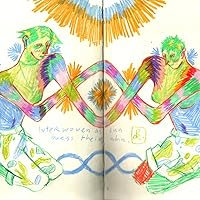
Pieta is a josei Girls Love manga by Nanae Haruno. It revolves around a student named Rio Sakaki, who is suicidally depressed. Her father is distant, and her stepmother is emotionally abusive. She can't remember her early childhood, when her sister and biological mother left. Her therapists, Doctors Shoumitsu and Kyouko Minori, do their best to help her situation. Everything changes when Rio meets classmate Sahoko Higa, and they fall in love. With Sahoko's support, it seems like everything in Rio's life is changing for the better...
This is the best representation of mental health I've encountered in queer manga. Haruno is well versed in various psychological topics, from mental disorders (dissociation, depression, borderline, ptsd), to self-destructive coping mechanisms (cutting, truancy, suicide attempts), to abusive behaviours (gaslighting, invalidation), to various forms of healing (building an emotional support network, gaining economic autonomy).
While Pieta's characters are not particularly deep, their journey from trauma, abuse, and neglect into love, care, and devotion is impeccable. This isn't some queer assimilationist fantasy. The main villain is a tradwife whose obsession with domesticity, respectability, and positivity marks her suicidal step-daughter (Rio) as a deviant deserving of imprisonment/death. In the mother's world, social reputation and the wellbeing of her blood-related son matter more than the life of a disabled stranger who just happens to be her husband's daughter.
Two things are happening here. As yuri scholar Erica Friedman puts it, Pietasubverts older yuri tropes of the mentally unstable lesbian by situating her instability in an abusive household; in doing so, Pieta additionally challenges the biomedical model of disability. Disabling environments are what causes Rio's dysregulated emotions and maladaptive coping mechanisms (not her queerness or self-perceived brokenness), and domesticity is what disables Rio, or, at least, a particular kind of domesticity that is fascistic at its core, concerned more with blood, able-bodiedness, and appearances of wellbeing, than an actually healthy society.
Rio gains stability, motivation, and joy by rejecting hetnorm domesticity and affirming an alternative family. Two of my favourite characters in Pieta are Rio's therapists, who act as proxy parents. They're the opposite of Rio's step-mother, putting her desires above their own even when they think they know better. They explore not only the roots of her insecurity and suicidality, but also the ways she has and may build up her social and psychological resources for living joyously. There's a lovely moment where they talk about her partner Sahoko as a wellspring of love and worth due to her healthy upbringing, how this wellspring will give her the strength and dedication to support Rio in times of distress and suicidality.
It's just so fucking beautiful actually having mental health discussed accurately, with depth, and with a hope predicated on realistic expectations (Rio will probably try and kill herself in the future, but Sahoko will do get utmost to support Rio though it). Neither false comforts nor sadboy fatalism, just the acceptance of finitude through love.
I'm enjoying the old school art, and the story which is, although maybe a little dramatic, actually pretty interesting and I think the mental health aspects are pretty believable so far. Certainly, the main character can turn out very toxic for her love interest, and given that it's an old school yuri manga, I'm not holding my breath, but so far, I like it and I hope it turns out good.
Al principio la historia es un poco confusa, pero luego vas entendiendo a Rio, nuestra protagonista. Es una muchacha con muchos demonios adentro, que no es querida por su familia y por ende no sabe cómo ser una buena persona, a pesar de que es popular en su colegio, pero esto cambia cuando se ve atraída por Sahoko, y siente que con ella todo va a estar bien, que todos sus deseos de morir van a apagarse en tanto Sahoko este a su lado.
It was as though no matter where I went or what I looked at, there was a glass wall between me and the rest of the world.
i remember reading this when i was in my Obsessively-Devouring-Yuri-Manga phase as a teenager and being surprised by its depth. perfectly encapsulates the insane alienation of being a lesbian.