

What do you think?

How Paris Became Paris: The Invention of the Modern City
At the beginning of the seventeenth century, Paris was known for isolated monuments but had not yet put its brand on urban space. Like other European cities, it was still emerging from its medieval past. But in a mere century Paris would be transformed into the modern and mythic city we know today.
Though most people associate the signature characteristics of Paris with the public works of the nineteenth century, Joan DeJean demonstrates that the Parisian model for urban space was in fact invented two centuries earlier, when the first complete design for the French capital was drawn up and implemented. As a result, Paris saw many changes. It became the first city to tear down its fortifications, inviting people in rather than keeping them out. Parisian urban planning showcased new kinds of streets, including the original boulevard, as well as public parks and the earliest sidewalks and bridges without houses. Venues opened for urban entertainment of all kinds, from opera and ballet to a pastime invented in Paris, recreational shopping. Parisians enjoyed the earliest public transportation and street lighting, and Paris became Europe's first great walking city.
A century of planned development made Paris both beautiful and exciting. It gave people reasons to be out in public as never before and as nowhere else. And it gave Paris its modern identity as a place that people dreamed of seeing. By 1700, Paris had become the capital that would revolutionize our conception of the city and of urban life.
Though most people associate the signature characteristics of Paris with the public works of the nineteenth century, Joan DeJean demonstrates that the Parisian model for urban space was in fact invented two centuries earlier, when the first complete design for the French capital was drawn up and implemented. As a result, Paris saw many changes. It became the first city to tear down its fortifications, inviting people in rather than keeping them out. Parisian urban planning showcased new kinds of streets, including the original boulevard, as well as public parks and the earliest sidewalks and bridges without houses. Venues opened for urban entertainment of all kinds, from opera and ballet to a pastime invented in Paris, recreational shopping. Parisians enjoyed the earliest public transportation and street lighting, and Paris became Europe's first great walking city.
A century of planned development made Paris both beautiful and exciting. It gave people reasons to be out in public as never before and as nowhere else. And it gave Paris its modern identity as a place that people dreamed of seeing. By 1700, Paris had become the capital that would revolutionize our conception of the city and of urban life.
307 pages, Hardcover
First published March 4, 2014
About the author
Joan DeJean
32 books55 followersJoan DeJean has been Trustee Professor at the University of Pennsylvania since 1988. She previously taught at Yale and at Princeton. She is the author of eleven books on French literature, history, and material culture of the seventeenth and eighteenth centuries, including most recently How Paris Became Paris: The Invention of the Modern City (2014); The Age of Comfort: When Paris Discovered Casual--and the Modern Home Began (2009); The Essence of Style: How the French Invented High Fashion, Fine Food, Chic Cafés, Style, Sophistication, and Glamour (2005). She lives in Philadelphia and, when in Paris, around the corner from the house where, in 1612, this story began.
Ratings & Reviews
Friends & Following
Create a free account to discover what your friends think of this book!
Community Reviews
Displaying 1 - 30 of 219 reviews

June 20, 2020
This book is perhaps mistitled because it is really about the invention of Paris IN THE 16TH AND 17TH CENTURIES. Joan DeJean focuses on some of the changes initiated under Henry IV but primarily on the transformations under Louis XIV. Despite being a Parisian now for the past quarter-century and thinking that I knew all there was to know about Paris, I learned quite a bit. I had no idea that the "buttes" here (Butte Chaumont, Butte Montmartre, Butte aux Cailles, etc) were all garbage heaps that were filled in and became public spaces starting under Louis XIV or later regimes. I also didn't know that Louis XIV destroyed the ramparts around Paris (completely useless since the threat of invasion was theoretically eliminated (well until 1870 anyway)) and created the first greenway around Paris. And that the word "boulevard" came from the word for bulwarks which was the name of some of the walls behind the Bastille that were destroyed in that effort. The later chapters are less on architecture and topography and more on cultural changes (shopping, finance, fashion). If you are interested in how art and architecture was transformed across France over roughly the same time period, read Anthony Blunt's excellent Art and Architecture in France, 1500–1700.

June 28, 2014
I did not know quite what to expect when I ordered this book. But the blurbs made this volume sound intriguing.
Before the late 1500s, Paris was, as the author notes (page 4), "that urban disaster." From 1597 to 1700, though, the city was transformed. The country's leaders called upon architects and other specialists to apply contemporary technology and knowledge to create a better city. This book focuses on some key changes over time--physical, economic, and cultural--to explain "How Paris Became Paris," a modern city.
Henri IV presided over the completion of Pont Neuf (the work began under an earlier King), a radical approach to making a bridge into a public place. It rapidly became a centerpiece for citizens of the city. Henri IV became committed to making Paris a better place, a more exciting and dynamic venue. Through Louis XIV, and even beyond, French kings expended labor and funding; even wealthy financiers became major actors in supporting construction.
Each chapter in this book explores a distinct element in the process of making Paris Paris. The first chapter considers the impact of the Pont Neuf. Chapter two examines the construction of Place Royale now, Place des Vosges). Chapter 3? Ile Saint-Louis. Chapter five summarizes major public works--boulevards, streets, and parks (Chapter four describes political turmoil--relevant as it slowed progress in the city's transformation). Chapter six speaks of the introduction of lighting and better transportation and the impact of these. The remaining chapters move away from infrastructure and the physical changes to more cultural aspects: culture and fashion and shopping consume chapter seven; chapter 8 delves in to the financial world; chapter nine is entitled "City of Romance." The final chapter steps back, noting the new physical developments in Paris with Baron Haussmann in the mid-1850s. Then, the author goes back to summarize and contextualize the impressive development from the late 1500s to 1700, using objets d'art.
What is fascinating about this book is how a detailed case study of the various topics examined creates such a dynamic story of how Paris evolved over time. I have been to Ile Saint-Louis and had no concept that this was, in essence, a planned community, designed to develop an undeveloped area in Paris. Thus, the story in this book enriches an understanding of Paris.
All in all, an excellent work.
Before the late 1500s, Paris was, as the author notes (page 4), "that urban disaster." From 1597 to 1700, though, the city was transformed. The country's leaders called upon architects and other specialists to apply contemporary technology and knowledge to create a better city. This book focuses on some key changes over time--physical, economic, and cultural--to explain "How Paris Became Paris," a modern city.
Henri IV presided over the completion of Pont Neuf (the work began under an earlier King), a radical approach to making a bridge into a public place. It rapidly became a centerpiece for citizens of the city. Henri IV became committed to making Paris a better place, a more exciting and dynamic venue. Through Louis XIV, and even beyond, French kings expended labor and funding; even wealthy financiers became major actors in supporting construction.
Each chapter in this book explores a distinct element in the process of making Paris Paris. The first chapter considers the impact of the Pont Neuf. Chapter two examines the construction of Place Royale now, Place des Vosges). Chapter 3? Ile Saint-Louis. Chapter five summarizes major public works--boulevards, streets, and parks (Chapter four describes political turmoil--relevant as it slowed progress in the city's transformation). Chapter six speaks of the introduction of lighting and better transportation and the impact of these. The remaining chapters move away from infrastructure and the physical changes to more cultural aspects: culture and fashion and shopping consume chapter seven; chapter 8 delves in to the financial world; chapter nine is entitled "City of Romance." The final chapter steps back, noting the new physical developments in Paris with Baron Haussmann in the mid-1850s. Then, the author goes back to summarize and contextualize the impressive development from the late 1500s to 1700, using objets d'art.
What is fascinating about this book is how a detailed case study of the various topics examined creates such a dynamic story of how Paris evolved over time. I have been to Ile Saint-Louis and had no concept that this was, in essence, a planned community, designed to develop an undeveloped area in Paris. Thus, the story in this book enriches an understanding of Paris.
All in all, an excellent work.
October 31, 2021
Super interesting book. I wish it had a subtitle like “Looking back to the 16th and 17th centuries to understand Paris today” because it was pretty exclusively about that time period— no Eiffel Tower,
no passages about the art/literature scene in the early 20th century. So that was a bummer, but really well-researched and comprehensive for the time period and things which it described. Made me wanna go to France even more, which I didn’t think was possible.
no passages about the art/literature scene in the early 20th century. So that was a bummer, but really well-researched and comprehensive for the time period and things which it described. Made me wanna go to France even more, which I didn’t think was possible.

April 17, 2014
The story of how Paris in the 1600s became the first city to develop street lighting, paved streets, inviting public spaces and the things that came from that such as shopping districts and public flirting. Interesting information but a bit on the dry side.

May 29, 2025
To be honest, I was not expecting to enjoy this book as much as I did.
Well written
Well written

April 20, 2022
As the title says, How Paris Became Paris looks at the way the modern city (and reputation) of Paris was shaped in the 19th century. This was really because of several developments such as:
- Pont Neuf
- Place des Vosges
- île Saint-Louis
- The boulevards, Parks, Streets
- City services (including public transport! which quite quickly became ‘elite transport’! but they made an attempt)
and much more!
Each chapter is topical, picking one aspect (such as a landmark or even an idea, like how Paris became the centre of fashion) and exploring how it has developed. The good part of this method is that it’s very easy to see how certain parts of the city developed and what that meant for urban life. However, the focus on one topic also means that it can be harder to get a general overview of how all the various things interacted with each other.
One thing that caught my attention was this line in Chapter 9: City of Romance – “Foreign visitors to seventeenth-century Paris were constantly amazed at the freedom women enjoyed there, at what a visible presence they were in every new public venue then created – behaviou that was clearly unfamiliar in other European capitals“. In the next paragraph, we can find this line:
“The many descriptions of the women one encountered in the new Paris make it clear that seventeenth-century observers believed that a new kind of woman had come onto the scene in the new type of city […] Again and again, the beautiful women of modern Paris were the ruin of all those who were seduced by their charms.”
It reminded me of what I read in Stephanie Lynn Budin’s book ‘Freewomen, Patriarchal Authority, and the Accusation of Prostitution‘ which basically talked about how women with freedom and independence from men were invariably seen as prostitutes. To me, what happened in Paris seems to be milder version of this phenomenon, where the relative freedom that Parisian women had led to them being seen as “dangerous.” And of course, this conception of Parisian women led to the conception of the term “coquette”.
The term coquette has an interesting history too: before the 17th century, the coquette were ridiculous figures because they were prudes or old women; in the early 17th century, they became ridiculous because they always chased after fads. By the 1680s, the coquette was someone who defined what was in style (or la mode) and thus made others ridiculous.
Overall, I found this to be a fascinating and easy-to-read book! I’ve always thought that modern Paris was the work of Haussman, but this book has convinced me that earlier developments are more important to the modern idea of Paris.
This review was first posted at Eustea Reads
- Pont Neuf
- Place des Vosges
- île Saint-Louis
- The boulevards, Parks, Streets
- City services (including public transport! which quite quickly became ‘elite transport’! but they made an attempt)
and much more!
Each chapter is topical, picking one aspect (such as a landmark or even an idea, like how Paris became the centre of fashion) and exploring how it has developed. The good part of this method is that it’s very easy to see how certain parts of the city developed and what that meant for urban life. However, the focus on one topic also means that it can be harder to get a general overview of how all the various things interacted with each other.
One thing that caught my attention was this line in Chapter 9: City of Romance – “Foreign visitors to seventeenth-century Paris were constantly amazed at the freedom women enjoyed there, at what a visible presence they were in every new public venue then created – behaviou that was clearly unfamiliar in other European capitals“. In the next paragraph, we can find this line:
“The many descriptions of the women one encountered in the new Paris make it clear that seventeenth-century observers believed that a new kind of woman had come onto the scene in the new type of city […] Again and again, the beautiful women of modern Paris were the ruin of all those who were seduced by their charms.”
It reminded me of what I read in Stephanie Lynn Budin’s book ‘Freewomen, Patriarchal Authority, and the Accusation of Prostitution‘ which basically talked about how women with freedom and independence from men were invariably seen as prostitutes. To me, what happened in Paris seems to be milder version of this phenomenon, where the relative freedom that Parisian women had led to them being seen as “dangerous.” And of course, this conception of Parisian women led to the conception of the term “coquette”.
The term coquette has an interesting history too: before the 17th century, the coquette were ridiculous figures because they were prudes or old women; in the early 17th century, they became ridiculous because they always chased after fads. By the 1680s, the coquette was someone who defined what was in style (or la mode) and thus made others ridiculous.
Overall, I found this to be a fascinating and easy-to-read book! I’ve always thought that modern Paris was the work of Haussman, but this book has convinced me that earlier developments are more important to the modern idea of Paris.
This review was first posted at Eustea Reads

May 29, 2023
This is an excellent book about the development of Paris in the 17th century, when it went from a city surrounded by fortifications to a city that welcomed people in. During the time described, Paris developed public parks and sidewalks, which turned it into a walkable city. Also in the time frame Paris developed public transit, lighted streets, and shopping as a recreational pursuit. I expected the book to focus more on the Baron Haussmann era of development, but that appears only in the epilogue. I learned a lot and enjoyed the book immensely
June 30, 2025
Positief verrast door dit boek. Het begon als een random boek uit de kringloopwinkel, omdat ik voor mn vakantie naar Parijs wel geïnteresseerd was in het onstaan van de stad. Niet voor de desbetreffende vakantie kunnen lezen. Uiteindelijk des te leuker om daarna meer informatie over de stad te weten.
Bijvoorbeeld het Place des Vosges waar Alize en ik heerlijk in het zonnetje hebben genoten van de mensenmassa die van deze publieke ruimte aan het genieten waren. Om er tijdens het lezen achter te komen dat de plek aanvankelijk daar ook gecreeerd voor was. Dat het een plek was waar schrijvers zich geïnspireerd lieten worden en waar Alize een van haar gedichten schreef.
De vele uitvindingen die hier zijn oorsprong hebben, zoals de bankjes in een park of een stoep naast een weg. Zelfs de uitvinding van bepaalde woorden als trottoir, balcony en traffic jams hadden zonder de opbouw van Parijs geen aanleiding tot ontstaan.
Wie had gedacht dat ik een historisch feitelijk boek zo leuk kon vinden... De randomness waarmee ik dit boek gekocht heb, de interessante historische feitjes die het me gegeven heeft en de parallellen met de tegenwoordige tijd maakt dat ik dit boek een 5 geef qua sterren.
Bijvoorbeeld het Place des Vosges waar Alize en ik heerlijk in het zonnetje hebben genoten van de mensenmassa die van deze publieke ruimte aan het genieten waren. Om er tijdens het lezen achter te komen dat de plek aanvankelijk daar ook gecreeerd voor was. Dat het een plek was waar schrijvers zich geïnspireerd lieten worden en waar Alize een van haar gedichten schreef.
De vele uitvindingen die hier zijn oorsprong hebben, zoals de bankjes in een park of een stoep naast een weg. Zelfs de uitvinding van bepaalde woorden als trottoir, balcony en traffic jams hadden zonder de opbouw van Parijs geen aanleiding tot ontstaan.
Wie had gedacht dat ik een historisch feitelijk boek zo leuk kon vinden... De randomness waarmee ik dit boek gekocht heb, de interessante historische feitjes die het me gegeven heeft en de parallellen met de tegenwoordige tijd maakt dat ik dit boek een 5 geef qua sterren.

January 28, 2021
A great story about how Paris created the mold for the current Cities we live in. In the 17th Century the King started to move the City from a fortified group of castles and churches focused on the past; to a group of shops and houses accessible to all who lived in the City.
You will recognize many things that we take for granted as having started in Paris like street lights, open markets, entertainment facilities, parks, exploring your city by foot
You will recognize many things that we take for granted as having started in Paris like street lights, open markets, entertainment facilities, parks, exploring your city by foot

August 6, 2021
Read as part of a reading binge about Paris -- a mildly engaging read about how Paris's infrastructure created and supported all kinds of behaviors and features that we associate with the city and with urban life in general. The Pont Neuf as a place where people of all social classes gathered -- and a place from which to regard the river and the cityscape, which hadn't been much done before. Street lights and the kinds of night life they allowed. Baron Haussman's appartment blocks (and the buildings that preceded them, which DeJean argues weren't all that much different), which allowed for a city of walking (as did sidewalks). The invention of La Poste. The 17th century shopping arcade at the Palais de Justice, where both male and female shopkeepers worked and mingled with customers, and where there were features of modern sales experience: counters, shelves and other off-display merchandise, etc. And thus, shopping itself became an activity for Parisians and visitors. The uber-wealthy financiers who financed the Wars of Religion built themselves spectacular showplaces. The boulevards, parks, and streets -- and sewers, which were a tourist attraction. And Paris as a city of romance, which came from women's freedom to mingle with men in public.

January 17, 2020
I'm a sucker for books about Paris architecture and urban design. DeJean takes us back to 17th Century, for the most part, when Paris was becoming Paris with a capital "P." It was a fascinating look into the historical turns that created what we love when we walk down a boulevard or cross the Pont Neuf.

July 3, 2020
I really loved this book, which successfully explains its argument that Paris in the 17th century was the apogee of its allure as well as the first modern city to design its new works around open spaces and public social gathering.
The bulk of the development during that century occurred under Henri IV and Louis XIV, and DeJean dedicates significant time to the establishment of the Pont Neuf, the Place des Vosges, the Ile Saint-Louis, as well as significant public works developments such as the original boulevards, public lighting, the situation of Paris as the capital of the world of fashion, and even romantic assignations. The book accomplishes exactly what I was looking for: a much deeper understanding of the layout of Paris as a city, and enlightening me as to the bridges, avenues, and places that give Paris its distinctive identity as a city of the world. A bonus are the rich illustrations included on nearly every page to illustrate those concepts. It's a fabulous read, and has advanced my knowledge of the city I hope to return to soon. When I do, I'll know a whole lot more about its origins and functionality. A fun, entertaining, and even breezy read.
The bulk of the development during that century occurred under Henri IV and Louis XIV, and DeJean dedicates significant time to the establishment of the Pont Neuf, the Place des Vosges, the Ile Saint-Louis, as well as significant public works developments such as the original boulevards, public lighting, the situation of Paris as the capital of the world of fashion, and even romantic assignations. The book accomplishes exactly what I was looking for: a much deeper understanding of the layout of Paris as a city, and enlightening me as to the bridges, avenues, and places that give Paris its distinctive identity as a city of the world. A bonus are the rich illustrations included on nearly every page to illustrate those concepts. It's a fabulous read, and has advanced my knowledge of the city I hope to return to soon. When I do, I'll know a whole lot more about its origins and functionality. A fun, entertaining, and even breezy read.

January 27, 2014
How Paris Became Paris
The Invention of a Modern City
Joann Dejean
Copyright 2014
How Paris Became Paris is part history book on how Paris became the popular destination it is today, though for over a millennium Paris has acted as the capital of France, it was not as well known and taken care of as it is today. It's Popularity exploded in the seventeenth century with the advent of pocket guide books. Prompting changes to be made to the city, and new buildings to be built as well as old buildings to be remodeled. It is reported that the first carriage was not spotted in Paris until about 1550.
By 1614 the new reality of city life, led officials to ask owners of shops to help in making sure thieves were caught. It also tells of a time when food prices were so high many parisians died of starvation.
If you want to know more about Paris's modern history, How Paris Became Paris is an invaluable read.
Five stars for How Paris Became Paris!!!!
The Invention of a Modern City
Joann Dejean
Copyright 2014
How Paris Became Paris is part history book on how Paris became the popular destination it is today, though for over a millennium Paris has acted as the capital of France, it was not as well known and taken care of as it is today. It's Popularity exploded in the seventeenth century with the advent of pocket guide books. Prompting changes to be made to the city, and new buildings to be built as well as old buildings to be remodeled. It is reported that the first carriage was not spotted in Paris until about 1550.
By 1614 the new reality of city life, led officials to ask owners of shops to help in making sure thieves were caught. It also tells of a time when food prices were so high many parisians died of starvation.
If you want to know more about Paris's modern history, How Paris Became Paris is an invaluable read.
Five stars for How Paris Became Paris!!!!

March 20, 2015
Well-researched, -organized, and -executed, this book was a pleasurable discussion about the elements of Paris' history that made it unique--and therefore the legendary city so revered today. From landmarks, to technological innovations, to fashion, Paris of the seventeenth and eighteenth centuries demolished physical (medieval city) and social walls. Many results of city planning and improvement initiatives acted as great equalizers, reducing the limitations of class distinction and setting a model for other major world cities. A nice supplement for anyone who wants to understand the French or Paris better.

June 19, 2015
How Paris became Paris
Joan DeJean
The author and its team have summarized a captivating interesting
work regarding this great city. It informs with correct data what it would have taken the average person endless research.
Having been raised for a limited time in Paris and too young to appreciate its wonder it leaves me with nostalgic curiosity for which this book answers the questions of its creation.
A pleasurable read to the end.
Joan DeJean
The author and its team have summarized a captivating interesting
work regarding this great city. It informs with correct data what it would have taken the average person endless research.
Having been raised for a limited time in Paris and too young to appreciate its wonder it leaves me with nostalgic curiosity for which this book answers the questions of its creation.
A pleasurable read to the end.

March 15, 2015
This book was incredibly well researched and I enjoyed how each chapter focused on a theme.

November 1, 2018
So, so short. There is so much to Paris and this book barely scratches the surface.

May 14, 2019
A focused and topical look at many of the 17th century Parisian factors that built the reputation and experience of modern Paris. DeJean focuses on a single topic per chapter: some architectural, like the Pont Neuf, while others are more social, such as Parisian fashion ("la mode"). Each is explored in terms of how it developed and how it was experienced by the city's inhabitants at the time; DeJean has a taste for exploring these through contemporary images and plays, which she examines with a keen eye for detail. The book is more a study in detail than a broad overview, though DeJean draws connections with later developments that help connect 17th century Paris to the 19th century and, implicitly, our modern experience. A great read for understanding what it is you might come to love about Paris.

January 22, 2023
This is a well-written book on a subject about which I knew almost nothing. I imagine most people will be unfamiliar with the urban planning of any major city, and the author provides an easy, gentle and interesting introduction to a subject that could very easily (for most people) get boring. I really appreciated the time she took to detail how innovations that we largely take for granted completely transformed the experience of living in a city. Her discussion of the invention of streetlights and their effect on Paris was very interesting and thought-provoking, and she managed to at least partly rehabilitate the image I had of Louis XIV. Her writing style is clear and fluid. I took away a star because (i) I felt like at times she got a little repetitive in driving home some of her points; (ii) in several instances I thought she was (at least) implying a much too simplistic causal relationship between architecture and certain phenomena; and (iii) I thought her last chapter on why Paris had a reputation as a city of romance was a bit strained and by far the weakest chapter of the book.

September 24, 2019
The major takeaway for me from this book is that many of the Parisian features I always attributed to Baron Hausmann in the time of Napoleon III were much-older. Wide, straight boulevards, green public spaces, harmonious exteriors of entire neighborhoods? Those were transformations of the 17th century. The main innovation Hausmann brought to the table when he initiated similar projects is that his methods of achieving them were much more disruptive of what had gone before and dislocated many more inhabitants.
Joan DeJean is in love with Paris and shares that love with us in this book. The subtitle indicates one reason: This is where what we think of as the modern city was invented. A modern city is where large numbers of people from different social and economic strata mingle in public spaces, where goods, services, and ideas circulate with stunning velocity, throwing off creative sparks.
A city is also a place where the poor can experience poverty in a crushing way hardly imaginable in traditional, rural society. While DeJean might concede this, it is not something she focusses on. For that side of the Parisian experience through the ages, Alistair Horne’s Seven Ages of Paris is a counterbalance to this book.
Dispassionately, DeJean traces how the wars of Louis XIV played a role in creating Paris as we know it. By expanding the borders of France and making them defensible, he was able to order the removal of Paris’s medieval walls. This newly-freed area was used to create a ring of boulevards around the city, wide, tree-lined spaces amenable to walking. This development even lies behind the word “boulevard,” taken from an old form of our “bulwark.”
Another way in which war helped make Paris as we know it is that, while war is a terrible machine for wealth-destruction, there is one group for whom it has the opposite effect. They are those who can arrange to provide a sovereign with the means to quickly raise and equip vast armies, at interest, of course. The French even created a new word to denote the few individuals who could do this: “financier.” The proceeds enabled them to rise from often humble origins to gather fortunes that eclipsed those of the traditional aristocracy. The imposing urban palaces they built for themselves, the “hôtels,” set the model for Parisian residential architecture. DeJean accepts all this in a matter-of-fact, even admiring way that seems to ignore the effect that the incessant wars of the Sun King had on the rest of the population of France and its neighbors.
Two of the Parisian features DeJean admires most, however, predate this time and were the initiative of Louis XIV’s grandfather, Henri IV. They are the Pont Neuf and the Place Royale, now known as the Place de Vosges. Both were unprecedented in the western world. The former connected the right and left banks of the Seine, as well as the Île-de-la-Cité (the oldest kernel of Paris) with a stone bridge (the city’s few older bridges were of wood), wide enough to allow new, wider vehicles to cross at the same time in both directions. Even more innovative was the provision of raised sidewalks for pedestrians, interspersed with balconies jutting out over the river that invited passers-by to linger and take in the sights. Paris became a city with contradictory impulses: it was now possible to hurry from place to place (“faire des cours” was a neologism of the time) and yet to slow down and take one’s time, producing that well-known creature of Paris, the “flâneur.”
And where better to linger than in that other innovation, the Place Royale, a large public square surrounded on all four sides by mixed-use buildings (residences above shops) with a royally-decreed uniform facade.
These two innovations, argues DeJean, put Paris on the path to become the kind of city not seen before in Europe. I’m convinced, but I found the term she chose to describe them and other features such as private residences that follow, “monuments,” idiosyncratic. None of these were erected as memorials. They exist not to commemorate the past, but to enrich life in the present.
My other quibble with this book is that the writing is repetitive. DeJean often introduces a fact to illustrate a point; then a few pages later reintroduces the fact. At other times, she writes paragraphs in which the same thought is repeated three times, only varying the formulation. It’s as if she had an English teacher in school who insisted that a paragraph must treat one point but may not consist of only one sentence.
The book contains many images that are in the full sense of the word illustrations, demonstrating features DeJean describes in the text. Strangely, however, they are often introduced with the phrase, “this image... .,” at times denoting an illustration that follows on the next page. I had the sense that I was reading the transcription of a lecture that had been illustrated with slides. The oral nature of a lecture might explain my other quibbles with the prose.
In the end, though, this is a minor complaint and didn’t bother me as much as the author’s seeming indifference to the cost of war (she might feel differently had Hitler had his way and dynamited all the sights of Paris as the Wehrmacht withdrew). Like DeJean, I love Paris, an exciting urban space that rewards repeated visits and exploration. Her book helped me understand why this is so.
Joan DeJean is in love with Paris and shares that love with us in this book. The subtitle indicates one reason: This is where what we think of as the modern city was invented. A modern city is where large numbers of people from different social and economic strata mingle in public spaces, where goods, services, and ideas circulate with stunning velocity, throwing off creative sparks.
A city is also a place where the poor can experience poverty in a crushing way hardly imaginable in traditional, rural society. While DeJean might concede this, it is not something she focusses on. For that side of the Parisian experience through the ages, Alistair Horne’s Seven Ages of Paris is a counterbalance to this book.
Dispassionately, DeJean traces how the wars of Louis XIV played a role in creating Paris as we know it. By expanding the borders of France and making them defensible, he was able to order the removal of Paris’s medieval walls. This newly-freed area was used to create a ring of boulevards around the city, wide, tree-lined spaces amenable to walking. This development even lies behind the word “boulevard,” taken from an old form of our “bulwark.”
Another way in which war helped make Paris as we know it is that, while war is a terrible machine for wealth-destruction, there is one group for whom it has the opposite effect. They are those who can arrange to provide a sovereign with the means to quickly raise and equip vast armies, at interest, of course. The French even created a new word to denote the few individuals who could do this: “financier.” The proceeds enabled them to rise from often humble origins to gather fortunes that eclipsed those of the traditional aristocracy. The imposing urban palaces they built for themselves, the “hôtels,” set the model for Parisian residential architecture. DeJean accepts all this in a matter-of-fact, even admiring way that seems to ignore the effect that the incessant wars of the Sun King had on the rest of the population of France and its neighbors.
Two of the Parisian features DeJean admires most, however, predate this time and were the initiative of Louis XIV’s grandfather, Henri IV. They are the Pont Neuf and the Place Royale, now known as the Place de Vosges. Both were unprecedented in the western world. The former connected the right and left banks of the Seine, as well as the Île-de-la-Cité (the oldest kernel of Paris) with a stone bridge (the city’s few older bridges were of wood), wide enough to allow new, wider vehicles to cross at the same time in both directions. Even more innovative was the provision of raised sidewalks for pedestrians, interspersed with balconies jutting out over the river that invited passers-by to linger and take in the sights. Paris became a city with contradictory impulses: it was now possible to hurry from place to place (“faire des cours” was a neologism of the time) and yet to slow down and take one’s time, producing that well-known creature of Paris, the “flâneur.”
And where better to linger than in that other innovation, the Place Royale, a large public square surrounded on all four sides by mixed-use buildings (residences above shops) with a royally-decreed uniform facade.
These two innovations, argues DeJean, put Paris on the path to become the kind of city not seen before in Europe. I’m convinced, but I found the term she chose to describe them and other features such as private residences that follow, “monuments,” idiosyncratic. None of these were erected as memorials. They exist not to commemorate the past, but to enrich life in the present.
My other quibble with this book is that the writing is repetitive. DeJean often introduces a fact to illustrate a point; then a few pages later reintroduces the fact. At other times, she writes paragraphs in which the same thought is repeated three times, only varying the formulation. It’s as if she had an English teacher in school who insisted that a paragraph must treat one point but may not consist of only one sentence.
The book contains many images that are in the full sense of the word illustrations, demonstrating features DeJean describes in the text. Strangely, however, they are often introduced with the phrase, “this image... .,” at times denoting an illustration that follows on the next page. I had the sense that I was reading the transcription of a lecture that had been illustrated with slides. The oral nature of a lecture might explain my other quibbles with the prose.
In the end, though, this is a minor complaint and didn’t bother me as much as the author’s seeming indifference to the cost of war (she might feel differently had Hitler had his way and dynamited all the sights of Paris as the Wehrmacht withdrew). Like DeJean, I love Paris, an exciting urban space that rewards repeated visits and exploration. Her book helped me understand why this is so.

January 25, 2021
Although the book taught me a lot about the City, I was left with a feeling that the author was a bit too partial. What bugged me the most was how can a whole chapter be dedicated to "oldest and most famous stone bridge in Europe" without mentioning Charles Bridge or (admittedly much shorter) Rialto. Looking forward to see what is left of city described in the book.

August 31, 2026
I love Paris. I only visited once, but it was for the better part of a month during the bicentennial (1989). So, I was curious to read what makes Paris the City of Lights. Joan DeJean opens with an extended chapter that is something of an overture. All the themes of all the chapters are covered in miniature. Then, she gets down to business giving an in-depth history and argument for each of her main points. Paris became Paris because a series of kings chose to build revolutionary bridges, parks, boulevards, and buildings. They also chose to light the city at night in the 17th century! DeJean also covers the fashion industry and how the mere mention of Paris suggests the idea of high fashion and the most progressive culture. Excellent book.

May 27, 2024
This is an incredibly enjoyable book highlighting how Paris developed from a city that was most known for monuments to a living city with unbelievable texture. It blended how a city interacts, builds based on public services, and grows into more interactive city. Providing lights at night, for example, vastly increased safety and expanded shopping and nightlife; it set Paris aside. Moving into the fashion industry introduced Europe to dress fashionably and attracted people from around the world to the city of lights. This book speaks to how Paris, looking to the future, surpassed Rome as the “most celebrated European city.” It was a city where women enjoyed new freedoms, not truly transformative change like voting, but ability to wear what they wanted, shop where they are choice, and sexual expression. That sexual expression was highlighted in many books, making France also a center of erotica with various titillating materials. The author states that all this made Paris the city of romance and skipped ahead to the current century, speaking of the “Love Bridges,” where people covered various Paris bridges with “love-locks” expressing their unlocked love with another.
War had often held back the city’s development. Consider: the Hundred Years’ War (1337-1453), the Wars of Religion between Catholics and Protestants (1562-1598), but growth was spirited after these wars. Paris grew from 220,000 citizens after the wars and the start of the 16th century to 550,000 in habitats by 1700; slightly ahead of London but behind the most popular cities in the world: Istanbul, Tokyo and Beijing. Paris had a feeling of an oversized village, growing with the population but not in a planned manner. The author claimed that the city’s development of the first public mail delivery system (1653 initially as a private sector endeavor but started as a public adventure in 1759), public transportation (1662), street lighting (1667), a signature bridge, utilization of the river front, and French craftsmen who produced clothing, jewelers, and perfumes leapfrogged the city to the top of the heap of cities.
The author points out that change started under King Henri IV who commissioned a panorama at the end of the sixteenth century; the religious war that just ended was evident in the work since the King assured the exclusion of churches that were sprinkled across Paris; the city was about to rise as a secular city.
The Pont Neuf, the New Bridge, was highlighted as a pace-setting bridge that was held up as a symbol of their city and important part of their town. It was the first bridge to cross the Seine in a single span and was both unusually long and wide. It was also the first bridge that wasn’t financed by houses on both sides, allowing sidewalks to be included for the first time, allowing travelers to enjoy the river. The bridge was paid for with a tax on every cask of wine brought to Paris. The bridge’s progress was held up for a decade because of the religious wars. It was also built to carry more weight, an important aspect since the increasing weight of carriages.
The book highlights how the city harnessed the energy of the citizen and expanded the time citizens could enjoy the city by providing lights to keep it safer. The Place Royal (now known as Plaza Mayor) was opened for leisure activities as were spectacular gardens. A force of 4,000 were hired to clean the streets. According to the master plan, streets were widened and 4,000 public servants were added to clean the streets.
Moving into the fashion industry in the late 1600’s, Paris not only created jobs directly but then changed the way people bought the clothes. The Palace Gallery became the first shopping center in the world, encouraged complete gender mixing, and brought together different stratification and upper class started to intermingle with the general population as they went to stores to buy outfits instead of having fittings at their elegant homes. Prior to King Louis XIV’s times, merchants’ stores would be mainly warehouses for their inventory, but, now, they were sources of pride and attraction of more business. Shopping became a hobby and brought people together. Foreign travel increased to be able to capture the energy in Paris.
DeJean also pointed out that we can thank Paris for fixed prices, moving from bantering to paying what was on the price sticker. Mr. de La Frenai set the standard because he “names his price and never budges.” Gone were the days when merchants would offer their goods with no price on them and haggle with each shopper. Shopping in Paris was supposed to be expensive – even when exported to the rest of the world. Exports increased travel to Paris and helped to further make Paris the fashion capital of Europe – and the world. Gone was nationalist fashion, separated by boarders.
All this activity allowed new people into the upper economic class of the population who were not in the “traditional circles of power,” as the author coined. New, architecturally noteworthy homes were being built in Paris at this time, half from this new class of entrepreneurs. Some of this new money was produced by goods but much of it was gained through the banking industry, especially when France fell into deep debt due to the many wars they engaged. France went from an economic engine during King Louis XIV’s control with revenue four times bigger than England and nearly three times higher than the Dutch to huge deficits because of their many wars. Financiers were able to help the country stay afloat, buy the necessary military weapons and boats while making enormous profits because they charged between 5-8% higher rates than the market. Half of the new, beautiful homes built in the 1630’s and ‘40’s was due to these excessive rates. DeJean points out the various earlier careers the financiers held, over half very lowly and low paying.
The book spent considerable time analyzing how citizens communicated with others, marking the start of a fighting democracy that continues to today. The author speaks about how Parisians had connectivity that was different than many other countries in part due to an earlier revolutionary moment. Placards were distributed door-to-door and songs were used to educate. The government went as far as to approach printing companies to give them restrictions, but it didn’t help.
Much of what’s nearly hidden in this book is the tax benefits that have been handed out for hundreds of years that are often controversial in today’s era. For example, in August 1603, King Henri IV called together businessmen to rally to have Paris become the fine fabric manufacturing center. He offered titles of nobility and tax breaks for those who went into the silk manufacturing industry. The following year, he provided land for workshops and workers. Space was given away. Despite all the giveaways, the attempt failed. In 1661, King Louis XIV granted a monopoly to one group of private investors.
Perhaps the best chapter was her last, the conclusion. The author points out that the changes brought forward by King Louis XIV in the 1700’s were extended in a similar way by Napoleon III in the mid-1850’s, two centuries later. Against the resistance of change from those content in the city, Napoleon continued the earlier work from 200 years earlier. This work was documented better since maps were custom-made nearly every year (84 different maps in that century compared to only 21 maps during the 1600’s). DeJean points out that the paintings of France during those years displayed the city as people wanted to display it and more of the city than paintings being produced in competitive cities like London and Amsterdam. Recreational spaces in Paris became display spaces, attracting even more to the city. There were revolutionary views like aristocrats stepping from their private carriages to the public walks, side by side with those many classes below them.
DeJean’s book is a must to read or re-read prior to a trip to the city of lights. She speaks about:
• how the famous Champs-Elysees neighborhood was becoming a “fabric” of the community before the dawning of the 17th century.
• The second neighborhood that developed in the 1630’s was the Ile Notre-Dame, a vibrant center today.
• When one visits the Orsay Museum, visitors are standing on the same spot where King Henri IV started planning a transformed city.
• The Tuileries, the first public Parisian Garden and one that became an example that was held up throughout Europe.
Unfortunately, the book highlights mostly the developments during the 16th and 17th centuries with just some passing references to today’s Paris. While DeJean gives comprehensive background on the development of public carriages in the 1660’s, the book didn’t follow history later to the development of their all-inclusive subway system that allows Parisians and visitors to enjoy Paris today. She spoke about the Pont Neuf Bridge become the Eiffel Tower of later centuries; her book misses the story of the development of today’s Paris Icon. This loss was considerable but doesn’t take away the pleasure of this thoughtful book.
War had often held back the city’s development. Consider: the Hundred Years’ War (1337-1453), the Wars of Religion between Catholics and Protestants (1562-1598), but growth was spirited after these wars. Paris grew from 220,000 citizens after the wars and the start of the 16th century to 550,000 in habitats by 1700; slightly ahead of London but behind the most popular cities in the world: Istanbul, Tokyo and Beijing. Paris had a feeling of an oversized village, growing with the population but not in a planned manner. The author claimed that the city’s development of the first public mail delivery system (1653 initially as a private sector endeavor but started as a public adventure in 1759), public transportation (1662), street lighting (1667), a signature bridge, utilization of the river front, and French craftsmen who produced clothing, jewelers, and perfumes leapfrogged the city to the top of the heap of cities.
The author points out that change started under King Henri IV who commissioned a panorama at the end of the sixteenth century; the religious war that just ended was evident in the work since the King assured the exclusion of churches that were sprinkled across Paris; the city was about to rise as a secular city.
The Pont Neuf, the New Bridge, was highlighted as a pace-setting bridge that was held up as a symbol of their city and important part of their town. It was the first bridge to cross the Seine in a single span and was both unusually long and wide. It was also the first bridge that wasn’t financed by houses on both sides, allowing sidewalks to be included for the first time, allowing travelers to enjoy the river. The bridge was paid for with a tax on every cask of wine brought to Paris. The bridge’s progress was held up for a decade because of the religious wars. It was also built to carry more weight, an important aspect since the increasing weight of carriages.
The book highlights how the city harnessed the energy of the citizen and expanded the time citizens could enjoy the city by providing lights to keep it safer. The Place Royal (now known as Plaza Mayor) was opened for leisure activities as were spectacular gardens. A force of 4,000 were hired to clean the streets. According to the master plan, streets were widened and 4,000 public servants were added to clean the streets.
Moving into the fashion industry in the late 1600’s, Paris not only created jobs directly but then changed the way people bought the clothes. The Palace Gallery became the first shopping center in the world, encouraged complete gender mixing, and brought together different stratification and upper class started to intermingle with the general population as they went to stores to buy outfits instead of having fittings at their elegant homes. Prior to King Louis XIV’s times, merchants’ stores would be mainly warehouses for their inventory, but, now, they were sources of pride and attraction of more business. Shopping became a hobby and brought people together. Foreign travel increased to be able to capture the energy in Paris.
DeJean also pointed out that we can thank Paris for fixed prices, moving from bantering to paying what was on the price sticker. Mr. de La Frenai set the standard because he “names his price and never budges.” Gone were the days when merchants would offer their goods with no price on them and haggle with each shopper. Shopping in Paris was supposed to be expensive – even when exported to the rest of the world. Exports increased travel to Paris and helped to further make Paris the fashion capital of Europe – and the world. Gone was nationalist fashion, separated by boarders.
All this activity allowed new people into the upper economic class of the population who were not in the “traditional circles of power,” as the author coined. New, architecturally noteworthy homes were being built in Paris at this time, half from this new class of entrepreneurs. Some of this new money was produced by goods but much of it was gained through the banking industry, especially when France fell into deep debt due to the many wars they engaged. France went from an economic engine during King Louis XIV’s control with revenue four times bigger than England and nearly three times higher than the Dutch to huge deficits because of their many wars. Financiers were able to help the country stay afloat, buy the necessary military weapons and boats while making enormous profits because they charged between 5-8% higher rates than the market. Half of the new, beautiful homes built in the 1630’s and ‘40’s was due to these excessive rates. DeJean points out the various earlier careers the financiers held, over half very lowly and low paying.
The book spent considerable time analyzing how citizens communicated with others, marking the start of a fighting democracy that continues to today. The author speaks about how Parisians had connectivity that was different than many other countries in part due to an earlier revolutionary moment. Placards were distributed door-to-door and songs were used to educate. The government went as far as to approach printing companies to give them restrictions, but it didn’t help.
Much of what’s nearly hidden in this book is the tax benefits that have been handed out for hundreds of years that are often controversial in today’s era. For example, in August 1603, King Henri IV called together businessmen to rally to have Paris become the fine fabric manufacturing center. He offered titles of nobility and tax breaks for those who went into the silk manufacturing industry. The following year, he provided land for workshops and workers. Space was given away. Despite all the giveaways, the attempt failed. In 1661, King Louis XIV granted a monopoly to one group of private investors.
Perhaps the best chapter was her last, the conclusion. The author points out that the changes brought forward by King Louis XIV in the 1700’s were extended in a similar way by Napoleon III in the mid-1850’s, two centuries later. Against the resistance of change from those content in the city, Napoleon continued the earlier work from 200 years earlier. This work was documented better since maps were custom-made nearly every year (84 different maps in that century compared to only 21 maps during the 1600’s). DeJean points out that the paintings of France during those years displayed the city as people wanted to display it and more of the city than paintings being produced in competitive cities like London and Amsterdam. Recreational spaces in Paris became display spaces, attracting even more to the city. There were revolutionary views like aristocrats stepping from their private carriages to the public walks, side by side with those many classes below them.
DeJean’s book is a must to read or re-read prior to a trip to the city of lights. She speaks about:
• how the famous Champs-Elysees neighborhood was becoming a “fabric” of the community before the dawning of the 17th century.
• The second neighborhood that developed in the 1630’s was the Ile Notre-Dame, a vibrant center today.
• When one visits the Orsay Museum, visitors are standing on the same spot where King Henri IV started planning a transformed city.
• The Tuileries, the first public Parisian Garden and one that became an example that was held up throughout Europe.
Unfortunately, the book highlights mostly the developments during the 16th and 17th centuries with just some passing references to today’s Paris. While DeJean gives comprehensive background on the development of public carriages in the 1660’s, the book didn’t follow history later to the development of their all-inclusive subway system that allows Parisians and visitors to enjoy Paris today. She spoke about the Pont Neuf Bridge become the Eiffel Tower of later centuries; her book misses the story of the development of today’s Paris Icon. This loss was considerable but doesn’t take away the pleasure of this thoughtful book.
This entire review has been hidden because of spoilers.

November 28, 2016
I liked this, GoodReads. That's what I thought. Probably my favorite part is the fact that it was in style to wear a bunch of fake beauty marks, to walk around holding a literal, full face mask over your face, to announce to the other hot strangers that you're walking by that you are seriously too important to be seen and... maybe they'd like to fall in love with you and give you money for clothes before you dump them for someone else?
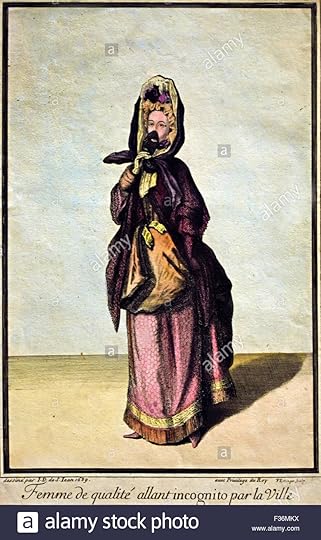
Also that rich guys financiers--the very first nouveau riche--were like "oh, beauty marks are in style? Louis XIV is wearing beauty marks? How many? Okay I'll triple the number of beauty marks I wear and be three times in style, I win I win I win." Then everybody knew they weren't actually aristocrats and were to be avoided.
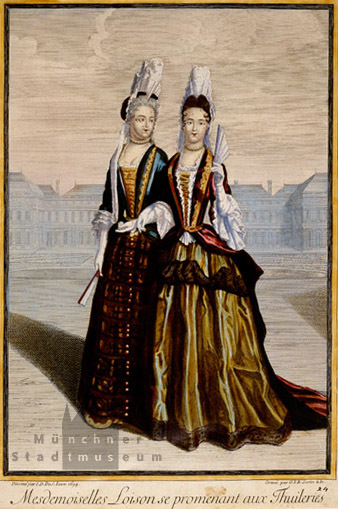
Also the debut of the Tuileries garden, where people would just walk around and sigh and hit on each other. And that these two gals were the Kardashians of their day (note beauty mark overkill):
And the fact that a single bridge (the Pont Neuf) had so much power and sway simply because it was wide and had sidewalks, which people hadn't seen since ancient Rome. Seriously, just the power of the sidewalk.
Other good tidbits include: the first ever public transportation system in the 1600's and all of the complications that caused, including "three carriages went by, totally full--they didn't even stop. I'm just trying to get to work!!!" and "no, rich guy, you can't rent out the whole carriage just because you don't like riding with butchers." The history of Louis XIV pimping out French silk in a very modern Instagram influencer type way. The epidemic of people stealing cloaks on that bridge everyone loved. The power of hot women and the resulting orphans all over the place, the removal of the city walls, and the fact that a financial crash, almost identical to 2008, happened in the 1600's, and really the power of infrastructure.
When I was in France, I was amazed that people could stare at you openly on the bus, and you could in turn stare at them too. No one minded. At one point on the bus, when my mom was with me, two kinda scary French types in track suits started staring at me in an expression of their 1600's roots, causing me to look away pretending nothing was happening and vanity is a lie, in an expression my American midwest roots. This caused my mom to say in very loud American English: "I'm her mother! HER MOTHER!" This caused the track suit Frenchies to just think she was crazy. Now I understand the culture clash.
Also that rich guys financiers--the very first nouveau riche--were like "oh, beauty marks are in style? Louis XIV is wearing beauty marks? How many? Okay I'll triple the number of beauty marks I wear and be three times in style, I win I win I win." Then everybody knew they weren't actually aristocrats and were to be avoided.
Also the debut of the Tuileries garden, where people would just walk around and sigh and hit on each other. And that these two gals were the Kardashians of their day (note beauty mark overkill):
And the fact that a single bridge (the Pont Neuf) had so much power and sway simply because it was wide and had sidewalks, which people hadn't seen since ancient Rome. Seriously, just the power of the sidewalk.
Other good tidbits include: the first ever public transportation system in the 1600's and all of the complications that caused, including "three carriages went by, totally full--they didn't even stop. I'm just trying to get to work!!!" and "no, rich guy, you can't rent out the whole carriage just because you don't like riding with butchers." The history of Louis XIV pimping out French silk in a very modern Instagram influencer type way. The epidemic of people stealing cloaks on that bridge everyone loved. The power of hot women and the resulting orphans all over the place, the removal of the city walls, and the fact that a financial crash, almost identical to 2008, happened in the 1600's, and really the power of infrastructure.
When I was in France, I was amazed that people could stare at you openly on the bus, and you could in turn stare at them too. No one minded. At one point on the bus, when my mom was with me, two kinda scary French types in track suits started staring at me in an expression of their 1600's roots, causing me to look away pretending nothing was happening and vanity is a lie, in an expression my American midwest roots. This caused my mom to say in very loud American English: "I'm her mother! HER MOTHER!" This caused the track suit Frenchies to just think she was crazy. Now I understand the culture clash.

December 19, 2016
In the 17th century, defense of countries moved from cities to the nation’s perimeters and Paris removed its fortifications. From prior bulwarks to promenade for the people, there was a huge change to city life that did not go unnoticed. This new theory of open spaces soon meant anyone could go almost anywhere, if they looked the part. By 1700, Paris had doubled in size in the past 100 years and developed a postal system, public transportation and street lighting. The Pont Neuf changed things big time because until then bridges had shops or houses on them and here without them anyone could now actually lean out and enjoy the river and the city. The Pont Neuf also had introduced sidewalks; carriage use was on the rise and now you could separate vehicles from foot traffic. With sidewalks, the wealthy finally could step down into “the streets” and a commingling of classes ensued. Vaudeville first meant a popular song people knew but with its lyrics then replaced to now be about current political events; such repurposed songs were always either satirical or seditious. Public lighting evolved as a way for all to get home without need for servants or paid torchbearers to light the way. Back then two thirds of the street lighting cost was for the cost of candles. By 1700, the city was lit by over 5000 lanterns, more than London and so Paris became known as the City of Light. With an elegant walkable city where you could be out and seen even at night came high fashion, and so illuminated walkable Paris naturally became Europe fashion capital. Paris offered an abundance of choice, with many establishments becoming proto-department stores. Desire was marketed to induce the rich to leave their homes. Marketing became an art form based on creating an aura. Merchants soon realized luxury goods could not exist on a large scale unless you kept changing the styles so that the customers had to come back for “the latest”. And you needed the revenue from low priced knock-off lines that induced the poor to imitate rather than fight the rich. Upward mobility for the average “Jacques” changed from a career in the church to a career in high finance as money began to trump all social status. I didn’t give this book a higher ranking because among other reasons it had a terrible section on critical role of George-Eugene Hausmann. Anyone can learn far more about his huge role in the way Paris looks today if you type “Hausmann’s renovation of Paris” on Wikipedia.

July 18, 2018
This well researched book contains loads on information and you could feel the passion of the author.
If you want to know everything about Paris, not just the Eiffel Tower then Joan DeJean tells it.
For example, the Pont Neuf; why was it built? Henry IV wanted a bridge without houses. So he had all the wine brought into the city of Paris, every cask brought in, was taxed.
You will learn about Henry IV's idea and how it became a success bringing together, people from all walks of life.
You will learn about it's nighttime illumination.
You will learn about Louis XIV.
The book is rich with colorful plates-many of them and also an extensive Bibliography and credits make it a complete work of Art.
Professor DeJean has been Trustee Professor at the University of Pennsylvania since 1988. Before then, she taught at Princeton and Yale. She grew up in Louisiana in a French-speaking family and was educated at Newcomb College/Tulane and then at Yale.
She has written extensively about France and the French and about the city of Paris.
If you want to know everything about Paris, not just the Eiffel Tower then Joan DeJean tells it.
For example, the Pont Neuf; why was it built? Henry IV wanted a bridge without houses. So he had all the wine brought into the city of Paris, every cask brought in, was taxed.
You will learn about Henry IV's idea and how it became a success bringing together, people from all walks of life.
You will learn about it's nighttime illumination.
You will learn about Louis XIV.
The book is rich with colorful plates-many of them and also an extensive Bibliography and credits make it a complete work of Art.
Professor DeJean has been Trustee Professor at the University of Pennsylvania since 1988. Before then, she taught at Princeton and Yale. She grew up in Louisiana in a French-speaking family and was educated at Newcomb College/Tulane and then at Yale.
She has written extensively about France and the French and about the city of Paris.

February 20, 2014
(Won this ARC through First Reads)
Pretty interesting read! Generally I'm a lot more interested in Italy (the Renaissance, duh) than I am in Paris and if I had to could go anywhere in the world, Paris would be pretty far down on my list. But I think that I'm a lot more intrigued by Paris's history now. I loved learning about the Pont Neuf, which I knew nothing about. The author was strightforward in the writing and managed to keep me interested through the overload of information, most of which I forgot after a few hours. Good book for those interest in Paris history and even for those not interested.
Pretty interesting read! Generally I'm a lot more interested in Italy (the Renaissance, duh) than I am in Paris and if I had to could go anywhere in the world, Paris would be pretty far down on my list. But I think that I'm a lot more intrigued by Paris's history now. I loved learning about the Pont Neuf, which I knew nothing about. The author was strightforward in the writing and managed to keep me interested through the overload of information, most of which I forgot after a few hours. Good book for those interest in Paris history and even for those not interested.

November 23, 2019
#NonfictionNovember #Design
So fascinating! We always hear about Haussmann's impact on Paris but in their own way the 17th century changes were more substantial even though they didn't knock much down, they created and built up the image of Paris. Imagine going from being afraid to go out at night because it's too dark to having well organised public street lighting in just a few years! Since the topics are interconnected, information is repeated in different sections. This book might be more enjoyable in small, spaced out bites or as a reading in a college course about one of the chapter themes but still a pleasure. Read for my own non-fiction challenge "About a place"
So fascinating! We always hear about Haussmann's impact on Paris but in their own way the 17th century changes were more substantial even though they didn't knock much down, they created and built up the image of Paris. Imagine going from being afraid to go out at night because it's too dark to having well organised public street lighting in just a few years! Since the topics are interconnected, information is repeated in different sections. This book might be more enjoyable in small, spaced out bites or as a reading in a college course about one of the chapter themes but still a pleasure. Read for my own non-fiction challenge "About a place"
February 3, 2018
Joan DeJean covers urban changes in Paris from the late medieval period to the early modern, with a heavy emphasis on posters, paintings, travel guides, and plays as sources. Joan really provides a delight of visual information to go with the text. You’ll read about the expansion of foot traffic along the Pont Neuf and the new boulevards of the city, as well as how these let Paris become the Mecca of fashion. My favorite theme throughout the book was how crime changed its patterns to complement those of the city itself.
March 19, 2014
A fabulous book that is easy to read and difficult to put down. A magnificent collection of illustrations and paintings that capture daily life of the 17th century. The guidebooks and maps offer a vivid glimpse into the past. Ms. DeJean has produced another wonderful book that is a pleasure to read!
Displaying 1 - 30 of 219 reviews