The debut graphic novel from a dazzling newcomer with a singular, idiosyncratic style
In the few short years since he began his pamphlet-size comic book series Lose, Michael DeForge has announced himself as an important new voice in alternative comics. His brash, confident, undulating artwork sent a shock wave through the comics world for its unique, fully formed aesthetic.
From its opening pages, Ant Colony immerses the reader in a world that is darkly existential, with false prophets, unjust wars, and corrupt police officers, as it follows the denizens of a black ant colony under attack from the nearby red ants. On the surface, it’s the story of this war, the destruction of a civilization, and the ants’ all too familiar desire to rebuild. Underneath, though, Ant Colony plumbs the deepest human concerns—loneliness, faith, love, apathy, and more. All of this is done with humor and sensitivity, exposing a world where spiders can wreak unimaginable amounts of havoc with a single gnash of their jaws.
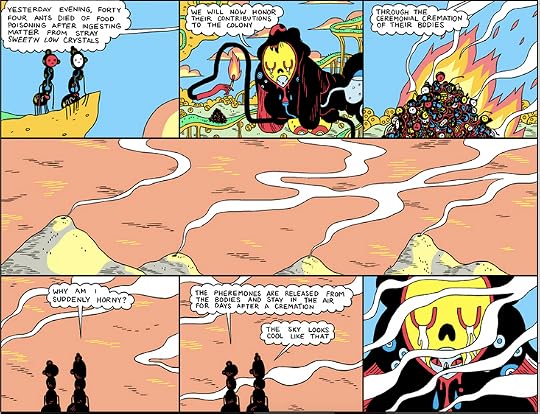
DeForge’s striking visual sensibility—stark lines, dramatic color choices, and brilliant use of page and panel space—stands out in this volume.
Michael DeForge lives in Toronto, Ontario. His comics and illustrations have been featured in Jacobin, The New York Times, Bloomberg, The Believer, The Walrus and Maisonneuve Magazine. He worked as a designer on Adventure Time for six seasons. His published books include Very Casual, A Body Beneath, Ant Colony, First Year Healthy, Dressing, Big Kids, Sticks Angelica, Folk Hero and A Western World.
i don't know why i didn't love this book. i should have - it's about ants and war and the despair of the overlooked:
and conquest:
and the big questions; the things that divide us, the impossibility of communication
but also gruesome horrible death
and these kind of richard scarry-gone-bad overview shots like rarrrrrrrrr
and pretty endpapers:
which are all good things!
but then there are these other things that just kind of grossed me out. yes, i KNOW i read monsterporn and i should be totally immune to this kind of shit, but i still think this is gross:
gross.
and i didn't really respond to the artwork the way i thought i would. still - i enjoyed many of the individual story-threads that make up this book as a whole, and even though i think it ended a little abruptly, what do i know?? NOTHING!! I KNOW NOTHING!!!
if you like ant-on-ant action, whether it be humping or warfare, maybe this is the book for you!
Goodness gracious! What was that?? And why do I feel so weird?!? If David Lynch ever directed a movie for Disney, I guess the result would be the movie equivalent of this comic book: cute, candy-colored, beautiful, mysterious, surreal, enigmatic, fearless, subversive, dark, obsessive, merciless, disturbing, brutal, deranged, and more than a little painful. An artfully delivered punch in the gut - what more could you ask for?
Ant Colony is a subversive look at Western society through the prism of anthropomorphised ants. A couple of gay ants have relationship troubles; everyone’s bothered by the repetitive drudgery of their work and the seeming pointlessness of keeping their Queen happy; a father gives bad advice to his son regarding an earthworm leading to his son becoming a prophet(!); there’s an ant-hunt to catch a serial-killing spider; and war with the red ants, a neighbouring colony, begins.
This was my first Michael DeForge comic and, having now finished it, I’m not encouraged to rush back for more. Ant Colony has an interesting look to the art - it’s very colourful, the creatures are designed weirdly, with a dog face for a spider, and a cheerful limo-look to the centipede, and the ants all look like anything but ants - but DeForge’s various rambling plotlines don’t really go anywhere.
The kid with the earthworm story is a lot like the Itchy & Scratchy parody of Disney’s The Sorcerer’s Apprentice where Scratchy chops up Itchy so many times Itchy becomes a vapour which Scratchy inhales and dies. A similar thing happens when the kid blends the earthworm and inhales it because earthworms in this world can’t die. Then the kid becomes a prophet or something to the bees and… that’s it. Wha…?
The ants fight the red ants because… that’s what they do. And that’s what humans do, fight each other, and that’s the point, isn’t what we do all so silly, etc. The gay couple fight and break up and so what. DeForge’s point seems to be life is stupid and pointless and the ants are the humans, etc. We’ve all read books with a similar nihilistic outlook so I’m not sure what makes DeForge’s one any better especially as he doesn’t provide any original insight. I didn’t crack a smile but maybe some people found this hilarious because they’re... ants?
I tried reading this 6 months ago and gave up because I was so bored. I forced myself through the whole thing this time around and, yup, boring again. DeForge is a very poor storyteller whose book feels as pointless to read as the ants’ lives. The unique character designs are imaginative but the writing is immensely tedious.
With Ant Colony, Michael DeForge has served me exactly the kind of graphic novel that I love to chomp, chew, swallow and smack over. A veritable feast for the sequential art gourmet with a palate for the bizarre and existential à la Werner Herzog’s Aguirre, the Wrath of God and Heart of Glass. Starting off as an offbeat, slice-of-life story about a black ant colony that could have been conceived by the painter Francis Bacon, events then take a ruinous turn during the second course, as war is waged with a psychotropic-crazed colony of red ants. The third and final dish takes the form of a surreal quest narrative, giving our rag-tag party of insectile players a chance to reevaluate their purpose in life outside the context of being a complacent member of myrmic society. Madness, same-sex relationships, gender inequality, bug banging, theology, violence, debauchery, parenting and fate are all tackled in a charmingly disturbed philosophical fashion. Plus, where else are you going to find spiders that look like they came out of a PCP-fueled nightmare of Walt Disney’s?
This included everything I appreciate in a graphic novel: humor, pathos, absurdity, subversion, social deconstruction, bizarre mythology, and anthropomorphized insects.
It's possible people thought I was a crazy person as I cracked up reading this on the Metro. The drawings are mostly simple panels of stick-like ant and bug figures, but the characters are creatively designed and well composed and you'll find yourself caring about their doomed attempts to find community as their colony falls apart around them. And every so often the artist throws in a huge one or two page panel that is just gorgeous to look at. I especially loved the gross and psychedelic design of the earth goddessy queen of the colony and the horrific large-scale battle panels. The writing offers a hilariously bleak examination of relationships, war, and existence. In the bug world (as in our own) no one is safe from random, horrible violence and a stray odor can change how you view a loved one forever.
LOLs early on and full-page Boschian panels of battles with red ants. The story broke apart but not the art. I met the author a few years ago at a book release party for one of his friends who played in a band with a friend of mine. Of all the books in the store devoted to comics and graphic novels etc, I was most attracted to one that turned out to be his. Been meaning to look at his stuff ever since. His drawing is unmistakably his own at a glance.
Ants, or ant-like creatures and other bug like creatures. DeForge obsessively creates this pretty detailed ant world with sex and politics and war and death, a world… which is also bizarre and gross and surreal at times.
This is like a really dark, adult episode of Adventure Time only with black ants, red ants, bees, spiders, and limousine centipedes.
The illustrations are somewhat creepy, the black ants are not cute like real black ants but look more like mutated little NoFaces from "Spirited Away." The red ants look a little more like ants in that they have big ol' mandibles and giant eyes on their bulbous heads but the similarities end there. The spiders are freaky with their huge, open-mothed '30's-cartoonish dog heads and their legs-into-bodies-to-mate ways. It all borders on fever-dreamish and it was weirdly compelling; I couldn't stop reading/looking.
In a way, it's comforting to think that even an orderly, peaceful black ant colony has all the same problems as a disorderly, disgruntled human society, down to the disturbing and unpleasant yet highly-resilient sociopath and hopeless ever afters.
This book is SO WEIRD. I think I loved it? But if someone told me they hated it, I'd be like "yeah."
Also, I knew it would be super dark and existential and gross, but I was surprised to find myself laughing out loud a lot. What does that say about me?
I think the art world and the literary world are both destitute and decrepit, locked between the frivolous gambling idiocy of the market, and the hidebound conservative immovability of the academy. MFAs, best seller lists, and global art fairs have left us with pallid ghouls instead of vibrant art and books.
Thankfully, the comic world isn't like that. I go to a comic book fair (albeit a fair that focuses on the so-called "literary" and/or "artistic") and I am continually blown away. Every few years a whole horde of new talent springs up with new ways of approaching and making comics.
DeForge, right now, is one of those "new talents." Over and over again he surprises me with both his experimentation and his skill at weaving readable comics. He's restless in trying out new things, and smart enough to keep it fun. He knows the history of the medium and is constantly mining it for surprising viewpoints. Once again, he comes up with a new book, a fantastic new story, and new formal experiments that move the story and push the medium.
Literature and the art world might be in a stage of suspended animation, but comics, thankfully, are alive and kicking ass. Maybe it's because there's neither money to be made nor institutional positions to be had.
4.5 stars -- This is your ant farm on drugs. Any questions?
Like many of the best aspects of art and life, ANT COLONY is difficult to describe. Human nature, war, and pettiness are examined through the use of fever-dream imagery of ants and other insects. I love all things weird, and I found ANT COLONY absolutely compelling. Those not attracted to the surreal aren't likely to be quite so amused, however.
I did dock this one-half a star because I thought that a small number of scenes--most notably the "breeding the queen" panels, seemed to exist mainly to be gross and shocking, as other reviewers have noted. However, when DeForge strikes the right balance, ANT COLONY is absolutely on.
DeForge's first book (preceded by years of mini-comics, series, and other smaller collections) uses a dying ant colony as the setting to explore compassion, impulse, desire, violence, and humanity. His flat, colorful, and fantastical drawing style bring together a small but mighty cast of characters who digress from their species' biological real-world counterparts in look and behavior at the whim of DeForge's fabulous imagination. It's sort of astounding how he moves so seamlessly between ennui and horror, compassion and brutality. Darkly funny. DeForge is one of those writer/artists who completely does his own thing and I'm glad to be on board for the ride. --------------------------------- Comics Alliance interview with DeForge: https://comicsalliance.com/michael-de... ---------------------------------
I found this graphic novel surreal, dark, and gross in parts, and yet I could not look away. It's the story of a civilization writ small: war, corruption, sex, angst, ennui, the search for meaning, them versus us, gender politics, murder, etc. all set in an ant colony. The art is creepily good - I especially loved the spiders, and was more than a little disturbed by the queen illustrations. My fave parts include an ode to the Lion King, the 300 style battle scenes, and the final bucket list. There are multiple narrators in this story, and I found it rather male-centric, but it is an interesting and colorful read nonetheless.
Vibrant illustrations, but I ultimately didn't connect. I think I was expecting something a little more accessible and anthropomorphic. I mean, I'm looking at a page with images of a blender and a baseball bat. And it's getting all kinds of acclaim. I'm coming out nonplussed.
To put it simply, this is one of the best comics I have read in a while. I enjoyed it immensely; and read the whole thing in one sitting. Great artwork that is very unique, and an excellent, surreal story. 5 stars and best reads pile.
I prefer DeForge's collections, like this one, that are all of a piece, rather than individual cartoons or compilations of short pieces. This is still bizarro, however.
A masterpiece, wayward and strange and occasionally surprisingly haunting and melancholy. It’s beautifully drawn and somehow the text and narrative mirror the oddness of the images. It’s quite something
Inspirational, sensational, gay gay gay, dreamy, deeply jarring and confrontational, loved it all! Once I saw the centipede I was like strap in lil Kob you’re gonna love this shit!! I have so many whirling thoughts about the last few haunting scenes.
I loved ANT COLONY because it defied me. I assumed as it began that anthropomorphized ants would stand in for the foibles of the human condition and I would be left with a brightly colored sit-com that I’d likely grow weary of before the end. Despite reading a great review, rarely am I enthralled by animals acting human so at best I was kinda hoping for a brightly colored Seinfeld episode. Instead I stumbled into a dazzling mixture of many things I love: Yellow Submarine meets Animal Farm with the dark touches of David Lynch and the light touches of early Woody Allen with Joan Miro attempting pop art and Albert Camus trying to act silly. Took a few pages before I let go and trusted the author—I may have actually been half way through before I let myself realize just how much fun I was having—alternately laughing and being grossed out. Certainly not for everyone, would be less surprised if someone hated it than if they had no opinion at all. The story is less about ants acting human than it is revealing how much of being human is still baseline animalistic. Like the characters of ANT COLONY we are searching for something we can rarely define with legs hopelessly shortened by our lack of empathy, self-awareness and imagination. These bigger themes are couched in art work that seems at first childish (or at least for children) but soon veers into the grotesque and surreal often reminding me of 60’s psychedelic poster art—something very much in my wheelhouse. While ANT COLONY reminded me of many things, it felt like a wholly unique creation.
A few weeks before reading Ant Colony, I watched Antz for the first time since I was a kid. I quickly understood that Antz was in fact a film for adults, masquerading as a kids’ movie. In this respect, Ant Colony is kind of like Antz dialled up to 100. On the one hand, it’s a lot more explicitly adult: it addresses darker, heavier existential themes and deals a lot more directly with sexuality, often in a bizarrely grotesque manner. On the other hand, its vibrant, simplistic visual style brings to mind Adventure Time, or even a pre-school picture book: all bold lines and bright, block colours. In comparison, Antz looks gritty and realistic.
Of course, there are limits to the comparison with Antz. Ant Colony starts out as series of two-page vignettes, which feel only loosely linked to one another through shared setting and characters. As such, the beginning of the book feels like a collection of comic strips more than the start of a cohesive graphic novel: a series of snapshots illustrating life in and around the titular colony. By the mid-point an overarching narrative does emerge – and events tend to flow into one another more directly than at the start – but the story remains meandering and whimsical. There is no grand quest, spectacular climax or satisfying resolution. In that sense, despite all its surrealism, Ant Colony is a fundamentally realistic work: its characters wander through life, reacting to events and searching for meaning, but there is none to be found.
A colony of ants that is both disturbingly antlike and horrifyingly human tries to maintain its peaceful existence in the face of various challenges, managing to feel like a parable for modern life and a warning about taking middle-class suburbia for granted.
What a weird book. The author works for Adventure Time as an illustrator, I believe (not one of the main ones), and says it's the ideal day job. This book is much stranger than Adventure Time, but you can probably see the resemblance. The plot is semi-episodic, a kind of ant apocalypse. Some of it makes sense, as in, "Oh, ants do that!" Other parts, you're not sure if that's an ant thing, a human thing, or just plain surreal. It's strangely effective.
I recommend this for people who love All Things Weird. Like, try it if you like Jeff VanderMeer or Blood & Guts in High School. Weird weird.
This book falls into a special subset of graphic novels that I refer to with the highly-technical term of "weird". I used to avoid weird comics due to some unconscious bias. Happily, though, I've started to give them a shot. Not surprisingly, there are some winners and some losers. Ant Colony is an overwhelming "win". Once I got over my initial knee-jerk complaints ("ants are female!", "they have six legs!") and remembered that I'm not looking for sources for an academic paper on arthropods, I realized what a jewel this comic is. Michael DeForge knows how to tell a good, funny, compelling story filled with engaging characters. Bring on the weird comics!
oph. this was cutting edge when i first read it, but now so much of it feels like my early 20's—shock and morbidity with little else to it. I love De Forge's illustration styles, but here there was no feeling to engage in other than some worn out sophomoric exploration of nihilism. Big Kids, which I also recently read, holds up quite a bit more. I just don't like snark much anymore is maybe what it is.




 come to my blog!