

What do you think?

Paleofantasy: What Evolution Really Tells Us about Sex, Diet, and How We Live
Armed with a razor-sharp wit and brilliant, eye-opening research, Zuk takes us to the cutting edge of biology to show that evolution can work much faster than was previously realized, meaning that we are not biologically the same as our caveman ancestors. Contrary to what the glossy magazines would have us believe, we do not enjoy potato chips because they crunch just like the insects our forebears snacked on. As Zuk argues, such beliefs incorrectly assume that we’re stuck—finished evolving—and have been for tens of thousands of years. She draws on fascinating evidence that examines everything from adults’ ability to drink milk to the texture of our ear wax to show that we’ve actually never stopped evolving. Our nostalgic visions of an ideal evolutionary past in which we ate, lived, and reproduced as we were “meant to” fail to recognize that we were never perfectly suited to our environment. Evolution is about change, and every organism is full of trade-offs.
From debunking the caveman diet to unraveling gender stereotypes, Zuk gives an analysis of widespread paleofantasies and the scientific evidence that undermines them, all the while broadening our understanding of our origins and what they can really tell us about our present and our future.
From debunking the caveman diet to unraveling gender stereotypes, Zuk gives an analysis of widespread paleofantasies and the scientific evidence that undermines them, all the while broadening our understanding of our origins and what they can really tell us about our present and our future.
336 pages, Paperback
First published March 11, 2013
About the author
Marlene Zuk
15 books61 followersMarlene Zuk is an American evolutionary biologist and behavioral ecologist. She worked as professor of biology at the University of California, Riverside (UCR) until she transferred to the University of Minnesota in 2012. Her studies involve sexual selection and parasites.
Ratings & Reviews
Friends & Following
Create a free account to discover what your friends think of this book!
Community Reviews
Displaying 1 - 30 of 237 reviews

Read
November 14, 2018Huuummm.
This is one of those books in which one imagines the respected author sitting high up in her burrow scratching away with her pen, when suddenly she sits up, all senses alert and straining: somewhere on the internet crazy people are gathering and proposing crazy things, someone must deal with this...by writing a book! But of course, the voice of sweet reason will convert the crazies to take a new nuanced view, away from their comfortable absolutist stances on diet, exercise, family and gender relations .
That is one strand of this book. The other are some interesting anecdotes about evolution and rapid evolutionary change - some about humans adaptations: to living at altitude (two different unrelated developments one among Tibetians, one among Andean peoples), the ability to digest diary products (at least three variants - two genetic, the third bacterial - some people have gut bacteria that allow them to digest diary products into adulthood (likewise among Japanese people researchers have found they have gut bacteria that improve their ability to digest seaweed), the great earwax shift, and genes that give protection against certain contagious diseases - some about animals, such as the population of male crickets that lost the ability to sing (due to all singing ones having been eaten).
You can imagine these two strands braided together to produce her rope of sweet reason. There would have been many paleolithic lifestyles, with different diets and group dynamics simply judging from the variety of hunter-gatherer societies today, also looking at them we should not assume a hard boundary between a hunter-gatherer lifestyle and a sedentary one, several groups have only become hunter gatherers within recorded history.
At times it struck me that much of what she was saying was very provisional, the DNA analysis seems to be a rapidly developing field and the dating of changes I suspect seems to be open to interpretation and the function of certain genes or groups of genes is not so clear cut either. Equally studies of hunter-gatherer societies and of great apes are still ongoing, the data can be limited and those groups themselves are changing and not fixed.
The area which interests me more is one that Zuk doesn't address which is the fantasy element - the insecurity that drives some people to seek to justify their behaviour (meat eating or opposition to running) or their notions of propriety (monogamy or infidelity) or ideas on gender relations (woman the cave maker, man the hunter) by reference to a mythical past. Is this a reaction to the stress of contemporary societies? Or to the whithering of traditional authorities? Or a reflection of the attraction of big picture just-so stories (we are the way we are because of the stone age)?
It strikes me with time how all this is all political and ideological. Whether about paleo diets or the mating habits of human ancestors what ever is said or asserted runs quickly far beyond what the evidence can sustain. The passions involved in such discussions a warning that this is all about visions of human nature and what people hope or believe it to be. Locating such ideas in the distant past means that they are not much at risk of being completely debunked. However if you are not emotionally invested in absolute visions of human nature, Zuk's book is a sweetly reasonable guide to an evolving area of knowledge.
The non-ideological, or less ideological side is that for Zuk it is misleading to state that a crisis in human health was caused by the transition to an agricultural life, our current health woes for her are the consequence specifically of contemporary physically comfortable lifestyles and calorie rich diets. To live well, in her view, you don't need to invent an erzatz old stone age lifestyle, just one with more physical exercise and effort with a commensurate diet.
This is one of those books in which one imagines the respected author sitting high up in her burrow scratching away with her pen, when suddenly she sits up, all senses alert and straining: somewhere on the internet crazy people are gathering and proposing crazy things, someone must deal with this...by writing a book! But of course, the voice of sweet reason will convert the crazies to take a new nuanced view, away from their comfortable absolutist stances on diet, exercise, family and gender relations .
That is one strand of this book. The other are some interesting anecdotes about evolution and rapid evolutionary change - some about humans adaptations: to living at altitude (two different unrelated developments one among Tibetians, one among Andean peoples), the ability to digest diary products (at least three variants - two genetic, the third bacterial - some people have gut bacteria that allow them to digest diary products into adulthood (likewise among Japanese people researchers have found they have gut bacteria that improve their ability to digest seaweed), the great earwax shift, and genes that give protection against certain contagious diseases - some about animals, such as the population of male crickets that lost the ability to sing (due to all singing ones having been eaten).
You can imagine these two strands braided together to produce her rope of sweet reason. There would have been many paleolithic lifestyles, with different diets and group dynamics simply judging from the variety of hunter-gatherer societies today, also looking at them we should not assume a hard boundary between a hunter-gatherer lifestyle and a sedentary one, several groups have only become hunter gatherers within recorded history.
At times it struck me that much of what she was saying was very provisional, the DNA analysis seems to be a rapidly developing field and the dating of changes I suspect seems to be open to interpretation and the function of certain genes or groups of genes is not so clear cut either. Equally studies of hunter-gatherer societies and of great apes are still ongoing, the data can be limited and those groups themselves are changing and not fixed.
The area which interests me more is one that Zuk doesn't address which is the fantasy element - the insecurity that drives some people to seek to justify their behaviour (meat eating or opposition to running) or their notions of propriety (monogamy or infidelity) or ideas on gender relations (woman the cave maker, man the hunter) by reference to a mythical past. Is this a reaction to the stress of contemporary societies? Or to the whithering of traditional authorities? Or a reflection of the attraction of big picture just-so stories (we are the way we are because of the stone age)?
It strikes me with time how all this is all political and ideological. Whether about paleo diets or the mating habits of human ancestors what ever is said or asserted runs quickly far beyond what the evidence can sustain. The passions involved in such discussions a warning that this is all about visions of human nature and what people hope or believe it to be. Locating such ideas in the distant past means that they are not much at risk of being completely debunked. However if you are not emotionally invested in absolute visions of human nature, Zuk's book is a sweetly reasonable guide to an evolving area of knowledge.
The non-ideological, or less ideological side is that for Zuk it is misleading to state that a crisis in human health was caused by the transition to an agricultural life, our current health woes for her are the consequence specifically of contemporary physically comfortable lifestyles and calorie rich diets. To live well, in her view, you don't need to invent an erzatz old stone age lifestyle, just one with more physical exercise and effort with a commensurate diet.

April 26, 2019
Hundreds of thousands of people try to practice a "paleo" lifestyle, where "paleo" is short for "paleolithic", and is a euphemism for "caveman". They eat mostly meat, thinking that this is what our ancestors thrived on for tens, or even hundreds of thousands of years. They believe that humans ate this way and evolved to take advantage of this type of diet. They believe that humans have not had enough time, since the agricultural revolution, to evolve toward a more modern type of diet. Some practitioners of the paleo lifestyle take their approach much further. Some, for example, donate blood frequently, in order to mimic the results of being wounded frequently. And, some do other strange things. But they don't necessarily refuse to vaccinate themselves (although some do), in order to prevent the scourges of yesteryear, like smallpox, polio, measles, and so on. But they are not always consistent; they wear modern clothes instead of skins, they don't live in caves, and they don't use bear teeth to incur blood loss, and they wear eyeglasses.
Marlene Zuk's builds up a pretty convincing argument to back up her main premise, that humans have indeed had time to evolve significantly since the "first" agricultural revolution, about 12,000 years ago. She is an evolutionary biologist and behavioral ecologist. So, she actively does research in related fields.
Some anthropologists study isolated "primitive" tribes in order to improve understanding of prehistorical humans. But, this approach is fraught with issues. Today's isolated tribes have been influenced by modern society in many ways, and are not as isolated as many would think. They do help anthropologists to understand small-scale societies, but not earlier stages of evolution.
Evolution can be rapid. There is an interesting story about how a group of crickets in Hawaii evolved in twenty generations to suppress their singing, to be quiet, to avoid a parasitic fly. There is a similar story about an experiment that showed rapid evolution of guppies in eleven years.
The ability for some people to drink milk makes it the poster child for rapid evolution in humans. These people have developed a tolerance for lactose in milk. Lactose tolerance is an advantage in high latitudes. Lactose tolerance allows a more efficient uptake of calcium, that is otherwise prevented where sunlight is low, and vitamin D is difficult to obtain. Some societies in northern Africa have also developed lactose tolerance, which must have evolved independently from those in northern Europe. A hypothesis for this evolution is that the ability to drink milk from animals gives people a source of uncontaminated fluid, in a region where water is scarce. So, this is an example of convergent evolution, where a functionality has evolved in multiple places at multiple times, independently. Zuk remarks that one cannot refuse to drink milk in a paleo diet, because lactose tolerance depends on one's genes, and these genes have changed.
Convergent evolution also occurred in societies that lived in high altitudes. Some people in the Andes mountains have developed high hemoglobin concentrations in their blood. On the other hand, people in Tibet who live at altitudes at 13,000 feet above sea level don't have high hemoglobin levels. Instead, they have evolved faster breathing rates, in order to distribute enough oxygen to their bodies.
A central question in this book, is whether a paleo diet really is the "one and only diet that ideally fits our genetic makeup." Early humans often ate roots, tubers, and other starchy foods. Prehistoric humans and Neandertals ate grains, and sometimes cooked their food. They ate a wide variety of plants, and even made crackers! So, the suggestion that we should eat a paleo diet consisting of meat and fish, and not fruits and vegetables and grains, is plainly wrong. It is also true that the proportion of meat eaten increased about 30,000 years ago, after the invention of the bow and arrow. However, big-game hunting was an unreliable as a sole source of support for a family. I just love Zuk's comment; "Saying you want to maintain your wife and children on it is the ancestral equivalent of claiming that you will support your family by playing lead guitar in a band."
I enjoyed this book, and it seems to cover some aspects of paleolithic diet trends. But I wasn't wholly convinced by the arguments. It is very difficult to quantify how much meat vs. how much plant food was eaten in prehistoric times. The remains of plants don't fossilize, and the evidence for grains and plants in prehistoric diets is sporadic. I think that a more complete understanding will require evidence from archaeology. (By the way, I am a vegan, so I certainly do not buy the arguments to follow a paleo diet.)
Marlene Zuk's builds up a pretty convincing argument to back up her main premise, that humans have indeed had time to evolve significantly since the "first" agricultural revolution, about 12,000 years ago. She is an evolutionary biologist and behavioral ecologist. So, she actively does research in related fields.
Some anthropologists study isolated "primitive" tribes in order to improve understanding of prehistorical humans. But, this approach is fraught with issues. Today's isolated tribes have been influenced by modern society in many ways, and are not as isolated as many would think. They do help anthropologists to understand small-scale societies, but not earlier stages of evolution.
Evolution can be rapid. There is an interesting story about how a group of crickets in Hawaii evolved in twenty generations to suppress their singing, to be quiet, to avoid a parasitic fly. There is a similar story about an experiment that showed rapid evolution of guppies in eleven years.
The ability for some people to drink milk makes it the poster child for rapid evolution in humans. These people have developed a tolerance for lactose in milk. Lactose tolerance is an advantage in high latitudes. Lactose tolerance allows a more efficient uptake of calcium, that is otherwise prevented where sunlight is low, and vitamin D is difficult to obtain. Some societies in northern Africa have also developed lactose tolerance, which must have evolved independently from those in northern Europe. A hypothesis for this evolution is that the ability to drink milk from animals gives people a source of uncontaminated fluid, in a region where water is scarce. So, this is an example of convergent evolution, where a functionality has evolved in multiple places at multiple times, independently. Zuk remarks that one cannot refuse to drink milk in a paleo diet, because lactose tolerance depends on one's genes, and these genes have changed.
Convergent evolution also occurred in societies that lived in high altitudes. Some people in the Andes mountains have developed high hemoglobin concentrations in their blood. On the other hand, people in Tibet who live at altitudes at 13,000 feet above sea level don't have high hemoglobin levels. Instead, they have evolved faster breathing rates, in order to distribute enough oxygen to their bodies.
A central question in this book, is whether a paleo diet really is the "one and only diet that ideally fits our genetic makeup." Early humans often ate roots, tubers, and other starchy foods. Prehistoric humans and Neandertals ate grains, and sometimes cooked their food. They ate a wide variety of plants, and even made crackers! So, the suggestion that we should eat a paleo diet consisting of meat and fish, and not fruits and vegetables and grains, is plainly wrong. It is also true that the proportion of meat eaten increased about 30,000 years ago, after the invention of the bow and arrow. However, big-game hunting was an unreliable as a sole source of support for a family. I just love Zuk's comment; "Saying you want to maintain your wife and children on it is the ancestral equivalent of claiming that you will support your family by playing lead guitar in a band."
I enjoyed this book, and it seems to cover some aspects of paleolithic diet trends. But I wasn't wholly convinced by the arguments. It is very difficult to quantify how much meat vs. how much plant food was eaten in prehistoric times. The remains of plants don't fossilize, and the evidence for grains and plants in prehistoric diets is sporadic. I think that a more complete understanding will require evidence from archaeology. (By the way, I am a vegan, so I certainly do not buy the arguments to follow a paleo diet.)

September 4, 2013
I have to admit that I'm a tempeh eating herbal tea guzzling sugar shirking healthy ethical vegan foodie prepared to spend a shocking proportion of my income on pricey & organic raw and free from* goodies. In the last couple of years, the kind of places I shop have been regularly advertising a lot of products under the banner of 'paleo'. There are even some candy bars, cookies and granola explicitly branded as such, and often they appeal to me as they're full of my favourite ingredients: cashews, dates, coconut flakes, macadamias, cherries mmmm. Rich treats to be eaten sparingly, especially at the price. Point is, in close proximity to my own bubble, there are apparently folks taking this live-like-a-'caveman' idea at least partly seriously. Zuk makes use of some amusing examples of proponents' comments. I gave some real belly-laughs to the ideas about exercise. Apparently instead of wasting our time at zumba class or jogging round the park we should be doing activities that mimic hefting rocks around and running frantically away from snakes.
Aside from giving-it-enough-rope to mock itself, Zuk uses her own perspective as an evolutionary biologist to undermine the foundations of 'paleofantasy', the idea that humans evolved in a particular environment (the Pleistocene) living a certain way (hunting and gathering) and that we are now suffering the consequences of genetic maladjustment since agriculture only started 10,000 years ago and we can't possibly have evolved fast enough to cope with eating porridge and living in houses. Actually, she points out, evolution is a continual process, with no end point or intent, that can and sometimes does happen very fast. Moreover, humans have lived and thrived in a wide variety of environments, and there is no evolutionary reason to think one of them is the most 'natural' or appropriate.
Like other good popular science books, this clears up common misconceptions by breaking down tough-to-explain ideas to that point that they seem really obvious and straightforward. Add the spice of dry wit and you have a fun, readable text that delivers some interesting facts. I learned most from the part on the question 'are we still evolving?', because I really hadn't thought about the obvious mechanisms at work here: just the fact that some people have more surviving children than others determines the frequency with which particular genes spread. Medical advances like vaccinations may mean that our resistance to measles isn't improving but it's hard to think of other ill effects. Natural selection favours reproductive success, so it wouldn't help us resist diseases of old age, for example, and as Daniel C Dennett also explains in Darwin's Dangerous Idea, there's nothing moral about evolution or the aims of our genes.
I enjoyed reading about examples of rapid evolution in humans and other animals, and the techniques used to identify it. If you love nature documentaries as I do, you'll probably find this pretty cool. It was also thought-provoking for me – for example I considered the way I think about exercise. I choose dance, yoga and swimming because I enjoy them, but I also privately consider them more 'functional' than, for example, lifting weights repetitively (though I do that sometimes as well!). But thinking about it, what's 'functional' depends on what you plan to do with your body, to say nothing of ability, which isn't given much mention here. Dance makes me better at dancing, yoga makes me better at yoga, and being able to touch my toes and having good balance are pretty satisfying, but it's possible to imagine other priorities. I remember being told that drumming strengthens the back but not the chest, so drummers sometimes have a particular body shape, but that's OK if it works for what you want to do, right?
Regarding sex and families, I appreciated Zuk's feminist take on the masculinism of many earlier texts on evolutionary biology, as well as the paleo movement itself. The monotonous focus on men hunting was one of the aspects of The Naked Ape: A Zoologist's Study of the Human Animal that so grated on me. In addition to posing oppositional theories and pointing out biased standpoints, Zuk draws on the work of a large proportion of female theorists. My favourite section on this topic was about 'co-operative breeding', the practice of having multiple carers for young animals. The nuclear family has often been thought of as an important part of our evolution, but Zuk makes the case for much wider kinship networks being involved in rearing young humans, who are by far the most demanding and slow-developing baby animals we know about. Fathers, grandmothers, aunts & uncles, older siblings and non-relatives can all pitch in, and the result, in general, is that more infants survive and mothers produce more of them, so the genes score. Zuk also quotes research that suggests children who form strong bonds with three or more carers, regardless of blood relationships, have the best emotional and psychological health. This important aspect of human society is often ignored while the importance of hunting is, it seems, overstated.
I have long been arguing that nutrition is more individual than people usually imagine, and that this is one reason why advice on the topic can be so confusing. Zuk argues that trying to eat like stone age hunter gatherers is misguided because prehistoric populations in different areas ate different things (including grains, not to mention root vegetables that are high in carbs). Many dietary adaptations are evident in our genes. For example, some members of some groups of people (a global minority of about 25%) have evolved a 'lactase persistence' that allows them to digest lactose and thus consume dairy products into adulthood, while those who eat a lot of grains tend to have more genes for amylase production. This backs up Zuk's point, but also suggests the possibility that more sophisticated gene-profiling might lead to more helpful individual nutritional advice, just like I thought (however, I'm obviously still aiming for a world where everyone is vegan). I was surprised that Zuk doesn't mention any of the studies that relate high starch consumption to lower instances of some cancers and other diseases, and though she does quote a study that found paleo to be the least healthy of twenty different diet regimes, she clearly isn't out to critique the details here. Sedentarism gets a strong thumbs down, but intensive farming techniques get a relatively easy ride, and issues like environmental racism and colonisation of food supplies don't enter the picture at all, so on food this book turns out to be pretty mainstream.
Aside from giving-it-enough-rope to mock itself, Zuk uses her own perspective as an evolutionary biologist to undermine the foundations of 'paleofantasy', the idea that humans evolved in a particular environment (the Pleistocene) living a certain way (hunting and gathering) and that we are now suffering the consequences of genetic maladjustment since agriculture only started 10,000 years ago and we can't possibly have evolved fast enough to cope with eating porridge and living in houses. Actually, she points out, evolution is a continual process, with no end point or intent, that can and sometimes does happen very fast. Moreover, humans have lived and thrived in a wide variety of environments, and there is no evolutionary reason to think one of them is the most 'natural' or appropriate.
Like other good popular science books, this clears up common misconceptions by breaking down tough-to-explain ideas to that point that they seem really obvious and straightforward. Add the spice of dry wit and you have a fun, readable text that delivers some interesting facts. I learned most from the part on the question 'are we still evolving?', because I really hadn't thought about the obvious mechanisms at work here: just the fact that some people have more surviving children than others determines the frequency with which particular genes spread. Medical advances like vaccinations may mean that our resistance to measles isn't improving but it's hard to think of other ill effects. Natural selection favours reproductive success, so it wouldn't help us resist diseases of old age, for example, and as Daniel C Dennett also explains in Darwin's Dangerous Idea, there's nothing moral about evolution or the aims of our genes.
I enjoyed reading about examples of rapid evolution in humans and other animals, and the techniques used to identify it. If you love nature documentaries as I do, you'll probably find this pretty cool. It was also thought-provoking for me – for example I considered the way I think about exercise. I choose dance, yoga and swimming because I enjoy them, but I also privately consider them more 'functional' than, for example, lifting weights repetitively (though I do that sometimes as well!). But thinking about it, what's 'functional' depends on what you plan to do with your body, to say nothing of ability, which isn't given much mention here. Dance makes me better at dancing, yoga makes me better at yoga, and being able to touch my toes and having good balance are pretty satisfying, but it's possible to imagine other priorities. I remember being told that drumming strengthens the back but not the chest, so drummers sometimes have a particular body shape, but that's OK if it works for what you want to do, right?
Regarding sex and families, I appreciated Zuk's feminist take on the masculinism of many earlier texts on evolutionary biology, as well as the paleo movement itself. The monotonous focus on men hunting was one of the aspects of The Naked Ape: A Zoologist's Study of the Human Animal that so grated on me. In addition to posing oppositional theories and pointing out biased standpoints, Zuk draws on the work of a large proportion of female theorists. My favourite section on this topic was about 'co-operative breeding', the practice of having multiple carers for young animals. The nuclear family has often been thought of as an important part of our evolution, but Zuk makes the case for much wider kinship networks being involved in rearing young humans, who are by far the most demanding and slow-developing baby animals we know about. Fathers, grandmothers, aunts & uncles, older siblings and non-relatives can all pitch in, and the result, in general, is that more infants survive and mothers produce more of them, so the genes score. Zuk also quotes research that suggests children who form strong bonds with three or more carers, regardless of blood relationships, have the best emotional and psychological health. This important aspect of human society is often ignored while the importance of hunting is, it seems, overstated.
I have long been arguing that nutrition is more individual than people usually imagine, and that this is one reason why advice on the topic can be so confusing. Zuk argues that trying to eat like stone age hunter gatherers is misguided because prehistoric populations in different areas ate different things (including grains, not to mention root vegetables that are high in carbs). Many dietary adaptations are evident in our genes. For example, some members of some groups of people (a global minority of about 25%) have evolved a 'lactase persistence' that allows them to digest lactose and thus consume dairy products into adulthood, while those who eat a lot of grains tend to have more genes for amylase production. This backs up Zuk's point, but also suggests the possibility that more sophisticated gene-profiling might lead to more helpful individual nutritional advice, just like I thought (however, I'm obviously still aiming for a world where everyone is vegan). I was surprised that Zuk doesn't mention any of the studies that relate high starch consumption to lower instances of some cancers and other diseases, and though she does quote a study that found paleo to be the least healthy of twenty different diet regimes, she clearly isn't out to critique the details here. Sedentarism gets a strong thumbs down, but intensive farming techniques get a relatively easy ride, and issues like environmental racism and colonisation of food supplies don't enter the picture at all, so on food this book turns out to be pretty mainstream.

January 15, 2022
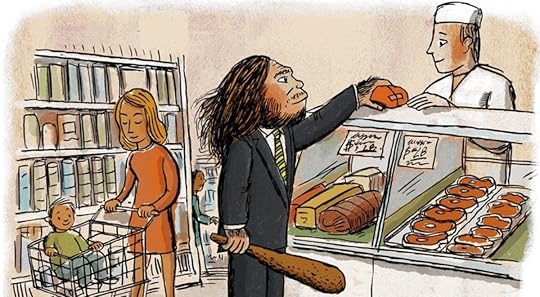
Paleofantasy is an exposé of pseudoscientific myths about our evolutionary past and the lifestyles we live today. Supported by eye-opening research combined with easily accessible language, anthropologist Marlene Zuk shows us that evolution can work much faster than was previously realized and that we are not as biologically identical to our caveman ancestors as we assume.
Evolution is about unplanned change, and every organism is full of trade-offs. From debunking the “paleo” diet to unraveling gender stereotypes, Dr. Zuk delivers a deep dive into paleofantasies and the scientific evidence that undermines them. Her ultimate goal: broadening our understanding of our origins and what they can really tell us about our present and our future.
Dr. Zuk critically approaches some of popular beliefs among people and debunks myths about them with scientific analysis.
Despite being informing, she is not a good writer and it takes her a lot of writing to express her ideas.

June 15, 2013
Marlene Zuk's Paleofantasy fails to deliver the serious critique that is expected of someone of her caliber as a scientist. The book is quite frustrating to read. It's largely a barrage of straw man and reductio ad absurdum arguments against the Paleo movement. When I first saw the book and looked at her credentials as a biologist, I was expecting serious intellectual work in critiquing the Paleo movement. But as I was reading the book, I became quite disappointed when I realized that in order for her to dismiss the premise of the movement as ridiculous and pseudoscientific (which was her biased overarching goal), she selectively used outlandish quotes from random Paleo bloggers who tend to have unsubstantiated wild claims about evolution and prehistory.
The book is predicated on the wrong assumption that the movement is monolithic. It's not. As a serious scientist, she should have consulted and critiqued the many scientific papers published in the last 27 years or so, at least the scientific paper written by Boyd Eaton et al in 1985 in the New England Journal of Medicine. Only then can her work be really taken seriously. In general, she rejects the notion that there is a mismatch between our genetic endowment and our advanced culture demonstrating that evolution occurs faster than Paleo adherents contend. The trouble is that she deduces from the theory of natural selection to support her critique, which has not much to do with the mismatch. The renowned evolutionary biologist Richard Lewontin has stated succinctly in the New York Review of Books in 2009, reviewing Greg Gibson's It Takes a Genome: "The major changes from the usually minimal hunter-gatherer animal and plant diets to high-calorie sugar intakes cause great stress to our carbohydrate metabolism. In a curious contradiction of modern life, while in many human populations, for example in Africa, people are dying young from overwork and undernourishment, people in technologically advanced societies are dying at a greater age from overeating and too little physical activity. We cannot count on natural selection to deal with the problem." In this scenario, the Paleo diet and lifestyle as conceived by scientists like Loren Cordain and Boyd Eaton, makes a lot of sense.
The book is predicated on the wrong assumption that the movement is monolithic. It's not. As a serious scientist, she should have consulted and critiqued the many scientific papers published in the last 27 years or so, at least the scientific paper written by Boyd Eaton et al in 1985 in the New England Journal of Medicine. Only then can her work be really taken seriously. In general, she rejects the notion that there is a mismatch between our genetic endowment and our advanced culture demonstrating that evolution occurs faster than Paleo adherents contend. The trouble is that she deduces from the theory of natural selection to support her critique, which has not much to do with the mismatch. The renowned evolutionary biologist Richard Lewontin has stated succinctly in the New York Review of Books in 2009, reviewing Greg Gibson's It Takes a Genome: "The major changes from the usually minimal hunter-gatherer animal and plant diets to high-calorie sugar intakes cause great stress to our carbohydrate metabolism. In a curious contradiction of modern life, while in many human populations, for example in Africa, people are dying young from overwork and undernourishment, people in technologically advanced societies are dying at a greater age from overeating and too little physical activity. We cannot count on natural selection to deal with the problem." In this scenario, the Paleo diet and lifestyle as conceived by scientists like Loren Cordain and Boyd Eaton, makes a lot of sense.

March 17, 2013
There were parts of this book that I really enjoyed, but I find myself mildly disappointed after finishing reading it.
I knew before I began that this was not going to be a particularly political book and that it wasn't going to spend much time addressing the ways that science is used to support sexism, racism, eugenics, or other various nasty things that people try to explain away through science. However, I think I did expect to see some of these ideas discussed somewhat more than they were.
Race is barely mentioned at all, although the author does point out some interesting things that are at least tangentially related to race issues. For example, the fact that at least some of the people groups held up as examples of hunter-gatherer societies are not historically hunter-gatherers. Rather, they are people who reverted to hunting and gathering after being forced from their land by European invasions. However, the larger implications of this in the way we analyze history were mostly ignored, and the book seems careful to talk about these things in the most inoffensive (to white people) ways possible and avoids making any indictment of white/Western science.
I had high hopes for the chapters on sex and family in regard to addressing gender issues, especially the numerous issues with evolutionary psychology and the way that many people try to use circular reasoning to explain that modern gender roles are the way they are because of ancient gender roles, which (of course!) we know were the way they were because modern gender roles are the way they are. I also hoped to see, perhaps, some new and interesting explanations for how human societies have evolved modern sexual and family behaviors, but I was sadly disappointed. Again, I felt like the author was trying to write critically about science but without really criticizing scientists or the scientific community--or even science reporters or pop cultural ideas about science.
It's not that I regret reading the book or that I think it wasn't worthwhile. Certainly, I learned a few things that I didn't know before I read it. I just got the overall impression that, while the book seems written to encourage skepticism, the author was reluctant to espouse any particular "right" ideas or to condemn any particular "wrong" ideas. Most of the ire contained in the book is for paleo diet advocates, and, frankly, there are far more important things that could have been addressed in this book.
I knew before I began that this was not going to be a particularly political book and that it wasn't going to spend much time addressing the ways that science is used to support sexism, racism, eugenics, or other various nasty things that people try to explain away through science. However, I think I did expect to see some of these ideas discussed somewhat more than they were.
Race is barely mentioned at all, although the author does point out some interesting things that are at least tangentially related to race issues. For example, the fact that at least some of the people groups held up as examples of hunter-gatherer societies are not historically hunter-gatherers. Rather, they are people who reverted to hunting and gathering after being forced from their land by European invasions. However, the larger implications of this in the way we analyze history were mostly ignored, and the book seems careful to talk about these things in the most inoffensive (to white people) ways possible and avoids making any indictment of white/Western science.
I had high hopes for the chapters on sex and family in regard to addressing gender issues, especially the numerous issues with evolutionary psychology and the way that many people try to use circular reasoning to explain that modern gender roles are the way they are because of ancient gender roles, which (of course!) we know were the way they were because modern gender roles are the way they are. I also hoped to see, perhaps, some new and interesting explanations for how human societies have evolved modern sexual and family behaviors, but I was sadly disappointed. Again, I felt like the author was trying to write critically about science but without really criticizing scientists or the scientific community--or even science reporters or pop cultural ideas about science.
It's not that I regret reading the book or that I think it wasn't worthwhile. Certainly, I learned a few things that I didn't know before I read it. I just got the overall impression that, while the book seems written to encourage skepticism, the author was reluctant to espouse any particular "right" ideas or to condemn any particular "wrong" ideas. Most of the ire contained in the book is for paleo diet advocates, and, frankly, there are far more important things that could have been addressed in this book.

December 17, 2012
Science! Let's talk about scienceing it for a moment. Zuk does a really good job of debunking all sorts of recent paleomyths - incorporating data and evidence that wouldn't be out of place in a college level anthropology course - with (unintentionally humorous and frequently 'sic'ed) postings from paleo-lifestyle adherents on message boards such as cavemanforum.com. If there's fault with this book, it's that it isn't tailored to a mainstream audience - its arguments can be academic in a way that Mary Roach's books aren't.
But! If that is what you are looking for... (which as it turns out, I am into)...
Zuk puts forth a lot of compelling and recent research, quoting many studies from as recent as 2010. She highlights how we're continually changing and adapting (aka why we're *not* stuck in the bodies of our paleolithic ancestors) and why our ancestors themselves were not ideally adapted for their environments. I may have read this too fast to retain all the tidbits - a chapter a night might be a better pace to pick through it all - but I found myself continually fascinated.
But! If that is what you are looking for... (which as it turns out, I am into)...
Zuk puts forth a lot of compelling and recent research, quoting many studies from as recent as 2010. She highlights how we're continually changing and adapting (aka why we're *not* stuck in the bodies of our paleolithic ancestors) and why our ancestors themselves were not ideally adapted for their environments. I may have read this too fast to retain all the tidbits - a chapter a night might be a better pace to pick through it all - but I found myself continually fascinated.

May 5, 2013
This was fabulous and fascinating. The basic bent of the book is probably best summed up in this quote from the conclusion:
"A simpler life with more exercise, fewer processed foods, and closer contact with our children may well be good for us. But we shouldn't seek to live that way because we think it emulates our ancestors. We can mimic the life of a preindustrial, or preagricultural, society only in its broadest sense. Rather than trying to use our past to proscribe our present, or our future, we can use it as a way to understand where we came from. Paleofantasies call to mind a time when everything about us -- body, mind, and behavior -- was in sync with the environment. But [...] no such time existed. We, and every other living thing, have always lurched along in evolutionary time, with the inevitable trade-offs that are a hallmark of life." (p. 270)
Basically, Zuk, a scientist who studies ecology, evolution, and behavior, uses the fringe elements of the "paleo" movement as a jumping off point to discuss what we actually know about human evolution and human history. Key to her argument is the concept that humans did not evolve to a certain maximum level 10,000 years ago and then just stop: we are always evolving. In one particularly enlightening section, Zuk discusses the evolution of the ability to digest lactose, a capacity that appears to have arisen independently in differing areas of the globe, at different times, with a different genetic component. Lactose tolerance in some areas of Africa (mainly what is now southern Kenya and northern Tanzania) is estimated to have arisen only approximately 3,000 years ago, when people in these areas began keeping herd animals.
Overall, there is little patience here with speculation as to what humans were "meant" to do -- Zuk is mainly interested in what humans CAN do, and when these traits arose. She is particularly irked by people who talk about the "unintended" consequences of evolution, because evolution has no intentions. Traits arise that may or may not be beneficial, and there are always trade-offs. The genetic trait that makes some people more resistant to HIV infection also seems to make them more susceptible to West Nile Virus. Humans who have the tuberculosis-resistant genotype appear to be more susceptible to auto-immune diseases. The list goes on.
If you are looking for a point-by-point refutation of pop culture versions of evolutionary biology, this will be a bit of a disappointment. However, if you're interested in evolution in general and human evolution specifically, you will find this absolutely fascinating.
"A simpler life with more exercise, fewer processed foods, and closer contact with our children may well be good for us. But we shouldn't seek to live that way because we think it emulates our ancestors. We can mimic the life of a preindustrial, or preagricultural, society only in its broadest sense. Rather than trying to use our past to proscribe our present, or our future, we can use it as a way to understand where we came from. Paleofantasies call to mind a time when everything about us -- body, mind, and behavior -- was in sync with the environment. But [...] no such time existed. We, and every other living thing, have always lurched along in evolutionary time, with the inevitable trade-offs that are a hallmark of life." (p. 270)
Basically, Zuk, a scientist who studies ecology, evolution, and behavior, uses the fringe elements of the "paleo" movement as a jumping off point to discuss what we actually know about human evolution and human history. Key to her argument is the concept that humans did not evolve to a certain maximum level 10,000 years ago and then just stop: we are always evolving. In one particularly enlightening section, Zuk discusses the evolution of the ability to digest lactose, a capacity that appears to have arisen independently in differing areas of the globe, at different times, with a different genetic component. Lactose tolerance in some areas of Africa (mainly what is now southern Kenya and northern Tanzania) is estimated to have arisen only approximately 3,000 years ago, when people in these areas began keeping herd animals.
Overall, there is little patience here with speculation as to what humans were "meant" to do -- Zuk is mainly interested in what humans CAN do, and when these traits arose. She is particularly irked by people who talk about the "unintended" consequences of evolution, because evolution has no intentions. Traits arise that may or may not be beneficial, and there are always trade-offs. The genetic trait that makes some people more resistant to HIV infection also seems to make them more susceptible to West Nile Virus. Humans who have the tuberculosis-resistant genotype appear to be more susceptible to auto-immune diseases. The list goes on.
If you are looking for a point-by-point refutation of pop culture versions of evolutionary biology, this will be a bit of a disappointment. However, if you're interested in evolution in general and human evolution specifically, you will find this absolutely fascinating.

August 15, 2013
Notwithstanding the subtitle - 'what evolution tells us about sex, diet, and how we live' - this book is mostly a rebuttal of people who argue that we should do X because early human beings evolved over millions of years to thrive doing X. Even more narrowly, it does not rebut claims that people should eat more meat/ eat fewer carbs/ be faithful to their spouses/ practice free love/ run barefoot. Instead, Paleofantasy merely argues that no one can legitimately argue for or against any of these positions on evolutionary grounds, because (1) our best evidence suggests prehistoric people could have lived happily in a variety of ways, and (2) evolution is a continual process, so there never was a time when humans were optimally adapted.
All of that is fine, and some of the science Zuk discusses is pretty interesting. The reliance on internet comment boards to document a 'man on the street' view is just bizarre - who takes comment boards seriously?
What feels strangest about the book is the way Zuk's chosen conversation - basically, an argument against paleo strawmen - lies alongside, but virtually never intersects with, ongoing debates about the impacts of anthropogenic chemical releases into the environment. It's not as though these other debates are esoteric; googling any of the following will bring them up: epigenetics, colony collapse disorder among bees, endocrine-disrupting chemicals, amphibian population declines, implications of reduced food crop diversity for human nutrition. Yet, these topics are never mentioned explicitly in this book. Perhaps Zuk felt it would muddy the waters - she already has to acknowledge that the paleo advocates may be right about their conclusion, that people need to exercise more, they're just wrong in their theory of why. Presumably Zuk wrote the book she wanted to write, but it feels like a missed opportunity.
All of that is fine, and some of the science Zuk discusses is pretty interesting. The reliance on internet comment boards to document a 'man on the street' view is just bizarre - who takes comment boards seriously?
What feels strangest about the book is the way Zuk's chosen conversation - basically, an argument against paleo strawmen - lies alongside, but virtually never intersects with, ongoing debates about the impacts of anthropogenic chemical releases into the environment. It's not as though these other debates are esoteric; googling any of the following will bring them up: epigenetics, colony collapse disorder among bees, endocrine-disrupting chemicals, amphibian population declines, implications of reduced food crop diversity for human nutrition. Yet, these topics are never mentioned explicitly in this book. Perhaps Zuk felt it would muddy the waters - she already has to acknowledge that the paleo advocates may be right about their conclusion, that people need to exercise more, they're just wrong in their theory of why. Presumably Zuk wrote the book she wanted to write, but it feels like a missed opportunity.

May 28, 2017
I'm working my way through most of the popular books on the market about human evolution, and I would without hesitation recommend this as the first book to someone interested. I rejected reading it for some time because of the `paleofantasy' marketing angle: so I thought it would be mostly full of the all-too-easy cheap shots at the paleo diet crowd, but this book goes far deeper than that. Zuk lays out an evolutionary biologist understanding of human evolution, what we're pretty sure of (how patterns work to create evolution, some things that our species is more specialised in, and that humans are good adapters to wildly different conditions) and what we don't know (what pre-human ancestors were actually like).
Unfortunately, many reviewers seem to not get past the fact that Zuk did not prove a Paleo diet is bad for you: completely missing that the book was never about that.
Which is not to say that there aren't cheap shots. Zuk seems largely motivated by annoyance at the way various movements have sought to return to a particular moment in our evolution when we were perfectly suited to our lifestyle. She has enormous fun with a group of NYC Cavemen, who run barefoot, eat raw meat and give blood regularly to imitate blood loss from wounds. But it isn't just the dieters, she also takes on hunter-man, childrearer-woman brigade, and attachment parenting. Zuk uses her biology knowledge to explain at length that no species is ever perfectly adapted; that like us, our primate genetic ancestors have always had highly varied ways of living, eating and organising their families, and, perhaps most powerfully, that we are still evolving.
Zuk also has a keen understanding of the way our society governs our science. She somewhat caustically remarks early on that if we want to make a dangerous or harmful choice - whether that be cheating on a partner, or eating a meal we know is bad for us, it makes it easier to blame our genes. In discussing the infamous chimp/bonobo divide, she comments that many assume if we had studied bonobos earlier, in the 70s, we would have a different view of human nature, but adds: 'This is one possibility; the other is that if we had known about bonobos earlier, we would have characterized them as more violent and warlike than we do now, simply because anthropologists and primatologists in the 1960s and ’70s were disposed to emphasize male aggression, which bonobos do exhibit, albeit to a lesser extent than chimps do.'
Along the way, she provides a wonderful crash course in genetics; paleoanthropology; and some aspects of basic human biology. Each chapter is packed with enough content about current scholarship to power a book. There are some real gems in here: and once Zuk has schooled us on the proper way to speculate about the past, she allows herself to indulge in some speculation, from the possible survival advance of active elders in child rearing; through polygamy as a result of agriculture in some societies, or whether smallpox resulted in a great step forward for European immune systems (by wiping out so many without them). I may not have agreed with every conclusion, but I had the freedom to disagree as Zuk explains the evidence, the arguments and the detracting arguments for each she raises, and the footnotes were excellent*. Zuk loves science, takes it seriously, and most of all wants us to know that our past doesn't constrain us: it can tell us how we got here, but not where to go next. As she puts it: 'Rather than trying to use our past to proscribe our present, or our future, we can use it as a way to understand where we came from ... whatever we choose has consequences, and choices have to be made. We do not have genes plunked wholesale into one environment or another, whether Paleolithic, medieval, or industrial; we have genes that respond to that environment and to each other.'
*One exception: they weren't linked in the ebook, necessitating a tedious process of looking them up. Thankfully this is getting rarer, but it is irritating.
Unfortunately, many reviewers seem to not get past the fact that Zuk did not prove a Paleo diet is bad for you: completely missing that the book was never about that.
Which is not to say that there aren't cheap shots. Zuk seems largely motivated by annoyance at the way various movements have sought to return to a particular moment in our evolution when we were perfectly suited to our lifestyle. She has enormous fun with a group of NYC Cavemen, who run barefoot, eat raw meat and give blood regularly to imitate blood loss from wounds. But it isn't just the dieters, she also takes on hunter-man, childrearer-woman brigade, and attachment parenting. Zuk uses her biology knowledge to explain at length that no species is ever perfectly adapted; that like us, our primate genetic ancestors have always had highly varied ways of living, eating and organising their families, and, perhaps most powerfully, that we are still evolving.
Zuk also has a keen understanding of the way our society governs our science. She somewhat caustically remarks early on that if we want to make a dangerous or harmful choice - whether that be cheating on a partner, or eating a meal we know is bad for us, it makes it easier to blame our genes. In discussing the infamous chimp/bonobo divide, she comments that many assume if we had studied bonobos earlier, in the 70s, we would have a different view of human nature, but adds: 'This is one possibility; the other is that if we had known about bonobos earlier, we would have characterized them as more violent and warlike than we do now, simply because anthropologists and primatologists in the 1960s and ’70s were disposed to emphasize male aggression, which bonobos do exhibit, albeit to a lesser extent than chimps do.'
Along the way, she provides a wonderful crash course in genetics; paleoanthropology; and some aspects of basic human biology. Each chapter is packed with enough content about current scholarship to power a book. There are some real gems in here: and once Zuk has schooled us on the proper way to speculate about the past, she allows herself to indulge in some speculation, from the possible survival advance of active elders in child rearing; through polygamy as a result of agriculture in some societies, or whether smallpox resulted in a great step forward for European immune systems (by wiping out so many without them). I may not have agreed with every conclusion, but I had the freedom to disagree as Zuk explains the evidence, the arguments and the detracting arguments for each she raises, and the footnotes were excellent*. Zuk loves science, takes it seriously, and most of all wants us to know that our past doesn't constrain us: it can tell us how we got here, but not where to go next. As she puts it: 'Rather than trying to use our past to proscribe our present, or our future, we can use it as a way to understand where we came from ... whatever we choose has consequences, and choices have to be made. We do not have genes plunked wholesale into one environment or another, whether Paleolithic, medieval, or industrial; we have genes that respond to that environment and to each other.'
*One exception: they weren't linked in the ebook, necessitating a tedious process of looking them up. Thankfully this is getting rarer, but it is irritating.

March 30, 2021
Or, as I would title it, "Dude, it's science. Just science. Quit dramatizing it."
I was at a gender reveal party a while ago - and let me say, What the beck kind of gift begging excuse is this for a... No. I won't go there. People die at those things.
Anyway, the woman in charge of food for the gathering had every single dish labeled for every single food fad or sensitivity. And there was a lot of food!
And she still got grief. Two people were arguing with her over whether blueberries are paleo and cranberries are not or the other way around.
I couldn't keep my big mouth shut. "Blueberries and cranberries are the same fruit! The only difference is the color and how the grow."
That got met with, "Cranberries grow in the water," which they don't. They grow in dirt. The growers flood the fields in the fall and the berries float to the top of the plants where they can be raked off.
Anyway, "Paleofantasy" gives the straight, scientific rational reason why we are not cavemen and do not need to eat like them. In fact, the ancestors we think of as cavemen were not who we thought they were, and did not eat the way we thought they did.
In the end, we all need to just step back, stop obsessing on food so much. It's narcissistic, and makes us forget the fact that while we have so much food that we can play mind games with it, too many people in the world don't even have enough to eat.
I was at a gender reveal party a while ago - and let me say, What the beck kind of gift begging excuse is this for a... No. I won't go there. People die at those things.
Anyway, the woman in charge of food for the gathering had every single dish labeled for every single food fad or sensitivity. And there was a lot of food!
And she still got grief. Two people were arguing with her over whether blueberries are paleo and cranberries are not or the other way around.
I couldn't keep my big mouth shut. "Blueberries and cranberries are the same fruit! The only difference is the color and how the grow."
That got met with, "Cranberries grow in the water," which they don't. They grow in dirt. The growers flood the fields in the fall and the berries float to the top of the plants where they can be raked off.
Anyway, "Paleofantasy" gives the straight, scientific rational reason why we are not cavemen and do not need to eat like them. In fact, the ancestors we think of as cavemen were not who we thought they were, and did not eat the way we thought they did.
In the end, we all need to just step back, stop obsessing on food so much. It's narcissistic, and makes us forget the fact that while we have so much food that we can play mind games with it, too many people in the world don't even have enough to eat.
July 28, 2013
The first time I heard the idea that human beings are in trouble because we're living out of sync with the environment we evolved in, it seemed to make a certain amount of sense. Evolution takes a long time, after all, and modern society has and is continuing to change the way we live with breakneck speed. In Paleofantasy, biologist Marlene Zuk takes a close look at the assumptions implicit in the idea that we evolved to survive in a very different environment than we live in now, that we haven't had time to adapt to the changes brought on by such events as agriculture, and that we are much the worse off for it.
Though this book is written in accessible language and is often quite funny, it does not shy away from diving into evolutionary science to consider these questions. As someone who observed a cricket that had evolved to be silent in a few short years in response to the attacks of a parasitic wasp, Zuk does a particularly good job of debunking the idea that evolution happens at a snail's pace. She highlights clear evidence of rapid evolution across species including demonstrable changes in humans - such as blue eyes and altitude tolerance - that have developed in just the last few thousand years. Several strains of evidence show that the ability to digest milk into adulthood evolved in direct response to the rise of animal husbandry and stands as a stark debunking of the idea that we have not had time to adapt to the dietary changes brought about by agriculture.
Zuk also spends a fair amount of time teasing apart the idea that there is such a thing as and "optimal environment." She gives a number of examples showing how certain traits that are beneficial in one respect can be harmful in another, and that we're not the end result of some elegant predetermined process, but rather the hodgepodge one would expect from a combination of randomness and environmental pressures.
Her discussion on disease and examination of the evidence of cancer rates in early peoples was particularly interesting to me. She goes into some detail about how genes that may have helped us survive infections in prehistoric times actually make us more susceptible to the health problems that plague us now, and makes a compelling argument that cancer rates (when controlled for things like smoking) have not changed that much since pre-history.
While Zuk thoroughly undermines certain aspects of paleofantasy, she also points out places where evidence lends support to old ways of doing things. She gives a cautious nod to both aspects of the attachment parenting and barefoot running movements, and also addresses the fact that the sharp increase in sedentary behavior has obviously been detrimental to our health.
Throughout the book, however, Zuk does not so much wholeheartedly accept or reject anything as she does to point out that it's all quite a bit more complicated than pop science would have you believe. The question is not are we more like chimps or bonobos, but rather what traits did we inherit from our common ancestors, how have we changed since then, and how are we changing today. Recommended for anyone who is interested in evolution and/or tired of having to justify their desire to eat a potato to paleo-obsessed friends.
Though this book is written in accessible language and is often quite funny, it does not shy away from diving into evolutionary science to consider these questions. As someone who observed a cricket that had evolved to be silent in a few short years in response to the attacks of a parasitic wasp, Zuk does a particularly good job of debunking the idea that evolution happens at a snail's pace. She highlights clear evidence of rapid evolution across species including demonstrable changes in humans - such as blue eyes and altitude tolerance - that have developed in just the last few thousand years. Several strains of evidence show that the ability to digest milk into adulthood evolved in direct response to the rise of animal husbandry and stands as a stark debunking of the idea that we have not had time to adapt to the dietary changes brought about by agriculture.
Zuk also spends a fair amount of time teasing apart the idea that there is such a thing as and "optimal environment." She gives a number of examples showing how certain traits that are beneficial in one respect can be harmful in another, and that we're not the end result of some elegant predetermined process, but rather the hodgepodge one would expect from a combination of randomness and environmental pressures.
Her discussion on disease and examination of the evidence of cancer rates in early peoples was particularly interesting to me. She goes into some detail about how genes that may have helped us survive infections in prehistoric times actually make us more susceptible to the health problems that plague us now, and makes a compelling argument that cancer rates (when controlled for things like smoking) have not changed that much since pre-history.
While Zuk thoroughly undermines certain aspects of paleofantasy, she also points out places where evidence lends support to old ways of doing things. She gives a cautious nod to both aspects of the attachment parenting and barefoot running movements, and also addresses the fact that the sharp increase in sedentary behavior has obviously been detrimental to our health.
Throughout the book, however, Zuk does not so much wholeheartedly accept or reject anything as she does to point out that it's all quite a bit more complicated than pop science would have you believe. The question is not are we more like chimps or bonobos, but rather what traits did we inherit from our common ancestors, how have we changed since then, and how are we changing today. Recommended for anyone who is interested in evolution and/or tired of having to justify their desire to eat a potato to paleo-obsessed friends.

April 10, 2014
I am the sort of person who wonders:what kind of person argues about how many angels can dance on the head of a pin? It isn't as if any factual evidence can be agreed upon. I don't think there's even widespread agreement that angels are minescule, is there?
Anyway, now I know. "People on the internets" is the answer. Zuk uses the statements of random people on various paleolithic-ish lifestyle blogs and demonstrates just how wrong they are. Of course, it's shooting fish in a barrel. The statements in published scientific papers are more speculative and more moderate, but as they filter through news headlines and magazine articles and diet and exercise books, the positions just get continually more outrageous as well as more deeply held.
Zuk's thesis is pretty straightforward: while there are many things we can know about the behavior of our ancestors in particular places and times, there is just too much diversity of place and time and climate and culture to pretend that any one setting was somehow ideal. And, even if everyone could agree on that perfect paleolithic golden age, evolution has been continually working on people ever since, so we're not those people.
I don't know how many people are really convinced that there was a single best way for humans to do everything (eating, mating, child-rearing, exercising, etc) in our distant past, but the author has done an excellent job of explaining human evolution and prehistory in great detail without losing her sense of humor. A really good work of popular science, both entertaining and informative.
Library copy.
Anyway, now I know. "People on the internets" is the answer. Zuk uses the statements of random people on various paleolithic-ish lifestyle blogs and demonstrates just how wrong they are. Of course, it's shooting fish in a barrel. The statements in published scientific papers are more speculative and more moderate, but as they filter through news headlines and magazine articles and diet and exercise books, the positions just get continually more outrageous as well as more deeply held.
Zuk's thesis is pretty straightforward: while there are many things we can know about the behavior of our ancestors in particular places and times, there is just too much diversity of place and time and climate and culture to pretend that any one setting was somehow ideal. And, even if everyone could agree on that perfect paleolithic golden age, evolution has been continually working on people ever since, so we're not those people.
I don't know how many people are really convinced that there was a single best way for humans to do everything (eating, mating, child-rearing, exercising, etc) in our distant past, but the author has done an excellent job of explaining human evolution and prehistory in great detail without losing her sense of humor. A really good work of popular science, both entertaining and informative.
Library copy.

February 11, 2013
This is a fantastic book--funny at times, but serious about science in a very accessible way. Zuk is taking on the growing wave of "getting back to our cave-man selves", "paleo-living" gurus and enthusiasts, explaining just how things have changed. Basically, we aren't in a cave anymore, and there is no way to go back to that, not even close. The process of evolution is examined often in "Paleofantasy", with plenty of fascinating details about the hard facts or strong theories of why things have changed as they have. She doesn't "dumb down" anything, but rather speaks in clear language and offers plenty of examples so that any reader can follow her through even the most cutting-edge science, helping us to understand what it is and why it's important. And certainly her sense of humor kept me turning the pages. Since I left college, I can probably count the science books I've read on one hand. This one really got my attention and curiosity, so I am highly recommending it to all of you!

November 17, 2012
Like lots of popular bio-science books, this is really a one-trick pony, but Zuk does such a nice job with illustrative examples that it's no problem to read the whole thing. The basic premise is that there is no stable "paleo" or "ancestral" period in human history or prehistory that we can use to explain our needs, urges or current problems. The environment of human life has always been dynamic and so has human biological and cultural response. We are always evolving, sometimes slowly and often quickly and the environmental challenges we face are part of that evolution. Zuk has a very readable style and makes fairly complex terminology not only understandable, but interesting.

June 7, 2016
Among the current dietary and lifestyle fads is the paleo diet--the idea that we evolved to eat like our paleolithic ancestors, and have had too little time to evolve to suit our current lifestyle and diet. Marlene Zuk looks at the actual science, including what our paleolithic ancestors really ate, and how long it really takes for natural selection to spread changes in what foods we can digest and how.
I should say up front that Zuk isn't against eating a paleo diet, if that's what works for you. What she's arguing against here is the idea that paleo, or any other highly specific diet, is or can be the One True Way.
The archaeological evidence says our ancestors were eating grains and root vegetables much earlier than previously thought. Also that just like contemporary humans, populations in different areas ate different things, based on what was available locally. The idea that paleolithic humans only ate meat, fruits, and maybe some non-starchy vegetables is as unfounded as the idea that eating meat is "unnatural" despite the ample evidence that our ancestors have been eating meat for at least two million years.
What we do see when we look at modern humans is that, whether living in "developed" countries or maintaining something close to a hunter-gatherer lifestyle, diets vary widely depending on what's readily available and culturally acceptable to the people doing the eating. Hunter-gatherers in coastal regions eat a lot of fish. More inland hunter-gatherers eat a lot more plant foods, but the animal foods they eat are a lot more likely to be mammals than fish. Most Western populations don't make much, if any, use of insects as food, though they are valued as a tasty, convenient source of protein in many other cultures.
The evidence we do have for paleolithic hunter-gatherers, as far as we've been able to find it, is that they had similarly diverse diets, based on what was available in their regions.
The other part of the equation is, how fast can we evolve changes in what we can easily digest? Here, the evidence is that the paleo enthusiasts, as well as other, differently extreme, diet advocates, have it wrong.
Consider milk. Most people reading this review will have grown up in a culture that regards milk as a healthy food. Most will also be aware of some people who have "milk intolerance," the inability to digest milk because their bodies stopped manufacturing the necessary enzyme, lactase, in infancy.
What you may or may not realize, depending on your background, is that ending lactase production after weaning is normal, in humans and pretty much all other mammals. Adult milk consumption is weird, really.
But in people descended from populations that had a pastoralist lifesstyle--following herds or keeping herds of cattle, horses, goats, etc., eating milk and milk products is normal, while in places that have been long-settled and long-civilized, such as China, the mammalian norm of hardly anyone producing lactase after weaning is the norm for the human populations there, too.
In populations where people lived a pastoralist lifestyle for a long time, that minority of the original population who kept producing lactase into adulthood were more successful, and had more offspring, and that mutation became widespread. And this happened fairly quickly, starting no more than about 7,000 years ago.
What's even more interesting is that while the mutation that continues lactase production is the most common route to adult milk consumption, in some populations, a different path to the same result occurred. Zuk describes populations that, instead of producing lactase as adultss, seem to have a different mix of gut bacteria. Gut bacteria do a lot of the work of digestion, and these populations have a mix of gut bacteria that helps them digest milk.
My discussion of this is not nearly as interesting as Zuk's. If I've interested you at all, or touched on things you think could be interesting if discussed better, do read the book.
Highly recommended.
I bought this book.
I should say up front that Zuk isn't against eating a paleo diet, if that's what works for you. What she's arguing against here is the idea that paleo, or any other highly specific diet, is or can be the One True Way.
The archaeological evidence says our ancestors were eating grains and root vegetables much earlier than previously thought. Also that just like contemporary humans, populations in different areas ate different things, based on what was available locally. The idea that paleolithic humans only ate meat, fruits, and maybe some non-starchy vegetables is as unfounded as the idea that eating meat is "unnatural" despite the ample evidence that our ancestors have been eating meat for at least two million years.
What we do see when we look at modern humans is that, whether living in "developed" countries or maintaining something close to a hunter-gatherer lifestyle, diets vary widely depending on what's readily available and culturally acceptable to the people doing the eating. Hunter-gatherers in coastal regions eat a lot of fish. More inland hunter-gatherers eat a lot more plant foods, but the animal foods they eat are a lot more likely to be mammals than fish. Most Western populations don't make much, if any, use of insects as food, though they are valued as a tasty, convenient source of protein in many other cultures.
The evidence we do have for paleolithic hunter-gatherers, as far as we've been able to find it, is that they had similarly diverse diets, based on what was available in their regions.
The other part of the equation is, how fast can we evolve changes in what we can easily digest? Here, the evidence is that the paleo enthusiasts, as well as other, differently extreme, diet advocates, have it wrong.
Consider milk. Most people reading this review will have grown up in a culture that regards milk as a healthy food. Most will also be aware of some people who have "milk intolerance," the inability to digest milk because their bodies stopped manufacturing the necessary enzyme, lactase, in infancy.
What you may or may not realize, depending on your background, is that ending lactase production after weaning is normal, in humans and pretty much all other mammals. Adult milk consumption is weird, really.
But in people descended from populations that had a pastoralist lifesstyle--following herds or keeping herds of cattle, horses, goats, etc., eating milk and milk products is normal, while in places that have been long-settled and long-civilized, such as China, the mammalian norm of hardly anyone producing lactase after weaning is the norm for the human populations there, too.
In populations where people lived a pastoralist lifestyle for a long time, that minority of the original population who kept producing lactase into adulthood were more successful, and had more offspring, and that mutation became widespread. And this happened fairly quickly, starting no more than about 7,000 years ago.
What's even more interesting is that while the mutation that continues lactase production is the most common route to adult milk consumption, in some populations, a different path to the same result occurred. Zuk describes populations that, instead of producing lactase as adultss, seem to have a different mix of gut bacteria. Gut bacteria do a lot of the work of digestion, and these populations have a mix of gut bacteria that helps them digest milk.
My discussion of this is not nearly as interesting as Zuk's. If I've interested you at all, or touched on things you think could be interesting if discussed better, do read the book.
Highly recommended.
I bought this book.
March 11, 2013
Ok, i admit i picked up this book because i thought the paleo diet was a load of wild bison dung, and i always enjoy seeing good science dismantling wacky popular science-y ideas. But i got to learn some new things, too: details about the development of lactase persistence in various human populations; that Tibetans and natives of the Andes tolerate high altitudes by really different mechanisms; that there are two really different types of earwax in humans and there's a strong geographic signal in their distribution. The first few chapters were a lot of review if you happen to be an evolutionary biologist and the daughter of an anthropologist, but they may be more or less interesting if you don't come to the book with that kind of background knowledge. If you want the take-home message, there is no paleo diet. Humans have eaten a variety of diets in a variety of environments over the course of our history, and there's been plenty of evolution since our cave-dwelling days--we're not stuck with paleo bodies in a post-industrial landscape. That doesn't make Twinkies good for you, and you still should get off the couch, but a diet of meat meat and more meat is probably not going to fix whatever ails you.

May 13, 2016
Every once in a while, it is a good idea to read a book that has a point you expect to disagree with. But what to pick? It's not like it would be a good idea to just take a random incorrect-sounding non-fiction book off the bookstore shelf, and hope that it was worth reading. Most incorrect-sounding books are just bad.
Fortunately for me, Marlene Zuk (author of "Sex on Six Legs", a book about insects that I liked) has written a new book, called "Paleofantasy". She's talking about the idea that we are healthier if we eat/exercise/otherwise behave more similarly to our Paleolithic ancestors. This is, broadly speaking, an idea that I agree with. As the title suggests, Zuk disagrees.
The essence of her thesis is that human evolution happens faster than we used to think it did, and over the course of even a few thousand years we can change a lot. The poster child for this is lactose tolerance, the ability to digest milk as an adult, which has arisen in more than one place within the last several thousand years. In recent decades, alcohol tolerance, malaria resistance, and wheat gluten tolerance have joined the list, and as gene sequencing costs plummet the list appears ready to grow ever more rapidly. It turns out that humans have not stopped evolving, and the thousands of years since we left the African savannah and began using agriculture appears to have indeed been plenty of time to do so.
Some of the targets Zuk aims at are so deserving it almost seems like shooting fish in a barrel, for example those people who claim to believe that agriculture was a mistake, or who use paleo-just-so-stories to justify whatever their opinions happen to be on how sexual relations ought to work. Zuk only occasionally allows her literary eye-rolling to interfere with the elucidation of why these arguments do not hold up to scrutiny.
Other points, Zuk is a little too eager to move on from. For example, she does basically concede that the logic of paleofantasies holds in the case of things like smoking tobacco, high-fructose corn syrup, or virtually endless periods of physical rest that comes from office jobs. Bees can live off honey and not get diabetes, and most cats can rest all the day long and remain svelte (as long as they don't also have access to limitless food). Humans, though, are not adapted for this, and it will be quite a few generations before we are, if ever. The timescale of paleofantasies may be off, but there are numerous things in our modern environment which are too new for us to be adapted to, and she could have done a bit more to acknowledge that.
There is also another minefield in her logic, which is that if humans have done significant amounts of evolving in the last few thousand years, there could be meaningful differences between races, since they were evolving in different environments (e.g. agricultural vs. pastoral/nomad). Zuk acknowledges this as a potentially scary prospect, in a single sentence, then drops it like a hot rock and moves on. Perhaps it is just as well, since outside of diet and disease resistance we don't have a lot of evidence of any such differences, anyway. But if we're saying that human evolution has been recent and significant, it would seem like one ought to explore the possible consequences of that.
On balance, though, Zuk's analysis is well-researched and well-written, and an entertaining read. I still think it's a useful mental exercise to think about the differences between what humans encountered, and needed to be good at, for 99.9% of our existence, and what we're encountering and need to be good at now. Every mental trick can be taken too far, though, and it is useful to read a well-written counterpoint. Zuk provides one that is as enjoyable as a good-natured argument with your friend at a local bar. I look forward to reading what she disagrees with me on next.
Fortunately for me, Marlene Zuk (author of "Sex on Six Legs", a book about insects that I liked) has written a new book, called "Paleofantasy". She's talking about the idea that we are healthier if we eat/exercise/otherwise behave more similarly to our Paleolithic ancestors. This is, broadly speaking, an idea that I agree with. As the title suggests, Zuk disagrees.
The essence of her thesis is that human evolution happens faster than we used to think it did, and over the course of even a few thousand years we can change a lot. The poster child for this is lactose tolerance, the ability to digest milk as an adult, which has arisen in more than one place within the last several thousand years. In recent decades, alcohol tolerance, malaria resistance, and wheat gluten tolerance have joined the list, and as gene sequencing costs plummet the list appears ready to grow ever more rapidly. It turns out that humans have not stopped evolving, and the thousands of years since we left the African savannah and began using agriculture appears to have indeed been plenty of time to do so.
Some of the targets Zuk aims at are so deserving it almost seems like shooting fish in a barrel, for example those people who claim to believe that agriculture was a mistake, or who use paleo-just-so-stories to justify whatever their opinions happen to be on how sexual relations ought to work. Zuk only occasionally allows her literary eye-rolling to interfere with the elucidation of why these arguments do not hold up to scrutiny.
Other points, Zuk is a little too eager to move on from. For example, she does basically concede that the logic of paleofantasies holds in the case of things like smoking tobacco, high-fructose corn syrup, or virtually endless periods of physical rest that comes from office jobs. Bees can live off honey and not get diabetes, and most cats can rest all the day long and remain svelte (as long as they don't also have access to limitless food). Humans, though, are not adapted for this, and it will be quite a few generations before we are, if ever. The timescale of paleofantasies may be off, but there are numerous things in our modern environment which are too new for us to be adapted to, and she could have done a bit more to acknowledge that.
There is also another minefield in her logic, which is that if humans have done significant amounts of evolving in the last few thousand years, there could be meaningful differences between races, since they were evolving in different environments (e.g. agricultural vs. pastoral/nomad). Zuk acknowledges this as a potentially scary prospect, in a single sentence, then drops it like a hot rock and moves on. Perhaps it is just as well, since outside of diet and disease resistance we don't have a lot of evidence of any such differences, anyway. But if we're saying that human evolution has been recent and significant, it would seem like one ought to explore the possible consequences of that.
On balance, though, Zuk's analysis is well-researched and well-written, and an entertaining read. I still think it's a useful mental exercise to think about the differences between what humans encountered, and needed to be good at, for 99.9% of our existence, and what we're encountering and need to be good at now. Every mental trick can be taken too far, though, and it is useful to read a well-written counterpoint. Zuk provides one that is as enjoyable as a good-natured argument with your friend at a local bar. I look forward to reading what she disagrees with me on next.

April 23, 2013
The author dispels some obvious myths, mostly propagated online, about diet and other cultural practices. These myths are all misinterpretations of lessons from evolution with regard to our species.
The most prominent such myth is that humans aren't evolved to eat a modern diet. As the argument goes, things like milk products, refined sugars, and even cooked foods are bad for us, because we are cave men, evolved to eat a different diet. Of course, since the neolithic, lots has gone on in the human genome. The gene for adult lactase production, for example, is a very recent occurrence, and allows adult digestion of milk with little ill effect.
Other pernicious myths include arguments for or (more usually) against monogamy, on the basis of the "natural" sexual habits of our close relatives, Gorillas, Chimps and Bonobos.
This is all well and good. But the author's writing style is very annoying. She digresses into pop culture reference and tries unsuccessfully to be cute/funny. The argument style is very poor. Common sense topics are beaten to death, and several tricky issues go unchallenged.
I don't think she does a good job at quantifying the problem, either. She talks about deep time and quick changes, without using numbers. She's usually right, of course, but her argument is weak and unconvincing.
I only read this book because my Dad (naively) bought me The Paleo Diet, which is so horrible as to be unfit for use as toilet paper. I did enjoy when Zuk tore that monstrous bafoon Cordain a new one. Just for that, this book was worth the read.
The most prominent such myth is that humans aren't evolved to eat a modern diet. As the argument goes, things like milk products, refined sugars, and even cooked foods are bad for us, because we are cave men, evolved to eat a different diet. Of course, since the neolithic, lots has gone on in the human genome. The gene for adult lactase production, for example, is a very recent occurrence, and allows adult digestion of milk with little ill effect.
Other pernicious myths include arguments for or (more usually) against monogamy, on the basis of the "natural" sexual habits of our close relatives, Gorillas, Chimps and Bonobos.
This is all well and good. But the author's writing style is very annoying. She digresses into pop culture reference and tries unsuccessfully to be cute/funny. The argument style is very poor. Common sense topics are beaten to death, and several tricky issues go unchallenged.
I don't think she does a good job at quantifying the problem, either. She talks about deep time and quick changes, without using numbers. She's usually right, of course, but her argument is weak and unconvincing.
I only read this book because my Dad (naively) bought me The Paleo Diet, which is so horrible as to be unfit for use as toilet paper. I did enjoy when Zuk tore that monstrous bafoon Cordain a new one. Just for that, this book was worth the read.

February 22, 2021
Zuk scientifically and humorously pokes holes in the idea that life as a Neandertal was idyllic and that agriculture ruined us. For one: cooked starch grains have been discovered on the teeth of our paleolithic ancestors, which puts to rest the theory touted by paleo diets that they didn’t eat cooked grains.
Much of the book is a treatise on how quickly evolution can happen – from overnight, as sparrows with less resistance to cold were killed by a snap deep freeze, thus culling those with weaker genes – to five years in the case of calling crickets losing their calling apparatus due to the arrival of a predator who would kill the ones it heard. Humans also continue to evolve – Tibetans have evolved to cope with less oxygen and blue eyes appeared as a random genetic change somewhere between 6,000-10,000 years ago. There is a fascinating discussion about lactose/milk tolerance in Northern Europe and the benefit that evolutionary change has wrought, which includes both the nutritional value of milk, but also “lactose tolerance is advantageous at high latitudes, where sunlight can be scarce and hence vitamin D levels low, because it allows more efficient uptake of calcium, much the way the vitamin itself does. Milk drinkers would thus be more likely to avoid the debilitating bone disease of rickets.” In the end, her conclusion is that we can’t assume that there is only one particular diet that is ‘natural’ for humans because we ate so many different foods and are able to adapt to so many others.
She writes with dry wit and some prescience, particularly in the section on the effects of urbanization where she compares the spread of influenza in the trenches of WW1 with latte-drinking movie-goers and their proximity and potential for transmission (written pre-COVID).
-Marjorie
Much of the book is a treatise on how quickly evolution can happen – from overnight, as sparrows with less resistance to cold were killed by a snap deep freeze, thus culling those with weaker genes – to five years in the case of calling crickets losing their calling apparatus due to the arrival of a predator who would kill the ones it heard. Humans also continue to evolve – Tibetans have evolved to cope with less oxygen and blue eyes appeared as a random genetic change somewhere between 6,000-10,000 years ago. There is a fascinating discussion about lactose/milk tolerance in Northern Europe and the benefit that evolutionary change has wrought, which includes both the nutritional value of milk, but also “lactose tolerance is advantageous at high latitudes, where sunlight can be scarce and hence vitamin D levels low, because it allows more efficient uptake of calcium, much the way the vitamin itself does. Milk drinkers would thus be more likely to avoid the debilitating bone disease of rickets.” In the end, her conclusion is that we can’t assume that there is only one particular diet that is ‘natural’ for humans because we ate so many different foods and are able to adapt to so many others.
She writes with dry wit and some prescience, particularly in the section on the effects of urbanization where she compares the spread of influenza in the trenches of WW1 with latte-drinking movie-goers and their proximity and potential for transmission (written pre-COVID).
-Marjorie
September 4, 2013
Extraordinarily well-written analysis of the 'paleofantasy', i.e. the false notion that we humans simply have "Stone Age genes ill suited to our Space Age lives and environment, and that we suffer the consequences." I have long been sceptical of the particular subset of natural fallacies that attribute contemporary human characteristics and behaviour to stone age survival techniques (along the lines of "Women are better than men at grocery shopping because it resembles prehistoric berry picking"), but until reading Marlene Zuk's Paleofantasy I hadn't been aware of the pervasiveness and extent of this rather comical line of thinking. Paleo diets, paleo exercise, paleo nursing - really?
Zuk, a professor of biology, responds with three basic arguments: (1) We were never perfectly adapted to a particular environment; (2) evolution is a continuous process and we are obviously still evolving, adapting to our circumstances like we did in the past; (3) we don't really know how our prehistoric ancestors lived and even if we did, it's up for debate what relevance their lifestyles would have for ours.
Zuk wittily dissects the logical inconsistencies and cultural assumptions underlying the short-cut to our 'origins' and explains our evolutionary reality in very lucid and entertaining prose. To those stating that our genetic makeup differs very little from that of other hominins or the 'noble savages' of the Stone Age, she retorts: "The big question is not how many genes differ between ape and human, or between today's human and our ancestors of 50,000 years ago, but which genes differ." Evolutionary biologists calculate that in those 50,000 years (an eye-blink in the history of life on earth) nearly 3,000 new adaptive mutations arose in Europeans, resulting from changes in only a tiny percentage of our genes. For example, an important trait which evolved fairly recently (7,000-3,000 years ago) in humans in Europe and Africa, is the ability to digest milk after weaning, thus crucially increasing the number of food sources.
If I hadn't been smitten with this book already, I would certainly have given Zuk extra credit for taking a swing at one of Nassim Taleb's inanities, related in the chapter on paleofantasy exercise. To the claim that sports should be as erratic as possible to resemble our ancestor's 'natural' style of exercise, Zuk replies: "[S]edentary living is clearly linked to poor health, but we do not have to emulate a mammoth-spearing caveman to remedy the problem. We just need to get up off the couch."
In short, I'll be recommending this book to many people for years to come.
Zuk, a professor of biology, responds with three basic arguments: (1) We were never perfectly adapted to a particular environment; (2) evolution is a continuous process and we are obviously still evolving, adapting to our circumstances like we did in the past; (3) we don't really know how our prehistoric ancestors lived and even if we did, it's up for debate what relevance their lifestyles would have for ours.
Zuk wittily dissects the logical inconsistencies and cultural assumptions underlying the short-cut to our 'origins' and explains our evolutionary reality in very lucid and entertaining prose. To those stating that our genetic makeup differs very little from that of other hominins or the 'noble savages' of the Stone Age, she retorts: "The big question is not how many genes differ between ape and human, or between today's human and our ancestors of 50,000 years ago, but which genes differ." Evolutionary biologists calculate that in those 50,000 years (an eye-blink in the history of life on earth) nearly 3,000 new adaptive mutations arose in Europeans, resulting from changes in only a tiny percentage of our genes. For example, an important trait which evolved fairly recently (7,000-3,000 years ago) in humans in Europe and Africa, is the ability to digest milk after weaning, thus crucially increasing the number of food sources.
If I hadn't been smitten with this book already, I would certainly have given Zuk extra credit for taking a swing at one of Nassim Taleb's inanities, related in the chapter on paleofantasy exercise. To the claim that sports should be as erratic as possible to resemble our ancestor's 'natural' style of exercise, Zuk replies: "[S]edentary living is clearly linked to poor health, but we do not have to emulate a mammoth-spearing caveman to remedy the problem. We just need to get up off the couch."
In short, I'll be recommending this book to many people for years to come.

October 11, 2014
This book was absolutely fascinating. Yes, the author spends some time early on debunking many of the claims of those who advocate a "paleo" or "caveman" diet and exercise routine but that is only a portion of the book. The chapters on sex (mating) and family structure were extremely interesting. I learned a lot from this book about every aspect of evolution and natural selection -- and the fact that natural selection is only one factor that leads to evolution. I learned more about genetics than I expected to, as well.
I was amazed by Zuk's ability to draw me into some dense research without ever seeming overly academic or dull. The research she draws from is global and the examples range from very recent discoveries to long-term studies; she often manages to bring together and compare what seem to be very different aspects of research in order to make her points. I appreciated that she neither condescended to nor confused this reader; it is far to easy to take a subject like this and either oversimplify concepts or hit the reader with a "fact-alanche" of information.
I recommend this to anyone curious about current research in genetics and human evolution.
I was amazed by Zuk's ability to draw me into some dense research without ever seeming overly academic or dull. The research she draws from is global and the examples range from very recent discoveries to long-term studies; she often manages to bring together and compare what seem to be very different aspects of research in order to make her points. I appreciated that she neither condescended to nor confused this reader; it is far to easy to take a subject like this and either oversimplify concepts or hit the reader with a "fact-alanche" of information.
I recommend this to anyone curious about current research in genetics and human evolution.

November 7, 2013
When people say mankind didn't evolve to eat or behave in a specific way, they are often attempting to use fantasies of the past to justify their desires. The idea of the noble savage isn't anything new, and it isn't anything scientific either.
In this book Marlene Zuk asks a few key questions and proves in a clear, concise, factual way that the ways people attempt to emulate our paleolithic ancestors is often a waste of time. What makes you think there was ever a point when human beings were perfectly adapted to our environment? How do you imagine that we are not still evolving in a continuous process? Why do you say things like mankind and imagine that the neanderthals lived in a society structured around 1950s gender norms?
Basically it's this comic but with really fascinating stories of evolutionary biology. I highly recommend it.
In this book Marlene Zuk asks a few key questions and proves in a clear, concise, factual way that the ways people attempt to emulate our paleolithic ancestors is often a waste of time. What makes you think there was ever a point when human beings were perfectly adapted to our environment? How do you imagine that we are not still evolving in a continuous process? Why do you say things like mankind and imagine that the neanderthals lived in a society structured around 1950s gender norms?
Basically it's this comic but with really fascinating stories of evolutionary biology. I highly recommend it.

December 30, 2018
Really pretty interesting. I bought this book a few years ago out of spite really. I was really annoyed at the proselytizing by some co-workers and friends about their paleo diets (you lose weight, you don’t get cancer blah blah blah). Of course when you buy something out of spite it ends up at the bottom of the pile and you never end up reading it. But I dug it out and managed to finally read it. I found it to be very interesting, the author has a style of writing which is at times humorous and also very dense. Parts of this I skimmed a bit as it was maybe a little over my head but for the most part I found it pretty entertaining and informative. I learned a bit about evolutionary biology and anthropology which I kind of loved.
I also managed to finish 90 books this year. I was starting to worry that I wouldn’t.
I also managed to finish 90 books this year. I was starting to worry that I wouldn’t.

February 22, 2021
Zuk scientifically and humorously pokes holes in the idea that life as a Neandertal was idyllic and that agriculture ruined us. For one: cooked starch grains have been discovered on the teeth of our paleolithic ancestors, which puts to rest the theory touted by paleo diets that they didn’t eat cooked grains.
Much of the book is a treatise on how quickly evolution can happen – from overnight, as sparrows with less resistance to cold were killed by a snap deep freeze, thus culling those with weaker genes – to five years in the case of calling crickets losing their calling apparatus due to the arrival of a predator who would kill the ones it heard. Humans also continue to evolve – Tibetans have evolved to cope with less oxygen and blue eyes appeared as a random genetic change somewhere between 6,000-10,000 years ago. There is a fascinating discussion about lactose/milk tolerance in Northern Europe and the benefit that evolutionary change has wrought, which includes both the nutritional value of milk, but also “lactose tolerance is advantageous at high latitudes, where sunlight can be scarce and hence vitamin D levels low, because it allows more efficient uptake of calcium, much the way the vitamin itself does. Milk drinkers would thus be more likely to avoid the debilitating bone disease of rickets.” In the end, her conclusion is that we can’t assume that there is only one particular diet that is ‘natural’ for humans because we ate so many different foods and are able to adapt to so many others.
She writes with dry wit and some prescience, particularly in the section on the effects of urbanization where she compares the spread of influenza in the trenches of WW1 with latte-drinking movie-goers and their proximity and potential for transmission (written pre-COVID).
Much of the book is a treatise on how quickly evolution can happen – from overnight, as sparrows with less resistance to cold were killed by a snap deep freeze, thus culling those with weaker genes – to five years in the case of calling crickets losing their calling apparatus due to the arrival of a predator who would kill the ones it heard. Humans also continue to evolve – Tibetans have evolved to cope with less oxygen and blue eyes appeared as a random genetic change somewhere between 6,000-10,000 years ago. There is a fascinating discussion about lactose/milk tolerance in Northern Europe and the benefit that evolutionary change has wrought, which includes both the nutritional value of milk, but also “lactose tolerance is advantageous at high latitudes, where sunlight can be scarce and hence vitamin D levels low, because it allows more efficient uptake of calcium, much the way the vitamin itself does. Milk drinkers would thus be more likely to avoid the debilitating bone disease of rickets.” In the end, her conclusion is that we can’t assume that there is only one particular diet that is ‘natural’ for humans because we ate so many different foods and are able to adapt to so many others.
She writes with dry wit and some prescience, particularly in the section on the effects of urbanization where she compares the spread of influenza in the trenches of WW1 with latte-drinking movie-goers and their proximity and potential for transmission (written pre-COVID).

February 3, 2022
I read this book for school and I’m actually quite impressed with my enjoyment. I don’t typically read nonfiction science but this book was extremely readable and engaging. I thought the content was super interesting and the writing pretty enjoyable

August 30, 2013
Despite its name, Paleofantasy is not a deliberate debunking of arguments for a 'paleo diet' and a paleo lifestyle. Although Zuk does take aim at paleo proponents time and again, her argument approaches the same ideas from a different tack. Rather than assume that people ought to live the lifestyle our bodies evolved to expect, and then look for the science that informs that lifestyle, Zuk first asks: what does biology tell us about the way our ancestors once lived, and can that information be used to help us today? Subsequent chapters are a brief survey of the evolutionary heritage of our diet, our sex and childrearing practices, modes of exercise, and health. The essential point of Paleofantasy is that evolution is an ongoing process: humanity is not a finished product, nor a monolithic species. What is true for some populations doesn't necessarily hold for others. Thus, studying the lifestyle of our ancestors isn't particularly helpful, because they had different lifestyles depending on their local climate, and each made micro-adaptions in its own way. Two populations of mountain-living people ,in Tibet and the Andres, both adapted to living in such thin air -- but in two different evolutionary ways. Her message to those interested in paleo living is this: don't get carried away. By all means, don't overeat and get in a lot of exercise -- but do it because it makes sense now, not because the ancestors starved and were active.
Although the book will probably succeed in cooling the jets of the moderately interested, for more ardent practitioners, she will doubtless fall short, and not just because of defensiveness on readers' part. A staple of paleo nutrition is that grains are of the agricultural devil. Zuk's is response is to point out that look, we've evolved a gene that lets us process starch. We've adapted! Evolution in action. She does not, however, address the concern of anti-grain readers that while we can eat grain, we shouldn't because of its insulin-spiking effects and the subsequent relationship with diabetes and obesity. To borrow an example from her book, also used in Sean Carroll's The Making of the Fittest: while there are snakes who can survive eating poisonous toads, that doesn't mean they should turn poisonous toads into the bedrock of their snake food-pyramid. Likewise, she doesn't address the rationale that palo-fitness people use in pushing for short, intense workouts, namely that a high level of stress for a short time is better at building bone and muscle than a marginal level of stress done for long intervals. She simply says "Hey, there are people who have adapted to running really long times."
Paleofantasy doesn't necessarily impress, but it does offer a moderating voice to those who can get carried away by the prospect of living like our ancestors to the point of going to bed with a Sounds of the Nighttime Forest CD playing, because that's what our brains expect.
Related:
Antifragile, Nassim Nicholas Taleb (which includes a section on high-stress short-term exercise)
Wheat Belly, William Davis; Good Calories Bad Calories, Gary Taubes (on the problems of the modern diet)
Catching Fire: How Cooking Made us Human, Richard Wrangham
Sex on Six Legs, Marlene Zuk.
Although the book will probably succeed in cooling the jets of the moderately interested, for more ardent practitioners, she will doubtless fall short, and not just because of defensiveness on readers' part. A staple of paleo nutrition is that grains are of the agricultural devil. Zuk's is response is to point out that look, we've evolved a gene that lets us process starch. We've adapted! Evolution in action. She does not, however, address the concern of anti-grain readers that while we can eat grain, we shouldn't because of its insulin-spiking effects and the subsequent relationship with diabetes and obesity. To borrow an example from her book, also used in Sean Carroll's The Making of the Fittest: while there are snakes who can survive eating poisonous toads, that doesn't mean they should turn poisonous toads into the bedrock of their snake food-pyramid. Likewise, she doesn't address the rationale that palo-fitness people use in pushing for short, intense workouts, namely that a high level of stress for a short time is better at building bone and muscle than a marginal level of stress done for long intervals. She simply says "Hey, there are people who have adapted to running really long times."
Paleofantasy doesn't necessarily impress, but it does offer a moderating voice to those who can get carried away by the prospect of living like our ancestors to the point of going to bed with a Sounds of the Nighttime Forest CD playing, because that's what our brains expect.
Related:
Antifragile, Nassim Nicholas Taleb (which includes a section on high-stress short-term exercise)
Wheat Belly, William Davis; Good Calories Bad Calories, Gary Taubes (on the problems of the modern diet)
Catching Fire: How Cooking Made us Human, Richard Wrangham
Sex on Six Legs, Marlene Zuk.

July 16, 2014
We all enjoy seeing smug people who tell us how to live being taken down a peg, and in Paleofantasy, subtitled ‘what evolution really tells us about sex, diet and how we live’, Marlene Zuk lays into those who promote a ‘paleo diet’ or ‘caveman lifestyle.’ As the book entertainingly makes clear, these concepts are based on a total misunderstanding.
The idea behind the paleofantasy, particularly popular, it seems, among the New York chatterati, is that we ought to try to live more like our Palaeolithic forebears, because this was the lifestyle and diet we evolved for, where now we live in a very ‘unnatural’ environment. Zuk tears this idea to shreds, showing how evolution doesn’t evolve ‘for’ anything, how we weren’t particularly well matched to our Palaeolithic environment anyway, how we’ve evolved since and how the ideas of what, for instance, people of that period ate are wrong both because, for instance, they did seem to eat grains, and also because they weren’t a single population in a single environment, but actually had many, widely differing lifestyles.
This much is brilliant, but the reason I can only give the book three stars is that it really does feel like this part of the content is more a long article than a book, so it then had to be stretched. This produces a couple of problems. One is that Zuk keeps going back to what the people on ‘Caveman’ forums and the likes say, to compare with the science, and after the initial fun, we don’t care. It’s a bit like writing a book on climate change and using the non-science that Nigel Lawson puts forward all the way through as a straw man, rather than briefly mentioning and dismissing it at the start. It gives the paleofantasists who are, after all, a tiny minority, particularly outside the US, more weight than they deserve.
The other problem is that to fill it out there is an awful lot about the specifics of human evolution (or not) and what we can learn from genetics about our behaviour and illnesses and so on that somehow doesn’t quite work. Unlike the early, fun part of the book, it becomes a less interesting read. Perhaps it’s just me, but I couldn’t get engaged with the material.
Don’t get me wrong, there is lots of interesting science in there, from the genetics of different forms of earwax (though this mostly seems to be in to make a good chapter title, as when it comes down to it, the story is rather uninspiring) to the origins and nature of the structure of the human family, but the way it is presented just didn’t get me excited. It’s a book that’s well worth reading, nonetheless.
The idea behind the paleofantasy, particularly popular, it seems, among the New York chatterati, is that we ought to try to live more like our Palaeolithic forebears, because this was the lifestyle and diet we evolved for, where now we live in a very ‘unnatural’ environment. Zuk tears this idea to shreds, showing how evolution doesn’t evolve ‘for’ anything, how we weren’t particularly well matched to our Palaeolithic environment anyway, how we’ve evolved since and how the ideas of what, for instance, people of that period ate are wrong both because, for instance, they did seem to eat grains, and also because they weren’t a single population in a single environment, but actually had many, widely differing lifestyles.
This much is brilliant, but the reason I can only give the book three stars is that it really does feel like this part of the content is more a long article than a book, so it then had to be stretched. This produces a couple of problems. One is that Zuk keeps going back to what the people on ‘Caveman’ forums and the likes say, to compare with the science, and after the initial fun, we don’t care. It’s a bit like writing a book on climate change and using the non-science that Nigel Lawson puts forward all the way through as a straw man, rather than briefly mentioning and dismissing it at the start. It gives the paleofantasists who are, after all, a tiny minority, particularly outside the US, more weight than they deserve.
The other problem is that to fill it out there is an awful lot about the specifics of human evolution (or not) and what we can learn from genetics about our behaviour and illnesses and so on that somehow doesn’t quite work. Unlike the early, fun part of the book, it becomes a less interesting read. Perhaps it’s just me, but I couldn’t get engaged with the material.
Don’t get me wrong, there is lots of interesting science in there, from the genetics of different forms of earwax (though this mostly seems to be in to make a good chapter title, as when it comes down to it, the story is rather uninspiring) to the origins and nature of the structure of the human family, but the way it is presented just didn’t get me excited. It’s a book that’s well worth reading, nonetheless.

May 26, 2016
What I thought was going to be a take down of historical inaccuracies of the Paleo diet proved to be a much more well researched and much more involved book about the state of knowledge of neolithic man. This is a topic that necessarily changes as research advances but the pace of discovery is such that if you've not checked in for a decade, your knowledge is probably out of date.
What I liked:
-Book was thorough. There are few areas of neolithic life that aren't covered. Even then, if there is evidence for multiple theories, multiple options were presented.
-Non-advocacy. I rarely got the feeling the author felt a particular option was right. The author mostly pointed out where other people had been wrong, overstated a case, or made a large logical leap.
-Embrace of resiliency. The author seemed to be fine recognizing that humans are reasonably robust as to what we can handle but there may be ways to optimize life if you're mindful of your ancestry.
What I didn't like:
-Nothing much leaps out at me. Maybe more pre-human evolutionary context but that's about it.
A good read.
What I liked:
-Book was thorough. There are few areas of neolithic life that aren't covered. Even then, if there is evidence for multiple theories, multiple options were presented.
-Non-advocacy. I rarely got the feeling the author felt a particular option was right. The author mostly pointed out where other people had been wrong, overstated a case, or made a large logical leap.
-Embrace of resiliency. The author seemed to be fine recognizing that humans are reasonably robust as to what we can handle but there may be ways to optimize life if you're mindful of your ancestry.
What I didn't like:
-Nothing much leaps out at me. Maybe more pre-human evolutionary context but that's about it.
A good read.

July 11, 2014
In this book the author tries to disprove the theory that eating like our ancestors: Mostly protein, some fruit and vegetables (including tubers) and only few -if any- grains, is the way to go. Some of her points are good, as obviously we can avoid scurvy and other vitamin deficiency diseases a lot easier nowadays with access to fruit and vegetable year round than our ancestors who had to be lucky enough to stumble upon them during the months of their growth. And obviously modern science has given us insight into the composition of our diet that would best suit the human body. And this is where we may have to turn away from this book, as her arguments are not taken all points of view and all facts into account.
So as much as I agree that we have evolved from our ancestral hunter-and-gatherer fore bearers, it is wrong to dismiss the fact that we have indeed moved too far from our inborn nature.
A proper discussion with an advocate for the paleo life style - comparing points one by one- would be a better format, as this book loses itself in generalities.
So as much as I agree that we have evolved from our ancestral hunter-and-gatherer fore bearers, it is wrong to dismiss the fact that we have indeed moved too far from our inborn nature.
A proper discussion with an advocate for the paleo life style - comparing points one by one- would be a better format, as this book loses itself in generalities.
Displaying 1 - 30 of 237 reviews