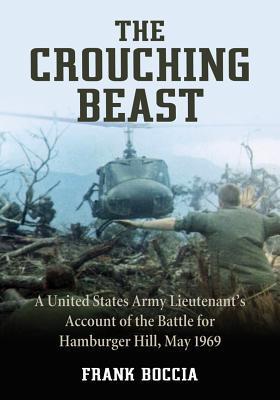
As a first lieutenant in Bravo Company of the Third Battalion, 187th Infantry, Frank Boccia led a platoon in two intense battles in the Vietnamese mountains in April and May 1969: Dong Ngai and the grinding, 11-day battle of Dong Ap Bia--the Mountain of the Crouching Beast, in Vietnamese, or Hamburger Hill as it is popularly known. The Rakkasans, the 3/187th, are the most highly decorated unit in the history of the United States Army, and two of those decorations were awarded for these two battles. This vivid account of the author's first seven months in Vietnam gives special attention to the events at Dong Ap Bia, following the hard-hit 3/187th hour by hour through its repeated assaults on the mountain, against an unseen enemy in an ideal defensive position. It also corrects several errors that have persisted in histories and official reports of the battle. Beyond describing his own experiences and reactions, the author writes, "I want to convey the real face of war, both its mindless carnage and its nobility of spirit. Above all, I want to convey what happened to both the casual reader and the military historian and make them aware of the extraordinary spirit of the men of First Platoon, Bravo Company. They were ordinary men doing extraordinary things."
This book is the memoir of Lieutenant Frank Boccia, who was in charge of First Platoon, Bravo Company during May 1969, when the battle of Dong Ap Bia took place in Vietnam. Known as Hamburger Hill to Americans, it achieved notoriety because of the strikingly high number of casualties that the Americans suffered there. Bravo Company lost fifty percent of its men, many of them Boccia's.
Many years later, he wrote this memoir, retrospecting about those men, himself, and their time in Vietnam. As he underscores in the beginning, this is not a work of history. His goal has not been to write a historical account of the battle, but to share his personal experiences during the Vietnam conflict. This is why he starts his narrative five months before Hamburger Hill, with his arrival in the mountains of Vietnam as a young, inexperienced lieutenant, trained but not ready to take over a platoon and the responsibility for its members' lives. His story effectively conveys what it was like to be an infantryman during the Vietnam conflict and what it is like to be a soldier in general. He shares everything – the sad, the nasty, and the funny.
The author's vividly descriptive writing made reading his account feel like watching a movie. He depicts the experience of the American soldier in Vietnam, from the C-rations to the exhausting hiking up hills, to the scorching heat and humidity, so beautifully and precisely that I could easily see every scene unfold before my eyes. I know other good war memoirs, but this is the first one that managed to immerse me in its setting to such an extent. I shivered together with Boccia and his men in the freezing cold nights of Vietnam – as high as the temperatures were during the day, at night they dropped way below what the soldiers dressed in fatigue shirts and small ponchos could endure comfortably. I scrunched my nose at the smell of diarrhea when the platoon had to climb steep hills after being poisoned by the special dinner served to them on Christmas. Sadness overwhelmed me when I listened, together with Boccia, to the personal tragedies of his men, and I triumphed when one of them survived the worst infection that the surgeon had ever seen.
The author's impressive writing skills are not the only thing that make his narrative sound like a movie. He depicts a cast of characters that all fit into different stereotypes. There was Robison, the commanding officer, a man of short-temper and many caprices, with whom Boccia butted heads multiple times a day. There was the calm, greatly knowledegable platoon sergeant Wright with fifteen years of army experience behind his back, who taught Boccia how to read the terrain correctly. There were Muldoon, the combative platoon medic who had neither the discipline nor the desire to serve but bore challenges with remarkable stoicism, and Dickson, a platoon leader whose immaturity, arrogance, and unwillingness to make an effort led to disastrous situations, such as his platoon almost shooting Boccia's platoon in the forest. There was Weldon Honeycutt, the new battalion commander, who wanted to be called Black Jack – a brutal, demanding, and egoistic man, he was never pleased with anything and pushed soldiers to their limits in his pursuit of victory. Of course, there was also Boccia himself: a Georgetown-educated, Jane Austen-reading, handsome, young, and impatient Italian-American lieutenant, who, in the words of his friend and fellow platoon leader Jerry Wolosenko, enjoyed losing his temper more than anyone else.
When these men were forced to work together, countless stories, many of them comedic, were made. It is actually the author's humor that makes his work so enjoyable to read. Almost every page offers a piece of hilarious banter, mostly between Boccia and Robison, or a hilariously critical comment about the author's abilities as a leader, or a misunderstanding or a tactical miscalculation with comically disastrous results. I had never thought that a war memoir would have me laughing out loud, but the author's humor is so on-point that I kept cracking up.
Notably, I liked the author as a person. In an environment in which it was easy to become brutal, he remained kind and brave. He had a genuine concern and appreciation for the men in his platoon, and he put effort into making them feel safe and comfortable. Knowing that trust was essential for good discipline, he became someone whom they could trust and rely on. Had there been more leaders like him in Vietnam, the American soldiers would have probably committed fewer atrocities.
THE CROUCHING BEAST is brilliantly written. Boccia knows how both to amuse and to touch the reader. This book will be of interest to anyone who would like to read a great war memoir.
This isn't the Hamburger Hill you're looking for--but you should be. Boccia's book works because, and despite, being a grunts-eye view. He arrives in Vietnam, has a month of hair-raising and hilarious adventures as a 2nd Lt, and, wham, runs smack into Division strength NVA. Drained of all politics, the author's trying to be a good leader of men, a good killer of the enemy, a dispassionate hater of the US Air Force and, ultimately, a survivor. What he never got to do, until now, is correct the misimpression of dozens of books and two movies, that we lost the battle. We didn't and, with a fine literary sense -- and to the tune of Brahms 4th -- Boccia's book is a must.
Added 15 Nov. 2016
I attended Frank Boccia's funeral at Arlington National Cemetery. It was a lovely service -- beautiful, warm fall day, colorful leaves, brass band, horse-drawn caisson, 21 gun salute -- but the wreath below was in the chapel and at graveside. All Boccia's buddies, including Colonel "Blackjack" (who told derisive stories about Colin Powell when the latter was a subordinate commander), said Frank would be laughing his butt off.
An exceptional grunt's-eye view of the grisly fighting for Dong Ap Bia (in U.S. popular culture, Hamburger Hill) during April and May of 1969. Within the canon of Vietnam War writings, Boccia's The Crouching Beast is a fine nonfiction complement to Marlantes' Matterhorn. Boccia's book is undermined by containing no maps to go along with a story closely-tied to geography. At 453 pages of text, it was 50-60 pages too long. A sharp editor's pencil could have worked wonders. A solid Four Stars in my library.
This is the best first-person account that I have read of combat in Vietnam. It reminds me a bit of Eugene Sledge's account of his time as a Marine in the Pacific in WW2, but Boccia's account is better written, if sometimes a bit florid. One thing that Boccia is really good at is describing the forest, weather, and terrain in which he lived during his battles; Boccia did an amazing thing, for a soldier in combat, he took the time to notice the beauty (and frequent misery) around him in the tropical forests of Vietnam. But the central and vital story that he tells is the life of a platoon leader in combat, and of his deep respect for the men he led. His respect and love for the men who bore the brunt of the hard work of jungle fighting is unstinting. At one point, after witnessing an almost superhuman effort by a squad in combat, he is humbled, and says, "No officer could ever be so good as to be worthy to lead such men".
Boccia's description of the ordinary life of a light infantry soldier is so true, and so realistic and detailed that anyone who has ever served in such a unit will immediately start nodding in agreement and recognition. I happen to disagree with him on the edibility of C-rations, but tastes differ.....;-) Boccia was a Georgetown graduate, an unlikely person to be found leading a platoon in the US Army in 1969, but he was also an immigrant who did not take his adopted country for granted. His experience mirrored mine in many ways; he comments that if he had not gone into the Army, it was unlikely that he would ever have known, or known well, the kinds of people he led; pipe-fitters from Delaware, grocery store clerks from rural North Carolina, farm boys from Minnesota. And he describes perfectly the relationship between a good platoon sergeant (Sergeant Wright) and his officer, and how each is dependent on the other in ways civilians might find hard to understand.
At one point, Boccia and his platoon descend a mountainside, and Boccia makes an excellent observation after finding 2 kilometers of massive steps made of hewn tree trunks that the North Vietnamese Army installed into the side of the steep mountain bordering the A Shau Valley to facilitate movement of their troops: if the North Vietnamese were motivated enough to do that, to organize the immense labor required to build those steps, what chance did the US Army have to defeat such an enemy on their home turf? Maybe if there had been four or five times as many US soldiers on the ground as were actually deployed - maybe. But US combat troops never came close to matching NVA forces in the field, not in total; there was occasional numerical superiority in certain battles, but never in totality.
What were President Johnson and his advisors thinking? In my opinion, at least part of the problem was that they believed the generals, who said the Army just needed to keep fighting battles like Hamburger Hill to destroy the NVA by attrition - hence the famous "body count". But the NVA body count claimed by the US Army at Hamburger Hill was 630, which represented 1/10 of 1% of the approximately 680,000 NVA soldiers, not counting about another 50-100,000 Viet Cong. So, extrapolating US deaths at Hamburger Hill, in order to have crippled the NVA effectively, at least another 100 to 500 battles like Hamburger Hill would have to have been fought, which would have implied another 7,000 to 35,000 US deaths to accomplish that goal, at least, because men die in many other ways in combat zones, mostly through accidents. And that could have been done only if (a big if) the US forces could have located two regiments or so of NVA for each of those battles; NVA regiments whose commanders were willing to fight, as happened at Hamburger Hill. Usually the NVA faded away without a real battle, because they knew that all that was required for them to win was not to lose, to keep the NVA in existence in the south in places like the A Shau Valley. And yet Generals like General Zais, commander of the Division (the 101st) to whom Boccia's battalion belonged, explicitly said their goal was to destroy the NVA by fighting multiple battalion- and regiment-sized battles to attrit the enemy.
But the above is my opinion, not what Boccia said. What he describes is the bravery and persistence and stoicism of the American soldiers who fought in the A Shau, and he does that superbly. Those men had no say in the grand strategy - they were drafted, reported for duty, followed orders, and lived or died but did their duty. Not for the Army, not for the country, but for each other. It is an inspiring story.
One can't help but compare The Crouching Beast to Karl Marlantes's acclaimed novel Matterhorn. There are differences, of course: Marlantes writes about the Marines, Boccia about the Army's 101st Airborne Division. Matterhorn takes place just south of Vietnam's DMZ, The Crouching Beast farther south in the A Shau Valley. Perhaps the most notable difference is that the Marlantes account of combat in Vietnam is fiction with all its freedoms of expression and imaginations whereas Frank Boccia's memoir is limited to the truth and to his own experience. Still, it's memoir as intensely riveting in its truth as any combat fiction you're likely to come across.
Frank Boccia arrived in country and reported to his unit as a young, inexperienced lieutenant. In some respects it follows the familiar arc of refining skills while moving inexorably toward harrowing experiences in his future. The book covers 7 months of his Vietnam tour.
I puzzled over, while reading, the lack of reflection. Boccia is intelligent and attentive, writes sensitively about the men under him. He writes descriptively about what it was like to campaign in those valleys and along the ridges above them. You learn what it was like to drop by helicopter into a landing zone or what it was like to have to endure one of Vietnam's violent thunderstorms while on patrol. This is writing good enough to put you right there with him. However, he doesn't record wondering about the North Vietnamese. He's a young man new at the war, but he doesn't mention wondering about what contact with them will be like. And he doesn't wonder about his place in the unit's mission, especially what Frank Boccia will be like under fire when they finally contact the North Vietnamese. He displays the confidence of a young Army officer but doesn't give the reader any sense of the anxieties which he must have felt about the dangers to come and how he'd perform under the stress of combat and its responsibilities. Again, a reader of this and the highly autobiographical Matterhorn can't help but compare young Boccia to the rich interiors of Lt. Melas that Marlantes gives us.
The 2d half of Boccia's memoir is taken up with a baptismal action at Hill 1485 and his part in the much larger sweep by 3d Brigade into the A Shau Valley and the controversial assaults to take what came to be known as Hamburger Hill. You won't learn much about the actual course of the 11-day battle. Boccia's telling of it is limited to Bravo Company's part, though it's searing and fascinating reading. From start to finish this is a compelling read, but especially on Hamburger Hill.
If one can find a damaging criticism of the book, it's that it needs maps. They would have added a graphic illumination and clarity to the narrative. This is most true in the long account of the assaults on Hamburger Hill. It's difficult to picture the swirling movements of Boccia's elements in that chaotic terrain without some visual aid.
But though the book lacks maps, it's full of courage and the "nobility of spirit" Boccia said he wanted to convey to readers. It's a gritty description of what Vietnam was like for a young Airborne officer. It's a gritty page-turner of a read.
This is an outstanding Vietnam War read. I liken Boccia’s book to the EB Sledge masterpiece, With the Old Breed. This is a Platoon Leader’s experience in Vietnam which includes the battle of Hamburger Hill. The first 150 pages or so is relegated to patrolling and humping mountainous jungle. The terrain sounds brutal and not what I imagined. The relief is incredible and there are grasses that will slice through your skin.
At some point the shooting starts and helicopters are falling out of the sky. The young platoon commander, under fire and intense pressure, does the right thing, only to have his ass chewed by the battalion commander. Boccia takes part in several attempts to capture and dislodge the NVA bunkered at the top of the hill, losing soldiers in his command and friends from OCS in the process. About 30% of the casualties, Boccia attributes to friendly fire such as ARA which he fears more than the NVA mortars.
Boccia’s perspective and introspection of the battle is invaluable to the military history reader. He brings the Vietnam war to the reader in the same manner is which EB Sledge brought the battles of the Pacific to his reader. Boccia’s learning process is a trial by fire. Along the way he has to deal with a fellow platoon leader that is a sad sack. He has to rescue decimated company and nearly relieve a company commander that has lost his nerve, telling him white lies to coax him into his own company perimeter and out of harms way. He has to retrieve pieces of his own KIA and get them off the battlefield so that the rest of the men are not unnerved by the sight and smell. Boccia’s war is nearly as ugly as as Sledge’s war but with its own twists and turns.
This should be required reading for NCOs and Platoon Leaders and anyone that would like a better understanding of the Vietnam War.
Frank Boccia's account of the bloody and controversial Battle of Hamburger Hill has nothing to say about the politics or strategy of this event, media coverage of which altered American public perception of the Vietnam War. Instead Lt. Boccia gives us a detailed view of the battle as experienced by one junior officer. The reader is left with as little knowledge of the big picture as the participants had, a narrative technique that enhances the impact of this powerful book. Lt. Boccia shares with us his most intimate thoughts and emotions, evoking a reality that is more intense and believable than any motion picture. As one who spent the war behind a desk in the CONUS, I can only wonder if I would have been as dedicated and brave as Lt. Boccia and his men if our fates had been switched.
A testament to the vastness of the human spirit. I was amazed by the detail in this book! Mr. Boccia transports the reader into his experience in Vietnam, leaving one feeling as if they were there and became acquainted with the many different personalities that he so deftly describes. I found the personal interactions and dialogue to be very authentic and chuckled often at some of the personality that was so clearly displayed. The stories about Westman and Logan, in particular, touched my heart. I won’t give any of it away, but it moved me and really put a face on a war that I had previously only learned about in college. I’ve said this many times before, and I’ll say it again - there is nothing like reading about these men’s experiences to put your own life struggles into perspective. I would recommend everyone read books such as this one to get a glimpse of what hardship and honor really is. “…There are more damn ways to get killed around here.” The book spares no gory detail of the bloodshed and death of the war. I did not realize and found it quite disturbing that so many of the deaths during the Vietnam War were due to “friendly fire”. So many young men lost… Who knows what they could have gone on to do with their lives. Mr. Boccia eloquently states, “Thank you, if You do exist, for allowing me the privilege of knowing these men.” This book is not only the story of a battle fought now long ago, but it is the story of the transformation of a man. I thank YOU, Frank Boccia, for allowing ME the privilege of getting to know these men, even if only to read about them in a book.
Phew this was a hard read but not because it was poorly written.
Frank Boccia was a leader of men in Vietnam and things were fairly sedate in the first couple of weeks as they entered the jungle. Still this part was not boring as the author describes how incompetent his superiors were and how poorly supplied the troops were. Also went in to great detail how one of his men received a truly sick and disturbed "Dear John" letter. The soldier's wife truly was a nasty piece of work. Also the boredom, sheer humidity and then freezing cold at night. In addition removing leeches from each other in some truly terrifying places!
Then the author and his men reach the infamous Hamburger Hill battle and boy what a mood shift. The change in the tone and urgency of his writing style really painted a vivid picture of what the guys in Vietnam went through. Hamburger Hill was a gruesomely tough battle and men were lost to RPGs and Claymores and enemy fire but more horrifyingly so called "friendly fire" when fire missions go tragically wrong.
It was a hard read because you almost felt you were there. You can feel Frank's anguish as he loses man after the man. You feel his anger as bodies cant be medivaced out as it is too dangerous for the Choppers so eventually the bodies start to decompose and putrify.
This is a really excellent and well written first hand account of a platoon leader in his time leading up to and then through the fight for Hamburger Hill (Dong Ap Bia). I highly recommend.
My perspective is that of a Vietnam combat veteran who morphed into a college professor and clinical psychologist. Although my experience was in a different service, a different place, a different enemy and a different perspective, I found myself remembering my thoughts, my worries, my fears and the heavy weight of responsibility as a junior officer committed first to the welfare of his men that Frank Boccia so powerfully communicates.
It is the siege of “Hamburger Hill,” bloody, heartbreaking and frustrating to those who faced it. Military jargon and technical language is inserted not to impress, only to add to the precision to the story line. Frank Boccia is a modest hero, at times humorously self-deprecating, at times startlingly lyrical, at times profound. Make no mistake, The Crouching Beast is a high-action text. Every combat veteran will resonate and re-experience their own memories of the heat of battle.
This is a unique literary work on the Vietnam experience and stands in a class by itself. Rarely do authenticity and command of language come together with a down-to-earth narrative, gripping in its realism and tension, capturing the fear and adrenaline we all felt in those intense moments. Certainly, it is the finest book on Vietnam I have read.
Stunning account of an Italian/American Lieutenant's tour in Vietnam 1969, thrust into the nightmare of Vietnam and the battle of Dong Ap Bia (Hamburger Hill), the meat grinder. A learning experience of what it's like to lead a platoon on patrol in barbaric conditions and horrendous scenarios, Frank Boccia puts you there with the platoon and you genuinely feel the tension and fear. An education. Highly recommend it.
The best book on the realities of the ground war in Vietnam..
I have read many books on Vietnam, a war that was there throughout my childhood. Mr Boccia's writing gives you the best feel if what these men went through. The rights and wrongs of the war itself cannot detract from these men as soldiors. I read Mr Boccia died earlier this year. He has left a fine testament to himself and his comrades.
Lt Boccia served in the same Company as I. It's strange reading about my own life events. I was hoping to thank him for the book, but I was saddened to find that he's gone over. It is accurate and detailed. I had thought the Army poisoned us for Thanksgiving, but after all these years, I find it was Christmas (1969). He was in charge of the first Platoon, so I only 'knew' him as one of the Platoon Leaders. I was an E-4 medic at the time.
One of the very best written accounts of the war - well done airborne!
Not only a great accounting of this particular battle but told in a way that kept me interested and wanting to return to the story as soon as possible - great writer.
Well written memoir that tells why it was really like to command men in Vietnam. Our soldiers deserved so much better than what they received in that time period. It makes it easy to understand why so many men who returned from Vietnam are still dealing with the experience today.
Excellent re-telling of Vietnam’s seminal battle for Hamburger Hill
Frank Boccia’s detailed account of the horrific battle for Hamburger Hill sets the record straight from the error-filled Hollywood recounting. As a LT, Frank’s perspective offers the reader a true sense of what it feels like to be thrust into a literal fight for his and the young men he was responsible for. Just as important, Boccia’s well written narrative paints a vivid picture of what it meant to face the fight of one’s life, not just for a few hours of intense firefights, but to endure for days and weeks the maelstrom of battles, repeatedly; the experience of losing men (very young men at that) as a result of decisions he and his superiors made. We witness both the bravery and the fear of the seemingly unending firefights, mortar barrages, and the cruelest battlefield outcome - friendly fire, getting killed by your own forces. Boccia’s writing is top notch, and the reader is rewarded by getting to know him and the men he served with. You get to know many of these soldiers, as their personalities, quirks and all are so expert;y brought to life. While the gravity of the situation is never undermined, Boccia anecdotes, side stories and experiences are also filled with laugh-out loud moments. The sum of this tale that takes place over several months in 1969 is one of the most accurate and fully-formed accounts of what it was like serving in the Army during one of the most historically significant battles of the much-maligned, misunderstood Vietnam War.
It’s truly amazing what the American soldier can do in impossible circumstances. I just can’t imagine what it would’ve been to go up that hill day after day after day and watch your friends and soldiers get killed. Looking back it’s just inconceivable to me that the leaders of this great country of ours ordered all this stuff to happen in a country that is 12,000 miles away and no one gives a damn about
A well written account of a significant battle that was front page news at the time and should not be forgotten. Boccia transport s the reader to a place you don't want to visit but can't think of leaving till the story is told.
A great recollection of a terrible battle during the Vietnam War by a remarkable soldier and leader. This is the best account written about this battle, and one of the most heart rendering recollections about what it's like to be an infantrymen in combat. A must read for anyone, but especially for a new soldier-leader who has never seen what it is like in war.