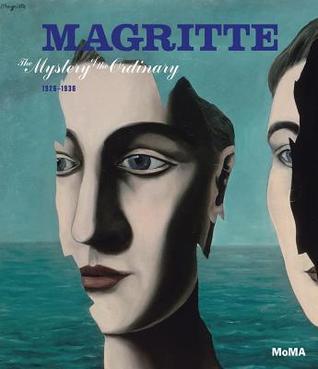
"Challenging the real world”―Magritte’s breakthrough years
Published in conjunction with a major exhibition organized by The Museum of Modern Art, New York, in collaboration with The Menil Collection, Houston, and The Art Institute of Chicago, The Mystery of the Ordinary, 1926–1938 focuses on the breakthrough Surrealist years of René Magritte, creator of some of the twentieth century’s most extraordinary images. Bringing together nearly 80 paintings, collages and objects with a selection of photographs, periodicals and early commercial work, it offers fresh insight into Magritte’s identity as a modern artist and one of Surrealism’s greatest painters. Beginning in 1926, when Magritte first aimed to create paintings that would, in his words, “challenge the real world,” and concluding in 1938--a historically and biographically significant moment just before the outbreak of World War II--the publication traces central strategies and themes from this seminal period, particularly those of displacement, isolation, transformation, metamorphosis, the “misnaming” of objects and the representation of visions seen in half-waking states. The publication also includes an illustrated chronology outlining significant moments in the artist’s life during this period, including travel, connections with other Surrealist artists and writers, contributions to journals and important exhibitions and reviews.
René François Ghislain Magritte was a Belgian surrealist artist. He became well known for a number of witty and thought-provoking images.
Magritte was born in Lessines, in the province of Hainaut, in 1898, the eldest son of Léopold Magritte, a tailor, and Adeline, a milliner. He began lessons in drawing in 1910. In 1912, his mother committed suicide by drowning herself in the River Sambre. Magritte was present when her body was retrieved from the water. The image of his mother floating, her dress obscuring her face, may have influenced a 1927–1928 series of paintings of people with cloth obscuring their faces, including Les Amants, but Magritte disliked this explanation. He studied at the Académie Royale des Beaux-Arts in Brussels for two years until 1918. In 1922 he married Georgette Berger, whom he had met in 1913.
Magritte worked as an assistant designer in a wallpaper factory, and was a poster and advertisement designer until 1926, when a contract with Galerie la Centaure in Brussels made it possible for him to paint full-time. In 1926, Magritte produced his first surreal painting, The Lost Jockey (Le jockey perdu), and held his first exhibition in Brussels in 1927. Critics heaped abuse on the exhibition. Depressed by the failure, he moved to Paris where he became friends with André Breton, and became involved in the surrealist group.
When Galerie la Centaure closed and the contract income ended, he returned to Brussels and worked in advertising. Then, with his brother, he formed an agency, which earned him a living wage.
Surrealist patron Edward James allowed Magritte, in the early stages of his career, to stay rent free in his London home and paint. James is featured in two of Magritte's pieces, Le Principe du Plaisir (The Pleasure Principle) and La Reproduction Interdite.
During the German occupation of Belgium in World War II he remained in Brussels, which led to a break with Breton. At the time he renounced the violence and pessimism of his earlier work, though he returned to the themes later.
His work was exhibited in the United States in New York in 1936 and again in that city in two retrospective exhibitions, one at the Museum of Modern Art in 1965, and the other at the Metropolitan Museum of Art in 1992.
Magritte died of pancreatic cancer on August 15, 1967 and was interred in Schaarbeek Cemetery, Brussels.
Popular interest in Magritte's work rose considerably in the 1960s, and his imagery has influenced pop, minimalist and conceptual art. In 2005 he came 9th in the Walloon version of De Grootste Belg (The Greatest Belgian); in the Flemish version he was 18th.
Otro libro hermoso. Solo tiene cuatro ensayos; todos dispares entre sí. Algunos se enfocan en una descripción de las obras reproducidas, otros lo interpretan y los menos los relacionan con la vida del pintor.
Magritte es uno de los grandes: sus pinturas de trazos hoscos van más allá de la representación y son filosofía pura -o tal vez cuentos de terror psicológico-.
Las reproducciones elegidas tienen un buen balance: obras reconocibles hasta en pipas de gas de la Ciudad de México y obras que veo por primera vez. Eso sí, no hay una sola manzana verde.
I have been a great fan of Magritte's work without really knowing why. This book gave me a lot of insight into what he was doing, and perhaps why that resonates so with me. It includes lots of full-page reproductions of his art from the years covered, which was a huge bonus.
Another terrific exhibition catalog with great essays.
A longtime favorite artist. This catalogue supports the big summer special exhibition at the Art Institute of Chicago. This is the second major Magritte show at the Art Institute in twenty-one years. Can we look forward to a third one in another twenty-one years, in 2035? Hope so.