At over 430-pages, MM25 is the ultimate Mega Man artwork collection! MM25 collects the complete artwork behind every Mega Man and Mega Man X game, including character art, concept sketches, game covers, rare pin-ups, and much more. This new edition also features over 100-pages of never-before-published material, plus new tribute art and interviews from the creators behind the blue bomber!
Capcom Co., Ltd. is a Japanese developer and publisher of video games, known for creating multi-million-selling franchises such as Devil May Cry, Ghosts'n Goblins, Street Fighter, Mega Man and Resident Evil. Capcom also developed and published Ace Attorney, Bionic Commando, Lost Planet and Dark Void. Its head office is in Chūō-ku, Osaka. Originally established in 1983, it has since become an international enterprise with branches and subsidiaries in North America, Europe, and East Asia.
Visually stuffed with a ton of imagery, but for all 450-ish pages, this is a very surface-level treatment of the Mega Man franchise. Some great nuggets and moments, but pretty wide and shallow. I'm still waiting for the exhaustive, behind-the-scenes book that covers all of these games in appropriate detail.
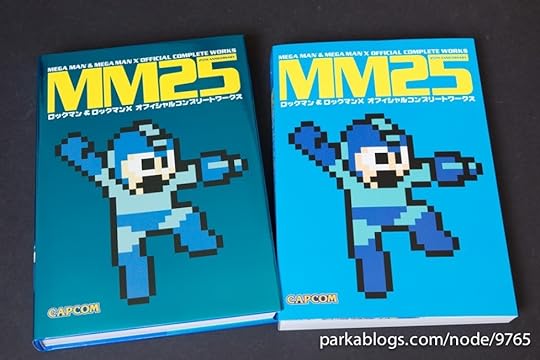
This time, for the 25th anniversary mega man artbook, Udon has retained the single book format of the Japanese edition. In addition to the standard paper edition, there's the limited edition featuring a gorgeous blue laser foil hardcover. As with Udon's limited editions, they are only available on Udon's online store.
The books debuted at San Diego Comic Con 2013 and sold out promptly. Retail copies will be available in August 2013.
This new edition has 432 pages, of which 96 pages of new content. The binding looks strong enough for a book this thick, but I will still be careful not to damage the spine though, for the paperback edition.
Majority of the content remains the same, and there are minimal layout changes. Much of the new content comes from Mega Man 9 & 10, miscellaneous art from gaming cards, and interviews with the illustrators Tatsuya Yoshikawa, Haruki Suetsugu, Hideki Ishikawa, Ryuji Higurashi, Keisuke Mizuno, Kenta Saito and Yuri Kataiwa.
I've reviewed the earlier editions before so I'll not repeat much. This is an awesome book packed with an astonishing amount of art for the characters and merchandise. You'll flash back to your childhood days when Mega Man first came out in 1987. Since then, there have been so many sequels and the expansion into the X series and other spinoffs. There are forty over titles and art for all are inside the book. That should give you an idea of the scope of the book.
This is a book all Mega Man fans should have. Highly recommended.
Should you get the book if you have the two earlier books? It depends on whether you want the Mega Man 9 and 10 art.
Just reading back through this again. It's such a well produced art book, not just within its super-narrow genre (video game art), but in general. Almost every page is lined with interview snippets about the specific art we're seeing, which is great for getting stories about the sort of tools and environment the artists were working in at the time. The artist interviews were also conducted in a group setting, which means the interviews have a conversational feel to them. Artists will comment on each other other's work and remind each other of things that happened around the time the art was being made. Subject matter covers everything from the art itself to the games' programming, as well anecdotes about the older machines they were using to produce the art, and the office drama unfolding around production. It's a great collection of the art I mimicked as a kid to learn how to draw, and it's taken to new heights by these modern interviews with the artists about their old work.
I'm learning Mega Man fans are a unique breed of fan. Originally the contents of this book were split into two separate releases that quickly sold out. This was announced as being released for Mega Man's 25th year and of course, I had to have it.
I was not disappointed.
Mostly.
I wish that it went even more in depth than it did, but it never strayed from its focus. It is attempting to be both an art book and a textual exploration of each game in the first two Mega Man franchises. To that end, it succeeds.
It is also a beautiful book to just have lying around.



 (
More pictures on my blog
)
(
More pictures on my blog
)


