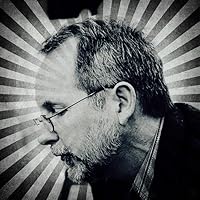
Explosive language, rough sensuousness, and an unflinching eye — here is a poet who doesn't look away and is committed to poetry’s first to bring song. Tombo is a book of lyrics fueled in equal parts by realism and big-fish storytelling, a book of wanderers, foghorns, summer rain, feral cats, and city jazz. Built on heartbreak particulars, these poems are raw, mysterious dilations of the moments of existence. Di Piero’s work has been praised by luminaries of the poetry world like Philip Levine, John Ashbery, Christian Wiman, the editor of POETRY, and also by The New York Times, the Philadelphia Inquirer, and the San Francisco Chronicle.
William Simone Di Piero was born in 1945 in Philadelphia, Pennsylvania and earned degrees from St. Joseph’s College and San Francisco State College. A poet, essayist, art critic, and translator, Di Piero has taught at institutions such as Northwestern University, Louisiana State University, and Stanford, where he is professor emeritus of English and on faculty in the prestigious Stegner Poetry Workshop. Elected to the American Academy of Arts and Sciences in 2001, Di Piero was awarded the Ruth Lilly Poetry Prize in 2012.
Di Piero’s poetry is known for its gritty realism. Populated with characters and settings reminiscent of the South Philadelphia neighborhood of his boyhood and the Italian-American working-class families he grew up with, Di Piero’s poetry frequently makes use of colloquial language and diction.
An award-winning translator of Italian poetry, Di Piero’s first translation, Giacomo Leopardi's Pensieri, was nominated for a National Book Award. Other translations include Sandro Penna's This Strange Joy, which received the Academy of American Poets Raiziss/de Palchi Translation Award, Leonardo Sinisgalli's The Ellipse (1982) and Night of Shooting Stars (2011), and a translation of Euripides’s Ion.
W.S. Di Piero has won numerous honors and awards for his work, including fellowships from the Guggenheim Foundation, the Ingram Merrill Foundation, and the Lila Wallace-Reader’s Digest Fund. He lives in San Francisco.
I love the mix of nature’s rhythms and urbanity’s music, of the movements of birds and trees and the slow motion of domesticity. And the espying of love. It’s not a keeper of a collection for me, but it has a handful of gems.
Favourite Line: “Be constant in / inconstancy, love, / be the kingfisher / flying from the wire.”
Favourite Poems: One Night at the End of Winter, Que Tal, The Black Paintings: The Mouth
My review for the San Francisco Book Review: Words follow words like autumn leaves racing each other atop a rushing stream, swooping and spinning, each glistening in dappled sunlight or hiding in spots of shades until it catches another current to spurt ahead. Sentences Faulkneresque in length yet reminiscent of William Carlos Williams in their simplicity and naked power fill this slim volume. Di Piero’s words will take readers back to times past and places of uncertain memories, evoking feelings as strong and as deep as an ocean eddy, jerking readers out of complacency and into a kind of raw reality. There is a breathlessness to his writing, as if he has to get these words out before they escape from his mind into some other work of literature, but he holds them close, picking and choosing exactly the right words to build his images and stir the emotions of his readers. None of those readers will remain untouched by these poems. De Piero’s poems are earthy and organic, yet have such sophistication there is no doubt his work belongs in the most serious study of modern poetry.
“Breakfast again, like the one once here with that one he lost—we become so lost in the sorry whiteness of our kitchens, and like children lost in a monstrous wood, We panic. It’s too hard to find our way.”
i struggle with appreciating these poems as i think they approach the world in such a different way than how i view it that they almost seem like a foreign language to me. especially rhapsodizing about the beauty of san francisco, i guess i sometimes was thinking to myself "man is he serious?" but he is, and he is a respected/celebrated poet. so i think it just wasn't my cup of tea.
I liked a lot of this book and there are many wonderful lines and turns. But as a poetry mentor once admonished me: more chips with the salsa please. There is an awful lot of ornamentation and flourish in need of something to decorate. In high school and friend and I would try to express ideas using the most complicated terms we could pull out of a dictionary, and I felt like this was how many of these poems were revised: rather than coming away with a "wow, I want to read that one again!" too often my reaction was "wow, that was -- I better read that one again to make sure I didn't miss anything." And too often what is to be got is really simple (not a problem!), just not very simply stated. So the reader is left to admire Di Piero's considerable command of language, simultaneously filling in missing punctuation to make it a bit more palatable.
A lot of lines where "we see one lean redbreast / jumping branch to branch, few leaves fall, / there's no frost, a jaybird cuts across our view" ("Walking the Duboce Triangle"), so that we may feel that same sense of loss in observed & lived-in moments pulled-apart by Di Piero, of "the indifferent world / that rivers through and past me" ("Tombo"). Oh there are other things too (sentences that careen between the expected word and the unusual, lively one, San Fran & a little Philly, the ocean's mood and it's corresponding rain) but the part about loss & birds worked for me.
Favs: "The Running Dog" . "Imagination Running Away" . "Que Tal" . "There Were Such Things . "The Birds of the Air."
W.S di Piero is one of the true elder statesmen of American poetry today and I was sent this book to review for a literary journal, knowing it would be of high quality and knowing that it would be fascinating. In places, it stays a bit too close to expected topics and approaches, but overall it doesn't disappoint and it showcases some of the poet's best writing, in my opinion, of his long career.
I've been enjoying the diverse poetry from the McSweeney's Poetry Series. Tombo is the sixth volume in the series. Our world doesn't always appear to leave brain space or time for poetry, but it's worth finding that time and space now and again. Perhaps that is part of why I enjoyed the poem "Starting Over."
A few other favorites: --The Running Dog --Late Lessons --The Goldberg Variations
Beautiful collection. Strong California flavor, especially San Francisco. Actually, a strong sense of place is a more accurate description. I was initially disappointed this wasn't available in an ebook version. Seeing the care McSweeney's took with the print version, now I'm glad. A lovely collection to treasure. Note: this is a slim volume, don't go in expecting 1000 poems.
Favorite poems: Imagination running away Tombo One night at the end of winter The running dog