Jump to ratings and reviews
Rate this book

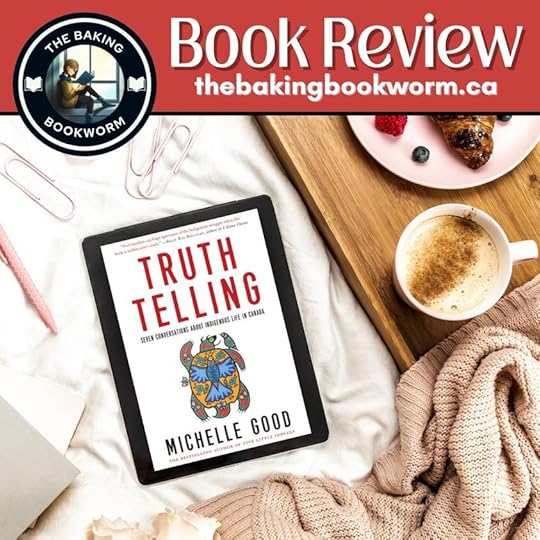
Truth Telling: Seven Conversations about Indigenous Life in Canada

Rate this book
Abold, provocative collection of essays exploring the historical and contemporary Indigenous experience in Canada.

With authority and insight, Truth Telling examines a wide range of Indigenous issues framed by Michelle Good’s personal experience and knowledge.

From racism, broken treaties, and cultural pillaging, to the value of Indigenous lives and the importance of Indigenous literature, this collection reveals facts about Indigenous life in Canada that are both devastating and enlightening. Truth Telling also demonstrates the myths underlying Canadian history and the human cost of colonialism, showing how it continues to underpin modern social institutions in Canada.

Passionate and uncompromising, Michelle Good affirms that meaningful and substantive reconciliation hinges on recognition of Indigenous self-determination, the return of lands, and a just redistribution of the wealth that has been taken from those lands without regard for Indigenous peoples.

Truth Telling is essential listening for those looking to acknowledge the past and understand the way forward.

5 pages, Audible Audio

First published May 30, 2023

232 people are currently reading
5296 people want to read

About the author

Michelle Good

3 books653 followers
Michelle Good is a writer of Cree ancestry and a member of the Red Pheasant Cree Nation in Saskatchewan. She obtained her law degree after three decades of working with indigenous communities and organizations. She earned her MFA in Creative Writing at UBC, while still practising law, and won the HarperCollins/UBC Prize in 2018. Her poems, short stories and essays have been published in magazines and anthologies across Canada. Michelle Good lives and writes in south central British Columbia.

Ratings & Reviews

What do you think?
Rate this book

Friends & Following

Create a free account to discover what your friends think of this book!

Community Reviews

5 stars
1,388 (51%)
4 stars
1,053 (38%)
3 stars
228 (8%)
2 stars
25 (<1%)
1 star
7 (<1%)
Displaying 1 - 30 of 337 reviews
Profile Image for Laurie • The Baking Bookworm.
1,810 reviews516 followers
July 6, 2023
4.5 STARS -

This small book is a set of seven essays that packs a powerful punch. It is a book that I took my time with, reflect up and reassess what I was taught in school as a Canadian non-Indigenous person, what I saw in the media and read in books.

Truth Telling should be required reading in high school. Good pulls no punches in describing how Indigenous peoples have been and continue to be treated by the Canadian government and society. From the beginning of colonization and our government's planned pillaging of Indigenous land, intentional starvation and subsequent genocide of Indigenous communities and their culture; to residential schools that resulted in intergenerational trauma, to our government's encouragement of racism and misinformation about Indigenous Peoples.

This is a well-written, often emotional call to action and request for non-Indigenous Canadians to stop viewing history through the colonial lens. It is a time for action, not continued apologies. As Good says

"Let the age of the apology end. We don't need any more apologies. We need an acknowledgement of the harm that's been done. We need a mea culpa, followed by full and proper restitution". - pg 30


Readers need to understand and acknowledge:

From those very early days, Canadians bought into the myth of Canada as the benevolent provider to Indigenous Peoples as opposed to the colonial oppressor determined to control the valuable resources on Indigenous lands. - p 52


Truth Telling is a request for non-Indigenous Canadians to do better. To ask questions, to learn more and understand what restitution means.

Truth Telling is important in that it restores the human dignity of the victims of violence and calls governments and citizens to account. Without truth, justice is not served, healing cannot happen, and there can be no genuine reconciliation between Aboriginal and non-Aboriginal peoples in Canada - pg 54



Thought-provoking, emotional and provocative, Truth Telling is a book that will shock many non-Indigenous readers, but will hopefully inspire the much needed action so that we can honestly and truthfully reconcile with Canada's dark colonial past.
Profile Image for Andrew Di Rosa.
100 reviews12 followers
June 13, 2023
7 Stars. One for each of these highly important, insightful and incredibly thought provoking essays. Heartbreaking, full of joy, pride and deeply provocative. This book should be required reading in every history class across this country. Michelle Good does it again.

“No Canadian can feign ignorance of the Indigenous struggle when this book is in arm’s reach”.
Profile Image for Drew.
150 reviews8 followers
June 4, 2023
This should be required reading.

I read this alongside “Sisters of the Lost Nation” by Nick Medina and they worked really well in dialogue.
Profile Image for Shannon.
8,309 reviews424 followers
June 19, 2023
A MUST READ!

Part brutally honest truth telling of Indigenous treatment in Canada and part personal and family history, this collection of essays are deeply heartfelt calls to action for individuals and politicians to finally make true changes to work towards improving Indigenous relations, treatment and respect.

The author doesn't shy away from talking about intergenerational trauma, residential schools, the Sixties Scoop, land appropriation, racism and the violence and mistreatment of Indigenous women (through forced sterilization, rape and murder) - including her own history of rape, anxiety and cPTSD.

Eye opening and likely shocking for some readers, this is a book everyone should be reading and hopefully will go towards inspiring the type of change we so desperately need in Canada. Good on audio read by Megan Tooley.

**I especially enjoyed the author calling out Joseph Boyden and Carrie Bourassa (among others') attempts to appropriate Indigeneity in her chapter on Cultural pillagers and the damage their actions cause to actual Indigenous people!
Profile Image for Natasha Niezgoda.
932 reviews244 followers
July 20, 2024
I learned so much about indigenous people (in Canada and in general). However, the lack of recognition, sovereignty, and legitimacy of all indigenous people isn’t surprising - which is a fucking sad reality. The consistent white-washed and farcical “truths” continue to out weigh the truth of colonialism and its devastating impact on Canada’s indigenous community.
Profile Image for Ratso.
186 reviews
July 27, 2023
I was particularly interested in the essays where Michelle shared her own story a bit, as well as the one about the Indigenous literary canon and the one about Pretendians. SUPER INTERESTING STUFF.
723 reviews3 followers
May 31, 2023
If you've read Five Little Indians by Michelle Good, then you already know that she is a fine writer and a compelling storyteller. Her new book is also compelling and pretty powerful.

Introduction: "Truth is more than fact."
We need to "move beyond...positional and confrontational relationships and into functional ones dedicated to functional change." She talks about the effects of colonization being economic exploitation, and she returns to this theme throughout the book. She challenges non-indigenous people to not only talk but to act.

Residential Schools: Taking of land by colonizers happened without consideration of the interests of Indigenous people. Broken treaties and the slaughter of buffalo was intentional starvation of Indigenous people, and that violence has extended to very recent history. First steps for the government were to civilize the savages through education and to transition them from hunter-gatherers to farmers. However, inadequate tools were provided to encourage farming. From 1885, potlatches were illegal since they were anti-Christian, and by 1920 indigenous children were required to attend residential schools as a further attempt to stomp out indigenous culture. Good calls this colonial violence genocide, and she expressed that apologies for this are inadequate.

Lucy & the Football: This is a reference to Lucy in the Charlie Brown comics promising not to pull the football away from Charlie Brown, and as he runs up to kick it, of course she pulls it away. She makes the point that Canadian promises are pulled away each time, and the Indigenous Charlie Browns are left with empty promises. She says that the promises of the Truth and Reconciliation Committee (TRC) have yet to be realized, and that reconciliation is "setting things right" with societal change at the roots. There must be truth, justice and healing to achieve reconciliation. We don't just want Lucy to hold the football as promised, but to actually set aside her need to control the ball.

Racism: Exorbitant rates of TB in the residential schools, generations of conditioning by non-indigenous people to believe that Indigenous people are less than human and can be disposable. Indigenous women who have been abused, raped, sold, and gone missing is proof of the disposable Indian. "Colonial archtypes...have become...normalized and form a Canadian 'common sense'" which is wildly inaccurate.

$13.69: Michelle Good spent 5 years in residential schools, and her "sixties sweep" compensation amounted to $13.69 per day for that time she spent being physically, emotionally and sexually abused. She asks us if that is adequate compensation.

Rise and Resistence of Indigenous Literature: Good writes that most of Canada's history is written by colonizers and descendants of non-indigenous people. The 1960's saw the Hawthorne report which provided a "lightning rod for change" which has not been realized yet. It was also the beginning of Indigenous literature, which grew slowly until about the 1990's when it began to expand more quickly. "Indigenous writers play such an important role in fostering non-indigenous understanding."

Cultural Pillagers: The legal definition of "Indian" comes from the Indian Act that was discriminatory. Bill C-35 in 1985 tried to correct this but ended up excluding others rather than addressing the problem completely. The U.S. uses a blood quantum system for measuring whether someone is an Indian, but this will never be used in Canada. Inevitably some non-indigenous people will try to pass themselves off as indigenous ("pretendians"), but Good describes these people as an invasive species that have a destructive influence. "Pretendians only pop up where lucrative opportunities await them."

Land Back: Good writes that "the government's intention is to terminate us Indians". She reports that the Supreme Court of Canada recognizes the "collective nature of land titles", but then they uphold fishing rights and mining rights of non-indigenous people. She said that Indigenous people agreed to share the land, not disinherit themselves. She concludes that "We must have the land back in order to return to a self-determining state." She makes the point that 89% of Canada is public land, and that Canada should begin returning it.
Profile Image for Sarah.
472 reviews79 followers
July 30, 2023
7 essays. Author / lawyer Michelle Good presents the evidence and makes convincing arguments of “the truth behind the myth of Canadian history”. The history of indigenous literature in Canada, Pretendians, Wet’suwet’en protecting their legally recognized and unceded land, the Land Back movement, Residential schools, reconciliation and more. Not what I learned in school and absorbed from growing up in this country but once you know, you can’t not know.
Profile Image for Rebeccah.
413 reviews22 followers
July 16, 2023
Really good! Very thought provoking essays that highlight how hopelessly inadequate our education system is when it comes to teaching indigenous issues and centring indigenous voices and perspectives. I learned more in a four hour audio book than I did in my entire secondary education. Highly recommended.
Profile Image for Paige Pierce.
Author 8 books140 followers
October 14, 2024
4.5/5

Quick but informative and personal - would highly recommend to anyone looking to engage with authentic Indigenous experiences of injustice, discrimination, and the path forward to reconciliation
Profile Image for Jamie.
78 reviews
January 7, 2024
Excellent book. A must-read for all Canadians. Questions about what truth and reconciliation looks like in action? Read this book. This is how we change.
Profile Image for Abby.
88 reviews1 follower
July 1, 2023
An absolute must read. Loved the collection of essay style, reading about specific topics injected with history (told correctly), personal anecdotes, and work to be done in the present day.
Profile Image for Robin.
17 reviews25 followers
July 8, 2024
4 stars. It would be 5 stars, but the author ignorantly asserts imperialist propaganda about Uyghur Muslims in Xinjiang. Solid understanding of settler colonialism in a N. American context. Great work on that. Then she parrots the "correct" position on China every progressive is supposed to without any deeper understanding of the history or geopolitics. Quintessential liberalism. I'm sorry, but spreading propaganda manufactures consent for the coming war with China. That virtue signaling bs has real world consequences.
Profile Image for Dayla.
2,904 reviews221 followers
February 19, 2025
I'm grateful to audiobooks because they help my brain focus on books I normally wouldn't pick up but are incredibly important. TRUTH TELLING is such an incredibly powerful collection of essays, that I urge everyone to read it.

There were definitely instances where I had to pause my audiobook to just say "wow", or to just be incredibly angry and disappointed. I have a complicated relationship with Canada and its history, but the topic of Indigenous peoples and how wronged they have been and continue to be in this society will always make me so angry.

The author shares her own experiences with how the government "repays her" monthly and how her family was affected by the crimes committed against them. We also get some insightful history lessons and, to be punny, some truths that desperately need to be told. Also, the subject of people faking their Indigenous ancestry in order to benefit from certain things like publishing was so eye-opening.

This book is short and to the point--I recommend TRUTH TELLING to all. It's important and powerful!

Happy reading!
201 reviews2 followers
August 30, 2025
Overall, the book is informative about various discussions and issues happening in Indigenous communities in Canada, with a decent amount of historical and cultural context. I'm grateful for the stories she shared, and I learned a lot, I'm sure baring some of her own trauma and abuse was not easy. However, I wanted so much more. "Truth" is such a hard, messy concept, and I wish this book engaged with that more.

The chapter on Cultural Pillagers is... a lot. The author claims she doesn't advocate for blood quantum (citing that it's a "legal term exclusive to the U.S." so it can never really apply in Canada) while conflating Indigenous race, ethnicity, culture, and nationality, getting dangerously close to ethnonationalism. "Would anyone claim to be Japanese or Italian or Ethiopian if they had not a single drop of Japanese or Italian or Ethiopian blood?" .... yes??? Those are nationalities??? Nearly every single country in this world (save for Myanmar and Palau) has a legal process that allows people without "a drop of blood" to become citizens of that nation/ Are some nearly impossible in practice, like Japan? Sure! Are some nations famously xenophobic and will tell naturalized citizens that they'll never really belong? Certainly! Asian Americans are seen as "forever foreigners" in the only country they call home, regardless of how many generations of their families have lived in the country. You can criticize Indigenous pretenders without advocating for ethnonationalism, where community members who are not related by blood (even if they meet all other cultural and legal expectations) are always second-class citizens.

Along that line, the author doesn't engage with the painful history of slavery within First Nations, with a throwaway line about how "slaves in such [Indigenous] communities experienced nothing like that of Black slaves in America. They were fed, cared for, and often lived out their entire lives in the community, having families of their own." ... Aligning with the "benevolent slave owner" talking point is certainly a choice... A choice that avoids accountability, reflection, and "the truth." It is also interesting that the author fails to mention Afro-Indigenous members and any issues they may experience with their Indigenous identity being recognized. Proclaiming Our Roots is a cool project that records the oral histories of Black Indigenous peoples in Turtle Island. The plant metaphor she uses is also a messy misrepresentation of what the literature in plant ecology says, Ren wrote a great explanation of it in their review.

More broadly, for a book on truth telling, I wish the author had engaged more with the inherent complexities of what "the truth" is, and how multiple truths may overlap and conflict and coexist; the book is too short to meaningfully do this. Two examples:

* On the chapter on the financial settlement for the Sixties Scoop, the author grapples with the mere idea of putting a price to their abuse, and then the disappointment of how low that settlement ended up being (it came out to $13.69 per day for her 5 years in the system, and all individuals got the final amount, so the price per day decreased the longer they were in). This is a powerful discussion, central to the Canadian Truth and Reconciliation process, and what they experienced is abhorrent. However, there's no mention of the Metis and non-status Indigenous people who were intentionally excluded from the settlement, and thus got $0 for the abuse they faced. Their exclusion from the settlement does not undermine the complex feelings around the settlements that were dispersed, but it is not the full, complex truth.

* On the chapter on the growing Indigenous Canadian literature, the author points to the unique storytelling and epistemological style used by Indigenous Peoples of Canada, which clearly differs from much literature from non-Indigenous Peoples in Canada and the U.S. in its circularity, non-linearity, and cultural context, and as a result is often overlooked and dismissed by audiences not used to the style. However, the author says that this is a unique style in the Western canon, which is not true. Latin American literature by non-Indigenous authors, a part of the western canon, is famous for writing in a similarly non-linear style that is dismissed and overlooked by the mainstream North America literary world for similarly being confusing and difficult to grasp. Hopscotch by Julio Cortázar literally has the reader jumping around the narrative, to say nothing of One Hundred Years of Solitude by Gabriel García Marquez. It lacks the cultural specificity of Indigenous writing, but they have their own cultural inside knowledge, too. I also wished she had explored any tension between the Indigenous tradition of oral history and the process of writing down and publishing stories and histories to a mainstream audience. Again, these added contexts don't undermine the importance of the genre, but excluding them do fail to engage with its complexities.
Profile Image for Emily.
47 reviews1 follower
August 7, 2024
This should be in the curriculum for Canadian history classes. Michelle Good systematically dissects the political follies that Canada has ingrained into the way in which land is governed against the indigenous community. Not only does she highlight the pitfalls on where racisms and oppression has been taught to every generation, she also provides solutions and suggestions on how these reparations can be made. A very educational read for someone who grew up and attended school in Canada but 'somehow' was never taught the country's indigenous history.
Profile Image for Ali Shewchuk.
6 reviews
February 10, 2025
These essays are so emotionally charged that you can sense the passion with which the author shares their Stories, Truths, and Experiences. While I was familiar with most of the information mentioned in these essays, I did learn a few new things. It’s important to remember that everyone has slightly different opinions, and there’s always something valuable to take away from reading these accounts. If all you’ve ever been taught about Indigenous life in Canada was in school, I highly recommend picking up this book!
Profile Image for Renay Russell.
330 reviews2 followers
July 29, 2023
This book showcases 7 essays about Indigenous life and issues in Canada. Some of the information I am very familiar with but some was new and shocking to me.
Profile Image for Jessica .
200 reviews2 followers
June 27, 2024
Michelle Good's book, Truth Telling: Seven conversations about Indigenous life in Canada, offered valuable insights and knowledge about past and present Indigenous history and culture. Despite the sadness that Chapter $13.69 brought me, it enhanced my understanding and encouraged me to further educate myself.
52 reviews
August 1, 2025
Audiobook. 3.5/5. Learned a lot listening to this, though there were some parts that weren't overly interesting.
46 reviews
July 25, 2023
A collection of essays. A must read for anyone that wants to learn more about the Indigenous struggle in Canada. I have so much to learn.
Displaying 1 - 30 of 337 reviews

Can't find what you're looking for?

Get help and learn more about the design.