

What do you think?

Fromentin
[...]for things and administering to himself doses of his own keen analysis, he suffered from that curious affliction of dual personality which, twenty-five years later, he described in Dominique: "That cruel gift of being able to look on at one's own life as at a performance given by someone else. Sensibility is an admirable gift; in the order of creation it may become a rare power, but on one condition: namely, that one does not turn it against oneself." Having taken his licentiate's degree, Fromentin pursued his studies for the doctorate. He entered the law office of M. Denormandie. There he met, as fellow clerks, the future lawyer, M. Nicolet, and Forcade de la Roquette, destined later to become minister. Here Fromentin spent his time chiefly in drawing sketches on the desk pads, the margins of legal pleadings, and even the panels of the doors. One day he descended into the courtyard and covered the coach-house, [...].
35 pages, ebook
First published May 29, 2013
Ratings & Reviews
Friends & Following
Create a free account to discover what your friends think of this book!
Community Reviews
Displaying 1 - 1 of 1 review

June 8, 2013
Free download available at Project Gutenberg
Opening lines:
EUGÈNE-SAMUEL-AUGUSTE FROMENTIN-DUPEUX was born at La Rochelle on the twenty-fourth of October, 1820. His family was a very old one and held in high honour throughout Aunis and Saintonge.
Aunis, one of the ancient provinces of France, glows languidly beneath the caresses of a humid sun, enveloped in a thin veil of ocean mists, and at times she seems to float in the midst of her waves and her sands, beneath a sky bounded by remote and indeterminate horizons, vague and immense, like some vast wreckage overgrown with gardens and oases. For more than a century, she was downtrodden by the English. But if she owes them the pain and humiliation of defeat, they at least inspired her with a passion for commercial greatness and a desire for wealth. Through her shipowners and bankers, she amassed riches that permitted her to devote a goodly share of her days to leisure and festivities, for the betterment of her material welfare and the embellishment of her mind. Thus in the midst of this industrious community, faithful to its duties, jealous of its liberty, there was slowly formed a powerful and cultured bourgeois class, eager for all forms of intellectual improvement.
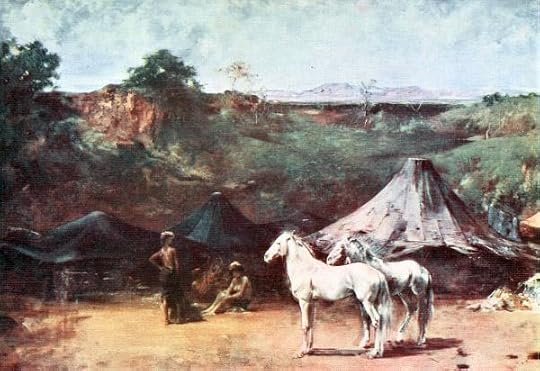
PLATE II.—THE ARAB ENCAMPMENT
(Musée du Louvre)
Against the sombre verdure of the oasis, the whiteness of the tent stands out in sharp relief. The Arabs are resting: meanwhile their horses, untethered, roam at will. This essentially simple scene, undoubtedly drawn straight from life, owes its charm to Fromentin’s admirable art, and his ability to throw some gleam of light even into his densest masses of shade.
Opening lines:
EUGÈNE-SAMUEL-AUGUSTE FROMENTIN-DUPEUX was born at La Rochelle on the twenty-fourth of October, 1820. His family was a very old one and held in high honour throughout Aunis and Saintonge.
Aunis, one of the ancient provinces of France, glows languidly beneath the caresses of a humid sun, enveloped in a thin veil of ocean mists, and at times she seems to float in the midst of her waves and her sands, beneath a sky bounded by remote and indeterminate horizons, vague and immense, like some vast wreckage overgrown with gardens and oases. For more than a century, she was downtrodden by the English. But if she owes them the pain and humiliation of defeat, they at least inspired her with a passion for commercial greatness and a desire for wealth. Through her shipowners and bankers, she amassed riches that permitted her to devote a goodly share of her days to leisure and festivities, for the betterment of her material welfare and the embellishment of her mind. Thus in the midst of this industrious community, faithful to its duties, jealous of its liberty, there was slowly formed a powerful and cultured bourgeois class, eager for all forms of intellectual improvement.
PLATE II.—THE ARAB ENCAMPMENT
(Musée du Louvre)
Against the sombre verdure of the oasis, the whiteness of the tent stands out in sharp relief. The Arabs are resting: meanwhile their horses, untethered, roam at will. This essentially simple scene, undoubtedly drawn straight from life, owes its charm to Fromentin’s admirable art, and his ability to throw some gleam of light even into his densest masses of shade.
Displaying 1 - 1 of 1 review