The long-awaited biography of the defining illustrator of the twentieth century by a celebrated art critic.
Norman Rockwell, as much as Walt Disney or Ronald Reagan, provided America with a mirror of its dreams and aspirations. As the star illustrator for The Saturday Evening Post for nearly half a century, Rockwell portrayed a fantasy of civic togetherness, of American decency and good cheer. Or, as Deborah Solomon writes in her authoritative new biography, he painted “a history of the American people that had never happened.” Who was Norman Rockwell? Behind the folksy, pipe-smoking façade lay a surprisingly complex figure—a lonely man all too conscious of his inadequacies. Solomon describes him as an obsessive personality who wore his shoes too small, washed his paintings with Ivory Soap, and relied on the redemptive power of storytelling to stave off depression. He wound up in treatment with Erik Erikson, the influential psychotherapist. American Mirror draws on unpublished papers to explore the relationship between Rockwell’s anguished creativity and his genius for reflecting American innocence. “The thrill of his work,” writes Solomon, “is that he was able to use the commercial form of magazine illustration to thrash out his private obsessions.” In American Mirror, Solomon, a biographer and art critic, trains her perceptive eye on both the art and the man. She also brilliantly chronicles the visual history of American journalism and the battle pitting photography against illustration.
Deborah Solomon (born August 9, 1957, New York City) is an American art critic, journalist and biographer. She writes primarily for The New York Times and her weekly column, "Questions For," ran in The New York Times Magazine from 2003 to 2011. Her art reviews appear on WNYC Radio.
Solomon was born in New York City and grew up in New Rochelle, New York. Her parents, Jerry and Sally Solomon, owned an art gallery. She was educated at Cornell University, where she majored in art history and served as the associate editor of The Cornell Daily Sun. She earned a bachelor of arts degree in 1979. The following year, she received a master's degree from the Columbia University Graduate School of Journalism.
Solomon began her career writing about art for various publications, including The New Criterion. For most of the 1990s, she served as the chief art critic of The Wall Street Journal. She has written extensively about American painting, and is the author of several biographies of American artists, including Jackson Pollock and Joseph Cornell. Solomon was awarded a Guggenheim Fellowship in 2001 in the category of biography.
I learned more about Rockwell. However, I despised Solomon's speculations about Rockwell's sex life. I did not see anything in any past interviews or articles that would ever lead me to believe that Rockwell was a closet pedophile. Oh that's right - Solomon said he never ACTED on these impulses. And telling me that a doll in one portrait is practically masturbating?! How dare you. I've seen more serious and honest writing on Wikipedia.
Without a pinch of evidence, author Solomon gags that America's favorite magazine illustrator was (perhaps) a pedophile. Can I say that (perhaps) she's an alcoholic? I haven't a shred of evidence, but let's unzip our fantasies. This strip-tease arrives bare-back from FSG.
I’ve never been a particularly big fan of Norman Rockwell, but because of this book, I’m sold on him now! What prompted me to read it was a comment on the call-in show “Indivisible Radio,” which aims to get Americans of diverse points of view to understand each other in these divided times. The comment was made on the show focusing on the urban/rural divide, and the caller said that she thinks that people who liked the slogan “Make America Great Again” were wishing for America to look like a Norman Rockwell painting. Knowing as I do that art is often born of the artist’s unfulfilled wishes and becomes popular when the public shares those same wishes, I was not at all surprised to learn that, as Chapter Two puts it, Norman Rockwell’s was not “a Norman Rockwell childhood.” But what did surprise me was how much the 1960’s liberalized him. His life and work are a microcosm of America in the 20th century, and this book shows his evolution in thorough detail.
The first stop in the story is the Armory Show of 1913, which introduced abstract expressionism to the American art world. Rockwell was a young art student at that time, but he remained true to the classic teachings of realistic painting. That meant he wasn’t taken seriously as an artist even though he was a master craftsman. The book compares his famous “Doctor and Doll” to the work of Rembrandt. As I’m no judge of artistic technique, I take the author’s word on it.
The book then goes into his personal life: his conflicted marriages and the possibility that he had homosexual tendencies. Other Goodreaders contend that the author didn’t provide sufficient evidence for the latter, but as she had access to his personal writings and quoted from them, I say she did. You’ll have to read the book to decide for yourselves.
Alongside his personal journey, the book chronicles his most famous paintings, whether from the Boy Scout calendar, the Saturday Evening Post, or his later stuff in Look magazine. It would take too long for me to go through all these, but I do want to highlight his most political paintings because they were completely new to me.
The first is actually a series of four called “The Four Freedoms.” They were published during World War Two and symbolized the freedoms America was fighting to protect: “Freedom of Speech,” “Freedom of Worship,” “Freedom from Want,” and “Freedom from Fear.” Note that the latter two aren’t constitutionally guaranteed freedoms, but they’re certainly at the heart of current debate. In this age of automation and displaced workers, does every American citizen have a right to a guaranteed income? Is health care also a right? And how do we protect ourselves from future acts of terror?
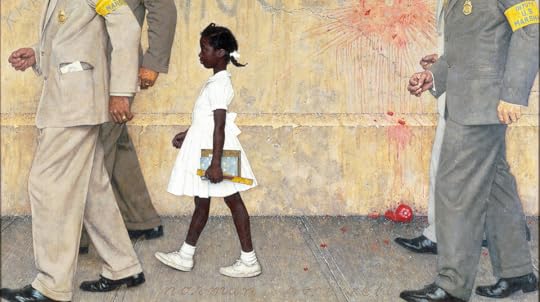
The other painting I want to discuss is the most famous painting of the Civil Rights movement, “The Problem We All Live With.” It’s a point of my ignorance that I didn’t know of it until now, and ironically, it was while I was reading this book that a parody of it garnered some Internet rage. Someone did a painting that replaces Betsy Devos for the African American schoolgirl, Ruby Bridges. I don’t quite get the point, but I can understand why people were angry about it.
It was this painting that sold me on Norman Rockwell and made me think of him more kindly after having learned what an inattentive husband he was. The Saturday Evening Post covers were all of white people in idyllic small town scenes, but Rockwell didn’t dream of an all-white world. He was pro-integration, anti-Vietnam, and became friends with Arlo Guthrie, though he was many decades older. I especially loved reading about this because we are living in times very similar to the sixties, except now, the youth protesters of the sixties are themselves in their sixties, but they’re out there alongside the millennials and middle-aged Gen Xers, and all of us are getting inspiration from 74-year-old Bernie Sanders.
So, did Norman Rockwell want America to look like a Norman Rockwell painting? It’s not so simple. He may have loved small town life, but he was flexible enough to understand that the Four Freedoms are for everybody.
I knew of the controversy regarding this book before I read it but I am stunned at just how bad it was. Solomon provides an interpretation of Rockwell that is so biased as to almost be laughable if it weren't so sad. She sees in his imagery a closeted homosexual and borderline pedophile. Apparently she's never heard that adage that you create from what you know or what you understand. OK so Rockwell's first love was his art and he led an overly structured life but few artists don't in their own way. The idea that he had latent homosexual urges is odd to say the least and if one looks at history he grew up during a very repressed time. I'm inclined to think that has much more to do with it than Solomon seems to think.
It's a shame too because with these stupid and unnecessary asides this is a good to excellent biography and shows a complex man who created some very simple, yet evocative, works of American art. I think she did a very good job of showing what influenced Rockwell and how he turned these influences into his own. She does a very good job of showing how he never let his fame really go to his head and was pleased and rather casual about his own works. I do recommend fans of Rockwell read it if only so they can write a book free of her third-rate psychobabble.
Norman Rockwell (1894-1978) is best known for his iconic illustrations which graced the cover of The Saturday Evening Post between 1916 and 1963. But in addition to these 300+ covers, Rockwell painted or sketched about 4,000 other works of art for use in books, magazines and calendars.
In many ways, Solomon’s “American Mirror” is nearly everything a reader could want in a great biography. It is comprehensive, appropriately detailed, wonderfully descriptive and consistently inquisitive – while maintaining a nearly perfect balance in focus between Rockwell’s personal and professional lives. It also includes nearly 100 illustrations which are incorporated into the narrative in a way that is both insightful and accessible to the general reader.
Solomon’s exploration of Rockwell’s life is enormously captivating, a notable achievement since he seemed to have led a purposefully mundane life largely devoid of the glamour and glitz one might expect for an artist notable even in his own time. Given the choice of attending a high-profile social gathering in his honor or hiding out in his studio, Rockwell would invariably chose the latter.
But if his social skills were lacking, his professional skills were not and much of the narrative’s allure is derived from the author’s astute analysis and interpretation of Rockwell’s countless illustrations. And in this respect, Solomon’s background as both an art critic and extraordinarily fluent writer proves invaluable.
For all its merit, however, “American Mirror” is not without controversy. Shortly after the book’s publication, Rockwell’s granddaughter Abigail launched a spirited campaign rebutting some of the assertions made by Solomon in her biography. Many, but not all, of the highlighted issues relate to Solomon’s suggestion the famous artist exhibited signs of homosexuality and, possibly, pedophilic impulses.
Although the relevant portions of her narrative are replete with disclaimers, Solomon has received significant criticism for the ultimately unprovable insinuations. Not content to fire just a single salvo and retreat, however, Abigail Rockwell has continued to press her case with additional commentary.
Readers unaware of the controversy will nevertheless notice Solomon’s tendency to speculate on matters large and small. But she does note these items as points of conjecture rather than fact. Less importantly, while Solomon does an excellent job balancing Rockwell’s artistic career and personal life (which included three marriages…each interesting in its own way), his three children receive significantly less attention than they deserve.
Controversy aside, Deborah Solomon’s biography of Norman Rockwell is robust, colorful, thought-provoking and surprisingly captivating. Although Rockwell attempted to lead an insular life within the safe confines of his studios, his interpersonal relationships, peripatetic impulses and enthralling art conspired to make his world one that is well worth exploring. With less speculation regarding Rockwell’s inner-self, “American Mirror” would be almost perfect.
I was very keen to read this book after several excellent reviews in a number of publications, and when I started it I was immediately hooked on the life of an artist who was underestimated during his lifetime by his peers and critics, and who also underestimated himself. Through the first half of the book, I was impressed with the author's command of the subject and details of Rockwell's life and the people he worked with. As I wound my way through the second half, however, the author began to inject substantial editorial commentary, often without any basis and seemingly just to provoke readers. For example, Rockwell's skill and interest in painting young boys at play was deemed to be clear indication of his potential tendencies as a pedophile -- although the author acknowledges there is no evidence of this. Rockwell's friendships and close ties with other male artists and residents of the communities he lived in are labeled as suggestions that he was homosexual -- again, although the author acknowledges no evidence of this. The author also doesn't hesitate to put a sexual interpretation or spin on every painting Rockwell drew, or to deem them all evidence of his own insecurities and loneliness. Certainly, Rockwell was no perfect person and he was eccentric and guarded in his personal life, but these claims are just unfounded and are directed more at sensationalism rather than a true scholarly study. Unfortunately, that approach tainted the last half of the book for me and spoiled what was otherwise a very detailed and interesting histoiry.
American Mirror was the most entertaining book I've read this year. I read it straight through without skipping the boring parts, because there just weren't any. Author Deborah Solomon is an art critic as well as a biographer, so that brought an extra dimension to the life story. It was every bit as much about the art as about the man.
I've always had a love/hate attitude toward Rockwell's illustrations. I admire the composition and the realism, but I hate the cutesy facial expressions. But the pictures are fascinating to look at, you can spend as much time and imagination on them as you can with Edward Hopper's paintings. And after reading Richard Halpern's Norman Rockwell: The Underside of Innocence, I find it impossible not to look for the dark side of the story in them.
Solomon takes the story further, by exploring Rockwell's influences, both the artists that were from the generation before his that he'd grown up studying, and his contemporaries, as well as the massive effect the modernist movement had on all western art from the 1910s through mid century. She notes that he often consulted numerous art books for ideas and inspiration, and shows the overt nods he made to the masters, such as in his Rosie the Riveter pose, and his Triple Self Portrait.
As for Rockwell the man, Solomon finds a needy, sometimes bitter man, one who upon learning that his brother's long time girlfriend had accepted his (brother's) proposal of marriage, immediately proposed to her himself. He seemed to prefer the company of men to that of women, although he married three times. Rockwell was self-effacing to the point of insecurity, insisting that he was not an artist, he was merely an illustrator.
I liked the style of writing -- Solomon is direct and informative, and keeps a documentarian's distance, except on rare occasion when she just can't resist. "It is odd to think of three married men (two of whom had young children) leaving their wives for two months to frolic in Europe -- the [1920s] sometimes seem too silly for words."
Plenty of illustrations, photographs, and a full color insert of Rockwell paintings for easy reference. Five stars!
It's an age of globalization. People from some cultures take interest in or otherwise get introduced to those of the others. This is exactly my case. I needed to tell the readers of my Russian-language blog (all from the ex-USSR) about Norman Rockwell and his paintings.
I was short of time and mostly skimmed through the book, mostly stopping to read paragraphs pertaining to featured illustrations. They explained to me, rather uninitiated to depths of American XX cent. culture, the true meaning and circumstances of many of his cult paintings. Although as a great artist he made humor and emotions of his paintings universally understandable, precisely the book's comments helped a lot with the contexts, guaranteeing a far larger satisfaction with every picture. Stories of how such and such painting was concieved or how the casting and the actual drawing process unfolded, what reception it got from models, critics and public provided better understandiing and insights into both America's and Rockwell's life.
I am sure my readers would enjoy my retelling of the circumstances of appearing of "The Russian Classroom". And since I'm from Moscow, maybe we'll manage to find actual models, who sat for the artist.
And until I started reading people's reviews here, was I unaware of author's speculations re artist's intimate life. I gleaned tons of valuable information, but these bits went under my radar. Maybe it is because you already know so much about Rockwell, his art and contexts, that those paragraphs marr your perception of the entire work?
As much as I hated the author's lurid speculation about Rockwell's sexuality I was impressed by the general thoroughness of her research and I generally enjoyed her observations about particular pieces of his art.
Let me get the bad part over with first. I'm awed by Rockwell's paintings and saw many original works on a recent visit to the Norman Rockwell museum in Stockbridge, MA. Of course he's portrayed as a kindly and humble everyman at the museum, which is a-ok with me. The author, however, seemed hell-bent on lifting the curtain and suggesting that he may have been a pederast because of the time he spent with his boy models (more evidence: he didn't paint as many girls) and he may have been a homosexual as well. She caveats the not-so-veiled accusations with the disclaimer that there's no evidence to suggest that either accusation is true. I would be appalled if he was a pederast and it would ruin my appreciation of his artwork. I couldn't possibly care less if he was gay. But without proof of anything it's just reckless speculation and has nothing to do with my interest in the subject matter.
On the positive side the book traces the author's life from birth to death in impressive detail. Each chapter covers a reasonable time frame, usually a few years, and runs chronologically. Lots of his art is pictured and the author, an art critic, offers insights about symbolism, objects in the pictures and lighting that enhanced my appreciation of the pieces. I wanted to know more about how Rockwell created his paintings but there's very little about the process. Also, I was surprised the author didn't tell more about some of the back stories of certain pictures. For instance, she describes aspects of Marriage License (1955) (it's in the color insert) but neglects to mention a poignant detail I learned at the museum. The clerk, an older man, is slouched in a chair looking despondent as the young married couple complete their marriage license. The missing detail is that the clerk was recently widowed before he posed for the picture. I understand that the picture stands on its own and the viewer wouldn't know such a detail but it adds a certain depth once you learn the backstory. Later she describes the painting The Runaway (1958) and doesn't mention that Rockwell painted a nearly identical picture with the same three characters but with a few telling differences. Both paintings are on display at the Rockwell museum.
Wearing her art critic hat the author generally praised Rockwell's works and gave me the impression she saw him as a true artist rather than merely as a talented illustrator. I think some of her criticisms were overly harsh but as I know nothing about art I'll concede they may have been well grounded.
I suspect anyone interested in reading a Rockwell biography approaches it as a fan of his work. You won't find this book in the museum gift shop for obvious reasons but it may be worth your time depending on what you're looking for. Do some research before diving in. In any event I highly recommend a visit to the Rockwell Museum if you have the opportunity to go.
Also, you can view all of the covers of the Saturday Evening Post on its website. The sheer volume of Rockwell covers is amazing.
Benjamin Franklin, Mark Twain, John Wayne, and Norman Rockwell. Few quartets are as diverse yet few have been as influential in shaping the way in which we Americans see ourselves and how the world sees us.
Norman Rockwell has long deserved a full-length, definitive biography. Deborah Solomon has attempted to do that in "American Mirror: The Life and Art of Norman Rockwell."
Solomon is a gifted writer who has crafted a page-turning biography. A professional art critic, Solomon gives Rockwell his due as an American master and, for this, Rockwell fans should be grateful.
Readers will quickly learn that there was nothing "Rockwellesque" about Norman Rockwell. He was highly complex: constantly plagued by self-doubt, prone to periods of deep depression, and emotionally detached. In other words, he was a lot like many of our most gifted artists and writers. Solomon presents us with a portrait of Rockwell in full.
Unfortunately, Solomon takes this a step too far. Throughout the second half of the book Solomon is fixated on whether or not Rockwell was a repressed homosexual. There is no proof to back up her theory but that doesn't stop the author from dwelling on the matter. Solomon's fixation (and that is the only way you can describe it) ultimately distracts from what is an otherwise praise-worthy biography. For example, Solomon finds sexual undertones in two of Rockwell's signature illustrations: The Runaway and Girl in the Mirror. In laying out her theory, and especially in finding sexual undertones in these two classic pieces, Solomon ultimately reveals more about herself than her subject. And that is why at the end of an otherwise superb biography, this reader has to reluctantly give this book four stars.
The bottom-line: A recommended read for all Rockwell fans and biography readers...just be sure to read it with a grain of salt.
Norman Rockwell is what us illustrators consider a success. He is what the art world considers a propaganda artist, in the same vein as Thomas Kinkade; saccharine, kitschy and AMERICAN. He was an illustrator during a time where illustration was not considered “high art,” yet he was a household name. I too must confess that I found him to be a droll and not thought provoking. A “he keeps the masses happy” AKA the Jerry Bruckheimer of illustration. So I am glad that I read this book, because I found that I related to his process and art more than I expected to.
While I found most of this enjoyable, I will say that this book had a tendency to drag on. The author decides to investigate his life year by year, which leads to a 400+ pages of him going and coming from California, marrying women he was not sexual attracted to, and forming unusual strong bonds with men. This ‘attraction’ to men was also another issue I had with the author. While this assumption may be true, the era in which Rockwell lived was one of a male obsession with manliness. This was the era of Sigmund Freud, who never gave a second thought to women other than having ‘penis envy;’ Thomas Eakins was famous for painting active men and boys at swimming holes, playing baseball, etc. I feel that Rockwell was more product of this time frame (which seems like a reaction to the women’s suffrage movement) when intense friendships with men were the norm.
Other than these issues, I found that I learned a lot about Rockwell and a little bit about myself in the process. And isn’t that what reading is about anyway?
Good golly, Ms. Solomon, what were you thinking? I did read it to the end, as the photos and proven facts were interesting, and because I love Norman Rockwell's work.
Evidently, Ms. Solomon is supposed to be a respected art critic. But she certainly seems to think she's a psychoanalyst. I truly thought I would throw up when I read her assassination of Rockwell's Girl at the Mirror. The disgusting imagery she conjured up regarding the discarded doll was just too much. And her constant accusations regarding his sexual preferences..........Why am I bothering typing this? I guess to warn anyone who plans on reading this.
It would have been a wonderful & scholarly retrospective, but his family felt totally betrayed, and so did I. Now, I'll never be able to fully enjoy many of his paintings when I see them, without having Ms. Solomon's trashing coming to mind. And not trashing of his work, but of her unsubstantiated and ridiculous suppositions regarding his sex life.
I was a child in the 50's & 60's, and the majority of my peers would be quick to tell you that men had a very different role as fathers back then. And not wanting to go on a business trip in the company of an alcoholic wife who may or may not fall off the wagon? That makes him cold & uncaring? He wasn't perfect, but who is?
3 1/2 stars. If not for the one issue I have with this biography, I'd have given it 5 stars.
Prior to reading American Mirror, I'd have guessed Norman Rockwell to be a different kind of person altogether (the guess based on his paintings alone, so not fair of me, I know). The humor part though, that's him.
Ms. Solomon did an excellent job chronicaling Norman Rockwell's career path from school to illustrating for the Boy Scouts, the Saturday Evening Post & beyond. Also well done was the history on his family, marraiges, mental health, etc.
Where she loses points (stars) is with the direction she took to Norman Rockwell's sexuality in himself and in his paintings. In fairness, I don't recall a single sentence where she stated her assumptions as fact. While some quirks of the man may lead a person to wonder how warm & loving he may (or may not) be, I think she went a bit far. The writing might also lead someone to believe he painted fewer girls looking somewhat girly than he actually did - he painted quite a few. When she got to the sexuality shown by the position of a cast off doll... well, maybe that says more of her than it does of him. But I'm not psych expert so I'll leave it there.
Provides no new information or insight. Solomon seems equal parts annoyed and befuddled by her subject. Rockwell, despite the author's years of research and 400+ pages of writing, remains aloof and he keeps his own secrets. The author is forced to rely on increasingly speculative "insights" from selected works and habits of Rockwell to prove...what, exactly? The homo-eroticsm she finds says more about her than him and her constant habit of seeing things in their worst possible light do Rockwell no justice.
Rockwell's reputation as an artist improves with the passage of time. This author's work will not, at least in this instance.
While this book is frequently insightful, engaging, and entertaining its flaws too often outweigh the positives. The frequency of the word "perhaps" that is most disturbing for the author uses it as a catch-all for her extensive and excessive interpretive whims. She assumes everything from latent homosexuality to pederasty, though in both cases the author admits there is no evidence of either. So why does the author include it? Why make mention of that which there is no evidence? In these cases sensationalism replaces careful analysis. The process involved in the interpretation of art is not the same process as examining a human life. Simply suspecting, feeling, or assuming something about a character, in this case Norman Rockwell, does not allow one to commit those assumptions to print. This is a shame, for when the book is fair, analytical, and investigative the book is moving and personal, and Rockwell comes alive. But the sins here do great damage to the whole.
This is the worst biography of Rockwell Kent I have ever read.
(Just kidding. A very solid, enjoyable, and thorough biography. Solomon goes a little overboard on the pop-psych investigations of Rockwell's sexual preferences, but the chapters on his political awakening are very interesting, and throughout the book, she has a great ear for anecdote. Considering how chilly and inaccessible Rockwell seemed to be, her ability to present him here as a complex, three-dimensional figure are very admirable.)
After reading this you will never look at Rockwell or his art in the same way! His marriages, his obsession with youth, especially boys, and his lack of focus on the nuclear family are all aspects of Sampson’s s study of the painter. Also revelatory is his therapy with Erik Erickson. Insightful.
This moved me very much in the same way as, "Never-Ending Man: Hayao Miyazaki." As an artist myself, it's rewarding to see how great creators struggle with the friction of daily life, relationships and aging. It often seems a creator can have his art, or his family. Seldom both.
Sometimes artists who convey the most painstaking details of humanity, warmth and relationships, feel very little of these in their own lives. This book, though by no means a quick read, shows the rest of Rockwell. He is more that observant eyes, skilled hands and a hearty laugh. American Mirror paints Rockwell not as a god of art, but a humble man with foibles and an earthly plight.
This book should forever be referenced as a prime example of libel, the defamation of someone's character through the use of the written word. Deborah Solomon manages to insert sinister undertones and criminal motivations throughout much of Rockwell's life without providing a shred of credible evidence. Instead, she coats her malicious statements with layers of indefinite words like "perhaps", "maybe," and "probably." According to Solomon, Norman Rockwell was a homosexual pedophile who cross-dressed and had a relationship with a young boy who eventually committed suicide. The "proof" she provides to support the pedophilia claim is as follows: he painted numerous young boys early in his career. That’s it. It should be noted that many of the paintings were for Boy's Life magazine, for which he worked, and the boys were often depicted as Boy Scouts since the magazine served that audience specifically. In later years, he also painted boy models for Saturday Evening Post covers, along with other models of varying ages and genders. Solomon labels Rockwell a homosexual due to his three marriages and two divorces. He, apparently, showed his true homosexual inclinations by taking fishing and camping trips with other men. On top of that overwhelmingly damning evidence (sarcasm), he also wore his shoes too tight, and once wrote "frolic" (Solomon points out the 'lick' syllable at the end of "frolic") in a journal entry. Solomon seems to take particular offense to Rockwell's brand of "homosexuality" though I'm not sure if it stems from a possible antipathy she harbors for homosexuals or because she believes that he should not have hid homosexuality from the world. Either way, the argument is pointless because Solomon herself says on at least two separate occasions that there is no proof he was homosexual or a pedophile, but that doesn't stop her from continuing to insinuate it throughout much of the book. She then labels Rockwell a cross-dresser but does not even attempt to explain her reasoning for it; evidently, she hopes that we’ll take her word for it. In regard to the boy model which Solomon blatantly portrays as a victim of suicide due to his relationship with Rockwell, the fact of the matter is that the unfortunate boy fell from his third story window/roof while trying to sneak out at night. She connects Rockwell to the death because he had released the boy from modeling work due to his increasing age which made him unsuitable for sitting for paintings of younger boys. Solomon twists the unfortunate incident so as to assign responsibility to Rockwell. One wonders why Solomon undertook the task of writing a "biography" of someone she seems to revile. Ultimately, her defamation tactics only managed to bring ruin upon herself. Her personal integrity and professional capability go out the window when she can't provide the slightest proof for her bizarre allegations. The damage she does is so catastrophic that it calls the factuality and validity of the entire work into question.
Interesting read, and it's good to see Rockwell getting his due as an artist.
This is a long book, heavily researched, with quite a bit of extraneous detail not pertinent to Rockwell that could have been cut. Mistakes were bound to creep into this mass of info, such as when Solomon wrote that Rockwell flew down to Cape Canaveral in Orlando. Cape Canaveral is on the coast, Orlando is not. The painting "Going and Coming" also appears as "Coming and Going." Future biographers may want to check facts gleaned from this book.
She remarks over and over again that Rockwell's paintings keep you out, there's something you can't reach. That's pretty much true of every painting. It's a PAINTING. Shuffleton's Barbershop "suggests that looking is not the same thing as living." Her unnecessary analysis of the paintings is larded with superficial Freudianism (a baby in a carriage is like a baby in the womb).
Her analysis is at times absurd, making something out of nothing and missing the real something. The letters "TNARU" on the inside of a restaurant window in Saying Grace can be anagrammed "UR ANT" -- you're an insignificant ant, get it? She makes much of the back of the boy's neck in the painting but nothing of the religious theme. In fact there is no examination of Rockwell's philosophical or religious views.
In The Runaway, Solomon notes the "tantalizing" back of the large policeman, and thinks the counterman at the diner undercut the homoeroticism, sort of a pictorial chaperone. Someone should get that girl a date.
At times Solomon's writing reminds me of Beavis and Butthead doing art criticism: Rockwell couldn't decide whether to stencil "Yankee Doodle came to town, or went to town [on the mural Yankee Doodle]... Rockwell settled on the word came. Interpet at your own risk." Nudge nudge wink wink.
Solomon likes to suggest that maybe Rockwell liked boys. Or men. Not that he ever acted on it. But she likes nosing around the subject, maybe more than he did. She may have touched on the real heart of his attraction, in that he admired men who were what he thought he would have liked to be, more like his athletic brother, although he and the brother grew apart.
Solomon leaves the reader thinking Rockwell was a somewhat unpleasant man and a bad husband and father, though all his neighbors thought he was a prince. Maybe both are true.
Deborah Solomon’s biography, American Mirror: The Life and Art of Norman Rockwell, claims to be the first definitive biography about the famous illustrator and does a remarkable job explaining how Rockwell’s illustrations have resonated with the American public since his first Saturday Evening Post cover in 1916. Solomon gives fascinating insight into the evolution of Rockwell’s paintings over the span of his 60-year artistic career. However, her sometimes flippant characterization of Rockwell is not a particularly flattering one: she speculates that Rockwell was closeted and may have harbored some perverse inclinations; she portrays him also as an unloving spouse and father; as a bland man fairly steeped in dull, daily routines; as an unsentimental man who used people, only to sever ties with them after their usefulness had expired. Despite her occasional heavy-handed quips, Solomon’s biography does provide an interesting critique of Rockwell’s paintings and the genius and context behind their meticulously painted symbols of 'American life.' (Russ K., Ref.)
Sad because of the unfounded allegations made in the book but interesting too because of the home life Rockwell came from compared to the type of paintings he did, i gave the book 3 stars. Norman Rockwell really led one life and portrayed another. I have always admired his art and that was partly from knowing a family who posed for Rockwell and owned two of his paintings. This book is hard on Rockwell and those who surrounded him including a gallery owner who exploited him at the end of his life. Rockwell's tie ins with people like Lyndon Johnson, Arlo Guthrie and (almost) Sting were also fun to read about. I read this as an e-book from the library but would recommend a real paper book where it is easier to look at the illustrations being described while reading about the subjects.
I have always been a big fan of Norman Rockwell "art" (illustration?). I still consider it art. From the time I was a kid and visited Stockbridge, I have been fascinated. I disagree with many of the reviewers who feel the book focused on his sex life or lack of it. His upbringing was devoid of any parental affection and in fact he was pretty much ignored by his parents - which obviously reflected on his personality.
I purchased the hardback book because I wanted to look at the illustrations and flip back and forth easily. This book was written in a style that was so easy and enjoyable to read that I felt as if I were reading a novel.
I have had a lifelong affinity for Norman Rockwell's art, finding it (as many Americans have) familiar and comforting, in a way that exceeds even the familiarity of real life. This is a comprehensive biography, that illuminates the man behind the art as well as the man behind the genial pipe-smoking Everyman he wore as his public face. Parts were almost too comprehensive, detailing every trip and malady Rockwell experienced, but the exploration of where he and his art fit into the larger art world were fascinating.
Actually, let's call this 3 1/2 stars. The only parts not good about the book were the author's psychobabble analysis of Rockwell's paintings and of Rockwell himself (as many reviews have despaired). Otherwise, it detailed his life very well. I have to say that although I admire Rockwell as an artist, I really don't think I would have liked him as a person. At least in his early years, he seemed very self-absorbed and entitled. Later, he was excessively obsessive-compulsive. The author tries to dismiss these traits, but they just can't be ignored.
A very good biography that does a lot, thankfully, to raise the reputation of this American artist who for a long time has been derided, unreasonably, as a mere illustrator of kitsch and warm-fuzzy domestic scenes. The author, Deborah Solomon, presents the basic structure of his personal and family life, shows us how he composed his paintings, and analyzes quite well their themes (both overt and hidden), and analyzes how -- and how well -- he achieved his artistic goal in each.
One of the best biographies i have read. Solomon's account of Rockwell's life is fasciinating - this is a wise and judicious account of a complex artist and of his work. I especially appreciated her analyses of his paintings which are much more profound than at first glance. She also shows how Rockwell's work evolved and grew more complex over time - i gained a new respect for his work.
I enjoyed it much more than I had expected to. Recently, one of his models objected to the author's suppositions of homoreoticism. I do think she read way more into his enjoyment of his male friends and activities than was merited. What is wrong with just assuming he was a well behaved man not obsessed with sex who possibly saw the world the same way he depicted it?
Outstanding and engaging biography of Mr. Rockwell. It is well written and illustrates the layers of Mr. Rockwell's personality and his art in a open and honest manner.