

What do you think?

Hunting Hitler: New Scientific Evidence That Hitler Escaped Nazi Germany
In 2009, three US professors with access to Adolf Hitler’s alleged remains startled the world with scientific DNA proof that the skull and bones that Russia had claimed since the end of World War II were Hitler’s actually belonged to a middle-aged woman whose identity remains unknown. This announcement has rekindled interest in the claim made by Joseph Stalin, maintained to the end of his life, that Hitler got away. The truth is that no one saw Hitler and Eva Braun die in the bunker in Berlin on April 30, 1945. No photographs were taken to document claims Hitler and Evan Braun committed suicide. Hitler’s body was never recovered. No definitive physical evidence exists proving Hitler died in the bunker in Berlin.
Dr. Jerome Corsi explores the historical possibility that Hitler escaped Nazi Germany at the end of World War II. FBI and CIA records maintained at the National Archives indicate that the US government took seriously reports at the end of World War II that Hitler had escaped to Argentina. More recent evidence suggests Hitler may have fled to Indonesia, where he married and worked at a hospital in Sumbawa. Even the chief of the US trial counsel at Nuremburg, Thomas J. Dodd, was quoted as saying, �No one for sure can say Adolf Hitler is dead.”
Putting massive amounts of evidence and research under a critical eye, Dr. Corsi shows that perhaps modern history’s most tantalizing question has yet to be definitively answered: Did Hitler escaped Nazi Germany at the end of World War II to plot revenge and to plan the rise of the Fourth Reich?
Dr. Jerome Corsi explores the historical possibility that Hitler escaped Nazi Germany at the end of World War II. FBI and CIA records maintained at the National Archives indicate that the US government took seriously reports at the end of World War II that Hitler had escaped to Argentina. More recent evidence suggests Hitler may have fled to Indonesia, where he married and worked at a hospital in Sumbawa. Even the chief of the US trial counsel at Nuremburg, Thomas J. Dodd, was quoted as saying, �No one for sure can say Adolf Hitler is dead.”
Putting massive amounts of evidence and research under a critical eye, Dr. Corsi shows that perhaps modern history’s most tantalizing question has yet to be definitively answered: Did Hitler escaped Nazi Germany at the end of World War II to plot revenge and to plan the rise of the Fourth Reich?
138 pages, Hardcover
First published January 2, 2014
About the author
Jerome R. Corsi
60 books75 followersAmerican author and political commentator.
Corsi is mostly known for his books against Democratic presidential candidates John Kerry and Barack Obama, that were published in the years of presidential elections.
Corsi has discussed topics that are considered conspiracy theories, such as the alleged plans for a North American Government, the theory that President Barack Obama is not an American citizen.
Corsi is mostly known for his books against Democratic presidential candidates John Kerry and Barack Obama, that were published in the years of presidential elections.
Corsi has discussed topics that are considered conspiracy theories, such as the alleged plans for a North American Government, the theory that President Barack Obama is not an American citizen.
Ratings & Reviews
Friends & Following
Create a free account to discover what your friends think of this book!
Community Reviews
Displaying 1 - 30 of 51 reviews

January 9, 2025
"What really happened in the bunker during the last days of the war in Europe, while the Soviets were invading Berlin?"
—Abel Basti, Hitler’s Escape (2011)
The real truth behind what happened to the 20th Century's most impactful single individual is perhaps one of history's greatest unsolved mysteries. For decades after the war, there have been conspiracy theories abounding that Hitler escaped Germany in the final days of WW2. A new potentially pivotal piece of evidence emerged recently when - as the book's description mentions - a 2009 examination and DNA testing of the supposed skull fragments of Adolph Hitler in Russian custody determined that the skull did not belong to Hitler, but instead to a ~40 year old woman.
Hunting Hitler was a super interesting look into the topic. I enjoyed hearing the author lay out his case, although some of his reasoning fell apart for me at the very end of the book, when he added in a superfluous epilogue commenting on contemporary American politics. More below.
Right off the bat, I will give an obvious disclosure that although I have read a decent amount on WW2, I am far from a historian, and therefore am not qualified to judge the veracity of all the claims made by the author in these pages.
I will say that on balance, the author did a good job of establishing reasonable doubt around the "official" story of Hitler's supposed death. That is; Hitler and his girlfriend Eva Braun committed suicide in the Führerbunker on 30 April, 1945 by a combination of swallowing cyanide capsules and self-inflicted gunshot wounds.
Author Jerome Corsi received a Ph.D. from Harvard University in political science in 1972. He is the author of the #1 New York Times bestseller The Obama Nation: Leftist Politics and the Cult of Personality and the co-author of Unfit For Command: Swift Boat Veterans Speak Out Against John Kerry, which was also a #1 New York Times bestseller. He is a regular contributor to WorldNetDaily.com.
Jerome R. Corsi:

The book is written in a lively and engaging manner, and it shouldn't struggle to hold even the most finicky reader's attention. It is also very well researched and evidenced; complete with hundreds of footnotes.
Corsi drops this quote early on, setting the pace for the rest of the writing to follow:
In this quote Corsi establishes the aim of the book:
Central to the case laid out here, in addition to the 2009 DNA tests, is the lack of consistent eye-witness accounts of the Fuhrer's death:
It should be noted that Stalin didn't buy the official story of Hitler's death. Corsi writes:
As a quick related sidebar, this article from the Guardian talks about what happened to the original supposed remains of Hitler; seized by Stalin right after the war. Here's a quote:
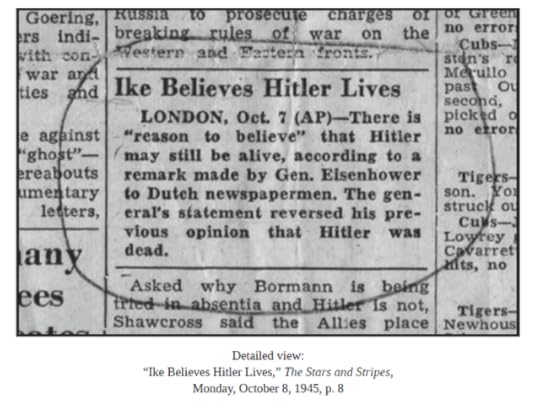
General Dwight D. Eisenhower also had his doubts that Hitler was dead, according to the author:
So, if Hitler did not kill himself in that bunker at the end of April, 1945, what actually happened to him? Well, the author unravels a somewhat compelling case that he escaped to Argentina. I'll cover the main bullet points with a spoiler, to avoid giving anything away.
Unfortunately, aside from the investigation into the story of what became of Hitler, the author shoe-horns in some bizarre commentary at the very end of the book about the knock-on effects of the Nazis pillaging Jewish assets and investing them abroad. He writes:
I found this commentary a bit ridiculous. There are many reasons that a postwar America became the World's economic powerhouse, and (IMHO) the investment of ill-gotten Nazi spoils of war doesn't play a deciding role. During the war, America ramped up industrial production. The country is blessed with an abundance of natural resources that facilitated this large-scale production. By the war's end, it was the biggest industrial powerhouse in the world. Also, although many thousands of Americans would die fighting in the war, there was notably no conflict fought on mainland USA, leaving all its infrastructure intact. Finally, the postwar period saw an unprecedented rise in childbirths, who are now referred to as "Baby Boomers." These Boomers would go on to the work in the factories that produced all the goods that saw the American economy prosper for decades afterwards.
********************
Notwithstanding my minor gripe above, Hunting Hitler was a thought-provoking read. What is the real story?? No one knows for sure. Maybe that's why this is such an interesting topic in the first place.
I really enjoyed this one. It was well-written, researched, and presented.
5 stars.
—Abel Basti, Hitler’s Escape (2011)
The real truth behind what happened to the 20th Century's most impactful single individual is perhaps one of history's greatest unsolved mysteries. For decades after the war, there have been conspiracy theories abounding that Hitler escaped Germany in the final days of WW2. A new potentially pivotal piece of evidence emerged recently when - as the book's description mentions - a 2009 examination and DNA testing of the supposed skull fragments of Adolph Hitler in Russian custody determined that the skull did not belong to Hitler, but instead to a ~40 year old woman.
Hunting Hitler was a super interesting look into the topic. I enjoyed hearing the author lay out his case, although some of his reasoning fell apart for me at the very end of the book, when he added in a superfluous epilogue commenting on contemporary American politics. More below.
Right off the bat, I will give an obvious disclosure that although I have read a decent amount on WW2, I am far from a historian, and therefore am not qualified to judge the veracity of all the claims made by the author in these pages.
I will say that on balance, the author did a good job of establishing reasonable doubt around the "official" story of Hitler's supposed death. That is; Hitler and his girlfriend Eva Braun committed suicide in the Führerbunker on 30 April, 1945 by a combination of swallowing cyanide capsules and self-inflicted gunshot wounds.
Author Jerome Corsi received a Ph.D. from Harvard University in political science in 1972. He is the author of the #1 New York Times bestseller The Obama Nation: Leftist Politics and the Cult of Personality and the co-author of Unfit For Command: Swift Boat Veterans Speak Out Against John Kerry, which was also a #1 New York Times bestseller. He is a regular contributor to WorldNetDaily.com.
Jerome R. Corsi:
The book is written in a lively and engaging manner, and it shouldn't struggle to hold even the most finicky reader's attention. It is also very well researched and evidenced; complete with hundreds of footnotes.
Corsi drops this quote early on, setting the pace for the rest of the writing to follow:
"Everyone knows Adolf Hitler committed suicide by gunshot in his underground bunker on April 30, 1945.
As Russian troops neared the bunker’s location in the Reich Chancellery in Berlin, fighting an urban battle street-by-street, Hitler preferred suicide to being captured and put on display as one of the most notorious mass murderers in history.
Everyone knows Hitler’s death involved a double-suicide, as Eva Braun, his mistress and long-time female companion, married Hitler in a simple ceremony in the bunker before she too took her life by biting down on a cyanide capsule.
Seated on a couch in Hitler’s private chambers in the underground bunker, Eva Braun died first, but she died as the bride of her beloved Führer.
Their bodies were taken, as Hitler had commanded, outside the bunker and doused with gasoline to be cremated in a shallow trench dug for that purpose in the garden of the Reich Chancellery, right outside the secret entrance to the bunker below.
The Russian army, in liberating Berlin, came across the bodies of Hitler and Eva Braun; hurriedly, the Russian army buried the charred remains in a secret location in Berlin, keeping the bodies safe until the cessation of hostilities permitted their safe transport to Moscow.
Who would dare be silly enough to think Hitler escaped Berlin to run away to a safe haven such as Argentina?
Anyone who questions that Hitler died by suicide in his bunker in the closing hours of World War II in Europe is by definition considered a “conspiracy theorist”—a polite way of claiming the doubter is a proverbial nut-case.
But in recent years, the world has come to see that the scientific proof offered for decades by the Russians to back this politically correct version of Hitler’s demise is deeply flawed.
Moreover, the cover-up story, concocted and published in 1947 by Hugh Redwald Trevor-Roper, then a British 32-year-old history graduate student who had worked during World War II as a British military intelligence officer, turned out to be inconsistent in several major aspects of the story with other arguably authoritative accounts of Hitler’s demise."
In this quote Corsi establishes the aim of the book:
"The research and analysis presented here will make a scientific case that no proof exists or has ever existed that Hitler died in Berlin as recounted in Trevor-Roper’s official version of events.
Examining the now-declassified FBI and US military intelligence files, a compelling case can be made that US investigators suspected from the beginning that Hitler had escaped, but were willing to go along with the Trevor-Roper story for political reasons.
The point of this book is that hunting Hitler must continue until the weight of scientific evidence proves one way or the other whether Hitler died by suicide in the bunker on April 30, 1945, or if he escaped, to die elsewhere.
Hunting Hitler, the world’s most notorious mass murderer, an international criminal whose crimes against humanity and the law of nations have never been adjudicated, must continue until we know the truth.
History should not rest until the Hitler chapter is closed, not with politically convenient lies, but with the truth.
With the truth in hand, steps can be taken to adjudicate blame, not just for the unspeakably horrendous crimes Hitler committed, but also for the inexcusable crimes committed by those who helped Hitler escape..."
Central to the case laid out here, in addition to the 2009 DNA tests, is the lack of consistent eye-witness accounts of the Fuhrer's death:
"How were Hitler and Eva’s bodies discovered? Did eyewitnesses in the bunker immediately carry the bodies outside to be cremated, or did eyewitnesses in the bunker hold some sort of viewing or service for the newly wed and even more newly deceased Führer and his bride?
As we shall see, the truth is that we have no authoritative account of the discovery and disposal of the bodies of Hitler and Eva Braun after committing suicide, as the several available accounts conflict on many important details...
...As this book will demonstrate, the truth is that when the Russians entered Hitler’s underground bunker in Berlin, Adolf Hitler and Eva Braun were gone. Neither were ever captured, and their bodies were never found.
When the Russians burst into the bunker, Hitler and Eva Braun were simply missing..."
It should be noted that Stalin didn't buy the official story of Hitler's death. Corsi writes:
"...In a discussion with Stalin in Moscow, Hopkins commented that he hoped Hitler’s body, which had not yet been recovered, would be found by the Russians. Stalin replied that Soviet doctors thought they had identified the body of Joseph Goebbels, Hitler’s minister of propaganda; and of Erich Kempka, Hitler’s chauffeur; but that he personally doubted that Goebbels was dead. He said the whole matter was strange, and that the various talks of funerals and burials struck him as being very dubious. He further explained that he thought Hitler, Goebbels, and General Hans Krebs, the chief of staff of the German army, along with Hitler’s secretary Martin Bormann, had all escaped and were in hiding. Hopkins commented that the Nazis had several large submarines, and he was aware no trace of Hitler had yet been discovered. Stalin responded that the Germans were using those submarines to transport gold and negotiable assets to Japan, with the connivance of Switzerland. He further mentioned that his intelligence service was investigating these Nazi submarines, but Russia had also failed to find any trace of Hitler. In concluding the discussion, Stalin speculated that Hitler and the other top Nazis he mentioned may have fled to Japan."
As a quick related sidebar, this article from the Guardian talks about what happened to the original supposed remains of Hitler; seized by Stalin right after the war. Here's a quote:
General Dwight D. Eisenhower also had his doubts that Hitler was dead, according to the author:
"On Monday, October 8, 1945, the US military newspaper The Stars and Stripes published a shocking statement by General Dwight D. Eisenhower, then the Supreme Commander of the Allied Forces. The short piece, published in a separate box buried in the middle of a report on pending war
crime charges to be brought against Nazi Rudolph Hess and baseball scores from the United States, ran with a headline, “Ike Believes Hitler Lives.”
The short piece was datelined from London on October 7, 1945. It read: “There is ‘reason to believe’ that Hitler may still be alive, according to a remark made by Gen. Eisenhower to Dutch newspapermen. The general’s statement reversed his previous opinion that Hitler was dead.”
So, if Hitler did not kill himself in that bunker at the end of April, 1945, what actually happened to him? Well, the author unravels a somewhat compelling case that he escaped to Argentina. I'll cover the main bullet points with a spoiler, to avoid giving anything away.
Unfortunately, aside from the investigation into the story of what became of Hitler, the author shoe-horns in some bizarre commentary at the very end of the book about the knock-on effects of the Nazis pillaging Jewish assets and investing them abroad. He writes:
"It is far from certain that the United States and Western Europe would have had the economic strength to withstand an expanding Soviet Union throughout the Cold War years had Bormann not invested the ill-gotten Nazi capital—including the wealth stolen from the Jews about to be murdered—in the Western economies in order to establish viable escape routes for himself, Hitler, other top Nazis such as Heinrich Müller, and tens of thousands of other Nazi war criminals. Without Dulles’s complicity, it is much less likely that Hitler or any of the other Nazi henchmen like Eichmann and Mengele would ever have escaped. Without Bormann’s funding, it is much less certain that Ronald Reagan would have had the economic base from which to challenge Gorbachev to tear down the Berlin Wall..."
I found this commentary a bit ridiculous. There are many reasons that a postwar America became the World's economic powerhouse, and (IMHO) the investment of ill-gotten Nazi spoils of war doesn't play a deciding role. During the war, America ramped up industrial production. The country is blessed with an abundance of natural resources that facilitated this large-scale production. By the war's end, it was the biggest industrial powerhouse in the world. Also, although many thousands of Americans would die fighting in the war, there was notably no conflict fought on mainland USA, leaving all its infrastructure intact. Finally, the postwar period saw an unprecedented rise in childbirths, who are now referred to as "Baby Boomers." These Boomers would go on to the work in the factories that produced all the goods that saw the American economy prosper for decades afterwards.
********************
Notwithstanding my minor gripe above, Hunting Hitler was a thought-provoking read. What is the real story?? No one knows for sure. Maybe that's why this is such an interesting topic in the first place.
I really enjoyed this one. It was well-written, researched, and presented.
5 stars.

Read
November 26, 2020I have mixed feelings about this book, while I found a lot of it great food for thought and opened my mind, there were many serious issues.
I don't know what drew me to this book as I'm normally not a fan (to say the least) of conspiracy theories but I must admit some of what the author presented us readers with is very informative. However, I found the author like to stress lack off\ unreliable evidence when it served his purpose and was more lenient towards evidence of the same nature when it suits him.
I liked that he raises the question about Hitler and Eva Braun's suicides and points that all we know about it is very vague, but if you are trying to eschew something that is considered a historic fact, I expect more.
I think you should always take everything you read with a grain of salt, books of this nature in particular.
The last chapter should have been written off, as the current state of the US and other world politics in the eyes of the author have zero to do with the topic.
I don't know what drew me to this book as I'm normally not a fan (to say the least) of conspiracy theories but I must admit some of what the author presented us readers with is very informative. However, I found the author like to stress lack off\ unreliable evidence when it served his purpose and was more lenient towards evidence of the same nature when it suits him.
I liked that he raises the question about Hitler and Eva Braun's suicides and points that all we know about it is very vague, but if you are trying to eschew something that is considered a historic fact, I expect more.
I think you should always take everything you read with a grain of salt, books of this nature in particular.
The last chapter should have been written off, as the current state of the US and other world politics in the eyes of the author have zero to do with the topic.

November 12, 2013
I received an ARC of this book.
I've heard the rumors about Hitler escaping from Germany so I thought this might be an interesting book to read. i found it interesting the evidence the author included in his book that told about the possibility that Hitler did not die in his bunker like the official report states.
The author really makes you think, considering the idea that Hitler died in a way other than the official reports says and may even have escaped to Argentina alive. I thought this was a thought provoking book that also included books I would like to read in the future about this topic.
I've heard the rumors about Hitler escaping from Germany so I thought this might be an interesting book to read. i found it interesting the evidence the author included in his book that told about the possibility that Hitler did not die in his bunker like the official report states.
The author really makes you think, considering the idea that Hitler died in a way other than the official reports says and may even have escaped to Argentina alive. I thought this was a thought provoking book that also included books I would like to read in the future about this topic.

October 14, 2020
Very interesting concept to this book, is it true or not true? by the end of the book you will be questioning the history that we have been taught for so long is it true? Plenty of arguments and evidence to suggest Hitler escaped Germany in 1945, very interesting indeed. Worth reading, very well written, the author supplies you enough information without being over saturating, the story flows at a good pace, traveling across different countries (escape route), one of the most interesting books I read (war related) for a long time.

April 6, 2014
Hunting Hitler
By Jerome Corsi
Publisher: Skyhorse Publishing
Published In: New York City, NY
Date: 2014
Pgs: 138
REVIEW MAY CONTAIN SPOILERS
Summary:
If Hitler had died on April 30, 1945, the facts surrounding his death should have been easy to prove...Doesn’t the explanation that the Soviets absconded back to Moscow with Hitler’s remains before the United States had a chance to demand proof that the Fuhrer was dead seem a little too convenient? Historically, it appears not only did Stalin and the Russians doubt Hitler was dead, but so did US General Dwight D. Eisenhower. And in 2009, DNA testing proved the skull the Russians had been claiming was Hitler’s since the end of the war was actually that of a forty year old woman. The truth is that when the Russians entered Hitler’s underground bunker in Berlin, Adolf Hitler and Eva Braun were gone. Their bodies were never found. Exactly what happened to them on April 30, 1945, has long remained a mystery...
Genre:
nonfiction, conspiracy theory, hitler, ww2, world war 2, nazis, history
Why this book:
The claim of “new scientific evidence that Hitler escaped Nazi Germany” on the cover sucked me in.
This Story is About:
Shoddy investigative work more in service of propaganda than in search of the truth. That’s the story of both the Allied and Soviet investigations into what happened. There was a whole lot of bending the truth to the narrative instead of letting the truth drive the narrative. What was always a meager suspicion on my part is a strong feeling now.
Favorite Character:
N/A
Least Favorite Character:
Trevor-Roper who seemed more interested in writing a book and having it be dramatic than in doing his job and investigating like the intelligence officer that he was purported to be at the time.
Peron and Evita for their complicity in the escapes of many of the Nazis along with the Roman Catholic Cardinals of Argentina in that era..
Character I Most Identified With:
N/A
The Feel:
You get the feel early on that there was a lot of propaganda trying to tell a good story instead of a real search for the truth.
Settings:
Berlin; Moscow; Washington DC; Argentina; Vatican City; Switzerland
Pacing:
This documentary is very well paced.
Plot Holes/Out of Character:
N/A
Last Page Sound:
The author threw away the good will he had built up with me in the close when his politics came to the fore whereas the majority of this book relied on speculation on a strong foundation of fact.
I buy it. Hitler, at least, didn’t die in that bunker in the ways that the various histories claim. He may have died somewhere else during the escape or as an older man in Argentina. Either way he’s dead today. Still...I wonder.
Author Assessment:
My politics and the author’s don’t line up. But I won’t hold that against him if he delivers a good and interesting read.
Editorial Assessment:
Well edited. The prose is kept punchy and direct.
I wish the editor had lured him away from the political statement in the closing paragraphs.
Did the Book Cover Reflect the Story:
A shattered swastika with Hitler’s face inside the broken cross.
Hmm Moments:
Stalin and Eisenhower, neither one, believing that Hitler was dead.
The main guy who wrote the Allied version of the accepted story didn’t have access to all the witnesses that he claimed to quote and he is the same guy who later in life falsely authenticated The Hitler Diaries.
The dental plates that the Russians used for their identification. And the question of whether their investigators allowed the dental witnesses who had handled Hitler and Eva Braun’s teeth to see the plates and base their findings on their memory rather than having them produce at least a drawing of what they remembered and then compare that to the plates the Russian authorities had recovered from the suspect corpses.
Erich Kempka, Hitler’s chauffeur and one of the purported witnesses that much of the little that is “known” about those days is based on, admitted in a 1974 interview that in those 1945 interrogations he told investigators what they wanted to hear. This admission throws Hugh-Roper’s “definitive” and Btitish propaganda backed book The Last Days of Hitler is thrown into severe doubt due to Kempka being one of his primary sources.
Hugh Thomas’s assertion that “some of these eyewitness accounts are confused, some are deliberately duplicitous; very few are unchanged.”
The father of Eva Braun’s brother-in-law received a message from his son after he was supposedly shot for treason. The message told him that his son and the Furher had left Berlin.
J. Edgar Hoover following up on a report through a US Counter Intelligence Corps from Austria that Hitler was in the company of the Eichhorn family in Argentina in the area of a farm and spa called La Falda informed the US embassy in Buenos Aries to be on the look out for the family and put the embassy on alert.
Dulles and the nascent CIA’s complicity with the escaping Nazis. Same with the banks both in Switzerland and abroad; in Argentina, the US, and around the world.
Knee Jerk Reaction:
instant classic, real classic, real genre classic, really good book, glad I read it, it’s alright, meh!, why did I read this, not as good as I was lead to believe
Disposition of Book:
Irving Public Library
Why isn’t there a screenplay?
I’m sure this will show up as a documentary on Discovery, History Channel, etc
Casting call:
N/A
Would recommend to:
history buffs, conspiracy theorists, militarists, genre fans
By Jerome Corsi
Publisher: Skyhorse Publishing
Published In: New York City, NY
Date: 2014
Pgs: 138
REVIEW MAY CONTAIN SPOILERS
Summary:
If Hitler had died on April 30, 1945, the facts surrounding his death should have been easy to prove...Doesn’t the explanation that the Soviets absconded back to Moscow with Hitler’s remains before the United States had a chance to demand proof that the Fuhrer was dead seem a little too convenient? Historically, it appears not only did Stalin and the Russians doubt Hitler was dead, but so did US General Dwight D. Eisenhower. And in 2009, DNA testing proved the skull the Russians had been claiming was Hitler’s since the end of the war was actually that of a forty year old woman. The truth is that when the Russians entered Hitler’s underground bunker in Berlin, Adolf Hitler and Eva Braun were gone. Their bodies were never found. Exactly what happened to them on April 30, 1945, has long remained a mystery...
Genre:
nonfiction, conspiracy theory, hitler, ww2, world war 2, nazis, history
Why this book:
The claim of “new scientific evidence that Hitler escaped Nazi Germany” on the cover sucked me in.
This Story is About:
Shoddy investigative work more in service of propaganda than in search of the truth. That’s the story of both the Allied and Soviet investigations into what happened. There was a whole lot of bending the truth to the narrative instead of letting the truth drive the narrative. What was always a meager suspicion on my part is a strong feeling now.
Favorite Character:
N/A
Least Favorite Character:
Trevor-Roper who seemed more interested in writing a book and having it be dramatic than in doing his job and investigating like the intelligence officer that he was purported to be at the time.
Peron and Evita for their complicity in the escapes of many of the Nazis along with the Roman Catholic Cardinals of Argentina in that era..
Character I Most Identified With:
N/A
The Feel:
You get the feel early on that there was a lot of propaganda trying to tell a good story instead of a real search for the truth.
Settings:
Berlin; Moscow; Washington DC; Argentina; Vatican City; Switzerland
Pacing:
This documentary is very well paced.
Plot Holes/Out of Character:
N/A
Last Page Sound:
The author threw away the good will he had built up with me in the close when his politics came to the fore whereas the majority of this book relied on speculation on a strong foundation of fact.
I buy it. Hitler, at least, didn’t die in that bunker in the ways that the various histories claim. He may have died somewhere else during the escape or as an older man in Argentina. Either way he’s dead today. Still...I wonder.
Author Assessment:
My politics and the author’s don’t line up. But I won’t hold that against him if he delivers a good and interesting read.
Editorial Assessment:
Well edited. The prose is kept punchy and direct.
I wish the editor had lured him away from the political statement in the closing paragraphs.
Did the Book Cover Reflect the Story:
A shattered swastika with Hitler’s face inside the broken cross.
Hmm Moments:
Stalin and Eisenhower, neither one, believing that Hitler was dead.
The main guy who wrote the Allied version of the accepted story didn’t have access to all the witnesses that he claimed to quote and he is the same guy who later in life falsely authenticated The Hitler Diaries.
The dental plates that the Russians used for their identification. And the question of whether their investigators allowed the dental witnesses who had handled Hitler and Eva Braun’s teeth to see the plates and base their findings on their memory rather than having them produce at least a drawing of what they remembered and then compare that to the plates the Russian authorities had recovered from the suspect corpses.
Erich Kempka, Hitler’s chauffeur and one of the purported witnesses that much of the little that is “known” about those days is based on, admitted in a 1974 interview that in those 1945 interrogations he told investigators what they wanted to hear. This admission throws Hugh-Roper’s “definitive” and Btitish propaganda backed book The Last Days of Hitler is thrown into severe doubt due to Kempka being one of his primary sources.
Hugh Thomas’s assertion that “some of these eyewitness accounts are confused, some are deliberately duplicitous; very few are unchanged.”
The father of Eva Braun’s brother-in-law received a message from his son after he was supposedly shot for treason. The message told him that his son and the Furher had left Berlin.
J. Edgar Hoover following up on a report through a US Counter Intelligence Corps from Austria that Hitler was in the company of the Eichhorn family in Argentina in the area of a farm and spa called La Falda informed the US embassy in Buenos Aries to be on the look out for the family and put the embassy on alert.
Dulles and the nascent CIA’s complicity with the escaping Nazis. Same with the banks both in Switzerland and abroad; in Argentina, the US, and around the world.
Knee Jerk Reaction:
instant classic, real classic, real genre classic, really good book, glad I read it, it’s alright, meh!, why did I read this, not as good as I was lead to believe
Disposition of Book:
Irving Public Library
Why isn’t there a screenplay?
I’m sure this will show up as a documentary on Discovery, History Channel, etc
Casting call:
N/A
Would recommend to:
history buffs, conspiracy theorists, militarists, genre fans

Read
December 1, 2013Hunting Hitler is exactly what the synopsis states it to be. It is nothing more than a detailed examination of all of the evidence put forth by the Germans and by the Allies proclaiming the double suicide of Eva Braun and Adolf Hitler. Written in a narrative fashion, Dr. Corsi explores one piece of evidence per chapter, giving each case a thorough evaluation on its plausibility, especially in the context of other evidence gathered. He takes the driest evidence and gives it a life of its own through historical context.
As one would imagine given its timeliness, Dr. Corsi pays particular attention to the DNA discovery in 2009 but does not limit his review to that event. He also focuses on the multiple contradictions in the alleged eyewitnesses to the events, declassified documents discussing Nazi defections to Brazil, as well as the mysterious and unsolved routes taken by various U-Boats before they surrendered, also in Brazil. Of particular interest is the length Hitler’s secretary went to distribute the Nazi wealth among various businesses and banks to get it out of Germany should the war not end in their favor. Unbelievably, this massive export of funds and other valuables started as early as 1942 and ended up involving some of the most well-respected banks and companies in existence even today.
What emerges is a clear understanding that while one will never definitively know Hitler’s fate on 30 April 1945, there is too much evidence that points to Hitler’s escape from Germany rather than his suicide. Dr. Corsi presents the idea that the suicide story is nothing more than a fabrication by the Allies to further embarrass the defeated Germans. That there is much more to the story than the history books state, there is no doubt. Hunting Hitler presents a very intriguing hypothesis that could not only rewrite the history books but also force people to rethink the complexity of the Nazi regime and its survival.
As one would imagine given its timeliness, Dr. Corsi pays particular attention to the DNA discovery in 2009 but does not limit his review to that event. He also focuses on the multiple contradictions in the alleged eyewitnesses to the events, declassified documents discussing Nazi defections to Brazil, as well as the mysterious and unsolved routes taken by various U-Boats before they surrendered, also in Brazil. Of particular interest is the length Hitler’s secretary went to distribute the Nazi wealth among various businesses and banks to get it out of Germany should the war not end in their favor. Unbelievably, this massive export of funds and other valuables started as early as 1942 and ended up involving some of the most well-respected banks and companies in existence even today.
What emerges is a clear understanding that while one will never definitively know Hitler’s fate on 30 April 1945, there is too much evidence that points to Hitler’s escape from Germany rather than his suicide. Dr. Corsi presents the idea that the suicide story is nothing more than a fabrication by the Allies to further embarrass the defeated Germans. That there is much more to the story than the history books state, there is no doubt. Hunting Hitler presents a very intriguing hypothesis that could not only rewrite the history books but also force people to rethink the complexity of the Nazi regime and its survival.

September 21, 2017
Jeg har tidligere alltid trodd at meningene om at Hitler overlevde og flyktet bare var konspiasjonsteorier. Etter å ha sett tv-serien Hunting Hitler og lest denne boka, ser man hvor mye mer beviser det er for at han faktisk overlevde. I 2014 ble det frigitt mange dokumenter fra FBI som viser at blant andre amerikansk etterretning har mistenkt og etterforsket dette fra krigens slutt, men at de ville alle ha en slutt på krigen og gikk med på den offisielle forklaringen om at Hitler og Eva Braun tok sitt eget liv. Jeg likte at denne boka er mer kritisk enn tv-serien, slik at jeg kan vurdere hva som er troverdig og være kildekritisk. Da er det lettere å gjøre seg opp en mening og se hva de ulike kildene fokuserer på og hva de utelater. Men jeg har fremdeles den samme troen på at han overlevde og flyktet til Argentina, som etter å ha sett serien. Jeg skal lese meg opp på flere kilder også for å få et enda bedre blikk på dette. Utrolig spennende bok som er vanskelig å legge fra seg.

January 20, 2024
Author is a right-wing nut job. Yikes!
December 8, 2022
I read (listened to) this title because it was free on audible, and I was interested in the topic. Political opinions of the writer aside, this is hardly a comprehensive analysis of the material. Nonetheless I found the argument fairly compelling, (and for very ironic reasons). The fact of the matter is that the skull presented by authorities for decades to have been Hitler's skull is not Hitler's skull, as DNA evidence has revealed. Both the US and Soviets at the time believed Hitler had not really committed suicide, and said so on record. Furthermore, several thousand (at least) high-ranking Nazis are known to have escaped to right-wing led fascist regimes in South America, where there is widespread belief that Hitler himself escaped and lived in exile at the Argentinian foothills of the Andes mountains. All of this is covered fairly clearly, which is to say neutrally, despite the author's aggressively partisan political affiliations. There is more to the discussion, but these three data points alone should be enough to justify a rational inquiry into a question which is concerningly marginalized under the typically name-calling of "fringe" or "conspiracy".
Probably the most important contribution of this volume is the author's attempt to make the work of several Spanish-speaking Latin American journalists accessible to an English-speaking audience. Argentinian born Abel Basti and Italian-Argentinian Patrick Burnside have written 'Tras los pasos de Hitler' and 'El Escape du Hitler: Su vida invisible en La Argentina, Las Conexiones con Avita y Peron', respectfully, and have conducted extensive interviews into the German-speaking regions of Latin America associated with wider Nazi escapes. The amount of claimed witness reports to Hitler's arrival there in 1945 is staggering, not even to mention the stories of his long exilic life, and his claimed heirs. These texts have not been translated into English, and have been subject to a very limited printing, making them nearly impossible to access in the English-speaking world. Many of the comments in this book reveal Corsi's right wing bias, which I fully expected, and considered accordingly. However, what I did not expect was that the first book I ever read from right-wing populist would give me such direct access to a powerful set of voices located in the global south, previously unknown to me, and a widespread belief they hold-- which, despite a shockingly wide body of evidence-- has been almost entirely marginalized by the bias of the Western Academy. The fact that the writings of an arch Trump supporter has effectively deconstructed an aspect of my ignorance born of neocolonial cultural imperialism is provocatively shocking. I am still digesting the implications of this fact and can say not much more than that it feels like a potentially massive turning point for me personally.
There are two primary reasons for rejecting the Hitler Escaped theory. First-- the best evidenced case against this theory-- the alleged verification of his dental records with a jawbone in Russian (formerly Soviet) possession (which piece of evidence Corsi is honest enough to admit). The problem with this of course is that any recording of Hitler's dental records was done by Nazi officials, many of whom were in the process of planning well-accepted ratlines, and so are pretty obviously suspect. If the Nazi leadership was trying to fake Hitler's death, then the most obvious way to do that would be to create false dental records, as dental record identification was the leading scientific means of corpse identification at the time. This is something Nazi scientists definitely would have had the capability to do. This fact, especially considering the very strong evidence that they also would have had the motivation to do so as well, prevents this piece of admittedly substantial evidence from proving Hitler's 1945 death beyond the shadow of a reasonable doubt. Lead researchers on these dental records seem not even to recognize this possibility. Moreover, these researchers also seem deeply motivated to dispel this sort of speculation. An article published by Charlier et al mentions -- mentions this in the first sentence of the abstract of the paper no less-- that speculations of Hitler's survival are "historical fantasy". Which, call me a contrarian-- but the language and behavior of these authors doesn't exactly invoke the lauded image of academic neutrality. Given the proven Nazi operation, headed by Martin Boreman, in which a truly enormous amount of German capital was intentionally transferred overseas beginning in 1942 (the year the US entered the war), in addition to unchallenged existence of Nazi 'ratlines' by which thousands of high ranking Nazis utilized that capital to live out exilic lives in Latin America-- there is every reason to believe that the escape of many high-ranking Nazis was meticulously planned several years prior to its execution. To presume that these plans would not have involved Hitler is bizarre. To assume surviving Nazi dental records are entirely credible is laughably uncritical. Therefore, to simply accept this admittedly substantial piece of evidence, despite the many thousands of eyewitness reports among Argentinians, not to mention the obvious ideological motivations at play amidst the state-funded research, the shameless unprofessionalism of its lead researchers, and the unwillingness of the Russian authorities to allow skeptics access to test the jawbone themselves-- to believe such a piece of evidence constitutes definitive proof is downright irrational and nothing besides.
The second and more important problem here is the materialist obsession with document-based historiography. According to this philosophy of history, the voices of the Argentinian people do not qualify as evidence-- despite the rigorous reporting and meticulous documentation of qualified Argentine journalists. While the historical establishment's proposed smoking gun (Hitler's dental records) may at first appear a proof of archeology, the only reason it registered as fact is via comparison to Hitler's dental records-- which are (uncritically) considered evidential for the mere fact that they are defined as an official document. From the existence of structural racism, to the historical reality of the Xia dynasty, to the transpacific voyages of the pre-Columbian Polynesian sailors, to over a dozen more examples-- the Western academic establishment has consistently made definitive claims against the oral traditions of indigenous people, which claims have been consistently proven wrong as a result of intrepid researchers who pursue the truth despite the career-threatening vitriol of the colonialist establishment. It is an absolutely uncontroversial fact that non-literate societies use oral histories to transmit information. It is an undeniable fact that ethnographic researchers and journalists have developed rigorous methods for documenting and analyzing such information. The fact that document-based historiography has such an unreasonably poor track record, compared with the analysis of oral tradition, should demonstrate beyond the shadow of a doubt that the burden of proof is on the colonialist establishment in such cases, not the indigenous wisdom it denies. To every last well0-informed rational person, the very rejection of a well-documented oral tradition should constitute an absolutely extraordinary and unlikely claim, for which proof demands ought to be intensely steep.
The fact that a Trump supporter revealed this to me is genuinely disturbing. And the question as to whether or not oral traditions among Argentian-Germans represents genuine indigeneity is a real one. Nonetheless, this is another example of a historical revisionism in which the oral traditions of a globally marginal community are taken seriously and pitted meaningfully against a contemptuous narrative perpetuated by an academic institution funded and regulated by a leading western state. I do not stand here claiming I know beyond the shadow of a doubt that Hitler faked his dental records and his death, thereby escaping to Argentina on the famous ratlines in 1945, and lived out the rest of his days in relative exilic peace among the beautiful Andean foothills. However I will claim that, given the evidence available to me, this will, objectively-speaking, appear the more likely scenario to any rational observer given the same data. And furthermore, that one aware of such an apocryphal rationality would have every reason to examine further the continuing influence of fascist ideology on the global system, as well as the eerie militarism surrounding southern Argentina and Antarctic territory.
Probably the most important contribution of this volume is the author's attempt to make the work of several Spanish-speaking Latin American journalists accessible to an English-speaking audience. Argentinian born Abel Basti and Italian-Argentinian Patrick Burnside have written 'Tras los pasos de Hitler' and 'El Escape du Hitler: Su vida invisible en La Argentina, Las Conexiones con Avita y Peron', respectfully, and have conducted extensive interviews into the German-speaking regions of Latin America associated with wider Nazi escapes. The amount of claimed witness reports to Hitler's arrival there in 1945 is staggering, not even to mention the stories of his long exilic life, and his claimed heirs. These texts have not been translated into English, and have been subject to a very limited printing, making them nearly impossible to access in the English-speaking world. Many of the comments in this book reveal Corsi's right wing bias, which I fully expected, and considered accordingly. However, what I did not expect was that the first book I ever read from right-wing populist would give me such direct access to a powerful set of voices located in the global south, previously unknown to me, and a widespread belief they hold-- which, despite a shockingly wide body of evidence-- has been almost entirely marginalized by the bias of the Western Academy. The fact that the writings of an arch Trump supporter has effectively deconstructed an aspect of my ignorance born of neocolonial cultural imperialism is provocatively shocking. I am still digesting the implications of this fact and can say not much more than that it feels like a potentially massive turning point for me personally.
There are two primary reasons for rejecting the Hitler Escaped theory. First-- the best evidenced case against this theory-- the alleged verification of his dental records with a jawbone in Russian (formerly Soviet) possession (which piece of evidence Corsi is honest enough to admit). The problem with this of course is that any recording of Hitler's dental records was done by Nazi officials, many of whom were in the process of planning well-accepted ratlines, and so are pretty obviously suspect. If the Nazi leadership was trying to fake Hitler's death, then the most obvious way to do that would be to create false dental records, as dental record identification was the leading scientific means of corpse identification at the time. This is something Nazi scientists definitely would have had the capability to do. This fact, especially considering the very strong evidence that they also would have had the motivation to do so as well, prevents this piece of admittedly substantial evidence from proving Hitler's 1945 death beyond the shadow of a reasonable doubt. Lead researchers on these dental records seem not even to recognize this possibility. Moreover, these researchers also seem deeply motivated to dispel this sort of speculation. An article published by Charlier et al mentions -- mentions this in the first sentence of the abstract of the paper no less-- that speculations of Hitler's survival are "historical fantasy". Which, call me a contrarian-- but the language and behavior of these authors doesn't exactly invoke the lauded image of academic neutrality. Given the proven Nazi operation, headed by Martin Boreman, in which a truly enormous amount of German capital was intentionally transferred overseas beginning in 1942 (the year the US entered the war), in addition to unchallenged existence of Nazi 'ratlines' by which thousands of high ranking Nazis utilized that capital to live out exilic lives in Latin America-- there is every reason to believe that the escape of many high-ranking Nazis was meticulously planned several years prior to its execution. To presume that these plans would not have involved Hitler is bizarre. To assume surviving Nazi dental records are entirely credible is laughably uncritical. Therefore, to simply accept this admittedly substantial piece of evidence, despite the many thousands of eyewitness reports among Argentinians, not to mention the obvious ideological motivations at play amidst the state-funded research, the shameless unprofessionalism of its lead researchers, and the unwillingness of the Russian authorities to allow skeptics access to test the jawbone themselves-- to believe such a piece of evidence constitutes definitive proof is downright irrational and nothing besides.
The second and more important problem here is the materialist obsession with document-based historiography. According to this philosophy of history, the voices of the Argentinian people do not qualify as evidence-- despite the rigorous reporting and meticulous documentation of qualified Argentine journalists. While the historical establishment's proposed smoking gun (Hitler's dental records) may at first appear a proof of archeology, the only reason it registered as fact is via comparison to Hitler's dental records-- which are (uncritically) considered evidential for the mere fact that they are defined as an official document. From the existence of structural racism, to the historical reality of the Xia dynasty, to the transpacific voyages of the pre-Columbian Polynesian sailors, to over a dozen more examples-- the Western academic establishment has consistently made definitive claims against the oral traditions of indigenous people, which claims have been consistently proven wrong as a result of intrepid researchers who pursue the truth despite the career-threatening vitriol of the colonialist establishment. It is an absolutely uncontroversial fact that non-literate societies use oral histories to transmit information. It is an undeniable fact that ethnographic researchers and journalists have developed rigorous methods for documenting and analyzing such information. The fact that document-based historiography has such an unreasonably poor track record, compared with the analysis of oral tradition, should demonstrate beyond the shadow of a doubt that the burden of proof is on the colonialist establishment in such cases, not the indigenous wisdom it denies. To every last well0-informed rational person, the very rejection of a well-documented oral tradition should constitute an absolutely extraordinary and unlikely claim, for which proof demands ought to be intensely steep.
The fact that a Trump supporter revealed this to me is genuinely disturbing. And the question as to whether or not oral traditions among Argentian-Germans represents genuine indigeneity is a real one. Nonetheless, this is another example of a historical revisionism in which the oral traditions of a globally marginal community are taken seriously and pitted meaningfully against a contemptuous narrative perpetuated by an academic institution funded and regulated by a leading western state. I do not stand here claiming I know beyond the shadow of a doubt that Hitler faked his dental records and his death, thereby escaping to Argentina on the famous ratlines in 1945, and lived out the rest of his days in relative exilic peace among the beautiful Andean foothills. However I will claim that, given the evidence available to me, this will, objectively-speaking, appear the more likely scenario to any rational observer given the same data. And furthermore, that one aware of such an apocryphal rationality would have every reason to examine further the continuing influence of fascist ideology on the global system, as well as the eerie militarism surrounding southern Argentina and Antarctic territory.

January 18, 2014
Exactly like the two stars say, it was O.K., and that is about it. Nothing really sizzling here. Berlin, end of the war, rats deserting the ship, mass confusion, and the question of whether Hitler could have gotten out. The "actual" accounts of Hitlers demise at the end were, and remain, fictional accounts at best. With no body ever found and identified and many top Nazi's ending up in Argentina who is to say Hitler did not make it out. At less than 150 pages this is an O.K. read for those that may not really know much about the last days of the war in Berlin. Other than that I would probably say that it would be O.K. if you pulled a pass on this book.

May 29, 2023
This book does not even deserve one star. The author is a fraud and a charlatan. It's large percentage of positive ratings proves the stupidity and gullibility of the public. It does not deserve the one star rating I have been forced to give it. Amusingly, Corsi, a right winger of the most extreme sort, is actually essentially pedalling mythology which can be traced back to Stalin. Irony of the richest kind and the only redeeming feature, redeeming is probably to strong a word, of this book. If you enjoyed this and think it's true, I have a bridge to sell you.

November 26, 2017
Interesting thought and conspiracy fodder. It loses a star for the irrelevant commentary on the current-ish political climate in the United States and Europe in the last few pages.
Too bad Robert Stack isn't alive to do the audiobook. Or is he?
Too bad Robert Stack isn't alive to do the audiobook. Or is he?
January 4, 2014
Muddled writing that fails to prove the title. Boring!

January 19, 2023
A well-researched and comprehensive piece about theories regarding Hitler's escape from Germany after losing WWII. I thought this book pieced well with other books I have read regarding this subject, specifically Blitzed by Norman Ohler and Operation Paperclip by Annie Jacobsen.
Jacobsen's Operation Paperclip made me realize not only the prevalence, but also how easy it was for many Nazi's to escape Germany after the war, many undetected and never prosecuted for their crimes. Thus, this fact makes me think there was absolutely a chance Hitler could have escaped after the war, realizing he would face severe consequences for his part in the deaths of millions.
Although, after reading Blitzed, I became aware of how mentally and physically unwell Hitler was as the Nazi regime was rapidly falling. His doctor, Dr. Theodor Morell, was administering multiple injections throughout the day to keep the Fuhrer alive and able to still perform his duties. Anyone who encountered Hitler at this time could take one look at him and see he was very unwell. Even with all the vitamin injections, Hitler's long-term use of Pervitin was catching up to him. Considering this, if Hitler was able to escape Germany and fake his own death, I don't see him living much longer after leaving the Fuhrer bunker based on his poor and quickly declining health.
Corsi did a great job of following through several different theories regarding Hitler's whereabouts after the war, all of which seemed very plausible to me. This was a fast-paced and extremely interesting book that had me intrigued from start to finish! 4.5/5
Jacobsen's Operation Paperclip made me realize not only the prevalence, but also how easy it was for many Nazi's to escape Germany after the war, many undetected and never prosecuted for their crimes. Thus, this fact makes me think there was absolutely a chance Hitler could have escaped after the war, realizing he would face severe consequences for his part in the deaths of millions.
Although, after reading Blitzed, I became aware of how mentally and physically unwell Hitler was as the Nazi regime was rapidly falling. His doctor, Dr. Theodor Morell, was administering multiple injections throughout the day to keep the Fuhrer alive and able to still perform his duties. Anyone who encountered Hitler at this time could take one look at him and see he was very unwell. Even with all the vitamin injections, Hitler's long-term use of Pervitin was catching up to him. Considering this, if Hitler was able to escape Germany and fake his own death, I don't see him living much longer after leaving the Fuhrer bunker based on his poor and quickly declining health.
Corsi did a great job of following through several different theories regarding Hitler's whereabouts after the war, all of which seemed very plausible to me. This was a fast-paced and extremely interesting book that had me intrigued from start to finish! 4.5/5

June 17, 2022
I am not into conspiracy theories for the most part but I genuinely believe this one. Perhaps my inclination to believe that Adolf Hitler survived the war before reading this book made the reading experience better. Other than reaffirming what I had a tendency to believe, it's rather dry to read but still interesting overall. I feel like there's an interesting (yet repulsive) idea of many more Nazis escaping justice, including those helped through Operation Paperclip, than previously thought to have escaped. But then the final chapter is where things get weird. The author starts infusing his own political ideas, making weird claims how we live in a fourth Reich. It's rather sad because I think this book has a lot of interesting evidence towards an idea that history has decided is not true, but then a lot of that validity is swept away with strange comments at the end of the book.

March 20, 2025
A decade ago, I watched the show with the same title as this book, Hunting Hitler, and it convinced me that Hitler really did escape Germany. When I came across this book written a year before the show, I just had to read it. This book describes first hand evidence of various accounts that show the lack of actual evidence there was that Hitler and Ava died in the bunker in Germany. I love the discussion the author did, bringing in quotes and showing inconsistencies. I'd always thought that Hitler was way too smart and vain to kill himself, that he had to have a plan of escape, and learning about his body doubles and the will just firmed up that belief. This book was excellent, and makes you question what you think you know about the ending of one of the worst men in all of history.

August 3, 2026
This is a large collection of proven facts, rumors, allegations, accusations, excerpted dialogue, fragments of documents, suppositions, possibilities, guesses. and other bits of information that prove beyond a shadow of doubt that we will never (probably) be able to disprove the conspiracy theories circulating about the supposed escape of Adolph Hitler from Germany at the end of WWII. What a take! Sadly lacking is any rigorous investigation let alone look at the places Hitjer was supposed to have been be living while in hiding. It defies logic that someone amongst the hundreds of people complicit in his supposed escape and relocation didn’t come forward with any definitive proof of his living in Argentina or anywhere else for that matter. Entertaining ? Yes. Proof? Absolutely not.

August 17, 2023
Hooter: Conspiracy theory of Hitler faking his suicide
Taking a cue from all the circumstancial evidence from the alleged suicide of Hitler and Eva , Jerome tries to paint a picture of what ifs with reports of a lot of private Nazi submarines available to escort the top leadership out of Germany to friendlier right wing run governments including familiar Argentina. From reports that the skull identified was that of a woman and not Hitler , dental records that could be faked , conflicting reports from various eyewitnesses , Jerome takes that all to piece an angle of Hitler escaping Germany and dying of old age.
Taking a cue from all the circumstancial evidence from the alleged suicide of Hitler and Eva , Jerome tries to paint a picture of what ifs with reports of a lot of private Nazi submarines available to escort the top leadership out of Germany to friendlier right wing run governments including familiar Argentina. From reports that the skull identified was that of a woman and not Hitler , dental records that could be faked , conflicting reports from various eyewitnesses , Jerome takes that all to piece an angle of Hitler escaping Germany and dying of old age.

September 23, 2020
3-stars
I've read a few of these types of reads lately. They're good enough to hold your attention, but you come away from them not any better for having read them. It'd be like reading a hundred page article in the National Enquirer or something. It's like, there's probably some bits and pieces that contain some parts of truth here and there, but good luck figuring out which ones that is and to what extent that's actually the case. I think we should dub these kinds of books as "bathroom fodder" if you catch the drift.
I've read a few of these types of reads lately. They're good enough to hold your attention, but you come away from them not any better for having read them. It'd be like reading a hundred page article in the National Enquirer or something. It's like, there's probably some bits and pieces that contain some parts of truth here and there, but good luck figuring out which ones that is and to what extent that's actually the case. I think we should dub these kinds of books as "bathroom fodder" if you catch the drift.

September 25, 2021
I came across this book through Richard Syrett's podcast, "Conspiracy Unlimited." The information delivered in that podcast and this book is quite convincing! Unfortunately for the future of America and freedom, the people who need to read this book, won't. "The Left" may as well be following a step-by-step guide to Nazism all while declaring how "anti-fascist" they are and calling "The Right" the Nazis...

March 2, 2022
There are a lot of questions surrounding the historical facts presented regarding Hitler's death. However, as soon as I read the title of this book I still saw it as just another conspiracy theory. But once I read it, not only do the possibilities of Hitler surviving makes sense, but so does the political reasoning behind keeping it reported as a suicide. This was an interesting book, I would recommend it to anyone.

October 21, 2023
Raises More Questions Than It Answers 3.5 Stars
This is a comprehensive examination of all the claims by various authorities after WWII that Hitler and Ava Braun escaped death. Unfortunately, it ultimately leaves the reader with more questions than answers. It ends with some chilling pronouncements about the present US government having become a de facto Fourth Reich... which makes me wonder if Corsi is sympathetic to MAGA conspiracy theories.
This is a comprehensive examination of all the claims by various authorities after WWII that Hitler and Ava Braun escaped death. Unfortunately, it ultimately leaves the reader with more questions than answers. It ends with some chilling pronouncements about the present US government having become a de facto Fourth Reich... which makes me wonder if Corsi is sympathetic to MAGA conspiracy theories.
January 13, 2018
I’ve enjoyed the book. I thought at times it got a little confusing. I also appreciated the mention of other books that I can read for more information. What I found disconcerting was the very end when the author decides to make a political statement about the Tea Party. Felt that wasn’t pertinent to the topic.

May 2, 2024
This book is well written and is a very compelling read.
The book is not long however the author has managed to get a lot of interesting information into the book.
I had heard about the subject in the book - but here I really got a deeper dive into the theory of Hitler not committing suicide but escaping from Germany.
*This review has been published on multiple platforms
The book is not long however the author has managed to get a lot of interesting information into the book.
I had heard about the subject in the book - but here I really got a deeper dive into the theory of Hitler not committing suicide but escaping from Germany.
*This review has been published on multiple platforms
January 15, 2017
Was not a lot different than several other books I've read on the subject. My copy of the book had little notes written in it from a previous reader, which added a little twist to reading it. Great book overall, but not really new information.

June 10, 2020
Not as exciting as I was hoping. A very interesting topic, but this just seemed to skim over the information. There wasn't really anything juicy in there. The part at the end about America and Europe supporting the rise of a fourth Reich was a bit odd...

October 5, 2021
It's amazing how cover-ups happen, and seem to succeed, for years, even decades. It's good that this is coming out now. I truly believe Hitler did not die like we were led to believe. Good narration.

March 23, 2022
What we have here is a thorough investigation of all possible (and in some cases plausible) courses of escape for Hitler post WW2 with the exception of his suicide, the politically correct answer. Did it sway me? No.

February 17, 2023
The idea of Hitler committing suicide at the end of WWII is a political construct. Some of the missing gold and art treasures were shipped out to create havens after losing the war. They weren’t stupid. Hitler wanted to live also.
September 23, 2023
Excellent read!
This book is very well laid out. I have read several now that concern Hitler's escape to Argentina and this highlights aspects of each very thoroughly. The last part also gives much to think about concerning the way we are heading.
This book is very well laid out. I have read several now that concern Hitler's escape to Argentina and this highlights aspects of each very thoroughly. The last part also gives much to think about concerning the way we are heading.
Displaying 1 - 30 of 51 reviews