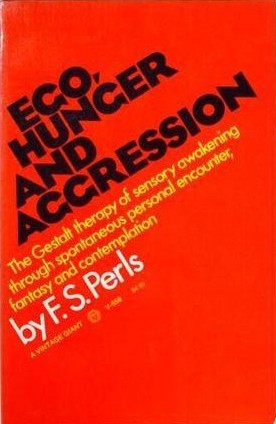
This 1st book by Perls is significant because in addition to criticising Freud, it also lays the groundwork for a new system of psychotherapy. In fact it's the beginning of the gestalt therapy by one of the founding fathers of this therapy.-- Ehrenwald Frederick Perls received his M.D. in Berlin in 1921. Like Wilhelm Reich he started out as a Freudian analyst, but under the influence of Kohler, Wertheimer & Kurt Goldstein developed his own school of analysis: Gestalt Therapy. His principles of gestalt therapy have been adopted by countless encounter & sensitivity groups. He aims in this book to examine some psychological & psychopathological reactions of the human organism within its environment. The author is criticsl of orthodox psychoanalysis, & claims that the use of the new intellectual tools holism (field conception) & semantics (the meaning of meaning) can greatly improve our theoretical outlook.
Friedrich (Frederick) Salomon Perls better known as Fritz Perls, was a noted German-born psychiatrist and psychotherapist. Perls coined the term 'Gestalt therapy' to identify the form of psychotherapy that he developed with his wife, Laura Perls, in the 1940s and 1950s. Perls became associated with the Esalen Institute in 1964, and he lived there until 1969. His approach to psychotherapy is related to, but not identical to, Gestalt psychology, and it is different from Gestalt theoretical psychotherapy.
The core of the Gestalt Therapy process is enhanced awareness of sensation, perception, bodily feelings, emotion, and behavior, in the present moment. Relationship is emphasized, along with contact between the self, its environment, and the other.
Фредерик Перлз, основатель гештальт-терапии, однажды встретился с Фрейдом. Их единственная встреча продолжалась всего около 4-х минут. Сам Перлз описывает её так: - Я приехал из Южной Африки сделать доклад и увидеть Вас. - Ну, и когда Вы уезжаете? - спросил Фрейд Перлз был сокрушен и разочарован такой реакцией человека, которого он долгие годы считал своим Учителем. Он обнаружил в теории Фрейда столько несоответствий и белых пятен, и при единственной возможности не смог даже обсудить их со своим гуру. Эту ситуацию Перлз называем одним из своих основных незавершенных гештальтов. Книга "Эго, голод и агрессия" первая, которую я прочитал по теме гештальт-терапии. Наверное, мне повезло сразу выбрать именно её без чьей либо рекомендации. Судя по всему, она является фундаментальным трудом Перлза, в котором он формулирует главные постулаты гештальт-подхода: пищевой инстинкт как основную глубинную сущность и осознавание как основной инструмент в лечение невроза. Перлз вводит понятие ментальной еды и именно с этой позиции можно описать "Эго, голод и агрессию" как очень вкусное аутентичное блюдо. Приготовить, употребить и усвоить которое необходимо в соответствии со всеми канонами поварского искусства, этикета и гастроэнтерологии :). В общем, книженция не простая для усвоения, но труд едока будет вознагражден с лихвой - часто встречаются такие куски мяса, которые хочется кусать-жевать и не хочется глотать, потому что ну очень вкусные. Книга будет интересна тем, кто интересуется осознанностью. Вы еще раз убедитесь, что интересуетесь правильными вещами :) #осознанность
This book was obligatory to read through my studies of Gestalt psychotherapy. And I was wondering what bad I have done in life to deserve this? The presentation of theory in the book looked sloppy, boring, hard to follow and with some doubtful insights. At the beginning it was not clear what the author wanted to say.
Perls criticized S. Freud a lot. This gave me a feeling that from the book I have learned more about classical psychoanalysis than gestalt therapy. The author’s criticism was directed not only to S. Freud, but also C. Jung, A. Adler, O. Rank and others. This involvement into fictional war with other schools of psychology was annoying most of the time. But sometimes it has some interesting insights. E.g., dividing psychology schools on the time scale: S. Freud - past, S. Perls - present, A. Adler - future. Also some criticism to religion looked right to the point.
The essence of the book was a hunger instinct which was used a lot by F. Perls as a structural example to explain mental and physical processes. He also used other examples of nature to justify his ideas. Unfortunately, sometimes such attempts reminded me of a wishful thinking phenomenon when all means are used to justify your rightness and contradictory facts are omitted.
I found the third part of the book most valuable. It was interesting to follow the description of concentration (awareness) practice. These exercises can make you feel more grounded and bound to here and now. And it was not necessary to philosophize so deeply in the first two parts in order to justify the benefits of these exercises.
The principle of F. Perls’ method lied in so-called concentration therapy (awareness + assimilation). “Neuroses are outcomes of a conflict between organism and environment. <...> Every need disturbs the equilibrium of the organism. The instinct indicates the direction in which the balance is upset. Gratification will restore the organismic peace and balance. <...> Healthy Ego is functioning according to the requirements of different situations, and disappearing with the restoration of the organismic balance. <...> To dissolve a neurotic symptom in one’s organism one needs the awareness of the symptom in all its complexity, not intellectual introspection and explanations. <...> Through full contact with a neurotic symptom you will be in a position to dissolve it.”
I’d summarize this method in free steps: 1. Get a proper feel of now: sense the body and the environment; feel the emotions; notice the thoughts, the facts (without evaluation). 2. Learn what the body is needing to restore the balance (“Ego function”). 3. Act it out by doing, saying, breathing or dreaming. And this would close your Gestalt.
фундаментальная критика фрейда, написанная отцом-основателем гештальт-терапии (поэтому, собственно, я ее и читала). кажется, практически из нее мало что можно вынести: теория гештальта сильно продвинулась и дополнилась, но всегда интересно видеть, откуда что растет в твоем методе.
Перша частина давалася ну дуже складно, а вже друга і третя це чисте задоволення і дуже цікаво. Особливо про ментальний метаболізм, утримання агресії і розлади які вона провокує.
This, the book in which Perls first formulated his new, gestalt therapy, was assigned reading in a group seminar conducted by two visiting psychotherapists teaching for a year or two at Grinnell College in Iowa. It is not Perls' best writing, but he was relatively new to English. It and his his autobiography, In & Out the Garbage Pail, should certainly be read by anyone interested in his development.
класика є класика. ідеї Перлза були революційні для його часу, а деякі залишалися незрозумілими дотепер, і лише з розвитком нейронаук зараз стає очевидно, що його інтуїція науковця і філософа була вражаючою.
¡Exelente libro!, Lo estoy leyendo por segunda vez. La razón de mi aprecio por este libro, es sin duda: su gran aportación a un área un poco resagada del estudio de la mente. Por otro lado, es un libro algo difícil de conseguir en librerías de mi país.
This was not nearly as readable and interesting as Gestalt Therapy Verbatim. As a first book, and I believe, at one point his dissertation, there is a lot of paper spent dismantling Freud and Adler in an academic, boring tone. The hallmarks of 1950's "science" writing are there: diagrams that look "science-y" as if sadness were also bound by Newtonian physics; long, slow arguments that disprove and consider everyone else before getting to the point, and a hefty, seemingly entirely unnecessary sprinkling of homophobia. Perls badassness is there however, and glimmers through from time to time, popping like fireworks for the last three chapters on symptoms where he lays out treatment techniques and considerations.
Below I've added some of the words and definitions I found interesting or unfamiliar.
Screen Expressions: "no precise referent and which conceal instead of reveal. People speaking of nervousness may mean anxiety, irritability, annoyance... "Thinking" is one if the most common screen words... In endeavoring to clarify our minds we should...express {sic} the precise meaning which we wish to convey."
Neurotic: "does not experience sensations instead of emotions, but at the expense or even to the exclusion if consciousness of the emotional component; having partly lost the "feel of himself" (the senso-motoric awareness) he experiences as incomplete situation--a scotoma (blind spot) for the psychological manifestation of the emotion."..."neurosis is a disorganization of the proper functioning of the personality within its environment."..."the neurotic symptom is always a sign that the biological self wants attention."
Introjection: "means preserving the structure of things taken in, whilst the organism requires their destruction."..."the wolf symbolizes greediness and introjection. In the story of little red riding hood the wolf introjects the grandmother, copies her, behaves "as-if" he was she, but his real self is soon unmasked by the little heroine."
Dummy Complex: the dummy allows for the discharge of a certain amount if aggressiveness."
"Four ingredients, so it appears to me, come together to mix the cocktail of ethics: differentiation, frustration, the figure-background phenomenon, and the law that quantity changes into quality."
"Man in general has forgotten that good and bad were originally emotional reactions, and is inclined to accept good and bad as facts."
"The disadvantage of "avoidance" is the impairment of the holistic function. By avoidance, our spheres of actions and our intelligence disintegrate. Every contact, be it hostile or friendly, will increase our spheres, integrate our personality and, with assimilation, contribute to our faculties, as long as it is not fraught with unsurmountable danger, as long as there is a chance to master it."
"Intellectualism is mental hypertrophy, and by no means identical with intelligence, a fact which many people dislike admitting. It is an attitude designed to avoid being deeply moved."..."the avoidance is a general factor to be found in probably every neurotic mechanism."
"For manageable tasks one does not need scapegoats or explanations."
"The desire to master ourselves results from insufficient co-operation between organism and Ego-function."
"The avoidance of external conflicts , however, results in the creation of internal ones."
"The awareness of, and ability to endure, unwanted emotions are the conditio sine qua non for a successful cure; these emotions will be discharged once they have become ego functions."
"The suspicious man should suspect himself, the victimized one certainly victimizes his environment. If you feel unjustly treated, you can be sure that you are the last one who is fair in his dealings."
"Without accepting their biological "reality," "idealistic" Dr. Jekyll and "materialistic" Mr. Hyde will go on existing until mankind has finally destroyed itself."
Well, this book has very high viscosity and hard to digest, very raw and unrefined. Some of the author statements are questionable while others quite interesting but almost all unproven, it appears Perls didn't have much of the prove to back it up at a time of writing this book. Though its very speculative in nature it did provide a general new direction in psychotherapy based on synthesis of Freid, Reich and Perls own ideas. So its obviously not a good choice for those wishing to dive first into gestalt-therapy but a good book to see where it came from. Because of this carefully recommended.
Dal punto di vista di una non addetta ai lavori, è stata una lettura estenuante. Pomposo e logorroico, sembra non arrivare mai al punto e ho dovuto faticare molto per cavare fuori qualche concetto utile.