Patterned on the novels of the Brontë sisters, Antonina is a poignant account of a young Russian whose life is shaped by the cruel neglect of her stepparents, the financial ruin of her father and husband, and--the centerpiece of the novel--her failed love affair with a sensitive but weak young man.
Evgenia Tur (Russian: Евге́ния Тур) (August 24, 1815 – March 27, 1892) was a Russian writer, critic, journalist and publisher. Her birth name was Elizaveta Vasilyevna Sukhovo-Kobylina. Her full married name was Countess Elizaveta Vasilyevna Salias De Tournemire. The playwright Aleksandr Sukhovo-Kobylin was her brother.
It says it right on the back cover: Patterned after the successful contemporary novels of the Brontë sisters. Indeed, one malodorous character - Milkot - was intentionally named after the town of Millcote in Jane Eyre as, I guess, a homage. So I was warned. Warned to expect unrequited love and heroines bursting into tears, oh, every other page. And it was all there; all there, and nothing more.
So why did I, having successfully avoided the Brontës for more than half a century, read this?
Well:
1) It wasn't a Brontë, whom everyone has read. It was an obscure Russian woman whom almost no one has read. It made me feel good, like, you know, recycling.
2) Turgenev, who was, if not her friend, her habitué at literary salons, wrote a review of this novella which can be reduced to the following sentiment: pretty good for a girl.
3) I'm a completist. And I found something very special in the Northwestern University Press European Classics Series. A Shout-Out here for the series. Please do.
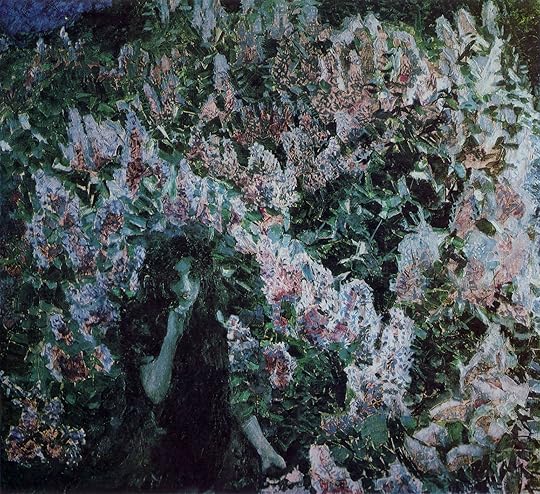
4) I found this in a used book store in Seattle. Held it in my hands. And I looked at this painting which was on the cover:
image:
5) It's lilac season. And I wanted to find out what happened to the girl.
"Evgeniya Tur (1815-92) was a prominent and influential author in the nineteenth century; she participated in nearly every institution of Russian letters (fiction, criticism, editing, children's literature, the salon) and was accommplished in all these areas."
Excerpt from a Review by Ivan Turgenev: "There seems to be no reason to assure our readers of the deep sympathy in us by the talent of Madame Tur. These pages-we say with firm conviction-will remain in Russian literature."
But these pages did not remain in Russian literature, although, perhaps, they are now returning to it. The return offers rich possibilities for reimagining the Russian literary tradition. Introduction by Jehanne Gheith.
Novella pg 88
"During the first stage of life, love, devotion and self-sacrifice constitute a single unbreakable whole, and we are given over entirely to the person we love. Reason remains silent; there's not even a seed of analysis of oneself or others....reason appears unexpectedly, after the first storm, shattering young life, it breaks into our memory of the past and examines every petty detail of it. That's the first thing. Later, having stolen into our soul. It mercilessly destroys forever the life of the heart by never admitting into it any vital sensations. Now it remains for me to tell you all about it."
Reading via the intro about this book's place in Russian literature and how it functions as social criticism of the typical family structure of the time was a more interesting experience than reading the book itself. The influence of the Brontes' novels is present in the tyrannized orphan stuff from Jane Eyre's childhood and the bad men of Wuthering Heights, but the majority of the plot is pure Romeo and Juliet. Over half the book is the teenaged Antonina exchanging forbidden letters with her proscribed beloved and being held literal prisoner by her horrible step-parents. It gets repetitive. However, the strengths of the novel show when Antonina grabs onto whatever little agency she can in such oppressive circumstances, fighting back against societal mores and making her own conscious decisions.
'Men are egotistical - they demand a great deal in the name of their love: they want us to submit gladly, and if they notice our sacrifice costs us both struggle and effort, they find it as unbearable as reproach - and gratitude oppresses them like an obligation. If fulfilling their desire doesn't cost us any effort or struggle and the sacrifice is simply offered, they don't appreciate it.'
'(...) but there are quite a few people on earth who love in a very strange way, under certain conditions, more for themselves than for those they love.'
'The young heart has to suffer many blows before it ceases to trust; the young mind must endure many betrayals before it can grasp that such things are possible; the very being must withstand many powerful shocks before it splits into two parts, one preserving the love while the other debates whether the object of its love is really worth loving.'
'Analysis, like the anatomists's knife, cuts through and destroys vital energy everywhere, leaving behind a corpse where only a moment before blood was flowing, life was throbbing, and the heart was beating.'
This was good! I had trouble getting into it, then the middle 60-70% flew by, and the ending was also eh. That's fair though, because it's just one part of a larger novel. The no chapter breaks rantyness was great, for some reason so much less unbearable with a woman narrator than with dostoevsky's underground man. That being said, its also the fact that Antonina sees what's wrong with her with less of a whiny attitude, which is more palatable. Also because she's more of a direct, real, actualized victim compared to underground man, which perhaps makes her musings more event focused, but is also easier to swallow so... I love reading a book and doing a goodreads cause its like oh, nice, you did something good(reads), you know? Now that I goodred it I can goodreads it and have a good(reads) night. Letterboxd is like... I finish the review and I'm just feeling... boxd... is this anything? 7/10!
I solely recommend this book only because I like to read depressing stuff sometimes. I was amazed at how much “the grave issues” of the main heroine aligned with contemporary equivalents of the 21st century. Antonina stands her ground, speaks her own mind and she doesn’t allow anyone to tell her how to feel, talk or breathe. It’s true that it’s modelled after Jane Eyre, I can see it in the emotions of the main heroine more than anything else in the book. I wish it was longer, it felt way too quick for me, not nuanced enough. And I especially disliked the abrupt ending, which made me feel like the story is “unfinished”. If I had to say more, I would spoil the plot.
Russian novel from 1851 of doomed love between a weak man and a strong but powerless woman; steeped in Charlotte Brontë. Turgenev was a fan, and so am I.
An absolutely fantastic book that contains relevancy to our society even today. So many more people should read Tur's work, which is poignant and inspiring. A darker, twistier version of Jane Eyre!