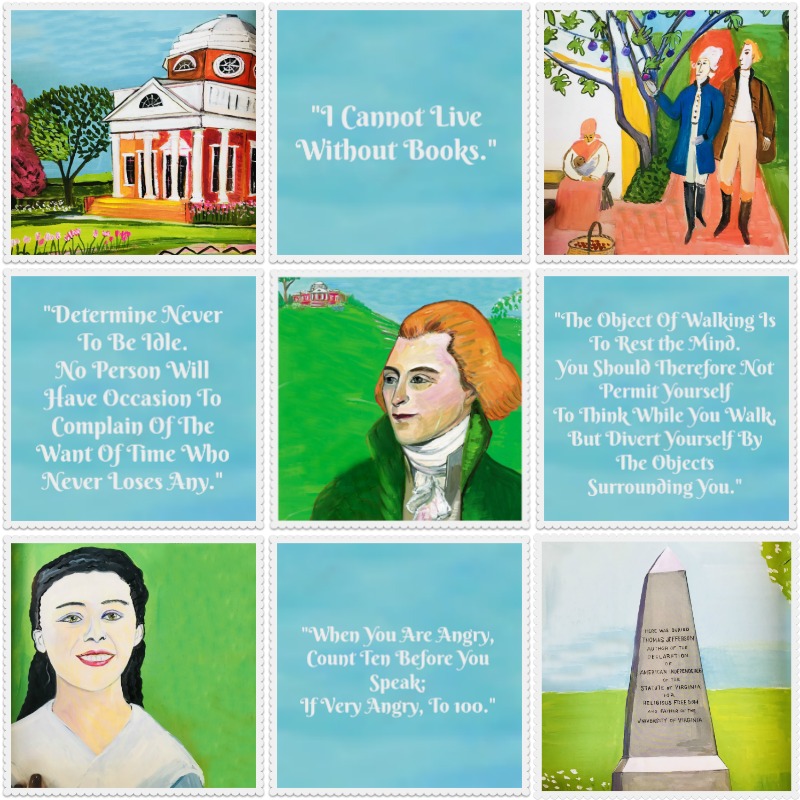
Renowned artist Maira Kalman sheds light on the fascinating life and interests of the Renaissance man who was our third president.
Thomas Jefferson is perhaps best known for writing the Declaration of Independence—but there’s so much more to discover. This energetic man was interested in everything . He played violin, spoke seven languages and was a scientist, naturalist, botanist, mathematician and architect. He designed his magnificent home, Monticello, which is full of objects he collected from around the world. Our first foodie, he grew over fifteen kinds of peas and advocated a mostly vegetarian diet. And oh yes, as our third president, he doubled the size of the United States and sent Lewis and Clark to explore it. He also started the Library of Congress and said, “I cannot live without books.” But monumental figures can have monumental flaws, and Jefferson was no exception. Although he called slavery an “abomination,” he owned about 150 slaves.
As she did in Looking at Lincoln , Maira Kalman shares a president’s remarkable, complicated life with young readers, making history come alive with her captivating text and stunning illustrations.
Maira Kalman was born in Tel Aviv and moved to New York with her family at the age of four. She has worked as a designer, author, illustrator and artist for more than thirty years without formal training. Her work is a narrative journal of her life and all its absurdities. She has written and illustrated twelve children's books including Ooh-la-la- Max in Love, What Pete Ate, and Swami on Rye. She often illustrates for The New Yorker magazine, and is well known for her collaboration with Rick Meyerowitz on the NewYorkistan cover in 2001. Recent projects include The Elements of Style (illustrated), and a monthly on-line column entitled Principles of Uncertainty for The New York Times.
This might have been a 4 star, beautifully illustrated, decently worded picture book biography, but I was so impressed with how Kalman handled discussing Jefferson's slaves (Sally Hemming in particular) that I can't help but give it 5 stars.
Celebrating a historical figure while also acknowledging and lamenting their flaws can be a very difficult thing to do, especially in a children's book. Kalman does it beautifully here. I think she captures the essence of who Thomas Jefferson was and what he accomplished while also pointing out his inconstancies and hypocrisies. Great book.
I don't even know where to begin with this book. I guess I'll start with the stark lack of Black enslaved people on the majority of the pages featuring Monticello. How can you write a biography of Thomas Jefferson that does not discuss his legacy of enslaving Black Americans on every page? It permeates everything he ever did: his wealth, his children, his home, his work in government. This man, like many of our founding fathers, preached "life, liberty and the pursuit of happiness" while enslaving 600 people during his lifetime, freeing only five after his death. Why should such a man be portrayed as anything other than cruel and hypocritical?
I'll highlight some of the most egregious parts of this book here: -When discussing his vegetable garden, the author wrote "A garden makes people happy," without acknowledging who tended to the garden at Monticello. But don't worry, she takes the time to point out that peas are wonderful and fun to count. (?!?!) -When discussing his family, the author writes: "Here is his darling Patsy, the only child that lived longer than he did." This is demonstrably false, as 4 of his children with Sally Hemmings survived Jefferson. For the author to write something blatantly inaccurate like this in a book published in 2014 by a major publishing house (Penguin) is infuriating. -When we finally get the first depiction of an enslaved woman, it is in an image of Thomas Jefferson and Marquis de Lafayette "strolling through the gardens," past a Black woman and her baby. -The author does acknowledge the horrors of slavery, but not until after exalting all of Jefferson's many accomplishments. She writes: "The man who said of slavery 'this abomination must end,' was the owner of about 150 slaves [this is also false; the Monticello website states he enslaved 600 people.] The monumental man had monumental flaws." Even the word "flaws" feels diminishing here, like it was just a problem of his character that he chose to enslave 600 people. -When describing the kitchen at Monticello: "He probably said a few kind words to the cooks." The cooks who were enslaved. But he was kind to them? Ok???? -The next page is really a head-scratcher. The author describes the many flavors of pudding available to Jefferson, calling them "the best of everything." And then in the very next sentence says: "Jefferson may have been a kind master, but it was still a horror." This sentence, paired with an illustration of a beautiful dining room table set with silver, does nothing to relay the true horror of slavery. -When Sally Hemings is finally discussed, she is described as "beautiful," which seems like an inappropriate way to describe someone who was enslaved and raped for most of her life. She is drawn smiling, although no images of her actually exist. She mentions that he had children with Hemings, after previously claiming only one of Jefferson's children outlived him.
The book closes with this: "If you want to understand this country and its people and what it means to be optimistic and complex and tragic and wrong and courageous, you need to go to Monticello." While this may be true, the author did not paint an accurate picture of Thomas Jefferson's life or legacy. This type of biography perpetuates the myths we tell about the Founding Fathers. Children may read this book and not have an adult in their lives who is able to contextualize it. This book is harmful, and I'm disappointed that this type of story is being told this way in 2019.
This is a surprisingly nuanced book about Thomas Jefferson from one of my favorite authors & illustrators. The first chunk of the book focuses on the man, his personality, and his myriad achievements. In the last third, Kalman deftly talks about the hypocrisy and horror of his slave ownership. It's not a perfect portrayal (the page about the Louisiana purchase left me thinking about all the native American land that was taken in the "pursuit of everything"), but is certainly more nuanced than I expected a picture book to be while still being readable and engaging.
I have never before been excited about reading a book about Thomas Jefferson until I opened my latest shipment from Junior Library Guild and pulled this out of the box. I love Kalman's Looking at Lincoln, and I didn't know she was writing a book about Jefferson, so this was a great surprise. I wondered how she would handle the slave-owner bit of his bio. And here's how she handled it: beautifully.
Slavery is neither mentioned nor hinted at in the first 2/3 of the book. Then we see an illustration of Jefferson with the Marquis de Lafayette, strolling through the gardens of Monticello, passing by a young black woman sitting on a bench, holding a baby. Kalman mentions that the man who said of slavery, "This abomination must end," was the owner of about 150 slaves. The monumental man had monumental flaws.
What a perfect line.
Jefferson may have been a kind master, but it was still a horror.
Here is Jefferson's farmbook with a list of his slaves and the supplies they were given. Our hearts are broken.
Speaking of Sally Hemings and her children ("It is strongly believed...Jefferson had children with the beautiful Sally Hemings.") Kalman informs us that some of her children were freed and able to pass for white: To hide your background is a very sad thing. Perhaps people felt they had no choice in such a prejudiced land.
How could Kalman have done any better? She shows us the paradoxical and bewildering history of Thomas Jefferson right alongside his celebrated, brave, and brilliant accomplishments. She doesn't belabor it, doesn't debate, doesn't excuse, merely states it outright and briefly mourns.
As for the first 2/3 of the book, we learn snippets of information about Jefferson, some that are familiar and some not: that he was interested in practically everything, especially books, that his home was Monticello and he loved the flora and fauna on his land. We learn that there he housed his collections of all kinds of things, from maps and bones to paintings, statues, and Native American artwork. We learn about his love for growing vegetables (especially peas), for music (he practiced his violin three hours a day), of his part in the American Revolution and that he was the third U.S. president.
My favorite page of Kalman's Lincoln book is the last, because of the graceful wording. I feel the same way about her work here. The last page is just lovely: If you want to understand this country and its people and what it means to be optimistic and complex and tragic and wrong and courageous, you need to go to Monticello.... Maybe you will lie down under a tree and fall asleep thinking about life, liberty and the pursuit of everything. That's him. That's Thomas Jefferson: optimistic and complex and tragic and wrong and courageous. Isn't it all of us, really?
Kalman is eternally optimistic and finds the best in any place, any person, any story. Her work here, more about Monticello than it is about Jefferson, reminds me of my days in college touring the homes at Lexington and Concord, Massachusetts. I wanted to make books like this (but wasn't ready, drawing and thought wise yet). Maira Kalman, who I also heard speak in college, finds the smallest things and stories beautiful and creates books that emphasize what is the most special, unknown nuggets about someone - even a titan like Thomas Jefferson who is the stuff of American legend. This book feels personal, like she knows him through his rooms - the best page, in my opinion is a painting of Jefferson's bed that straddled two rooms and explains he, never one for wasting time, could get out of bed into one room that was a study OR on the other side, jump right into his boots and run outside. I find stories like these SO important to American history. These men, flawed as they were, wanted to WORK for themselves and this country and make libraries, schools, laws....and work tirelessly at their own pursuits in writing, the arts, planting, running a household. I was relieved to see this book wasn't strictly romantic but also highlighted the more problematic sides of Jefferson's life and legacy too. Bright colors, deep thoughts, sweet tour of Monticello and the life of a man.
There's a point in her biography of Thomas Jefferson that Maira Kalman seems to suggest that Thomas Jefferson could never stay focused on one thing. I hope that this line served as her guiding focusing in illustrating and designing the book, because it's almost impossible to find a guiding focus on pages or in the book as a whole. Factoids and ideas are thrown about pell mell and seemingly randomly (woohoo, now you know why he slept between his study and the great outdoors kids!) I must give credit that Kalman at least attempts to address slaves and Sally Hemmings, but have to say that the randomness of everything undercuts these issues as important in much the same way that his favorite shoes or instruments were important. Pursuing everything about the man leaves the book a mile-wide and an inch deep.
Though it is receiving starred reviews, the title of Kalman's book brought me up short.
I'm an enrolled member of a federally recognized tribe. Anyone who has just a bit of insight and knowledge as to how Native land was taken from Native Nations should also have paused at that title. It celebrates "pursuit of everything" which includes land. Should that be celebrated?
Replete with original and vibrant illustrations, this peek at Jefferson includes many fascinating details from interests and contributions to a snapshot of the time and even his peers.
Considering the brevity of this work and the intended audience (very young children) it seemed that a little too much attention was given to Sally Hemings.
As usual, the illustrations are exquisite and I love the tone of magical excitement Kalman usually brings to her books (although I'm not sure how appropriate that is here).
Unlike other reviewers, I really disliked her handling of the people Jefferson enslaved. They felt shoe-horned in at the end, and even then, I got the sense of an apologist/reassuring presentation, with Kalman suggesting that Jefferson may have said "nice words" to the (presumably enslaved) cooks. The monumental achievements that these enslaved Africans were forced to carry out were brushed over, in favor of Jefferson practicing musical instruments for three hours each day. While Sally Hemmings was included, it never explicitly says that she was enslaved, and she is illustrated to look white. (Unless that illustration was one of her white-passing children? It's not made clear. I did appreciate the brief discussion of passing as white.)
And of course, no mention at all of Native Americans, besides Sacagawea.
In the end, beautiful but predictably disappointing.
So many things to love about this book, but the non-handling of the role of native peoples was a big disappointment. I'm glad his role in owning slaves was detailed here. It is problematic for us to venerate our founding fathers without being completely honest about what they did, and this book doesn't go quite far enough. I will still purchase it to replace other, even more problematic titles, and also hope that we as children's history writers continue to learn to tell the truth about America.
A good children's book my son and I read during homeschool. The language is easy to understand and the illustrations are vivid. A good basic primer about Thomas Jefferson.
Thomas Jefferson, one of the Founding Fathers of America, was born on April 2 according to the old style (Julian) calendar, which was changed in 1752 in the U.S. to the Gregorian calendar, still in use today. The new calendar pushed all dates forward by eleven days, so that Jefferson's birthdate became April 13. Those born during this period often celebrated their birthdays on both days, if they celebrated at all. (According to scholars at Monticello, Jefferson always insisted the only birthday he observed was July 4, the birthday of his country.)
Maira Kalman creates gorgeous books, and fortunately, she is an excellent storyteller as well. Her book for children on the life of Lincoln was absolutely wonderful (see my review here) but I was worried about this one: what would she say about Jefferson and his unwillingness to give up his slaves?
Kalman does not make Jefferson’s weaknesses central to the book, but she doesn’t ignore them either. She writes:
"‘The man who said of slavery ‘This ABOMINATION MUST END’ was the ownere of about 150 slaves. The MONUMENTAL MAN had MONUMENTAL FLAWS.”
Including a reproduction of the list of Jefferson’s slaves in his farm books, she notes:
"OUR hearts are BROKEN.”
Most of all, however, Kalman focuses on Jefferson’s eclectic range of interests, his love of books - “on history, science, philosophy, government, mathematics, music, art and so much more”), his work on his estate which he called Monticello, and his accomplishments in government.
She explains about his belief in the separation of church and state, and about his purchase from Napoleon of a large part of the land that became the United States.
She ends with the advice:
"If you want to understand this country and its people and what it means to be optimistic and complex and tragic and wrong and courageous, you need to go to Monticello.”
What an amazingly concise and astute way to summarize not just the character of Jefferson, but of the other Founding Fathers as well.
The Matisse-like whimsical paintings in the book are bursting with vibrant colors, and the typeface varies in size, style, and color, depending on the text.
In the back, a brief annotated note section adds more details about the people and events described in the book.
Evaluation: This is an outstanding resource about Jefferson for readers of all ages. The text is funny and informative, with lots of kid appeal. The illustrations are stunning.
The author of Looking at Lincoln takes on Thomas Jefferson in her newest picture book biography. The focus in this biography is on the wide range of Jefferson’s interests and how he truly was a Renaissance man. Monticello, the house Jefferson designed and built, serves as a fine background to his interests since the home itself was ever changing and also housed many of his interests as well. The book looks at fascinating small details like the design of Jefferson’s bed, the extensive vegetable gardens, and his hours spent practicing music. After fully exploring Jefferson personally, the book turns to the Declaration of Independence and Jefferson becoming the third President of the United States. Then the book also explores the fact that Jefferson had slaves and fathered children with one of them, Sally Henning. This is a complex and thorough look at a man who was brilliant in so many ways but troubled as well.
Kalman writes biographies with her own opinions right on the page. So when she addresses the slave issue, she speaks of “our hearts are broken” and then speaks to how tragic it is that Jefferson’s children who could pass as white had to hide who they really were. This adds a personality to the book, making it far richer than simple facts would. It will assure young readers that it is good for them to have opinions about history and to express them too.
As always, it is Kalman’s art that sets this book apart. Her illustrations range from more serious portraits of the historical figures to eye-popping bright colors in the vegetable gardens where paths are pink next to the bright green of the grass. It is all entirely rich and joyful.
Another dynamic and unique biography from Kalman, this book belongs in every public library serving children. Appropriate for ages 7-10.
"Thomas Jefferson: Life, Liberty, and the Pursuit of Everything" by Maira Kalman was a selection for Chapter and Verse book club - as a potential candidate for the Sibert Award. I didn't expect to like it as much as I did.
Strengths:
- Kalman's illustrations are vibrant, interesting, and attractive. Could this/should this be a consideration for the Caldecott Award?
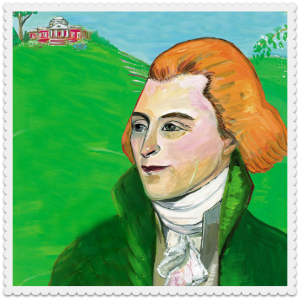
- The inclusion of lots of little known facts about Jefferson is really interesting. Kalman paints a picture of a flawed but brilliant man - who was full of contradictions. And who knew he had red hair?
- I liked the child-like voice from which the story is told. I could almost hear an elementary aged child speaking these words.
Weaknesses:
- There is a lot of editorializing here that reduces the book's authenticity as an objective piece of "non-fiction." I would have appreciated letting the facts speak for themselves.
The problem with the Siebert Award is that there are no age categories - all of the exceptional non-fiction for a variety of audiences is grouped together. It is difficult to compare this to something more substantial like "Eyes Wide Open" and "The Family Romanov."
This is among the best children's biographies I've ever read. Factual and fun and absolutely does not talk down to its audience. I read it and I thought that if I knew the man, Jefferson and I might be friends. I also thought, what are the ways in which I am tragic? where I am not only not living my values but not taking seriously that I'm not living them? Wow. Who'd have thought all that would come out just now. I think I have to change my rating to 5 stars.
Really good. Maira Kalman serves up a genuine portrait of Jefferson. I love this line "if you want to understand this country and it's people and what it means to be optimistic and comes and tragic and wrong and courageous you need to go to Monticello...maybe you will lie down under a tree and fall asleep thinking about life, liberty and the pursuit of everything"
Maira Kalman brings her signature artistic style and wit to this biography of Thomas Jefferson targeted at the very young reader. I am a fan of Jefferson, and Maira captures a balanced portrayal of both his greatness and his flaws. While reading this one, I was reminded of my visit to Monticello last year, a place well worth a visit.
A vibrantly illustrated biography that gives particular attention to Jefferson as a Renaissance man and insatiable intellectual curiosity. Kalman sums up Jefferson quite well when calls him "a monumental man with monumental flaws."
An outstanding and honest biography of one of America's greatest citizens. Amazing illustrations and well-researched, interesting information throughout.
We purchased this book on a trip to New England in 2018 from the Boston Tea Party Ships and Museum store.
It has a very interesting style with varying fonts and a casual, fun tone of writing tailored to children. There were a few times that my husband and I laughed out loud while reading it. Although it's not what I normally gravitate toward, I really liked the illustrations. They're quirky, colorful and and artistic.
The book covers a few major points about Jefferson's life as well as interesting little tidbits, like how he designed his bed to open to two different rooms so he decide if he wanted to go into his study right away or go outside upon waking. It talks about the many languages he learned, his collections, his home, Monticello, his love of walking, and his involvement in the founding and development of our country.
It also talks about his ownership of slaves and relationship with the slave, Sally Hemings. I don't have children, so it's hard for me to know how this would go reading this to a child, but I really appreciated a lot of the author's treatment of this subject. She writes that Jefferson was opposed to slavery but that "the monumental man had monumental flaws." How true of all of us. The author grieves his involvement with slavery (on one page she writes, "Our hearts are broken.") but doesn't let it color the other parts of his life and important contributions (although she devoted more pages to that topic than any other). On the last page, the author writes, "If you want to understand this country and its people and what it means to be optimistic and complex and tragic and wrong and courageous, you need to go to Monticello."
Overall I thought the book had a very positive, upbeat tone that conveyed many of Jefferson's strengths along with a few of his more grave errors. I really liked the author's acknowledgement that great men have failed greatly and that human beings are never perfect. If we discarded the contributions of every person who ever had a moral failure, none would be left standing. With every person we admire, we must learn from the good and grieve over the bad. It seemed like the author struck a decent balance in a brief overview of Jefferson's life (although I haven't studied him in depth so this is based on the basic background that I knew about him going into the book).
"Determine Never To Be Idle. No Person Will have Occasion To Complain Of The Want Of Time Who Never Loses Any."
"This Abomination Must End."
"The Object Of Walking Is To Rest the Mind. You Should Therefore Not Permit Yourself To Think While You Walk, But Divert Yourself By The Objects Surrounding You."
"When You Are Angry, Count Ten before You Speak; If Very Angry, to 100."
Monticello // Jefferson's Library // Vegetable Garden // Jefferson's Wife // Jefferson's Daughter // British King // Revolutionary War // Founding Fathers // Declaration Of Independence // Benjamin Franklin // John Adams // George Washington // Separation Of Church And State // Louisiana Purchase // Lewis And Clark Expedition // Sacagawea // Marquis de Lafayette // Mulberry Row // Jefferson's Slaves // Sally Hemings // University Of Virginia //
TRAVELED TO // Virginia - Monticello MET ALONG THE WAY // Thomas Jefferson
This illustrated children’s book describes the complex life of our third president of the United States, Thomas Jefferson. It tells of how he was interested in basically everything including (though certainly not limited to): history, science, philosophy, government, math, music, art, and nature. Jefferson did not like to sit still and was so ambitious/active in his own life that he kept his bed between two rooms in his house so when he woke up in the morning, he could more quickly spring to action in whichever room was appropriate. The colorful (what appears to be colored-pencil) illustrations give the reader images to coincide with the information around Thomas Jefferson’s life, especially the ones of his estate and the vast gardens he so enjoyed. I couldn’t allow myself to give this story 5 stars, even though it did a good job laying out his biography, as it seemed so passive and uncaring of his bondage of human lives through owning over 150 slaves himself. It briefly mentions “The man who said of slavery ‘this abomination must end’ was the owner of about 150 slaves. The monumental man had monumental flaws.” What an understatement! It later went on to mention how it is strongly believed that Jefferson fathered several children with one of his slaves, Sally Hemings, and that of those children some who had lighter skin pigment were freed while the others remained enslaved. What it does NOT mention of this, is whether or not his and Sally’s relationship was consensual/mutual and how morally wrong Jefferson was to have kept human lives in the bondage fo slavery to begin with, especially regarding the slaves he fathered. Overall, a good children’s book about Thomas Jefferson’s biography even with certain details glossed over. I suppose some details of American history are better to be presented to older children when they are cognitively ready to handle the good with the bad.
Title: Thomas Jefferson: Life, Liberty and the Pursuit of Everything Author: Maria Kalman Illustrator: Marikka Tamura Genre: Biography (3-5) Theme(s): Presidents, Slavery, Declaration of Independence, Determination Opening line/sentence: Thomas Jefferson had red hair and some freckles (about 20 I think), he grew to be very tall and oh, yes he was the third President of the United States. Brief Book Summary: This books brings the reader on a journey of pages through the life of Thomas Jefferson, who was interested in EVERYTHING. The book fills the reader with facts of everything that Thomas Jefferson likes and emphasizes that he was always on the go doing things – including writing the Declaration of Independence. The author also incorporates facts about things such as a list of all the different kinds of peas. The book also includes quotes from Thomas Jefferson and discusses his friendships with other historical people, such as – Benjamin Franklin, George Washington, and John Adams. Towards the end of the story the reader learns about the lives of Jefferson’s slaves and his interactions with them. Professional Recommendation/Review #1: Jeanne McDermott (Booklist, Feb. 15, 2014 (Vol. 110, No. 12)) Starred Review* Thomas Jefferson was complex as this picture-book biography vigorously demonstrates. Famous for life, liberty, and the pursuit of everything, he sometimes fell short of the ideal. If Kalman expressed adulation for Lincoln in Looking at Lincoln (2012), in this examination, although admiring of her subject and his accomplishments, she s more clear-sighted. Vibrant gouache paintings some full-spread, some more intimate images capture Jefferson s family and colleagues, his interests and pursuits, his lavish home, and its inferior slave quarters. The voice is that of a curious child reporting fascinating research findings. The rangy tone, however, allows Kalman to supply a wealth of information though not everything is well explained. Jefferson had an ingenious copying machine ? Just a sentence or two highlighting each point is often followed by unrestrained commentary: upon sharing a list of his slaves, the text laments, Our hearts are broken ; after revealing that Jefferson did not include his presidency in his epitaph, a musing: I wonder why. Even the typography, which alternates between staid print and handwritten flourishes, conveys enthusiasm. Playful but informative, as quick witted as Jefferson himself, this will along with the author s note will inspire young readers to learn more. Professional Recommendation/Review #2: Elizabeth Bush (The Bulletin of the Center for Children s Books, February 2013 (Vol. 67, No. 6)) Kalman launches right in to this attractive picture-book biography with a succinct, spot-on summary of what made Thomas Jefferson memorable: What was he interested in? Everything. I mean it. Everything. The ensuing pages support the claim with a litany of his personal enthusiasms, his multitudinous concerns as a statesman, and his mind-boggling legacies, edited and arranged to pique children s interest even as it covers salient textbook facts. Kalman has reprises some elements of her marvelously innovative picture-book biography Looking at Lincoln (BCCB 2/12), including an accessibly informal tone, a fruit bowl of vibrant colors, a frequent focus on a single telling artifact, and plenty of holes punched through the fourth wall to invite readers into the conversation. However, in this case there is no child guide regaling her peers with her discoveries about a Great Man, and thus the na ve comments and asides that pepper the text are a little more more distracting ( His favorite vegetable was peas. Peas really are wonderful and fun to count ). Still, her candid discussion of Jefferson s contradictory views on slavery is particularly well handled, and a closing observation gives kids permission to be perplexed by this complicated guy: If you want to understand this country and its people and what it means to be optimistic and complex and tragic and wrong and courageous, you need to go to Monticello. Response to Two Professional Reviews: The reviews note the author’s use of text which can be hard to read at times, causing it to be distracting to readers or even too illegible that they skip over lines. They also note the short phrases of everything Thomas Jefferson did with little explanation, which can leave the reader wanting to know more. They describe this book, as “playful” which increases is attractive, inviting look for young readers. The illustrations and text definitely add to this books playful look and tone, which can be both negative and positive for the reader depending on the age or if they are reading independently versus with someone who is able to explain puzzling thoughts. Evaluation of Literary Elements: The author does an excellent job of following the life of Thomas Jefferson. The text at sometimes, however, is not very reader friendly but is attractive and laid out in an exciting way. The illustrations are very vibrant and the portraits of the characters are very life-like. The illustrators use of acrylics bridges the gap between life-like images and animation-like images, thus making them attractive to the readers’ eye. The author is very focused on the character of Thomas Jefferson and his life as the book includes so much in few pages. Consideration of Instructional Application: There is a lot I would want to do with this book in a classroom of 4th or 5th graders. First, I could see this book as a beginning of a unit on the Presidents. I would find other books similar to this on all of the Presidents to do a unit in the classroom where the students would learn about each President. Following this unit study, I would want to do a character dress-up day in my classroom where each student would come dressed as a character from one of the books. On the dress-up day each student would give a presentation on his or her specific character (assuming each student is a different historical figure). Depending on my school location, I would also find it very educational and fun to travel to Thomas Jefferson’s home, Monticello, where the students could walk through the place where he once lived. Another thing I would do with this book is a unit study on slavery. At the end of the book the author includes a few pages on their daily lives in the past. And finally, the author includes two pages with terms and definitions from the book that I would turn into an instructional activity by splitting the class into groups to study each term more where they would present their findings to the class. These terms include: Sacagawea, Separation from Church and State, Founding Fathers, Revolutionary War, British King, etc.
This was a difficult book to rate. On the one hand, 5 stars for the fact that this is a picture book about Thomas Jefferson that actually acknowledges the wrongness of him enslaving people (and uses the word "wrong" explicitly) and actually includes the Marquis de Lafayette's condemnation of his friend's enslaving others AND acknowledges the existence of Sally Hemings and her children. These truths are so often erased entirely in children's books -- detrimentally and unnecessarily, as children can understand these concepts -- that the book has merit for this alone.
However, HOW enslavement is treated...almost as an afterthought, and while including a sentence like, "He probably said a few kind words to the cooks" and "Jefferson may have been a kind master" and so many details about all the luxury and different kids of puddings..NO. Just no. Worse, the editorializing about the children of Sally Hemings that says, "Passing for white meant that your skin was so light, you could hide the fact that you were partially black. To hide your background is a very sad thing"...implicitly saying that what Hemings's children did to survive and thrive was wrong rather than necessary, given the circumstances into which they were born.
The latter part of the book then mentions that in his old age, he "no longer cared for fancy clothes", mentioning nothing about the fact that he was essentially bankrupt and that his recklessness with money meant that hundreds of the people he enslaved had to suffer after his death.
Rated just on those later parts, I'd give the book a 1 at best....and yet, is acknowledging his ugly history of enslaving people alongside the meritorious parts of his story enough to rate the title more highly? Given the lack of other options on the shelf right now, I'd say so. So I settled on a 3.
Summary: This book does a great job in incuding vital information about not only the life of Thomas Jefferson, but the people and events that surrounded him as well. It talks about the things he loves to do, such as read about EVERYTHING he could possibly get his hands on. His accomplishments with the Revolutionary War, becoming president, and his Louisiana Purchase he made with the French. It also talks about the not so great aspect of his life. His wife died at a young age and so did all but one of his children. He owned slaves and is thought to have children with one of them. They were so light skinned that they were able to pass for being white. It brought in people who created the Declaration of Independence along with him, like Benjamin Franklin. He died on July 4, the same date as when he finished writing the Declaration of Independence. Reflection: I think this is a great book to show both the good and bad of Thomas Jefferson, and also really digs into how he lived his life. He hated having nothing to do and was a firm believer in the importance of knowledge and studying the world around him. Laziness, to him, is one of the worst things in the world. I also like that it includes that even though he was a kind master to his slaves, he still owned slaves. It was an evil practice and although he was probably better than most, it is an evil practice. All the great food he and his family ate were the products of slave labor. Teaching Idea: A great teaching idea I could do with this book is to include it in a lesson where we compare and contrast. While this book includes some great facts about the third president and flaws that he had, not a lot of other books showcase these. If we were to read one book on Thomas Jefferson that only takes about his accomplishments and then read this book, we could compare what things were included in both and then things that one book had that the other didn't. This can show them the importance of reading multiple resources when they are learning about a particular topic in order to get the most accurate information possible.
This book presents quite a bit of information about Thomas Jefferson in an engaging way, without a lot of text per page. However, I was a bit put off not only by the title but by the first line: "Thomas Jefferson had red hair and some freckles (about 20 I think)...," which seems silly enough that I immediately doubted whether this biography would be grounded in fact. More significantly, I agree with one of the previous reviewers here that although the issue of slavery is raised in the book, and although the author states that Jefferson was flawed in this respect, the tone feels apologetic. Slavery isn't mentioned until far into the book, after we have learned both monumental and trivial information about Jefferson's life. Some of the text on slavery:
"He probably said a few kind words to the cooks."
"Jefferson may have been a kind master, but it was still a horror."
"Passing for white meant that your skin was so light, you could hide the fact that you were partially black. To hide your background is a very sad thing. Perhaps people felt they had no choice in such a prejudiced land." - Something just rubs me the wrong way about a presumably white author passing this almost moral judgment, not only on the nation that allowed these people to be ENSLAVED, but also in a sense on the former slaves (Jefferson's children with Sally Hemings) for choosing to pass.
My 10- and 8-year-old daughters did not like this book.
Grade level: Kindergarten- Third Grade Awards: Kirkus Reviews Best Books of 2014, and Amazon.com Best Books of the Year 2014 Summary: Thomas Jefferson: Life, Liberty and the Pursuit of Everything by Maria Kalman is a story about our third president of the United States. The story covers all that Thomas Jefferson was interested in including violin, gardening, and learning new languages. This book is great for young readers who are learning about their country's history the good and the bad. This book informs the reader about Thomas Jefferson's complicated life and all that happened in it from his hobbies to his presidency. Review: I love this book; I think it is a great resource for young readers who are learning about the presidents of the United States. The illustrations are charming and really bring the text to life for the reader. I would highly recommend this book for young students. Classroom uses: This book can be used in the classroom to teach about our third president Thomas Jefferson. This story could spark conversations about other presidents, and even could be used to help students research more information for a "president bio bash".
Message learned: Even historical figures have their flaws.
I read this right after having stumbled upon this glorious (and not kid appropriate) video. BTW, Douglass totally wins.
No, I didn't show my kids that.
Anyways, back to the actual book. I was thinking that everything had been very whitewashed about Jefferson. Then I turned the page and it mentioned slavery and Sally Hemings. It's not a pleasant part of history, but it's important to include this in the book. It's important to show that these things happened. As it says at the end of the video, "You need to put an asterisk next to your name."
It brought up the touchy subjects in a manner that was easily understood by my kids. I appreciated that. All in all, it's a good book. I'm still stunned that someone was able to get as much done in a day as he did. It's a great one to read with kids that are starting to learn about history - although they may want to visit Monticello on the next family trip.