To the world at large, Doc Savage is a strange, mysterious figure of glistening bronze skin and golden eyes. To his amazing co-adventurers - the five greatest brains ever assembled in one group - he is a man of superhuman strength and protean genius, whose life is dedicated to the destruction of evil-doers. To his fans he is one of the greatest adventure heroes of all time, whose fantastic exploits are unequalled for hair-raising thrills, breathtaking escapes and bloodcurdling excitement.
THE RED SKULL
Into a subterranean world of red-hot lava, Doc Savage and his fantastic five descend -- to face the most fiendish foe of his career. Awaiting Doc is an irresistible power that can level mountains... that can enslave the world... and that threatens to make Doc's most dangerous adventure his very last...
Kenneth Robeson was the house name used by Street and Smith Publications as the author of their popular character Doc Savage and later The Avenger. Though most Doc Savage stories were written by the author Lester Dent, there were many others who contributed to the series, including:
William G. Bogart Evelyn Coulson Harold A. Davis Lawrence Donovan Alan Hathway W. Ryerson Johnson
Lester Dent is usually considered to be the creator of Doc Savage. In the 1990s Philip José Farmer wrote a new Doc Savage adventure, but it was published under his own name and not by Robeson. Will Murray has since taken up the pseudonym and continued writing Doc Savage books as Robeson.
All 24 of the original stories featuring The Avenger were written by Paul Ernst, using the Robeson house name. In order to encourage sales Kenneth Robeson was credited on the cover of The Avenger magazine as "the creator of Doc Savage" even though Lester Dent had nothing to do with The Avenger series. In the 1970s, when the series was extended with 12 additional novels, Ron Goulart was hired to become Robeson.
The first Doc Savage story appeared in 1933 and the series ran in pulp and later digest format into 1949. Bantam reprinted the entire series in paperback with wonderful, iconic covers starting in the 1960's. Doc was arguably the first great modern superhero with a rich background, continuity, and mythos. The characterizations were far richer than was common for the pulps; his five associates and their sometimes-auxiliary, Doc's cousin Pat, and the pets Chemistry and Habeas Corpus, all had very distinctive characteristics and their byplay was frequently more entertaining that the current adventure-of-the-month. The settings were also fascinating: Doc's Fortress of Solitude, the Hidalgo Trading Company (which served as a front for his armada of vehicles), and especially the mysterious 86th floor headquarters all became familiar haunts to the reader, and the far-flung adventures took the intrepid band to exotic and richly-described locations all over the world. The adventures were always fast-paced and exciting, from the early apocalyptic world-saving extravaganzas of the early days to the latter scientific-detective style shorter works of the post-World War Two years. There were always a few points that it was difficult to believe along the way, but there were always more ups than downs, and there was never, ever a dull moment. The Doc Savage books have always been my favorite entertainments... I was always, as Johnny would say, superamalgamated!
Of all the pulp era heroes few stand out above the crowd, Doc Savage is one of these. With his 5 aides and cousin he adventures across the world. Fighting weird menaces, master criminals and evil scientists Doc and the Fab 5 never let you down for a great read. These stories have all you need; fast paced action, weird mystery, and some humor as the aides spat with each other. My highest recommendation.
A straightforward but entertaining Doc story, sixth in the original series (August 1933). Less fantastical than many, it's more of a mystery with only a few speculative-fiction elements. There are several good characters here, especially Monk's secretary, Lea Aster—a fun, feisty female who I wish had become a regular in the series.
Doc and his pals accept a mission to foil a plan to undermine a dam construction in Arizona. And that is pretty much it. Nothing special about this tale, that is unusually mundane in comparision with other Doc exploits.
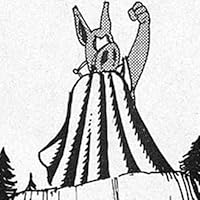
The aforementioned "Red Skull" is just a rocky formation, not a villain. Perhaps naming the story "Nick Clipton" would not be so spetacular and ominous.
The writing is not the best in the world (it was only written for the old pulp magazines in the 1930's)but a lot of fun. really entertaining... similar to Indiana Jones except that Doc Savage is a genius....
Lester Dent, the primary author of the Doc Savage stories, vaguely hinted in the final sentence of The Pirate Of The Pacific as to what his next story promised to be … it promised to be another rip-roaring adventure, since Monk thrived on such activity; Lester informs the reader that Monk and the reading audience would not be disappointed.
The Red Skull, published in the August, 1933 issue of Doc Savage Magazine gets right into the action as we read seven thugs are running along a golf course in the northern suburbs of New York City; a small plane was enroute with a man desperately seeking Doc Savage’s help. He is wearing a money belt that, instead of concealing money, contains a letter, a map, and an envelope stuffed with an assortment of records.
Doc and the crew soon find themselves in Arizona at the site of a massive construction project, a gigantic hydro dam spanning the Red Skull Canyon. Of course, this coincides with the Hoover Dam project under construction in Black Canyon on the Arizona/Nevada border from 1931-36. Lester never gives the dam an official name, as he only mentioned that it is a massive construction project “across the upper end of Red Skull Canyon and was self-financed.” The river in the story was the Red Skull River, which coincides with the Colorado River at the Hoover Dam. Sabotage and murder are daily occurrences at the site as Doc and the guys set about to discover who is the mastermind behind these dastardly deeds and why they are being committed. He eventually figures everything out and exposes the mastermind.
Doc does a lot of detective work in this adventure; he brings the bad guys to justice, with the master mind and his chief lieutenant getting what they deserve … fate plays a huge role as is usually the case in these Doc Savage stories.
This is an enjoyable read, as Lester keeps his Doc Savage Adventures current and with regard to The Red Skull, believable, doing what he does best … incorporating the current events of the day into his five-star adventures. I also like the fact that he uses many “real life” place names in his stories; for example, he pays homage to his home state of Missouri in this one as he has the bad guys stopping in Kirksville, Missouri to refuel their plane.
As mentioned, it was an enjoyable read; although it contained less action than many of his stories, a good “whodunit” is hard to beat. The Red Skull is an excellent example of a good “whodunit.” *****
My first experience with a Doc Savage tale. It was a typical pulp action-adventure, not particularly well-written, but with fun characters and set pieces, and of course Savage as the prototypical superhero.
It's not hard to see why Savage has recently gained the nickname of "the first superhero." Later comic writers clearly borrowed a lot from him. A nearly perfect physical form, enhanced hearing and sight, even a Fortress of Solitude located at the North Pole, all point to Superman. A hugely wealthy orphan, supreme powers of observation and deduction, and unique vehicles, gadgets, even a utility belt, all point to Batman.
This particular story was more pedestrian than others, from what I understand. Doc Savage crosses paths with some unscrupulous businessmen who will stop at nothing to gain control of a dam construction project. Kidnapping, chases, gunfights, and intrigue ensues. Nothing too speculative or fantastical involved.
I enjoyed it enough, I suppose, but the writing lacked the dynamism of the works of Robert E. Howard. It was filled with plenty of 1930's gangster slang, which was both amusing and educational. I was also fascinated to see umlauts placed over the second vowel whenever two were consecutive, e.g. reënter or coöperate. That's a typesetting trick I'm a little sorry we've lost.
Overall, not a bad little read. I'm glad I picked it up for a quarter, and I'd be happy to try another some time.
In the sixth Doc novel, author Dent/Robeson and the editors have clearly found their groove. This is the Doc Savage we'll see in the next 170+ adventures. And, for the modern reader, the overt racism is all but gone (just one sentence in the first chapter).
So, at last, this is the Doc Savage adventure I can whole-heartedly recommend to the person who is not already a Doc fan.
The writing is tight. Dent's natural ability for description is well on display, which is wonderful in the story's Arizona desert setting. The mystery is solid: someone is trying to sabotage the construction of a great hydroelectric dam being built in Arizona, a project keeping laborers from being laid off in the deepest depths of the Great Depression. And that someone has no qualms about murdering anyone who gets in his way!
In addition to the mystery-adventure, this is also a 1930s style western. There's a lot of cowboy talk and slang, although it's fairly authentic, as Dent grew up west of the Mississippi, and had visited the area as an adult (including the Native American pueblos, which play a pivotal role in the novel).
This tale is a must-read for introducing someone to the pinnacle of pulp heroes. Although golf fans may want to stay away; as one of the Arizonans quips while flying over a New York golf course, "Why any grown man would fiddle away his time on this cow pasture pool is more'n I can savvy."
Doc Savage is hired to investigate a criminal conspiracy and incidents sabotage involving a dam being built by the Desert Mining Construction Company.
While not without merit, this is probably the blandest entry in the Doc Savage series so far. There are some nice action scenes and Monk's secretary Lea Aster, the sole female character, shows a great deal of ingenuity in getting word out to Doc Savage after she is kidnapped by hoods. This volume was also completely absent of dated racist stereotyping, but this is probably because the book takes place entirely within America's borders. Exotic locations are a big draw for me when it comes to pulp fiction, so their absence in this story was a definite negative. While physically present for most of the story, another weakness is the fact that Savage's five companions also do not have much dialogue.
The criminal conspiracy at the heart of the story is interesting, as is the fact that Doc Savage spends a great deal of time surrounded by people who may or be secret saboteurs. However, once again the masked mastermind is dramatically revealed to be...a minor, unobtrusive supporting character who we are given no prior reason to suspect. This seems to happen frequently in the Doc Savage stories. A little foreshadowing would go a long way when it comes to adding some impact to the final reveal. All in all a C effort.
One of the early adventures, and a pretty straightforward story from Lester Dent. Sabotage at a dam project draws Doc and his aides from New York to Arizona.
One of the main features is the introduction of Monk Mayfair's secretary, Lea Aster. I can't clearly recall whether she made appearances after The Red Skull, and it's possible that the arrival of Doc's cousin, Patricia Savage, five stories later in Brand of the Werewolf completely supplanted any thoughts Dent had about using another recurring female character. I can understand why she didn't come up often or at all, even without Pat's introduction, because Dent was juggling Doc and the five aides, and giving each of the five something to do in the narrative wasn't simple. It's only in the coming years that some of the aides are off doing their "real" jobs, letting Doc and a smaller cast (primarily Monk and Ham Brooks) take the stage. While Dent does a decent job involving everyone in The Red Skull, it's likely Lea made the storytelling a little too difficult. Even when Pat arrives, she's only used intermittently, and any femme fatales are present as distractions for Doc and the others.
Definitely one of the better tales of Doc Savage and his crew.
The author provided a moment for every assistant to shine. Not an easy task, but centering the tale around a nearly finished dam gave all of them, except Ham, a chance to use their skills and training to resolve the case. For Ham, he got the chance to show off his flying skills to assist the others.
Happily, the fighting between Ham and Monk was kept to a minimum. There was just enough to explain why it was happening, but not enough to interfere with the pace of the book.
The identity of the villain was telegraphed (but they usually are), but it still made for an enjoyable tale. The author even took us down a false path or two that could have been the truth. It made the final reveal a bit more interesting, and if you read the book in one sitting, there is definitely a surprise or two along the way.
Highly recommended for fans of Doc Savage, Adventure tales or Pulp stories in general.
The Red Skull was a nice adventure but the continuing saga of the mystery boss is getting a bit tiring. I assume that this was a common plot development back in the days of pulp fiction.
Once again the adventure begins in New York City. This time danger reaches out from Arizona following a man desperate for Doc’s help. He is killed before he can enlist Doc’s help. This isn’t a problem as Doc and his men are more than capable of unraveling the mystery that leads them from New York City to the Red Skull in Arizona. Although there is damsel in distress connected to the victim, Monk’s most beautiful secretary in NYC is abducted from Doc’s lab and held hostage throughout the yarn.
I appear to be a contrarian when it comes to these old pulp books. I seem to enjoy the one's not very highly thought of. like this one. and conversely the ones held in higher regard feel flat to me. I'm glad this was a return to form.
More 30s of a straight mystery than other Doc books. Also, there is a stronger than usual female character in it. Pretty good but the 1930s slang was kind of hard to follow
Another great adventure. This one saw Monks secretary kidnapped and the team trying to rescue her...well...during the first few and the last two chapters they do, but the middle part is about a damned dam. For someone they knew and thought so highly of being taken hostage, they sure didn't seem too worried about her welfare or about finding her.
I was impressed by the way the author describes thunder, i seriously have never read it describe in such a way as: 'Thunder gave a sudden thump in the distance, then rolled across the heavens like the insane laughter of a man half choked.' and 'It was as if some ethereal colossus had been tickled.' - I will never hear thunder the same way again.
But this adventure did bring some Noteworth notations, such as: "Jumpin' steers!" said one uneasily. "The gent ain't a piker!" (yea, whatever that is he sure ain't one!)
"Don't let a jasper's rep get your nannies!" (Hey! Hands off my nannies Jasper! You have to buy me a drink first!)
"About the boner you pulled down on the street a while ago--you sap!" (I hate when I pull a boner on the street, and so do the cops)
'An explosive ejaculation came over the wire.' (I'm sure there's a joke here somewhere, just let me think...)
'But it was impossible to tell whether he was really affronted, or wearing his cloak of wrath to cover more sinister feelings.' (Just let your sinister feelings out, we're all friends here, this is a safe place)
'A moist, jingly plop sounded near the shack.' (So come on down to 'The Shack' for all the jiggly plopin food you can eat!)
And this issue gave us 2 (insert your own joke here) lines:"Oh, well--what the heck! He ain't the first gent I've salivated." (...go on..)
'Doc, instead of answering, exposed himself at the door for a flash moment.' (You too?) - sometimes the jokes write themselves.
Also, for those who care (its probably just me) this adventures superamalgamated count: was a big fat goose egg. Zero.
But again, not a bad read. Extremely enjoyable, like some ethereal colossus being tickled., or something to that effect. Oh well, on to the next one....
A man falls dead on Doc’s doorstep after surviving several attempts on his life. Then the killers go after Monk in his laboratory, kidnapping his pretty blonde secretary, Lea Aster. Doc and the boys follow the kidnappers to a doomed dam-building project in the desert wilds of Arizona, where sabotage has bedeviled the project at every turn. Someone is trying to bankrupt the Mountain Desert Construction Company, and it’s up to Doc to find out why—and save pretty blonde Lea from her captors!
Even though the Doc Savage novels were obviously written well before modern attitudes had taken hold, I am continually impressed by the way women are handled in these books. They’re no shrinking violets, and Lea Aster is particularly feisty and unflappable. Never once do her captors so much as throw a mild scare into her, and she outwits them often, aiding Doc and his men in rescuing her.
As usual, I highly recommend another classic Doc Savage tale.
In August, 1933 Street & Smith released The Red Skull and it was a doozy! One of the best Doc Savage novels to date, Doc and the Fabulous Five face off against a Western villain in Arizona whose identity is revealed only at the very end. His chief henchman, the evil Buttons Zortell, is one of Dent's best characters to date. It was also nice to see Renny actually do some engineering, ably assisted by Monk, Johnny and Long Tom. Doc's escapes, while hair-raising, at least make sense and don't leave you saying "Oh come on! He could never have predicted that!"
Most of the early Doc Savages are great, but occasionally Lester Dent produced a decent but rather uninspired one, understandable considering the rigors of monthly releases. "The Red Skull" pales mostly in comparison to the gold that surrounds it. But it was early enough (1933) that the extreme pulpiness of the first few Docs isn't in this case offset by a great and colorful story. Not bad, though.