Jump to ratings and reviews
Rate this book

Paideia

The Paideia Proposal: An Educational Manifesto

Rate this book
The Paideia Proposal: An Educational Manifesto lays out the fundamentals of a Paideia education, based on the principle that all children can learn.

Mortimer Adler published The Paideia Proposal: An Educational Manifesto in 1982, on behalf of the members of the Paidea Group. The Paideia Group was an assemblage of 22 leaders in education and philosophy, affiliated with colleges and universities, public school systems, private high schools, and research institutions. These leaders united in their call, in The Paideia Proposal, to educate all American schoolchildren so that they can earn a good living, enjoy full lives, and contribute to a democratic society.

This manifesto is based on the first principle of a Paideia education—that all children can learn. The Paideia Proposal rejects the assumption that some children can be fully educated while others can only be trained for jobs. It asserts that all children can master critical thinking skills and that gaps in achievement will diminish as children rise to meet higher expectations. Adler declares, “There are no unteachable children.” Therefore, he asserts, “All children deserve the same quality of education, not just the same quantity.”

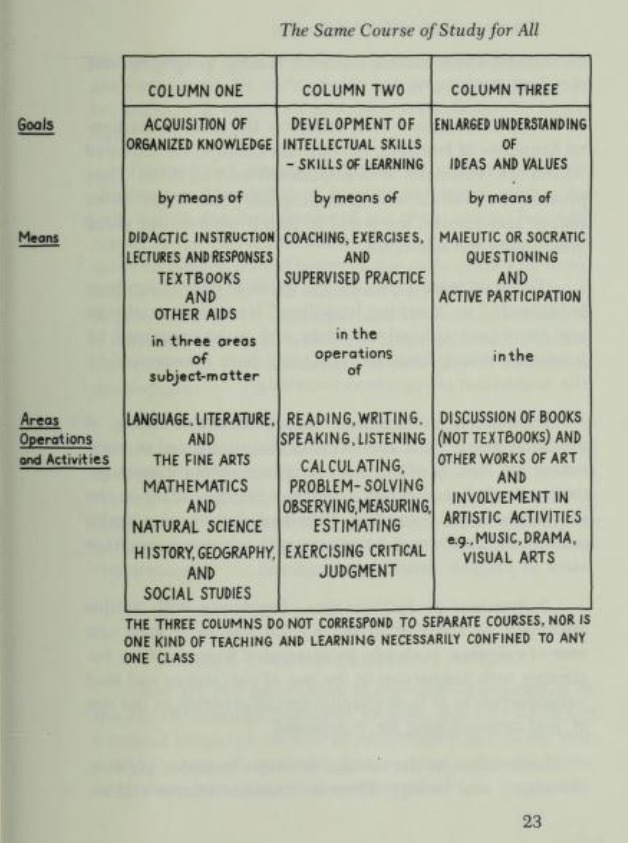
The book goes on to describe the Three Columns of a Paideia education: didactic instruction, intellectual coaching, and Socratic seminar.

96 pages, Paperback

First published January 1, 1982

37 people are currently reading
765 people want to read

About the author

Mortimer J. Adler

592 books1,049 followers
Numerous published works of American educator and philosopher Mortimer Jerome Adler include How to Read a Book (1940) and The Conditions of Philosophy (1965).

This popular author worked with thought of Aristotle and Saint Thomas Aquinas. He lived for the longest stretches in cities of New York, Chicago, San Francisco, and San Mateo. He worked for Columbia University, the University of Chicago, Encyclopædia Britannica, and own institute for philosophical research.

Born to Jewish immigrants, he dropped out school at 14 years of age in 1917 to a copy boy for the New York Sun with the ultimate aspiration to a journalist. Adler quickly returned to school to take writing classes at night and discovered the works of Aristotle, Thomas Aquinas, John Locke, John Stuart Mill, and other men, whom he came to call heroes. He went to study at Columbia University and contributed to the student literary magazine, The Morningside, (a poem "Choice" in 1922 when Charles A. Wagner was editor-in-chief and Whittaker Chambers an associate editor). Though he failed to pass the required swimming test for a bachelor's degree (a matter that was rectified when Columbia gave him an honorary degree in 1983), he stayed at the university and eventually received an instructorship and finally a doctorate in psychology. While at Columbia University, Adler wrote his first book: Dialectic, published in 1927.

In 1930 Robert Hutchins, the newly appointed president of the University of Chicago, whom Adler had befriended some years earlier, arranged for Chicago’s law school to hire him as a professor of the philosophy of law; the philosophers at Chicago (who included James H. Tufts, E.A. Burtt, and George H. Mead) had "entertained grave doubts as to Mr. Adler's competence in the field [of philosophy]" and resisted Adler's appointment to the University's Department of Philosophy. Adler was the first "non-lawyer" to join the law school faculty. Adler also taught philosophy to business executives at the Aspen Institute.

Adler and Hutchins went on to found the Great Books of the Western World program and the Great Books Foundation. Adler founded and served as director of the Institute for Philosophical Research in 1952. He also served on the Board of Editors of Encyclopædia Britannica since its inception in 1949, and succeeded Hutchins as its chairman from 1974. As the director of editorial planning for the fifteenth edition of Britannica from 1965, he was instrumental in the major reorganization of knowledge embodied in that edition. He introduced the Paideia Proposal which resulted in his founding the Paideia Program, a grade-school curriculum centered around guided reading and discussion of difficult works (as judged for each grade). With Max Weismann, he founded The Center for the Study of The Great Ideas.

Adler long strove to bring philosophy to the masses, and some of his works (such as How to Read a Book) became popular bestsellers. He was also an advocate of economic democracy and wrote an influential preface to Louis Kelso's The Capitalist Manifesto. Adler was often aided in his thinking and writing by Arthur Rubin, an old friend from his Columbia undergraduate days. In his own words:

Unlike many of my contemporaries, I never write books for my fellow professors to read. I have no interest in the academic audience at all. I'm interested in Joe Doakes. A general audience can read any book I write—and they do.

Source: http://en.wikipedia.org/wiki/Mortimer...

Ratings & Reviews

What do you think?
Rate this book

Friends & Following

Create a free account to discover what your friends think of this book!

Community Reviews

5 stars
99 (24%)
4 stars
162 (40%)
3 stars
108 (26%)
2 stars
27 (6%)
1 star
5 (1%)
Displaying 1 - 30 of 59 reviews
Profile Image for Kirk Lowery.
213 reviews37 followers
July 24, 2011
A fantastic Utopian proposal, actually implemented in one of the Chicago school districts. But inevitably doomed to failure in our dumbed-down, committed to mediocrity, anti-intellectual, narcissistic, Oprah-fied culture.
Profile Image for Davis Smith.
904 reviews118 followers
November 25, 2024
Great for a short-attention-span read for anyone who doesn't see why people complain so much about public schools and the society with which they are entwined. Many of the diagnoses of the sorry state of the system have become far more dire over time. Just don't mistake it for classical education—it's just a Dewey-lite progressive vision that happens to have respect for old books. Still, it's miles better than what we have today in the average school.
Profile Image for Nathan Albright.
4,488 reviews161 followers
November 25, 2016
Some years ago I took a standardized test where I was asked to write at some length about the question of education in the United States and the principles that should animate it.  My comments were that our contemporary education system fails to effectively provide for the sort of egalitarian democracy that we claim to want as a society and that if we truly wanted to be a republic that we would focus on the need for all students in our educational system to grow up with the capacity for the acquisition of knowledge and the critical examination of the claims of media and culture that often would not bear scrutiny.  Although I thought that my essay was fairly fiercely worded, at least by the standards of my own discourse, I received very high marks for the essay, meaning that the readers of the essay were not offended by my criticisms of the contemporary educational system.  This manifesto, a short work of less than 100 pages, amounts to a longer and more strident argument along the same lines that I had made about the ideal education for a republic that wished to pay more than lip service to the goal of educating our people for the responsibilities of freedom and the discharge of our duties as citizens of a noble republic.  As this particular approach cuts against the contemporary grain when it comes to much of education [1], it goes without saying that I found much to appreciate about this book's approach.

The contents of this book are striking and particularly intriguing.  The word Paideia itself comes from the Greek root pedo related to pedagogy (the teaching of children) and pediatrics (medicine with a focus on children), and in the context of this book and in the larger body of writing by its author the word paideia refers to the common knowledge of a wide variety of fields that should be the possession of every child growing up in the United States of America.  The book opens with a dedication to Horace Mann, John Dewey, and Robert Hutchins, marking this from the start as a book in the secular public school tradition, for all of its striking and somewhat radical approach.  The manifesto itself is divided into four parts.  The first part looks at the purpose of education in a republic, and points out rather sensibly that schooling is only a part of education and that being a truly well-educated person requires a lifetime of maturity and self-education after our formal education is ended.  After that comes a section on the essentials of basic schooling which require the same objectives and course of study for all, as well as discussions on the need to overcome initial impediments and deal with individual differences in a way that does not threaten the egalitarian aims of a common education system.  The third section looks at teaching and learning, setting the roles and training needed for teachers and principals and also examining the heart of the Paideia proposal in the establishment of a well-structured tripartite structure for education that aims at three goals for students:  the acquisition of information or organized knowledge, the development of intellectual skills like speaking, writing, and calculating, and the enlargement of understanding through discussion  and conversation.  The fourth section contains a discussion of what is beyond basic schooling, like issues of higher learning, the distinction between earning a living and living well, and the beleaguered state of our free institutions in the face of widespread ignorance among the people of our republic.

Nevertheless, although there is a lot about this book that is timely and flattering about this book in that it desires for all children in our nation an education that is strikingly Nathanish in being deep and broad and encouraging thoughtful reading and reflection and conversation, there are a few aspects of this book that are deeply troubling.  For one, the author's solution the widely recognized problem of families that do not support educational efforts or that do not provide a context for the intellectual growth of their children is government intervention, which provides an ominous statist threat at the core of this proposal should families be judged by the authorities as being hostile to the aims of the state.  Additionally, this book was particularly troubling in what was not said in that in this book the need for our republic to be devoted to standards of godly morality was entirely absent.  To be sure, this total absence of moral education was likely due at least in part to the fact that the manifesto wishes to reform public education in a culture that shows no interest in allowing the state to be governed by godly morality, but that does not make this proposal any less ineffectual in light of the most threatening aspects of our contemporary cultural malaise.  To raise children to be intellectually sophisticated without having build up a godly sense of morality is to raise those who are culturally advanced but decadent and corrupt, and that is a terrible sort of abuse to inflict upon a child, far worse than allowing a child to remain in ignorance.  The fact that the Paideia group includes Jacques Barzun, author of From Dawn To Decadence, makes this absence of the threat of decadence in this proposal given the absence of moral education at its foundation even more striking and ironic.  To be sure, this proposal has much to offer it, but the absence of moral education or the need for it, and the belief that government knows best make this proposal little more than rearranging the deck chairs on the Titanic given our society's moral decline in recent decades.

[1] See, for example:

https://edgeinducedcohesion.blog/2014...

https://edgeinducedcohesion.blog/2011...

https://edgeinducedcohesion.blog/2011...

https://edgeinducedcohesion.blog/2010...

https://edgeinducedcohesion.blog/2016...
Profile Image for Stephanie.
188 reviews
March 2, 2014
The Paideia Proposal was written in 1982, the year after I was born, yet so much of what Mortimer Adler finds fault with in regards to modern education still sadly exists today. Teachers spending more time dealing with behavior and paperwork than engaging in quality teaching? Check. Parents concerned about their children's futures as a result of uneven schooling? Check. College officials frustrated by the amount of remediation incoming freshmen must undergo in order to succeed? Check again.

As an educator, it is daunting just how far we still need to go before ALL of our students are fully educated citizens able to think and reason for themselves. For this is the goal of The Paideia Proposal -- to develop a system of education that nurtures all children to be lifelong learners and intelligent thinkers while avoiding a system of education that views students as unequal and places them on different life "tracks" as a result. I think Adler is right. We educators must teach our students to know, do, and understand; we must have the same high expectations for all students; and we must raise the importance of the core areas of learning (reading, writing, mathematics, science, etc.) back above extracurricular activities and electives. Without this basic schooling, another 30 years will go by and our education system--and students--will still be the same, or even worse.
588 reviews11 followers
March 2, 2017
"Our country faces many insistently urgent problems, on the solution of which its prosperity and even its survival depend--the threat of nuclear war, the shrinking of essential resources and supplies of energy, the pollution or spoliation of the environment, the spiraling of inflation accompanied by the spread of unemployment. To solve these problems, we need resourceful and innovative leadership. For that to arise and be effective, we must have an educated people. Trained intelligence in followers as well as leaders, holds the key to the solution of the problems we face."

Written in 1982, this manifesto is based on the idea that the 20th Century offered us something of great value in the United States--UNIVERSAL SUFFRAGE. Adler believes that in order to have a fully functioning democratic society ALL CHILDREN, regardless of home situation, color, creed, or socioeconomic status, are entitled...yes, ENTITLED to the best education possible. He believes education is the key to bettering oneself, overcoming poverty, living a full life, and beneficial employment. Additionally, it is *key* to a functioning democracy, because "democracy without education becomes a mobocracy." As of 1982, he felt that there was still a large class of children, who from the beginning, are relegated to be "workers" who do not need to be "educated." This, he believes, is a huge miscarriage of justice for a civil and advanced society. Whatever the end vocation, wherever interests lead an individual, whatever career path they choose, every individual--no matter their capacity--deserves the absolute best education possible. He also believes pre-school education to be vital to better prepare children who come from homes where they may be less prepared, and intense remediation for any child who might need it--no matter the cost, time, or effort, because as members of the human species every single individual is innately valuable and every single person should have EQUAL access to a shot at happiness.

His ideas might sound Utopian, but what an amazing idea. This is an ideal worth striving for! Do we want our children graduating from schools to be "workers"? Or do we want them to be thinkers and problem solvers, adept for any employment? Do we want the rising generation to be conversant in the great ideas of the world, or full of "facts" they have learned to memorize and regurgitate? I, for one, choose creativity, interaction with the arts and sciences, the readings of books, and intelligent discourse as a means to solve the world's problems. I am excited to work on incorporating what principles I can in my college classes.
Profile Image for Marcos Junior.
353 reviews12 followers
June 28, 2017
Se Mortimer Adler estiver certo, estamos fazendo tudo errado, copiando o que fizeram de pior nos Estados Unidos. Ele é enfático na defesa de uma escola igual para todos, deixando qualquer especialização para a universidade e escolas profissionalizantes. A parte mais interessante do manifesto é a descrição das três dimensões da educação, a obtenção de conhecimentos organizados, o desenvolvimento de habilidades intelectuais e a ampliação do entendimento. Além disso, os três objetivos da educação: poder exercer uma ocupação, ser um cidadão e ter uma vida responsável. Uma leitura para pensar.
Profile Image for Cristobal Peña.
67 reviews7 followers
October 6, 2022
Some people have pointed out the inadequacies of “higher learning” and some people have pointed out the inadequacies of “basic schooling”. There have not been many “paradigm-changing” breakthroughs in education. In the pedagogical literature, we can read about how to get students to remember things better, how to make students more engaged, etc. What about the aims? That is something that for the most part remains the same (with some exceptions). Mortimer J. Adler proposes a radical change in education, which would make education the great equalizer and the necessary training a citizen would need to participate in their democratic society. Setting one track for all to end the distinction between political leaders and political followers and setting up a student to become a student for life.
The proposal makes the student the leader of his/her own education and not just a passive participant.
This is all packed in a small 84-page book, to be honest, I was fascinated for the most part the only thing which left a sour taste in my mouth was the whole section on appreciating art and “fiction” which I quote “admired for their excellence”. I could see how this would then turn children into a bunch of nebbishes that “appreciate great works of fiction” uncritically due to their status.
With all this being said, once I finished the book, I went to look for what this book went on to inspire, there were a few schools (an amount which doesn't clearly let me know if it has been a success or a failure). For context, there are 24 schools in the whole wide world that use the system while for example Montessori (which I am not a fan of at all) has about 5 in my city alone.
Thankfully I got it a few weeks back. I got a book that deals with the paideia classroom which should give me a better idea of how it would work in practice.

Even though among pedagogical circles, the enthusiasm for technological-based solutions is still ongoing, whatever new technology we may use for pedagogy will be capped on its usefulness inasmuch as the goals remain the same. The paideia proposal was published in 1982 but in 2022 who is willing to imagine a new educational system?
Profile Image for Minna.
178 reviews2 followers
September 15, 2020
Good lord this is outdated. I only read it for the M.Ed, hopefully will never have to do so again. It has a fair purpose as a "primary source" of an analytical study curricular change, but not much more.
Profile Image for Jacob Alcott.
15 reviews
October 31, 2024
Truly a good look at educational reform with the focus on a good, liberal, human education for all citizens. Based on equality and the dream of liberty through an adequately educated electorate. Adler argues the highest quality of education for all citizens, not just the rich and inherently fortunate.
Profile Image for Matt Hutson.
317 reviews109 followers
August 26, 2024
The Problem of Education
In "The Paideia Proposal," Mortimer J. Adler presents a compelling vision for reforming the American education system, arguing that it is failing to prepare students for the responsibilities of citizenship and the demands of adulthood. Adler’s proposal emphasizes a unified, high-quality education for all students rather than a system divided by socioeconomic status or intellectual ability.

Reflecting on this, I find that Adler’s concerns are more relevant than ever. Today’s students are increasingly distracted and unmotivated, largely due to the proliferation of digital devices and the constant pull of social media. While social interactions are crucial for development, the challenge lies in balancing these with a focus on learning—a challenge that is growing more complex as technology advances. Teaching, as Adler suggests, is indeed a difficult job, but one that can be approached effectively with strategies that encourage cognitive development and motivation.

Part One: The Schooling of a People
Adler begins by addressing the relationship between democracy and education, emphasizing that a democratic society requires an educated citizenry. He argues that the same quality of education should be accessible to all, though the specific content and teaching strategies may vary according to individual needs. This aligns with my belief that while education should be standardized in terms of quality, it must also be flexible enough to accommodate different learning styles.

One of Adler’s key points is that schooling is only a part of education, and this resonates strongly with my own views. Education is a lifelong process that extends beyond the classroom. Schools should focus on teaching students how to learn—how to take notes, apply knowledge, and think critically. These are the skills that will enable them to continue growing long after formal education has ended. Life itself is a continuous education, shaped by experiences, interactions, and the knowledge we gain from various sources. Therefore, schooling should be seen as a preparatory stage that forms the habit of learning and equips students with the tools they need to navigate the complexities of life.

Part Two: The Essentials of Basic Schooling
Adler advocates for a common curriculum for all students, focusing on fundamental skills that are universally applicable. However, I disagree with his stance that elective courses should be eliminated. While the core curriculum is essential for building a strong educational foundation, electives play a crucial role in fostering individual interests and personal growth. Without these opportunities, education becomes a monotonous, one-size-fits-all experience that fails to engage students fully.

Moreover, Adler’s emphasis on reading classic texts, such as the Declaration of Independence and the Federalist Papers, highlights the importance of understanding the origins of our society. However, it’s concerning how much education has shifted away from these foundational documents in recent decades. The decline in knowledge of one’s country’s origins reflects a broader trend in education that prioritizes immediate relevance over deep, contextual understanding.

In addition to these classics, Adler’s curriculum should also include subjects like business, entrepreneurship, and finance—areas that are increasingly important in today’s world. While the proposal was published before the rise of digital content, I believe that blogs, podcasts, and YouTube videos can complement traditional texts, provided they are used discerningly and with an awareness of their varying levels of credibility.

Part Three: Teaching and Learning
Adler places significant emphasis on the role of teachers, arguing that the success of his educational model depends on the quality of teaching. This remains a critical issue even today. Despite advances in educational theory and practice, the number of highly effective teachers is still relatively small compared to the total number of educators. This gap poses a challenge to achieving the kind of education Adler envisions.

One of the most striking aspects of Adler’s proposal is his insistence on making education a dynamic process that involves active participation from students. He criticizes the passive, lecture-based approach that dominated education in his time—and, to some extent, still does today. Instead, he advocates for a model where students engage in discussions, think critically, and apply their knowledge in practical ways.

Reflecting on Adler’s ideas, I’m reminded of how relevant they are to modern educational challenges. For instance, the distractions posed by gadgets and social media today make it even more difficult for students to engage deeply with physical books and traditional texts. This lack of engagement underscores the importance of Adler’s emphasis on understanding and applying knowledge rather than merely acquiring information.

The Relevance of Adler’s Vision
Mortimer J. Adler’s "Paideia Proposal" offers a powerful blueprint for educational reform that is still applicable today. His call for a unified, high-quality education that prepares students not just for jobs but for life as engaged, thoughtful citizens is more urgent than ever. However, to fully realize Adler’s vision, we must adapt his ideas to the realities of the 21st century—embracing technology thoughtfully, valuing individual differences and ensuring that education remains a lifelong journey.

Adler’s proposal reminds us that the ultimate goal of education is not just to impart knowledge but to cultivate the habits of mind that enable individuals to continue learning and growing throughout their lives. As educators and parents, our challenge is to create environments that foster these habits, equipping students with the tools they need to navigate an increasingly complex and interconnected world.
2 reviews
April 11, 2024
Literally disagreed hard! Generalizing education def would not help us! It barely addresses race in the classroom and does not feel it should be considered when teaching this generalized approach. It simply says all students are the same in human nature and as citizens, contradicting their point that they all have different socioeconomic backgrounds. Everyone has different situations and we have to make sure to adapt to each student and provide help to everyone to ensure equal opportunities. Also, having no elective courses or vocational schools does not prepare students for life after college as they have no opportunity to explore their interests. Learning the basics of English, math, and history is not enough.
235 reviews18 followers
November 19, 2014
You have to go into this realizing it is long on "what" and short on "how," but the substance of the proposal is pretty compelling. Adler's bloviations about democracy and egalitarianism would be better delivered by Jimmy Stewart against the background of an American flag as a fife softly pipes The Battle Hymn of the Republic.
Profile Image for Nuruddin Azri.
385 reviews170 followers
March 29, 2020
Adler menulis proposal ini setelah mengarang banyak buku-buku besarnya seperti How to Read a Book, Reforming Education, Great Ideas from the Great Books dan How to Speak, How to Listen.

Seperti biasa, beliau konsisten dengan gagasan agung, pendidikan berteraskan pelajar, pembelajaran sepanjang hayat, pembacaan karya-karya agung dan keperluan mengadakan seminar yang diimplementasikan di dalamnya "Socratic Method".

Walau bagaimanapun, ada beberapa isi baru yang dapat dicerap melalui pembacaan buku ini.

Antaranya, persekolahan yang tidak membuatkan pelajar berasa ingin belajar lagi seusai tamat persekolahan merupakan pendidikan yang gagal (tidak kiralah sebagus mana pencapaian yang pernah dicapai oleh pelajar tersebut di sekolah itu).

Fizikal pula tidak akan berkembang selepas 18-20 tahun tetapi mental, moral dan spiritual berkembang sehingga ke akhir usia.

Adler menawarkan tiga kolum model pendidikan yang harus diterapkan di setiap sekolah dan ketiga-tiga kolum/tahap ini perlu berjalan seiring dan berkembang tahap kesukarannya dari semasa ke semasa.

a. Tahap pertama (pemerolehan ilmu yang tersusun melalui proses "didactic"). Tiga komponen di dalamnya ialah bahasa, seni halus dan sains tabi'i. Pecahan ilmu di dalamnya ialah:

-Bahasa dan sastera: tatabahasa, sintaks, wacana, sejarah seputarnya, perbandingan dengan bahasa lain, bahasa Matematik dll.
-Seni halus: matematik (arithmetik, calculus, penggunaan kalkulator dan asas "programming" dalam komputer)
-Sains tabi'i: sejarah, geografi & kajian sosial (kaitan rapat antara fizik-kimia-biologi, bermula dengan "story-telling" dan kisah biografi diikuti dengan kombinasi/adunan kisah politik, sosial, ekonomi dan evolusi kebudayaan)

b. Tahap kedua (mengembangkan kemahiran melalui latihan seperti atlet berlatih). Menurut Adler, kemahiran tidak terhasil melalui vakum.

Para pelajar perlu mempunyai kemahiran membaca, mendengar, bercakap, menulis, memerhati, mengira, menganggar, mengukur, berfikir secara kritikal dan menggunakan komputer. Juga keperluan menguasai bahasa asing demi memahami kerangka budaya mereka seperti bahasa Perancis, Jerman, Itali, Sepanyol, Rusia, Mandarin, Latin dan Greek.

c. Tahap ketiga (mengembangkan pemahaman melalui "Socratic Method" - "maieutic")

Para pelajar perlu menelaah karya-karya agung (bukannya buku teks) dalam setiap genre & disiplin ilmu. Kaji setiap idea, nilai & bentuknya.


Baca "Declaration of Independece", perlembagaan, seleksi dari "Federalist Papers" dan "Gettysburg Adress" supaya dapat berkomunikasi dalam bahasa yang sama dengan kosa kata idea yang terkandung dalam prinsip politik negara yang kita berada (dalam konteks ini, Adler bercakap untuk negara Amerika Syarikat).

Cara terbaik untuk memahami puisi adalah dengan mendeklamasikannya, muzik dengan menyanyikannya manakala drama dengan melakonkannya. Ini adalah cara kita menghargai nilai estetika sesebuah karya seni itu sendiri.

Tambah Adler lagi, tanpa latihan dan diskusi yang mencukupi, pelajar hanya mampu menjawab kuiz dan melepasi peperiksaan tetapi tidak benar-benar memahami inti kepada perbahasan sesuatu disiplin ilmu tersebut.

Bagi pembelajaran "auxillary" (fizikal) pula, para pelajar perlu belajar ilmu-ilmu asas memasak, menjahit, menaip, membuat kraftangan, bertukang, memandu, membaiki kenderaan, peralatan elektrik dan peralatan rumah serta diberikan pendedahan yang mencukupi untuk pemilihan karier (kepentingan, keperluan, ganjaran dan peluang dalam jangka masa panjang).

Pembelajaran yang tulen ialah pembelajaran yang aktif (bukannya pasif) iaitu apabila murid menggunakan mindanya (bukannya memori) dan murid menjadi agen utama (bukannya guru).

Mengajar adalah salah satu daripada tiga seni kooperatif agung (great cooperative arts) selain ilmu perubatan dan ilmu bercucuk tanam kerana ketiga-tiganya memerlukan interaksi dengan perkara semulajadi (nature) demi mencapai kebaikan yang dihajati.

Guru besar atau pengetua pula dipanggil "headmasters" kerana mereka adalah ketua kepada semua guru dan mereka telah (dan sewajarnya) menguasai kesemua "liberal arts" (ilmu-ilmu alat).

Kepakaran dalam setiap bidang, baik ekonomi, kebajikan, keselamatan, kesenian, sains dan semua jenis kesarjanaan merupakan perkara yang penting tetapi setiap individu yang pakar ini perlu menjadi seorang "generalist" juga iaitu manusia yang mendapat pendidikan secara umum (generally educated human beings) - iaitu mendapat pendidikan daripada ketiga-tiga kolum yang disebutkan di atas.

Ahli politik dan pentadbir yang terdidik juga perlu dibentuk kerana manusia merupakan sumber kekayaan negara yang terbesar.

Dalam buku ini, Adler jelas memandang konsep pendidikan itu untuk membentuk rakyat yang baik (good citizen). Ini berbeza sekali dengan konsep pendidikan menurut kaca mata Islam iaitu untuk membentuk individu/insan yang baik (good human) kerana insan yang baik pasti akan menjadi rakyat yang baik manakala rakyat yang baik tidak semestinya menjadi insan yang baik (rujuk Prof al-Attas dalam The Concept of Education in Islam).
Profile Image for Talbot Hook.
638 reviews30 followers
April 16, 2020
This book is so far at-odds with modern educational paradigms as to be a bucket of ice water thrown in the face. It is simultaneously traditional and progressive (often intensely so!), and the core of it, in my estimation, is a much better view of education than we currently have. As Postman long ago pointed out, modern education doesn't have an end: there's no narrative, no purpose. Society thinks that education is for an introduction into the work force, but I've always held that is the most shallow view of education that can ever exist. Indeed, Adler remarks that it is only a third of what education should prepare one for; equally important to making a good and honest living are preparing children to become educated citizens who can discharge their duties in a democratic republic, as well as preparing them to live examined, good lives. School is myopic if it overlooks one of those facets to education. The function of any democracy is dependent upon its citizens, who ultimately hold the power; school should therefore prepare children to become citizens cognizant of the framework of our government, our institutions, and our history up to this point. And individually, school should provide the intellectual framework and motivational energy required for all students to continue a lifelong affair with learning. Being "educated" is not something given with a diploma: it is a state that comes at the end of a life of intense learning, if at all.

Adler recommends a tripartite approach to education, consisting in the acquisition of organized knowledge, the development of intellectual skills (e.g. reading, writing, calculation, observation), and the broadening of understanding, insight, and aesthetic appreciation. (Try bringing that last one up with a modern!) Each requires a different methodological framework of teaching and learning, but these are the true fundamentals of a generalized education. To that end, Adler recommends the jettisoning of electives, specialized training, and all vocational training. If a democracy rests upon egalitarianism (which it presupposes and demands), then the education must be the same for all children. And this education must be broad and liberal. We are not training some to become mathematicians and others to be welders; we are training students for entrance into a society in which they will pursue their own happiness. To shunt them onto a certain track of education is to deprive them of their shared heritage. Adler insists that, not only are all children educable to their utmost capacities, it is their birthright to have the same education as all their peers.* Seeing some students as merely "trainable" for menial labor is the ultimate betrayal of the educational system.

What, then, are the implications for modern education? Where we track and divide, we must stop; we must unify the curriculum around broad cultural literacy and domains of knowledge (Common Core, to an extent); we must prepare children for citizenship; we must teach students to use their time well, to set their sights beyond mere pleasure (here the Good Life enters); we must train teachers liberally, and allow no teacher to teach who is not themselves a learner (this I feel intensely); principals must become head-teachers who subordinate everything in the school to education; we must enlighten parents and society as to the true nature of an education; above all, we need to think about what we want from education. Because what we're currently getting is a damned shame: tired, complacent, and listless educators hobbling students already hobbled by a society that views education as unimportant.

*This is not to say that Adler does not recognize learner differences. He does. He recognizes the need for remediation and intervention, and also recognizes that differentiation in learning is utterly essential. He likens the classroom to a weight-room, funnily enough, where the coach is able to assign a task, and then walk around helping each child in turn, meeting their individual nature as it meets the assigned task.
Profile Image for Paul.
Author 4 books135 followers
September 13, 2014
This short manifesto gives a cogent overview of what public schooling should be setting out to achieve, the rationale for doing so, and how to get started.

In doing some research on education in the ancient world, I made a search of the word paideia on Amazon, and this was one of the books that came up. I've been a fan of Mortimer J. Adler for a few years now, and I was reminded of how I'd already intended to read this book sometime. So I bought a copy.

I'm glad I did. This crisp little print-on-demand paperback makes a powerful and impassioned case for the urgent need of reform in the American public-school system (the book was published in 1982). The argument is presented in four parts:

the role of education in a democracy
what form public schooling should take
what are the best ways to learn and to teach
what form postsecondary education should take

First of all: why paideia? What is it? This definition appears on the book's dedication page:
PAIDEIA, from the Greek pais, paidos: the upbringing of a child. In an extended sense, the equivalent of the Latin humanitas (from which "the humanities"), signifying the general learning that should be the possession of all human beings.

Yes, this book argues for a return to providing young people with the beginnings of a liberal education (the book distinguishes between education and schooling: the former is a lifelong activity that doesn't begin in earnest until maturity, while the latter is preparation for the former). The school system should dispense with all electives, vocational courses, and other kinds of "multi-track" schooling in favor of a unified program that provides exactly the same--high-quality--schooling to all. And the reason it should be the same is because it is teaching children who are equals, and who will grow up to be equal citizens of a democracy.

This point is key. As Adler says near the top of chapter 1:
Not until this century have we undertaken to give twelve years of schooling to all our children. Not until this century have we conferred the high office of enfranchised citizenship on all our people, regardless of sex, race, or ethnic origin.

The two--universal suffrage and universal schooling--are inextricably bound together. The one without the other is a perilous delusion. Suffrage without schooling produces mobocracy, not democracy--not rule of law, not constitutional government by the people as well as for them.

But what about the great differences between children--the differences in their circumstances, backgrounds, and inborn abilities? Mustn't schooling take account of these? Yes: but only in the sense of providing help to those who need it in order to get through the curriculum. The author is emphatic that no child is to be written off as unsuitable to have a life of learning. If the United States takes Thomas Jefferson's assertion that "all men are created equal" seriously, then it is bound to set up its schools accordingly. As Adler puts it:
Here then are the three common callings to which all our children are destined: to earn a living in an intelligent and responsible fashion, to function as intelligent and responsible citizens, and to make both of these things serve the purpose of leading intelligent and responsible lives--to enjoy as fully as possible all the goods that make a human life as good as it can be.

As parents, do we not want these things for our children? Do we not want them for ourselves?

The book goes on to provide an overview of how this is to be achieved. The 12-year course of public schooling should be arranged in a sequence of three phases, each devoted to a different goal:

the acquisition of organized knowledge
the development of the skills of learning
an enlarged understanding of ideas and values

The boundaries between these are not hard and fast; there is more a shift of emphasis from the first through to the third goal as the student progresses.

These things are all discussed in more detail in the book--but not too much detail, for it is short. It is a manifesto, a call to action.

And will that action require a wholesale revolution of the education system? An endless battle in Congress with some compromised, watered-down version resulting after 10 years of wrangling? No. In 2 pages at the end of the book, the author provides 10 steps that can be taken by any school or any school district at any time to start walking the walk of liberal education. It can be achieved incrementally. But first of all it requires a change of attitude, a change of motivation.

As a (North American--I'm writing in Canada) society, we've become obsessed with wealth and celebrity as the only measures of success and achievement; they've become our proxies for happiness and fulfillment. Our political involvement as citizens has degenerated to culture wars; the life of the mind is taken over by reality TV and video games. In some sense, this is what we have schooled ourselves for. But it doesn't have to be this way. Those who care enough about this will start taking action, and this book provides both a vision statement and a mission statement for revolution, as well as some practical steps.

The author and his Paideia Group care about whether we fully realize our human nature. The question is: do we care?
62 reviews1 follower
December 30, 2021
I didn't agree with Adler on every single point but I think his points about the three kinds of facilitation of learning are extremely insightful, and his discussion of the relationship of education to democracy was extremely worthwhile. I think I may have to photocopy the three columns page and pin it on my wall for reference for a time.
Profile Image for Cindy.
24 reviews20 followers
July 11, 2017
I have learned so much about the manifestos in the book. This is the book which I refer from time to time when it comes to talking about education. I really love this idea of the same course of study for all—especially the importance of Socratic Questioning. Been thinking about this idea and how amazing it would be if this one was applied to our education system.
Profile Image for Ilib4kids.
1,107 reviews3 followers
January 18, 2016
370.973 Adl
on behalf of the memebers of the paideia group. It is followed by Paideia Program

My summary: if it is not a classical education book, but at least it theorize all important aspects of educations. It is the guide book doing education. This is a short book, only 84 pages.

I like the style of his writing, simple, terse, easy understood. I've read "Aristotle for everyone" which I recommend everyone to read. I am planning another one "How to read a book".

Paideia (py-dee-a) from the Greek pais, paidos: the upbringing of a child. In an extend sense, the equivalent of the Latin humanitas (from which "the humanities"), signifying the general learning that should be the possession of all human beings.

Summary of chap 2: Schooling - only a part of education
Education must go beyond schooling. It must be prepare the people for continuation of learning in their life. Schooling, basic or advanced, that does not prepare the individual for further learning has failed, no matter what else it succeeds in doing. p11

The essentials of basic schooling:
1. The same objectives for all (preparation for citizenship; a continued personal development growth; preparation for earing a live)
2. The same course of study for all. p23 a diagram for the same course.
three modes of learning (Acquisition of organized knowledge; development of intellectual skills; enlarge understanding of ideas and values.
three modes of teaching(Didactic instruction, lectures, textbooks; coaching, exercises; maieutic or Socratic questions and active participation)
three subjects: Language, literature, fine arts; mathematics and natural science; history, geography, and social science.

Teaching:
Chap 7 The heart of matter. p49 -p56
Teaching at its best is only an aid to learning, but that aid is most needed by those who are least adept at learning. All genuine learning active, not passive. It involves that use of the mind, not just the memory. It is a process of discovery, in which th student is the main agent, not the teachers. Learning by discovery can occur without help, but only geniuses can educate themselves without the help of teachers. For most students, learning by discovery must be aided. That is where teachers come in - as aids in the process of learning by discovery, not as knowers who attempt to put the knowledge they have in their minds into the minds of their pupils. Teachers may think they are stuffing minds, but all they ever affecting is the memory. Nothing can ever be forced into anyone's mind except by brainwashing, which is the very opposite of genuine teaching. Teachers who do not understand these truths misunderstand the true character of learning. Worse, they do violence to the minds in their care. By assuming that they are the primary cause of learning on the part of their pupils, by filling passive receptacles, they act merely as indoctrinators -- overseers of memorization -- but they are not teachers.

p59 The teacher who has stopped learning a deadening influence rather than a help to students being initiated into the ways of learning.

Educators:
Horace Mann
John Dewey Democracy and Education
Robert Hutchins

10.6k reviews34 followers
June 7, 2024
THE PHILOSOPHER’S PROPOSALS FOR AN “EDUCATIONALLY CLASSLESS SOCIETY”

Mortimer Jerome Adler (1902-2001) was an American philosopher, educator, and popular author, who worked at various times for Columbia University, the University of Chicago, Encyclopædia Britannica, and his own Institute for Philosophical Research.

He wrote in the first chapter of this 1982 book, “We are on the verge of a new era in our national life. The long-needed educational reform for which this country is at last ready will be a turning point toward that new era. Democracy has come into its own for the first time in this century. Not until thus century have we undertaken to give twelve years of schooling to all our children. Not until this century have we conferred … enfranchised citizenship on all our people… The two---universal suffrage and universal schooling---are inextricably found together... Suffrage without schooling produced mobocracy, not democracy---not rule of law, not constitutional government by the people as well as for them.” (Pg. 3)

He states, “We should… be an educationally classless society. We should have a one-track system of schooling, not a system with two or more tracks, only one of which goes straight ahead while the others shunt the young off onto sidetracks not headed toward the goals our society opens to all. The innermost meaning of social equality is: substantially the same quality of life for all. That calls for the same quality of schooling for all.” (Pg. 5-6)

He observes, “Schooling should open the doors to the world of learning and provide the guidelines for exploring it. Basic schooling in American does not now provide this fundamental objective… The failure to serve all in this essential respect is one strike against basic schooling in its present deplorable condition. The reform we advocate seeks to remedy that condition.” (Pg. 11)

He suggests, “public schooling… must aim directly at three main objectives and make every effort to achieve them to a satisfactory degree… three objectives are determined… The first of these objectives …relates to that aspect of adult life which we call personal growth or self-improvement---mental, moral, and spiritual… the second objective of basic schooling---an adequate preparation for discharging the duties and responsibilities of citizenship… The third main objective takes account of the adult’s need to earn a living in one or another occupation… basic schooling must prepare them for this task… by giving them the basic skills that are common to all work in a society such as ours.” (Pg. 16-17)

He adds, “To achieve these three goals, basic schooling must have for all a qualify that can be best defined… by saying that it must be general and liberal… it must be nonspecialized and nonvocational. Describing it as nonvocational may appear to be inconsistent with what has been said about its relation to earning a living. However, the schooling proposed is truly vocational in the sense that it aims to prepare children for the three vocations or callings common to all.” (Pg. 18)

He outlines, “The diagram … depicts in three columns three distinct modes of teaching and learning… the different modes of teaching … correspond to three different ways in which the mind can be improved---(1) by the acquisition of organized knowledge; (2) by the development of intellectual skills; and (3) by the enlargement of understanding, insight, and aesthetic appreciation… the require course of study also includes a group of auxiliary subjects of which one is physical education and care of the body… COLUMN ONE: ACQUISITION OF KNOWLEDGE: Here are three areas of subject matter indispensable to basic schooling---language, literature, and fine arts… Why these three? They comprise the most fundamental branches of learning… COLUM N TWO: DEVELOPMENT OF SKILL: Here are the basic skills of learning---competence in the USE of language… aided by facility in a second language, as well as competence in dealing with a wide range of symbolic devices, such as … computers and scientific instruments… COLUMN THREE: ENLARGMENT OF THE UNDERSTANDING:… The materials of learning in Column Three can be described by calling them, on the one hand, books… and… products of human artistry.” (Pg. 22-29)

He notes, “The ‘Paideia Proposal’ will be followed by a book of essays entitled ‘The Paideia Program: Pointers and Prospects.’ This will provide guidelines for putting the program into effect.’ (Pg. 36)

He states, “Preparation for schooling is not a dispensable accessory to the reform we are proposing. It is an essential ingredient… A democratic society… is one in which all… enjoy equality of treatment… Preschool tutelage should, therefore, be provided at public expense for those who need but cannot afford it… The inequality of homes produces inequalities of nurture that lead some to draw wrong conclusions about the abilities of children… The sooner a democratic society intervenes to remedy the cultural inequality of homes and environments, the sooner it will succeed in fulfilling the democratic mandate of equal educational opportunity for all.” (Pg. 38-39)

He asserts, “there is no uneducable child---no unteachable child. There are only children that we fail to teach in a way that befits their individual condition… Our program is not utopian. It is more realistic than the schooling that magnifies and overreacts to individual differences, that accepts deficiencies as irremediable, and that makes a mockery of equal educational opportunity by failing to recognize and make the best use of the sameness that underlie the differences.” (Pg. 45)

He proposes, “Those going to college to prepare themselves for vocations requiring specialized knowledge and technical training should be able to choose among a wide variety of programs. But, in addition to such elective majors, there should be for all a required minor course of study that will carry them to levels of general, liberal, and humanistic learning beyond what they received in their basic schooling.” (Pg. 71)

He concludes, “Our country faces many insistently urgent problems, on the solution of which its prosperity and even its survival depend… To solve these problems, we need resourceful and innovative leadership. For that to arise and be effective, we must have an educated people. Trained intelligence, in followers as well as in leaders, holds the key to the solution of the problems we face… Without it, a poorly schooled population will not be able to put to good use the opportunities afforded by the achievement of the general welfare. Those who are not schooled to enjoy the blessings of a good society can only despoil its institutions and corrupt themselves. Human resources are the nation’s greatest potential riches. To squander them is to impoverish our future.” (Pg. 79)

This book will be of keen interest to those studying, or involved with, educational reform.
Profile Image for Rob Smith, Jr..
1,289 reviews35 followers
November 18, 2013
I first read The Paideia Proposal about thirty years ago and generally agreed with it. Through recent discussions, I thought I'd re-read it through older eyes and find I still generally agree with it.

Adler’s proposal of introducing discussion in the classroom seems an essential addition to public education. That and focusing on educating young people without the extraneous mess found in all schools should be the main focus of a school. The magnet school concept (preparing young for work they may never do), sports (Football, basketball and lacrosse need to be done OUTSIDE of school. Lacrosse???), teachers subbing for parents (Discipline for doing wrong needs to return) plus so much else need to go. Very important point Adler makes: A second language is to enhance the knowledge and importance of English.

The recent Common Core approach takes up some of Adler’s proposal. But then drastically leaves it behind to take up the cause of big business and certain political ideals.

The original intent of public school was to have local people teaching our young to be better people and prepare for a future. After that, the young are on their own.

Now I know Adler was also meaning to level a supposed slanted playing field involving the so-called poor by using his methodology to have all be equal. His proposal has a very shaky way to do this, basically involving having faith the proposal will work. I feel it should be a survival of the fittest approach and let the best win.

Anyway, I think this short thesis is well worth consideration for reading a well-known philosopher’s views of solving educational problems. I don’t think this P.C. world will accept this also well-known very liberal professor’s ideas. It shows how politics has drastically changed in thirty years.

Bottom line: I recommend this book.
Profile Image for Gregory Downey.
101 reviews1 follower
September 3, 2008
This is a really good book for Professional educators as well as those who have taken upon themselves the responsibility of educating their own children.
It has been added to me personal list of classics.
It addresses the purpose and aims of education, the different types of education, and the many issues facing institutionalized education.
He points out that although institutionalized education aims to make equal education available to all, the education system can never achieve that aim as not all educators approach their position with the same dedication and desire.
I highly appreciate Adlers views on being prepared to be educated and the ease at which education can be acquired when the student has a sufficient desire to be educated.
He strongly emphasizes that education is for lack of a better term less of a hassle when the student actually wants to learn what is being taught.
Education then becomes something you get to do and not something you have to do.
Hmmm.. Imagine that...
14 reviews
Read
May 20, 2009
Written in the early 80s, Adler proposes bringing the liberal arts back into k-12 general education, with an emphasis on Socratic Discussion. In it's day I'm sure it was a novel proposal to the education crisis. I am so familiar with Socratic Discussion now given my participation at St. John's College over the years living in Santa Fe that reading it was too basic. I am a huge fan of Socratic method and thought it was important to go back and read this proposal which is now in effect in many charter schools in the States.
Profile Image for Elaine.
232 reviews3 followers
August 12, 2009
"The Paideia Proposal" is a must for anyone planning to teach. It discusses a bold progressive educational reform that focuses on a more holistic education that advocates critical thinking beginning in kindergarten. While somewhat idealistic, its success is evident in many educational institutions that have adopted the proposal and have been as successful, if not more so, than traditional schools.
Profile Image for Sean Blevins.
337 reviews38 followers
July 18, 2015
Useful for its argument that different types of teaching and learning are appropriate at different ages and for its moral call to educate all equally.

Somewhat dated, since NCLB gutted many vocational programs in its demand for higher math and ELA scores. Well in-line with E.D. Hirsch and his idea of "core knowledge."

No clear curriculum is proposed, nor is any means of assessment. Perhaps they appear in the follow-up: The Paedia Program
Profile Image for Chris Comis.
366 reviews13 followers
April 13, 2010
This was one of the most horrendous books on education that I've read in a long time. This was a manifesto for classical humanism with a side of classical education. It just stank with democratic egalitarianism all over the place. Adler might be a brilliant man, but he definitely dropped the ball on this one.
Profile Image for Mia.
299 reviews2 followers
February 18, 2010
One cannot have universal suffrage w/out universal schooling. Universal schooling must not merely be equal in quantity, but in quality. A distributist text, in its way. Simple arguments with radical ends.
Profile Image for Kevin.
9 reviews
July 12, 2013
Adler proposes and pleas for -- quite logically, practically and eloquently -- education, in the original and truest sense of the word, especially in democratic societies in which it is absolutely essential.
Profile Image for Emily.
342 reviews35 followers
September 15, 2013
Education will never be perfect, Adler outlines a lot of good ideas and you can easily see that his influence is still in education today. I don't agree with ALL of his suggestions, but I do agree with some of them.
Profile Image for Chris.
164 reviews13 followers
August 20, 2019
This book is fantastic. A treatise on how we should approach educating our children. I firmly believe that we should approach education in this way, with well educated teachers. I firmly believe that all students are educable, and this program is based on that fundamental ideal.
Displaying 1 - 30 of 59 reviews

Can't find what you're looking for?

Get help and learn more about the design.