The devastating US atomic bombing of the Japanese cities of Hiroshima and Nagasaki not only brought World War II to an end, but effectively gave birth to the Cold War. The postwar world would thereafter be marked by the fragile relationship of two superpowers with opposing ideologies: the United States and the Soviet Union. For forty-five years, these two superpowers would vie for supremacy in world politics. The Cold War, defined by events such as the Cuban Missile Crisis, turmoil in the Third World, and the arms race, held the potential for an apocalyptic confrontation that could have spelled doom for the human race. Understanding the Cold War, with all of its far-reaching, global implications, is absolutely essential to our understanding of the history of the second half of the twentieth century and beyond. 14 Lectures on 7 CD's.
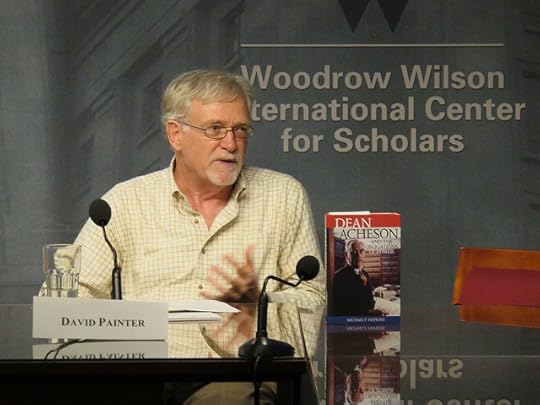
David S. Painter (born 1948) is an emeritus associate professor of international history at Georgetown University. He is a leading scholar of the Cold War and United States foreign policy during the 20th century, with particular emphasis on their relation to oil.
Cold War: On the Brink of Apocalypse was an interesting look at events that shaped the modern world.
Professor David S. Painter is an associate professor of international history at Georgetown University. He is a leading scholar of the Cold War and the United States foreign policy during the 20th century.
David S. Painter:
The lecture series is a big picture analysis of global politics and realpolitik, where Professor Painter examines the events of the Cold War period, as well as the impact of the Cold War on the modern world, and how it carved the world into different spheres of influence divided along ideological lines.
Cold War: On the Brink of Apocalypse is presented as a series of 14 lectures, each ~30mins long, as well as an accompanying 85 page PDF guidebook. The lectures are: 1 Hiroshima and the Origins of the Cold War 2 The Superpowers and the World in 1945 3 The Struggle for Europe 4 Globalizing the Cold War 5 The Korean War and Changing Power Balances 6 Turmoil in the Third World 7 The Cuban Missile Crisis 8 The Turbulent 1960s 9 Origins of Détente 10 Revolution in the Third World and the End of Détente 11 The Arms Race and the Breakdown of Détente 12 The Reagan Offensive 13 Gorbachev and the End of the Cold War 14 Understanding the Cold War
I found the lectures here well presented; Professor Painter offers the listener a concise summary of many of the pivotal events of the Cold War, and offers insightful political commentary as he goes. Lecture 1 gets off to a good start, as Painter examines the decision to drop the bombs on Japan.
The course concludes with Lecture 14: Understanding the Cold War, where Professor Painter offers a look back at the global ramifications of the Cold War. I'm not sure I agree with all his conclusions here, but his arguments were well-reasoned, and it was a good presentation nonetheless.
**************
Cold War: On the Brink of Apocalypse was a nice offering from the people over at Modern Scholar. I enjoyed these lectures, and would recommend this course to anyone interested. 5 stars.
The collapse of Soviet Union was viewed as the conclusion of First World War, and Allende was viewed as a bigger threat to the US than other communist dictators. These are some of the new viewpoints I learned and savored from Prof Painter here.
Really interesting topic, really entertaining speaker (he had a great southern accent), lots of information. The speaker was very knowledgeable and I learned a lot, but he focused on the foreign policy aspect of the Cold War and less on the civilian repercussion, which was fine, but which didn't do justice to exactly how evil the Communist party had become. He also was not at all a fan of Ronald Reagan and didn't like to accredit Reagan with ending the Cold War by outspending Russia on defense. I'm not saying the author was lying outright, but he definitely believed a perspective that jars with my current understanding and in fact, the mainstream interpretation of the history of events. Suspected bias aside, I loved this lecture series and will likely look for more in future.
I didn't realize how broad the Cold War was until I began listening to this course. It was so broad that it was a bit hard to it seemed to include just about everything that the USA and Soviet Union were involved in from 1945-1990. The course is a mile wide and an inch deep, but that was helpful for me to get the context.
Since listening to this, I've watched several documentaries about the atomic bomb. It's really crazy to think of what the outcomes could have been...
Decent overview, goes over many previously known facts and events. He does not like Ronald Reagan, though! Er, I mean "scholars say" Reagan was terrible and did everything wrong. Unlike Nixon and Carter, who had things handled no problem.