

What do you think?
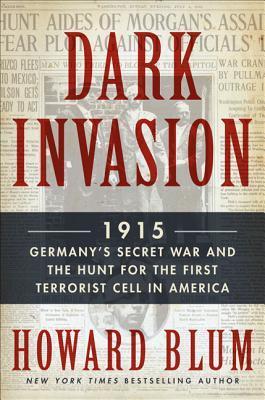
Dark Invasion 1915: Germany's Secret War & the Hunt for the First Terrorist Cell in America
What happens when German spies collaborate to unleash a campaign of terror upon America at the start of World War I?
In the summer of 1914, New York Police Department captain Tom Tunney is preoccupied by Manhattan's raging gang rivalries and has little idea that, halfway around the world, a much more ominous threat to the city is brewing. As Germany teeters on the brink of war, its ambassador to the United States is given instructions to find and finance a team of undercover saboteurs who can bring America to its knees before it has a chance to enter the conflict on the side of the Allies.
At the page-turning pace of a spy thriller, Dark Invasion tells the remarkable true story of Tunney and his pivotal role in discovering, and delivering to justice, a ruthless ring of German terrorists determined to annihilate the United States. Overwhelmed and undermatched, Tunney's small squad of cops was the David to Germany's Goliath, the operatives of which included military officers, a germ warfare expert, a gifted Harvard professor, a bomb technician, and a document forger. As explosions leveled munitions plants and destroyed cargo ships, particularly in and around New York City, pan- icked officials talked about rogue activists and anarchists—but it was Tunney who suspected that these incidents were part of something bigger and became determined to bring down the culprits.
Through meticulous research, Blum deftly reconstructs an enthralling, vividly detailed saga of subterfuge and bravery. Enhanced by more than fifty images sourced from global archives, his gritty, energetic narrative follows the German spies—with Tunney hot on their heels—from the streets, harbors, and warehouses of New York City to the genteel quads of Harvard, the grand estates of industry tycoons, and the steps of the U.S. Capitol. The New York Police Department's breathtaking efforts to unravel the extent of the German plot and close in on its perpetrators are revealed in this riveting account of America's first encounter with a national security threat unlike any other—the threat of terrorism—that is more relevant now than ever.
In the summer of 1914, New York Police Department captain Tom Tunney is preoccupied by Manhattan's raging gang rivalries and has little idea that, halfway around the world, a much more ominous threat to the city is brewing. As Germany teeters on the brink of war, its ambassador to the United States is given instructions to find and finance a team of undercover saboteurs who can bring America to its knees before it has a chance to enter the conflict on the side of the Allies.
At the page-turning pace of a spy thriller, Dark Invasion tells the remarkable true story of Tunney and his pivotal role in discovering, and delivering to justice, a ruthless ring of German terrorists determined to annihilate the United States. Overwhelmed and undermatched, Tunney's small squad of cops was the David to Germany's Goliath, the operatives of which included military officers, a germ warfare expert, a gifted Harvard professor, a bomb technician, and a document forger. As explosions leveled munitions plants and destroyed cargo ships, particularly in and around New York City, pan- icked officials talked about rogue activists and anarchists—but it was Tunney who suspected that these incidents were part of something bigger and became determined to bring down the culprits.
Through meticulous research, Blum deftly reconstructs an enthralling, vividly detailed saga of subterfuge and bravery. Enhanced by more than fifty images sourced from global archives, his gritty, energetic narrative follows the German spies—with Tunney hot on their heels—from the streets, harbors, and warehouses of New York City to the genteel quads of Harvard, the grand estates of industry tycoons, and the steps of the U.S. Capitol. The New York Police Department's breathtaking efforts to unravel the extent of the German plot and close in on its perpetrators are revealed in this riveting account of America's first encounter with a national security threat unlike any other—the threat of terrorism—that is more relevant now than ever.
496 pages, Hardcover
First published September 10, 2013
About the author
Howard Blum
36 books312 followersHoward Blum is the author of New York Times bestsellers including Dark Invasion, the Edgar Award–winner American Lightning, as well as Wanted!, The Gold Exodus, Gangland, and The Floor of Heaven. Blum is a contributing editor at Vanity Fair. While at the New York Times, he was twice nominated for a Pulitzer Prize for investigative reporting. He is the father of three children, and lives in Connecticut.
Get in touch!
Website: www.HowardBlum.com
Email: Howard@HowardBlum.com
Facebook: Like Howard Blum on Facebook
Twitter: @HowardBlum and @FloorOfHeaven
Get in touch!
Website: www.HowardBlum.com
Email: Howard@HowardBlum.com
Facebook: Like Howard Blum on Facebook
Twitter: @HowardBlum and @FloorOfHeaven
Ratings & Reviews
Friends & Following
Create a free account to discover what your friends think of this book!
Community Reviews
Displaying 1 - 30 of 194 reviews

February 11, 2014
When I read a non-fiction book, the more interesting facts I learn, the more I like it. This is especially true if the book covers a topic I arrogantly think I'm already familiar with. "Dark Invasion" did an excellent job of covering both of those areas for me.
Similarly, when I read fiction, such as a spy novel, the intrigue, the cleverness of the spies, and the obstacles they face all have to be believable and challenging for me to enjoy it. Once again, "Dark Invasion" did that job brilliantly.
I would assume that many people, like myself, think of the attack on the World Trade Towers and Pentagon on 9/11 as the first and only large scale terrorist attacks against our Country. I certainly had never known about use of biological agents used against our Country during World War I, or the widespread planting of bombs and incendiary devices on weapon and supply ships heading to England and France, or the millions of dollars in damages caused by bombs planted in munitions depots in the U.S prior to our entry into the War.
Yet, as Howard Blum tells us, all those things took place, as a German spy network was quite active in the New York, Baltimore, and Washington D.C. area. The challenge to identify the people behind these mysterious happenings was more daunting by the fact that the Country had no Agency in place equipped to ferret out the culprits. We know of the Department of Homeland Security formed after 9/11, but in the early part of the 20th Century, the spy hunting was left to local policemen, working without FBI labs, eavesdropping devices, aerial surveillance, and other modern crime fighting techniques. That alone made Blum's book fascinating, introducing us to the small New York City police squad tasked with putting all the pieces together. Having a good guy to root for, who had to depend solely on his instincts and hard work, made this book of non-fiction read like a good spy thriller.
Similarly, when I read fiction, such as a spy novel, the intrigue, the cleverness of the spies, and the obstacles they face all have to be believable and challenging for me to enjoy it. Once again, "Dark Invasion" did that job brilliantly.
I would assume that many people, like myself, think of the attack on the World Trade Towers and Pentagon on 9/11 as the first and only large scale terrorist attacks against our Country. I certainly had never known about use of biological agents used against our Country during World War I, or the widespread planting of bombs and incendiary devices on weapon and supply ships heading to England and France, or the millions of dollars in damages caused by bombs planted in munitions depots in the U.S prior to our entry into the War.
Yet, as Howard Blum tells us, all those things took place, as a German spy network was quite active in the New York, Baltimore, and Washington D.C. area. The challenge to identify the people behind these mysterious happenings was more daunting by the fact that the Country had no Agency in place equipped to ferret out the culprits. We know of the Department of Homeland Security formed after 9/11, but in the early part of the 20th Century, the spy hunting was left to local policemen, working without FBI labs, eavesdropping devices, aerial surveillance, and other modern crime fighting techniques. That alone made Blum's book fascinating, introducing us to the small New York City police squad tasked with putting all the pieces together. Having a good guy to root for, who had to depend solely on his instincts and hard work, made this book of non-fiction read like a good spy thriller.

December 11, 2013
Although President Wilson was determined to remain neutral when the first World War broke out in Europe, the nation's "neutrality" was mostly one-sided. Even if America didn't officially take sides, huge amounts of munitions and weapons were sold to the Allies (Britain enforced a sea blockade, preventing any possibility of trade with Germany). And as German frustration mounted, they began a secret campaign of sabotage against American ships. Inventive cigar-shaped incendiaries and bombs attached to ship's rudders crippled or destroyed ships when they were far from land and sent bullets that would have been fired at German soldiers instead to the bottom of the sea. A bomb blew up in the U.S. Capitol and an assassin tried to kill J. P. Morgan, whose support for the Allies was never in doubt. German spies even initiated germ-warfare against America, all in an attempt to keep America out of the war.
We tend to think terrorism directed at America started with the Sept. 11, 2001 attacks on the World Trade Center. But even before the "infamy" of Pearl Harbor, America was secretly attacked on her own soil by an enemy nation. Howard Blum has pieced together the plots and intrigue of Germany at the beginning of WWI, and it's a lot more extensive that most people realize, and it goes far beyond blowing up the munitions depot at Black Tom, NJ. Blum's "hero" in the story is NYPD Inspector Tom Tunney, who was charged with finding out who was responsible for the ship fires. Blum tells the story in a novel-like way that highlights the action of the story without bogging it down with too many details. Still, there's a lot of information in his narrative - so much that it runs over 400 pages, and sometimes I felt it grew a little tedious. Tunney isn't the most heroic figure either, and he seems to have always been a step or two behind the bad guys (although I'm not faulting him - his was a near impossible task), and President Wilson is portrayed as simple and only looking for excuses to keep his head in the sand. But it's a good story, and I appreciated the many period photos of the people and places.
We tend to think terrorism directed at America started with the Sept. 11, 2001 attacks on the World Trade Center. But even before the "infamy" of Pearl Harbor, America was secretly attacked on her own soil by an enemy nation. Howard Blum has pieced together the plots and intrigue of Germany at the beginning of WWI, and it's a lot more extensive that most people realize, and it goes far beyond blowing up the munitions depot at Black Tom, NJ. Blum's "hero" in the story is NYPD Inspector Tom Tunney, who was charged with finding out who was responsible for the ship fires. Blum tells the story in a novel-like way that highlights the action of the story without bogging it down with too many details. Still, there's a lot of information in his narrative - so much that it runs over 400 pages, and sometimes I felt it grew a little tedious. Tunney isn't the most heroic figure either, and he seems to have always been a step or two behind the bad guys (although I'm not faulting him - his was a near impossible task), and President Wilson is portrayed as simple and only looking for excuses to keep his head in the sand. But it's a good story, and I appreciated the many period photos of the people and places.

January 29, 2014
Today's nonfiction book is Dark Invasion: 1915 Germany's secret war against America by Howard Blum. It is 512 pages long including notes and index. It is published by HarperCollins. The story is told from journals, interviews, and recent conversations with the people involved to the silent author; it is third person close. There is language, talk of sex, and violence in this book. Because of content 16 and up just to be safe. The cover has a newspaper on it with the title and author name overlaid on it. There Be Spoilers Ahead.
From the back of the book- When a “neutral” United States becomes a trading partner for the Allies early in World War 1, the Germans implement a secret plan to strike back. A team of saboteurs- including an expert of germ warfare, a Harvard professor, and a brilliant, debonair spymaster- devise a series of “mysterious accidents” using explosives and biological weapons to bring down vital targets such as ships, livestock, and even captains of industry such as J. P. Morgan.
The New York police inspector Tom Tunney, head of the department's bomb squad, is assigned the difficult mission of stopping these enemy agents. Assembling a team of loyal operatives, the cunning Irish Cop hunts for the conspirators among a population of more than eight million Germans. But the deeper he finds himself in this labyrinth of deception, the more Tunney realizes that the enemy's plan is far more complex and dangerous than he first suspected.
Full of drama and intensity, and illustrated with photographs throughout, Dark Invasion is a riveting nonfiction war thriller that chillingly echoes our own time
Review- This book is fascinating and I just could not put it down. The overall plot is pretty simple. Stop America from entering the war. But the execution is so much more complicated. Germany sends and uses some smart people who in turn use dumb people to get the job done. This is the story about the first known Anti-America spy-ring and the first homeland security trying to find them. All of the people are interesting. Tunney is smart and determined to stop the deaths. The German's are just loyal followers to the Fatherland and everyone else is caught between them. The scope of Germany's plans to terrorize America is frightening. The will to serve and destroy is really scary. As I was reading all the things that happened I just kept thinking “Why wasn't I taught any of this in school?”. Because I knew nothing about it at all. If you want an eye-opening and exciting war read, I highly recommend this book.
I give this book a Five out of Five. I get nothing for this review and I was given this book as a free ARC in exchange for my honest review.

December 10, 2014
Technically this book is "history," but I've labeled it historical fiction because the author was including so many details of his own invention - personal thoughts, emotions, etc. It reads more like history than fiction. But he is definitely walking on the line.
Blum tells a story of coordinated German sabotage in the US from 1914-17. It isn't really terrorism. The agents worked for the German government and their goal was to operate in secret. They wanted the problems they caused to be dismissed as accidents. Causing panic among Americans is the opposite of what they wanted to accomplish, because it would have brought the US into the war sooner.
There are a few places where I wish that Blum had been more specific. He talks about the plan to bring reserve officers to Germany using fake passports. He says that the plan was discovered, but makes it sound like at least some officers were able to sneak out of the US. No specific number is mentioned though. Similarly, when he discusses the attempt to spread anthrax among horses awaiting shipment to the Allies, he says that four people die in Virginia but not the number of horses who died - which was their actual goal.
Blum says briefly that additional German cells were created in New Orleans, San Francisco, and Baltimore, but rather than include events there the focus remains on the NYPD efforts to find them, with each tiny lead being described in minute detail. The book would be better if German efforts in other US cities were included. Or if the focus is on NYC exclusively, the book could be cut down to half its length.
Blum tells a story of coordinated German sabotage in the US from 1914-17. It isn't really terrorism. The agents worked for the German government and their goal was to operate in secret. They wanted the problems they caused to be dismissed as accidents. Causing panic among Americans is the opposite of what they wanted to accomplish, because it would have brought the US into the war sooner.
There are a few places where I wish that Blum had been more specific. He talks about the plan to bring reserve officers to Germany using fake passports. He says that the plan was discovered, but makes it sound like at least some officers were able to sneak out of the US. No specific number is mentioned though. Similarly, when he discusses the attempt to spread anthrax among horses awaiting shipment to the Allies, he says that four people die in Virginia but not the number of horses who died - which was their actual goal.
Blum says briefly that additional German cells were created in New Orleans, San Francisco, and Baltimore, but rather than include events there the focus remains on the NYPD efforts to find them, with each tiny lead being described in minute detail. The book would be better if German efforts in other US cities were included. Or if the focus is on NYC exclusively, the book could be cut down to half its length.

May 18, 2020
How had I never heard of any of this? It seemed not only like an important part of history, but fascinating tale! I mean, I figured there was some German espionage and/or sabotage, but this was much more than I was aware! I vaguely remember something about an attempt on JP Morgan, but I did not recall it having to do with the Germans. The covert activities of the German spy ring and the NY police unit trying to capture them was well told in this book, reading more like a cloak and dagger spy novel than a history book. Some of the successes and failures were crazy and sometimes it was hard to believe this was nonfiction. I will definitely be reading another by this author and hoping for a repeat performance!

December 22, 2013
Howard Blum’s book Dark Invasion covers the time from just before World War 1 though the conclusion of World War 1 and focuses on the efforts of Germany to seed disruption and terrorism in the United States. The book also follows a New York Police inspector who acted as a homeland security expert tracking down saboteurs and spy rings before groups like the FBI would be tasked with doing so. A German diplomat set up a ring of saboteurs and spies aimed at spreading anti-British propaganda, disrupting war supplies, and even assignation against JP Morgan. In a story that is almost to surreal to be true the author takes us through the events that led up to one of the most bizarre attempts by a nation to undermine another during war time. For those who are interested in World War 1 they will not be disappointed in this book. It is written as a spy thriller with great twists and turns as the drama unfolds. It is a startling look at the danger of neutrality and the blindness that Wilson clung to in order to maintain it. Overall very well written and a must read for those interested in the World War 1 era.

September 4, 2014
Have read many times about Germany's attempts to prevent the US from supplying the Britian and France in WW1. This book details the depths of the German efforts lead by the German ambassador to the US! Author Blum tells of the efforts of Captain Tom Tunney's of the New York City Police Department and his small squad of detectives to thwart the German sabatouge efforts and the German plans to wage chemical war on the US population and the animals being supplied to the Allies. The Federal government had almost non existant law enforcement divisions to stop the Germans. Thus, Capt. Tunney and the NY Police almost single handed stopped the Germans The book is complete with lots of colorful participants on both sides. Dark Invasion at times reads like fiction. It is hard to believe some of the German "schemes" to stem the US's assistance to the Allies. A well written book that holds you in suspence like a novel would!! Highly recommended for the history buff on a chapter of US history that is not well known. Very enlighting.

May 10, 2019
This is the true story of German secret agents and saboteurs in the US during WWI prior to the US entering the war. It's a fascinating story and it really reads like a novel. Basically, President Wilson was determined that the US would remain neutral, but American business and shipping interests were allowing the Allies to purchase war supplies from the US and have them shipped across the Atlantic. Germany obviously didn't like this. We all know the story of the Lusitania, which was torpedoed for similar reasons later on, but who knew that Germany had a spy network to sabotage outgoing ships?
The "good guy" narrative focuses mainly on the New York City bomb squad and one of its detectives, Tom Tunney. I was struck by his obvious intelligence and ingenuity throughout the book. The German agents were more varied and there were a lot of them. It was a little confusing to keep up with each person and what they were doing, but it's understandable since there was so much going on. Bombings, attempted assassinations, and germ warfare are all mentioned.
The "good guy" narrative focuses mainly on the New York City bomb squad and one of its detectives, Tom Tunney. I was struck by his obvious intelligence and ingenuity throughout the book. The German agents were more varied and there were a lot of them. It was a little confusing to keep up with each person and what they were doing, but it's understandable since there was so much going on. Bombings, attempted assassinations, and germ warfare are all mentioned.

March 7, 2021
Fascinating story of WW1 espionage. I knew a little about this topic, but had no idea the extent of the German infiltration of America. Really intricate plots designed to disrupt supplies to the allies all while deflecting suspicion and thus America's entrance into the war. Equally interesting are the detectives involved in uncovering this network of spies, and the methods they use are no less devious.
Still, I would have liked some follow up at the end. It's a common nonfiction courtesy. What happened to all these people after the war? Don't make me get sucked into a wikipedia wormhole...
Still, I would have liked some follow up at the end. It's a common nonfiction courtesy. What happened to all these people after the war? Don't make me get sucked into a wikipedia wormhole...

September 16, 2017
This book is fascinating. I had never heard of or had any idea that German terror cells had infiltrated the United States during WWI. The parallels between then and now are stunning. I think the author put it best when he writes "in one large and affecting way, little has changed over the past one hundred years for the officers who are responsible for defending our sprawling republic." What an eye opener this book is. Wow!
September 8, 2026
Per usual, another interesting book by Howard Blum. This focused on WWI (which is often overlooked in favor of the second war). Interesting to learn that deep cover infiltration has been happening as long as WWI. And anthrax and other germ warfare… this could have been a more recent James Bond episode or come out of the pages of history from the early 2000s. Quite the story. So thankful many plots failed or were foiled and that America is around to tell it.
March 1, 2023
Non-fiction that reads like a thriller. Great cast of characters. Rather rosy view of some of the more powerful--including Woodrow Wilson. Amazing story of German spies and saboteurs in the U.S. before WWI and the NYC cop who sniffed some of them out. I had never heard of Black Tom N.J. explosion, for example, which was so horrific that it blew out the windows of the NY Public Library on Fifth avenue.

April 5, 2016
I so disliked this book that I had to force myself to finish it for two reasons: (1) I wanted the historical content; (2) it was for a nonfiction book club where I knew we'd discuss our opinions about this genre of fictionalized nonfiction, history as spy thriller, etc. Frankly, I understated my first sentence. I hated this book. To be fair to the author and those who like this style of nonfiction, I should say "I hate this genre" and because of that I hated the book. Blum did his research -- four years' worth -- so why RUIN it with this melodramatic, even silly, true-crime narrative? I felt Capt. Tom Tunney and the U.S. agents were trivialized as Keystone Kop-like characters. The saboteurs' damage and the investigators' tenacity were actually lost in this genre, muffled by the cloak-and-dagger prose. To maintain false suspense with cliff-hanger chapters, Blum jumps from character to character, and insists on beginning each chapter with sentences like "So-and-So felt unusually chipper that November morning as he skipped down the steps of his walkup and walked out onto the rain-streaked sidewalk, ready to meet his new cohort in crime." (I made that one up.) The text jumped around so much I gave up trying to keep everything straight. If you read his Note on Sources, you'll see what this book could have been -- a gripping history as well as an illuminating essay on fighting terrorism in different eras. This was REALLY serious sabotage, people, but in Dark Invasion you think you're reading just a rip-roarin' tale.

December 10, 2013
A fast-paced, tautly-written story of German clandestine warfare in US territory during the period, 1914-1917, when the US had not yet declared war, formally, and yet was under secret attack. Anyone familiar with this dark period, as I am, will recognize the characters -- Ambassador Bernstorff, military attaches von Papen and Boy-Ed, spymasters Dr. Albert and von Rintelen, British intelligence agent Guy Gaunt. We see, 100 years ago, the frontline role the NYPD served even then. The work of Captain Tom Tunney and his detectives gets a more vivid telling in this book than in past accounts of German sabotage.
Mr. Blum's research seems to have been thorough, and he's done well to extract this story from the dull and often dense post-war investigations and hearings (see, e.g., Henry Landau's The enemy within: the inside story of German sabotage in America, which centers mainly on the hearings in the 1920s and 1930s).
We also get a sense, at the end, why a peace-seeking statesman like Woodrow Wilson would finally seek a declaration of war. The submarine warfare and the Zimmermann Telegram seem to be provocations, certainly, but given this amount of German sabotage -- acts of war, really -- this book explains much.
Mr. Blum's research seems to have been thorough, and he's done well to extract this story from the dull and often dense post-war investigations and hearings (see, e.g., Henry Landau's The enemy within: the inside story of German sabotage in America, which centers mainly on the hearings in the 1920s and 1930s).
We also get a sense, at the end, why a peace-seeking statesman like Woodrow Wilson would finally seek a declaration of war. The submarine warfare and the Zimmermann Telegram seem to be provocations, certainly, but given this amount of German sabotage -- acts of war, really -- this book explains much.

September 20, 2015
Okay, I have to start out by saying I am a bit biased in this review; I LOVE history. What I love even more is learning something new about something we think we know. The subject this time around? World War I.
The year is 1915 and America is not in the war. President Wilson is doing everything in his power to keep America out of the war. What he does not know is there are German spies on American soil; spies who are employing saboteurs to damage or destroy American ships that carry supplies to Allied troops. The saboteurs are succeeding.
Enter NYPD Detective Tom Tunney. He is the lead of the bomb squad and given the task of stopping the saboteurs before more damage is done. Tunney gets a team together and the game of Cat and Mouse begins. For each step closer they get knocked back two on many occasions.
Then the Germans up the game and start germ warfare on American soil. The intent is to poison horses and mules that are headed to Europe to help the allies.
This book fires on all cylinders. It is a history that reads like a modern day thriller. As I read this book, I could not help but see the similarities between the world of World War I and the world of today. This is a must read.
The year is 1915 and America is not in the war. President Wilson is doing everything in his power to keep America out of the war. What he does not know is there are German spies on American soil; spies who are employing saboteurs to damage or destroy American ships that carry supplies to Allied troops. The saboteurs are succeeding.
Enter NYPD Detective Tom Tunney. He is the lead of the bomb squad and given the task of stopping the saboteurs before more damage is done. Tunney gets a team together and the game of Cat and Mouse begins. For each step closer they get knocked back two on many occasions.
Then the Germans up the game and start germ warfare on American soil. The intent is to poison horses and mules that are headed to Europe to help the allies.
This book fires on all cylinders. It is a history that reads like a modern day thriller. As I read this book, I could not help but see the similarities between the world of World War I and the world of today. This is a must read.

January 4, 2016
Fictionalized account of the efforts by German secret agents to undermine US support for the Allies in World War I. The "first terrorist cell" of the subtitle seems like a stretch - this group was funded by Germany and there were covert terrorists and anarchists long before 1915.
Focuses mostly on three stories - fires on American ships delivering materials to the Allies; a murderer who planted a bomb in the capitol building and attacked JP Morgan Jr.; and a group trying to infect horses headed for Europe with glanders and anthrax. The last was the least covered, with many hints in the final chapter that the full story came out in litigation after the war - it would have been appropriate to have the full story here.
All three tales are intermingled to add "page-turning pace" but this really didn't work for me. One example - the story of Muenter's attack on Morgan mentions that after the attack there was an increased mistrust of Germans. What the author doesn't mention is that the well-publicized sinking of the Lusitania two months earlier probably had a lot more to do with anti-Germanic feelings. Dates were elsewhere ignored to my irritation.
I understand the individual threads have all been published elsewhere. I would recommend reading those instead of this.
Focuses mostly on three stories - fires on American ships delivering materials to the Allies; a murderer who planted a bomb in the capitol building and attacked JP Morgan Jr.; and a group trying to infect horses headed for Europe with glanders and anthrax. The last was the least covered, with many hints in the final chapter that the full story came out in litigation after the war - it would have been appropriate to have the full story here.
All three tales are intermingled to add "page-turning pace" but this really didn't work for me. One example - the story of Muenter's attack on Morgan mentions that after the attack there was an increased mistrust of Germans. What the author doesn't mention is that the well-publicized sinking of the Lusitania two months earlier probably had a lot more to do with anti-Germanic feelings. Dates were elsewhere ignored to my irritation.
I understand the individual threads have all been published elsewhere. I would recommend reading those instead of this.

August 1, 2015
Dark Invasion tells the story of German sabotage efforts in the US during the early (pre-US declaration of war) days of World War I, and the efforts to track down and neutralise these German efforts. Since one of the main German strategies was to place bombs on munition ships heading to the Allies, and there was apparently no US federal agency able or willing to lead, the hero on the US side was Tom Tunney, head of the New York City police bomb squad.
On the one hand, the book tells a story that is not well-known. While the author doesn't come right out and say it, one can assume that the story was actively repressed because US President Wilson wanted to stay neutral in the war. Also, some information isn't revealed in the narrative until it was available to Tunney, which lends an air of mystery to it. So it's recommended for these reasons.
However, on the other hand, at times I found the chronologies difficult to follow and at others, it seemed as some things were being glossed over or skipped. This makes it difficult for me to give it a higher rating. But this is a strong three stars.
On the one hand, the book tells a story that is not well-known. While the author doesn't come right out and say it, one can assume that the story was actively repressed because US President Wilson wanted to stay neutral in the war. Also, some information isn't revealed in the narrative until it was available to Tunney, which lends an air of mystery to it. So it's recommended for these reasons.
However, on the other hand, at times I found the chronologies difficult to follow and at others, it seemed as some things were being glossed over or skipped. This makes it difficult for me to give it a higher rating. But this is a strong three stars.

September 6, 2014
Before the US entered WW-I, German agents conducted massive sabotage acts designed to prevent munitions from reaching Britain. The Germans planted delayed action fire bombs on ships, bombed munitions plants, and tried to start a Mexican war with the US. They even set off a bomb in the US Capitol building, and shot JP Morgan in a murder attempt.
Pres Wilson desperately tried to keep the US out of the war but finally had to concede there was no alternative other than to fight. He did not know that German agents were growing anthrax -- in a basement about 6 miles from
The White House - to do biological warfare in a big way.
If the Germans would have resisted the temptation to commit acts of terrorism, and if they had not sunk the Lusitania and other US vessels, maybe America would not have declared war on them. On the other hand, if Germany would had the sense not to start the war in the first place, everybody in Europe would have been far better off.
Interesting that only a short time ago, Germany booted out a US guy for spying.
Pres Wilson desperately tried to keep the US out of the war but finally had to concede there was no alternative other than to fight. He did not know that German agents were growing anthrax -- in a basement about 6 miles from
The White House - to do biological warfare in a big way.
If the Germans would have resisted the temptation to commit acts of terrorism, and if they had not sunk the Lusitania and other US vessels, maybe America would not have declared war on them. On the other hand, if Germany would had the sense not to start the war in the first place, everybody in Europe would have been far better off.
Interesting that only a short time ago, Germany booted out a US guy for spying.

March 30, 2015
I will be honest. I did not read this book. Here's the first sentence. "If Eric Muenter hadn't walked across the Harvard campus to Emerson Hall on that wet February day in 1906 to borrow a book, he would never have seen the student pull the short-barreled black revolver from his pocket, aim, and just as his arm was grabbed, fire. And then things might have been different."
Dum de dum dum.
I hate this kind of writing. I wish Blum would have gone to a different creative writing class, because this paragraph is an example of everything I dislike about how some people write.
If you like it, great. It will work out well for you.
Dum de dum dum.
I hate this kind of writing. I wish Blum would have gone to a different creative writing class, because this paragraph is an example of everything I dislike about how some people write.
If you like it, great. It will work out well for you.

March 19, 2014
Blum's book Dark Invasion, a nonfiction account of German sabotage in the United States during WWI, reads more like a fiction thriller. If I didn't know the setting (and I definitely didn't know the story) I would think it was fiction after all.
I hemmed and hawed over the five stars, because Blum's background as a newspaper reporter almost makes the book too punchy. But, that is what makes it so readable. Makes me want to read up on the conundrum German-Americans faced during World War I, to understand this story and my family history a little better.
I hemmed and hawed over the five stars, because Blum's background as a newspaper reporter almost makes the book too punchy. But, that is what makes it so readable. Makes me want to read up on the conundrum German-Americans faced during World War I, to understand this story and my family history a little better.

August 29, 2014
Anthrax,dynamite bombs disguised as cigars,all this occurred in 1915? This book tells all about German infiltration in America before WW1. Spooky story!

July 4, 2016
An interesting book. Never really had the war from this perspective. Told from different POV - and from different countries - Germany, New York...police, medicos...good stuff.

October 25, 2015
The facts are interesting but the non-fiction novel format didn't work very well for me.
Read
January 1, 2016Howard Blum's exciting story of the German terrorist cell that operated in the United States in the aftermath of the start of World War I in Europe was inspired by an article Blum read in the CIA's in-house publication, Studies in Intelligence. The article, written by a CIA staff historian one year after 9/11, was subtitled "Protecting the Homeland The First Tome Around".
The story reads like fiction and is well-told by Blum. The hero of the piece is New York City Police Captain Thomas J. Tunney. A series of bombings in and around New York City in the first decade-and-a-half of the 20th century led New York City Police Commissioner Arthur Hale Woods to name Tunney commander of a newly formed bomb squad in 1913. Tunney had made his bones by solving the case of the Brescia Circle crime syndicate that had attempted to blow up St. Patrick's Cathedral. Tunney's work in preventing that tragedy was the start of a whirlwind period in the mid-teens when Tunney and his officers would prevent countless other deaths as well.
While the Brescia Circle had been a domestic syndicate [albeit made up largely of recent Italian immigrants] it was a foreign threat that led to Tunney's heroics.
Even before the start of the fighting in World War I in 1914, Germany knew it was going to war. It also knew that it wanted to keep the U.S. out of the fight. That desire, however, had to be balanced with the need to make sure that America did not become what Franklin Roosevelt would call 25 years later - prior to the next World War - "the arsenal of democracy." The Kaiser and his secret intelligence service, Abteilung IIIB, planned to make sure that Britain and France were not aided by supplies sent from America.
To do this, it was decided to set up a spy network in the United States to sabotage - as much as possible - attempts to aid the Allies at Germany's expense. The Kaiser decided that the German Foreign Service in the U.S. would be the best cover for the operation. Along those lines, in July 1914 Germany's Ambassador to the United States, Count Johann Heinrich Andreas Hermann Albrecht von Bernstorff was recalled to Berlin by the Supreme Commander of Abteilung IIIB, Walter Nicolai, for a full briefing on the plan. When Nicolai met von Bernstorff in Berlin, his instructions were simple: establish a network of intelligence agents in America. This network's mission would be twofold: keep the U.S. out of the war; and prevent arms and other goods from leaving U.S. docks for Europe.
While working out of the German Embassy in Washington, von Bernstorff decided to locate the headquarters of the spy network in New York City - a more German-friendly area and one less likely to raise suspicions. For staffing, Heinrich Albert, the Embassy's commercial attaché, served as paymaster for the cell. Indeed, in that first year alone, he distributed $30 million to spies and saboteurs in the network. Other key players included Karl Boy-Ed, a German diplomatic expert on the U.S. Navy and it's fleet, as well as Franz von Papen, who set up a War Intelligence Center to recruit and direct spies and saboteurs to where they were most needed.
It is important to note, as Blum reminds us, that at this time over 8,000,000 people - one tenth of the U.S. population - had been born in Germany or had a German parent. Another key audience from which to cull spies was the large number of German military reservists (about 500,000) who had suddenly found themselves stranded in America when the war broke out. President Woodrow Wilson's neutrality policy kept these German soldiers on U.S. land because he stated that any ship docked in the United States at the outbreak of the war would not be allowed to leave the U.S. to join the hostilities. Because of this, East Coast ports were filled with German vessels and idle sailors for the duration of the war. A captive audience from which to recruit spies, indeed.
The network was made up of more than just Germans, though. There were also 4,500,000 Irish-Americans in the U.S., and the strains of Irish nationalism ran deep for the common enemy - Great Britain. So here, too, was a population likely to help the Germans.
One of the final leaders put in place was Paul Koenig, a man Blum describes as, "a thug and a bully and he enjoyed hurting people." He was hired to carry out covert assignments for the Abteilung IIIB. Because he worked security for the Hamburg-American Shipping Line, he was familiar with all of the best criminals on the New York City docks. Koenig rounded up his best thugs and formed a "secret service division". They planted and detonated bombs on ships carrying materiel to the Allies throughout 1914-15. In most cases, the bombs went off at sea and appeared as "fires" rather than intentional explosions.
By the spring of 1915, Tunney had formulated a theory that these fires were not the result of poor safety practices by sailors but were instead related to German sabotage. Tunney went to Commissioner Woods with his theory after more than 70 fires/explosions, 38 deaths, and $22 million in damages had occurred.
At almost exactly the same time, the British Secret Service cracked the German code. To continue to make that a useful tool, however, they obviously did not want the Germans to know of their success. Britain, therefore, would not share with the United States that the code had been broken. They would, however, share with them the knowledge of the German sabotage cells, gleaned from being able to read the dispatches between Berlin and Washington. Guy Gaunt, head of Section V, the British Secret Service New York station - let Franklin Polk, his liaison in the Wilson Administration, know that the German Secret Service was directing a campaign of sabotage against the United States. President Wilson had placed Polk in charge of U.S. security operations at the start of the European war. Polk had grave doubts, however, that there was anyone in Washington who could handle such a case. He knew about what Woods and Tunney had done with the Brescia Circle case in New York City, and he tapped them with the job of investigating the bombings. Tunney's group thus became the awkwardly-titled Bomb and Neutrality Squad.
At this time - spring 1915 - two new actors appeared. Franz Dagobert Johannes von Rintelen was sent by Nicolai to the U.S. to take over the German sabotage campaign in April 1915. While von Bernstorff would remain in charge of the entire operation as Ambassador to the U.S., Nicolai realized that there needed to be a physical presence in New York City overseeing day-to-day operations, something von Bernstorff could not do from Washington.
The second actor was Dr. Walter Scheele. Scheele invented a bomb that evaporated in the explosion itself - thus it was untraceable and allowed the user to create fuses that would not detonate for up to two weeks after they were planted - when ships were well at sea. These "cigar" bombs were smuggled aboard ships heading for Europe. They'd be in international waters by the time they ignited and therefore there would never be a clue as to what caused the fire. Unless, of course, Tunney could find a cigar bomb that - for some reason - didn't explode.
To manufacture these bombs in sufficient quantities, space was needed. Charles von Kleist - a longtime German captain stranded in New York City - suggested to von Rintelen that he use the steamship Friedrich der Grosse and it was transformed into a factory. It took one week to fabricate about 100 lead cigars. Von Rintelen used Irish stevedores to smuggle them onto the ships. The first ship targeted was the British ship Phoebus carrying American-made bullets and shells. It worked.
Not every bomb exploded, of course, When French police found unexploded bombs on the steamship Kirkoswald when it docked in Marseille from New York City. the French sent the bombs to the U.S. State Department who sent them onto Tunney and his team. After studying the design, Tunney figured out how the bombs worked, but not why this particular bomb hadn't. Tunney knew "by their design that they were the work of a skilled and artful professional with a sophisticated knowledge of chemistry and design."
While most know the story of Germany's attempt to recruit Mexico against the United States just prior to U.S. entry in the war, Blum discovered that it was not the first time Germany had tried this. In mid-1915, von Rintelen met with ousted Mexican dictator Victoriano Huerta [who was trying to regain his seat of power in Mexico]. Von Rintelen proposed that German U-Boats would deliver covert shipments of weapons along the Mexican coast; Germany would provide large sums of money to outfit Huerta with a Mexican rebel army; in return, once Huerta regained power, his troops would attack the United States. Unbeknownst to either man, the whole meeting had been recorded by British Intelligence [they had bugged Huerta's hotel room, where the meeting had been held].
The plan started when 8,000,000 rounds of ammunition were purchased and awaited shipment to Huerta; another 3,000,000 rounds were on order; $800,000 was deposited into Huerta's personal bank account; another $95,000 went into a Mexican bank account also in Huerto's name; and Franz von Papen, from the aforementioned War Intelligence Center, started drafting plans to attack the American army barracks in Brownsville, El Paso and San Antonio.
That's as far as this plot got. The British tipped off the Americans - again, not explaining how or exactly what was learned - and Huerta was arrested on charges of sedition. As Blum writes, this is where the story of what really happened must go untold. We know that Huerta was first incarcerated in El Paso, and then released on bail. He was invited mysteriously to a dinner at Fort Bliss. It was there that Blum surmises that Huerta was more than likely poisoned. He died before ever returning to Mexico.
As incredible as the story of sabotage is, many of these acts were occurring in international waters. What the Germans next proposed would be on U.S. soil. In the spring of 1915, the Germans sent Erich von Steinmetz to the United States to launch germ warfare. The target wasn't humans - although there was a grave risk of human contraction of deadly disease - the primary targets were horses. In the war in Europe, horses, "we're suddenly as valuable as oil." The idea was to poison the American horses before they could be shipped to serve in Europe. The fact that Americans would die too was irrelevant. . Von Steinmetz came to the United States with vials of bacteria for glanders, anthrax, and meningitis. He went to Van Cortlandt Park, where hundreds of the soon-to-be shipped horses were held. He inserted a stick covered with glanders bacteria into a nostril of every third horse. Then he waited. And waited. Nothing happened. After a week the horses were still healthy. It turned out that the germs he'd brought with him were too old. After a month they lost their potency and these were at least four months old. For now, at least, germ warfare was put on hold.
One of the great financiers of the Allies was J.P. Morgan. As such, he was the target of much wrath from Germany. In early June 1915, a new figure [one with an incredible backstory detailed marvelously throughout the book by Blum] presented himself on stage. He name was Frank Holt and he was going to "convince" Morgan that he shouldn't aid the allies. Holt also wanted to send a message to Congress that their protests over the sinking of the Lusitania were "misguided".
Holt's plot unfolded quickly. On July 2, 1915, Holt toured the U.S. Capitol and planted a bomb under a canvas covering the switchboard near the Vice President's office. He then sent a letter to five recipients - President Wilson and the four principal Washington newspapers.The bomb went off at 11:23 pm.
By that point, Holt was en route to see Morgan. On July 3rd, Holt managed to gain entry to Morgan's summer home on Long Island by pulling a gun on the butler. Holt then rounded up the two youngest Morgan children as protection should Morgan be armed. Seeing his children, without thinking, Morgan threw himself at Holt, who shot Morgan in the abdomen and left thigh. Though shot, Morgan fell on Holt and managed to wrestle the gun from his hands while the butler knocked Holt unconscious.
Once he regained consciousness, Holt gave a statement that read similarly to the language used in the letters dealing with the U.S. Capitol bombing. Tunney quickly linked Holt to both events. Tunney took over the case and was hopeful that Holt would be the linchpin that would help him bring the others down. This was particularly true because, after only a short conversation with Holt, Tunney realized that he had no idea how to make a bomb himself, meaning he must have had accomplices.
Then another of those unknowable mysteries arose: Holt died in his holding cell. There were conflicting stories that Holt had gotten hold of a gun and shot himself; that German agents had somehow gotten access to him and shot him; that there was no gunshot at all and Holt managed to commit suicide by jumping head-first from the top of the window in his cell onto the concrete floor below. Blum expanded on each theory but concludes that Holt's death is one of those things that will never be solved. Indeed, back when Commissioner Woods had given Tunney "command of his special task force, the commissioner had warned that some secrets might never be revealed. The circumstances surrounding Holt's death, he now suspected, were among them."
A break in the case of the overall spy network came on July 24, 1915, when German paymaster Heinrich Albert accidentally left a briefcase full of incriminating documents on an elevated train, just as he was being watched by one of Tunney's agents, who confiscated the briefcase. The documents in it were a treasure trove of detail. The contents took a circuitous route to President Wilson: Tunney forwarded them onto Secret Service Chief William Flynn, who brought them to Secretary of the Treasury William McAdoo, who briefed Wilson. McAdoo told Wilson that the briefcase contained details on the German sabotage network including plans to set up a phony company to buy up as much American munitions as possible to exhaust the supplies of those receiving orders from Europe. The documents also disclosed plans to buy up liquid chloride (used for poison gas). [As an aside, Blum notes that by that point the United States was selling 52 tons of liquid chloride a month to the Allies].
It was an incredible find. But Secretary of State Robert Lansing pointed out the elephant in the room: the documents couldn't be used in a court of law - a federal agent had essentially stolen them. Wilson agreed but his close aide, Colonel Edward House, had seen about enough of his friend's tortured 'neutrality' policies. These documents were too much for House to allow. If they couldn't be used in court, they could be used in the press. House subsequently leaked the documents to Frank Cobb, editor at the New York World. They were front page news on August 15, 1915.
House was not alone in being exasperated by Wilson. Blum - for most of the book - is extremely critical of Wilson's unwillingness to act on the intelligence Tunney and others were giving him. Blum said, "...Wilson's patience was inexhaustible." The patience of his friends was not. House in particular became more and more critical of Wilson. In language that risked his friendship with his boss, House said that by refusing to speak out against Germany's covert operations in the United States, Wilson was endangering the nation. As Blum reports, "The president was unmoved."
A second attempt at germ warfare came in the person of Anton Dilger in early October 1915. Dilger was sent by Abteilung IIIB to carry out von Steinmetz's aborted mission. Dilger set up his headquarters in Chevy Chase, Maryland, just six miles from the White House. He set up what he called "Tony's Lab" in the basement and went to work on breeding anthrax and glanders.
At the same time, though, the organization itself was beginning to unravel. And the key was an old standby - money. A German operative in Hoboken, New Jersey, Charles von Kleist, was angry. He had performed work for Walter Scheele - inventor of the cigar bomb - but felt he had not been paid properly. Von Kleist was furious and wanted his money. He'd tried to get it by going up the chain of command but he had gotten nowhere. Just at that moment, Tunney had decided to send agents into heavily German Hoboken to try to infiltrate a cell. One of the agents posing as a German spy, Henry Barth, found von Kleist and was all too eager to tell the German that he could make sure that Scheele paid him his money. Soon, von Kleist thoroughly trusted Barth and told him everything he knew, which was quite a bit - including the location of a bomb-making factory in Hoboken. The final straw was when he brought Barth to his home and dug up a cigar bomb to show him what they'd used. Barth immediately arrested him.
With von Kleist talking, others were rounded up and arrested. Actually, most of the conspirators were talking. One of those Tunney interviewed was named Bonford Boniface, who had first-hand knowledge of von Steinmetz's attempts at germ warfare. According to Bonfiace, a second attempt at germ warfare was supposedly in motion but he didn't know any details.
Tunney was stunned. As he shared this plot up the chain, Franklin Polk - also tired of Wilson's lack of backbone - didn't even bother to bring the news to House, "...he had no faith that the president would listen to the news and then act decisively."
Meanwhile, things in "Tony's Lab" were about ready. Frederick Hinsch, one of the German operatives, was tasked with taking the germs from Dilger. He took anthrax and glanders, which were to be given to horses to start a plague.
But the Germans were running out of time. Another pillar fell out from under them when John Archibald, an American reporter sympathetic to Germany, agreed to deliver papers from German Ambassador von Bernstorff to Germany. Amazingly, a waiter at the table where von Bernstorff and Archibald were dining tipped off the Secret Service. When he arrived in England [en route to Germany], Archibald was arrested with 110 documents outlining German plans to foment labor strikes in the U.S.; cancelled checks to saboteurs and dozens of other incriminating documents. By this point, the British had joined the legions of those wary of Wilson. Rather than forward the information onto Washington, the British simply leaked the contents of the files to the American press.
Meanwhile, unlike von Steinmetz's samples, Dilger's germs worked. It is believed that the first human to die was a handler of the horses on one of the ships. The cause of death was glanders and it was assumed the man had contracted it from a sick horse. Indeed, it would not be until 1924 - when lawyers seeking reparations for Germany's sabotage activities in the U.S. conducted their investigations - that the existence of "Tony's Lab" was discovered. While this man was the first known human fatality in the contagion caused by Germany's germ warfare attack, Blum says we will never know how many deaths went undiagnosed.
Blum adequately covers the build-up to U.S. entry in World War I. By the time the Germans declared unrestricted submarine warfare [February 1, 1917], much of the German spy network was either in jail or back safely in Berlin. By that time, the German spy network - in just three years - had destroyed $150 million in property and caused over 100 deaths.
It could have been much, much worse if not for Thomas Tunney. As Blum writes, "In the end, it had been left to Tom and his small group of men to protect the homelan

June 3, 2018
World War I is a perplexing war to understand. With WWII there is Hitler and Pearl Harbor, but WWI started with an entanglement of treaties and eventually led the majority of the world into a witch's brew of machismo, nationalism and "The enemy of my friend is my enemy." taken to a murderous degree.
Woodrow Wilson, the US President in 1914, was a bit of a pacifist and isolationist and held back America from the war . . . kind of. While America was technically neutral, the non-German and Irish communities were torn. The Anglophiles of America strongly backed the Allies with large numbers of dollars and materials used to by the Allies to fight Germany and their allies.
America's neutrality was easily seen through when the leaders claimed that they would have also sent materials to Germany, but Germany had no means to get those materials to the Fatherland. England had the greatest navy in the world and used that navy to block all shipments headed to their enemies. Of course, Americans knew this, and rather than choose to send materials to neither side, they used this lame excuse to covertly support the Allies, with whom they were obviously aligned.
In my opinion, the Germans were left with little choice. They had to stop materials from getting to England and France to tilt the scales for evenly . . .
This fine book of history written to be read as well as studied, tells all about how the Germans used ambassadors, longshoreman, and everything in between to destroy ships on the high seas that were headed for the Allies. Their work expand from there.
This interesting network of saboteurs included high society German immigrants as well as Irish working men who hated the English for their treatment of Ireland.
In that there was no real federal investigation bureau to investigate the growing number of explosions and fires at sea, it was left largely to the New York City Police Department to get to the bottom of this destruction.
The details of both the Germans hard at work and the NYCPD hard at work to stop them are fascinating. Those interested in WWI, spies or just a good mystery story will love this book.
Woodrow Wilson, the US President in 1914, was a bit of a pacifist and isolationist and held back America from the war . . . kind of. While America was technically neutral, the non-German and Irish communities were torn. The Anglophiles of America strongly backed the Allies with large numbers of dollars and materials used to by the Allies to fight Germany and their allies.
America's neutrality was easily seen through when the leaders claimed that they would have also sent materials to Germany, but Germany had no means to get those materials to the Fatherland. England had the greatest navy in the world and used that navy to block all shipments headed to their enemies. Of course, Americans knew this, and rather than choose to send materials to neither side, they used this lame excuse to covertly support the Allies, with whom they were obviously aligned.
In my opinion, the Germans were left with little choice. They had to stop materials from getting to England and France to tilt the scales for evenly . . .
This fine book of history written to be read as well as studied, tells all about how the Germans used ambassadors, longshoreman, and everything in between to destroy ships on the high seas that were headed for the Allies. Their work expand from there.
This interesting network of saboteurs included high society German immigrants as well as Irish working men who hated the English for their treatment of Ireland.
In that there was no real federal investigation bureau to investigate the growing number of explosions and fires at sea, it was left largely to the New York City Police Department to get to the bottom of this destruction.
The details of both the Germans hard at work and the NYCPD hard at work to stop them are fascinating. Those interested in WWI, spies or just a good mystery story will love this book.

January 10, 2021
This is almost a "4" star book for me - it falls short because while well executed, I am not sure I'm a fan of the "detective story" style of history writing. If you like that style, you will truly love this book, I think.
The story was eye opening in many ways and while it didn't spend much time on the one thing I thought it would cover in depth (sabotage at Black Tom munitions depot), it did a great job of giving you a flavor of the complexities of being a "neutral" in a world war and how a sabotage network has to operate. It is very relevant in the sense that the next great act of foreign (or domestic!) sponsored sabotage is probably on its way and it must be nerve-wracking for those charged with trying to "sniff out" what's coming next.
One other thought this book provided to me - and I word this carefully, I hope - was that I gained some insight on the Japanese American internment of WWII (not covered in this book, of course). I had largely assumed that the fears of sabotage after Pearl Harbor were purely a cover for racist jingoism and that the internment could largely be answered with the word "bigotry".
I had not fully appreciated that a very real sabotage network by a particular ethnic group within the US was an established event and that the internment concerns had some roots in real, previous behavior. I did not realize the depth and breadth of German interference prior to America entering the war.
To be clear, what some Germans did in 1915 does not in *anyway* justify what was wrongfully done to Americans of Japanese descent 25 years later. Even so, this book made me realize that the actual fears of sabotage rings orchestrated by a foreign government were not entirely groundless. The solution was utterly wrong, but the perceived risk itself was not entirely hysterical - it had happened before.
The story was eye opening in many ways and while it didn't spend much time on the one thing I thought it would cover in depth (sabotage at Black Tom munitions depot), it did a great job of giving you a flavor of the complexities of being a "neutral" in a world war and how a sabotage network has to operate. It is very relevant in the sense that the next great act of foreign (or domestic!) sponsored sabotage is probably on its way and it must be nerve-wracking for those charged with trying to "sniff out" what's coming next.
One other thought this book provided to me - and I word this carefully, I hope - was that I gained some insight on the Japanese American internment of WWII (not covered in this book, of course). I had largely assumed that the fears of sabotage after Pearl Harbor were purely a cover for racist jingoism and that the internment could largely be answered with the word "bigotry".
I had not fully appreciated that a very real sabotage network by a particular ethnic group within the US was an established event and that the internment concerns had some roots in real, previous behavior. I did not realize the depth and breadth of German interference prior to America entering the war.
To be clear, what some Germans did in 1915 does not in *anyway* justify what was wrongfully done to Americans of Japanese descent 25 years later. Even so, this book made me realize that the actual fears of sabotage rings orchestrated by a foreign government were not entirely groundless. The solution was utterly wrong, but the perceived risk itself was not entirely hysterical - it had happened before.

May 16, 2019
Today we are all too familiar with the idea of terrorism and plots to cause panic through various means such as bombings, shootings, germ warfare, and more. But over a hundred years ago America was already dealing with terrorist plots sponsored by Germany leading up to WWI in order to intimidate us into staying out of the coming war. Their embassador to the US had assembled and financed a team of espionage agents in the US, many of German descent, including military officers, a germ warfare expert, a bomb technician, a Harvard professor, and a document forger. They conspired to set off explosions in the New York area as well as rigging explosives that would sink ships on their way to England with war supplies. New York Police Department captain Tom Tunney frantically tried to discover the causes of these terror attacks being like David determined to find and bring down the German Goliath. One of the attacks involved sneaking into holding pens with horses ready to be shipped to England and swabbing germ-laden cloths in their nostrils to contaminate them with a deadly virus that would then spread throughout the herd. Fortunately, the germ material had mostly expired because it wasn't applied soon enough. But they were responsible for sinking several ships as well as blowing up warehouses and other targets. In Dark Invasion 1915, the author details the efforts by the New York Police Department to unravel this plot, identify the players, and bring them to justice in one of America's first encounters with a national security threat and terrorism that most American's today are not aware of. Well written account of historical events that essentially backfired and did not keep the US out of the war.
July 17, 2017
In his nonfiction spy tale, Howard Blum told the true story of how Germany launched a sophisticated, covert campaign of terror - bombs, germ warfare, and murder - against an unsuspecting America during World War I. Blum successfully weaved multiple plot lines together to create an intelligible arc, focusing on the establishment of the German terrorist cell, the execution of various German sabotage operations, and the eventual capture of the network through the work of the New York Police Department.
While a well-written narrative with strong evidence, Blum avoided discussing some of the more interesting questions that arise when writing this history. In the title of his book, he referred to the German operation as the "first terrorist cell in America". However, in the 450 pages that follow, Blum only mentioned the word "terrorist" a handful of times. Was Germany's espionage network in America during World War I a terrorist organization? Is there a such thing as state-sponsored terrorism? Also, he half-heartedly attempts to draw a parallel between the hunt for Abteilung IIIB's operation and modern day America's fight against terrorism. What lessons can America learn from these 100 year-old events? Despite these missed opportunities, I recommend this book to anyone interested in some of the lesser known history of World War I.
While a well-written narrative with strong evidence, Blum avoided discussing some of the more interesting questions that arise when writing this history. In the title of his book, he referred to the German operation as the "first terrorist cell in America". However, in the 450 pages that follow, Blum only mentioned the word "terrorist" a handful of times. Was Germany's espionage network in America during World War I a terrorist organization? Is there a such thing as state-sponsored terrorism? Also, he half-heartedly attempts to draw a parallel between the hunt for Abteilung IIIB's operation and modern day America's fight against terrorism. What lessons can America learn from these 100 year-old events? Despite these missed opportunities, I recommend this book to anyone interested in some of the lesser known history of World War I.
April 29, 2023
This is a fascinating story of German sabotage, subterfuge, germ warfare and assassination during WW1 as their spies attempted to harm the British and French war effort, slow down any American aid and discourage US from entering the war. I gave only two stars because , unfortunately the author made the poor decision to try and make it a thriller in which a hero NYPD officer is on the trail of the spies. The problem is that the American authorities, including the supposed hero, were clueless, bumbling and completely ineffective. So, throughout the book the mayhem and sabotage continue. The German spies pretty much acted with impunity throughout. They had a device which was able to start fires on board ships well after they left the Harbour, and despite having a sample of the device, the police and authorities were never able to stop the arson campaign.
However, the story of the spies, told through their own viewpoint, was fascinating and illuminating. For those of us who were brought up during the Cold War, I believe there was a desire to forget all the bad history with our new friends, the Germans. This WWI history also gives a valuable backdrop to later events: the Nazis didn't invent all their strategies - they re-used many of these WW1 strategies in the years leading up to, and during WW2.
However, the story of the spies, told through their own viewpoint, was fascinating and illuminating. For those of us who were brought up during the Cold War, I believe there was a desire to forget all the bad history with our new friends, the Germans. This WWI history also gives a valuable backdrop to later events: the Nazis didn't invent all their strategies - they re-used many of these WW1 strategies in the years leading up to, and during WW2.
This entire review has been hidden because of spoilers.
July 31, 2017
Everyone knows WWI started in April, 1917 for the United States. This book goes shows that Germany had declared war on the United States in late 1914. Much of the evidence comes from books wrtten by the participants and Blum explains them in clear, concise ways for the average layman. Sabotage was a main goal and the ability to use interned Germans to further their efforts was almost too simple. Munitions, food, almost any war material was subject to being interferred with or destroyed. The Germans even had a bomb making factory on one of their interred liners. Tom Tunney is the main protagonist as the head of the New York Police bomb squad. Having dealt with anarchists in the 20s he seemed (and was) a natural choice for the anti-sabotage effort. He receives help from Guy Gaunt, Britain's Secret Intelligence Service (now MI6), freely operating in America which was neutral at the time. Another interesting character on the scene is one Franz von Papen, who not only was working against the US, but when declared PNG (personna non grata) and is kicked out of the US, he is sent to Mexico to stir up trouble there. (He later became German Chancellor in 1930 and welcomed Adolf Hitler into the government thinking he could contol him.) The only quibble with the work is that Blum does not always date the particular activity being described, perhaps because he is back and forth with certain characters, but even so dates would be helpful.
Displaying 1 - 30 of 194 reviews