What do you think?
Rate this book


316 pages, Hardcover
First published December 1, 1788
Amusive birds!—say where your hid retreat
When the frost rages and the tempests beat;
Whence your return, by such nice instinct led,
When spring, soft season, lifts her bloomy head?
Such baffled searches mock man’s prying pride,
The GOD of NATURE is your secret guide!
A circumstance respecting these ponds, though by no means peculiar to them, I cannot pass over in silence; and that is, that instinct by which in summer all the kine, whether oxen, cows, calves, or heifers, retire constantly to the water during the hotter hours; where, being more exempt from flies, and inhaling the coolness of that element, some belly deep, and some only to mid-leg, they ruminate and solace themselves from about ten in the morning till four in the afternoon, and then return to their feeding. During this great proportion of the day they drop much dung, in which insects nestle; and so supply food for the fish, which would be poorly subsisted but from this contingency.White is particularly bemused by a tortoise which is kept by a fellow noble upon his estate, which, as it begins building its "hibernaculum" in November,
crapes out the ground with its fore-feet, and throws it up over its back with its hind; but the motion of its legs is ridiculously slow, little exceeding the hour-hand of a clock; and suitable to the composure of an animal said to be a whole month in performing one feat of copulation*.[*which elsewhere is variously termed "commerce" and "the business of generation"!]
Nothing can be more assiduous than this creature night and day in scooping the earth, and forcing its great body into the cavity; but, as the noons of that season proved unusually warm and sunny, it was continually interrupted, and called forth by the heat in the middle of the day; and though I continued there till the thirteenth of November, yet the work remained unfinished.He senses a certain "sagacity" in the brute, however, which is common in these pages (e.g. "Thus is instinct a most wonderful unequal faculty; in some instances so much above reason, in other respects so far below it!"), as White takes pains not to underestimate the intelligence of the creatures he studies even as he anthropomorphises them no less than we dog and cat lovers do:
"I was much taken with its sagacity in discerning those that do it kind offices: for, as soon as the good old lady* comes in sight who has waited on it for more than thirty years, it hobbles towards its benefactress with aukward alacrity; but remains inattentive to strangers. Thus not only ‘the ox knoweth his owner, and the ass his master’s crib,’ but the most abject reptile and torpid of beings distinguishes the hand that feeds it, and is touched with the feelings of gratitude!Such warm affections do not necessarily require human presence, however: White later describes a friendship between a horse and a chicken with the dewy-eyed sentiment of one raised under the wing of the 3rd Earl of Shaftesbury's "benevolence" or fellow-feeling, something far more appropriate to the Nature of England's green-and-pleasant-land than the Hobbesian red-in-tooth-and-claw:
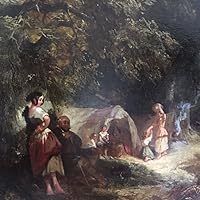
Even great disparity of kind and size does not always prevent social advances and mutual fellowship. For a very intelligent and observant person has assured me that, in the former part of his life, keeping but one horse, he happened also on a time to have but one solitary hen. These two incongruous animals spent much of their time together in a lonely orchard, where they saw no creature but each other. By degrees an apparent regard began to take place between these two sequestered individuals. The fowl would approach the quadruped with notes of complacency, rubbing herself gently against his legs: while the horse would look down with satisfaction, and move with the greatest caution and circumspection, lest he should trample on his dimunitive companion. Thus, by mutual good offices, each seemed to console the vacant hours of the other: so that Milton, when he puts the following sentiment in the mouth of Adam, seems to be somewhat mistaken:If that thinking being, homo sapiens, though, is not quite always given such a wide, latitudinarian grin ("Gypsies" do seem to "infest" the countryside, and the "very poor" are "very poor" Chiefly on account of their being "the worst oeconomists"), there nevertheless have been a few signs of progress in the human sphere as well:
Much less can bird with beast, or fish with fowl,
So well converse, nor with the ox the ape.
The plenty of good wheaten bread that now is found among all ranks of people in the south, instead of that miserable sort which used in old days to be made of barley or beans, may contribute not a little to the sweetening their blood and correcting their juices; for the inhabitants of mountainous districts, to this day, are still liable to the itch and other cutaneous disorders, from a wretchedness and poverty of diet.This is as it should be as Britain unconsciously girds itself for the nascent industrial revolution in the north of the country…long may she live in this bucolic twilight in these, more southern, somewhat sunnier climes! Methinks 'tis time to go put the (endearing, occasionally cloysome) several seasons of Elizabeth Gaskell's pastoral Cranford on perma-rotation on the DVD…where rumours of an approaching Iron Horse are but apocryphal, gossip spread upon the winds by the overheated brainsickly denizens of the district.
As to the produce of a garden, every middle-aged person of observation may perceive, within his own memory, both town and country, how vastly the consumption of vegetables is increased. Green-stalls in cities now support multitudes in a comfortable state, while gardeners get fortunes. Every decent labourer also has his garden, which is half his support, as well as his delight; and common farmers provide plenty of beans, peas, and greens, for their hinds* to eat with their bacon; and those few that do not are despised for their sordid parsimony, and looked upon as regardless of the welfare of their dependants.