“Дайми Брадвата живееше в една къща, в която всичко си беше такова, каквото винаги е било.
„Коминът си стои върху къщата и пуска навън дима - казваше Дайми Брадвата. - Дръжките отварят вратите. Прозорците са винаги или отворени, или затворени. В тая къща ние сме винаги или на горния, или на долния етаж. Всичко си е такова, каквото е било."
Затова Дайми Брадвата реши да остави децата си да измислят сами своите имена.
-Първите думи, които кажат, когато се научат да говорят, ще бъдат имената им - рече той. - Нека сами си ги измислят.
Първото момче, което се роди в къщата на Дайми Брадвата, се нарече Моля Дайми. Първото момиче, което се роди по-късно, си измисли името Няма Дакажа.
И двете деца имаха в очите си нощните сенки на равнините, а на челата им грееха лъчите на ранното утринно слънце.
Косите им бяха досущ като потъмняла полска трева. Те обичаха да отварят вратите на къщата и да тичат навън, за да може вятърът да им реше косите, да докосва очите им и да гали челата им с шестте си ласкави пръсти.
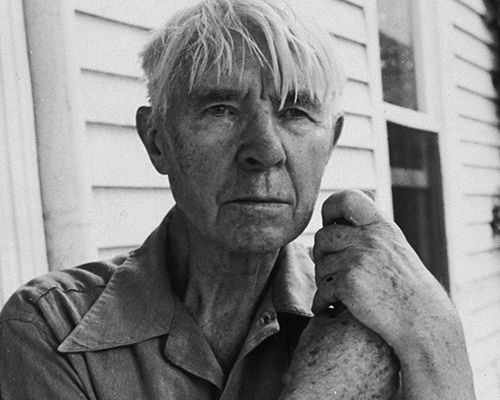
Free verse poems of known American writer Carl August Sandburg celebrated American people, geography, and industry; alongside his six-volume biography Abraham Lincoln (1926-1939), his collections of poetry include Smoke and Steel (1920).
This best editor won Pulitzer Prizes. Henry Louis Mencken called Carl Sandburg "indubitably an American in every pulse-beat."
I had been assuming that my distaste for Sandberg stemmed from having to read that same Fog poem in school every year. But no, apparently I don't like him. I'm starting to think that despite Michael Hague's universal acclaim, I'm not that fond of his illustrating style, either, although individual elements are well done. I remember loving his illustrations for Narnia, but I haven't seem them since I was eight.
I can't put my finger on what turned me off here, although there did seem to be an underlying unpleasantness that didn't mesh well with the overlay of fluffy surrealism. Gimme the Ax doesn't seem like a guy who should have children (are they even his? no woman seems to be involved in producing them.) and that story about the women being forced by the magic Golden Buckskin Whincher to fall in love with men she didn't like was effed up. Were these supposed to be funny? Because the tone seemed to imply that they were, but I was not amused. I was slightly less displeased by the ones that seemed to try for less humor and more melancholy, like the two Skyscrapers Who Decided to Have a Child, but it still seemed sad and pointless. Unless maybe that is the point? That life is arbitrary and we shouldn't expect good luck or happy endings?
This was marked as "juvenile" but I think it would work better for adults. Interestingly, the first stories were written for his daughter, and I had the same feeling about, for example, The Crows of Pearblossom, which Huxley wrote for a specific child: that it would not work for most kids, and perhaps was more likely to appeal to adults. (And, to change genres completely, Story of O. Writing for a specific person is not the same as writing for an unknown audience.)
While I do realise that in particular Carl Sandburg's lyrical output is much beloved by many, I do have to admit that his poetry (ever since I was introduced to it in grade nine English) has never really all that much appealed to me. Yes, I can definitely appreciate Carl Sandburg's literary talents, but no, I just do not all that much enjoy his verses (or at least the vast majority of Sandburg's poetry) on a personal reading pleasure level. Yet I was still willing enough to at least consider Carl Sandburg's 1922 Rootabaga Stories but indeed mostly so because I happen to be very much a fan of illustrators Maud and Miska Petersham and was therefore kind of hoping that their artwork would truly shine and to also and hopefully make me forget any issues I might end up having with Carl Sandburg's presented texts, with his stories (and yes, the book title of Rootabaga Stories certainly did sound intriguing enough for me to consider borrowing it from Open Library).
But no, I have really not at all enjoyed Rootabaga Stories, finding Carl Sandburg's surrealism rather off putting at best and especially the first presented tale of an axe that somehow begets his own children (who then also have to find names for themselves) rather too uncanny and strange for my personal reading tastes, leaving me at best simply shaking my head with and in consternation and actually so unamused and unimpressed that I very quickly decided to abandon Rootabaga Stories as yet another "did not finish" book. For indeed, Carl Sandburg's presented narratives, they are just not sufficiently interesting in and of themselves for me to be able to accept and handle their inherent and often really enforced and artificial seeming strangeness (and yes, even the Petershams' accompanying black and white artwork is in my humble opinion not in any manner special and descriptive enough in Rootabaga Stories for me to want to continue, and especially so since the online copy of Rootabaga Stories I borrowed from Open Library is also rather blurry and hard on my eyes, so yes indeed, far better to basically just cut my losses and to move on to something else and hopefully also to a book that is more readable and personally enjoyable).
Carl Sandburg, winner of Pulitzer Prizes both for his biography of Abraham Lincoln and for his COMPLETE POEMS, explores another genre in ROOTABAGA STORIES, fairy tales that he wrote for his daughters. When asked how he wrote the stories, Sandburg replied, "The children asked questions, and I answered them."
The ROOTABAGA STORIES are unconventional in almost every way. Unlike traditional fairy tales, they have no perfect princesses and evil witches. They are American fairy tales with a rural flavor and, in fact, they have no evil characters. The settings, though fanciful, include images that defined America in the 1920s, when the stories were published: the railroad, which "ran across the prairie, to the mountains, to the sea," and the skyscraper.
In Rootabaga Country the railroad tracks go from straight to zigzag, the pigs wear bibs (some checked, some striped, some polka-dotted), and the biggest city is the Village of Liver-and-Onions. Characters in this fanciful world are equally peculiar: Please Gimme, Blixie Blimber, Eeta Peeca Pie, and dozens of others. Children and literary critics alike would be hard-pressed to explain (even symbolically) the events that occur in the stories. Nevertheless, meaning comes through and truth is revealed. For example, in "Three Boys with Jugs of Molasses and Secret Ambitions," ambition is defined as "a little creeper that creeps and creeps in your heart night and day, singing a little song, 'Come and find me, come and find me.'" Who would expect that "The Two Skyscrapers Who Decided to Have a Child" would have an absolutely poignant ending?
Although the events of the stories may not be explainable, the stories are replete with concrete images. Sandburg provides both visual and auditory description with musical, repetitious phrases and novel juxtaposition of words ("a daughter who is a dancing shaft of light on the ax handles of morning"). Occasionally he invents words, such as "pfisty-pfoost," the sound of the train's steam engine, and "bickerjiggers," the buttons on an accordion.
ROOTABAGA STORIES are wonderful for reading aloud. They provide an opportunity for readers and listeners to delight in language and revel in truths revealed in a fanciful world.
(April 4, 2011. I welcome dialogue with teachers.)
"It is simple. If a blind man plays an accordion on the street to make people cry it makes them sad and when they are sad the gold goes away off the accordion. And if a blind man goes to sleep because his music is full of sleepy songs like the long wind in a sleepy valley, then while the blind man is sleeping the diamonds in the diamond rabbit all go away *****°°°°°°°°°*•••••••••°°°°°************°°°°°•••••••°°°°****°°°****°°°°°••••••••••°°°°°°°°°****°°*
..…She met the high school principal. His name was Fritz Axenbax. Blixie dropped her eyes before him and threw smiles at him. And for six weeks he kept steady company with Blixie Bimber. They went to dances, hayrack rides, picnics and high jinks together.
"Why do you go with him for steady company?" her relatives asked.
"It's a power he's got," Blixie answered, "I just can't help it—it's a power."
"One of his feet is bigger than the other— how can you keep steady company with him?" they asked again.
All she would answer was, "It's a power."
All the time, of course, the gold buckskin whincher on the little chain around her neck was working. It was saying, "If she meets a man with three X's in his name she must fall head over heels in love with him."
At a band concert in the public square one night she met James Sixbixdix. There was no helping it. She dropped her eyes and threw her smiles at him. And for six weeks they kept steady company going to band concerts, dances, hayrack rides, picnics and high jinks together.
"Why do you keep steady company with him? He's a musical soup eater," her relatives said to her. And she answered, "It's a power-I can't help myself." ----------:::'''____++=====_':-----------;'':::::'''' ------ ------____----=======
"Is there anything I can do?" asked Any Ice Today.
"I do it myself," said the Potato Face Blind Man. "If I am too sorry I just play the sleepy song of the long wind going up the sleepy valleys. And that carries me away where I have time and money to dream about the new wonderful accordions and postoffices where everybody that gets a letter and everybody that don't get a letter stops and remembers the Potato Face Blind Man." = # H --- = º o -- = # H ---- = -- 0 º = h == #= - o = 0• O º -- ==
So with his mind full of simple and refreshing thoughts. Gimme the Ax went out into the backyard garden and looked at the different necktie poppies growing early in the summer. Then he picked one of the necktie poppies to wear for a necktie scarf going downtown to the postoffice and around looking around.
"It is a good speculation to look nice around looking around in a necktie scarf," said Gimme the Ax. "It is a necktie with a picture like whiteface pony spots on a green frog swimming in the moonshine."
So he went downtown. For the first time he saw the Potato Face Blind Man playing an accordion on the corner next nearest the postoffice. He asked the Potato Face to tell him why the railroad tracks run zigzag in the Rootabaga Country.
"Long ago," said the Potato Face Blind Man, "long before the necktie poppies began growing in the backyard, long before there was a necktie scarf like yours with whiteface pony spots on a green frog swimming in the moonshine, back in the old days when they laid the rails for the railroad they laid the rails straight."
"Then the zizzies came. The zizzy is a bug. He runs zigzag on zigzag legs, eats zigzag with zigzag teeth, and spits zigzag with a zigzag tongue.
"Millions of zizzies came hizzing with little hizzers on their heads and under their legs. They jumped on the rails with their zigzag legs, and spit and twisted with their zigzag teeth and tongues till they twisted the whole railroad and all the rails and tracks into a zigzag railroad with zigzag rails for the trains, the passenger trains and the freight trains, all to run zigzag on. ----- --------------- - --------------------- ------------
"It came to me first when I was a boy, when I had my eyes, before my luck changed. I saw the big white spiders of the moon working, rushing around climbing up, climbing down, snizzling and sniff ering.....
Isn't it delightful to find an established poet or author who also wrote delightful kids' stories? T.S. Eliot was one, of course (Old Possum's Book of Practical Cats), and had I not moved to the Midwest as a young adult, I'm not sure I'd ever have learned of these wonderful Rootabaga Stories by big-shouldered Chicago poet Carl Sandburg (1922).
Sandburg was of that generation who wished to discard European tropes like knights and castles in his kid's stories, so the "Rootabaga Country" somewhat resembles the U.S.A., but a bizarro one with blue foxes, zigzag railways, and pigs that wear bibs. Wordplay is paramount, and while most stories are pretty bouncy, a few end on a more bittersweet note. I think they're wonderful, and recommend them highly to parents and kids who can read.
Carl Sandburg's ROOTABAGA STORIES remain unique in American Literature. I regard the best ones as prose poetry and as among my own favorite Sandburg poems.
My own personal favorites:
The Two Skyscrapers Who Decided to Have a Child This is the most beautiful and touching of all the Rootabaga Stories. It is also, perhaps, best captures the American spirit/experience. I used to open at coffeehouses by reading this. Audiences of ALL AGES {adult, college students, teens} invariably responded to it.
How They Broke Away to Go to the Rootabaga Country The first - and highly amusing - Rootabaga Story. One really should know of the Counties of the Circus Clowns and the Balloon Pickers.
The White Horse Girl and the Blue Wind Boy Beautiful and poetic.
How To Tell Corn Faries When You See 'Em Young children love this story, and it frequently makes adults cry.
Apparently Sandberg wrote these to be American fairy tales, feeling that traditional fairy tales from Europe had too many references to things we don't have here (such as royalty). In that aim, he only partially succeeded -- these are very nice childern's stories but overall they don't resonate. I think it is because they are mostly missing the conflict between good and evil that most traditional fairy tales have.
I first read this book 5-7 years ago, if I recall correctly. They are among my children's favorite stories to listen to or read out loud. Librivox.org offers a good set of mp3 recordings. These stories are lyrical, whimsical and contain some elements of chiasmus which may be of interest to some acquainted with the form. Great read aloud books for children and others. Many of my high school (mathematics) students found them enjoyable to hear. I believe Sandburg wrote the stories to tell to his own children as American fairy tales set in a country more familiar to American children than the forests, mountains, moors and country side of Europe and involving more familiar sorts of home spun characters than princesses, knights, witches, wizards, fairies and dragons. Well worth reading aloud or listening to.
This is (nearly) a five star work for it's lyricism if not for it's life/mind changing effect, though it may do that as well.
"I hear you talking but it is like a dream talking." That one line from the second set of short stories perfectly describes this book. It's like a strange dream world with no structure.
There is no character development, no plot, no story line that moves anywhere. There is no tension and no resolution. It's a stream of random ideas, fragments of characters, and odd places. There is a lot of repetition of long phrases in the writing. I didn't even think it was that imaginative or original.
It has some of the same type of whimsical elements as Alice in Wonderland or Wizard of Oz, but without the story structure or development. It also has a fairy tale aspect in the writing, but without the classic moral lesson or struggle between good and evil.
I was very disappointed in this book. It hurt my brain to read it. Punctuation died in this book.
The original edition of this book had an accompanying vinyl LP recording, which I am fortunate to own a copy of. This is a bedtime book intended to put kids to sleep, and the LP, specifically the recording of Sandburg himself reading the stories … (there are many attempts to replicate Sandburg’s version, but in my opinion most of those are far inferior) will definitely lull you off to dreamland … Sandburg’s melodic voice and his way of stringing words together is absolutely a lullaby. I love Sandburg’s whimsical poetry, his rhythm and rhyme. The stories are magical, even though I’m now over 60. “So far? So early? So soon???” This is a treat to read…. Although sadly, kids today raised on iPhones and internet might not get it.
Years ago, Sandburg had an evening radio show titled ‘The Sandman’. My parents used to tune in to that show hoping that I would ‘tune out’ to sleep … haha.
Friends of mine (including pre school teachers!!) have complained that listening to the LP puts them (and their young charges) to sleep …. and that’s the point!!! I do NOT suggest playing this LP in a classroom setting unless the accompanying activity is nap time !!!
This review was based on one of the original (1922) editions of the book, so NOT the edition/s featuring the work of the illustrators mentioned above.
For 1920s picturebooks in Children's Books group, June 2020. Not enough illustrations to fit the theme perfectly, but since we're having trouble finding a lot of choices, some of us are reading these.
I have long looked forward to reading this, because I have liked a lot of poems by Sandburg, including "Arithmetic," and at least one short story by him, "The White Horse Girl and the Blue Wind Boy" (which turns out to be included here). However, I failed to appreciate this. As one of the last stories puts it, "you must listen with your littlest and newest ears." And I no longer have access to any little and new ears, unfortunately.
The rhythms and sounds of the language delight when read aloud (because, you know, poetry) and the art by the Petershams delights. But I just can't stop being a grown-up and enjoy these the way the first audience, the author's own little daughters, did.
(I do have to say, though, if you read this aloud to your littles, which I think you should do, skip the story of Rags Habakuk. Too confusing, and a real downer of an ending.)
Though the names were unique and there was an occasionally striking image, overall I didn't much care for these short stories. They often relied on verbatim repetition of long phrases, and there was little plot or character development in any of them. There wasn't much of a lesson or take-away either. They seemed to be more about creative character and place names than anything else. Each group of stories was prefaced by a list of characters that appeared in the stories (Ax Me No Questions, Wing Tip the Spick, Spoon Lickers, The Blue Wind Boy). I had to force myself to finish it.
Here I am in my 60s, an English major in college, and I don't recall ever having heard of the Rootabaga Stories by Carl Sandburg. As with most of my children's books I am sharing this one with a 7 1/2 year old. She is most enthusiastic about this book. Maybe I will understand why by the time we get to the end. It is clearly a book that must be read out loud. I would say it makes no sense but then there is probably a lot in life like that for a youngster.
Not having been exposed to these stories earlier in my life, I was surprised when I found out that Carl Sandburg wrote children's stories. While I strongly wanted to like these stories I found their absurdity off-putting. I love fantasy so I can't understand my reaction. I realize the word play would make them great fun if you heard them read by a great story teller but reading them I just didn't enjoy reading them.
Somehow I got through my schooling without ever reading Carl Sandburg. Since he’s from my home town and 1/2 the town is named after him this is quite a feat. Decided to pick this up for my reading challenge- a book of short stories.
Dude, this is crazy stuff. Some of it is a little silly like Dr. Seuss-ish, but then some of it is like Alice in Wonderland on acid. As much as I want to be, I’m not a fan.
I can't remember whether or not I finished this book. I'm pretty sure that I did, but months have passed. I just found the stories really boring. I know that a lot of people go on about this book about how imaginative it is, but I could never get past how silly the stories were. Didn't find this amusing at all.
The formatting on this book was very poor. This book is a series of stories that Carl Sandburg told his children. I am afraid that because of changing times, children now might not think these stories were as enchanting as they once were.
While the fantastical and whimsical language of the book peaked my interest in Sandberg's poetry, the book itself dos not satisfy either myself or my daughter as tales for small children.
This is a very odd collection of short stories. The narratives are very fluid, but nonsensical, and while the words tripped off my tongue very easily, half the time I had no idea what the point of the story was or what the author was talking about. Our oldest loved it. Our youngest hated it. And I was somewhere in between. I loved the lyrical language, but I really wasn't a big fan of the nonsensical words or the repetition.
Still, we read this book in small bites, usually one short story each night with breaks in between, so it wasn't overwhelming. The fact that it's only part one of two made my youngest daughter groan, but I promised that we'd take a week off before starting the next one...
Each story has a one page illustration that is just as whimsical as the story itself. The images are colorful and bizarre and we'd often pause in reading the story to check out the details. Overall, I thought this was an entertaining book; frustrating at times, but a worthwhile read.
new words: spanch, steeplejack, whincher, slimpsing
I read this several times as a child and am currently re-reading it. There's a lot of invention here, on occasions it gets contrived and perhaps a bit precious, but when Sandburg is in full flow the words are like nonsensical music- the overall effect being more important than the narrative.
My childhood's favorite bit: "Hat Ashes Shovel" - when you need a Hat you make it from Hat Ashes, and to work with them you need the Hat Ashes Shovel. The term made me laugh.
It started out great... the boys and I were rolling with laughter, and talking about it the next day. But the next three stories were so awful that the boys couldn't take anymore. Honestly, I don't even want to continue. I'm giving it two stars because the first story was so much fun.... I'm going to give Sandburg the benefit of the doubt and assume there are a few more gems mixed in the book somewhere.
We read this for our fables in homeschool. It was just a little too weird and nonsensical for me. Like Alice in Wonderland, but with a little more morals and way less dark. The names are quirky and silly, but some of the stories just made absolutely no sense to me and just seemed to be random thoughts. A few things I thought were clever, and my kids really liked it, so I guess you just have to be young at heart to truly enjoy ;).
Supposedly american fairytales, although they have more semblance to Edward Lear nonsense. If they were in poetry form, or i was american or a child MAYBE these stories would be tolerable. However i think even as a kid i would have hated this. I gave up reading at about the quarter mark but was just able to get through the rest thanks to a very good LibraVox recording.
My dad used to read this book to us when we were little-he would be so animated when he read it that we really could picture all of the crazy things in this book as if they were reality.
I found it in my hope chest the other day and had almost forgotten about its existence.