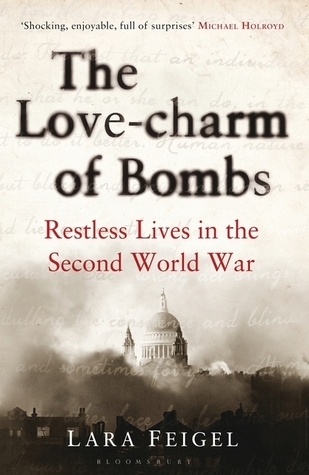
'The nightly routine of sirens, barrage, the probing raider, the unmistakable engine ("Where are you? Where are you? Where are you?"), the bomb-bursts moving nearer and then moving away, hold one like a love-charm' Graham Greene
When the first bombs fell on London in August 1940, the city was transformed overnight into a battlefront. For most Londoners, the sirens, guns, planes and bombs heralded gruelling nights of sleeplessness, fear and loss. But for Graham Greene and some of his contemporaries, this was a bizarrely euphoric time when London became the setting for intense love affairs and surreal beauty. At the height of the Blitz, Greene described the bomb-bursts as holding one 'like a love-charm'. As the sky whistled and the ground shook, nerves were tested, loyalties examined and infidelities begun.
The Love-Charm of Bombs is a powerful wartime chronicle told through the eyes of five prominent writers: Elizabeth Bowen, Graham Greene, Rose Macaulay, Hilde Spiel and Henry Yorke (writing as Henry Green). Volunteering as ambulance drivers, fire-fighters and ARP wardens, these were the successors to the soldier poets of the First World War and their story has never been told. Now, opening with a meticulous evocation of a single night in September 1940, Lara Feigel brilliantly and beautifully interweaves letters, diaries and fiction with official civil defence records to chart the history of a burning world in wartime London and post-war Vienna and Berlin. She reveals the haunting, ecstatic, often wrenching stories that triumphed amid the mess of a war-torn world.
Lara Feigel, the author of The Love-charm of Bombs: Restless Lives in the Second World War, was one of the interviewees on a very interesting, 2013 episode of BBC's The Culture Show entitled Wars of the Heart. Wars of the Heart explains how whilst for many Londoners during the Second World War, the Blitz was a terrifying time of sleeplessness, fear and loss, some of London's literary set found inspiration, excitement and freedom in the danger and intensity. The imminent threat of death giving life an immediacy, spontaneity and frisson absent during peace time.
Lara Feigel explores the war time experiences of five writers: Graham Greene, Elizabeth Bowen, Rose Macaulay, Henry Yorke (aka Henry Green), and Hilde Spiel. During the Blitz, and with the very real chance of not surviving the next 24 hours, the social classes mingled more freely, in the underground and the streets, and, in some cases, with partners and/or children evacuated, there was the opportunity for extra marital affairs.
Between them, the writers profiled were variously ARP wardens, an ambulance driver, and an auxiliary fireman. Hilde Spiel was the odd one out, being an Austrian exile, with responsibility for her parents and a young child. Her story is an interesting and informative counterpoint to those of the other four writers.
Lara Feigel uses letters, diaries, and fiction, along with historical information, to illuminate the lives of these writers during and after the Second World War, before summarising what became of them all.
I enjoyed this but concluded Lara Feigel went into too much detail for my level of interest. My edition was 465 pages, with another 55 pages of notes and acknowledgements. I would have preferred a more succinct account. That said, I came away from this book far more knowledgeable about five interesting writers.
On re-reading, this book worked better for me: perhaps because I knew what to expect, perhaps because I went in the second time with a specific interest in Bowen and Greene to link to fictional works of theirs - whatever the reason, Feigel's deft interweavings of the events of WW2 with the lives of these authors felt illuminating so I've raised by rating to 4 stars.
-------------------------------------------- The idea of this book really appealed to me: restless writers and passionate love affairs against the background of the Blitz. The actual execution, however, didn’t live up to the promise.
Part of the problem is that this is a very loose narrative and one which perhaps needs to have its parameters tightened. Feigel takes a core group of four writers: Elizabeth Bowen, Graham Greene, Henry Green, and Rose Macaulay, and traces their lives and loves during the war years. But she unsettles this pattern by adding in a fifth, Hilde Spiel, an Austrian writer who just doesn’t fit with the other four who are all part of the same expanded literary group. And, on top of that, about a third of the book takes place after the end of the war and into the 1950s so doesn’t fit the title at all.
I did enjoy reading parts of this: but the problem with ensemble biographies is that, inevitably, not all the characters are equally interesting. I wanted to know more about Elizabeth Bowen, less about Henry Green and Rose Macaulay. I also could have done without the simplistic readings of these authors’ books and short stories: Feigel uses them in a naive and fairly crude manner to fill out the lives of the writers... as if fiction is mere autobiography with the names changed.
So, I don’t want to sound completely negative as there’s a good organising idea here, and, in parts, a sound evocation of the way in which the tensions of war heightened the erotic emotions. If Feigel had stuck to this rather than throwing in everything else she could find, this would have been a better read
This is the fascinating account of the Second World War seen through the eyes of five famous authors: Elizabeth Bowen, Rose Macaulay, Henry Yorke (Henry Green), Graham Greene and Hilde Spiel. The book begins in London during the Blitz, a "makeshift present in which pre-war morality seemed less relevant" and the threat and danger of imminent death made people want to grab every experience and relish every moment. Elizabeth Bowen and Graham Greene were both ARP wardens, enforcing the blackout, Rose Macaulay drove an ambulance and Henry Yorke was an auxiliary fireman. These four authors shared experiences and friends and met socially. Hilde Spiel shows the war from a different perspective - that of an exiled author, who suffered depression and homesickness, as well as struggling financially and having a small child and her parents to care for during wartime.
During the time period of this book the author discusses novels written, love affairs undertaken and where the war takes the five authors. Both Graham Greene and Henry Yorke had evacuated their wives and children to the country, allowing them the freedom to have affairs. Greene's lover was Dorothy Glover, while Henry Yorke met Mary Keene; a young girl who tended to pilfer from houses they visited together. Rose Macauley's long term lover Gerald O'Donovan was seriously ill at the beginning of the war and Elizabeth Bowen met Charles Ritchie, during the war years, who was to become the love of her life. As well as affairs of the heart, the author discusses how they were affected by the bombs themselves - the Blitz not only created a world of freedom and intimacy, it also, of course, destroyed homes, lives and personal possessions. When Rose Macauley's flat was destroyed she mourned the loss of her books and love letters which were irreplaceable. Hilde Spiel's mother was terrified by the bombings and it is illuminating to read how few of those people involved actually had somewhere safe to shelter during the air raids.
The novels written, or set, during this time period are also examined, with reference to this book. Elizabeth Bowen's "The Heat of the Day", which looks at her affair with Charles Ritchie; Graham Greene's "The End of the Affair" and "The Ministry of Fear" which deal with wartime love affairs and the Blitz and Henry Yorke's "Caught", which is about firemen and the civil defence services, were all directly inspired by wartime London. Henry Yorke, in fact, feared when he heard the German's were intending to translate and publish "Caught" as he felt it could be used as propaganda. While, undoubtedly, Londoner's showed immense bravery and strength during the war, there were those who were not so self sacrificing or stoic, of course, and the continual fear did wear people down. This book tracks the five authors throughout the war years and, indeed, follows Spiel back to Europe at the end of the war.
Overall, this really is one of the most interesting books I have read about wartime and, as a book lover, it is always excellent to have such stories told from the point of view of authors themselves. While, for some, the war opened new worlds and experiences, new freedoms and new loves; for others it was a difficult time of feeling isolated and not belonging. Wonderfully written and highly recommended, this is a book to savour and will, hopefully, also lead you on to explore the work of the five authors mentioned if you are not familiar with them already.
I was smitten with ‘The Love-charm of Bombs’ from the very first time I read about it. The prospect of seeing London in the Second World War through the eyes of five remarkable writers – Elizabeth Bowen, Graham Greene, Rose Macaulay, Hilde Spiel and Henry Yorke (who wrote under the name Henry Green) – was simply irresistible.
And I was pulled in from the very first page, into the Blitz. I found Rose Macaulay, who had already lived through the Great War, driving an ambulance; Elizabeth Bowen and Graham Greene serving as ARP wardens – making sure that the blackout was maintained; and Henry Yorke in a team of auxiliary fireman.
The picture that is painted – of dark skies, empty streets, damaged buildings – of community, fear, exhilaration, uncertainly – is extraordinarily vivid.
For a moment I wasn’t sure that this was going to work – the telling of stories of real people, constructed from their letters and diaries, from the writings of their contemporaries, and from historical records. It felt strange to read that Elizabeth (Bowen) walked out on to her balcony and stretched, but I held on and soon I was caught up, in a story that reads like a novel, that sometimes spins off into history, into biography, into literary analysis.
Four of the principals moved in the same literary circles – Virginia Woolf, J B Priestly, Rosamund Lehmann, Evelyn Waugh and May Sarton are among those who mix and correspond with them – but Hilde Spiegel lived a very different life. She was a wife, a mother, exiled from Austria to South London, trying to establish herself in a new world, trying to find just a little time for her writing. Her story, of which I had known nothing, was fascinating and a wonderful counterpoint to the stories of the other four.
In an uncertain world, passions ran high. Graham Greene and Henry Yorke had both evacuated their wives and children to the country and both behaved as single men might, taking up with other women. Their stories seemed similar at first, but that only highlighted how different they were as they moved in different directions and revealed different attitudes. Elizabeth Bowen met Canadian diplomat Charles Ritchie who would be the great love of her life, though she remained married and he would marry another.
But Rose Macaulay’s story was sadder. She lost her sister and her lover to cancer, and she lost her home, her letters, her books to a German bomb. My heart broke for her.
Lara Fiegel wove their stories together beautifully. She wisely kept her style simple, focusing on the stories and the facts, her writing had exactly the right momentum, and the perspective was wonderful. I can’t quite explain it, but she brought me close those real lives without ever making me feel I was intruding.
But even better was the writing about the books that were written during the war or inspired by it. Elizabeth Bowen’s feelings about her relationship with Charles Ritchie are echoed in ‘The Heat of the Day’ and ‘A World of Love’; Henry Yorke’s experiences in the fire service inform ‘Caught’; ‘The End of the Affair’ has some – but not all – of its roots in Graham Greene’s wartime relationships; and Rose Macaulay walked through the ruins that she would not be able to write about until many years later, in ‘The World My Wilderness.’
Lara Feigel’s love, curiosity and knowledge shine, leaving me eager to read more by and about all those she writes about, and applauding what she has accomplished with this book.
In the end the story moves beyond the War, looking at the consequences and the rest of the lives of the five principals. The War had changed their lives and the end of the War would change them again.
There is so much here, so many fascinating details that it is impossible to pick out points to focus on. This is a book that I will go on thinking about, read again, and come back to when I pick up the books I’ve been reading about. But I need to shout about it now, because it’s wonderful!
‘The Love-charm of Bombs’ has left me in awe of Elizabeth Bowen, drawn to Rose Macaulay, more interested in Henry Green and Graham Greene than I ever thought I’d be, and curious to read more about the life of Hilde Spiel.
Time, I think, to read and re-read their work, and then come back to this book …
I don't normally read or review non-fiction, but this is a book about novelists. Two of them are favorites (Elizabeth Bowen and Graham Greene); two (Rose Macaulay and Henry Yorke a.k.a. Green) are great writers whom I have merely sampled; and the fifth (Austrian expatriate Hilde Spiel) was completely unknown to me. All five lived in London during the Blitz of 1940–41, engaged in often heroic civilian work, found their lives expanding in unexpected ways as the normal barriers came down, and transmuted their experiences into writing of the greatest power. Feigel's brilliantly-titled book could almost serve as a reader's guide to such masterpieces as Greene's The End of the Affair, Bowen's The Heat of the Day, or Yorke/Green's Caught, besides providing essential background to more modern novels of the Blitz such as Sara Waters' The Night Watch or Kate Atkinson's Life After Life, as seen by writers who actually lived through it.
During the Blitz, Greene and Bowen were both air raid wardens, Macaulay drove an ambulance, and Yorke worked as an auxiliary fireman—all this in addition to their day jobs and whatever time they found for writing. All four came into many situations of personal danger, and dealt directly with ruin and death, writing about these experience in letters, articles, or journals, and incorporating them eventually into their novels. All four engaged in passionate extra-marital affairs, though the circumstances were different in each case, ranging from Graham Greene, who linked up with a fellow warden, to Rose Macaulay, whose affair considerably antedated the war and whose lover was already terminally ill when the Blitz began. So although I began the book hoping to find a definitive exploration of why wartime romance, especially during WW2, is such a recurring trope in fiction, I was only partially satisfied. Feigel's intent is more biography than literary exploration, and the lives of these four writers are just too different to generalize from.
The odd one out is Hilde Spiel. Although not clear of the bombing, she lives out of the center, in suburban Wimbledon. Whereas all the others know one another, she has difficulty as a foreigner breaking into English literary circles. Like most of the rest, she is married (to fellow émigré Peter de Mendelssohn), but hers is a more domestic life, with a small child to look after and her parents living in the house. It is not until after the war that she comes into her own, as Vienna correspondent for The New Statesman. Oddly enough, the experience does not return her to her former nationality, but reinforces her acquired Britishness in a way she never felt in London.
Feigel's extension of her biographies into a section she calls "Mid-century, Middle Age" continues to offer numerous interesting tidbits. But it also feels like a dilution of her themes. For whatever commonalities these five writers shared all but disappear once they no longer have wartime London to contain them. Indeed, the drop-off begins with the end of the nightly bombing in June of 1941, ushering in a period when, as that Elizabeth Bowen described in a characteristically potent turn of phrase, "war moved from the horizon to the map." Almost all the writers felt the ending of the Blitz as an anticlimax, and so as a reader did I. But Feigel still has 300 pages to go. She continues to follow the romantic entanglements of her characters, pretty much denying the implication of her title, that it took a rain of bombs to get them bed-hopping. She is especially good, for example, on the affair immortalized in Henry Green's Loving. But the continuity of the book—and I fear its thesis—has largely been lost. So although we began in five-star territory (when I wrote the first paragraph of this review), my opinion gradually declined.
Extremely interesting multibiography that caused me to seriously question one of my favourite authors and add others to my "want to read" list.
As the war stretched on the stories palled for me; people who were interesting and, dare I say, romantically urgent became insufferably preoccupied with love and unpleasantly conservative in their convictions. When even the Austrian immigrant who had felt out of place in England for a decade declared her disappointment in Attlee's landslide victory, I nearly stopped reading.
It became blatantly obvious that "writer" was a byword for "leisured class", and that this meant people who had endless hours in the day to conduct affairs, make their spouses miserable, dwell unhealthily on the importance and immutability of "love" - a thing that I have since begun to notice is essentially a hallmark of English novels in the first half of the 20th century - and, when the war became too dangerous or boring, to escape gleefully to their Irish castles, their shacks by the sea, their pleasantly undemanding jobs for some Ministry or other, without fear of reprisal and apparently few money issues.
I grew to dislike each and every one of these five writers with a surprising intensity, and it is either a testament or a drawback of Feigel's light touch that she did not appear to make much comment on the situation. I eventually landed on the fact that she chose to portray these people in this way, and that this was not an accident - it is a very deliberate book. And whilst I'm not sure it's the place of a biographer to pass moral judgement on their subjects, I think some kind of engagement with the obvious changes in social situations and attitudes is called for.
I think this is an important, deeply researched, excellent book. But I didn't finish it happily.
The effect of the war on five writers; Graham Greene, Elizabeth Bowen, Rose Macaulay, Henry Yorke (Green), and Hilde Spiel. Lots of interesting detail, especially regarding the blitz. Tends to bog down toward the end.
The Love-Charm of Bombs: Restless Lives in the Second World War is the newest offering from established non-fiction writer and King's College London lecturer Lara Feigel. I was lucky enough to meet Dr Feigel whilst studying at King's. Here, she has attempted to create ‘a powerful wartime chronicle told through the eyes of five prominent writers: Elizabeth Bowen, Graham Greene, Rose Macaulay, Hilde Spiel and Henry Yorke (writing as Henry Green).’ These authors, Feigel states in her introduction, all played their part in the war: ‘Volunteering as ambulance drivers, fire-fighters and ARP wardens, these were the successors to the soldier poets of the First World War, and their story has never been told’. They have been chosen for a very particular reason. All of them, the author of The Love-Charm of Bombs believes, ‘floated dangerously on the futureless present’ when the war began, and ‘their public war work became the backdrop for volatile individual private lives’.
To illustrate this, Feigel has interwoven extracts from the fictional writings of the five writers she has selected, along with their letters and diary extracts. These sit alongside official facts about the Second World War, creating an interlinked book which is part history textbook, part biography and part literary criticism. Along with writing about the war as it was experienced in England’s capital, Feigel has also embraced ‘post-war Vienna and Berlin’. The book is split into six parts, each of which provides a chronological picture of the war, beginning with the Blitz and ending with accounts of the lives of each of the authors in the post-war years.
Feigel’s introduction sets the scene immediately: ‘… And then the sirens will start wailing, as they have wailed every evening for the last two and a half weeks, and another night of bombing will begin’. She has chosen to begin her narrative in the midst of the Blitz, the physical beginnings of the Second World War for British civilians. The first figure she describes is that of the ‘imposing’ Elizabeth Bowen as she surveys the city below her home, ‘strong-backed and long-necked’. The war, states Feigel, provides a situation through which Bowen can excel, not just as a writer, but in her role as an ARP warden: ‘She has found a home in wartime London and she paces the blacked-out streets with a vigorous certainty’.
The author then moves geographically from one writer to the next: ‘A few streets south’ of Elizabeth Bowen’s residence is ambulance driver Rose Macaulay, ‘who is finding the intensity of wartime London more sad than exhilarating’. Henry Yorke works ‘just around the corner from Macaulay’ as an auxiliary fireman, and is ‘enjoying the Blitz… pleased to be a hero at last’. Graham Greene works nearby at the Ministry of Information and in his nightly shifts as an ARP warden, and Austrian writer Hilde Spiel, who fears yet ‘another wakeful night at home’ in light of the air raids is a resident of Wimbledon. An informative map has been included to illustrate the locations of these authors.
‘Bowen, Green, Macaulay and Yorke were participants rather than witnesses [in the war], risking death, night after night, in defence of their city’, Feigel tells us. These writers are all separate from one another – they did not make up a set of literary friends akin to the Bloomsbury Group, for example – but all are linked, both through friendships and mutual acquaintances within the writing world. Spiel is the only one of Feigel’s authors who is not in the same position as the others. Although she went on to translate the works of Bowen and Greene into German after the Second World War, Spiel has been included as ‘a counterpoint to the more exalted lives of the other four protagonists: a reminder of the gloomy and often horrific reality of the war years’. Such a decision is an interesting one to make, particularly as Spiel herself seems so far removed from the others in the book. The chapters which focus on her feel entirely separate, whereas those which focus on the other authors link into one another rather nicely.
From the outset, The Love-Charm of Bombs is historically and geographically grounded, and the author has set the scene incredibly well. She has interspersed her own writing and original sources from the five authors which she focuses on with quotes from prominent writers of the day – Harold Nicolson and Virginia Woolf being prime examples. She presents each of the writers in a glowing light, explaining their origins and following their decisions and life stories in minute detail at times. She describes their circumstances, their privileges, their turmoil and their relationships. Throughout, we also learn about the ‘liberating effects of war for women’, the fascination of doing one’s utmost for the war effort, the camaraderie within air raid shelters, the uniforms and duties of wardens and the like, and ways of avoiding conscription into the Army. Feigel has also illustrated the ways in which wartime experiences have impacted upon the fiction of each of her writers, and how they used their own day-to-day lives to craft harrowing stories.
The lives of the female authors whom Feigel has focused on are far more interesting than the lives of her men. There was something entirely endearing about her portrayals of Bowen, Macaulay and Spiel, but the sections which detail the lives of Greene and Yorke lack the same sparkle.
The book certainly contains a lot of material, but it is written in such a way – almost with a fictional third person perspective style of narrative voice – that it does not at any point feel overwhelming. Feigel has done well to create such a multi-layered biography of five very different wartime experiences, and The Love-Charm of Bombs has evidently been meticulously researched, a fact which is evident from the extensive pages of notes and bibliography alone. Photographs have been included throughout to better illustrate points, and the majority relate incredibly well to the text which surrounds them. The only downside to the text is that it does begin to feel rather repetitive at times, and the same details are often written about several times within the space of just a few pages. It is perhaps a little long on the whole, but it is well pieced together, and Feigel certainly cannot be faulted on her marvellous research.
I enjoyed reading this in batches, especially the sections on Rose Macaulay, Elizabeth Bowen and Graham Green. The biographical information, the detail on their wartime affairs and how their personal lives were upended by the stress of the blitz were interesting, well-researched and well-written.
Like others who have commented on this book, I resisted the integration of the fiction they wrote during and after the war with their personal lives. To me, it is an interesting juxtaposition and a way to read the novels, but it's not reliable either as a biographical tool or a definitive form of literary analysis. Too easy!
The book has also confirmed my interest in Bowen, complemented my readings of Macaulay and confirmed my annoyance with Greene, who comes off to me as flawed, self-indulgent, hypocritical and exploitative. I just don't understand his kind of religiosity, which seems to revel in sin more than goodness.
This book is encapsulated in a quote right at the end by one of its subjects Elizabeth Bowen, "War is a prolonged passionate act, and we were involved in it." It follows five writers, Bowen, Graham Greene, Henry Yorke, Rose Macaulay and Hilde Spiel from the declaration of war through to the 1950s, with a particular focus on their love lives and their writing.
The book gives an alternative view of the war and I enjoyed seeing the war from the point of view of creative writers, rather than the dry history of facts. Feigel shows the sheer sensuality of fear, bombs, rubble and the emotions, both positive and negative, that this releases in the lives of these writers.
The style is learned but also creative. There are some very juicy stories which would make good novel settings in themselves and she tells them in a novelistic but not too sensationalist style. For my mind she could have gone further in this direction.
She ties in the research and the narrative well. It is obviously very heavily researched but it still reads easily and comfortably, not like an academic text.
I have read several reviews which suggest the book is too long and that she should have stopped at the end of the war but I enjoyed reading the contrast with the post war period and the part that the war played in the writers' later lives.
Aside from the history, the book also explores the nature of the creative mind and how it is affected by external events. It also examines several different sorts of relationships, some monogamous, most not which is interesting from the point of view of social history, regardless of the bombs.
Elizabeth Bowen said in later life that 'I would not have missed being in London throughout the war for anything.' She was open about considering it the most interesting period of her life. That sense of excitement comes across very vividly in her most famous novel The Heat of the Day where Stella and Louie wander the deserted streets of Blitz-torn London and the ordinary rules of society are suspended. While World War One is known for its poetry from the trenches, its successor has been regarded as a missed literary opportunity. With much of the conflict taking place in the skies and with the advent of total war, the experience of war was very different but Lara Feigel's breath-taking book underlines that it was a period of great creativity for many authors.
The authors under the spotlight are Graham Greene, Henry Yorke (who was published as Henry Green), Elizabeth Bowen, Rose Macauley and Hilde Spiel. I had own books by all of these aside from Hilde Spiel, who is more celebrated in her native Germany. Feigel included nonetheless because she offers the fascinating outsider perspective within war-torn Britain. This books is a clear labour of love, with Feigel's passion and enthusiasm for her subject matter clear from the very first page. Feigel clearly has an in-depth of knowledge of the authors' lives and works and puts them into context ably and with fascinating detail. For someone who is something of a 1940s fan-girl my self, The Love-charm of Bombs was a pleasure from start to finish.
The lives, loves, stories and wartime volunteer work of four writers are interwoven into a very well written history. Another writer, Hilde Spiel, gives a dramatic contrast. The author has done her research, but doesn't push all the information she uncovered, she selects. The quotations from diaries, memoirs, letters and fiction are well chosen and apposite. She uses war time records to good effect rather than listing statistics. She intersperses the fiction and real lives of these writers to good effect. She uses an accessible style and rich vibrant real characters to put over her information. She uses some well-informed speculation, but not too much. I will be looking out for more books by this author.
Quite marvellous exploration of the impact of living in London during the Blitz on five writers - Elizabeth Bowen, Graham Greene, Rose Macaulay, Henry Yorke, and Hilde Spiel. Feigel writes deftly and intuitively, drawing connections between experiences, and wearing her careful research lightly.. Really worthwhile.
Also, goodness, the adultery in those days! I feel very square. Though more sophisticated from having read this.
The book’s premise is how London was transformed into a battlefront during WWII, but for many (including writers) it became a bizarrely euphoric time for passionate love affairs and surreal beauty. Focus is given to five authors: Graham Greene, Elizabeth Bowen, Rose Macaulay, Henry Yorke and Hilde Spiel…and they crossed literary and social paths… and beds.
Toward the end of the book (and the war) where the writers were reporting on what they experienced on V-E Day. one noted the rusted barbed wire now off of the beaches-- though the seaside villas remained deserted. Elizabeth Bowen was at home of her friend, Lord Berners (an endlessly fascinating character of that time,) and she witnessed the return of the fountain at his country estate for the first time since the war:
“There was a breathless pause, then a jet of water, at first a little rusty, hesitated up into the air, wobbled, and then separated into four curved feathers of water. It was so beautiful and so sublimely symbolic—with the long view, the miles of England stretching away behind it, that I found myself weeping.”
Bowden thought a fountain was a better way to celebrate peace than the bonfires that were taking place in villages throughout England, though she did realize her viewpoint was less democratic—a fountain on a private estate. Berners’ fountain made her think of the spectacular fountains at Versailles and the Villa d’Estes in Tivoli, which soon would no longer be sealed off by war. The world seemed to opening up once more and Bowen hoped that one day soon she and her lover Charles, could look at a fountain together and expand their shared (but previously hidden) world onto the continent.
While I was reading this passage, I couldn’t help but think of all of our national shutdowns going on right now, including fountains. The fountain at Dupont Circle, the fountains on the Mall—in particular the fountain at the WWII Veterans Memorial…but many more. Somehow, once our fountains are returned to us, I do not think it will be nearly as celebratory as it was for Bowden. After all, it was our own government holding them hostage during extended political power jousting. As with all of nature, I find water highly symbolic, and the play and flow created by man to allow for mental and visual expansiveness has given way to barrenness and “yes”, rusty pipes.
Surprisingly good account of five successful novelists' lives during and after World War II. This serves as a very interesting and educational timeline regarding general WWII events and day-to-day life in war-torn London, especially during the Blitz.
These writers--Rose Macaulay, Graham Greene, Henry Yorke (writing as Henry Green), Elizabeth Bowen, and (less so) Hilde Spiel--all seemed to live their lives in a very self-centered and privileged fashion. Not just how they were able to attend or host parties--which included luxuries like smoked salmon and alcohol during times of rationing and when others were starving--but in all their adulterous relationships and general disregard of most of the spouses for each other (there were a couple of doormat wives who didn't cheat as far as we know but it was excessively prevalent). Was that just normal for the times, or for the upper class, or is it just my puritanical Americana background that makes me scratch my head at how hurtful they were to each other? It made it hard for me, at first, to sympathize with them but I eventually succumbed to their collective charms...some of them doomed themselves in the end anyhow and did their penance.
After reading this, I've started further exploration of these writers' works, and after knowing more about their background and circumstances leading to their writings, I am enjoying with fresh perspective those I was already familiar with. Also, since there have been excellent movies made of some of these works, I have been enjoying catching some of them as well. Of course, [Graham Greene's] "The End of the Affair" with Ralph Fiennes and Julianne Moore is excellent. [Elizabeth Bowen's] "The Last September" isn't the greatest movie I've ever seen, but it's helpful in visualizing what her real-life Irish "Big House" (Bowen Court) may have been like. I also enjoyed [another of Greene's novels turned into film] 1948's "The Third Man" with Orson Welles, Joseph Cotten, and Trevor Howard, especially considering it was filmed in post-war Vienna in the Russian district. Even more so than seeing photographs of the destruction, it is interesting to see people navigate through the city amidst the actual rubble and ruins. Heartbreaking to think of all the loss (not only on the obvious human scale) during that wretched war.
Really impressive research and ability to pull it all together.
The Love-charm of Bombs has a very interesting slant on life during and immediately after WWII because its focus is the experiences of five noteworthy authors, Elizabeth Bowen, Graham Greene, Rose Macaulay, Hilde Spiel, and Henry Yorke, who wrote under the name Henry Green. Since it discusses the way the war affected what they wrote in such fascinating detail, it added a number of books to my already over long to-be-read list, so be forewarned.
This book opens during the Blitz of London when four of the authors had active roles in the late night, class-mixing, civilian mobilization that played a crucial part in protecting the city. Rose Macaulay spent her nights driving an ambulance to still smoking ruins to collect the wounded, Henry Green put out sometimes raging bomb-ignited fires as an auxiliary fireman, and Elizabeth Bowen and Graham Greene roamed pitch-dark streets to enforce the blackout as ARP wardens. Nightly danger and the high drama of their jobs became a kind of aphrodisiac so all of them were involved in passionate affairs that had a lifelong influence on the stories they wrote. As a more isolated young mother and an Austrian writer in exile, Hilde Spiel’s experiences during the war were different but equally absorbing and they round out the book.
The book continues to follow the writers’ upturned lives and intense love affairs into the early post war years when Europe was restructuring and Cold War was starting. For most of the five, the Blitz was the high point of their lives, filled with excitement and purpose, and for me the vivid chapters that covered that time are the most engrossing part of the book, though I enjoyed all of it. The interconnected WWII experiences of these highly literate civilians make compelling reading, especially since The Love Charm of Bombs is written with a sort of fervent scholarship.
"Droning things, mindlessly making for one." - Elizabeth Bowen describing V1's. Love, World War II, London, the Blitz, buzzbombs...this book has so many things which have always fascinated me. Five writers (Elizabeth Bowen, Rose Macaulay, Graham Greene, Henry Yorke and Hilde Spiel) spent most of the war years in London. Through letters and diaries, Lara Feigel can sometimes pinpoint what each of them was doing on the same night. For Bowen, Yorke and Greene, the Blitz is exhilarating, they never felt so fully alive; for Macaulay it is a time of great loss and sadness; and for Spiel it is, alternately, terrifying and depressing. When I lived in London I used to walk the streets trying to imagine what it must have been like with bombs thundering down. For many years I didn't know that my own block of flats had been built on the site of an entire street that had been destroyed in a single night. This book brings it all vividly to life in a way that my imagination never could. I THINK that I probably would have been as terrified as Spiel but might have chosen to work as an ARP warden, like Bowen and Greene, because patrolling the streets took your mind off the barrage, and sitting in a shelter night after night would have driven me crazy. That's something else that comes across - the Blitz may have been exciting and pulse-quickening to begin with - it quickly became a never-ending endurance test. Bowen and Macaulay wrote brilliantly about love - Bowen finds the love of her life; Macaulay loses her's. But honestly! Men! Men don't come out of this book very well. What's the matter with them?
If you love writing, famous authors, their lives, what factors influence their writing, the Brits, and the timeperiod of WWII, this book is for you. A well researched non-fiction book on the lives of five writers in London during WWII: Elizabeth Bowen who worked as a volunteer for the Home Guard in Marylebone; Graham Greene who volunteered for the Home Guard in Bloomsbury; Rose Macaulay who drive an ambulance; Henry Yorke who volunteered with the fire brigade; and Hilde Spiel in Wimbledon. The book profiles how the war and their experiences taking risks, dodging bombs, losing their homes and books, dealing with the fear, death and destruction influenced their writing and lives. The pressure and threats of the war increased their taking risks in their personal lives. The social scene was filled with affairs. While they married, many were taking risks on the side with extramarital relationships. Virginia Woolf played a prominent role in their friendships. Woolf documented contemplating suicide in a debate with Rose Macaulay after an air raid in June 1940. She commited the act on March 28, 1941.
An account of five writers and their experiences during the Blitz. These are interesting people and it is written engagingly. Graham Greene and Elizabeth Bowen were Air RAID wardens and both had a good war. Henry York who wrote as Henry Green was an auxiliary fireman. Rose MacAuley was an ambulance driver. They had a good war too. Overall it was better to be active than to sit and wait for bombs to fall on you. Hilde Spiel was not so settled. She had escaped Vienna at the start of the war with her husband and parents but she was homesick for the Vienna that had been in dreary wartime London.
I was enjoying this but my library time was running out and I abandoned it. I’d like to get back to it some time.
I've always been fascinated about life in London during the Blitz, so when I saw that there was a book that covered five authors who lived in London during the Blitz and how it influenced their lives and writing, I was ALL OVER THIS. Out of all the authors, I am the most familiar with Graham Greene, and of all the stories, it was his that I focused on and really looked toward to reading. It was a bit remarkable at all the infidelity going on in the book, but that was partly the point of it. Life in wartime is harsh, so take any chance of happiness you can get. This book was a bit long and drawn out. I wished it was a bit shorter and more focused.
Five writers lives are examined for how they were changed by living in London during the Blitz. Elizabeth Bowen, Rose McCauley, Graham Greene, Hilde Spiel and Henry Green all saw their lives intensify during these vivid years. The author tracks them through letters and diaries. There is a stunning amount of infidelity within the group. Love affairs take on exaggerated importance. Pining for the lover who is not around is a common preoccupation. Writers exhibit no more common sense than ordinary mortals. In fact, they can be quite tedious on the subject of love. Feigel takes the lives of the five well beyond the war years and the final effect of the book is quite satisfying.
This is an interesting hybrid of a book; part historical account, part biography, part literary criticism. I wasn't sure it quite worked at first, but it held together magnificently.
An account of the Blitz through the lives and books of five British authors who lived through it - I was skimming for Macaulay, but the narrative was interwoven so skillfully with Bowen, Greene et al. that I read it as a whole. Three-dimensional in a way lit crit or literary bio can fail to be on their own at really getting across the historical context. It's not often you see all three elements given such equal weight and the result is so great I might borrow from the design.
While I gained greater insight to daily life in London during the Blitz, I was not very interested in the minute history of five British writers. I imagine the writer spent considerable time piecing the literary history of these writers and it would be relevant to anyone studying British literature. I found it tedious and wished the writer would avail herself to summarizing in grand sweeps ... though I suppose this would do a great disservice to herself and the writers of interest.
Horrible title, interesting book. This followed five authors (Elizabeth Bowen, Rose MacCauley, Hilde Spiel, Graham Greene and Henry Green) during the Blitz and the years immediately after. I think I was expecting a little more interaction between the authors, and occasionally, it read as though it were a dissertation expanded into a book, but overall, it was enjoyable and prompted me to check out books by the various authors.
In an odd way a comparable book to "Parallel Lives" - but with 20th century mayhem and multiple partners outside of marriage. The actual marriages of these literary figures in mid-century are as unusual as those depicted in the Victorian era of "Parallel Lives." There is a lot of analysis of authors' lives in the context of fiction that they compose and publish. Graham Greene, Henry Green, and Elizabeth Bowen are the three central and better known authors in the book.
Although very interesting, I was always aware during this account of five British authors and their experiences during the Blitz, that this would have been vastly more enjoyable to me if I enjoyed reading these authors. (Actually, I do enjoy Graham Greene, though maybe less after this unflattering view of him.)
I AM an Anglophile and love the history of this period, but the restless lives were a drag, and the tales extend well beyond WWII. I suppose this is to follow up on the affairs (literally) of the entangled writers, but after a while one really doesn't care whose lover was whose, who stayed together after the war, who was drinking themself to death, and where (Ireland, US, London, Vienna).
Magnificent biographical and literary chronicle interweaving the lives of five writers: Graham Greene, Elizabeth Bowen, Rose Macaulay, Hilde Spiel and Henry Yorke ... It visits primarily the London Blitz and other areas of World War II, plus the immediate post-war years ... seamless transitions between the five lives ... splendid reading, immensely well-written ...