Jump to ratings and reviews
Rate this book

CLOSURE

Rate this book

96 pages, ebook

First published April 19, 2013

56 people want to read

About the author

Why The Lucky Stiff

6 books41 followers
From Wikipedia:
http://en.wikipedia.org/wiki/Why_the_...

why the lucky stiff (often known simply as why, _why) was an anonymous, but prolific writer, cartoonist, musician, artist, and computer programmer notable for his work with the Ruby programming language. Along with Yukihiro Matsumoto and David Heinemeier Hansson, he was seen as a key figure in the Ruby community.

His best known work is Why's (poignant) Guide to Ruby, which "teaches Ruby with stories." Paul Adams of Webmonkey describes its eclectic style as resembling a "collaboration between Stan Lem and Ed Lear". Chapter three was published in The Best Software Writing I: Selected and Introduced by Joel Spolsky.

On 19 August 2009, his online presence was drastically truncated; his accounts on Twitter and GitHub were shut down, along with many of his personally maintained sites.

In April 2013, a complete book attributed to _why was digitally released via the website whytheluckystiff.net and the GitHub repository cwales. It was presented as individual files of PCL (Printer Command Language) without any instruction on how to assemble the print outs into a book. Based on timestamps from the git repository, Steve Klabnik compiled the pages in the order in which they were released into a PDF file which he titled CLOSURE since the book provides some resolution to the story of _why. Although no authorship is claimed in either the book or the git repository, the writing style and content are remarkably comparable to that of _why.

Ratings & Reviews

What do you think?
Rate this book

Friends & Following

Create a free account to discover what your friends think of this book!

Community Reviews

5 stars
25 (62%)
4 stars
10 (25%)
3 stars
5 (12%)
2 stars
0 (0%)
1 star
0 (0%)
Displaying 1 - 9 of 9 reviews
Profile Image for Tobias Langhoff.
138 reviews67 followers
March 25, 2016
This book will likely not be appreciated by anyone unfamiliar with why the lucky stiff – or _why for short – as it is a farewell letter of sorts, but just in case someone who doesn’t know him wants to know more, I’ll give a short recap. It’s not a spoiler, but I’ll hide it behind a spoiler tag so people who know the story can skip it easily (or people who don't can read this great summary of _why's online life instead.


Now that CLOSURE has been put into context, what is there really to say about the book itself? Anyone who was a follower of _why will love it, and anyone who wasn’t won’t understand it. If you’re one of the latter, but is intrigued, read his other works, watch the talk I linked to over, google “why the lucky stiff” and read some blog posts about his disappearance and mystique, and if you’re still interested, read CLOSURE.

It’s part memoir, part philosophy on the ephemeral existence of computer programs and humans, part a treatise on identity and anonymity in today’s age. The book’s format reminds me of House of Leaves. It consists of almost 100 pages that were published in a public printer queue, which had to be assembled manually; there are drawings, maps, handwritten pages, typewritten pages, stories, and much more.

Although _why states in his book, which came out in 2013, that he spent about a year writing it, one part of it refers to one of his last tweets before he deleted all his social media accounts in 2009. Clearly, it’s something he’s been thinking about for a while. He heavily implies that after reading all of Franz Kafka’s works, he was done as _why. (Interestingly enough, he didn’t read Kafka’s letters, only his fiction: “(Don’t care who he was outside of his own imagination.)”) None of _why’s computer programs would live as long as Kafka’s novels, even though Kafka himself wanted them all burned after his death. If Kafka’s works were written on a now-defunct computer, he wouldn’t even have to burn them, says the tweet and the book. Kafka made sure his works would live forever by ordering them to be burned, says _why. Kafka orchestrated his own legacy, as _why orchestrated his. (You can read more thoughts about this, and the rest of the book, in this eloquent blog post, “The CLOSURE Companion”, and also this blog post.)

Other parts of the book make it seem like _why just deleted himself one day, and now later looks for a way to make his self-imposed exile into art. Like the hand-written pages talking about how he believes people expect the book to be a manifesto about why he did it and how he now lives his life. He offers no such manifesto, but explains how free he felt after he’d done it. It reminds me of how acquaintances have spoken about deleting their Facebook account, which I suppose is basically what _why did, just on a larger scale. He makes it sound as low-scale as deleting your Facebook account.

We also get _why’s typewritten accounts on what he did right around the time he deleted his persona off the internet: He went to the dentist, and he also had lunch with a friend, and they talked about movies. It’s boring and mundane, which _why himself admits in scrawlings in the margins. He has also written that we basically shouldn’t take his opinions as gospel, for they are worthless. Perhaps a commentary on the mythical status he has in the Ruby community? (I’m reminded of this exchange from Life of Brian: Brian: “I'm not the Messiah! Will you please listen? I am not the Messiah, do you understand? Honestly!” Girl: “Only the true Messiah denies His divinity.”)

_why constructs a meta-narrative about his own disappearance. He claims that before and after he expunged his _why identity, he researched “pseudonymity” and “info-suicide”; he reproduces an e-mail exchange with an expert on the former, and also recalls an episode of Oprah where she revealed the identities of a few persons who had done the latter, who as they are unmasked commit literal suicide – an interesting metaphor to how the online identity of _why commited suicide after an (anonymous!) person in the Ruby community revealed _why’s true identity in a blog post. Both accounts are completely fictitious, of course.

He admits in a passage that he does not enjoy reading David Foster Wallace, an author I think he resembles in his writing. The reason, he says, is that he feels DFW’s personality is reflected in all his characters, and that the only appeal of that would be to get into the mind of the author. But what else is this book but a way to get into _why’s mind after years of absence?

In another chapter he stages his own real-life disappearance, presumably right after having deleted all his online content, by jumping off a ferry and wading ashore on an island with a suitcase full of cash and necessary belongings. Here he meets a man, and presents himself as “why the lucky stiff”. The man insists on wanting to know _why’s real name, but _why refuses, stating “You don’t need it.” They argue a bit: The man says it doesn’t mean anything to hide his identity, but _why says it doesn’t mean anything to reveal it. The man tries to restrain _why and force him to reveal his true name. The metaphor is obvious in this chapter as in many others. In its form this is an oblique book, but its contents are often explicit.

In the last chapter, on an island _why encounters a tribe of French-speaking people dressed as Steve Jobs. This part of the book is the most absurd, and I’m not sure what it means yet. They have three fingers on each hand, though, and I noticed that therefore they use a senary (base 6) numeral system (the number seven was called “onze”). This is reflected in six-note music they played on piccolos, where songs started with the note C# (like the language) and combinations of notes create words and eventually statements and expressions, like mathematical logic or a programming language. The piccolo flutes are also used as tools, like programs. Songs played on the flute can teach other people how to make the flute. Metaprogramming. The Jobsian men also age very quickly, like software (or programmers themselves?) becomes outdated and is replaced in the cycle of code. And _why is assimilated into this tribe, he also ages rapidly, perhaps he is chewed up and spit out by the software industry, worn out, burned out. And then he dies.
45 reviews
February 27, 2015
The book took an interesting approach in mixing different types of print media and portraying itself as a mix/scans of these. It's a very personal work written in a round about way and has a lot of charm. There are a lot of things in it relevant to a programmer, but a majority of the book is just about living in a modern world, whatever that may mean. I got a lot out of it, and the ending was very "poignant".
48 reviews5 followers
December 25, 2025
Well, this was a post-post-post-post-post-post-post-postmodern book. The problem with this kind of really odd books is that they're rarely found in stuffy ol' library databases. Probably not even in Goodreads.

Oh, wait, it is in Goodreads.

Wat.

This is a really bizarre... creation. Which is, of course, nothing less than what you can expect from the wonderfully weird author, _why. He sort of disappeared from the Internet, left the Ruby programming language community behind, and... kind of showed up to let others catch this book. From an online printer queue.

I like weird literature. I also like literature that just kind of showed up one day. I didn't even know this thing showed up and now I'm glad it showed up. Amazing.
Profile Image for Sergey Kruk.
16 reviews
January 2, 2022
I admire Why The Lucky Stiff very mush. His (poignant) Guide to Ruby was very influential in my professional path. It might be a reason ruby is my favourite language to this day. I like good guides, and I enjoy good narrative. Good story helps to communicate very complex concepts. Unfortunately our habit to look for a narrative pushes us to always explain all the things and seek to explain everything. Including ours and other people's behaviour. Which to my mind is not possible at all.

In most people's heads there is a clear story of how they got where they are and why they did what they did, but I challenge this notion. An explanation for a choice exists only from the point (in time and context) of the explanation but not from the point (in time and context) of the choice. Being honest with oneself leads to understanding that the choice is inexplicable until after it is made. Looking for an explanation on why _why left Internet is pointless. Whatever closure one might gets is most certainly a lie.

I'm prepared to live with the mystery of _why's decision for the rest of my life and I like this book that it makes my living in that state a tiny bit easier.
Profile Image for Benjamin Lewis.
22 reviews1 follower
December 7, 2022
I didn't expect much from this but it truly blew me away. _why seems like and interesting fella whose introspection makes his work more fascinating to read then I could have ever expected.
Profile Image for Gavin.
Author 3 books624 followers
July 17, 2018
[Downloadable here and only here.]

This is a wilfully glitchy, difficult, intense bundle of handwritten sketches about unspecifiable loss, faltering ambition, unchecked and uncaught exceptions. Why he doesn't program any more. It is autobiographical but most of it is probably not literally true.

The 95 stories, each brutally truncated:

ACCIDENT.pdf, ACCOUNTS.pdf, AMANDA.pdf, ATTEMPT.pdf, AWAKEN.pdf, BIBLICAL.pdf, BLANK.pdf, BOOMS.pdf, BRICKS.pdf, BURN.pdf, BUSTS.pdf, CAPRICE.pdf, CLOWNS.pdf, CONFLICTING.pdf, CORRUPTION.pdf, DELIRIUM.pdf, DESOLEE.pdf, DISCLAIMER.pdf, ELEVENTH.pdf, EXPERTS.pdf, EYES.pdf, FALLEN.pdf, FAREWELL.pdf, FIGHTS.pdf, FIRELESS.pdf, FLIPPED.pdf, FOOLS.pdf, FORGIVABLE.pdf, FRIGHTS.pdf, GAIMAN.pdf, GINGERBREAD.pdf, HELLOYES.pdf, HERBERT.pdf, HO.pdf, HOLES.pdf, HOMEWORK.pdf, IDEAS.pdf, IDOLATRY.pdf, IMPERSON.pdf, INVESTMENT.pdf, ITISUS.pdf, JERKS.pdf, JUXT.pdf, KIDS.pdf, LEAPS.pdf, LEVELS.pdf, LOGICAL.pdf, LOOKUP.pdf, MEANING.pdf, MIMICS.pdf, MISSING.pdf, MOLDED.pdf, NO.pdf, NOTES.pdf, NOTHIN.pdf, NOTYET.pdf, OBVIOUS.pdf, OUTRAGE.pdf, PASSAGES.pdf, PEANUTS.pdf, PIRATEO.pdf, PITHY.pdf, POULET.pdf, PRESENTLY.pdf, PROFESSORS.pdf, READING.pdf, REALITY.pdf, REASON.pdf, RECEIPT.pdf, RELATED.pdf, RESPONSIBLE.pdf, REVERSE.pdf, RIP.pdf, SACRED.pdf, SEAWATER.pdf, SENSORED.pdf, SOLICIT.pdf, SPAWN.pdf, SPENT.pdf, STACKS.pdf, STINKS.pdf, TABLETS.pdf, TEST.pdf, THEFT.pdf, TIGHT.pdf, TORN.pdf, TRESMAL.pdf, TRIALS.pdf, TRUMPETS.pdf, UNBOUND.pdf, URGENTLY.pdf, WELLWELL.pdf, WHATSUPDOC.pdf, YOU.pdf, YOUGETIT.pdf


Along with Gwern and Perlis, _why is one of our developer-artists. Art about code. So this is conceptualism that I don't immediately despise.

(A closure is a neat piece of code that can remember what has happened, knows what's going on outside, beyond what the code explicitly mentions.)

We get dead-format nostalgia, memery, a handwritten stretch of Ruby, and reflections on feeling inferior to Franz Kafka, of all people.

_why has a unique voice. That is a banal thing to say, but it is true here as I suspect it is not elsewhere. There are only two technical passages, one litany of relief from enterprise development, and one entire module in handwriting.

There is torment. Keep up the names: he is the Simon Weil, the Tristram Shandy of web development, the DFW of running out of ritalin. Unquiet introversion.

Can anyone that has had a blog be called private? (Where are all the introverts these days? Technology has upgraded introverts into - soft extroverts I guess.)

Here are his self-hating notes in the margin of his beautiful, kind comment on Shymalan's The Happening:

Perhaps the greatest pain of talking about art is how shallow it is compared to the actual experience of watching movie/song/etc... previously I had criticized the kinds of small talk discussions, particularly discussions about music, because they revolved around "Did you like this? Have you heard that?" and never went anywhere beyond that...

Those pointless discussions that had always left me feeling empty, never able to talk about the beauty of music itself adequately, just the names and the styles... But why would anyone want to have a meaningful discussion all the time?

In a way I feel that's the point of being candid. To expose how shameful I am.

Wilfully awkward, marginal, analogue. He calls himself the Professor, as an insult.
The PDF is of images, not text: you cannot copy anything without putting in the effort. Old misaligned book scans, dumb Gorey cartoon jokes, an itemized grocery bill, astute literary notes on Kafka, Ishiguro, Gaiman. He lives now with extreme thrift and extreme technophobia, slamming down his friend's phone when she browses it during conversation. He makes seawater bread instead of web apps.

The harsh jump-cut absurdism between the sketches is not genuine - they are all linked. Not sure what by, but I say so.

I must strictly require you that, if you are to continue reading and go with me on this sally, that you resist from looking up anything to do with the book SACRED CLOWNS. This is paramount. I know the urge must be incredible to go out with your smartphones and to find out if the book is real, but I must INSIST that you just let it be. I don't know if it's possible for you to exercise that kind of self-restraint in this modern age, but you must. Of all the things I could ask of you, this seems so small and simple. Can you do this for me?

(I did resist, but it was actually hard to.)

I usually don't rate merely formal experiment, intentional awkwardness. But the warmth of his great first book and the constant self-deprecation and plaintive concrete detail make it easy.

"What's your name?"
"I won't say"
"It's just a name, mate! Doesn't mean anything to hide it!
"It doesn't mean anything to say it!" I yelled
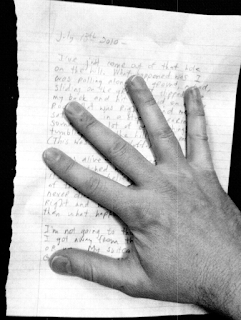
Someone is squatting his old site. I wonder if it's _why; if the banal entrepreneurial positivity on it is him continuing CLOSURE. Since the book refuses to end; this is the last page:


4/5 but only if you care already.
Displaying 1 - 9 of 9 reviews

Can't find what you're looking for?

Get help and learn more about the design.