What do you think?
Rate this book


336 pages, Hardcover
First published March 11, 2014
She understands, now, the dangerous, intoxicating quality of a leading role. It is as though she is the worst sort of dictator—callous and terrible and omnipotent. She wears the orchestra like a silk train, perfectly attached. Her voice fills the theater.Sing da Navelli is a singer, an opera singer. She has a horrible name. She knows she has a horrible name. Please don't hold it against her---or this book. That's what you get when your father is a world-famous conductor and your late mother a legendary opera singer. Her life was written out for her before she was born.
Her parents could have named her Aria, or Harmonia, or Tessitura, or a hundred other clever names that would have alluded to her ancestry. But they weren’t for her, these names that roll or sparkle or play or simply proclaim, I am normal!Sing hates her name. I hate her name. Please do not let your prejudice against her name dissuade you from giving this book a fair shot.
No, it was Sing. A name and a command.
The crow turned.Something lurks in the forest behind the Dunhammond Conservatory. Something ancient, something deadly.
It didn’t see the long, dark body, precariously, impossibly perched. It didn’t see the lashing tail or the yellowing claws. It saw only the eyes, deep and black violet, hungry and pitiless.
The crow had never seen the Felix before, but it knew to be afraid.
“Have you been singing a long time?” Marta asks.Sing is actually a great singer. She has been dreaming of the opera Angelique her entire life, this is her chance. She will enroll at the Dunhammond Conservatory, she will perform in Angelique.
The question takes Sing by surprise. Two years, she thinks. Ever since my father decided I would become the new Barbara da Navelli.
“Farfallina,” he says, “I leave tonight. But please promise me to stay always on the campus. They say this forest is dangerous.”Her father was right to warn her. It's a tough, competitive school, but the competition isn't the only thing that's cutthroat. There is something in the forest. Something related to the opera Angelique.
Sing tilts her head. “That sounds almost superstitious of you, Papà.”
She shrugs. “I’m not afraid of ghosts.”
Her father continues to smile, but his eyes are grave. “That is good to hear.”
The man stood, still shaking with cold or fear. The Felix took another step closer and looked into his eyes.The Felix isn't the only strange creature in the forest, there is also a crow, a man, a thing.
She saw his pain and disease, his hope, his uncertainty. A sleeping part of her mind stirred from where it lay curled around her memories of home. For a moment, she was mesmerized.
Then it passed.
She tore out his throat.
He squinted hard, then recoiled.Sing doesn't know about any of this. She only knows what's inside herself, and that is uncertainty, fear, and the knowledge that she cannot sing to the full extent of her abilities. There's something missing. Something feels terribly wrong.
It was a human arm.
There was something wrong about it. It didn’t look strange, exactly, except for the tattoo.
Then one of the pale fingers began to move.
Sing’s hands start to shake. She doesn’t say, I can’t sing Angelique for real. Not yet. Admitting that would be sure to squash any chance she has of getting the lead. There’s no need for anyone here to know her secret—that despite her blood and her training, there is still something...wrong...with her voice.Her audition is a disaster.
She backs off, worried that if she pushes too hard, the sound will become wobbly or, worse, break altogether. She can’t move her jaw. She tries to decrescendo on the last note, but the bottom just drops out and she’s left with a weak little whine.Instead of the lead, she becomes the understudy. Sing is barely good enough for the role of understudy, as she is so cruelly reminded.
"Considering how badly you butchered your audition, I should have cast you as the mute. But the plain fact is we need an understudy, and you were the only decent soprano available.”It's tough going, there is a diva at school who is a better singer. She has friends, but what does it mean when she cannot sing the role of her dreams. The forest calls to her. She is constantly challenged, criticized by her teachers, snickers abound everywhere, people whisper about her behind her back. It is a tough thing to be the daughter of two famous parents.
She turns, but as she expected, none of the girls are looking at her. They appear deeply entrenched in their own conversation. “I like to sing,” one of them says. The other two laugh and snort.It's a horrible name to bear, when you can't even do what you love. To make it worse, the professors at her school hate her, including the school laughingstock, Daysmoors, or as the students call him. Plays-poor.
Plays-poor. The disgraced vampire. He seems to have the temperament for it. Booed off the stage during his only performance.All is not well at the campus. There is a young man, named Nathan, imprisoned by someone's obsession.
It doesn’t matter. The crystal is here, and he will have it back soon.The Felix still lurks in the forest, waiting, always, for its prey. There is a myth, The Felix is said to grant wishes.
Then no one will take Nathan away ever again.
The great, black forest betrays no sign of life, no indication of a magical, wish-granting beast. Sing wonders what she would wish for given the opportunity.The crow. The Felix. Sing. The mystery of Nathan. It will all come to a crescendo as the performance of Angelique approaches.
Quand il se trouvera dans la forêt sombre...She finds herself humming an all-too-familiar aria. When he finds himself in the dark forest...I love forest settings. I love boarding school settings. This book delivers on both fronts. With every other chapter, we find ourselves in the forest, seeing things through the eyes of the mysterious Felix, as he/she/it prowls, and it is deliciously creepy.
The rustling of trees, the odd snap or scrape from the forest.This book is set in a school. There are classes! Whoo! Yeah, you may think it's odd that I get excited about this, but trust me when I say that there are a surprising number of boarding school books that barely include any details about the actual fucking school whatsoever. There are many students here, BESIDES THE MAIN CHARACTER (WHOO!). There are actual classes (WHOO!). There are actual musical lessons.
The moon illuminated the walkway that ran the length of the building and ended abruptly at the grassy quadrangle.
Must have been just another creak from the old door.
There it was again.
A low, rasping groan coming from the roof. Perhaps not human after all.
Professor Needleman looks at her. “We all think too much. Here, go grab that broom from the corner.”There are other students. Many students. People interact, they make friends, they have realistic relationships. This truly feels like a book that takes place in a boarding school.
For the rest of her lesson, Sing sings while balancing a broom, bristles up, on her palm. Following the subtle, capricious swaying of the broom, not letting it fall, takes all her focus and energy.
She is completely surprised when Jenny stretches out a hand and says, “It sucks that you didn’t get the part you wanted. I think maybe it sucks more than Marta and I know. But look, we’re on your side, okay?” She looks into Sing’s eyes, and Sing feels real in a way she hasn’t for a long time.The Main Character: In so many YA books, the book is completely ruined by the idiotic, Mary Sue characters. This book is not one of them. Sing is not a brat. She has wealthy, famous parents, but she is never a cruel brat. She has insecurities (well, what do you expect, having two world-famous parents?). She goes through disappointments. She goes through bouts of self-pity, where she just wants someone to tell her what she's believed about herself all along: Sing, you're not worth it.
Jenny says, “What’s up with you, Sing?”Sing snaps out of it. She accepts critique. She accepts disappointments, even if it takes her awhile to get over a slump.
Marta shushes her, but Sing looks up coolly. “What do you mean?”
Jenny looks right at her. “What’s the matter?”
“Nothing.”
“Leave her alone, Jenny,” Marta says, cutting steamed carrots.
“No! She’s been acting rotten all lunch. I’m sick of it.”
Sing is silent, in no mood for Jenny’s frankness. Her hackles rise. Go ahead, she thinks. Tell me I don’t belong here. Tell me my father is buying my career. Tell me I’ll never sing Angelique for real.
What am I doing? Sing thinks. Do I think my life will be better if I get bad grades? If I get kicked out of the conservatory?She works hard to train herself and her voice.
The Maestro raises his voice just a little and looks at the president. “You know, my mother was a nurse. Would you come to me if you broke your arm? I mean, what are we trying to do here? I’m sorry the public misses Barbara da Navelli, but it’s not our job to bring her back!”The Romance: No spoilers, because it's part of the story, but I thought the romance was unexpected, and so well-done. I recently read another book that took place in a boarding school setting, which was horrible, because of the tremendous amount of insta-love (See Liv, Forever). There is no insta-love in this book. There is really well relationship development, and I may be dumb, but I couldn't have predicted the romance in this book when I started.
No one says, That’s her mother you’re talking about. No one says that.
But she realizes his touch is no different from that of Professor Needleman, or Maestra Collins, or any of them. This closeness they are sharing will be over in a moment. It isn’t real—it only has the shape of truth. He is interested in her cartilage, not her skin; her trachea, not her neck; her consonants, not her mouth.This book has its faults, it felt overly long, and the overall mystery is quite strange, and I didn't feel it was adequately resolved. Still, I greatly enjoyed the writing, the atmosphere, and the characters. Recommended.


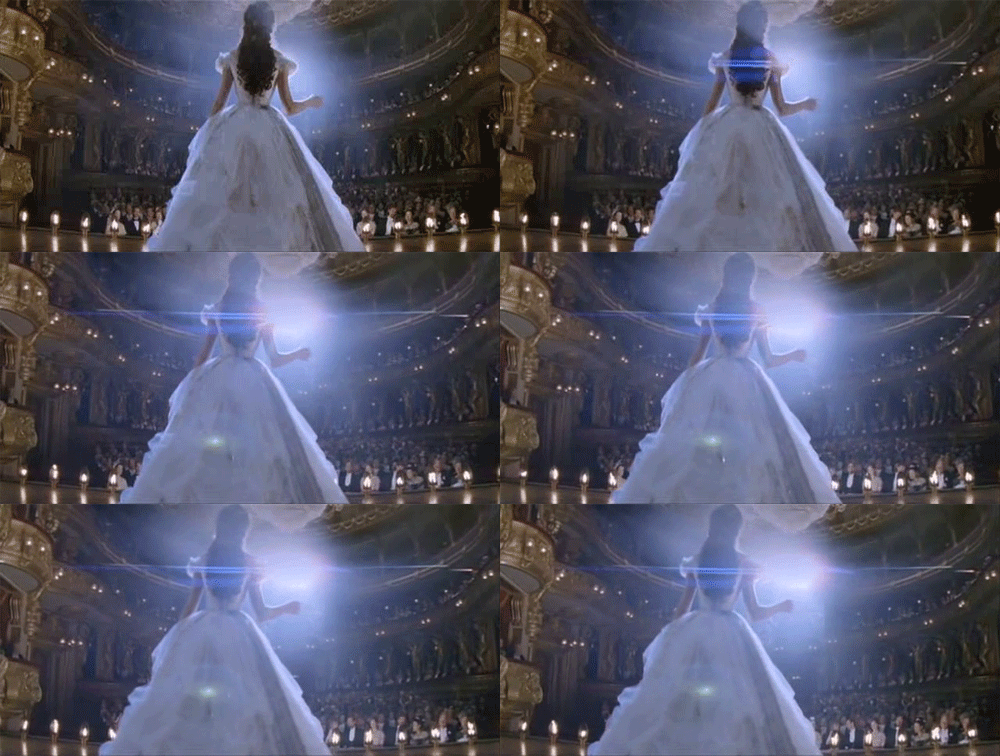
Sing. Is it even her name anymore, or is it merely a word? An order? Given by whom?

Sing’s dress isn’t ready for dress rehearsal. It’s still being altered. She’s thicker than Lori, shorter. Lori is a swan. Sing is a duck.

She backs off, worried that if she pushes too hard, the sound will become wobbly or, worse, break altogether. She can’t move her jaw. She tries to decrescendo on the last note, but the bottom just drops out and she’s left with a weak little whine.
“Sing,” Zhin said, only it sounded different now. It wasn’t quite sing, it was thin and strange and lovely. “It means ‘star’ in Chinese. Like in the sky.”
Sometimes I worry that belief and hope are the same thing, and that truth is something else entirely.

Once upon a time, a composer went walking in the woods and was inspired to write an opera about farmers, a prince, and a mystical wish-granting beast that lives in the forest. A hundred years later, Sing da Navelli, daughter of the late super-soprano Barbara da Navelli and world-famous conductor Ernesto, finds herself enrolled in a conservatory in that same woods and competing for the lead in that same opera -- her very favorite. But there is still a beast that prowls the forest, and a mystery involving the school ... and Sing is drawn to both, as she struggles to find her own voice and make her own wishes come true.This is a very unusual story. The first chapter is absolutely amazing. It then turned a little rocky for me, with alternating chapters from the POV of (1) mysterious characters whose story does not become clear for a good while into the book; (2) the Felix, a magical other-dimensional space-cat beast that haunts the northern woods; and (3) Sing, told in third person-present tense, which kept me very distant from her and irritated the heck out of me for at least the first 50 pages of the book. I nearly chucked it aside during this bit, but am so glad I didn't.

This book is just Amazing! It is beautifully written. The atmosphere was so dark, magical and realistic with a forest at the base of the mountains and almost a century old school. I really love music in real life, and the musical environment in the book made me love classical music even more.
This book had three main narratives. In the first few chapters, the narrative was about a 'crow'. Then we had our main characters Sing da Navelli, George, and the Felix's narratives.
-Sing da Navelli is daughter of world famous parents. She always wanted to be a soprano though she had little choice in that matter as the whole world expect her to follow in her mother's footsteps. Now it's her first year in the school and the school is performing her favorite opera. But instead of getting a part as the main soprano, she is cast as the understudy. Throughout the book, we got to see Sing becoming more mature. At times she was annoying and sometimes conceited but then she starts understanding and gets better.
-Nathan Daysmoor was so mysterious. He has a secret of his own about which his friend George knows. He is just an apprentice and also Sing's vocal coach. He acted as if he doesn't care about anyone and especially he hates Sing. But in reality he cares about Sing.
-Then we have Felix, a huge magical cat who came from the sky. The legend says that if she looks in someones eyes and sees pain that is greater than hers, then she will shed a tear and grant that person a wish. But Felix isn't the only magical cat, there is also a magical big kitten whom Felix have as her own son.
In this book there is a legend, a dark forest, a beast, a school, love and music. Sing's father is a world famous conductor and her mother was a world famous soprano. Sing's mother died in between the performance of her favorite opera. Now she has arrived as the celebrity child in her school. But while performing she thinks there is something missing in her voice. She has yet to discover the magic in her voice. Like every school there is also a rival. The only support she has is from her friends and Nathan. The author amazingly described about music, orchestra and operas.