Jump to ratings and reviews
Rate this book

Alexander

Alexander, Who Used to Be Rich Last Sunday

Rate this book
Last Sunday, Alexander's grandparents gave him a dollar -- and he was rich. There were so many things that he could do with all of that money!

He could buy as much gum as he wanted, or even a walkie-talkie, if he saved enough. But somehow the money began to disappear...

Readers of all ages will be delighted by this attractive new edition of Judith Viorst's beloved picture book.

32 pages, Paperback

First published February 1, 1978

42 people are currently reading
1890 people want to read

About the author

Judith Viorst

118 books799 followers
Judith Viorst is an American writer, newspaper journalist, and psychoanalysis researcher. She is known for her humorous observational poetry and for her children's literature. This includes The Tenth Good Thing About Barney (about the death of a pet) and the Alexander series of short picture books, which includes Alexander and the Terrible, Horrible, No Good, Very Bad Day (1972), which has sold over two million copies.
Viorst is a 1952 graduate of the Newark College of Arts and Sciences at Rutgers University in Newark, New Jersey. In 1968, she signed the "Writers and Editors War Tax Protest" pledge, vowing to refuse tax payments in protest against the Vietnam War. In the latter part of the 1970s, after two decades of writing for children and adults, Viorst turned to the study of Freudian psychology. In 1981, she became a research graduate at Washington Psychoanalytic Institute after six years of study.

Ratings & Reviews

What do you think?
Rate this book

Friends & Following

Create a free account to discover what your friends think of this book!

Community Reviews

5 stars
3,159 (43%)
4 stars
2,227 (30%)
3 stars
1,463 (20%)
2 stars
267 (3%)
1 star
85 (1%)
Displaying 1 - 30 of 416 reviews
Profile Image for Karina.
1,027 reviews
June 26, 2019
Alexander is a little money hungry brat. (Didn't kids get spanked in the 70's? He really, definitely needed a good spanking.) But my kids laughed at his attempts to be $1.00 rich (not richer) after he spends and loses it. Who can buy a pc of gum for a nickel nowadays? Aaah, inflation adjustment... Lol...

My kids, "Mom, I spent my $5 at Target."
Me, "Yeah, that's good if that's what you really wanted."
Them, "But aren't you going to give it back to me for spending it?"

Uuumm, reimbursement...? 🤔
Profile Image for Kathryn.
4,773 reviews
July 28, 2009
Although this book is definitely dated (the 1979 illustrations of the family made me really nostalgic for childhoods watching "Family Ties" -- and I can't imagine any kids who would be able to make $1.00 buy anything, let alone several things, these days) the concept is one that is timeless and especially relevant in today's difficult economy. Alexander is given $1.00 from his grandparents--he WANTS to save it up to put toward a new radio, but somehow he just keeps on finding other things he wants to buy and pretty soon he is out of money. Of course, this is also just a really great concept story for kids learning about the various things they can do with their money, some wise choices some not so wise! Told with Viorst's great humor and insight into the child's mind.
40 reviews1 follower
Read
March 3, 2010
Alexander is given money from his grandparents and he thinks he is rich. He really wants to save up his money to buy something great, but his money begins to disappear quickly.

The illustrator in this book creates a space for the text at the top of the page and the illustration at the bottom of the page. The illustrator uses all black and white sketches throughout the entire book. These simple sketches with no color leave a need for very detailed pictures to get the emotion in the book. The illustrator show great emotion on the characters faces that really bring a mood to this book. Alexander can look grumpy, mischievous, surprised, mad and nervous in a way that makes the reader really think of him as a real person. The characters in the background are each sketched to have their own emotions that explain what is going on in Alexander’s day.
Profile Image for David.
81 reviews3 followers
August 9, 2007
The best lesson I've ever read, to teach kids about:
* limited financial resources
* the benefits of controlling impulse
* the value of money

Beautiful in that it doesn't preach or tell, it demonstrates by example.

My son enjoys the story, and secretly picks up on the lessons...
Profile Image for Shari.
581 reviews1 follower
January 21, 2020
Read this hilarious book to discuss what it means to be frugal and use your money wisely. Alexander definitely does NOT use his money wisely and he suffers for it. Something just about every kid can relate to when they get a dollar!
Profile Image for Nur.
27 reviews
November 5, 2022
Çocuğun 1 dolara alabildiği şeyler tarafından bıçaklandım. Abv enflasyon
Profile Image for John Kirk.
437 reviews19 followers
December 20, 2011
I like the idea of this book: it's intended to teach children the importance of saving rather than spending. Unfortunately, there are some problems with the execution. That's not really a criticism of the writer, but you need to be aware of the target audience.

Firstly, this is an American book, so all the references to cents/dollars/etc. will probably confuse a child in other countries (e.g. the UK). Similarly, there were some words that I didn't recognise ("lox") and other terms that aren't used in this country ("stoop").

Secondly, this book was written over 30 years ago (in 1978), and inflation has taken its toll. By modern standards, I think that he got amazingly good value for his dollar, so I would say that he actually spent it wisely rather than frittering it away. Meanwhile, electronics have generally got cheaper, so I'd guess that a walky-talky is more affordable now than it was back then. This means that the book is actually sending the wrong message!

Also, the page where Alexander ponders how long it will take him to save up has several years listed (e.g. 1981), but that will confuse a modern child. If you have to keep stopping the story to say "Ignore that" or "Pretend it says this" then that's going to disrupt the narrative flow.

Still, there are some funny ideas in here which kids will probably still relate to, and the illustrations are good (although they're in black and white). Ideally, I'd like to see a revised international edition.
9 reviews3 followers
January 16, 2014
This book is great to use as a read aloud to students in grades 3 or 4. This specific children's complex picture book may be too simple for children in the 5th grade. I like the fact that the book has multiple characters that are incorporated throughout. I think this book would interest all students and get them thinking about saving their own money that they have. The copyright of this book is older, but the story is something that children today can relate to. All children save money and spend it on useless items.

I would incorporate this book into my classroom by doing an interactive read aloud with the whole class. Throughout the story, Alexander receives money but continues to spend it on unnecessary items. I would love to use this picture book in my math lesson about money and have each student figure out how much he spent on each item and create one large math equation. Using the older brothers' money in the math problem would also help the students see how much more they started with and who had the most money in the beginning.
Profile Image for Stephanie.
633 reviews18 followers
September 29, 2015
This is another classic book that I read as a child. It's funny and has some good lessons for kids about spending and saving. It's all in black and white so it may not be the most attention grabbing, but the illustrations are still well done and I love the facial expressions.

"Last Sunday, when I used to be rich, Cathy around the corner had a garage sale. I positively only went to look. I looked at a half-melted candle. I needed that candle. I looked at a bear with one eye. I needed that bear."
32 reviews
October 12, 2017
Alexander Who Used to be Rich Last Sunday was written by Judith Viorst and illustrated by Ray Cruz. This is a great book for children to learn to save their money. Alexander starts out with one dollar and everyone told him to save although he wanted to by walkie talkies with it he ended but having to pay for a few things throughout the book. In the end Alexander spends his money and then is stuck with some not so great items. He wishes he would have saved it. Overall this book teaches children to save their money rather than spend it.
49 reviews
October 19, 2018
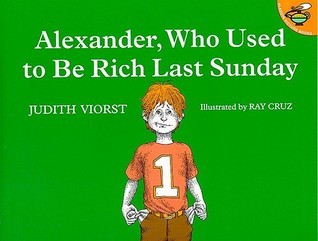
This book has a rich sequencing plot and it also used past events in the plot. The images of the book are black and white. They make the book different, but it makes the book a bit boring. However, as mentioned, the rich plot and word choice help the keep the reader's attention. The cover of the book is very vibrant and gives the character physical characterizations that are not shown once the book in opened and read. The boy kept buying stuff with the dollar and could not figure out how his money began to disappear.
Profile Image for Nicola.
3,634 reviews
October 22, 2018
We love Alexander's 'Terrible Horrible No Good Very Bad Day'. We liked 'used to be rich last Sunday' (probably me more so than Miss 4, but it was useful for talking about saving vs spending). 'I'm not moving' didn't appeal (probably more helpful if you have an upcoming move).

Miss 4 and I like to explore different books and authors at the library, sometimes around particular topics or themes. We try to get different ones out every week or so; it's fun for both of us to have the variety and to look at a mix of new & favourite authors.
34 reviews2 followers
April 15, 2013
This was a cute book, it is about Alexander who receives a dollar from his grandparents and his first plan is to save it but instead he spends it all and is only left with some bus tokens. This is a great book for learning about the concept of money. I would use fake coins to express how many of each coins makes up a dollar and could expand the lesson by creating a class store and having the students buy items that would add up to be a dollar.
101 reviews
June 21, 2017
This book is about Alexander. His grandparents came and gave him and his brothers money. His brothers saved theirs and Alexander spent his so he is angry because his brothers have money and all he has is bus tokens.

I liked this book. This book teaches kids a good lesson that money is exciting to have but the choices you make with it have different results. If you choose to spend it, you won't have it anymore.

(Contemporary Realistic Fiction)
Profile Image for Dolly.
Author 1 book671 followers
August 23, 2008
Shows how quickly a windfall can disappear. It's on a micro-scale in this story, but the lesson holds true universally. Good story to introduce fiscal responsibility to kids. We really enjoyed reading this book together and I will be sure to look for more books by Judith Viorst at our local library.
Profile Image for Tracy Mercier.
18 reviews
Read
December 6, 2011
This book really helped us understand how adding and subtracting well helps us spend our money smartly.
Profile Image for Virginia.
609 reviews17 followers
July 14, 2019
The follow-up to the classic Alexander and the Terrible, Horrible, No-Good, Very Bad Day. In this story, Alexander can't seem to save his money... no matter how badly he wishes to!
Profile Image for Kim.
767 reviews17 followers
October 25, 2022
Funny, but nothing beats the original.
Profile Image for Amelia.
48 reviews11 followers
May 1, 2019
Alexander's grandparents gave him a dollar, but he was told to save it. He told himself over and over again that he would save his dollar to buy a walkie- talkie, but he bought gum at the drug store for 15 cents, then he bet he could hold his breath until 3 o'clock, he lost. Then he bet his mom she couldn't guess what hand he put the purple marble in, he lost 15 cents. After that, he rented a snake for an hour and lost 12 cents. Next, Alexander said some bad words to his brothers and was fined 5 cents each. He lost 10 cents. Then he flushed 3 cents down the toilet and lost 5 in a crack. After that, he ate his brothers chocolate bar and lost some of his money. His other brother tricked him into giving up 4 cents. All in all, Alexander was not very responsible with the money he was given. In the end, Alexander has spent all of his money and is left with bus tokens.
I enjoyed this book. I thought it was really cute. I like all the ways Alexander spends his money. How he flushes it down the toilet, I will never understand. I also like how his brothers tricked him into giving up his money. As a younger sibling, this is very relatable. I'm pretty sure my brother did something similar at least once. I also enjoy seeing the pictures. Alexander makes the best faces they're so relatable. It's very easy to see how he is feeling.
I can use this book to introduce a math lesson on money. I can read through the book one time, then ask the students where they think all the money went. Hopefully, they will tell me the events in the story. I can ask the students how much money Alexander had to begin with. Then I can ask them how much they think he lost. As a class, we can work together to do the subtraction. Before this, I can tell them to find how much he lost we have to do subtraction. Then we can read through the story again and find out how much he lost on each page and subtract the amount he lost. Then I can give my students some coins and place them in groups. In those groups, they will have to work together to make a dollar out of all the coins they have. I can give some groups quarters, some dimes, some pennies, some nickels, and some a dollar bill. Then once they've made a dollar out of their coins, they will have switch tables and make a dollar out of the new coins they have. Hopefully, they learn that each table has the value. This will also give them practice counting money.
Profile Image for Jessica Emly.
30 reviews
September 26, 2018
Alexander, Who Used to Be Rich Last Sunday, by Judith Viorst, tells the story of a little boy named Alexander, who ended up spending the whole dollar that his grandparents gave him last Sunday. Despite absolutely positively wanting to save his money for a walkie talkie, between his bouts of uncontrollable spending, two meddlesome brothers, and paying his parents for various misbehaviors relating back to said brothers, Alexander ends up with absolutely no money. I selected this book for my read aloud because Viorst incorporates such a strong sense of voice in the writing, which makes it a great book to read aloud to others! Not only is the text humorous, but anyone reading or listening in our modern day world can't help but empathize with Alexander's money problems -- whether children or adults. The black and white illustrations add a note of simplicity to the book while still mantaining the comedic tone. The kid-friendly story is perfect for children from Kindergarten all the way up to 3rd grade, and can easily be incorporated into a math lesson -- since the whole plot of the book centers around money. Not only is the book mathematical, it also offers an important lesson to students about the value of practicing self-control.
20 reviews
November 5, 2017
Text-To Self
Funny, funny read! The book “Alexander, Who Used to Be Rich Last Sunday,” by Judith Viorst, and illustrated by Ray Cruz took me back to the experience of sibling rivalry and older brothers. Alexander and his brothers receive a dollar each, from their grandparents when they came to visit. Alexander, being the youngest, has a difficult time using his money wisely. His impulsiveness and immaturity lead to him spending all his money. His older brothers exacerbate his situation by teasing him every chance they can.
Memories of my older brother teasing me made me laugh aloud and took me back to when I was a little girl. Just as Alexander’s brothers tease him, my brother was similar in teasing me. He would hold me back with his hand on my head, refuse to give me the phone if a boy would call, and mostly would tease me with words. All his teasing is done with love! I know that today, but thought differently at the time. I believe if I could extend the story of “Alexander, Who Used to Be Rich Last Sunday,” he would feel the same way I do as the teasing is done with complete love.
Profile Image for Kelly Santamaria.
22 reviews1 follower
October 2, 2020
This is a story about a boy named Alexander. As the title suggests, he used to be rich last Sunday. Alexander narrates the story and takes the reader through his adventure of being rich.

Defining Children's and Adolescent Literature can be somewhat of a debatable topic. However, for this particular book, I prefer the definition given by Peter Hunt, children's literary critic and scholar. Peter Hunt defines children's books as books intended for children. Given that definition, this book is a children's book, as its intended audience is clearly children. The author uses simple words and repetitive sentences for a child to understand. Along with the easy to read language, the book is filled with pictures.

Inside this book, the reader will find black and white illustrations from Ray Cruz. Although the illustrations are not filled with color, the amount of expression drawn onto each of the characters faces and body language adds a much more in depth understanding of the words coming from the narrator, Alexander.

If you enjoy this book, try another one with Alexander, such as, "Alexander and the Terrible, Horrible, No Good, Very Bad Day."
30 reviews
September 13, 2017
Summary: Alexander was given one dollar last Sunday. which made him a rich kid. He had the power to do so much with his money. His money slowly started to disappear throughout the week even though he kept telling himself to save it.

Evaluation: I remember reading this book as a child and I still like it to this day! Although it is fairly wordy, I feel like even children who struggle with reading can still make sense of what is happening based on pictures and words they do know. It provided "thought bubbles" and illustrations of Alexander losing money, which made it easier to follow along using the pictures in the story.

Teaching Point: I would use this story in a 2nd grade classroom to coincide with my instruction on how to count money. Alexander begins by sharing how many coins and dollar bills each of his brothers has (I could use manipulatives or drawings to help students count the coins). Then, he is given one dollar, but he spends it on various items throughout the story (students could subtract each amount he spends from his original amount until they reach 0).
Profile Image for Gina.
80 reviews3 followers
May 18, 2017
This book is wonderful for today's students, even though it was written in 1978. It follows Alexander, who gets a dollar from his grandparents. He wants to buy a walkie talkie with it, and intends to save it. However, along the way, he sees so many things on which to spend his money. He finally ends up empty handed and tries to sell bottles, rent toys, and find money to replace his lost dollar.

I loved this book. The illustrations were bland, but that was appropriate for this book because it added to the seriousness of Alexander's predicament. It was funny, yet it was serious. It teaches a lesson we don't hear very much of today - frugality and saving.

This book would great to use in math because of the monetary value of the items in the book. It would be good for grades 2-4, I think. It would also be good to have a discussion about savings and self-control.
Profile Image for Steve Holden.
477 reviews13 followers
October 4, 2017
This is an anchor text in our second grade reading curriculum, and I must say, I love reading it with my students each year! I grew up loving the Alexander books. Ray Cruz gives such detailed illustrations, and Viorst comes through so well in her Alexander narration. We use this text to teach point of view, and how a writer can tell a story through a character's eyes. We also use it for making inferences with illustrations connecting to the text.

My kiddos love the humor in the telling. As we work with this one for a few days, we also use it to help promote reading fluency and reading with expression. Alexander is one of the most expressive characters I can think of in the picture book world!
50 reviews
October 19, 2018
"Alexander Who Used to be Rich Last Sunday" is a great read for young children who are beginning to learn and understand the concept of money. This book shows how Alexander started out with the dollar that his grandparents gave him, and describes how he spent his money and how much he spent on each item. This book also shows how Alexander needed to save his money but couldn't resist the urge to spend it. This is an important lesson for children to be aware of for their lives. This book could be used greatly as an interactive read aloud for a mathematics class. Overall, the story line of this book is great and it is a great example to use when teaching children about the concept of money and all of its key elements.
55 reviews2 followers
March 7, 2018
Summary:
Alexander’s two older brothers both have more money than him, because he only has bus tokens left. Alexander used to be rich last Sunday when his grandparents visited and gave him some money. He meant to save his money, but instead ended up using it all on different things, like gum, bets, flushing it down the toilet, dropping it, and at a garage sale. He tried to do different things to get some money like turning in cans or losing some teeth, but that didn’t work either. So, all he ended with was a few bus tokens.

Possible Topics:
1. Learning to save money.
2. Spend money wisely.
3. Be careful with your money, don't drop it anywhere.
Profile Image for SaraKat.
1,970 reviews38 followers
July 1, 2018
This was on my school's pillars of character reading list under 'fairness'. I guess it was supposed to show that Alexander was treated fairly by the grandparents who gave all three boys the same amount of money, but it seems to fit more under responsibility since he wasted the money and bemoaned his state off financial health afterward. It is an amusing story and I liked the way it was implied that Alexander said naughty words and acted on his violent impulses, but didn't show it. Clever. I didn't really care for the illustrations. And kids today might not understand that a few cents actually used to be worth saving!
50 reviews
October 16, 2018
Most illustrations are on every page in this book. I think it is very good for children to understand the story of this book because illustrations can show how the story flows. In addition, illustrations are expressed Alexander's emotions very well. This book includes a course that Alexander spended his money. When children get their allowance from their parents, they have a lot of plan how they use it. At first, they are rich so they spend money fast. It makes them poor. This situations is expressed very well by Alexander. And this book includes a unit of money so children can learn the unit of money.
Displaying 1 - 30 of 416 reviews

Can't find what you're looking for?

Get help and learn more about the design.