Jump to ratings and reviews
Rate this book

American Revolution #1

Bunker Hill: A City, A Siege, A Revolution

Rate this book
The bestselling author of In the Heart of the Sea, Mayflower , and  In the Hurricane's Eye  tells the story of the Boston battle that ignited the American Revolution, in this "masterpiece of narrative and perspective ." (Boston Globe)

In the opening volume of his acclaimed American Revolution series, Nathaniel Philbrick turns his keen eye to pre-Revolutionary Boston and the spark that ignited the American Revolution. In the aftermath of the Boston Tea Party and the violence at Lexington and Concord, the conflict escalated and skirmishes gave way to outright war in the Battle of Bunker Hill. It was the bloodiest conflict of the revolutionary war, and the point of no return for the rebellious colonists. Philbrick gives us a fresh view of the story and its dynamic personalities, including John Adams, Samuel Adams, John Hancock, Paul Revere, and George Washington. With passion and insight, he reconstructs the revolutionary landscape—geographic and ideological—in a mesmerizing narrative of the robust, messy, blisteringly real origins of America.

396 pages, Paperback

First published April 30, 2013

1731 people are currently reading
12565 people want to read

About the author

Nathaniel Philbrick

45 books3,545 followers
Philbrick was Brown’s first Intercollegiate All-American sailor in 1978; that year he won the Sunfish North Americans in Barrington, RI; today he and his wife Melissa sail their Beetle Cat Clio and their Tiffany Jane 34 Marie-J in the waters surrounding Nantucket Island.

After grad school, Philbrick worked for four years at Sailing World magazine; was a freelancer for a number of years, during which time he wrote/edited several sailing books, including Yaahting: A Parody (1984), for which he was the editor-in-chief; during this time he was also the primary caregiver for his two children. After moving to Nantucket in 1986, he became interested in the history of the island and wrote Away Off Shore: Nantucket Island and Its People. He was offered the opportunity to start the Egan Maritime Institute in 1995, and in 2000 he published In the Heart of the Sea, followed by Sea of Glory, in 2003, and Mayflower. He is presently at work on a book about the Battle of Little Big Horn.

Mayflower was a finalist for both the 2007 Pulitzer Prize in History and the Los Angeles Times Book Award and was winner of the Massachusetts Book Award for nonfiction. In the Heart of the Sea won the National Book Award for nonfiction; Revenge of the Whale won a Boston Globe-Horn Book Award; Sea of Glory won the Theodore and Franklin D. Roosevelt Naval History Prize and the Albion-Monroe Award from the National Maritime Historical Society. Philbrick has also received the Byrne Waterman Award from the Kendall Whaling Museum, the Samuel Eliot Morison Award for distinguished service from the USS Constitution Museum, the Nathaniel Bowditch Award from the American Merchant Marine Museum, the William Bradford Award from the Pilgrim Society, the Boston History Award from the Bostonian Society, and the New England Book Award from the New England Independent Booksellers Association.

from his website

Ratings & Reviews

What do you think?
Rate this book

Friends & Following

Create a free account to discover what your friends think of this book!

Community Reviews

5 stars
3,573 (34%)
4 stars
4,513 (43%)
3 stars
1,906 (18%)
2 stars
346 (3%)
1 star
95 (<1%)
Displaying 1 - 30 of 1,076 reviews
Profile Image for Jeffrey Keeten.
Author 5 books252k followers
July 4, 2019
”In the end, the city of Boston is the true hero of this story. Whether its inhabitants came to view the Revolution as an opportunity or as a catastrophe, they all found themselves in the midst of a survival tale when on December 16th, 1773, three shiploads of tea were dumped in Boston Harbor.”

 photo BattleofBunkerHIll_zps59587145.jpg
Battle of Bunker Hill

The funny thing of course about the Battle of Bunker Hill is that it was not fought on Bunker Hill, but on Breed’s Hill. I think some of the confusion about events really starts with the orders that were sent down to Israel Putnam to build a fort or redoubt on Bunker Hill. He disregarded those orders, if you can call them that, (really at this point any order is really a request) and built a redoubt on Breed’s hill a position much closer to the British. Putnam’s intention, to force the British to do something.

April 19th, 1775 the Minutemen had clashed with the British at Lexington and Concord. ”The shot heard round the world.” The militia then chased the British all the way back to Boston firing at them from behind fence lines and trees inflicting heavy casualties. Both sides were unnerved by the ferocity of the encounter. Sam Adams, a man very good at encouraging violence, used the event with his rhetoric to further drive wedges between loyalists and patriots. We are quickly reaching a point where neutrality will be impossible.

 photo minuteman_zpsa9d1d7f2.jpg
The Minutemen harassed the British from behind every fence and every tree every step of the way back to Boston. The British Officers had coats made of better material and the dye stayed bright red while the British Regulars the color had faded to orange because their coats were made of inferior cloth. It was easy to pick out the officers.

So was this all over taxes?

”Hindsight has shown that, contrary to what the patriots insisted, Britain had not launched a preconceived effort to enslave her colonies. Compared with other outposts of empire, the American colonists were exceedingly well off. It’s been estimated that they were some of the most prosperous, least-taxed people in the Western world.”

Hmmm not really oppressed or over taxed so why all the high fever to throw off the yoke of the mother/fatherland?

’Years later, one of the militiamen who participated in the events of the day insisted that it wasn’t the Tea Act or the Boston Port Bill or any of the Coercive Acts that made them take up arms against the regulars; no, it was much simpler than that. ‘We always had been free, and we meant to be free always,’ the veteran remembered.”

Now that sounds more like it. Although Captain Thomas Pickering had his own doubts.

”But what troubled Pickering the most about the meeting was not the wildness of the rhetoric; it was the motives of the more radical patriot leaders. Up until that moment, Pickering had assumed they were driven by an honest love of country; but now he had the unsettling suspicion that ambition was as powerful a stimulus as the former.”

Most of the founding fathers were wealthy none as wealthy as George Washington (estimated net worth $525 million... no other President even comes close to that net worth until J.F.K. who did not live long enough to inherit his father’s vast fortune), but certainly the leaders of this burgeoning nation would have been considered to be well to do by the lads that did the fighting for independence. Severing the ties with England and becoming an independent nation certainly held financial opportunities for those with the means to take advantage of those new opportunities.

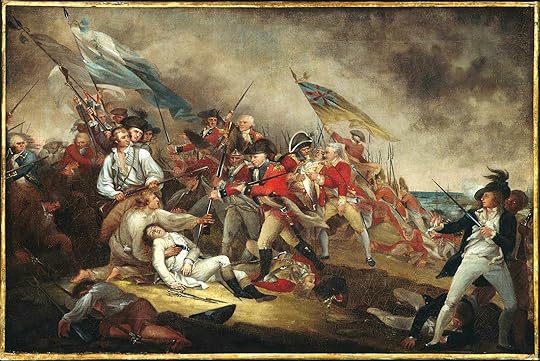
As things heat up in Boston, John Hancock and Sam Adams leave for Philadelphia leaving Dr. Joseph Warren nominally in charge of the Boston area. Unlike his fellow patriot leaders Warren has a need to be in the middle of the action. He refuses to head up the medical department of the Continental Army and opts for a Major General position instead. As he sees things develop on Breed’s Hill he heads for the action and volunteers as a private even though Putnam and the other officer ask him to take command. Warren refuses. "These fellows say we won't fight! By Heaven, I hope I shall die up to my knees in blood!"

 photo DeathofGeneralWarrenattheBattleofBunkerHill_zps95f8f7d2.jpg
The Death of General Warren at the Battle of Bunker Hill by John Trumbull.
“I can only say,” Abigail Adams wrote, “that in looking at it, my whole frame contracted, my blood shivered and I felt a faintness of heart.”
As a child I can remember first seeing this painting and I felt the same way as Abigail. Not historically accurate, but so powerful.


I think there is a missed opportunity here to unify the colonial troops. Joseph Warren was well respected even outside the confines of Massachusetts and he would have made a convincing argument to have the troops, despite their state affiliation, prepare for the fight as one unit. As it was men stayed with the leadership from their state. There was no continental army. George Washington had just been appointed supreme commander June 15th and the Battle of Bunker Hill happens on June 17th. There are no orders. There is no chain of command. It is simply amazing that these men made any kind of showing whatsoever.

It was crazy.

”Peter Brown of Westford, Massachusetts, was appalled. He estimated that they were surrounded by eight cannon-equipped ships, along with ‘all Boston fortified against us. The danger we were in made us think...that we were brought there to be slain, and I must and will venture to say that there was treachery, oversight, or presumption in the conduct of our officers.’”

What would they have done if they had not only had a command structure, but also enough powder. Even as disadvantaged as they were they repulsed the British twice inflicting heavy casualties. By the third assault their guns had fallen silent for lack of powder and the British took Breed’s Hill. Joseph Warren is shot in the head, bayoneted beyond recognition, stripped of his clothes and thrown into a ditch. He did get his wish of dying up to his knees in blood.

 photo British_zps986914bf.jpg
The British bravely marched up the hill into withering fire.

Salem Poor, an African-American who had bought his freedom in 1769 enlisted in the militia and displayed such gallantry at the Battle of Bunker Hill that fourteen officers petitioned the Court of Massachusetts to cite him for bravery.

”The Reward due to so great and Distinguished a Character. The Subscribers beg leave to Report to your Honorable. House (Which We do in justice to the Character of so Brave a man) that under Our Own observation, we declare that A Negro Man Called Salem Poor of Col. Fryes Regiment, Capt. Ames. Company in the late Battle of Charleston, behaved like an Experienced Officer, as Well as an Excellent Soldier, to Set forth Particulars of his Conduct would be Tedious, We Would Only beg leave to say in the Person of this Negro Centers a Brave & gallant Soldier.”

 photo SalemPoor_zpsa3814426.jpg

The Continental Army that General George Washington dreamed of did not have African-Americans or Native Americans. One of his first orders was to discontinue letting them join the militia, but he did allow those that had already served to continue serving. Lord Dunmore on hearing this decision offered freedom to any slave who was willing to serve with the British. Washington on hearing this offer rescinded the order and allowed all men regardless of color to serve in the continental army. Given the bravery displayed by Salem Poor you would have thought any misgivings Washington would have had would have been put to rest.

The British had 1,054 casualties. The Patriots had 450. If the Patriots had won this battle the whole course of the war would have been changed. A loss in the first real battle of the war might have given parliament and King George pause. They might have been more interested in a settlement than continuing a costly war, but then George Washington would have never been President or certainly not the first one and with victory so easily won would we be the country we are today? Would the states without a conflict to unite them in blood have become one nation or would the map of North America ended up looking more like Europe with a cluster of small countries? I for one am happy with the course that history has taken.

I am a direct descendent from an American Revolutionary descendent. My mother is an Ives. Due to some great research by my first cousin Nancy Ives Knabb we know about John Ives’s service record. He is my great great great great grandfather. His father G5 Grandfather Abel Obed Ives also served during the conflict.

John may have moved to Meriden as records there show him serving in the Continental Army. He was in the Lexington Alarm List for the Town of Wallingford, and appears in Captain Isaac Cook's Company - "3rd, private eight days". In Meriden 1774, he was listed as a resident there.
Following are the dates of his service during the Revolution -
August 19, 1776 to September 25, 1776 - 18th Reg't. Conn. Militia, ens. John Norton's Co., commanded by Jonathan Pettibone, Esq.
April 10, 1782 to November 30, 1782 - 1st Conn. Reg't, Capt. David Strong's Co., commanded by Col. Heman Swift
April 10, 1782 to November 13, 1782 - 2nd Conn. Reg't 7th Company, Col. Heman Swift
November 13, 1782 to November 30, 1782 - 2nd Conn. Reg't 8th Company, Col. Heman Swift, Medical Discharge
From September 1782 to November 1782 John transported wood from Connecticut to New York as a "teamster".
As of April 7, 1778 his enlistment papers read "transferred to Gen's Guard March 19". This was George Washington's personal body guard. You needed three things to be a member: be a native born citizen, be almost 6 feet tall and be of impeccable character.
Thus he enlisted for 3 years in this Guard. (this is shown in copies of his papers from National Archives)

 photo PhilbrickandCaleb_zps0c7db13f.jpg
Nathaniel Philbrick with Caleb Keeten at the book reading and signing at The Tattered Cover Bookstore in Denver, Colorado.

My son turns 18 this month and; therefore, he is old enough to join the Sons of the Revolution(not to mention the draft). So just as Abel and John joined a conflict almost 240 years ago so too will my son and I join the cause ready at a moments notice (less than a minute) if our country ever needs us.

If you wish to see more of my most recent book and movie reviews, visit http://www.jeffreykeeten.com
I also have a Facebook blogger page at: https://www.facebook.com/JeffreyKeeten
Profile Image for Matt.
1,053 reviews31.1k followers
July 5, 2019
“And now ensued one of the greatest scenes of war that can be conceived; if we look to the height, Howe’s corps, ascending the hill in the face of entrenchments, and in a very disadvantageous ground, was much engaged; to the left the enemy pouring in fresh troops by the thousands, over the land; and in the arm of the sea our ships and floating batteries cannonading them; straight before us a large and noble town in one great blaze – the church steeples, being timber, were great pyramids of fire above the rest…The roar of cannon, mortars and musketry; the crash of churches, ships upon stocks, and whole streets falling together, to fill the ear; the storm of the redoubts…to fill the eye; and the reflection that, perhaps, a defeat was a final loss to the British Empire in America…”
- General John Burgoyne, in a letter to his nephew, Lord Stanley, June 25, 1775

The American Revolution was not – relatively speaking – an overly-bloody conflict. The number of battle-related casualties was small compared to contemporary European conflicts and later American wars. Far, far, far more men died of disease than of wounds.

The Battle of Bunker Hill (which took place mostly on Breed’s Hill) was an exception. It did not involve a huge number of men; estimates at the high range put the combined Colonial-British forces at around 6,000 soldiers. Yet the fighting was hot, fierce, and lethal. The historian Alexander Rose puts total British casualties at 44% of all men engaged, with the Colonials suffering around 16.5% casualties. It was the costliest battle of the American Revolution.

In Nathaniel Philbrick’s Bunker Hill, however, the battle plays only a small role in the proceedings. This, instead, is the story of Boston at the dawn of the United States. It begins with the 1773 Boston Tea Party and ends with the British withdrawing from the city in 1776. In between is the formation of the Massachusetts Provincial Congress, the battles of Lexington, Concord, and Bunker Hill, and George Washington’s siege. In a hair less than 300 pages of text, Philbrick takes us through the process in which a protest became a revolution, a revolution turned into a battle, and a battle sparked a war for independence.

Nothing in American history has been so mythologized and simplified than the “War of Independence.” Philbrick brings back the complications without making things complicated. In graceful prose, he narrates how the policy of “salutary neglect” backfired on Great Britain. For years, the colonies had experienced economic growth without paying the taxes shouldered by other British subjects. This ended in the wake of the French and Indian War. A great sum of money had been spent defending the colonies from France, and Parliament decided it was time for Americans to pay their share.

Thus followed a series of taxes levied and repealed, levied and repealed. Parliament would make a move, the colonists would protest, and Parliament would back off. Tellingly, this occurred within a context in which even the most ardent protester sought change within the existing paradigm. They didn't want to leave Great Britain; they just wanted better terms. That all changed in 1775, when Great Britain sent troops to occupy Boston. Suddenly, the cats and dogs were living together. It is not surprising that blood was shed. Even so, a complete break with Great Britain was not a foregone conclusion until the collision on Charlestown Peninsula.

I’ve read several of Philbrick’s books. Strange to say, I’ve never loved a single one of them. Yet, taken as a body of work, I think he’s one of the best popular historians working today. One of the reasons is his facility with personalities. Philbrick recognizes history as drama, and historical figures as characters. He does a fine job humanizing the players. In Bunker Hill, top billing does not go to the usual suspects, such as firebrand Sam Adams, but rather to Dr. Joseph Warren, an ambitious physician, lover, and rabble rouser who rose to the presidency of the Provincial Congress, became a major general in the nascent Provincial Army, and died on Breed’s Hill fighting as a private. Philbrick is clearly enamored of Warren, and muses at the course of events had Warren survived. I’ve not read nearly enough to cast judgment on Philbrick’s treatment of Warren; nonetheless, I found it a spirited bit of revisionism.

Aside from illuminating bios, Philbrick is also very good with enlivening details and factoids. For instance, the tea infamously dumped into Boston Harbor was actually being sold at a fraction of its cost in order to get rid of the East India Company’s surplus. However, built into that fire-sale price was a small tax that infuriated many colonists despite the net windfall for consumers. For Great Britain, this was an unforced error. Of course, American anger wasn’t all on principle. Rich and gouty John Hancock, he of the heroic signature line, was a tea smuggler who lost profits when the East India tea undercut his prices.

As I mentioned above, the actual battle of Bunker Hill comprises only a single chapter. The retelling of the fight is competent, if not overly memorable. Alexander Rose’s Bunker Hill chapter in Men of War is a far superior retelling. Philbrick’s real achievement is not in the realm of military history, but in tracking how this engagement came about, and interpreting what it meant. Typical for Philbrick, he has consulted a wide range of sources that he lists and discusses in 56 pages of annotated endnotes. Bunker Hill also gets points for presentation, on top of its content. There are a decent number of maps, and two photo insets, including one inset in full color. (I don’t usually remark on the inclusion/exclusion of pictures, since it’s hard to do without sounding like my five year-old. Still, it’s really neat when an author describes a famous portrait, and then it’s right there, in the book. Nothing breaks up the flow of a reading experience more than the irresistible temptation to look something up on my phone).

Philbrick brings a healthy dose of Nantucket contrarianism to this book. He recognizes that revolutions are messy, and the American Revolution no exception. There were no guillotines, thankfully, but there was a lot of tarring and feathering, property destruction, physical violence, and mob rule. The American “patriots” were, at times, nothing more than thugs, and their vigilantism and neighborhood despotism more than a little terrifying. As the Reverend Mather Byles remarked: “Tell me, which is better, to be ruled by one tyrant 3,000 miles away, or by 3,000 tyrants not a mile away?”

This kind of sharp edged history, unafraid of sacred cows, is important for a topic like this. The revolutionary period still exists in the halcyon glow possessed by many origin stories. The men and women of this period were not infallible; that should be obvious, though many still look to them in determining the role of government in our lives today. If we are to give ghosts such power over the living, it is always worth remembering who, exactly, they were, and what, exactly, they stood for. Bunker Hill has a bursting dramatis personae. Not just Warren and Hancock, but George Washington, John and Abigail Adams, Paul Revere, and many more. Philbrick captures them in their honor and venality, in their courage and cowardice, in their insights, both brilliant and blundering.
Profile Image for Jason Koivu.
Author 7 books1,411 followers
November 21, 2013
I just love the hell out of Nathaniel Philbrick! That fella could write my obituary and I'd be happy as a pig in shit.

As a born and bred New Englander, I'm fairly well-versed in American Revolution history, but even I learned a few things from reading Bunker Hill: A City, a Siege, a Revolution.

Since it's more focused on a specific event rather than the entire war, Philbrick is able to dive deeper into the details, so the reader gets more info about the second tier players below the Washingtons and Adamses in fame, such as Joseph Warren, Thomas Gage, Henry Knox and John Hancock. Their backgrounds as well as the workings of their inner minds are elaborated upon. The strategies and maneuvers of the Colonials and British are laid out more minutely. Readers come to grips with this confusing conflict all while getting wrapped up in it.

Because these events are so precisely described and deliberated, I can't recommend this to everyone. But to anyone looking to learn more about the whys, whats and whos that make up the incorrectly named Battle of Bunker Hill, you may find a more scholarly text, but you're not likely to find one so deftly written in a prose that is a pleasure to read.
Profile Image for Michael.
1,094 reviews1,965 followers
January 21, 2015
Philbrick hits another home run for me in his compelling narratives of important areas of American history. This one, on the beginnings of the American Revolution, sits well for me between his history of the first 100 years of the Plymouth Colony, “Mayflower”, and McCullough’s “1776”. I lived all around the Boston area for 11 years, so it was cool to get a different lens on the places and geography. I used to get lost a lot, and I could usually spot the Bunker Hill monument in Charlestown to get some kind of bearing. Of course I missed the fact that the battle mostly took place on nearby Breed’s Hill where militia commander Prescott set up his fort against orders, making the threat of artillery to Boston over the water almost demand a response from the British holding siege over Boston.

There was plenty I had to unlearn from the simplistic account we all imbibe from grade school onward. Like how the vast majority of colonists conceived of themselves as loyal subjects of King George even after the skirmishes in Lexington and Concord. Their complaints mostly centered around the policies of the royal governor and “ministerial army.” Yes, there was rowdy dissention over taxes like the Stamp Act over 10 years earlier, but that got reversed. With the Tea Party protest of one group against import duties and unfair monopoly for British traders, Britain came down hard with the Port Act, shutting Boston Harbor down and forcing all shipping to go through nearby Marblehead. But I learned here that the expectation of nearly all was that things could be patched up again.

The picture I get overall from Philbrick is that the Province of Massachusetts was not seriously oppressed. It left me wondering if the war really necessary or inevitable, especially looking at how well Canada did without a revolution. That’s not on the agenda with this book. Still, Philbrick takes pains to cover how the new military governor Thomas Gage was generally restrained and respectful of the colonists:

While Gage had honored the civil liberties of the patriots, the patriots had refused to respect the rights of those with whom they did not agree, and loyalists had been sometimes brutally suppressed throughout Massachusetts. The Revolution, if it was to succeed, would do so not because the patriots had right on their side but because they—rather than Gage and the loyalists—had the power to intimidate those around them into doing what they wanted. As one of Gage’s officers observed, “The argument which the rebels employ to oblige everyone to do what they wish, is to threaten to announce them to the people as Enemies of Liberty, and everyone bends.” Not since the Salem witch trials had New Englanders lived with such certainty and fear, depending on which side of the issues they found themselves.

On the patriot side of things, we get the picture that a small set of radicals were obsessively intent on an agenda of independence and eventually got their way. For Samuel Adams,
Boston was now the victim of a more-than-a-decade-old plot on the part of the British ministry to enslave America, to drain this bounteous land of all her resources so that England, an island lost to luxury and corruption, could sustain the fraudulent lifestyle to which to had become accustomed.

A big focus of this book is on changing roles in the critical events of revolution by another figure unknown to me, Joseph Warren. He was a farmer’s son who assumed big responsibilities when his father died in Warren’s early teen years, went to Harvard at 14, and became a respected doctor. His charisma and problem solving talents made him a co-leader with Adams on the Committee of Safety and later the Provincial Congress, a sort of shadow authority dedicated to maintaining colony coordination in the face of British placement of lackey loyalists in most of the key positions of the provincial and many town governments. Compared to Adams, who was “part political boss, part ideologue, Warren, close to two decades younger, possessed a swashbuckling personal magnetism.” But Warren wanted to be part of the military response, not as a general, but among the ranks. That ambition was a challenge for him to pull off:

Warren’s biggest obstacle to achieving this goal was his own outsize talent. His seemingly limitless capacity for work, along with his unmatched ability to adapt his own actions to meet the demands of the moment, meant that as the speed of events began to increase in the days ahead, he was inevitably looked as the person to keep the patriot cause together.

For several months while Gage maintained a lockdown on Boston, the Committee had worked hard to make sure that precious stores of weapons and gunpowder were stockpiled in readiness for rapid access by town militia in towns to the west of Boston, notably in Concord, in case the British were to make serious punitive military actions or seize patriot leaders by force. Hiding the weapons from small army forays to nab stockpiles (“Powder Alarms”) was a response they were used to. The call for the militias throughout the colony ( aka the “Minutemen”) to respond by converging on the site of a major attack was only supposed to occur when a minimum of at least 500 troops with baggage and artillery headed out of Boston. To prevent rash action, there was also supposed to be a consensus of at least five committee members behind such a drastic action. However, Gage sent out a force of about 700, they included only lancers and light cavalry with no baggage. He wanted to seize weapons in a hit and run operation based on regular intelligence from a loyalist spy among the patriots (Benjamin Church), and he did not expect to be dealing with serious armed resistance. Warren was responsible on his own for making the fateful decision to send out the alarm:

What Warren did was technically wrong, but at least he had made a decision—something the hypersensitive Gage had been struggling to do now for weeks. Whether premeditated or spur of the moment, or a mixture of both, Warren’s decision to send out Dawes and Revere rendered the debates of the Provincial Congress moot. After more than four months of preparing for the eventuality, Warren was about to have his war.

Philbrick does a great job on the action at Lexington and Concord. In this well-trod ground, he is light-footed in weighing the who and what contributed to how things turned out (tons of footnotes and blbliography are tucked away in the back of the book). It was essentially a disaster for both sides. No one could control the action of panicky individuals on both sides. Accounts vary on who fired the first shots. Although only a handful were killed on both sides at the collision of forces in the two towns, much brutal action was taken by the swarming colonials during the 14-mile British retreat back to Boston. False rumors and exaggerations escalated the responses. Only extremists such as Adams were happy with the outcome. He was noted by Hancock as they snuck away from the chaos at Lexington to remark: “Oh, what a glorious day this is!”

In response to the hornet’s nest provoked by the skirmishes, Gage turned Boston into one big fort, and most of the city’s residents moved out. Off stage in Philadelphia the representatives of the other colonies at the Continental Congress organized a mobilization of their militia, resulting in a long stand-off of about 15,000 armed colonialists facing about 9,000 British. The vast majority of the patriots believed the British would cave in and compromise. Placing some men and cannons on Bunker Hill in Charlestown overlooking Boston Harbor was supposed to help the pressure for a resolution. Instead, the commander set up his main fortification on Breed’s Hill, much closer to the British defenses and a threat that could not be ignored. By this point in time, Britain had sent three generals to take over the military action and a strong order for Gage to unleash them to kick colonial butt. The resulting battle, led by General Howe, led to eventual victory but at the cost of about a 1,000 killed and wounded compared 400 by the colonial forces (including our hero in this rendering, Joseph Warren).


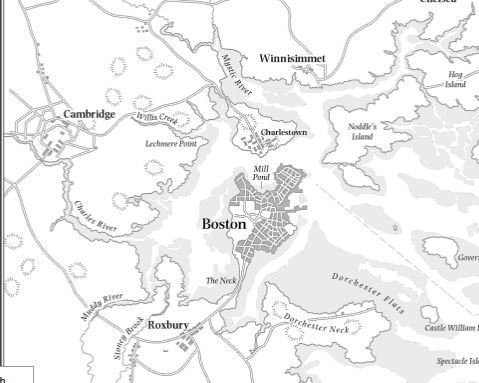
Map showing how Boston at the time was nearly an island and how the proximity of Charlestown made its hills strategic for placement of a battery

As the Siege of Boston continued, a Continental Army got more organized and sent its new commander to the scene, a wealthy planter for Virginia with a chip on his shoulder against the British for not advancing him for past service to the Crown. Washington had a poor record in waging war but had a great capacity in inspiring loyalty with his charisma and aristocratic bearing.: I love Philbrick’s way of capturing his style and outlook:

All agreed. No one looked better than Washington on a horse. …
A revolution had begun when several yeomen farmers decided to linger defiantly at Lexington Green was not being led by a general who looked and acted suspiciously like the enemy.…
Washington was not just disappointed by the New Englanders who had begun this war with the mother country: he was disgusted by them. ..
This was not a proper army: this was a mob of puritanical savages that included … Indians ... . Even worse, from the perspective of a slaveholder from Virginia, was the presence of a significant number of African Americans in the ranks.


Washington was eager to storm Boston, but the prospect of much slaughter and the burning of the city as happened to Charlestown during Bunker Hill kept him under restraint. The brilliant steps to put up a fortification overnight in the Dorchester Heights with artillery captured and moved from a distant fort in New York was a major impetus in persuading the British to evacuate to Nova Scotia. There was little motivation for the British to stay. For better or worse, an all-out war had been unleashed, and the next site of action was being staged at more strategic locations, such as New York.

The book was great for me to get a picture of the people involved, a more sympathetic portrayal of the British, and points where the conflict could have been defused. We can still be proud of our constitution and democracy and of the sacrifice of ordinary citizens to work against an unfair imperial situation. But we all should have a clearer understanding of the circumstances of how this war evolved before preaching to the world on America as a model for a righteous revolution against tyranny.
Profile Image for Brett C.
947 reviews231 followers
June 12, 2022
This was full of information on the events leading up to the Battle of Bunker Hill. From what I read the whole Boston area, the Stamp Act, the Townshend Act, the tea act, Powder Alarm, and the subject of this battle eventually led to full-scale war in the colonies. I was able to stay with the reading and found the author's writing style not dull or boring. I finished this book without troubles and without getting to bogged down in details. I enjoyed it and would recommend it to anyone interested in the American Revolution. Thanks!
Profile Image for Brian.
828 reviews506 followers
June 11, 2022
“The history of this war down to the present day…will be little else than a detail of the marvelous interpositions of providence.”

BUNKER HILL is the first book in a trio of texts that Mr. Philbrick wrote about the American Revolution. This entry is fine, but I do hope the series gets better.

The book’s subtitle, “A City, A Siege, A Revolution” is essentially the text’s focus, and I especially liked the very atmospheric and interesting insights about the city of Boston as an entity. I have not come across a lot of that in my reading about the buildup to the war.
There are lots of interesting tidbits in this book that have been neglected by a lot of writers and I appreciated the human stories that Philbrick incorporated into this popular history. I also like the emphasis given to Dr. Joseph Warren, who because of his death at Bunker Hill is forgotten often.

However, it is hard in my mind to single out any of the moments I reference above because they are overshadowed by the biggest negative of this text. Throughout the book Philbrick seems hell bent on insinuating sinister motives to the likes of Samuel Adams and others of the Patriot cause, while dismissing with the toss of a sentence things like the fact that the British regulars executed any prisoners they captured on the infamous retreat back to Boston on April 19, 1775. He compares apples and oranges and wants me not to notice. A constant irritation in the text are the cheap shots that the author feels he needs to take at the revolutionaries. Insulting their contradictions, undermining their motives. It’s smug. He does this consistently throughout the book. And yet, very rarely when he considers the British actions or motives does he try to undermine them. It’s a subtle, and dishonest method of trying to make one side look worse than the other.

Quotes: (these are primary sources, items contained in the book, not written by Philbrick)
• “Keep up a brave heart! They have begun it-that either party can do; and we’ll end it-that only one can do.”
• “It is not easy for men, especially when interest and the gratification of appetite are considered, to know how far they may continue to tread in the path where there are no landmarks to direct them.”
• “…there is no people on earth so ambitious as the people of America.”

It is unfortunate that this book is written with an implied (for no reason) bias. As mentioned earlier, there are some great elements to this text, but Philbrick makes a huge mistake in trying to negate the humanity and time period of his subjects by pointing out their flaws based on standards 250 years later. Bad historian, sir. With the Epilogue once again the author qualifies everything. He can’t seem to help himself. My hope for the next two books in the series is that we examine, celebrate when necessary, and judge these people based on the context of the times in which they lived.
Oh, I do hope this is the case.
Profile Image for Scott Rhee.
2,310 reviews159 followers
July 2, 2025
We may know, roughly, that the American Revolution was the war that brought about independence for the fledgling United States of America, but I would hazard a guess that most Americans---based on what little they learned from school textbooks---haven't a clue about what the Revolution truly meant to the 18th-century colonists who, at first, wanted their overseas government to show them the respect they deserved.

I could be wrong about my fellow Americans. Maybe everyone knows the ins and outs and whys and wherefores of the Revolutionary War, and I'm the only one that has a rather pathetic knowledge of my own country's history. I've studied elementary and high school history textbooks, though, and they are pretty slim on details and in-depth examination of the Revolution. Let's be honest: If you know about the Boston Massacre, the Battles of Lexington and Concord and Bunker Hill, and George Washington crossing the Delaware, then you have the basic building blocks of an understanding of one of the most important periods in our country's history. Hell, it's a start.

I love history. I want to say that upfront, because I also admit that I have a pretty pathetic knowledge of history. Comedian Nate Bargatze jokes about how he doesn't read: "I don't read any books. I don't do it. And I think that matters. I do think that matters. Reading, I believe, is the key to smart." Admitting that you're dumb is one thing, but admitting that you know how to not be dumb is really important, too.

So, like Bargatze, I admit: I haven't studied a lot of history. And I think that makes a difference. Studying history, I believe, is the key to understanding why we are in the situation we are in today. Looking at our past helps in understanding the present and in shaping a better future. I believe that.

When tackling a specific period in American history---the Revolutionary War, for example---it helps to start at the very beginning. One could start with David McCullough's wonderful "1776", and that would be an excellent starting point, but in 1776, the war was more than half-way over. To fully understand the whys and wherefores, one arguably needs to go back a year (or even two or three) before '76.

Nathaniel Philbrick's excellent 2013 book "Bunker Hill: A City, A Siege, a Revolution" brings to vivid life an important, definitive battle in the Revolution. Through a plethora of primary sources, Philbrick's extensively-researched and incredibly entertaining book gives the amateur historian a wealth of history to mull over.

The Battle of Bunker Hill took place on June 17, 1775 in Charlestown, Massachusetts, which is across the Charles River from Boston. Boston had been overtaken by the British, and patriots (those who were, if not for independence, against British occupation) had been slowly evacuating the city in droves.

Prior to Bunker Hill, the battles of Lexington and Concord in April jump-started the war by pushing back the British, which was a surprise to everyone involved. Known as "the shot heard round the world", these two battles gave the patriotic colonists something valuable: confidence that they actually had a chance against the enormity of the British Empire.

The Battle of Bunker Hill (important piece of trivia: the battle didn't actually happen on Bunker Hill but on a nearby hill called Breed's Hill, but everyone involved thought they were on Bunker Hill, so the name stuck) resulted in a loss for the patriots, but due to the extremely large casualty list on the British side (1000 British, including many important high-ranking officers) that resulted in a sense of uncertainty for Britain and a growing sense of confidence for the patriots, the battle settled any questions that colonists who were on the fence had: they were all in.

The resultant successful take-over of Boston by patriotic forces, led by General George Washington, cemented the colonists' support for the war. Everyone in the American colonies knew that this was it: fight for independence or be hung for treason.

Don't be turned off by the prospect of Philbrick resorting to graphic depictions of battle scenes where the participants are reduced to stock figures or casualty statistics. This is not that kind of history book. Philbrick is, at all times, well-aware---and aims to make us aware---that these were human beings on both sides of the war, often scared and worried about their loved ones back home. They were human in their foibles, mistakes, compassions, and heroisms.

Philbrick does what a good historian should do: make us understand why our American ancestors felt they needed to do what they did for succeeding generations.
Profile Image for Darwin8u.
1,835 reviews9,037 followers
October 5, 2018
"Boston was known for its love of liberty, its piety, and its prostitutes."
- Nathaniel Philbrick, Bunker Hill

description

I'm an unapologetic fan of Nathaniel Philbrick. I've enjoyed his maritime histories: In the Heart of the Sea, Sea of Glory, Mayflower, etc., but I've also started appreciating his New England histories. Mayflower was actually not just about the Pilgrims and the Mayflower, but was also a solid history of King Philip's War.

Philbrick has moved solidly into the popular (find his books at Costco and Walmart) and award-winning historian category with others like of McCullough, Ellis, and Kearns Goodwin. I haven't read his history of the Little Big Horn yet, but now that I've finished a non-maritime history by Philbrick, I'm completely comfortable that he can write on land as well as on sea.

The book, like his history of the Mayflower, expands beyond the history of the title. The actual history is focused on Boston from 1773 to the evacuation of Bunker Hill in March of 1776, so it includes Lexington & Concord, the Battle of Bunker Hill, the Siege of Boston, and the fortification of Dorchester Heights. My greatest thrill with this book is the focus it give to General Joseph Warren. He, in my opinion, is underappreciated by most Americans for his contributions to the Revoutionary War. If he hadn't died prematurely, he would have easily been ranked up there with Hamilton, Washington, and Jefferson. He was a polymath and amazing.
Profile Image for Trish.
1,422 reviews2,711 followers
July 4, 2016
Philbrick knows how to inhabit and interpret a battle scene. From Philbrick's earlier book, The Last Stand, and now with Bunker Hill, Philbrick allows us to imagine in detail the layout, action, and tension in a battlefield exploding with ordnance. Because we know more about the personalities of those men involved in the battle, have letters from survivors and rooftop observers and battle reports of the period, we can interpret to some extent how the battle for Bunker Hill must have developed and played out. It was grim. It was bloody. The provincials had very little gunpowder but buckets of bravado.

The British took Bunker Hill that day, but the loss did nothing more than whet the appetite of the provincials for the freedom they craved. Paradoxically, the battle crushed the spirit of the British generals and spurred the leadership and fighting men of the colonies to an even greater resolve to isolate and eventually push the British out of Boston.

This latest addition to Philbrick’s oeuvre gives us much more than news about a single battle. We get a glimpse of greater Boston in a conscribed period of time beginning 1775 and ending 1776. We learn details about the land, the weather, the ethos, the men and women living in Boston which aid in understanding the constraints and choices facing our earliest countrymen. We learn of Lexington and Concord and the heartbreaking admission by a provincial soldier found to have hacked a British regular to death with an axe: “he simply did what he thought was expected of a soldier in the midst of battle.”

A fascinating new series of maps created for the book and dated 2013 by Jeffrey L. Ward are a revelation. Boston of today bears almost no resemblance to the Boston of 1775-76 when Boston city itself was practically an island reachable only by water or by a very narrow neck of land reaching into Roxbury. Ward’s maps follow the scenes of Philbrick’s history closely and add immeasurably to our grasp of the action.

Another thing that stands out is how little fighting actually took place before the colonies declared independence in the summer of 1776. Hostilities continued afterwards, but “the Battle of Bunker Hill…[proved] to be the bloodiest engagement of the eight years of fighting that followed.” The provincials lost the Battle of Bunker Hill and sustained heavy casualties, but they appeared to come away from that time with a sense of their own power, and with determination.

Best of all may be the portraits drawn of James Warren, kinetic man-about-town, physician, politician, and leader who rose from his sickbed to participate (and die) in the Battle of Bunker Hill, and George Washington, gentleman general, who came up to Boston afterward to lay out the Siege of Boston. Washington succeeded in pushing the British from Boston with almost no conflict. He had prepared so well in surrounding the city, he was actually disappointed he did not need to put his plan into action.
"Two days after the evacuation, the British saw fit to destroy the fortifications at the Castle with a spectacular series of explosions. The resulting fire raged throughout the night with such an intensity that a lieutenant from Connecticut discovered that even though he was several miles away he was able to read a letter from his wife by the light of the burning fortress. The fate of the Castle served as a fresh reminder of the devastation that had been avoided through the occupation of Dorchester Heights. Washington, however, continued ‘lamenting the disappointment’ of not having been able to implement what he described in a letter to a friend in Virginia as his ‘premeditated plan’ to attack Boston, ‘as we were prepared for them at all points.’"

Philbrick is at his most eloquent in his chapter entitled “The Fiercest Man,” in which he describes George Washington. One of my deepest impressions from this book comes from this chapter, where Washington is rendered human. He was a large man, physically gifted and well-proportioned, who looked well on a horse: “There is not a king in Europe that would not look like a valet de chamber by his side.” He appeared to listen and accommodate another point of view while managing, in the end, to carry his own.

When Washington learned that the provincials were essentially without gunpowder, he was struck silent. “Could I have forseen what I have, and am about to experience, no consideration upon earth should have induced me to accept this command,” he later mused.

The book has 32 color plates, including Charles Willson Peale’s standing portrait of Washington with his hand on a gun barrel, and 30 black and white reproductions that allow us to put faces to names. This is a delectable, detailed history, adding to our store of knowledge, and it is a modern history: there is some discussion of attractive women, married or not, whom Warren and Washington were allegedly interested in. I assert, whether or not we think these details realistic, true, or relevant, they make these men more accessible to us, and we begin to wish we had more remaining clues about the lives of all these forbears so as to refute or confirm these theories.

Addendum: Philbrick tells us the painter Gilbert Stuart wrote that he suspected George Washington of harboring the “strongest and most ungovernable passions.” When I described this, from the chapter “The Fiercest Man,” to a 90-year-old Boston native, she acerbically rejoined, “One can see his passion, him in those pants", referring to her memory of Stuart’s full length standing portrait of Washington now hanging in the Museum of Fine Arts in Boston. One wonders if that portrait tells us more about Stuart than about Washington.
Profile Image for Jim.
581 reviews118 followers
June 18, 2018
This is not the story of a singular event. In the 1770's Boston was a tinderbox as the British Parliament imposed several laws on the colonists. When the Tea Act was imposed in 1773 the Sons of Liberty boarded ships in Boston Harbor and threw an entire shipment of tea sent by the East India Company overboard. Parliament responded in 1774 with the Coercive Acts which ended local self-government in Massachusetts and closed Boston's commerce. Things continued to escalate and led ultimately to the American Revolution. But before the colonies declared their independence there was Lexington and Concord in April and then in June Bunker Hill.

I learned about Bunker Hill growing up of course but the author helped bring a new perspective. A central character in this story is Dr. Joseph Warren who was one of the leaders of the patriot movement and died at Bunker Hill. While several of Boston's other patriot leaders were meeting in Philadelphia Warren kept the movement alive in Boston.

Some of Boston's citizens were patriots. Some were loyalists and sided with the British. Most were unsure what to think. The city was cut of from supplies by a British blockade of the harbor. Patriot militia was poised in siege. These citizens were caught in the middle.

Growing up I was familiar with many of the characters in this story ... George Washington, John Hancock, Samuel Adams, Paul Revere, etc. But I learned things I don't recall being taught in school. For instance that George Washington had a less than kind opinion of New England's militia. The author puts a human face to the names from history. While I was reading this book I had a better sense of what life was like for the citizens of Boston in the 1770's.
Profile Image for Rich.
182 reviews32 followers
May 1, 2022
A solid four stars. The story begins with the Boston tea party era.
Boston is the primary setting. How everyday patriots gradually developed into a fighting force.
Samual Adams, John Hancock, and Benedict Arnold we’re familiar names.
Boston seems to be one of the first grounds were Americans decided they wanted separation from British rule. Bunker hill one of the first significant battle grounds. Funny it seems that the actual battle was on Breeds Hill. Bunker hill was actually a fall back point for the patriots.
Interesting facts including how British officers had to be of the upper class and paid money for their posts. Americans earned posts by how many volunteers they could bring to the army. Americans had upward mobility that was not available to the British.
This takes us to George Washington the father of American independence. His description in this book was only a quarter of book but memorable. I have not really read about him before and learned a few things. He really wanted to be a British officer and was refused. He had red hair, fair skin, over six foot tall, strong build, and a fiery personality. An imposing figure with a drive to be on top. He also fell in love with his best friends wife and his hand picked officers all had beautiful wives. The author hints that this may not have been coincidence.
The book takes us through just a short time period in the Boston area. The heart of America’s separation from England, which seemed to be a very sticky and emotional issue for both sides.
Profile Image for happy.
313 reviews108 followers
December 30, 2013
This book is not just the tale of the Battle of Bunker Hill, Mr. Philbrick has written a very accessible history of the beginnings of the American Revolution. In this volume he traces the roots of the war that is based in the culture that had developed in Colonial New England. He not only does an excellent job recounting the events, but also does an admirable job of telling the stories of the people who made them happen, both on the colonial and British sides. In addition to the famous names, John and Sam Adams, John Hancock etc, Mr. Philbrick includes the stories on the not so famous including John Warren and his brother.

He recounts the famous events in the years leading up to 1775, including the Boston Massacre and the Tea Party. He also recounts some not so famous including the Colonials seizing the Royal Powder Magazine in what is now Maine.

As the events move to the spring of 1775, Mr. Philbrick really hits his stride. His account of the Battle of Lexington and Concord really evoked the confusion and indecision that affected both sides. In spite of the title, the Bunker Hill is only one chapter in the book, but the author again does a good job illustrating the problems both sides had in fighting the battle - the rebels shortage of gun powder and the British need to get them off of that hill for the safety of their position in Boston and what the delay in mounting the attack cost them. The hero of the first part of the book is definitely Joseph Warren. He was a Boston doctor who was one of the leaders of the Sons of Liberty and who ultimately dies on Breeds Hill. The author feels that if he hadn’t died during the Battle, he rather than Washington might have been the father of the country.

Mr. Philbrick concludes this volume with the siege of Boston, Washington assuming command of the troops and the final British evacuation. The picture he paints of Washington is not particular flattering. He portrayed as a general who wants to assault Boston come hell or high water – no matter if his troops could pull it off or not. He is also shown as somewhat distressed at the qualities of the Militia units in his battle line.

Mr. Philbrick had a gift of bringing the reader right into the history he is presenting. In this volume he has once again accomplished this feet. This is a very readable history of the beginnings of the American Revolution and I would recommend it to anyone
Profile Image for Judith E.
736 reviews250 followers
April 25, 2019
A smooth flowing account of the events leading to, during, and after the battle of Bunker Hill in the American Revolutionary War. The participation of Dr. Joseph Warren in the formulation of a new and self-governing nation, separate from the British Crown, is eye opening. If not for his early demise, Dr. Warren would have likely been a front runner for the first presidency.

Philbrick quotes actual diary entries, official proclamations, and other historical facts to illustrate just how radical and revolutionary these players were, and it is easy to see how the Second Amendment came about. (A well regulated Militia, being necessary to the security of a free State, the right of the people to keep and bear Arms, shall not be infringed.)

The Audible narration by Chris Sorensen was excellent and overall this was a good listen.
Profile Image for Cher 'N Books .
976 reviews392 followers
June 4, 2016
1.5 stars - I didn't like it.

Far too detailed about the most mundane, uninteresting things, making for a boring and tedious read. DNF'd at 11%.
-------------------------------------------
First Sentence: On a hot, almost windless afternoon in June, a seven-year-old boy stood beside his mother and looked out across the green islands of Boston Harbor.
Profile Image for Mike.
1,235 reviews175 followers
November 4, 2025
In the absence of any other books on the subject, I can see why readers thought highly of this book. However, this was the fourth book I read this anniversary year on the actions during 1775 and the least interesting. He covered the lead up to Lexington and Concord, the battles that day, the Battle of Bunker Hill and the siege of Boston both before and after Bunker Hill. Compared to the other books I read, this one added little except a few anecdotes about the loyalists and the British forces. Here is one:

Major Generals William Howe, Henry Clinton, and John Burgoyne were headed to Boston on the man-of-war Cerberus…..The irony of three well-known British generals sailing to America on a vessel named for the mythical three-headed dog that guarded the gates of hell was simply too obvious to escape comment in the English press:

Behold the Cerberus the Atlantic plow,
Her precious cargo—Burgoyne, Clinton, Howe.
Bow, wow, wow!


General John Burgoyne…. had…a way with words. As the Cerberus approached Boston Harbor, she came upon a packet bound for Newport. The two vessels luffed into the wind so that their crews could speak, and Burgoyne shouted out to the packet's Captain, “What news?” The captain responded that Gage’s army in Boston was surrounded by ten thousand country people. Burgoyne cried out in astonishment, “What! Ten thousand peasants keep five thousand king’s troops shut up! Well, let us get in, and we'll soon find elbowroom.” Burgoyne was to regret the boast, to which Gage (when he later heard of it) must have responded with a knowing and weary smile.


Just a 2 Star read for me. If you want to know more of this crucial year, I recommend these:

Much better account of the lead up to the battle and a real appreciation of the role of Dr Joseph Warren: With Fire and Sword: The Battle of Bunker Hill and the Beginning of the American Revolution

Best account of the actual battle: Now We Are Enemies: The Story of Bunker Hill

Best account of the lead up to and the actual battles at Lexington and Concord:
The Minute Men: The First Fight: Myths and Realities of the American Revolution
Profile Image for Práxedes Rivera.
456 reviews12 followers
December 21, 2022
A very thorough and spotlessly researched book, 'Bunker Hill' relates the very start of the US war of independence as it was --a messy, chaotic affair. My studies of the American History recounted these events as occurring methodically. But armed conflicts are seldom orderly.

On the contrary, petty jealousies, divisions within the rank and file, changes in morale, treason, etc. are all too common. Philbrick exposes this very human side of the war delightfully.

It also encompasses the time from the Battle of Concord and Lexington to the British evacuation of Boston, which helps frame this event in context. I enjoyed this book very much.
Profile Image for John.
70 reviews10 followers
June 26, 2019
I've read two of Philbrick's books including this one and have enjoyed them both. There is something about the colonial period and the Revolutionary War that just fails to capture me fully for some reason. I have never been able to figure out why. It certainly is through no fault of the author, because this is a very accessible and readable book. I'll just have to chalk it up to not being my favorite historical period. That said, I would definitely recommend this book to anyone who is looking to learn more about the period.
Profile Image for Tony.
210 reviews63 followers
March 31, 2024
Nathaniel Philbrick really manages to bring this period to life. After a slightly slow start this turned into an excellent read. Not overly biased, it’s detailed and informative, yet at the same a time fast moving and very accessible look at the beginnings of the Revolution.
Profile Image for Deacon Tom (Feeling Better).
2,639 reviews244 followers
February 3, 2021
Well Researched

An excellent book about one of the most crucial battles in American History. It is well researched and impressively documented with many supporting pictures.
Profile Image for Joy D.
3,137 reviews330 followers
July 30, 2023
Narrative non-fiction that provides a detailed history of the lead-up to and first conflicts of the American Revolution. It is much more than a recounting of the Battle of Bunker Hill (Breed’s Hill). The focus is on the main players and context in which revolutionary sentiments arose. Philbrick weaves these historic events into an appealing storyline. The book is structured in three primary segments: Liberty, Rebellion, and Siege. Philbrick’s writing is lively – this is not your dry textbook history. He presents the key people in with a full complement of strengths and faults. He does not ignore the British side, and it is a well-balanced account. In this book, it becomes evident that there were many misunderstandings, communication issues, and mistakes in judgment. The chaos of the time is obvious. This is a book for those who enjoy delving deeply into a short period of history to get a sense of what it was like to live back then. Philbrick does a great job of bringing history to life.
Profile Image for Sweetwilliam.
173 reviews63 followers
January 25, 2018
This is a really “goodread” if you can make it through the first 107 pages to the Lexington and Concord fighting. The battle of Bunker Hill is really the culmination of the Lexington-Concord campaign and the start of the American Revolution. The book is split into three Parts. In Part I entitled Liberty; Philbrick provides all the major events leading up to the fighting on the Lexington green. To me this preamble to the fighting was a little dry and slow at times but full of useful information. It also makes many of our founders, such as Samuel Adams for example, appear a little less heroic and a little more human than I imagined. However, I found Part II, The Rebellion; the fighting at Lexington and Concord and the harassing action of the Minute Men and Part III The Siege; The fighting on Bunker Hill (really Breed’s Hill) riveting. I rate part I – the first 107 pages a 2.5 and I rate the last two thirds of the book - parts II and III - a 4.5.

The Book is really a tribute to Dr. Joseph Warren of Boston. Dr. Warren was a highly respected physician and a patriot leader in Boston. He was given a commission as a Major General at the outbreak of the war and he died heroically in the fighting during the evacuation of Breed’s Hill. At his rank he should not have been anywhere near Breed’s Hill at that point of the fighting but he could not help himself. Philbrick argues that if Warren were not killed at Breed’s Hill, George Washington would have played a minor role in the revolution. If that is the case, than Warren’s martyrdom was probably a good thing. Warren was a 18th Century physician and did not have nearly the knowledge and experience of commanding troops as Washington. I feel the Continentals were probably better served by Washington. Even so, Joseph Warren was a heck of a guy. My home town in Michigan was named after him and I had no idea of what Warren did in the revolution until I read this book.
Profile Image for Scott  Hitchcock.
796 reviews261 followers
February 1, 2018
A different if somewhat dry look at the events that took place leading up to the revolution. I did like the the author had no sacred cows in critiquing the actions of different people all the way up to Hancock, Adams and Washington. Being from Boston and understanding the geography and how it's changed because of projects like filling in the Back Bay made it more interesting for me than it might some with no frame of reference.
Profile Image for Charlene.
1,081 reviews123 followers
October 31, 2024
Full confession to start — I listened to this and so my impatience with what I thought of as too much detail and too many characters would probably have been less if I had been reading instead.

Bunker Hill is a misleading title . . . Philbrick is telling the story of how the Revolution began in Boston, starting around 1770. I didn’t realize how long Boston was occupied by British troops, how long tensions simmered before the tea party, before Lexington and Concord, before Bunker Hill.

Last part, after the very bloody battle on Breed’s Hill (Bunker’s Hill is where it should have been if orders had been obeyed but these early Americans not good about that), with George Washington arriving was anti-climatic. Best part of book was the early story, the setting of the stage.

Philbrick gives star billing to an activist/leader, Dr. Joseph Warren, who was killed at Bunker Hill. We get some Paul Revere stories but almost nothing about Samuel Adams, who is mentioned mainly as Warren’s mentor.

Lots of interesting side stories in the book but sometimes that makes the overall narrative falter.

Chose this book as a follow-up to a short trip to Boston and it gave me more appreciation for the city’s leadership in the Revolution and a much better sense of its geography as a seaport back then.

Only a 3 as an audiobook. Maybe if I had read print copy with its maps, illustrations and notes it would have been a 4. I was looking for something like David McCullough’s 1776 to tell me a story of history and this one lost me sometimes in details that I was not really interested in (example: Dr. Warren’s possible illegitimate baby).


Profile Image for Jerome Otte.
1,916 reviews
December 25, 2018
A rich, dramatic, and fast-paced history of Boston in 1775 (a city “known for its love of liberty, its piety, and its prostitutes”), with the experience of Joseph Warren as an important focus. Although much of this story has been told in detail elsewhere, Philbrick does a fine job telling this story in a fresh way. Our popular imagination of the Revolution is often dominated by founders, but Philbrick is more interested in the trigger-happy, passionate population of Boston, and uses them to tell the story of the many chances, decisions, and blunders that led to the Battles of Lexington, Concord, and Bunker Hill.

Although the battles actually take up less space than you might expect, Philbrick refreshingly covers all of this in an evenhanded, dispassionate style that avoids glorifying the rebels, who he calls patriots “for the lack of a better word.” Philbrick also reminds the reader that no matter how much rhetoric they could spew, they didn’t give much consideration to the likes of women, Catholics, blacks, or Indians. “They wanted the liberties of British subjects," Philbrick writes, “not American independence.” John Hancock in particular seems more concerned with money than any high-minded ideals (his business rivals owned many of the tea ships involved in the Tea Party) and the violent mob culture of Boston is fleshed out. Philbrick also convincingly argues that the colonists dumped the tea because it was priced lower than Dutch tea, and the tax was just an excuse to destroy the competition. The American colonists, Philbrick writes, “were some of the most prosperous, least-taxed people in the Western world.” His treatment of Thomas Gage is also sympathetic although the rebels easily vilified him and the other British generals soon dismissed him as a timid, indecisive “old woman,” Gage here comes off as politically astute and averse to tramping on the colonists’ “rights.” The Boston “patriots,” however, “refused to respect the rights of those with whom they did not agree.”

Philbrick’s rendition of these events is vivid and powerful (especially the battles), and he is clearly a gifted writer and storyteller, and does a fine job fleshing out the humanity and motives of all of the players, big and small. Again, much of this story has already been told, but Philbrick brings to life all of these events no matter how many times you have heard them, and includes many anecdotes, many of them amusing, such as one British minister questioning whether one “tyrant” 3,000 miles away was better than 3,000 tyrants one mile distant.

At times, however, it seems like Philbrick relies too much on sources of questionable reliability. There are tales of William Emerson’s medical assistance or of a secret meeting between Warren and loyalist John Jeffries; when reading them in the narrative, you assume that they happened, but when you read the endnotes you find out that these accounts aren’t actually firsthand and are open to question. Also, there is little coverage of the deeper causes of the Revolution. There is little coverage of larger developments, wider context, and critical analysis, but this isn’t exactly unusual for popular history.

Still, a vivid, engaging and well-written history.
Profile Image for Rich.
48 reviews15 followers
March 24, 2023
The single most thought-provoking text in this book for me comes from Reverend Mather Byles, a minister who stayed in British occupied Boston throughout the 10-month siege that ended in March 1776. When asked how he could remain a brainless Tory, he replied, "'Tell me, which is better, to be ruled by one tyrant 3,000 miles away, or by 3,000 tyrants not a mile away?'"

It was that quote by the reverend that made me stop and pause...and think, "had other books I read conveyed the feelings of the those not sympathetic to the patriots' cause during the beginnings of the American Revolution quite like this?" I didn't think so. Byles certainly wasn't speaking for everyone, but no doubt many held this same view.

It put me in a different mindset about the beginnings of the country. The patriots still considered themselves loyalists before 1776. How could everyone possibly be on the same page if they all considered themselves loyalists? They couldn't. And it was a mess. They were interested in liberty, not necessarily freedom. What's the difference. I'd never thought about it.

Philbrick brought home for me the idea that the revolution had very small beginnings. It started in Boston, and Boston was basically an island. A small island. The leaders of the movement all knew each other. People like Samuel Adams and Joseph Warren were much more central to the story than the history I had previously read led me to believe. Philbrick does a great job at capturing what it was all about as it moved towards July 4, 1776.

After having previously read and enjoyed two books by the same author, "Bunker Hill" didn't disappoint. Philbrick's narrative is interesting, readable, and well researched.
Profile Image for Barbara.
1,910 reviews25 followers
October 7, 2017
Detailed history with multitudinous names and dates is not the best choice for an audiobook. Because of the setting in Massachusetts, I found this interesting enough to listen to the whole book. I learned about Salem Poor, a formerly enslaved African who had bought his freedom in 1769. His bravery at the Battle of Bunker Hill outshone the officers, and gained him recognition from George Washington. I was not aware of this particular story. Poor was honored on a stamp but it was issued in 1975 - over 40 years ago. http://usstampgallery.com/view.php?id...
I also didn't know how much Washington from Virginia disdained New Englanders - every negative adjective you can think of were used the the father of our country to disparage them - ignorant, dirty, etc. He may have adjusted his attitude by the end of the war. You do find a lot of negative attitudes in New England about Southerners but I didn't realize that this mutual dislike went back to the 18th century.
A book probably better in print, but sure to be of interest to those interested in the early history of the U.S.
Profile Image for Rick Riordan.
Author 373 books452k followers
November 8, 2013
I used to teach American history, and I just moved to Boston, so naturally I had to check out Nathaniel Philbrick's Bunker Hill. An engaging look at the characters who contributed to the earliest events of the American Revolution, Bunker Hill recaptures the 1770s and reminds us that the Revolutionary War was anything but certain, and the outcome of such a war was not at all predestined. So many things could have changed the course of history, and Philbrick 'embeds' us with the colonial militia and British forces for a close-up look at just how chaotic things got. I especially loved learning about the bizarre details of Boston in those times: the Pope Day wars between the North End and South End (imagine a very rowdy game of capture-the-flag), the cows who fought with the British soldiers over the Common, since that was where the herds usually grazed, the way George Washington looked on his Continental troops with disdain and disgust, and had to master his own emotions before mastering his army. If you like history, this is a fast, riveting read!
Profile Image for Brandon Dalo.
193 reviews11 followers
July 24, 2025
Nathaniel Philbrick’s Bunker Hill tells the story of the events leading up to the American Revolution, focusing mostly on Boston, its people, and the famous battle that helped spark it all.

I’d just read a biography on Samuel Adams and also The Ride (about Paul Revere's famous ride) as well as many other books on the American Revolution, so while the first portion of this book was a little slow - as it relayed similar facts told many times over, not a fault of the author of course - this book really shined for me once it got to the battle of Lexington and Concord. I’d never heard, in such detail, what happened there and it really brought the reality of the scene to life. Even the days immediately following Lexington and Concord were really interesting to read about. Usually, it’s all summarized in more broad histories of the Revolution.

This book’s focus is in Boston and the surrounding areas and does a great job at placing one there at that place and at that time. The Battle of Bunker Hill (really Breed’s Hill), was another highlight with vivid writing. When Washington took over, that was also highly interesting. I think the main thing is, as I mentioned earlier, this book has focused in on Boston and the beginning of the Revolution and so we hear details that other histories gloss over. For the history buff who is interested in this sort of thing, reading new details of events you’ve read about many times is a treat.
Profile Image for Christine.
7,224 reviews571 followers
May 8, 2018
Good short history of the events leading up to the battle. Philbrick even looks at what women were doing.
Displaying 1 - 30 of 1,076 reviews

Can't find what you're looking for?

Get help and learn more about the design.