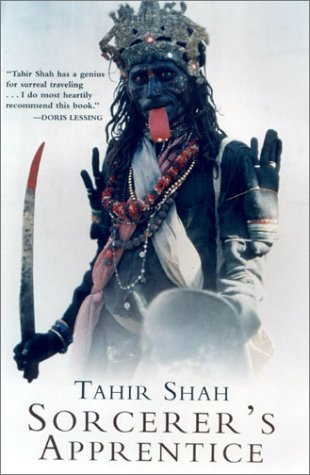
Follows the author's apprenticeship to one of India's master conjurers and his initiation into the brotherhood of godmen, during which he journeys the subcontinent, meeting a plethora of adhus, sages, sorcerers, hypnotists, and humbugs. Reprint.
Tahir Shah was born in London, and raised primarily at the family’s home, Langton House, in the English countryside – where founder of the Boy Scouts, Lord Baden Powell was also brought up.
Along with his twin and elder sisters, Tahir was continually coaxed to regard the world around him through Oriental eyes. This included being exposed from early childhood to Eastern stories, and to the back-to-front humour of the wise fool, Nasrudin.
Having studied at a leading public school, Bryanston, Tahir took a degree in International Relations, his particular interest being in African dictatorships of the mid-1980s. His research in this area led him to travel alone through a wide number of failing African states, including Uganda, Sierra Leone, and Zaire.
After university, Tahir embarked on a plethora of widespread travels through the Indian subcontinent, Latin America, and Africa, drawing them together in his first travelogue, Beyond the Devil’s Teeth. In the years that followed, he published more than a dozen works of travel. These quests – for lost cities, treasure, Indian magic, and for the secrets of the so-called Birdmen of Peru – led to what is surely one of the most extraordinary bodies of travel work ever published.
In the early 2000s, with two small children, Tahir moved his young family from an apartment in London’s East End to a supposedly haunted mansion in the middle of a Casablanca shantytown. The tale of the adventure was published in his bestselling book, The Caliph’s House.
In recent years, Tahir Shah has released a cornucopia of work, embracing travel, fiction, and literary criticism. He has also made documentaries for National Geographic TV and the History Channel, and published hundreds of articles in leading magazines, newspapers, and journals. His oeuvre is regarded as exceptionally original and, as an author, he is considered as a champion of the new face of publishing.
"What's in the bottle? It looks empty to me." "There's nothing in the bottle...just air. It's the yogi's last breath."
How many of these gurus have died just to have their closest disciples gather up everything they owned, their shoes, their bowl, their robes, their fancy cars, and then called them all holy? All religions do this or would if they could. Maybe it is like catching a baseball at the Super bowl and keeping it, or having Keith Urban's jacket, but at least these things are not considered holy, or are they? I remember when I was in a Neo- Hindu group, they sold bottled water from the Ganga river, and I bought one, so even I was not exempt from this, but I don't have that bottle now, as I poured it out on the ground one day and threw the bottle in the garbage.
So Tahir went to India to learn magic, while others joined Neo-Hindu groups in America to learn to meditate and find God, if not to learn some magic too. Tahir wrote a book about his experiences with his guru, while I just became disenchanted and left. And then I began reading books by ex-devotees and also listened to others' reasons for leaving. My own experiences were not as bad as what others went though, because I wouldn't put up with the gurus, and meditation never harmed me; instead it was rewarding. But to continue on:
Gurus can stop their pulses, sprinkle ashes on you and make other objects appear out of thin air. They can also heal the sick or even raise the dead, so they say. And they can stop eating and live on air, and you can learn to do this too, but I didn't try; I liked food too much. I also knew I would die. They can also read minds, and that I know to be true, but you never get enough information to make it all worth while; instead it becomes a side show or a way to make money, and most who do this are charlatans anyway or just think they are getting information from their higher self, when it is just a projection of their own minds. Have a psychic reading from someone you know, and you can learn what they really think about you.
In the 60s and 70s, India became a Disneyland for many hippies, as they flew on our magic airplanes to India to learn meditation, to learn the truth about life, and about the universe. Some came home with their minds' blown away from meditation and spent time in psychiatric wards, others came home disillusioned, as all their guru wanted was sex. And some closer to the gurus had sex with him or her, and then became disillusioned. And last of all some gurus taught "crazy wisdom." So if it wasn't meditation that blew their minds, it was how this crazy wisdom affected their minds. Either way they were blown away. Some committed suicide. The gurus just write these suicides off as "bad karma." So while Tahir's book is entertaining, it also contains some horrible truths.
Tahir searched and found his teacher, who was reluctant at first to teach him anything, and he told him that it wasn't magic, it was illusion. He put him through many tests. He taught him eat bad foods and chemicals and then how to throw them all up. He even swallowed small round stones and barfed those up too. Tahir obeyed; he had to if it wanted to learn. All gurus want you to obey; it is in their genes.
Tahir's stomach continued to churn, he got an ulcer, and he could have ended up in one of those graves where the bodies are just tossed into a pile and picked over by grave robbers and then sent to factories and displayed in doctor's offices. But this learning was that important to him, so he stayed with his teacher. He said that his teacher was sadistic. Yes, he was. Then after he learned, he wrote this book and exposed the gurus as charlatans.
I knew of monks and nuns that had left the ashrams, I know of disciples who had stayed and suffered because it was being disloyal to the guru to leave. Some monks and nuns in the ashrams left right away due to the abuse and were then considered weak by those who stayed. "Just can't get good disciples these days," the head lady said. If they stayed, some became depressed and finally had to leave, but were then called weak, but now they were also "disloyal." When the monks left, disciples also said of them, "They just wanted a woman." Remember in the movie, "Amarcord," when the old man got out of the nuthouse, climbed a tree and yelled to the world, "I want a woman!" It was like that. But it wasn't like that really; they just wanted out of the nuthouse. Women were secondary.
Tahir not only writes about what he has learned, he also wrote a great travel story and meets all kinds of eccentric people, as well as those who are living on the edge, like the grave robbers who sell skeletons, and the baby sellers who loan out the babies so that people can make money begging. And while I really loved Tahir's stories, I couldn't wait for him to leave his grueling teacher.
Still I liked one of the trips his teacher sent him on. He had to go to the cemetery and spend the night with just a candle, a blanket, a box of matches, some dates, and six samosas. Give me six samosas, and I will spend the night in a cemetery.
I remembered in high school when my friend Paulette, her male friend, Bob Fries, and I went to a cemetery at night. We saw a car pull up and stop. It was filled with boys from a nearby military base, and they were drinking and talking loud. They couldn't see us as it was a moonless night. Paulette got up from where we were sitting and walked along a row of evergreen trees that blocked the view of the car. As she walked along, she made a long drawn out moaning sound of a ghost " "My mother. My mother." Then she ran back to us and said that they had begun cussing. One said, "What the ---- was that?" Then they started the car and began driving around, flashing their spotlight over the cemetery grounds. We quickly ran under a nearby cedar tree and flatten our bodies on the ground just as their spotlight moved over our heads. They didn't find us and so left. But, Tahir in this book, was seen; he was being followed. I remembered him saying that you are never alone in India, and then I wondered if the person following him just wanted his samosas. And maybe it was me.
This is one of those books that gives me intense wanderlust. Tahir Shah is either a man with an incredible knack for stumbling across the bizarre, a fabulous liar, or some combination of the two. His story is absolutely outlandish, and sometimes I wondered if he was playing tricks on me just as the Indian godmen he visits perform illusions for rapt audiences. Several of the events in the book are just too coincidental, too good to be true. But in the end, I don't even care—his performance was so much good fun that it doesn't matter how much of it was real.
The book is about Shah's quest to complete a course in the art of illusion under the guidance of Hakim Feroze, an obsessive-compulsive and sadistic instructor whose skills border on the supernatural. After forcing him to study countless illusions and the work of incredible performers like Harry Houdini, Shah's teacher directs him to examine people throughout India and collect "insider information," which Shah accomplishes in ways you will definitely enjoy reading about. If you ever wanted to learn about India's skeleton dealers, questionable pharmacies, holy men, baby rental services, or a huge variety of other curiosities, this book is for you. Descriptions of unpleasant aromas, flea-infested hostels, and questionable dining experiences also make the stranger side of India come to life. This book made me want to hit the road and seek out "insider information" of my own.
One of the best things about Shah's work is that, no matter how gross or irritating his situation is, he describes it with obvious affability and good humor. Although he is a highly learned man and is occasionally prone to some high-falutin' prose, he never shies away from poking fun at himself. It's very easy to travel vicariously through him, and to feel like you've learned a lot by the end of the journey.
Ah, a juicy combination of Indian travelogue, cultural commentary, coming-of-age memoir and chemical cookbook. If you need to know how to fake not having a pulse with a walnut in your armpit, this is the book for you.
Interested in the relationship between spirituality, mysticism and stage magic?
Want to taste and smell dawn in Calcutta?
The writing is akin to Gerald Durrell's zoo collecting memoirs of the 1960s - a vast vocabulary at the service of precise detail and an enthralling true account of "surreal traveling".
A Journey of observation. Whose journey though? The writer's the reader's the sorcerer's the apprentice's. What a book even the commas are interesting. A burn the midnight oil book. Things are not what they seem in this extraordinary narrative. It is an inveigling 'wunderbar' book. 'Tahir Shah has a genius for surreal travelling..... I do most heartily recommend this book.' That is what Doris Lessing said. It is written on the dust cover of my 1998 hard cover edition. Quote from the book. 'Feroze was renowned as a magician, but his skills extended beyond the realm of illusion. He was a polymath of prodigious scope. His skills it seemed, were unlimited.' Pg 91. 'Whereas Godmen claim their conjury is "real magic" was Ferose maintaining the opposite-that his real magic was an illusion?' Page 87. I should think so: a master of illusion after all. A look at the detail suggests a sadistic master of tricks wide of the mark. It is funny too. 'Before I knew it the rickshawalla was giving me unnerving glances...fish heads had slimed down on to my shoes. Pg 143.
This book is a must read: a highly entertaining journey that can't be put down. I read it in about three days, staying up late at night to finish a chapter and then continuing onto the next one. If I hadn't had work to do, I would have read it in one sitting.
I don't know what the negative reviewers were expecting, but this book seems to have something for everyone: travel, humor, revelation of secrets of the trade. In a video on his YouTube channel, the author insists that the book is 100% true, and that there were even things he left out of it because they didn't sound real. I think this is a classic example of real life being even stranger than fiction. The author's experiences while in India are truly bizarre, and there is never a dull moment.
Interesante y amena mezcla entre novela, libro de viajes y tratado de magia (ilusionismo).
Al parecer, Tahir Shah es un viajero y escritor muy conocido en el mundo anglosajón, con decenas de libros editados, además de protagonizar numerosos documentales para la BBC, National Geographic y otros. En esta novela, supuestamente autobiográfica, Shah nos relata su viaje a la India en busca de un prestigioso profesor de magia. Aceptado como alumno, Shah comenzará por aprender (en un aprendizaje nada sencillo y lleno de anécdotas, a manos de un profesor despiadado y algo sádico) las bases de los principales trucos de magia y prestidigitación, para despúes partir en un viaje a través del subcontinente indio en busca de lo exótico, lo sorprendente, lo inesperado. Y de todo eso hay mucho en la India.
Veamos, tras leer el libro, personalmente no me creo que sea realmente autobiográfico al cien por cien: creo que hay mucho de novela y fantasía en todo lo relativo a la relación entre Shah y su maestro, y su supuesto aprendizaje mágico. Aunque lo que sí es evidente es que Tahir Shah, llegase a ser realmente aprendiz de mago o no, al menos se documentó exhaustivamente para el libro, explicando a lo largo de sus páginas cómo se llevan a cabo infinidad de trucos, muchos de ellos utilizados por gurús y similares en la India para atraer seguidores (y dinero) al tomarlos por "milagros". En cualquier caso, sí está claro que casi todo lo que explica sobre la India y los curiosos personajes y eventos que narra a lo largo del libro sí son ciertos, entre otras cosas porque muchas de estas descripciones están acompañadas por fotografías tomadas por Shah a lo largo de su periplo indio.
Al final tenemos lo que decía al principio: una mezcla entre exótico relato de viajes, mezclado con un tratado de trucos de magia de lo más variopintos y llamativos, y todo ello novelado con amenidad y con bastantes toques de humor. Todo ello convierte "El aprendiz de brujo" en una obra muy atractiva para casi cualquier lector, pero especialmente para los que se sientan más atraídos por los trucos de magia y/o por la India más profunda.
In his tenacious quest to become a master illusionist, Shah travels through India’s dark underbelly. Fantastically ingenious con men, skilled in misdirection and slight-of-hand, abound in India. Observing and reporting on India’s scam artists and “godmen” (frequently one and the same), Shah tells hilarious anecdotes, often at his own expense. The Tahir narrating Sorcerer’s Apprentice is a kind of Candide—naïve, exuberant, impervious to physical discomfort, boundlessly curious, obsessively carrying out a whacky agenda.
Sorcerer’s Apprentice begins when Tahir is eleven, living in a rural English village. Unexpectedly, an exotic Pashtin, Hafiz Jan, comes to visit. It is Hafiz Jan’s hereditary job to guard the tomb of Tahir’s ancestor, an Afghan warrior, Jan Fishan Khan, nicknamed the “Soul-Scatterer.” Warned by a prophetic dream, Hafiz Jan has traveled from India to save Tahir from falling down a mine-shaft. During his summer visit, Hafiz Jan instructs the child in magic.
Fast forward twenty years. Tahir is tired of his sensible job and security-obsessed friends. Deciding to pursue his boyhood dream of becoming an illusionist, he travels to Calcutta, seeking Hakim Feroze, Hafiz Jan’s mentor. Reluctantly accepting Tahir as a pupil, Feroze subjects him to a rigorous, multi-staged apprenticeship. Initially, Tahir must stand with arms extended in the hot sun, crawl on his belly to pick up small shells, and perform other demeaning and excruciating tasks. Demanding, equally meaningless mental exercises follow: e.g., memorizing a poem in Bengali, a language Tahir does not know. Maintaining that successful illusionists are polymaths, Feroze gives his disciple books on such disparate subjects as chemistry, cranial osteology, and Indian mysticism, demanding that he recite facts and formulas. In the fourth stage is the most interesting. Feroze demands that Tahir describe minute details of his surroundings. Again and again, Feroze asks Tahir to describe a room, a piano, or a person’s dress, then supplies details his pupil has missed. To borrow a phrase from Henry James’ Art of Fiction, Tahir must become “one of those on whom nothing is lost.”
These stages completed, Feroze teaches Tahir to perfect specific illusions: e.g., dipping his hand into boiling lead, swallowing and regurgitating stones, using supposed mental powers to make a ball of aluminum foil heat up. Feroze explains that Indian regard illusions differently from Westerners: “’In India, illusion, magic, conjuring, sorcery. . . is not a frivolous, whimsical thing. . . . It’s a tool of incomparable capacity. . . . . Sadhus, healers and mendicants, mystics and astrologers, so-called ‘godmen’, and street entertainers: they all use stage magic. . . . Through illusion, ordinary people realize their dreams of amassing astounding wealth and magnificent power” (p. 80).
As the final stage of his apprenticeship, Feroze asks Tahir to obtain “insider information.” In Calcutta, Tahir interviews Bhola Das, a hangman, who renders an execution painless by rubbing the rope with soap and banana, then positions a nut so as to snap the spinal cord. Tahir subsequently describes the processes used by entrepreneurs who steal corpses in order to secure skeletons for export abroad. In this poor, overpopulated city, people find imaginative, off beat ways to survive.
Feroze then sends Tahir on an odyssey of several months through India. An orphan, Bhalu, forces his company on Tahir. As streetwise and conniving as Tahir is bumbling and naïve, “the Trickster” serves as translator and fixer. Bhalu organizes and referees a contest between two illusionists. He somehow arranges that Tahir be entertained as an honored guest at an ashram run by Sri Gobind, a fraud whose prestige is based on skillful illusions. During his journey, Tahir observes “godmen” employing the illusions he has learned. “Miracles are more common in Hinduism than in almost any other religion. Indians,” Tahir maintains, “are far better accustomed to accepting the miraculous in everyday life. Other religions, like Christianity, do put faith in the inexplainable, but their miracles are few and far between” (211). Like Bhalu, who sells elixirs, made of common, often disgusting ingredients, godmen enrich themselves at the expense of the poor, desperate, and diseased.
Shah’s wonderfully funny, entertaining book left me with several questions. First, though Feroze subjects his disciple to a grueling, varied course of study, why does he never suggest that Tahir master any Indian language? During his Indian journey, Tahir is, therefore, totally dependent on a self-interested street urchin to translate and interpret. Second, because the bumbling Tahir that narrates Sorcerer’s Apprentice is so clearly a construct, what is the author really like? Is the narrator of Sorcerer’s Apprentice merely the much younger self of this much traveled and published author, or is he a fictional character? Finally, are people we meet in yoga classes, who believed that they had life-altering experiences at Indian ashrams, merely the dupes of con artists? Of course,it is deliciously refreshing to learn about Indian mystics from someone who, emphatically, has not received transcendental enlightenment. However, does the fact that Tahir’s godmen are illusionists mean that they are utterly without credibility as spiritual teachers?
This is the first Shah’s books I have read, and I am eager to read more! According to amazon.com, he is the author of numerous travel books.
For a really great Review of this book go and read Jessaca's ! I am not going to try to compete with that. But I have a couple of points to add. First to just briefly summarize; This is a brilliant book in which Tahir Shah is taken on and trained by what must be one of India's greatest Illusionists and then travels from Calcutta to Bombay observing India's godmen and explaining how they use illusions and trickery, rather than anything mystical, to impress the crowds of their powers, to win followers and to make vast amounts of money. These godmen use their knowledge of the body to stop the pulse in their arm by hiding a walnut in their armpit and pressing their arm against it so cutting off the blood supply in the 'axillary artery'. They use a vast knowledge of chemistry in most of their other miracles, making holy ash come from aluminium coins by rubbing a solution of 'mercuric chloride' on them so that 'the aluminium sweats ash' and placing a mixture of yellow phosphorous and carbon disulphide on their finger and thumb so that when they are 'rubbed together a plume of smoke rises upward from the hand'. But my favourite was the godman who was so holy that as he approached the stage all the tulips growing in pots in front of the stage bowed their heads in unison! Shah later crept back to the stage and found that, 'A concealed jet sprays chloroform over the blooms. Like humans, they are susceptible to anaesthesia and quickly droop.'
Let me also say that this is a brilliant travel book full of adventures and the colour of India and I thoroughly recommend it to everyone. But now to my main point. You could come away from this book believing that everything mystical and paranormal is a trick and a fake and I really don't want you to do that. In my own book 'Candles on The Ganges' I met one of these godmen on my second day in India and I suspected then that he used a magicians tricks to impress me and to get me to part with my money but he initially caught my attention by walking up to me and saying; "Sir, I am a fortune teller and a yogi and I must tell you that a lot of love comes to you on April 21st." I had gone to India as part of a six year spiritual search for my 'dead' son who's birthday was April 21st! How did he know the one date that would stop me in my tracks? Shah also mentions a guru who had been buried alive for forty days and was then dug up alive but gives no explanation or accusation that this was an illusion. A similar feat is recorded in the book 'A Season in Heaven' by David Tomory. During my six year search I trained in England to be a medium and during that time gave lots of evidence of survival of death to people that I had never met before (they are in my book) so I know there is life after death, it is not all trickery and illusions. In the 'Sorcerers Apprentice' a levitating guru is exposed when the blanket covering her falls away to reveal her standing on her two legs while holding two hockey sticks out in front of her as legs! Yet on one occasion as part of our training to be mediums four of us were encouraged to try to levitate a wooden table by pumping our energy into it. After nearly an hour of holding our finger tips to the table and trying to find the right brain waves to transfer our energy to the table, it began to vibrate and then to tip right over without falling, thus defying the law of gravity and then with us following it, keeping just our fingertips on its surface, the table proceeded to dance its way around the room with only one leg ever touching the ground. Afterwards we all agreed that this wasn't anything spiritual but it certainly was paranormal because science has not yet discovered how it could happen. One day science will understand that we are all far more powerful than we appear and can transfer our energy and will also understand that we all survive death.
Until that day I am happy for these things to be considered paranormal or occult (hidden knowledge) but just because there are Fraudsters and Illusionists out their taking advantage of people's naivity it doesn't mean that everything else whether mystical, paranormal or occult is also fake and an illusion. The only real illusion is death. Please remember that always. Now read Jessaca's brilliant Review.
If you ever plan to take a long trip through India, always go for a train provided you have the time, patience and fortitude for it. If you are an adventurous soul then always go for a non-AC sleeper option and it will be an incredibly rewarding experience in terms of the things you see and the people you meet. Of special interest to the traveler would be who come to sell their wares which range from ball pins to mobile batteries, the performers who sing and dance or perform magic tricks for a small donation either by themselves or with the small animals they carry etc. Take all these with a healthy dose of caution or you might find yourself in situations which are rather tricky for you to crawl out of. When I was doing my graduation, there were these two studious chaps who went for a seminar at a reputed IIT (Indian Institute of Technology) on the northern side of India. Their train journey lasted for a good two days either ways and on their return trip they were entranced by the smells of food that a vendor brought along. Unable to restrain himself, one of them bought and wolfed down a ‘Masala Cutlet’ which is the Indian equivalent of a cutlet laced heavily with spices. The aftermath of this crispy cutlet was quite explosive and he ended up spending almost all his remaining time in the train’s lavatory. The next time he turned up at college, the unfortunate fellow had lost 6 kg in body weight ! Tahir Shah’s book is not about cutlets or cell phone batteries, it is about the performers you meet across India : magicians/illusionists/god-men (& women) ! This is a hilarious roller-coaster ride across the length and breadth of India in search of the fantastic.
The number of adventures and experiences that Tahir Shah goes through makes the reader pause and think if all this is for real or the product of a very fertile imagination. The book however gets so immersive that such questions seem rather irrelevant beyond a point. Born into a well-to-do family settled in a sleepy village in England, Shah decides that a regular life is not what he is looking for and sets out on a journey to gain knowledge of the esoteric kind. Setting out in search of a long-lost acquaintance who can apparently teach him magic, Tahir ends up apprenticing himself to a master of the trade. The master, the inimitable and enigmatic Hakim Feroze is a character who steps straight out of a Chinese Kung Fu flick in being at the top of his game and completely dispassionate to the point of ruthlessness in his demands from the disciple. Tahir is broken and recast under Feroze’s tutelage and the incidents during this time of brutal learning are entirely hilarious. Tahir completes the ordeal by fire and then sets out across India to discover how the use of illusion is a means of livelihood for people. He meets sorcerers, witches, thieves, wig salesmen, a corpse stealing network, baby rental services, self-proclaimed gods, god-men and women, lunatics and true clairvoyants. This second part of the narrative is two parts rolled into one : Firstly is an excellent piece of travel writing that is a glimpse of India you get if you travel by foot, cycles or horse/bullock drawn carts. On the road you inhale the dust and diesel fumes, you smell the sewage and the street food sizzling by the wayside, you pass colorful characters on the road and you know that you are truly in India. Secondly, it is a sort of myth-buster about how the so called divine of India ply their trade. A lot of insider secrets on dazzling illusions are revealed as nothing more than an adeptness at prestidigitation and pure showmanship. To hold an entire group of people entranced, the effects that you show them should be nothing less than Hollywood standards !
A fantastic romp through a fantasy laden landscape that lies just beneath the veneer of the urban, metro India.
Labai tiksliai apibrėžta knygos esmė jos apršyme: "tai pasakojimas apie vakariečio klajones, gyvenimą ir patirtis Indijoje, pažintį su šalimi, kurios kasdienybė netelpa į racionalumo rėmus, kur kiekviena diena persmelkta neįmanomybės". Labai patiko žodis - neįmanomybės, nes joks kitas terminas tiesiog neateina į galvą, kai skaitai apie žmogų, patekusi iš surikiuoto ir aiškaus Vakarų pasaulio į visišką chaosą, kuriame negalima tikėtis jokios tvarkos, logikos at aiškumo. Noro keliauti ten nekilo, bet pasijuokti skaitant knygą buvo iš ko. Ypač patiko ta dalis, kur magijos mokytojas per pirmą mokymo etapą visomis Pelenės pasakos vertomis priemonėmis ugdo mokinio sugebėjimą klausyti nurodymų. Ačiū dukrai už puikią Kalėdinę dovaną.
I have read and have thoroughly enjoyed all of Shah's works. He comes from an elite British family of Afghan royalty. His parents wanted him to follow family tradition and pursue a noble profession. Instead Tahir opted for a free-spirited life of travel, anthropology and writing. His travel ideas are spontaneous andand the people that he meets along the way are serendipitous. In Sorcerer's Apprentice he travels throughout India in search of India's infamous illusionist. He writes about his magical journey in great detail, allowing you to learn much about the culture of India. This is one of my favorite reads of all time!
I enjoyed this story of Tahir running around India learning about Magic. I think there may of been a little embellishment in his true story. I believe one should not let strict adherence to the facts get in the way of a good story!
In the Sorcerer's Apprentice, author Tahir Shah, performs a feat of prose magic. Ordered by the Illusionist to whom he has apprenticed himself to take a cross-county tour to 'observe,' Shah takes the reader with him on a lively and ribald trip through the uniquely Indian world of religious gurus, healers, the 'secret army' and hucksters of many varieties. One of things I enjoy about Shah is his willingness to expose himself as alternatively credulous and incredulous, trusting and mistrusting while always up for anything. Shah's sidekick on his travels, Bahlu who Shah nicknames 'the trickster' is the kind of kid that one hopes will grow up to have safe, happy and prosperous life.
Another gem from Tahir Shah. I love the way the book is written . Highly enjoyable and evocative. To contemplate the intricacies of India in such detail and successfully meander the overwhelming chaos of the sub continent.
Always eager to read about the weird and exotic, this book met all the requirements. Traveling to India to learn the magician's arts, Shah becomes the student of the tyrannical but urbane and knowledgeable Hakim Feroze. After many weeks suffering through his training, Feroze ejects him into the vastness of India. Befriended by a young trickster, he experiences a country teeming with grifters and con men, traveling salesmen, roving holy men, buggy beds and bad food. (At one point, recovering from some bad water, he has a dream about elephants hauling the blocks that built the pyramids at Giza. In the many books I've read about Egyptian history, why have I never read of any archaeologists considering this?!!) Along the journey Shah sprinkles explanations of how the conjuring is done. This was one fantastic and enjoyable magic carpet ride.
Skaitant nesulaikomai kvatoji iki ašarų arba iš nuostabos ir pasibaisėjimo imiesi už galvos… Taip man jau buvo skaitant “Kalifo rūmus”. Tahir Shah puikus pasakotojas ir vedlys po egzotiškus Rytų kraštus, o šioje knygoje — po Indiją, šalį, kurioje gali nutikti bet kas. Visi aprašyti nutikimai, dažnai atrodantys tiesiog beprotiški, patirti paties rašytojo. Keletas citatų iš “Mago mokinio” geriausiai apibudins, ko iš šios knygos gali tikėtis skaitytojas.
“(…) tai pasakojimas apie Indiją, šalį, kurioje neįmanomybė yra kasdienybė.”
“Indija yra labiausiai ištobulintas ir patyręs gyvenimo teatras (…).”
“(…) Indija — šalis, kurioje Vakarų rūpinimasis saugumu liktų nesuprastas.”
“(…) buvom išvykę į Indiją ieškoti trečiosios akies, o radom tik dizenteriją.”
“Duokite bet kuriam Frankfurto ar Londono verslininkui desertinį šaukštelį, nuvežkite jį į Andhra Pradešą, ir jis badaus, nepraėjus nė savaitei. Bet duokite tokį paprastutį stalo įrankį indui, ir jis ras būdą visą gyvenimą iškaikyti savo gausią šeimą.”
“Jokia kita pasaulio šalis negali taip išmušti iš vėžių ir apstulbinti užsieniečio, kaip Indija.”
“Indijos kaimo gyventojui daugiau džiaugsmo už stebuklą teikia tik kieno nors viešos gėdos vaizdas.”
Europa dažnai panaši į prėską daržovių sultinį, o Indija — į kerintį, svaiginantį guliašą.”
Warning! This book is presented as a travel account, but it is mainly a work of fiction by an author who is deeply prejudiced against Hindus. It is materially impossible to get to know so many swindlers in so little time, and to gather so much information orally without knowing the local languages. The author very likely collected information from English-language newspapers he read during his stay and presented it as autobiographical, while choosing only the bits that would show Hindus in a bad light. Otherwise it would be extremely weird that he only managed to meet Hindu con artists while in my five-month stay in India twenty years later I got to meet a Sikh con artist in Delhi who was promising to heal travellers' "bad vibes" and a Muslim one in Goa who was posing as a hermit, but handed out name cards with his hotel address, strictly only to women. I managed to avoid the train scam by not accepting food from strangers. It did happen to an Indian friend of mine, though, but I didn't write a "travel report" and pretend it happened to me. After you have been warned, you can go on to read the book, which is fun enough, but taking it as a work of fiction.
This book had a lot of promise...which it did not live up to.
Author Tahir Shah goes on a quest to learn the "secrets of Illusion" from a master of illusion. He submits himself to all sorts of tasks that he should be learning from as assigned by the master.
He eventually is assigned the task of traveling through out India to observe. Observe what? Along the way he picks up a side-kick who helps pave the way for him. Never mind the sidekick is a young thief and liar.
After all his so-called adventures, what has Shah learned? Apparently nothing. If you don't believe me, go to the library, pull the book off the shelf, sit down (if you want), and read the last chapter. If you don't say "so what"? I would be surprised.
I have a bad habit of reading books I start to the end. This is one I should have dumped early on.
This journey in India was absolutely crazy,funny and informative.Big applauses to the author of the book Tahir Shah,the translator into Bulgarian language Maya Liutzkanova and the narrator in Storytel Viktor Tanev.Highly recommended to my Goodreads friends.
Indijoj esu buvęs tik kartą, trumpai ir darbo reikalais. Tačiau tikiu, ką rašo Tahir Shah - užtenka užsimerkti gatvėje ir Indija tave užlieja, o tu išvyksti visiškai kitoks, negu atvykai. Jau gerus septynis metus skaitau apie Indiją, ir jaučiu, kad tos kelios ten praleistos dienos iš tikrųjų įsirėžė labai smarkiai. Žinau, kad grįšiu ten gerokai ilgesnei ir nesusijusiai su darbu kelionei. “Mago mokinys” viena geresnių mano skaitytų knygų apie Indiją. Tai kelionių gidas, nuotykių knyga, autobiografija ir savęs paieškos. Rašymo stilius paprastas, bet vaizdingas.
It is little wonder that this, the book which tells of Tahir Shah’s time in India, learning conjuring and illusion from Hakim Feroze – a callous, sadistic, obsessed magician with unnerving occult powers – is his most popular work of travel.
Before initiating him into the secrets of Indian magic, Feroze instils in his apprentice the capacity to endure and insists he becomes a polymath. As if foreseeing the young man’s future life and work, he provides exactly the preparation needed. This includes striving for perfection and an extraordinary attention to detail. Then, after his pupil has practised illusions and can perform them to his satisfaction, he prescribes a search for Insider Information and a Journey of Observation.
As we accompany him, and the mysterious twelve-year-old trickster who has decided to be his travelling companion, we visit out-of-the -way places, from a shelter for mistreated cattle, to a factory where skeleton dealers ply their trade, to Bombay’s Native General Library, the haunt of elderly Parsi gentlemen. We meet highly unusual people, from the Keralan mahout (elephant trainer) to the scientist on the Hatia express, who confides he is building a temple ship, complete with dairy farm, on a Pykrete base. Pykrete is a composite material made from wood pulp and ice. There are hilarious episodes and images that will make you laugh out loud; but there are also dark passages where Tahir comes across drought and bonded labour in Orissa, or pregnant women having ultrasound scans as a prelude to gendercide.
You begin to realise there is more than one India. There is the vibrant country which can be sensed through our famliar sense organs but, in a parallel world, there is an invisible India, one which attracts Westerners on a quest. For those searching for truth, enlightenment, themselves, or simply the bizarre, India is a country dedicated to assisting any one on a journey.
If you haven’t read this book before, I heartily recommend you download it. If you have read the hardback, please consider reading the eBook. Every chapter is a gem.
This is a great book. I can tell because the other reviews are either love it or hate it. I am the weird one in that I wasn't in love with the book of journeys to find out the culture of illusion in India, but it was interesting and I chuckled a couple of times. I like the way Tahir Shah writes in a somewhat humorous self-debasing sort of way. And I was intrigued to find out how the "Godmen" (isn't that an oxymoron?) were able to do their tricks. And, I was impressed with the way Tahir Shah described India a beautiful, unique culture.
Tahir Shah goes to a man who is supposed to be one of the top illusionists in India. After going through some insane, brutal physical tests, he is then allowed to learn the art, and then he is sent on a journey to observe. I can't say I was shocked when I came to the "aha" moment, but I still feel as though I learned a few things, even about Houdini. Shah did a great job intermingling the culture with his story, but I have to say, there were lots and lots of parts to the story and while I just finished it yesterday, I think I forgot 3/4 of it already because there was so much. I'm a simple gal...
Disappointing in many respects. Shah wrote this long before The Caliph's House. His writing skills improved enormously over the years, but as he traveled through India, desperate to become a skilled illusionist, I was amazed and then annoyed by his overwhelming naivete. Although his wide-eyed, oh gee--was still evident in Caliph's House, in that account at least he was not a danger to himself and others. One of the astonishing elements is how the plot of The Case of the Man Who Died Laughing (Tarquin Hall) is literally the fictionalized account of Shah's book. And Shah praised Hall's book on its back cover. They must have worked together over many cups of tea.
Briefly, Shah journeys to Calcutta to study under Feroze, a master magician, also a world-class sadist. Shah is so anxious to claim his goal that he suffers physical and psychic cruelties far beyond the need for a nice healthy twist of commonsense. There is an overall structure to the account, which I get--but am really not sure it was worth the effort.
1971 I traveled to India, Nepal and Afghanistan. The world was a safer place. Many of the homes I visited had pictures of JFK hanging on the walls and once people found out you were American there was smiles and welcoming all about. If only it was still so. I digress. I enjoy travel books and was hoping this one would semi satisfy my chronic wanderlust. It didn’t. I liked the parts of the story when the author described the people and places. Much less so the rest of the book. Let’s just say I won’t be booking air travel to Calcutta any time soon.
This was an interesting travel book, where the author travels around India looking for magicians and illusionists and other odd characters. It definitely made me realize how much can be accomplished by tricks and illusion-levitation, flowers bowing down, "hibernating", etc. I found the story of the konkalwallas (skeleton collectors) particularly interesting. I'm not a big fan of his humor, and the resolution of his apprenticeship is anticlimactic. But still, in all it was a short, fun read.
Amaizingly interesting, humorous and sad at the same time, astounding and shocking. Yes, this is India, and Tahir with ease let you smell it, taste it, feel it, you will worry for people there and admire them...
Fascinating travelogue of a man in India studying to become a great illusionist and searching out the strange and bizarre across the country. The beginning of this book is very strong, but as it goes on it seems to wander (as the author is wandering) and lose focus.