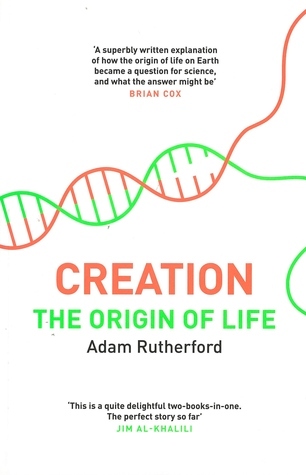
This book is about life’s story, from its earliest beginnings to now, the era of genetic engineering. My interest in the book is more on the former and, particularly, three issues: Life’s origins, definition, and goal-seeking.
Rutherford believes that life’s origins began roughly four billion years ago. This is when the transition from chemistry to biochemistry and to life occurred. Rutherford sides with the ocean vent theory of life’s origins. Though his technical account is difficult to follow, it is roughly this: Acidic seawater reacts with virgin mantle rock, splitting up the rocks into oxygen and hydrogen, and creating cavities that allow biochemicals, the precursors of life, to form. Through a process of coming together in the right way, this results in two great branches of life, archaea and bacteria. The key to all of this, Rutherford argues, is an energy gradient (the continuous interaction of acidic seawater and alkaline rock), and the protective membrane-like pockets in newly formed mantle rocks that allow life-giving chemicals to form. (1) This is “Luca” (the “Last Universal Common Ancestor), the first life forms where “two sets of molecules grow to line the inside of separate rocky chambers that hold this brimming biochemistry. One will lead to bacteria; the second, to every other living thing. The biochemistry that has developed in these cells is shared, but from now on, as they evolve new powers, they build different types of membranes to house themselves, and new ways of maintaining the energetic difference between outside and in. There, stuck to the side of a gassy rock at the bottom of the ancient sea, cellular life begins.”
The single-celled archaea and bacteria were the “two domains of life” that, about two billion years later, evolved into a third domain, eukaryotes, when “an archaea swallowed a bacteria.” This was “the arrival of complex life. Rather than death of one or both, mutual benefit was the result. The consumed ceased being a free-living entity and was permanently annexed into the guts of what would grow to become the third domain of life, the one that you are in.” And replication, mutation, natural selection took it from there.
With this history, Rutherford attempts to show that the basic mechanisms of life – cells, membranes and metabolism, the formation and refinement of code-bearing molecules, and the energy gradient that defines inter-cellular communication – had their origins in this primordial exchange of seawater with newly formed mantle rock. With life’s fundamental uniformity, his overall point is that we are manifestations of life’s Big History.
Rutherford’s discussion of life’s definition, the second issue, struck me as less than on-point. He goes around the topic several times, never landing for sure. In his chapter, “What is Life?” Rutherford writes that “everything pivots in the journey from inanimate matter to living matter,” and his book probably can be described, in part, as a description of this journey. He discusses all of the individual elements without singling out anyone. There’s the transfer of information “from cell to cell and from organism to organism.” Later, he refers more generally to life as “physics, chemistry and biology” and its “vital characteristics: energy, information, reproduction, metabolism and evolution.” Rutherford echoes a prominent Nobel researcher who states, “We just want to understand the process and all the steps. We don’t need to say, ‘Here’s the dividing line: on this side there’s chemistry and on this there’s biology.’ The important thing is the path.” Rutherford more or less drops out of this “what is life” debate when he writes, “When pondering the origin of life, however one tries to define it….” In short, he writes that “At one stage there was chemistry on Earth, and at a later stage there were living things. The route from the first to the second point is inevitably long, tortuous, and messy. The point where we definitely have living things is certainly where things become Darwinian, but not solely….In other words, the boundary between chemistry and biology is arbitrary.”
Yet, interwoven throughout the book the role of energy and its gradient seems key. (2) Rutherford notes the continuity that runs from physics to chemistry to life. (3) Physics is inanimate matter and energy, which is movement; it’s freedom pure and simple, void of purpose, created by energy gradients that move from higher to lower. It’s about the dissipation of power and entropy. With life, this changes. The process that gets to life as Rutherford outlines is long, but once that process moves across that arbitrary line, life formed by chance becomes something quite different. Life now becomes anti-entropic or counter-entropic if there are such words. It imports energy, incorporates it, transforms it into organization and order that defies, for a time, entropy. Life needs energy to support itself until it can survive no more and dies. Through replication, life defies entropy once again, but here, with the chain of life, it defies entropy forever. (4)
The third issue involves a couple of points that are more implicit than explicit in this book. In contrast to much of the discussion about life, which is Newtonian (life, in blind motion, reacts to objects and the environment; the self as a reactor to negative and positive objects), Rutherford is saying that life, from its earliest origins, is purposeful and goal-seeking, i.e., it is more than a passive being waiting to react. Otherwise, why does life “care” about movement (and the freedom to move), acting and reacting to objects of pain and pleasure? Life is both a seeking entity – it needs sustenance-energy from the environment (and all else is supporting cast) and a reacting entity. (5) With the membrane, life establishes a boundary between what it needs from the outside, energy, and what it doesn’t need, which are threats to its capacity to protect what it needs to survive. The cell membrane, the physical entity, is also the metaphor for life as a seeking and defending entity. It’s more than a protective boundary. It protects against incoming threats and harms so that it can retain the capacity to seek what it needs to survive. On another point, with eukaryotes, mutuality is established as a life property to go along with competitive self-interest. Here, mutuality based on utilitarian self-interest is built right into life’s very being. But, interestingly, the conceptual boundary between mutuality and competition is blurred. Mutuality provides a competitive advantage because it makes an organism or multi-organism (groups) stronger (this is a point Darwin makes regarding the origin of our social nature and group-versus-group competition).
(1) Rutherford writes that these vents are “fizzing with the energy of reactions between the mantle of rocks and sea water….The vents emerge from the seafloor as the plates of the earth shift and split, revealing fresh hot virgin rock drawn up form the mantle. Once exposed, they react with seawater, splitting it apart into oxygen and hydrogen and a host of other gasses that are equally brimming with energetic potential, eager to react. In so doing, these gasses percolate through the rocks, driving a honeycomb into them as they cool in the surrounding seawater, a process called serpentinization.” The pockets function something like a cell, with membranes and metabolism (a “most elemental metabolism….It relies simply upon there being more protons on one side of a membrane than the other”). The continuous exchange between the “rocks and sea form natural proton gradients [“electrically charged hydrogen atoms”] in the swirls around the honeycombed rocks.” “Protons,” he goes on to say, “stream around the pockets in the rocks, to be concentrated into the alkaline interior away from the acid sea.” And, he adds, “The acid sea and the alkali interior of the vent rocks provide a natural proton gradient for the flow of power that incepts a basic form of metabolism, and it is continuous for as long as the vent is active. Simple biochemical reactions that we observe in modern cells begin to occur in this energetic mix, and we start to see amino acids being forged in this tumult. Next come other foundation biomolecules, such as sugars, purine, and pyramidine rings, and other molecules that we see in metabolic cycles. Purine and pyramidine go on to fuse, becoming bases—the letters of genetic code….”
(2) Elsewhere Rutherford writes that “Life is a process of harvesting energy from the environment.” And “life-forms are first and foremost a sophisticated collection of chemical behaviors underwritten by the need for energy….In our cells there are two parts of metabolism: the first is the digestion of molecules to release energy, and the second is using that fuel to make life-sustaining molecules, including DNA and proteins.” And, regarding the two branches of life, Rutherford illustrates in a nutshell energy’s central role by writing that, in “the way animal cells can take in oxygen, extract energy, and pump out carbon dioxide; the way plan cells can take in carbon dioxide, extract energy, and pump out oxygen,” energy is fundamental.
(3) “Biological behavior is determined by chemical behavior, which is determined by atomic forces, and these are the realm of physics….Physics, by its nature, tends toward the fundamental, and Schrodinger’s conclusions derive from one of the absolute and most nonnegotiable universal rules: the second law of thermodynamics. This is the principle that dictates with total authority that over a period of time, energy will always flow from a higher state to a lower state and never the other direction.”
(4) Rutherford’s focus is on waste on each living system as the counter to entropy, but does this sidestep the more fundamental process that is involved with open systems? “To be alive is to struggle against entropy,” he states. “Life does not violate the second law of thermodynamics….In death we all submit to the will of physics, and our atoms accept their universal fate: to decompose and to be recycled, ultimately into less energetic states….Life has evolved to extract energy from our surroundings and use it to maintain our vital information against the universal slide toward equilibrium by swapping and pumping protons from one side of a membrane to another inside a cell.” And, “while order is increased and maintained during any life span within the living thing itself,” he writes, “this seeming contradiction of the second law is more than compensated for by an overall increase in entropy beyond the confines of that organism: that is, your waste, the entropy of the amount of waste you have generated in your life is overwhelmingly more than the reduced entropy your body maintains by being ordered.” The part that confuses me about this is Rutherford observation is that entropy applies to closed systems, which life is not. Life as an open system brings in energy and uses it for self-organization and order. The import of energy in an open system seems to be the central point, not the waste that is expelled.
(5) The energy of life is fundamentally different than the energy of physics. The latter is movement and freedom pure and simple. The former is purposeful energy and free movement now is dependent on objects.