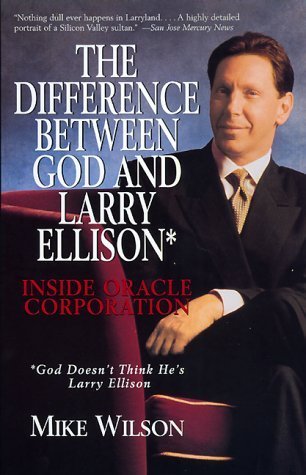
Mike Wilson has interviewed more than a hundred of Ellison's friends and enemies - as well as Ellison himself - to create an entertaining and provocative portrait of this enigmatic and visionary businessman. '
Ya gotta admit, Lawrence Joseph Ellison, founder of Oracle Corporation, is a potentially fascinating subject for a novel, but not for this one. The title itself is a give-away, and I’d not have chosen this particular book myself rather it chose me...ending up in my book basket The author has a seemingly endless dislike for the charismatic Mr. Ellison, and this gloomy aura permeates the entire read. One wonders how author Mike Wilson ever had the privilege of speaking with Ellison once much less 4 times (which speaks to the generosity of the subject). Yet the rare accidental and intriguing glimpses into the personal side of this enigmatic and powerful man are worth pondering.
“I’ve never met anybody like him, ever. Not even close.” Barbara Ellison, former wife and mother of Ellison’s children on why she never remarried or even dated seriously. “Once you’ve gone vertical in a fighter jet, who wants to chug along in a bi-plane?” Paraphrasing by author Mike Wilson
I never imagined life inside an enterprise software company could be so interesting! Kudos to the author of Ellison's biography for his witty style and convincing research. One might argue that the book is biased, focusing too much on Oracle's shortcomings and Ellison's personality flaws, but I'm sure the author has his reasons, plus it makes for a more amusing read. Hopefully someday we'll see part II of this biography, because it stops at year 1997.
Before judging Larry Ellison, you need to learn about the beginning from his childhood, raised by an old aunt, to the start of the project "Oracle" to build the # 1 database used around the world; from the CIA to national and multinational organizations in more than 142 countries. The lesson to me is inspiring because Larry Ellison success is about being DIFFERENT and STANDING OUT in the crowd. Larry Ellison is a visionary. Indeed, he started with internet applications. How do you pay your utilities or phone bills today? Larry Ellison also talk about "internet to go" and this was LONG before anyone How do you when stay connected when you are not sitting in front of your computer? There are many examples. Now the visionary is into CLOUD. And yes, Larry Ellison brings what most people fear The DIFFERENCE. He's UNIQUE and that is one of the factors positively impacting his success which also shown in the final showdown of the America's Cup Win by the ORACLE USA Team in 2013 as CNN put it something like "there are comebacks and comebacks" . That's Larry Ellison.
How did they get away with it? While Wilson focuses on Ellison, this book is a great reminder of how much guys like him, Gates and Jobs promised - but didn't deliver with their products. Yet, in the 1990s, we put up with the shortfalls and poor software, and made them billionaires.
This book was very interesting. It wasn't as good as the book about Steve Jobs (see my review at: https://www.goodreads.com/review/show...). I found Steve Jobs to be arrogant and driven, and he certainly had major issues with personal relationships, including his family. I don't think I would have liked him as a person, but while definitely flawed he certainly was a genius. It seems that all such senior executives are driven, have abrasive personalities, and are motivated by control and power (and also money).
But I find Larry Ellison a breed apart.
Full disclosure: I worked for Oracle for about 8 years, visited Oracle headquarters, but never met (or even saw in person) Larry Ellison. But it was hard to work for Oracle and not realize that the entire company was driven by Larry's attitude; I never was comfortable working there -- the brashness and arrogance seemed endemic; the attitude to get the product out whether it was ready or not, tested or not, was steeped into the psychology of the company. While reading this book, I could see why the attitude endured, and why customers knew not to immediately adopt a new version of the Oracle Server database until the "point version", when they might find the most serious bugs addressed. The books cites an entire history of these kinds of practices, driven mostly by Ellison.
Yes, Ellison was prescient in his early adoption of relational technology, and beat IBM (whose model it was) to the market with incredibly aggressive marketing and misrepresentation. But he was (and probably still is) an extreme case of arrogance, pushiness, but more to the point, underhanded tactics, behavior bordering on (and sometimes crossing the line of) illegality. Not to mention his well-publicized "private" life. No wonder that, by the time I was "sold" to Oracle as part of Digital Equipment Corporation's database group, Oracle had a pretty ugly reputation.
I could, to some extent, admire Steve Jobs as a truly gifted guy, albeit flawed, and he certainly was arrogant and pushy. But I find Larry Ellison to be underhanded, brash, even more arrogant, and so many other distasteful things. I felt to a certain degree "dirty" while reading about what he did to build Oracle. I'm glad he never achieved his goal of becoming richer than Bill Gates. And now Jeff Bezos is richer than either of them -- but that's yet another story...
Note that this book was published in 1997 (which precedes the Steve Jobs biography by 14 years). I miss learning about what happened to Oracle and Ellison since then.
Oracle’s sole focus was sales, not technology. They succeeded because despite having a mediocre product they: - didn’t let competitors differentiate (eg “oh Competitor supports DB transactions? We will as well in the next couple of weeks” ... 3 years later they offer it) - let salespeople be flexible (eg offering whatever discounts to make the sale) - did not allow other functional roles to add process that would slow them down (eg finance wants sales to fill out an additional form after making a sale? No way)
What’s most shocking is that even though Oracle continuously lied about what they had and paid no attention to customer support it simply didn’t matter. The moment a sale landed, customers would commit to investing into integrating with Oracle and would become customers for the next 10 years drying out any opportunity for competitors to survive.
Consequences of lying to customers? Minimal Consequences of having a shitty project? Minimal
Currently half-way through this one. Interesting pieces of info on Larry's upbringing in Chicago, including the motivations that drove him to build Oracle. However, the book reads more like a boring newspaper article than a good book. That said, it's quite factual and analytical, but a bit on the dry side and lacks anything resembling interesting prose.
Most of the book is dedicated to the deceit, trickery, and questionable ethics of Oracle's sales department — cooking the books, et. al (all of which Ellison denies any responsibility for). What I would have like to have read more on was about Ellison's character as an entrepreneur & businessman — since he appears quite interesting, introspective, articulate and visionary in his interviews (Charlie Rose being his best interviewer). I would have liked to have read more about his dare-devil escapades such as flying planes and racing carbon fiber yachts in the America's Cup, however those details seem to be missing somehow from this book (with more of an emphasis on office politics). Lastly, you'd really have to know how database technologies work to really find some of the more technical writings on the subject interesting; or to understand the jargon.
Wow! It's 369 pages are very inspirational and captivating bio of one my favorite entrepreneurs. I amazed reading about his first years, forward about his journey to Japan.
He´s an confrontational and agressive business man. His divorce and and his endless willingness of being number one... hardworking and very rough man.
Mr Wilson´s book has written a master piece on the life of L Ellison....a real must to read book
The book is indeed very long, sometimes it feels that it could some parts could have been skipped or summarized. Regarding the content, it basically tells the story of Ellison until the late 90's, diving into his personality. At the same time tells the story of Oracle. In some chapters the author focuses on the company and in others on Ellison. I personally found the first half of the book very interesting, basically because it tells how Oracle was started and came to be the number one database company, when at the beginning was probably the least likely to become the market leader.
I learned how much you can achieve with thinking differently (and a good marketing strategy). I think the basis of Oracle's strategy is the fact that usually people follow fashion instead of reason, as Ellison has mentioned. So instead of preaching customers to follow reason, Ellison decided to go for fashion. It didn't matter that there were far superior products to Oracle, what mattered is that people bought Oracle and that big customers did, so that small customers also did by inductive reasoning. Of course, this only works at the short term, but why would you care about the long term now?, the long term can be addressed later. As Oracle did later with Oracle 8 (or 7, not sure) which was the first Oracle DB that did work as promised, due to hiring ivy league students. The technical strategy to achieve long term market leadership is not mentioned that much and I think is equally as important as the marketing strategy.
Andrew Mendelsohn writes about this strategy and makes the argument that Oracle became a leader because they kept adding features to the DB that other companies offered as other new products, while they also focused on maintaining a technical differentiator against the competition (thinking differently is key). I would recommend this document to better understand the technical side of the strategy: The Oracle Story: 1984–2001. IEEE Annals of the History of Computing.
Ignore the horrific 90s cover. Picked this up because it was recommended to understand how Oracle got started and the ballsy way they seized their early breaks. Larry is the closest thing tech has to a bond villain and regardless of the fact he's a piece of work, the way he capitalized on the academic efforts of IBM and turned it into a real product is interesting to read about. One staffer sums it up as: "We took the [IBM] book, and we typed it in, and we shipped it".
Lots of amusing anecdotes, some slightly sickening ones. The reasons for the near collapse of the company's stock in 1990 is interesting and extremely relevant to this day. Contains insight into Bob Miner, the technical cofounder, that was interesting too. Unlike Larry, even when a multi-billionaire he used to sweat over buying a $15 CD...
Due to the publication date (the most recent edition only updates until around 2003) it doesn't cover the more recent history of hostile takeovers of Siebel, etc.
I didn’t know what to expect with this book and was frankly surprised by how interesting the history of Oracle was. For what seems like a boring database company the history is littered with made for tv bigness in its over the topness. The history includes stealing from IBM, gold bars, murder suicide, having the DoD be their QA department, crazy ex girlfriends, rivalry with Microsoft, and yachts.
However, Larry Ellison was prescient in regard to database, enterprise applications, portability across architectures, that marketing and sales are important for tech, and the Network Computer. Though the Network Computer failed at the time, Sun Microsystems’ CTO Eric Schmidt eventually created one with ChromeOS a decade later. The Network Computer’s hardware partner was Sun.
All in all an entertaining book that shows that work at all cost isn’t the way forward.
This is a workable account of the origins of Oracle and the creation of Larry Ellison as one of Silicon Valley's primary protagonists. For business journalists, it's also an interesting illustration of how people executed the craft 25-30 years ago. It is nothing more. The author wants it to be Citizen Kane, which it is not; at its best moments it almost accomplishes a Glenngarry Glenn Ross but for enterprise software vibe. The writing is a bit flabby, and the discussion of Ellison's interactions with women is, at the least, cringe by todays' standards. The book ends in 1997 or so, pre-Internet bubble, so it misses a key point of drama in any tech history. You can't blame Wilson for that, except that he went back and wrote an
This book is very interesting and written in a very engaging way. I appreciated it because it presents Larry Ellison's founding and running of Oracle in a very matter-of-fact light. It does not set him on a pedestal, but it praises his good qualities and is blunt about his shortcomings. It also has a fair amount of detail about Oracle's other executives through the years. I recommend this book to the reader that enjoys reading history about the technology industry and those that might be interested in the life of an eccentric character that created one of the biggest companies on the planet.
This was a good book on the history of Oracle and its founder. Gives you a rather complex picture of Larry Ellison, but he does seem like a complex person.
I wanted to read the book Softwar to read the history of Oracle corporation, but could not get my hands on it, but this was a good starting point.
You get to see that Larry is a great salesperson, good at strategy, but has shades of grey around a few areas. The fact that author had interviewed Larry Ellison many times was also helpful in providing his own view of the events which are described in the book.
I really enjoyed this book. I thought it was well-written, considering all the people he had to talk to and since we moved to the Silcon Valley shortly after this all started it felt like a piece of puzzle from my life.
It’s a long biography of a tech entrepreneur. It has good lessons on watts the wrong motivations can lead to and hoe good it is to be wrong when you were right about such a big thing that got you a lot of money and power.
I liked it, it’s good to see the detail involved with early stories of now lasting businesses. Everyone “hates” oracle products supposedly but my view is that there’s so many people in an org that it has to please, it’s hard to get everyone behind it.
It was really awesome and inspiring. What a man he is. He is stupid sometimes but some of things was astonishing ' he didn't ever care about past. He always talked about future'. He was daring to take risks. He had guts. He always believed, ' work is act of creation.'
I loved some of things about him 1). Always optimistic and thought in future never about past. 2). He didn't sell shares and took loan on them because he always believed in his work. He knew his shares or work will be more worth in future. 3). He would not feel embarrassed ever even if his ideas won't work. 4). He didn't let his affairs come in company work. 5). He bought everything he wanted except Apple. 7). He has only best friend Steve jobs and he was happy for him always and ready to help. He didn't buy Apple and one of reason was Steve jobs. 8). He used to go with his kid, 7 year old, for flying planes. He let his son take decisions while flying and put their life on risk. That's the fastest way to teach responsibilities to son. I liked it. 9). He didn't forgive the girl , Adee, who put wrong case on her. He took revenge after many years and Pu her behind bar. 10). He was full of charisma and good in making stories.
He did some mistakes in life like taking finance as stupid work, not caring about employees ever and was emotionally attached with his company (didn't sell his stocks in beginning).
But overall he was awesome.
Some things were common in both Steve jobs and him and it was inspiring. 1). They had vision and good in marketing. They didn't come up with idea but they executed other's ideas in better way 2). Both gave the most important to company. 3). Both could not run company at one time and everyone thought companies are no more. But they proved that they can do it better than anyone. 4). They were not visionaries from begging but they became with time. 5). Both were self made multi billionaire. They learnt the market with time sticking with their plans when very few trusted them. 6). It needs gut to stand against the most powerful guy in market and Both were against bill gates somehow bcz of different reasons. My next one will be biography of 'Musk'. Let's see what he did different.
I read a chapter or two before giving up on this book. He's written some juicy stuff no doubt but I wasn't gaining more interest on the subject. I feel like I couldn't care less whether he did X or did Y. What's in it for me? And besides the juicy gossip (about which I found what he had written to not be true) there's nothing else that answers the question.
I kept it on my shelf for a long time hoping that someday I would pick it up again. But nopes. It's not happening. So I'm dropping this book.
Die Biographie von Larry Ellison ist im wesentlichen eine Biographie der Datenbankfirma Oracle. Davor gab es wenig, was im Leben von Mr. Ellison eone größere, wichtige Rolle spielte. Nach Lektüre der Biographie versteht man den Software-Giganten Oracle und kann nachvollziehen, woher manch unpopuläre Entscheidung getrieben wird. Das Buch erschien bereits 1997, ergo bleiben die Ereignisse der letzten 10+ Jahre leider unberücksichtigt.
Wow! I'm mighty thrilled to be working at Oracle! The current edition ends with 2003. A humungous lot happened after that--for instance, major takeovers! I wait with baited breath to see what Mike Wilson has to say about all that.