

What do you think?

The Cloister and the Hearth
Set in 15th century Europe, the Cloister and the Hearth is a vast historic novel revolving around the travels of scribe and illuminator, Gerard Eliassoen, as he passes through multiple countries, presenting a vivid image of life and obligation during the Middle Ages.
728 pages, Kindle Edition
First published January 1, 1861
About the author
Charles Reade
245 books41 followersCharles Reade was an English novelist and dramatist, best known for The Cloister and the Hearth. He fell out of fashion by the turn of the century - "it is unusual to meet anyone who has voluntarily read him," wrote George Orwell in an essay on Reade - but during the 19th century Reade was one of England's most popular novelists. He was not highly regarded by critics.
Ratings & Reviews
Friends & Following
Create a free account to discover what your friends think of this book!
Community Reviews
Displaying 1 - 30 of 80 reviews

November 12, 2011
What a wonderful historical novel; my thanks to the person who turned me onto it. Beautifully written, The Cloister and the Hearth is the tale of the forbidden love between Gerard Eliassoen, a young novice scribe and illuminator, and Margaret Brandt, the daughter of a physician. The story takes place during the late Middle Ages, and therefore contains the requisite "thee"s and "thou"s and even a few "forsooth"s, so those whose cup of tea that is not, you know who you are.
Love thwarted by the machinations of a spiteful burgomaster and Gerard's greedy brothers, Gerard sets out for Rome, determined to make his way in the world and provide for his secret bride. Adventures ensue. Many adventures. He befriends Denys, a woman-crazy but good-hearted arbalestrier (a crossbowman--I had to look that one up) who becomes his boon companion. Adventures and more adventures. I won't give anything away, but the part where Gerard and Denys are beset by bandits at an inn, and the way Gerard cleverly uses his talents to gain the upper hand, is one of the coolest things I've ever read.
But I'm not even scratching the surface here. Adventure! Romance! Betrayal! Escapes from towers! Castle sieges! Assassinations! Bear attacks! Indeed, it's chock full of incident, but the wonderfully wrought. believable characterizations combined with Reade's beautiful, archaized Victorian prose make it worth reading. Keep your dictionary app handy, though.
The following is an incomplete list of words that I looked up during my reading of The Cloister and the Hearth:
theodolite
dithyramb
permanganate
jalousie
otiose
pismire
exequies
burthen
minaret
ultramontane
exegesis
diadem
catechumens
kickshaw
kirtle
farthingale
hircine
kine
arbalestrier
animalcula
quadrivial
ganymede
orison
psalteries
pipkin
auberge
diapason
leveret
pettifogging
dict
capias
wanion
pizzle
mijauree
minauderies
grimaciere
petronel
dudgeon
curtal ax
chough
cordwainer
groat
eftsoons
pursuivant
mantelet
mangonels
barbican
machicolate
fascine
devoir
malison
roof-tree
virago
leman
tabor
mickle
clept
yclept
febrifugal
whitemail
caitiff
whids
cozening
tatterdemalion
cul de bois
quean
lapwing
vopper
rotboss
glaive
windlass
culverin
marchpane
canzonet
oriel
cavil
Myrmidon
septemvious
seneschal
mare's nest
Aspersorium
peradventure
cilice
That's actually not a complaint; I like a book that keeps me on my toes.
Love thwarted by the machinations of a spiteful burgomaster and Gerard's greedy brothers, Gerard sets out for Rome, determined to make his way in the world and provide for his secret bride. Adventures ensue. Many adventures. He befriends Denys, a woman-crazy but good-hearted arbalestrier (a crossbowman--I had to look that one up) who becomes his boon companion. Adventures and more adventures. I won't give anything away, but the part where Gerard and Denys are beset by bandits at an inn, and the way Gerard cleverly uses his talents to gain the upper hand, is one of the coolest things I've ever read.
But I'm not even scratching the surface here. Adventure! Romance! Betrayal! Escapes from towers! Castle sieges! Assassinations! Bear attacks! Indeed, it's chock full of incident, but the wonderfully wrought. believable characterizations combined with Reade's beautiful, archaized Victorian prose make it worth reading. Keep your dictionary app handy, though.
The following is an incomplete list of words that I looked up during my reading of The Cloister and the Hearth:
theodolite
dithyramb
permanganate
jalousie
otiose
pismire
exequies
burthen
minaret
ultramontane
exegesis
diadem
catechumens
kickshaw
kirtle
farthingale
hircine
kine
arbalestrier
animalcula
quadrivial
ganymede
orison
psalteries
pipkin
auberge
diapason
leveret
pettifogging
dict
capias
wanion
pizzle
mijauree
minauderies
grimaciere
petronel
dudgeon
curtal ax
chough
cordwainer
groat
eftsoons
pursuivant
mantelet
mangonels
barbican
machicolate
fascine
devoir
malison
roof-tree
virago
leman
tabor
mickle
clept
yclept
febrifugal
whitemail
caitiff
whids
cozening
tatterdemalion
cul de bois
quean
lapwing
vopper
rotboss
glaive
windlass
culverin
marchpane
canzonet
oriel
cavil
Myrmidon
septemvious
seneschal
mare's nest
Aspersorium
peradventure
cilice
That's actually not a complaint; I like a book that keeps me on my toes.

January 16, 2022

As the Victorian author admitted it, a small portion of this tale appeared serialized in the magazine Once a Week , July-September, 1859, under the title of “A good fight” . I am not a cuckoo bird or a nuts, but I have been struggling myself to understand why he chose this title, even if in the first version it was a shorter tale. Happy was I when the mystery had cleared away, and the spell was broken. Okay, now I know why it was “A good fight”. Certainly, it’s not about domestic fight, nor street fight, or warlike. It was a spiritual fight, one man inside out. But I didn’t like this title, for a fact. That is to say that I am exceedingly glad that Reade reworked the tale and made it eventually under “The Cloister and The Hearth” . Of course, I am mad to the roots. So, again I have started my puzzling journey. Why this strange, oddly vintage title? Okay, the words separately mean what they mean, but together?! Yes, now I know that, too. My happiness is complete! :)
Now, to explain why my happiness is happy.
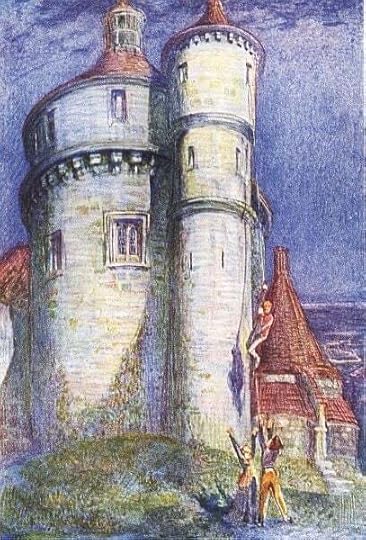
Firstly, because under the historical outline of the novel there is painted a true story. That’s because I say so :D As most of the synopsis were telling the same I have really enjoyed how the author used his imagination to extend from a couple of lines that was assumed to be written by Erasmus about his parents, and tell the strange history of a pair that loved each other truly and deeply, but couldn’t enjoy their earthly happiness as a normal married couple. To keep it simple, whatever story I do myself believe through the author’s words is true to me. This tale not only found a place in my heart whilst reading it, but I feel it’s going to remain there indefinitely, especially the tale of those two sore-tried souls…

Secondly, I was profoundly intrigued by the mediaeval setting of the story. I had myself travelled so far behind that it felt strange at some point, I got that feeling that I am part of that long past age too. It looks that this remarkably lengthy chronicle starts some time past the middle of the 15th century, in Holland, and it is full of old, rather strange words , and it offers a great mass of intolerable Latin
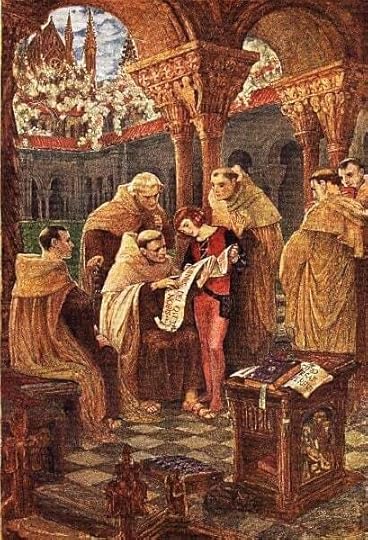
Thirdly, every sentence, every chapter of this mighty long tale is imbedded with minute details of the corresponding age, about the household, relations in the family, how the family life was supported and how each member of it was supposed to work, act, involve in the daily activities, about the relations in the village with the authorities, and how folks in the village used to interact, about the wars and struggles for power during that time, and the high division of the territories between the ruling powers, etc. Then there are so many shocks, emotions, perils, horrors added to the development of the narrative, that all this had tried my youthful feeling , and my sensitive nature too severely. I was mostly affected by grasping all those events in a manner too well known and understood in the 15th century… in other words, a fine fool I would make of myself if I would be living in that epoch.

Fourthly, the young man Gerard as the chief hero is from start different than the rest, in his family, but also amongst strangers. He was going into the Church, despite the fact that his own’s habits were frivolous, in the sense that his trivialities, whereas he easily got advanced in learning and skills, were reading and penmanship, also coquetting a bit with drawing and fine art. Moreover, as the story develops, it turns out that the young man Gerard is a prodigy of Don Quixote, in a sort of parallel. He is fighting all kinds of robbers, thieves, even wild animals, and it gets out of it victorious. I am still remembering the scene with the wind-mill, where Gerard managed to keep at distance all those ill men, and one by one they are eventually killed by a blazing fire… And then, more marvellous occurrences happened, and Gerard became Brother Clement, a friar of St. Dominic, as if dying to the world, the monk parted with the very name by which he had lived in it, and so broke the last link of association with earthly feelings. But that’s not all, because there are other steps on the ladder of his becoming till his end of days…a hermit, too, and then a priest, and then a monk again. And, surely, that age was not a time for fooling, if you know what I mean ;)

Fifthly, the young woman Margaret Brandt is a special character. Loved her from start to end. The first part of the novel feeds on very sweet thoughts showing how the passion is kindled between Margaret and Gerard, and how this unearthly bond is tied between them. Oh, yes, those were merry days, the merry days when we were young … As their union is not welcomed by his family, Gerard, feeling himself a craftsman and artist, decided to go to Italy, where he should earn money and reputation, and then come back to his native place, and form a family with this beloved Margaret. But Fate or Destiny meant for them something else…

Skipping the count, I will always cherish the wonderful pilgrimage of Friendship that Denys of Burgundy, the brave soldier, did apply to all his acts and deeds in time of peace and especially in his hardships and travels with Gerard, on foot on the road to Rome, the eternal city. By the way, about time of war, I can’t comment as I haven’t had a clue except that he always returned safe and sound. And yes, I will always remember him saying, “I’ll not forgive them my misery… Nobody is a man here, but all are slaves, and of what? Of a peevish, tinkling bell, that never sleeps…” , and maybe I would reply to him with Gerard’s, “Courage Denys! God’s eye is on us even here!” . But Denys is right, too deep and too true. By the by, I have myself removed my alarm clock for 2 years now, it turns out I don’t need this modern tinkling bell to get me awake anymore 😂
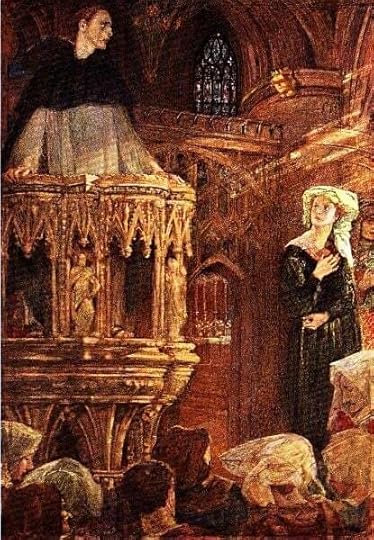
The writing style was a challenge but one that brought deep engagement and attention from my side. I was so well gripped in the story that it didn’t even matter that some words were not found in the translation application, so I had to go by guessing and interpreting according to my taste, mood and opportunity. I think I was right, in most cases though 😂 Reade’s writing almost choked me with his clear cut, edgy irony and satire. Well, that’s poor fool me for being an unlearned reader ;) so I thank him so much more and even for knowing my own’s frailty and absurdity…O my, novice of novices!
It is said that speech is the familiar vent of human thoughts, but Life is an intermittent fever , and there are emotions so simple and overpowering that they rush out not in words, but eloquent sounds. In the longer journey of it, there are days that come by with passions and perils, by fits and starts, and as it were, in clusters. And yes, I would candidly confess, this novel also made me sob single-mindedly. It is indeed a glorious book, it has all, all in all together, and especially vivid unforgettable adventures, marvellous occurrences, that can hardly be ever dismissed from human’s fancy :) I am surely one of his greatest fans now!
PS: …I am still clinging on it, no time to finish it now 😂

November 15, 2012
 Link: http://www.gutenberg.org/ebooks/1366
Group read: https://groups.yahoo.com/neo/groups/1...
Oct 12 Chapters 1 - 17
Opening Chapter 1: Not a day passes over the earth, but men and women of no note do great deeds, speak great words, and suffer noble sorrows. Of these obscure heroes, philosophers, and martyrs, the greater part will never be known till that hour, when many that are great shall be small, and the small great; but of others the world's knowledge may be said to sleep: their lives and characters lie hidden from nations in the annals that record them. The general reader cannot feel them, they are presented so curtly and coldly: they are not like breathing stories appealing to his heart, but little historic hail-stones striking him but to glance off his bosom: nor can he understand them; for epitomes are not narratives, as skeletons are not human figures.

Just some personal notes I started keeping before the eye-scorching set in.
Just couldn't help myself, sorry ladies! Gave up taking notes and read all the way through to the end reveal and it works mighty fine given the amount we just don't know about the backgrounds of so many famous people of long ago.
After finishing I went looking through reviews and descriptions and the predominant phrase is anti-catholic, yet in reality it isn't. I wasn't left feeling uncomfortable at all, in fact, I didn't really get any experience other than this was the set in Luther's time. History unfolding is all.
So that is the setting for the bigger picture, the up close and personal details of this story are made of tragedy and you'll be left booing and hissing at many a personality in this very fine Victorian era written, mediaeval historical fiction.
    "Even Christians loved one another
 at first starting"

November 9, 2020
I came across this book on Bettie's feed years ago, but the size of the thing was daunting. I was scared to start. It sat in my e-reader for years, gathering virtual dust. Thankfully, Tom Denholm (who has a lovely voice and even reads all the Dutch and French bits perfectly) rescued it from oblivion by recording it for Librivox. It must have taken me a month to listen to the whole book, and it's so big I hardly know where to start, so I'll be brief - unlike the book. (If only I could review in Haiku, that would be funny - medieval haiku, though? Maybe not.)
Favourite things:
- being on the road with Gerard. I love a good Chaucerian journey with changing travelling companions, dangers and tales shared between the characters.
- Good Denys - a friend with spirit and gusto, who's answer to everything is a - "Courage, camarade, La diable est mort!"
- Wonderful feasts of words - and I mean that. No one writes like this, no one talks like this, no modern literature can hold a candle to the colour and flavour and rollick of these old books about old times. I think we should bring back some of this language to spice up our bland modern lives.
- The big kerfuffle about flebotomy. An interesting topic that Reade must have been just waiting to give a platform to. Denys fights with Gerard about the efficacy of the procedure for a good while.
"...will you believe what a jackdaw in a long gown has heard from a starling in a long gown, who heard it from a jay-pie, who heard it from a magpie, who heard it from a popinjay; or will you believe what I, a man with nought to gain by looking awry, nor speaking false, have seen..."
- The scene with the gibbet wherein (haha) they stand under the decaying bodies of certain criminals and are regaled with the tales of how each poor soul was brought to this sorry end. Classic macabre medieval lit. Toothsome, that.
"Mercy! What's this? A gibbet! and ugh, two skeletons thereon! Oh Denys, what a sorry sight to woo by!" "Nay, said Denys, "a comfortable sight; for every rogue i' the air there is one the less a-foot."
The book was far too long, and I wished there was more about the Pilgrimage, but what a trip! I think I may have to actually read it next time, so I can spoon all those fragrant, steaming chunks of language manually into my brain.
Well! So much for being brief!
Highly recommended. And thanks again to Bettie, my book guide extraordinaire.
Favourite things:
- being on the road with Gerard. I love a good Chaucerian journey with changing travelling companions, dangers and tales shared between the characters.
- Good Denys - a friend with spirit and gusto, who's answer to everything is a - "Courage, camarade, La diable est mort!"
- Wonderful feasts of words - and I mean that. No one writes like this, no one talks like this, no modern literature can hold a candle to the colour and flavour and rollick of these old books about old times. I think we should bring back some of this language to spice up our bland modern lives.
- The big kerfuffle about flebotomy. An interesting topic that Reade must have been just waiting to give a platform to. Denys fights with Gerard about the efficacy of the procedure for a good while.
"...will you believe what a jackdaw in a long gown has heard from a starling in a long gown, who heard it from a jay-pie, who heard it from a magpie, who heard it from a popinjay; or will you believe what I, a man with nought to gain by looking awry, nor speaking false, have seen..."
- The scene with the gibbet wherein (haha) they stand under the decaying bodies of certain criminals and are regaled with the tales of how each poor soul was brought to this sorry end. Classic macabre medieval lit. Toothsome, that.
"Mercy! What's this? A gibbet! and ugh, two skeletons thereon! Oh Denys, what a sorry sight to woo by!" "Nay, said Denys, "a comfortable sight; for every rogue i' the air there is one the less a-foot."
The book was far too long, and I wished there was more about the Pilgrimage, but what a trip! I think I may have to actually read it next time, so I can spoon all those fragrant, steaming chunks of language manually into my brain.
Well! So much for being brief!
Highly recommended. And thanks again to Bettie, my book guide extraordinaire.

June 11, 2014
Download here: http://www.gutenberg.org/ebooks/1366
Read Mr Tony's review here:
https://www.goodreads.com/review/show...
Sounds terrific and it is free. Go download it and enjoy.
13 NOV 2014 - I will finish this book tonight. I will not, however, mark it READ as I am reading this with an off-site group. My review/thoughts will come next week. In the meantime, open up some time in your schedule and settle down to enjoy a really good (not, at times, a really great) read! (P.S. I have now marked this as READ and below is my review (of sorts)). I may come back and tweak it a bit; however, for now this stands.
15 NOV 2014 - I must admit I was torn about how to rate this book. Initially, I felt certain it was 5 stars. Then in the middle and in other places, we got bogged down with the novels-within-novels, the contrivances, and the theological dissertations. That put the book at a good, solid 3. Well, having completed the reading (and crying lots of tears at the ending), I rewarded The Cloister and The Hearth 5 stars.
An important question I ask myself when rating books 5 stars is “Will I want to read this one again?” And, while I will not want to read The Cloister and The Hearth right away, I can honestly say that at some point in the future, I will gladly sit down and visit with Gerard, Margaret, Denys (especially Denys), and all the others in this fabulous book.
Read Mr Tony's review here:
https://www.goodreads.com/review/show...
Sounds terrific and it is free. Go download it and enjoy.
13 NOV 2014 - I will finish this book tonight. I will not, however, mark it READ as I am reading this with an off-site group. My review/thoughts will come next week. In the meantime, open up some time in your schedule and settle down to enjoy a really good (not, at times, a really great) read! (P.S. I have now marked this as READ and below is my review (of sorts)). I may come back and tweak it a bit; however, for now this stands.
15 NOV 2014 - I must admit I was torn about how to rate this book. Initially, I felt certain it was 5 stars. Then in the middle and in other places, we got bogged down with the novels-within-novels, the contrivances, and the theological dissertations. That put the book at a good, solid 3. Well, having completed the reading (and crying lots of tears at the ending), I rewarded The Cloister and The Hearth 5 stars.
An important question I ask myself when rating books 5 stars is “Will I want to read this one again?” And, while I will not want to read The Cloister and The Hearth right away, I can honestly say that at some point in the future, I will gladly sit down and visit with Gerard, Margaret, Denys (especially Denys), and all the others in this fabulous book.

Read
June 19, 2025Finally! LOL Without my faithful buddy readers Sharon, Darryl, and Amy, I never would have kept going. I put this in my 'loooong slog' book category, which includes Moby-Dick and Tom Jones. These are all books that just weren't to my taste and felt like it took forever and a day to finish them. It doesn't mean I didn't enjoy parts (I did) or find them edifying/interesting at times (I did), but I wouldn't read them again for anything! (Unless that anything includes a manor house in England with library, garden, and an Aga--then maybe we can talk.)

November 13, 2012
I haven't read this book for many years, but at one point was obsessed with it and went around antiquarian and secondhand bookstores buying up every copy I could find. Some volumes have the most amazing illustrations and if you're into collecting books these are worth tracking down.
The story is not only bitter-sweet but also a fantastic 15th Century romp with our hero, Gerard, getting into all kinds of scrapes, some of which are fraught with danger while others are absolutely hilarious.
The story is not only bitter-sweet but also a fantastic 15th Century romp with our hero, Gerard, getting into all kinds of scrapes, some of which are fraught with danger while others are absolutely hilarious.

June 21, 2025
This is a unique one to rate and review! There were parts of it that dragged out, parts of it that were utterly ridiculous, parts of it that were sensational to the point of melodrama, and yet, as I reflect on the reading experience and the journey this book takes you on, I just don’t think I can rate it less than five stars!
The character of Gerard will stay with me for a long time. While I certainly enjoyed the romance and story of Gerard and Margaret, and really enjoyed some of the side characters, especially the feisty and indomitable Catherine, as well as the debauched but loyal sidekick, Denys, it is Gerard’s story that really touched me, and made the book for me.
There are so many critical lessons we face in our lives that Gerard has to learn along his way, even amongst all of the side drama and Reade’s spinning out of the tale probably longer and more convoluted than necessary (!): that good intentions can be misunderstood and misconstrued, but that one still has to live through the consequences of those misunderstandings with grace and forgiveness; that even when our understanding of our circumstances is based on false information and deception, we can still draw closer to God and continue the journey through our own sanctification; that we may think we know what’s best for ourselves, but that seeking God‘s will for us, and his wisdom regarding how to live it out, must never be taken for granted or assumed; that pain and suffering can be redeemed. I appreciated that Reade didn’t shy away from the trials and suffering and pain that Gerard goes through along the way, both physical and emotional. Gerard teaches us what it means to overcome, to the glory of God.
Many thanks to Sharon, Elizabeth, and Amy for the laughs, insights, cheering on, and friendship we shared as we read this together! 😊
The character of Gerard will stay with me for a long time. While I certainly enjoyed the romance and story of Gerard and Margaret, and really enjoyed some of the side characters, especially the feisty and indomitable Catherine, as well as the debauched but loyal sidekick, Denys, it is Gerard’s story that really touched me, and made the book for me.
There are so many critical lessons we face in our lives that Gerard has to learn along his way, even amongst all of the side drama and Reade’s spinning out of the tale probably longer and more convoluted than necessary (!): that good intentions can be misunderstood and misconstrued, but that one still has to live through the consequences of those misunderstandings with grace and forgiveness; that even when our understanding of our circumstances is based on false information and deception, we can still draw closer to God and continue the journey through our own sanctification; that we may think we know what’s best for ourselves, but that seeking God‘s will for us, and his wisdom regarding how to live it out, must never be taken for granted or assumed; that pain and suffering can be redeemed. I appreciated that Reade didn’t shy away from the trials and suffering and pain that Gerard goes through along the way, both physical and emotional. Gerard teaches us what it means to overcome, to the glory of God.
Many thanks to Sharon, Elizabeth, and Amy for the laughs, insights, cheering on, and friendship we shared as we read this together! 😊

October 12, 2016
Maybe four-and-a-half, because there were a few tedious passages. This Modern Library edition is 913 pages long; it was certainly long enough to slow my Kindle to glacial speed and occasionally to freeze it up. But it had everything--passionate love, hair-raising adventure, comedy, travel, fighting, sieges, narrow escapes, religion, irony, humanists, churchmen both cruel and kind, and lore about art in the 15th century. It had realistic characters who were (as far as I could tell) true to their time, not just 19th century characters (it was published in 1861) dressed up in 15th century clothes. It had a breathtakingly beautiful femme fatale, ruthless and powerful, who demanded that the main character be her lover; if he refused, she would have him killed. He refused. The result would be unbelievable nowadays, but in the 15th century, utterly authentic.
Sentimental? You bet; but never to my mind descending to sentimentality. The author even gave me a new idea of how to recognize sentimentality--it is sentiment that has a feeling of being ginned up or forced. I'd never thought of that before, but it seems true. Full of outrageous coincidence? Absolutely; but that is characteristic of the genre. Many authorial asides were quite amazing: "Women are creatures brimful of courage. Theirs is not exactly the same quality as manly courage; that would never do, hang it all; we should have to give up trampling on them." At the end of the story, when the lovers Gerard and Margaret have finally been reunited, they are still terribly separated because Gerard, having become a Dominican friar, so loathes himself that he has become a hermit. Margaret successfully lures him back into the world ("A resolute woman is a very resolute thing") first by appealing to his emotions (reminding him of his parents, brothers, and presenting him with his infant son) and then, "Margaret saw the time was come for that appeal to his reason she had purposely reserved till persuasion should have paved the way for conviction. So the smith first softens the iron by fire, and then brings down the sledge hammer." Wow. Needless to say, after relentless and erudite reasoning, she wins the day. But this being the 15th century, they are not quite happily reunited--he is still a friar, and she respects his religious convictions. They live for ten years as friends and mutual helpers. In a rare bitter comment, the author calls clerical celibacy "an invention truly fiendish."
A particularly surprising passage, both for the 15th and the 19 centuries, was one where the Pope in a relaxed private moment, delivered a multi-page disquisition on how, by the authority of the Bible, we must be kind to animals. He recalls that after Noah's flood, when God created the rainbow and made a covenant never to destroy the world again, he made the covenant not just with Noah, but explicitly with every living creature. He cites Balaam's ass, who sees the presence of divinity in the world where it is invisible to the supposed prophet. He cites the saving of Nineveh not just for the people, but for the cattle. On and on until all counter-argument is smothered. Similarly, a humanist goes on a long rant about how every vestment, every clerical rank, every saint, every holy-day, every bit of architecture, every ritual of the church was actually stolen from the ancient Greeks and Romans. This one the author prefaces with "partly for want of time, partly for lack of learning, I can reproduce but a few fragments." It then goes on for pages, hardly taking a breath. In short, upon finishing this book, you feel as though you've shared, on an epic scale, experiences with characters and an author who are truly exceptional. Oh, and--not really a spoiler--the surprise at the end is that the lovers' infant son will become Erasmus, the great Christian humanist.
Sentimental? You bet; but never to my mind descending to sentimentality. The author even gave me a new idea of how to recognize sentimentality--it is sentiment that has a feeling of being ginned up or forced. I'd never thought of that before, but it seems true. Full of outrageous coincidence? Absolutely; but that is characteristic of the genre. Many authorial asides were quite amazing: "Women are creatures brimful of courage. Theirs is not exactly the same quality as manly courage; that would never do, hang it all; we should have to give up trampling on them." At the end of the story, when the lovers Gerard and Margaret have finally been reunited, they are still terribly separated because Gerard, having become a Dominican friar, so loathes himself that he has become a hermit. Margaret successfully lures him back into the world ("A resolute woman is a very resolute thing") first by appealing to his emotions (reminding him of his parents, brothers, and presenting him with his infant son) and then, "Margaret saw the time was come for that appeal to his reason she had purposely reserved till persuasion should have paved the way for conviction. So the smith first softens the iron by fire, and then brings down the sledge hammer." Wow. Needless to say, after relentless and erudite reasoning, she wins the day. But this being the 15th century, they are not quite happily reunited--he is still a friar, and she respects his religious convictions. They live for ten years as friends and mutual helpers. In a rare bitter comment, the author calls clerical celibacy "an invention truly fiendish."
A particularly surprising passage, both for the 15th and the 19 centuries, was one where the Pope in a relaxed private moment, delivered a multi-page disquisition on how, by the authority of the Bible, we must be kind to animals. He recalls that after Noah's flood, when God created the rainbow and made a covenant never to destroy the world again, he made the covenant not just with Noah, but explicitly with every living creature. He cites Balaam's ass, who sees the presence of divinity in the world where it is invisible to the supposed prophet. He cites the saving of Nineveh not just for the people, but for the cattle. On and on until all counter-argument is smothered. Similarly, a humanist goes on a long rant about how every vestment, every clerical rank, every saint, every holy-day, every bit of architecture, every ritual of the church was actually stolen from the ancient Greeks and Romans. This one the author prefaces with "partly for want of time, partly for lack of learning, I can reproduce but a few fragments." It then goes on for pages, hardly taking a breath. In short, upon finishing this book, you feel as though you've shared, on an epic scale, experiences with characters and an author who are truly exceptional. Oh, and--not really a spoiler--the surprise at the end is that the lovers' infant son will become Erasmus, the great Christian humanist.

January 31, 2016
This is a book I've read before. In my opinion it is a far better story than Romeo and Juliet.
A bit about the author: Charles Reade was born at Ipsden House, Oxfordshire, on Jun 8, 1814. He was educated at Iffley and at Magdalen College, Oxford, entered Lincoln's Inn and was called to the Bar, and then turned to literature, writing a large number of plays and novels. He died in London on April 11, 1884. Of the 18 novels he wrote this is deemed one the top five. An interesting side note is that Sir Arthur Conan Doyle named this as his favorite novel of all time, saying that it combined intellect and heart in a unique way.
Other of his novels that come highly recommended are Peg Woffington (1853), It is Never too Late to Mend (1856), Hard Cash (1863) and Foul Play (1869).
A bit about the author: Charles Reade was born at Ipsden House, Oxfordshire, on Jun 8, 1814. He was educated at Iffley and at Magdalen College, Oxford, entered Lincoln's Inn and was called to the Bar, and then turned to literature, writing a large number of plays and novels. He died in London on April 11, 1884. Of the 18 novels he wrote this is deemed one the top five. An interesting side note is that Sir Arthur Conan Doyle named this as his favorite novel of all time, saying that it combined intellect and heart in a unique way.
Other of his novels that come highly recommended are Peg Woffington (1853), It is Never too Late to Mend (1856), Hard Cash (1863) and Foul Play (1869).

August 27, 2012
Some have considered this the greatest historical fiction ever penned, and I agree. It takes full concentration for the modern reader, but the rewards were great for this reader. C. Reade is a much neglected author.

October 30, 2013
One of the BEST historical novels I have EVER read! Reade's knowledge of the Medieval times are unparalleled. HIGHLY recommended!

November 29, 2008
This has to be one of the best books of all time. A chance finding on our book shelf at home [with of course no idea where it came from], we were delighted with it. It bogs down in parts, but it is extremely well done and very medieval. It is full of lovable characters, romance, humor, danger, and deep faith. The ending is quite real life and the whole book is spruced with strong morals. A MUST-READ for teens and up.

November 15, 2011
Wow. What an incredible reading experience. I borrowed this old, yellowed paperback from my friend in Texas 6 months ago and will now mail it back to her. This 785-page book is not an “easy read”, as the characters talk using Old English words (and sometimes using Latin and French), but the book lives up to its claim of being one of the best historical novels ever written. I can’t believe this book is so little-known and out-of-print (but full text is available online at Literature Network).
Written in England in 1861, this book portrays the medieval Church and 15th-century daily life in Holland, Germany, and Italy in fascinating detail. It is also an adventure story as Gerard survives death by starvation, suffocation, bloodhounds, a bear, drowning, hanging, burning at the stake, and arrows. And it is a touching romance as Gerard and Margaret try to overcome the obstacles in the way of their marriage. This is definitely my new favorite “medieval historical novel” (passing up The Hunchback of Notre Dame and The Betrothed). What a masterpiece.
Quotes:
"The courage, like the talent, of common men, runs in a narrow groove. Take them but an inch out of that, and they are done. Martin's courage was perfect as far as it went. He had met and baffled many dangers in the course of his rude life, and these familiar dangers he could face with Spartan fortitude, almost with indifference; but he had never been hunted by a bloodhound, nor had he ever seen that brute's unerring instinct baffled by human cunning. Here then a sense of the supernatural combined with novelty to ungenteel his heart. After going a few steps, he leaned on his bow, and energy and hope oozed out of him." --chapter XX
"'Leave this pilgrimage, and instant return to Rome. Penitence abroad is little worth. There where we live lie the temptations we must defeat, or perish; not fly in search of others more showy, but less lethal. Easy to wash the feet of strangers, masked ourselves. Hard to be merely meek and charitable with those about us.'" --chapter LXXV
"Some blackguard or other...said, 'A lie is not like a blow with a curtal axe.' True: for we can predict in some degree the consequences of a stroke with any material weapon. But a lie has no bounds at all. The nature of the thing is to ramify beyond human calculation. Often in the everyday world a lie has cost a life, or laid waste two or three. And so, in this story, what tremendous consequences of that one heartless falsehood!" --chapter LXXVIII
Here's the first passage of the book: "Not a day passes over the earth, but men and women of no note do great deeds, speak great words, and suffer noble sorrows. Of these obscure heroes, philosophers, and martyrs, the greater part will never be known till that hour when many that are great shall be small, and the small great; but of others the world's knowledge may be said to sleep: their lives and characters lie hidden from nations in the annals that record them. The general reader cannot feel them, they are presented so curtly and coldly: they are not like breathing stories appealing to his heart, but little historic hail-stones striking him but to glance off his bosom: nor can he understand them; for epitomes are not narratives, as skeletons are not human figures.
Thus records of prime truths remain a dead letter to plain folk: the writers have left so much to the imagination, and imagination is so rare a gift. Here, then, the writer of fiction may be of use to the public--as an interpreter.
There is a musty chronicle, written in intolerable Latin, and in it a chapter where every sentence holds a fact. Here is told, with harsh brevity, the strange history of a pair, who lived untrumpeted, and died unsung, four hundred years ago; and lie now, as unpitied, in that stern page, as fossils in a rock. Thus, living or dead, Fate is still unjust to them. For if I can but show you what lies below that dry chronicler's words, methinks you will correct the indifference of centuries, and give those two sore-tried souls a place in your heart--for a day." --chapter 1
Full text: http://www.online-literature.com/char...
Written in England in 1861, this book portrays the medieval Church and 15th-century daily life in Holland, Germany, and Italy in fascinating detail. It is also an adventure story as Gerard survives death by starvation, suffocation, bloodhounds, a bear, drowning, hanging, burning at the stake, and arrows. And it is a touching romance as Gerard and Margaret try to overcome the obstacles in the way of their marriage. This is definitely my new favorite “medieval historical novel” (passing up The Hunchback of Notre Dame and The Betrothed). What a masterpiece.
Quotes:
"The courage, like the talent, of common men, runs in a narrow groove. Take them but an inch out of that, and they are done. Martin's courage was perfect as far as it went. He had met and baffled many dangers in the course of his rude life, and these familiar dangers he could face with Spartan fortitude, almost with indifference; but he had never been hunted by a bloodhound, nor had he ever seen that brute's unerring instinct baffled by human cunning. Here then a sense of the supernatural combined with novelty to ungenteel his heart. After going a few steps, he leaned on his bow, and energy and hope oozed out of him." --chapter XX
"'Leave this pilgrimage, and instant return to Rome. Penitence abroad is little worth. There where we live lie the temptations we must defeat, or perish; not fly in search of others more showy, but less lethal. Easy to wash the feet of strangers, masked ourselves. Hard to be merely meek and charitable with those about us.'" --chapter LXXV
"Some blackguard or other...said, 'A lie is not like a blow with a curtal axe.' True: for we can predict in some degree the consequences of a stroke with any material weapon. But a lie has no bounds at all. The nature of the thing is to ramify beyond human calculation. Often in the everyday world a lie has cost a life, or laid waste two or three. And so, in this story, what tremendous consequences of that one heartless falsehood!" --chapter LXXVIII
Here's the first passage of the book: "Not a day passes over the earth, but men and women of no note do great deeds, speak great words, and suffer noble sorrows. Of these obscure heroes, philosophers, and martyrs, the greater part will never be known till that hour when many that are great shall be small, and the small great; but of others the world's knowledge may be said to sleep: their lives and characters lie hidden from nations in the annals that record them. The general reader cannot feel them, they are presented so curtly and coldly: they are not like breathing stories appealing to his heart, but little historic hail-stones striking him but to glance off his bosom: nor can he understand them; for epitomes are not narratives, as skeletons are not human figures.
Thus records of prime truths remain a dead letter to plain folk: the writers have left so much to the imagination, and imagination is so rare a gift. Here, then, the writer of fiction may be of use to the public--as an interpreter.
There is a musty chronicle, written in intolerable Latin, and in it a chapter where every sentence holds a fact. Here is told, with harsh brevity, the strange history of a pair, who lived untrumpeted, and died unsung, four hundred years ago; and lie now, as unpitied, in that stern page, as fossils in a rock. Thus, living or dead, Fate is still unjust to them. For if I can but show you what lies below that dry chronicler's words, methinks you will correct the indifference of centuries, and give those two sore-tried souls a place in your heart--for a day." --chapter 1
Full text: http://www.online-literature.com/char...

November 15, 2014
It is the latter half of the fifteenth century, and twenty-two year old Gerard Eliassoen is the eldest of nine children of Elias, a cloth merchant, and his wife Catherine of Tergou, Holland. His next two younger brothers, Richart and Jacob, have left for work in Amsterdam. Another brother became a tailor, and his oldest sister a robe maker. That left four others at home, the dwarf Giles, the crippled Kate, and the two youngest, Cornelis and Sybrant, both ne’er-do-wells. Gerard has been taught by the monks, became a scribe and illuminator, and is destined for service in the Church. However, on the way to a contest in Rotterdam, where some of his work has been entered, he meets Peter Brandt, a physician from the nearby village of Sevenbergen, and immediately falls in love with the doctor’s daughter Margaret. They also run across Ghysbrecht van Swieten, Burgomaster of Tergou, who years before had secretly cheated Peter’s father out of a huge sum of money.
Gerard decides that he will not become a priest, and he and Margaret privately elope. Gerard’s father opposes their relationship, and Ghysbrecht is afraid that Gerard may find out how he had cheated the Brandts, so Gerard is arrested. With the help of Margaret and an old friend of the Brandt’s named Martin, Gerard escapes and goes to Italy, hoping to gain information that will clear him. Meanwhile, Cornelis and Sybrant are jealous of their brother and conspire with Ghysbrecht to steal a letter being sent by a messenger from Margaret to Gerard and substitute a message stating that she has died, so he goes ahead and becomes a monk. Soon, Margaret gives birth to her and Gerard’s child, little Gerard. How can all this mess be resolved? Will Gerard and Margaret ever be able to get back together? And what will happen to the child? A fictional account of the birth of Desiderius Erasmus who is thought to have been born Gerard Gerardson, The Cloister and the Hearth is a typical Victorian novel with all kinds of story twists and subplots, having as its main theme the struggle between man’s obligations to family and to Church.
From an educational standpoint, the book contains a meticulous recreation of fifteenth-century European life with mention of various historical persons, often describing the events, people, and practices in minute detail. From an ethical standpoint, there are many references to drinking wine, but there also incidents which show the dangers of alcohol abuse. Also, it shows how important religion was to the lives of people at that time. At his lowest ebb, Gerard contemplates suicide but prays and turns away from his plan. Of course, the religion portrayed is Roman Catholic, and many practices with which non-Catholics will disagree, such as praying to saints and the demands of priestly celibacy, which even Reade admits is a “not quite reasonable” only a couple of pages from the end, are mentioned, but this is simply part of the historical background. It is not an easy read, with dialogue is written in a deliberately archaic style intended to evoke the Middle Ages, but it well illustrates how proper attitudes “could raise two truelovers’ hearts to the loving heart of their Father in Heaven.”
Gerard decides that he will not become a priest, and he and Margaret privately elope. Gerard’s father opposes their relationship, and Ghysbrecht is afraid that Gerard may find out how he had cheated the Brandts, so Gerard is arrested. With the help of Margaret and an old friend of the Brandt’s named Martin, Gerard escapes and goes to Italy, hoping to gain information that will clear him. Meanwhile, Cornelis and Sybrant are jealous of their brother and conspire with Ghysbrecht to steal a letter being sent by a messenger from Margaret to Gerard and substitute a message stating that she has died, so he goes ahead and becomes a monk. Soon, Margaret gives birth to her and Gerard’s child, little Gerard. How can all this mess be resolved? Will Gerard and Margaret ever be able to get back together? And what will happen to the child? A fictional account of the birth of Desiderius Erasmus who is thought to have been born Gerard Gerardson, The Cloister and the Hearth is a typical Victorian novel with all kinds of story twists and subplots, having as its main theme the struggle between man’s obligations to family and to Church.
From an educational standpoint, the book contains a meticulous recreation of fifteenth-century European life with mention of various historical persons, often describing the events, people, and practices in minute detail. From an ethical standpoint, there are many references to drinking wine, but there also incidents which show the dangers of alcohol abuse. Also, it shows how important religion was to the lives of people at that time. At his lowest ebb, Gerard contemplates suicide but prays and turns away from his plan. Of course, the religion portrayed is Roman Catholic, and many practices with which non-Catholics will disagree, such as praying to saints and the demands of priestly celibacy, which even Reade admits is a “not quite reasonable” only a couple of pages from the end, are mentioned, but this is simply part of the historical background. It is not an easy read, with dialogue is written in a deliberately archaic style intended to evoke the Middle Ages, but it well illustrates how proper attitudes “could raise two truelovers’ hearts to the loving heart of their Father in Heaven.”

May 14, 2013
best damn book ever.

Did Not Finish
November 14, 2025The writing is great - lots of good characters, funny lines, etc. The story was developing well. However, it turns out to be a journey tale of the Don Quixote style and I just wasn't up for 700 pages of it. Had to give up at 300 pages.

November 2, 2023
Took me exactly 10 months to read, er, listen to. 40 hours is a loooong time, so this gets 3 stars just because I was with the characters so long. I don’t know why I read these enormous, ye olde English stories when they’re so… :/ But the moral being that the Catholic Church only tears love apart got it another full star, haha

April 3, 2020
Imagine a cross between Don Quixote and Candide, one that goes on for nearly 700 pages. This book has been praised by authors as different as Rudyard Kipling, Arthur Conan Doyle, and Thomas Wolfe as being their favorite novel. Poor Gerard and Margaret, lovers in Holland in the 1500s. For a wide variety of reasons they are separated and both suffer terribly, nearly dying a couple of times each. Gerard, a skilled artist and scribe, escapes a tower, and goes off to Italy so that he can earn money and come back to Margaret. He learns to fight, often with the French soldier Denys by his side, endures poverty, illness, and disgusting bedding, plus having to fight off the women who throw themselves at him. Margaret, despite not having quite been married, has to survive with a old, sick father, illness, poverty, and the birth of her semi-legitimate child. Gerard is finally successful, earning lots of money which he then throws away when he receives a letter saying that Margaret is dead. Gerard gambles, drinks, and whores around, tries to kill himself, and ends up as a monk and a hermit. When they are finally reunited he has become a bishop and she his loyal supplicant, although they never renew their earthly romance. She dies of the plague and he dies of sorrow several weeks later.
This entire review has been hidden because of spoilers.

October 26, 2019
Really really good if you like (as I do) novels of the Victorian era. This is idealized, not realistic, but does an historical romance have to be realistic? That's part of the fun; it does not. The book is very long and drags near the end, but it's a charming and touching love story with lots of melodrama and scrapes. It's sad to see how few people have clocked it on Goodreads; likely the thickness, title and era of publication are putoffs. I only picked it up at hazard; good luck here.
A strong point is the archaic vocabulary (quite Shakespearean) , which Reade revels in and I do too. Everything you wanted to know about siege machinery and 15th C weaponry (arbalests, harquebuses, trebuchets) in glorious detail and a bevy of impolite terms for women who are not as good as they should be, including jade, quean, trull and leman. If you like Dickens, George Eliot, Thackeray, Trollope, Elizabeth Gaskell, Captain Marryat and R. D.Blackmore you will enjoy this book. That reminds me, I haven't read any Disraeli or Kingsley hmm.
A strong point is the archaic vocabulary (quite Shakespearean) , which Reade revels in and I do too. Everything you wanted to know about siege machinery and 15th C weaponry (arbalests, harquebuses, trebuchets) in glorious detail and a bevy of impolite terms for women who are not as good as they should be, including jade, quean, trull and leman. If you like Dickens, George Eliot, Thackeray, Trollope, Elizabeth Gaskell, Captain Marryat and R. D.Blackmore you will enjoy this book. That reminds me, I haven't read any Disraeli or Kingsley hmm.
April 7, 2012
I was truly delighted and amazed by this book. It is an early example of very fine historical fiction. The characters and story line are most engaging and the picture of medieval life drawn is marvelous. The language is not modern. There are many words we no longer use, like "yclept." It helps if you have read William Morris or Lawrence Sterne. There are also phrases and short passages in both French and Latin. Having studied both, I was lucky in that regard, but almost all of it is repeated in English, either directly or conceptually. The main issue of the novel is the social upheaval caused by the Catholic church's prohibition against clergy marriage. That debate seems to be ongoing.

Read
June 14, 2025. . .

January 9, 2018
I wonder what the medieval period was really like. We know what the fictional medieval era was like because it can be found in every single work of fiction about this age for hundreds of years. Indeed even the writers of that time perpetuated the myth.
If fiction is to be believed, there were soldiers and knights regularly roaming the country aimlessly on some pointless and digressive quest. Some were brave, some were evil, some were comical, some were weak – and there were very few of any other kind. These knights were always defending damsels, getting into skirmishes or being drawn into battles.
There were always priests, monks and other clergy to be found, and they were either ascetic or corrupt – rarely anything inbetween. Women could be lewd, shrewish, strong-minded or virginal, but essentially dependent on their menfolk. Taverns and prostitutes were a-plenty. Aristocrats were noble or dishonest, not much else. Poor people were subservient and loyal.
What is more, few medieval stories do not contain aristocrats, soldiers, servants, fair maidens and clergymen. To call these clichés or tropes is almost to underestimate the importance of these fictional conventions. They are the only story of the age. They are almost literally present in any tale about medieval times, no matter who the writer or artist is.
Indeed the formula has proved so popular that lamentably many writers of fantasy literature have never grown beyond it. Men and women who live in an age of cars, aeroplanes, machine guns, tanks and bomber planes, and who write about a world of wizardry, portals and magic artefacts, still seem obsessed with heroes who travel everywhere on foot or horseback, and who fight battles with swords, arrows, pikes and spears.
The Cloister and the Hearth belongs to this well-trodden path of mock-medieval fiction. This in itself need not be a problem. Many good stories have arisen from historical books set in the era, and so the quality of Charles Reade’s Victorian contribution must stand or fall on its own merits.
The story is about two lovers, Gerard Eliassoen and Margaret Brandt. Gerard is training to be a monk, but he soon becomes enamoured by Margaret, the daughter of a herbalist. Faced with serious opposition that leads to his arrest, Gerard decides to flee the country and to meet with Margaret in Italy.
Alas, after travelling a long meandering path, Gerard is falsely informed that Margaret has died. He returns to his religious vocation and becomes a hermit. Margaret finally catches up with him, and shows him their son as a means of luring him back into accepting his responsibilities. However Gerard chooses his vocation over Margaret and they live apart until their deaths.
The Cloister and the Hearth is certainly erudite, perhaps too much so. Reade makes the error that has become common in writers of the last few decades who wish to be taken seriously. He constantly makes a display of his factual knowledge of every aspect of medieval life, with the result that the story frequently grinds to a halt while we can hear some arid discussion about art or clerical disputes.
The most irritating discussion is one with a quack doctor (a stock character in fiction about the age). While many medical practitioners were indeed bad doctors, Gerard’s main objection seems to be the fact that the doctor insists on describing the medical facts about the body instead of merely saying that god did it, a fatuous quibble.
This pads out the book at the expense of any pacing, but perhaps this is as well, as there is not a lot of story to begin with. It is hard not to feel frustrated that the two lovers seem to spend decades before meeting up when a journey across Europe should not have taken more than a few months. This is achieved by the piling up of unlikely events designed to detain or deter Gerard from completing his travels.
I am reminded of The Odyssey or the Book of Exodus where the characters spend an extraordinary amount of time on a journey that should have been over sooner. At least in those two works, the protagonists were prevented by angry gods. Here there is nothing but bad luck, unless we put it down to a benevolent divine plan.
One reason the lovers are kept apart is perhaps that it is hard to imagine Gerard and Margaret living any normal life. Just as I cannot imagine Romeo and Juliet arguing over a smelly latrine, so I cannot picture Gerard and Margaret debating what colour to paint their spare room. These are idealised characters, and one whiff of reality would bring about their deaths.
Gerard is a tiresome hero. He foregoes his monastic vocation at the beginning, but he never loses his monkish personality. His virtuous and priggish manner does not make him endearing. In the book’s only piercing moment of psychological insight, he responds to news of Margaret’s possible death by descending into a life of hedonism and easily indulging in all the vices that he once deplored. The prude is generally one step away from the rake, and this proves so here, at least briefly.
However the monk wins out and Gerard becomes so committed to his vocation that even the return of Margaret to his life does not pluck him from his spiritual calling. He is willing to selfishly take her child from her, but not to take Margaret himself. So the lovers live apart until Margaret dies in a Black Death epidemic (another medieval trope) and Gerard finds he cannot live without her, so he sickens and dies too.
For some, this is evidence of an anti-Catholic tinge in the book. If Gerard and Margaret had embraced Protestantism, he could have married her and remained a vicar. This is true, but Reade seems to have an admiration for asceticism, and he appears to side with Gerard’s decision. There is pathos in their separation and their deaths, but there is no criticism of Gerard’s choice, or of a religious system that caused him to make it.
Indeed this is the greatest failing of the book. While people often reach for higher ideals of spirituality, education or aesthetics, the truth is that we are carnal, physical and material animals, and this latter part of our nature is stronger than the former. Of course a life based purely on hedonism is not a worthwhile one, but on the whole we respect people who put their worldly needs (needs, not desires) above their abstract ones.
This is the reason why writers as diverse as Shakespeare, Charlotte Bronte, Herman Hesse and Henrik Ibsen usually come down on the side of seeking joy from the material comforts of this life rather than losing oneself in the abstractions of religion, book-learning or being an artist.
Reade makes a virtue out of sentimentally choosing a life of self-denial above the important social and worldly impulses of love and family commitment, and this is why The Cloister and the Hearth is unlikely to ever become a popular book again.
If fiction is to be believed, there were soldiers and knights regularly roaming the country aimlessly on some pointless and digressive quest. Some were brave, some were evil, some were comical, some were weak – and there were very few of any other kind. These knights were always defending damsels, getting into skirmishes or being drawn into battles.
There were always priests, monks and other clergy to be found, and they were either ascetic or corrupt – rarely anything inbetween. Women could be lewd, shrewish, strong-minded or virginal, but essentially dependent on their menfolk. Taverns and prostitutes were a-plenty. Aristocrats were noble or dishonest, not much else. Poor people were subservient and loyal.
What is more, few medieval stories do not contain aristocrats, soldiers, servants, fair maidens and clergymen. To call these clichés or tropes is almost to underestimate the importance of these fictional conventions. They are the only story of the age. They are almost literally present in any tale about medieval times, no matter who the writer or artist is.
Indeed the formula has proved so popular that lamentably many writers of fantasy literature have never grown beyond it. Men and women who live in an age of cars, aeroplanes, machine guns, tanks and bomber planes, and who write about a world of wizardry, portals and magic artefacts, still seem obsessed with heroes who travel everywhere on foot or horseback, and who fight battles with swords, arrows, pikes and spears.
The Cloister and the Hearth belongs to this well-trodden path of mock-medieval fiction. This in itself need not be a problem. Many good stories have arisen from historical books set in the era, and so the quality of Charles Reade’s Victorian contribution must stand or fall on its own merits.
The story is about two lovers, Gerard Eliassoen and Margaret Brandt. Gerard is training to be a monk, but he soon becomes enamoured by Margaret, the daughter of a herbalist. Faced with serious opposition that leads to his arrest, Gerard decides to flee the country and to meet with Margaret in Italy.
Alas, after travelling a long meandering path, Gerard is falsely informed that Margaret has died. He returns to his religious vocation and becomes a hermit. Margaret finally catches up with him, and shows him their son as a means of luring him back into accepting his responsibilities. However Gerard chooses his vocation over Margaret and they live apart until their deaths.
The Cloister and the Hearth is certainly erudite, perhaps too much so. Reade makes the error that has become common in writers of the last few decades who wish to be taken seriously. He constantly makes a display of his factual knowledge of every aspect of medieval life, with the result that the story frequently grinds to a halt while we can hear some arid discussion about art or clerical disputes.
The most irritating discussion is one with a quack doctor (a stock character in fiction about the age). While many medical practitioners were indeed bad doctors, Gerard’s main objection seems to be the fact that the doctor insists on describing the medical facts about the body instead of merely saying that god did it, a fatuous quibble.
This pads out the book at the expense of any pacing, but perhaps this is as well, as there is not a lot of story to begin with. It is hard not to feel frustrated that the two lovers seem to spend decades before meeting up when a journey across Europe should not have taken more than a few months. This is achieved by the piling up of unlikely events designed to detain or deter Gerard from completing his travels.
I am reminded of The Odyssey or the Book of Exodus where the characters spend an extraordinary amount of time on a journey that should have been over sooner. At least in those two works, the protagonists were prevented by angry gods. Here there is nothing but bad luck, unless we put it down to a benevolent divine plan.
One reason the lovers are kept apart is perhaps that it is hard to imagine Gerard and Margaret living any normal life. Just as I cannot imagine Romeo and Juliet arguing over a smelly latrine, so I cannot picture Gerard and Margaret debating what colour to paint their spare room. These are idealised characters, and one whiff of reality would bring about their deaths.
Gerard is a tiresome hero. He foregoes his monastic vocation at the beginning, but he never loses his monkish personality. His virtuous and priggish manner does not make him endearing. In the book’s only piercing moment of psychological insight, he responds to news of Margaret’s possible death by descending into a life of hedonism and easily indulging in all the vices that he once deplored. The prude is generally one step away from the rake, and this proves so here, at least briefly.
However the monk wins out and Gerard becomes so committed to his vocation that even the return of Margaret to his life does not pluck him from his spiritual calling. He is willing to selfishly take her child from her, but not to take Margaret himself. So the lovers live apart until Margaret dies in a Black Death epidemic (another medieval trope) and Gerard finds he cannot live without her, so he sickens and dies too.
For some, this is evidence of an anti-Catholic tinge in the book. If Gerard and Margaret had embraced Protestantism, he could have married her and remained a vicar. This is true, but Reade seems to have an admiration for asceticism, and he appears to side with Gerard’s decision. There is pathos in their separation and their deaths, but there is no criticism of Gerard’s choice, or of a religious system that caused him to make it.
Indeed this is the greatest failing of the book. While people often reach for higher ideals of spirituality, education or aesthetics, the truth is that we are carnal, physical and material animals, and this latter part of our nature is stronger than the former. Of course a life based purely on hedonism is not a worthwhile one, but on the whole we respect people who put their worldly needs (needs, not desires) above their abstract ones.
This is the reason why writers as diverse as Shakespeare, Charlotte Bronte, Herman Hesse and Henrik Ibsen usually come down on the side of seeking joy from the material comforts of this life rather than losing oneself in the abstractions of religion, book-learning or being an artist.
Reade makes a virtue out of sentimentally choosing a life of self-denial above the important social and worldly impulses of love and family commitment, and this is why The Cloister and the Hearth is unlikely to ever become a popular book again.

Read
August 21, 2021In the mid 1970s, I read a four volume hardback edition from 1893 of this 1861 'Tale of the Middle Ages', which had belonged to my grandparents. It it a fanciful story about the possible parentage of Erasmus of Rotterdam, the humanist writer. It tells a story of romantic love, social convention, personal despair, religious proselytism, intense social reclusiveness, and very strong personal devotion. While focusing on an ill-starred couple, whose destiny seems to be to love each other as intensely as to be kept apart by the strict forces of social convention, it manages to construct a fairly detailed background of various countries, peoples, beliefs and customs in western Europe in the age during which the hidebound restrictions of an unswervingly sense of obedience to religious doctrine was giving way to just a subtle degree of personal liberty of intellectual and emotional expression. Such was humanism. The relatively sad plight of Gerard and Margaret was a testament as to how slow this melting of the ice of religious repression would be.

January 22, 2026
Enjoyable but overlong in my opinion. I liked the characterisation (I especially loved Denys the Burgundian) I enjoyed the depictions of the countries Gerard passed through, in fact I sometimes thought the action scenes detracted from the 'travelogue.' I thought some of the author's scholarship might be a bit dated - eg the idea that someone armed with an English war-bow might take a potshot at a pigeon in the hope of finding enough left to make a meal seemed a little far-fetched now that we know they had a draw weight in excess of 120lb. However his description of the siege was very convincing. I think that Reade's protestantism (to have been a fellow at Oxford from 1835 he must have been a Protestant) causes him to chafe a little when writing about Roman Catholic doctrine.
In short I'm glad I read it, it was entertaining but I did find it a little tedious in places.
In short I'm glad I read it, it was entertaining but I did find it a little tedious in places.

November 16, 2012
This book was recommended by Oscar Wilde in the Art of Lying, so I thought I'd give it a go. It was a big 19th century version of a medieval romance. It reminded me quite a bit of Walter Scott, with more philosophical and religious musings. It was very long, and I actually took a break half way through as I was getting a bit bogged down in it. I found some parts very enjoyable and some parts a bit dull. The parts in Burgundy with Denys were lots of fun. (The relationship between Denys and Gerard containing so much subtext it was really easy to see why Mr. Wilde liked the book so much). Then I felt the plot got a bit dull. But when Gerard finally made it to Rome again I really enjoyed it once more. I felt a bit let down by the end. It was as if the writer managed to write himself into a corner and wasn't sure how to get out without just talking about how the church and charity made people happy. The characterisation was quite good, but I felt it was a little light. I didn't like the characters as much as I should. Margaret (the young woman) was interesting. I liked that she had all the medical knowledge of a doctor, but wasn't allowed to practice because she was a woman. Though most of the time she just seemed to spend sighing and being sad over her lost love. Gerard was sometimes fun, and sometimes annoying. When he did eventually become a priest I think I lost all interest in him. His religious character just seemed more of a stereotype than anything real. (Despite all the crisis) I didn't love this as much as I was hoping. But it was interesting to see what a 19th century writer had to say about 15th century religion and philosophy and there was a fun story that went along with it. I did also enjoy the writing style. I don't think I'll be reading anymore books by Reade though, even though the rest are all very different to this.

May 17, 2016
This is a lengthy 19th century historical novel about a 15th-century church-educated young Dutchman who falls out with his family when he chooses his sweetheart over the Church. Gerard goes abroad and travels medieval Europe--which is depicted in loving detail--while Margaret suffers their separation at home. It sounds like a downer, but really it's a rollicking adventure with well-drawn characters. The author's extensive knowledge of manuscripts, hermits, inns, medicine, drinking customs, architecture, languages, pagan practices, and so on adds rich detail to the story. The printing press hovers around the edges of Gerard's world and even makes a roadside appearance on his journey. You can see the Renaissance dawning in the distance.
It's interesting to me that the author, a modern, was closer in time to the post-moderns than to the attitudes and beliefs of the Middle Ages. Yet, what I liked most about his novel was his appreciation for his characters and the time in which they were bound. The narrator comes across as a sympathetic observer rather than a condescending judge. I loved the observations he sprinkled in here and there and enjoyed his turns of phrase. I did a great deal of highlighting (I read a Kindle edition).
Despite the length, the plot sustained my interest, unlike other novels of the author's time. The story was conceived from a few lines written by Erasmus, whose name comes into the story at the end.
It's interesting to me that the author, a modern, was closer in time to the post-moderns than to the attitudes and beliefs of the Middle Ages. Yet, what I liked most about his novel was his appreciation for his characters and the time in which they were bound. The narrator comes across as a sympathetic observer rather than a condescending judge. I loved the observations he sprinkled in here and there and enjoyed his turns of phrase. I did a great deal of highlighting (I read a Kindle edition).
Despite the length, the plot sustained my interest, unlike other novels of the author's time. The story was conceived from a few lines written by Erasmus, whose name comes into the story at the end.

June 24, 2014
I struggled with this book, picking it up several times. Rarely is a book unfinished by me. However for some reason this book did not resonate with me and it just seemed to go on and on without catching me. Sorry.
J. Robert Ewbank author "John Wesley, Natural Man, and the Isms" "Wesley's Wars" and "To Whom It May Concern"
J. Robert Ewbank author "John Wesley, Natural Man, and the Isms" "Wesley's Wars" and "To Whom It May Concern"

Did Not Finish
September 6, 2010I'm sure this is great, but it's just not grabbing me the way the same author's _Griffith Gaunt_ did. Maybe I'll come back to it, maybe not.
Displaying 1 - 30 of 80 reviews