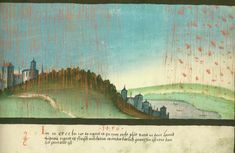
Apocalypse then: Newly uncovered illuminations from the Renaissance depicting miraculous phenomena The Book of Miracles that first surfaced a few years ago and recently made its way into an American private collection is one of the most spectacular new discoveries in the field of Renaissance art. The nearly complete surviving illustrated manuscript, which was created in the Swabian Imperial Free City of Augsburg around 1550, is composed of 169 pages with large-format illustrations in gouache and watercolor depicting wondrous and often eerie celestial phenomena, constellations, conflagrations, and floods as well as other catastrophes and occurrences. It deals with events ranging from the creation of the world and incidents drawn from the Old Testament, ancient tradition, and medieval chronicles to those that took place in the immediate present of the book’s author and, with the illustrations of the visionary Book of Revelation, even includes the future end of the world.
The surprisingly modern-looking, sometimes hallucinatory illustrations and the cursory descriptions of the Book of Miracles strikingly convey a unique view of the concerns and anxieties of the 16th century, of apocalyptic thinking and eschatological expectation. The present facsimile volume reproduces the Book of Miracles in its entirety for the first timeand thus makes one of the most important works of the German Renaissance finally available to art lovers and scholars. The introduction puts the codex in its cultural and historical context, and an extensive description of the manuscript and its miniatures, as well as a complete transcript of the text, accompany the facsimile in an appendix.
this is a spectacular collection, and shockingly well-priced ($100-150 on amazon). the collection comes boxed, with two books, a hard-bound facsimile of the 16th century Augsburg Book of Miracles and a softcover analysis that has four major divisions, listed below). the facsimiles themselves are excellent. in response to one prior review: it demonstrates scholarly competence that the facsimiles include the blank pages and the mold stains, etc. i was impressed by the attention to detail, as is a friend of mine who is actually an expert in medieval texts (and bought a copy himself). to get this level of attention, one can pay far, far more for a facsimile of a medieval text (quite literally ten times as much).
the pictures are both lovely and fascinating, with their topics ranging from hebrew bible events to alleged miracles of celestial events to monstrous births from the ancient through early modern period to images taken from the biblical Book of Revelation (Apocalypse in catholic bibles). the book is absolutely compelling to flip through.
the analytical softcover book is also fantastic. it includes an essay on the genre of books of miracles, an essay on the style and meaning of the Augsburg Book of Miracles, a list of transcriptions from the ABM's pages, and a table of sources for the ABM images (many of which borrowed from contemporary work). it is a terrific companion to the hardcover, written in erudite but lucid fashion (in english, german, and french!).
this is an amazing book. it's not cheap, but it is well worth adding to any home library.
En cuanto a imágenes, este libro es espectacular, las fotos muestran cada detalle del libro de los milagros. La única pega es que me hubiera gustado que en el texto se hubiera hablado un poco más de los milagros en sí y no tanto de la evolución de estos libros, que interesa solo a los especialistas del tema y además al final era una retahíla de nombres y fechas que te dejan un poco frío.
Mums siunčamų Dievo ženklų ar šaip baisių nutikimų knyga, su Renesanso dailininkų iliustracijmis. Šitaip krauju lijo tris dienas šiaures Italijoje 864- iais musu eros metais...
Who knew the apocalypse could be so pretty? Comets, multiple suns, rain of blood, the visions of Ezekiel and Jeremiah, the seven seals of revelation and even a pope that is part donkey part chicken part woman. They're all together here to instill fear and awe and propel your sinful life to repentance. This 1560 gorgeous illustrated collection of signs of the end of days both biblical and folkloric-medieval is pure joy.
“Most of all, the manuscript stands out for the extraordinary lavishness of its illustrations. These stunningly vivid pictures must have imparted to those readers first seeing them a sense of awe at the progression of disasters and wonders from the beginning of history to the end of time, as then understood. And they have lost none of their ability to astonish and engage us today.” Many years ago I saw the Taschen facsimile edition of The Book of Miracles, edited with introductory essays by Till-Holger Borchert and Joshua P. Waterman, in a bookshop and knew I had to have it. I finally got it for Christmas in 2023 and have been saving it for a rainy reading day ever since. As Waterman writes in his essay ‘Miraculous Signs from Antiquity to the Renaissance: Context and source materials of the Augsburg manuscript’, “The lavishly illustrated Augsburg Book of Miraculous Signs […], completed about 1552, recently discovered, and presented here in full, gives spectacular expression to sixteenth-century Europe’s ever-increasing concern for extraordinary signs sent from God.” Borchert’s essay, ‘The Book of Miracles: Genesis, style and meaning’, points out “it covers miraculous signs not just from the time of the creation of humankind up to its own day but also those expected at the end of the world.” This trilingual edition offers up the two essays and facsimiles of all the surviving plates from the book and typed translations of the script in the pages, and offers a thorough look at this vivid and astonishing book. It starts with Genesis and the Deluge, Sodom and Gomorrah, Moses parting the Red Sea, Isaiah’s & Daniel’s & Ezekiel’s visions, and ends with Revelation and the Fall of Babylon, with various medieval happenings in between, from strange creatures to celestial battles, apocalyptic weather, rainbows, sea creatures, burning torches, shafts of light, rain of blood, fiery arrows, frozen birds, parhelia, haloes, plagues, eclipses, mythical creatures, and a whole lot of comets.
XVI-wieczna kolekcja fantastycznych obrazów przedstawiających biblijne cuda i sceny z Księgi Apokalipsy - trzęsienia ziemi, komety, plagi szarańczy, potworne narodziny, dziwne ciała na niebie. Kto by pomyślał, że apokalipsa może być tak piękna? Komety, wiele słońc, deszcz krwi, wizje Ezechiela i Jeremiasza, siedem pieczęci objawienia, a nawet papież, który jest po części osłem, po części kurczakiem, po części kobietą. Wydarzenia historyczne opatrzone są biblijnymi odniesieniami. Ponieważ wszystko jest chronologiczne, na początku znajdują się cuda biblijne, takie jak potop i zniszczenie Sodomy. Na końcu znajduje się Objawienie. Wszystkie one są tutaj, aby wzbudzać strach i podziw.
A beautiful reproduction of the Augsburg Book of Miracles, along with an accompanying volume with two essays that discuss the sources of the work and analyze the contents, as well as a transcription/translation of the book's text (German, English, and French). The only negative I found was the reprinted original volume is missing Fol. 191 & 192 despite the fact that these two are shown with translations in the accompanying volume.
Astonishing compilation. Superb large rare illustration reproductions. Compelling theories and 'explanations'. Truly a research resource in its own right.
aside from some art books I've picked up, this is my first serious Taschen purchase. its a beautiful work, but I am somewhat disappointed. A slavish purism in the facsimile reproduction has hurt the cohesion. even blank pages are reproduced along with the dingy and stained back sides. translation, introduction, index, etc. are compiled into a separate paperback volume with both enclosed in a box. This makes a close reading a back and forth procedure requiring much table space. I wish commentary and research and interpretation was present. but this prompted me to do my own research and learn such things as the biological basis of blood snow and that centuries ago seldom seen northern lights were mislabeled as comets.
The amazing work recreated here recounts eclipses, parhelions, novas, plagues of locusts, sea monsters, and more. All are artfully depicted in painting. The art is most of each page with a short caption in German. The historical events are bookended with biblical references. As all is chronological, the beginning is biblical miracles, such as The Flood and destruction of Sodom. at the end is Revelation completing a theological narrative to this incredible compendium of the 1550s.
This is on my coffee table right beside the current issue of The Fortean Times and the juxtaposition is apt. A 16th Century collection of fantastic paintings depicting Biblical wonders and scenes from the Book of Revelations. These two comparatively mundane sections bookend the heart of the matter -- earthquakes, comets, locust plagues, monstrous births, strange bodies in the sky, all painted in a colorful style that prefigures Blake and later astronomical art, with commentary that reads like, yes, the works of Charles Fort. Typical gorgeous Taschen presentation here, with the actual facsimile and a matching volume of essays and translated text contained in a brilliant box. Hours of fun and a guide to the inquiring minds of 16th Century Augsburg, to whom the world itself was an expression of capricious divinity.
Legitimately one of the coolest things I've ever seen in my life. It has hundreds of Northern Renaissance depictions of catastrophe and apocalypse, mythical and historical.