The Russians are invading. But the locals have a plan.
It's March 2022 and Russian tanks are roaring across the vast, snow-dusted fields of Ukraine. Their Voznesensk, a town with a small bridge that could change the course of the war.
The heavily-armed Russians are expecting an easy fight - or no fight at all. After all, Voznesensk is a quiet farming town, full of pensioners. But the locals appear to have other ideas.
Svetlana, a grandmother with arthritis, reacts in fury when Russian troops turn her cottage into their blood-soaked headquarters. Valentin, a quick-talking lawyer, joins the town's 'Dads Army' defenders, crouching in a trench with an AK47. Meanwhile, 21-year-old Sergei grabs a Molotov cocktail and lies in wait for Russian tanks as they push towards Dead Water Bridge.
The odds are terrible. But a plan is emerging, and there's a chance it could save not just Voznesensk, but the rest of southern Ukraine. Meanwhile, inside the tanks, an inner battle rages. As Russian officer Igor Rudenko prepares to invade, he has a secret. He is Ukrainian himself.
A gripping work of reportage that tells the story of a pivotal moment in Ukraine's war, this is a real-life thriller about ordinary people facing extraordinary circumstances with resilience, humour and ingenuity.
'[Andrew Harding is] one of our most gifted and sensitive journalists' - Jon Snow
I'm the BBC's Africa Correspondent, based in Johannesburg. I'm the author of "These Are Not Gentle People," a true-crime novel set in South Africa and published in South Africa, the UK and the Netherlands. The book has been turned into a BBC Radio 4 series and podcast, "Blood Lands." Alexander McCall Smith described the book as "a masterpiece." Philippe Sands called it "utterly gripping, timely and shocking. "This is In Cold Blood meets Midnight In The Garden of Good and Evil. Believe me, Andrew Harding has given us an instant classic," said Justice Malala. I also wrote the internationally acclaimed non-fiction book, "The Mayor of Mogadishu" - the tale of a nomad, turned street brawler, turned refugee who left his family in London to return to take charge of the war-ravaged ruins of Somalia's capital. It was praised by the New York Times, The Economist, The Washington Post and chosen as one of NPR's books of 2016.
Part of me is like, why isn't everybody singing this book praises, it's such a lovely little book. Another part of me is like, self, you loved this book but failed to write a review, so you are part of the problem. Anyway, if you are a fan of underdog narratives and want a portrait of a small provincial town in the south of Ukraine taking a valiant, against-all-odds stand against the Russian army in the early days of the full-scale invasion, this is the book for you.
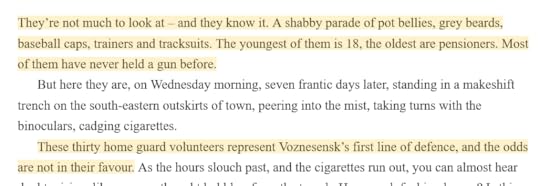
A bunch of pot-bellied, tracksuit-wearing, down-on-their-luck guys, aka territorial defense volunteers in the full-scale war, stand over a makeshift trench at the outskirts of their tiny town. If their town falls, so might the whole south of Ukraine. No pressure or anything.
If the advancing Russian army crosses the bridge in their town fast, it might then cut off the main route from Kyiv to Odesa, which Won't Be Good (an understatement). The book is not about the grand movements of land armies or war strategies though.
It's a very gentle frog's-eye view of a total war, with loving portraits of the people who are overlooked at the best of times: people who had fallen through the cracks of history and welfare networks, living with passports of a country that collapsed more than 30 years ago.
People living hand-to-mouth on scraps. Colorful lawyers who fail their state certification tests intended to weed out corruption. People like that, not stereotypical heroes, not the stuff of legends. The dignity of very ordinary people looking around, shrugging, saying essentially "well, I guess that'll have to be me" and making a stand. People rising to the occasion.
But also, people sinking low, pulled into the grey zone of the past Soviet and current Russian occupation. The book does interesting things with highlighting the muddle of legacies and loyalties, such as Ukrainian citizens in Crimea who opted to switch to the Russian side after the annexation & ended up being sent to kill their compatriots. Mixed families being torn apart because the Russian part of the family buys up the genocidal Russian propaganda wholesale. Stuff like that.
But at the core of it, it's a very gentle and kind book in a panorama of events that are decidedly short on gentleness and kindness, and you got to appreciate that. I sure do.
This tiny book was a nice surprise. This not a book about Ukrainian history, or complex international context of the war, it’s just a snippet about a big event (Battles of Voznesensk) right at the beginning that was critical for the defense of the whole south of Ukraine. It tells the story of a small, stubborn town, an underdog, who prevailed against all odds; it's about poor working-class people without complex ideologies, who never had to grapple with their identity until others invaded them with guns and tanks, forcing them to pick a side and protect their home.
This is a nonfiction that reads like an action movie. The war is not over, yet I hope this battle proves to be as paramount as it feels now. I am glad these people have their story told for the ages.
British journalist Andrew Harding tells the story of the February 2022 Battle of Voznesensk in this short but gripping book. As the Russian army roared into Ukraine, the small, unremarkable town of Voznesensk found itself guarding a key bridge on the road to the great Black Sea port of Odesa and facing the overwhelming might of what was reputed to be the second most powerful army in the world. And they couldn't get either Kyiv or the army on the phone.
It honestly boggles the mind to imagine facing such a situation, still less the decision to stay and defend in the face of such an onslaught. Yet that is precisely what many of the lawyers, farmers, students, garbage men, and undocumented Russian immigrants of Voznesensk choose to do. Harding writes the story like a thriller novel, painstakingly reconstructing events from interviews, footage, stories, and occasionally his own guesses.
At just under 3.5 hours in audiobook format, I'm not just recommending this as a gripping true story of human resilience in the face of unimaginable odds, but also as a nifty study on how terrain affects warfare for people who want to write fantasy battles. Anyway.
What an amazing book. I was lucky to receive an early copy of this book. Fascinating, heart breaking and heroic. It really reads like a fictional account - it isn’t - and very much in the style of Kurkov. I have no doubt that this will be a widely read and important book for many years to come. I loved it.
This is a great little book following the battle of Voznesensk, one week after Russia's full-scale invasion. Voznesensk is a small town north of Mykolaiv near the end of the Southern Buh river. It is a strategically important town because of its location; Voznesensk is necessary to form a direct route across Southern Ukraine, and its capture must precede a siege of Odesa. It is also the key to occupying Ukraine's second-largest nuclear power plant.
At times, it feels like a play, with the cast of characters listed at the beginning of the book. The people it follows range from the battle-hardened commander of a Ukrainian brigade to a local drunkard who went to fight while drunk. Some characters picked up a gun without experience and went to defend their town. Some were captured and imprisoned in a cellar. Some characters die as soon as they are introduced, showing the tragedy and reality of this war. All were regular people in a regular town thrown into extraordinary circumstances.
Two characters were particularly interesting for the narrative. Svetlana, an old pensioner, is an ethnic Russian woman and a Russian citizen who moved to Voznesensk after the fall of the Soviet Union and defiantly stood up to the occupying forces. The author also follows the story of Igor Rudenko, an ethnic Ukrainian and Ukrainian citizen who joined the Russian military as an officer when Russia annexed Crimea in 2014. He was one of the first to be sent into Southern Ukraine, only to be ambushed and captured. These two characters blur the lines of this simply being an ethnic conflict, and the author uses them as foils to paint how this is also a war for truth and values.
The book follows the entirety of the battle, from invasion to Russian retreat. The narrative style of the book makes it really quick and enjoyable to read. With the war being so massive, it is easy to forget these smaller snippets into the lives of regular people who have much to teach us on what to do when thrown into strange circumstances.
I listened to this on Audible. I first heard of this book on the Ukraine The Latest podcast. I am glad I took the time to listen to it. It was written by a BBC journalist who was covering the front line of the war in Ukraine in those early months of 2022. It centres on the town of Voznesensk in Southern Ukraine. The town was caught up in the early days of the Russian invasion. The Russians thought the Ukrainians would be jubilant at being liberated. The Ukrainians were taken by surprise by the invasion. The Russians living in Ukraine were conflicted, some having compassion for the Russians and some making firm decisions to outright oppose them. But the lovely thing about this book is that it takes the time to get to know people, who they are, how they got to be there and how they felt about the situation.
Svetlana is one of the main characters. A Russian who moved to Ukraine as a child. She still has family in Russia. She is horrified by the invasion and sickened by what she sees. Much of the story is told through her eyes. But there are other characters, like the town's mayor, Svetlana's son, members of the home guard, Ukrainian soldiers, even Russian soldiers to a certain extent. But this book shows the horrors of war and how it affects civilians. We like to think of war as affecting other people, but you can imagine what it would be like to hit your home town by reading this book. You do feel for the Russians a bit because they were lied to. But the real compassion is for the civilians who are caught up in a war not of their choosing. The heart wrenching scene is when a mother is told where to find the body of her son and she is forced to collect the pieces one by one. I wish all leaders would remember this passage the next time they plan for war.
A transportive and compelling account of Voznesensk’s remarkable resistance to the Russian invasion in 2022. A beautiful story, if sadly so given the news at the moment.
A short, snappy, and exciting look into a little Ukranian town at the beginning of the war. With short chapters that zip between various characters and perspectives; like Svetlana, the stubborn old lady refusing to bend in front of young Russian soldiers, Ghost, the reconnaissance expert and soldier who stalks the enemies from the shadows, and Igor, a young Ukranian soldier from Crimea who joined the Russian army after Crimea was taken over.
Following the story of this town as they mount a defence against the invaders is filled with fascinating strategic decisions. Moreover, this book gives a captivating insight into the Russian perspective and how the invasion was viewed as a liberation campaign. Harding keeps this book short but sweet, its an excellent weekend read.
Reporter Andrew Harding tells the story of the small Ukrainian town Voznesensk during the initial stages of the Russian invasion in March 2022. Looking at different perspectives, we see how grandmas, young alcoholics, Russian soldiers, and Ukrainian defenders all respond. At its heart, this is a story about power, information and misinformation. How do the "little people" make sense of what's happening when their leaders feed them a very different narrative to their experiences on the ground. This short book gives helpful insights to a war that can feel a little abstract for those of us on the other side of the globe!
A really well written book about an unlikely bastion of a town responsible for keeping encroaching forces from advancing further west in southern Ukraine, shortly after the Russian invasion.
Harding puts the people at the heart of this book, as a good historian should, humanising what often becomes fatality statistics or meaningless coordinates, attaching the reader to Voznesensk’s community and its colourful array of characters.
What bothered me though was that it is presented as a narrative, and I had a lingering feeling that it was not real in a way (after all, the author was not there in the moment). But maybe that's just my love for oral history speaking.
Listened on audio, great narrator who kept me engaged and breathed life into the stories of the Ukrainian citizens intervirwed. A quick listen well worth the while.
(The English review is placed beneath the Russian one)
Есть такие книги, которые актуальны по большей части в момент своего выхода, но в дальнейшем пускай не полностью, но частично утрачивают свою ценность. Возможно, это я уже устал от таких книг, возможно, правда в том, что автор открыто занял лишь одну сторону этого военного противостояния, а не как подобает журналисту, независимо и объективно освещает войну, стараясь донести до своего западного читателя объективную картину случившегося, а возможно книга стала по иному ощущаться в связи с изменившейся обстановкой, как например, не способность или даже нежелание мирового сообщества превратить путинскую Россию в парию, с которой ни один уважающий человек за один стол не сядет (как мы сегодня знаем, многие западные страны, готовы лоббировать снятие санкций с России, если эти санкции сильно ударяют по этим странам, а так же продолжают покупать у неё сырьё: «Sep. 30, 2025 — С 2022 по 2025 годы Франция, Бельгия, Испания и Нидерланды закупили в России сжиженный природный газ на 34,3 млрд евро»).
Я хочу сказать, что книга описывает ситуацию как борьбу добра со злом, что в реальности никогда не происходит. В этой книге русские по-голливудски изображены исключительно злодеями, в то время как украинцы - сплошь герои, стойко противостоящие превосходящим силам противника. Если в 2022-23 годах такая картина выглядела реалистичной, то сегодня это больше походит на приукрашенный взгляд. Но может реальность именно такая? Тогда почему в Украине с 2023 года людей насильно хватает ТЦК, почему границы закрыты, в то время как в России они открыты даже для мужчин и почему Украина, которую поддерживает весь мир, не может нанимать солдат за деньги, как это делает Россия? Подобные вопросы разрушают идеалистическую картину того, что описывает автор.
Нет, я не ставлю под сомнения страдания людей, которые оказались запертыми в войне двух стран (двух кланов, двух баринов) точно так же как я считаю, что вторжение России в Украину в феврале 2022 года было и ошибкой и преступлением. Дело в том, что читая книгу, возникает ощущение, что ты читаешь сказку с хорошим финалом, где добро обязательно победит зло, несмотря на все тяготы и лишения и случившиеся смерти. В реальности же, здесь нет, и не может быть хорошего конца точно так же как фон этой истории, на котором мы видим правительство Украины, не может быть таким позитивным. Я ещё в 2022 году писал, что за все эти смерти в Украине несёт ответственность не только российская элита во главе с Путиным, но и украинская элита: одни в ответе за то, что напали, а другие – что ничего не делали, чтобы предотвратить это нападение.
Короче говоря, подлинная картина, не приуменьшая смелость, стойкость и геройство гражданских людей Украины, имеет более приглушённые краски. К примеру, автор, видя в каком состоянии оказались обычные люди, не задаётся вопросом, почему правительство Украины не эвакуировало этих людей и почему они были вынуждены там находится во время перекрёстного огня двух армий? Где вообще было украинское правительство и почему оно в тот момент бездействовало? Ответ понятен: если задавать такие вопросы, то в таком случаи яркая героическая картина померкнет именно из-за политической и управленческой импотентности украинского правительства.
Но может быть оценка действий, точнее, бездействия украинского правительства просто не входило в обязанности автора, ибо его целью было показать борьбу с противником отдельного города и отдельных людей, живших в этом городе, т.е. показать персональную историю, а не политическую? А можно ли показать подлинную картину в вакууме, как это и сделал автор? Возможно, кто-то скажет, что можно, но я считаю, что сегодня это делать всё труднее и труднее. Да, в 2023 году я бы и сам поверил в такую идеалистическую картину украинского сопротивления, как например, вот это:
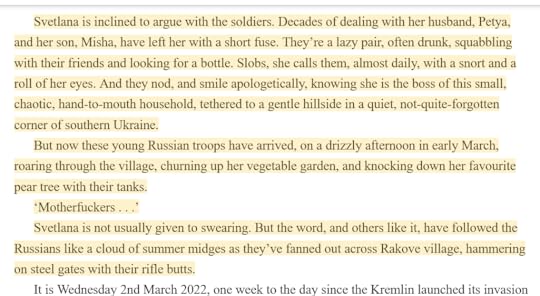
‘Put your fucking hands in the air!’ a Russian soldier shouts. He and two others, heavily armed and wearing green combat helmets, have just broken their way through the gates of a cottage, to be confronted by a defiant couple in matching blue sweaters. The pair – man and wife – are advancing towards the soldiers across the forecourt. Neither of them have any intention of raising their hands. <…> ‘Fuck off. Go to hell,’ the woman shouts. Slowly, as if pretending that this is what they intended from the start, the soldiers start to back out. In under a minute, they’ve exited the gate and are walking down the muddy street outside.
Однако сегодня, зная, что многие лидеры Европы не такие беспринципные, как в 2022, а так же зная о последующем бездействии многих политиков от республиканской партии, которые даже не пытаются спорить с Трампом по поводу его пророссийской политики в отношении Украины, всё это говорит о том, что история не такая чёрно-белая, точнее, не такая однозначная, по крайне мере в некоторых моментах. Конечно, трудно спорить по факту преступного начала боевых действий со стороны России, даже начиная не с 2022 года, а с 2014, но и не стоит излишне идеализировать и украинскую сторону. Думаю, если бы реальность была именно такой, какую рисуют проукраинские книги, боевые действия происходили бы сегодня где-то на подступах к Москве, а не на территории Украины. Если русских изображают как слабых, тупых и безмозглых, в противовес храбрым, стойким и смелым украинцам, то почему война идёт на территории Украины, а не на территории России?
В общем, книга интересна как отдельно взятая история города оказавшегося на линии фронта, где люди оказались запертыми, вот только до того момента пока автор не пытается придать всем гражданским геройское поведение или даже геройское самопожертвования во имя украинского государства. В этот момент хочется громко крикнуть: не верю! В остальном же, довольно неплохой текстовый репортаж из «горячей точки».
P.S.
The Russians begin wrestling with their consciences and with their actions here, in a country they’ve been assured would welcome them as liberators. The last week of fighting has made them aware of some of the flaws in that theory.
Не хочу расстраивать автора, но в армии солдаты выполняют приказы, а не действуют исходя из политических соображений. Поэтому писать, что они в чём-то начали сомневаться, значит совершенно не понимать, как работает армия. Российским солдатам, как любым другим, дали приказ и они его выполняют, как бы делали любые солдаты любой страны.
There are some books that are relevant mostly at the time of their publication, but later on—if not entirely, then at least in part—lose their value. Perhaps I’ve simply grown tired of books like this; perhaps the truth is that the author has openly taken only one side in this military conflict, rather than—as a journalist ought to—covering the war independently and objectively, striving to convey an unbiased picture of what happened to his Western readers; or perhaps the book has come to feel different due to the changed circumstances, such as, for example, the international community’s inability—or even unwillingness—to turn Putin’s Russia into a pariah with which no self-respecting person would sit at the same table (as we know today, many Western countries are ready to lobby for the lifting of sanctions against Russia if those sanctions hit them hard, and they also continue to buy raw materials from it: “Sept. 30, 2025 — From 2022 to 2025, France, Belgium, Spain, and the Netherlands purchased 34.3 billion euros’ worth of liquefied natural gas from Russia”).
What I mean is that the book portrays the situation as a battle between good and evil—something that never actually happens in reality. In this book, Russians are depicted in a Hollywood-style manner as nothing but villains, while Ukrainians are portrayed exclusively as heroes who steadfastly resist the enemy’s superior forces. While this portrayal might have seemed realistic in 2022–23, today it comes across more as a romanticized view. But maybe that’s exactly how reality is? Then why have people in Ukraine been forcibly rounded up by the TCC (Territorial Centre of Recruitment) since 2023? Why are the borders closed while in Russia they’re open even to men, and why can’t Ukraine—which is supported by the whole world—hire soldiers for money, as Russia does? Questions like these shatter the idealistic picture the author paints.
No, I do not question the suffering of the people who found themselves caught up in the war between two countries (two clans, two lords), just as I believe that Russia’s invasion of Ukraine in February 2022 was both a mistake and a crime. The thing is, when you read the book, you get the feeling that you’re reading a fairy tale with a happy ending, where good is bound to triumph over evil, despite all the hardships, deprivations, and deaths that have occurred. In reality, however, there is no happy ending here—nor can there be—just as the backdrop to this story, against which we see the Ukrainian government, cannot be so positive. Back in 2022, I wrote that responsibility for all these deaths in Ukraine lies not only with the Russian elite led by Putin, but also with the Ukrainian elite: some are responsible for launching the attack, while others are responsible for doing nothing to prevent it.
In short, the true picture—without downplaying the courage, resilience, and heroism of Ukraine’s civilians—is somewhat more subdued. For example, the author, seeing the plight of ordinary people, does not ask why the Ukrainian government did not evacuate them and why they were forced to remain there amid crossfire between the two armies. Where was the Ukrainian government, anyway, and why did it fail to act at that moment? The answer is clear: if such questions are asked, the vivid, heroic picture would fade precisely because of the Ukrainian government’s political and administrative impotence.
But perhaps evaluating the actions—or, more precisely, the inaction—of the Ukrainian government simply wasn’t part of the author’s remit, since his goal was to depict the struggle against the enemy by a single city and the individual people living there—that is, to tell a personal story rather than a political one? And is it even possible to portray an authentic picture in a vacuum, as the author did? Perhaps someone would say it is, but I believe it’s becoming harder and harder to do so today. Yes, back in 2023, I myself would have believed in such an idealistic portrayal of the Ukrainian resistance—like this one, for example:
‘Put your fucking hands in the air!’ a Russian soldier shouts. He and two others, heavily armed and wearing green combat helmets, have just broken their way through the gates of a cottage, to be confronted by a defiant couple in matching blue sweaters. The pair – man and wife – are advancing towards the soldiers across the forecourt. Neither of them have any intention of raising their hands. <…> ‘Fuck off. Go to hell,’ the woman shouts. Slowly, as if pretending that this is what they intended from the start, the soldiers start to back out. In under a minute, they’ve exited the gate and are walking down the muddy street outside.
However, today, knowing that many European leaders are not as unprincipled as they were in 2022, and also knowing about the subsequent inaction of many Republican Party politicians—who do not even attempt to challenge Trump over his pro-Russian policy toward Ukraine— all of this suggests that history is not so black and white—or, more precisely, not so clear-cut—at least in some respects. Of course, it’s hard to dispute the fact that Russia initiated hostilities—even if we start not in 2022 but in 2014—but we shouldn’t overly idealize the Ukrainian side either. I think that if reality were exactly as portrayed in pro-Ukrainian books, the fighting would be taking place today somewhere on the outskirts of Moscow, rather than on Ukrainian territory. If Russians are portrayed as weak, stupid, and brainless, in contrast to the brave, steadfast, and courageous Ukrainians, then why is the war taking place on Ukrainian territory rather than on Russian territory?
All in all, the book is interesting as a standalone account of a city that found itself on the front lines, where people were trapped—but only until the author tries to portray all civilians as heroes or even as making heroic sacrifices for the sake of the Ukrainian state. At that point, I just want to shout out loud: I don’t believe it! Otherwise, it’s a pretty well-written report from a “hot spot.”
P.S.
The Russians begin wrestling with their consciences and with their actions here, in a country they’ve been assured would welcome them as liberators. The last week of fighting has made them aware of some of the flaws in that theory.
I don’t want to upset the author, but in the military, soldiers follow orders; they don’t act based on political considerations. Therefore, to write that they began to have doubts about something is to completely misunderstand how the military works. Russian soldiers, like any others, were given an order, and they are carrying it out, just as soldiers from any country would.
A short but moving account of the resistance of the people of Voznesensk to Putin’s unthinkable invasion of Ukraine in February 2022. The town occupies a key strategic location on two rivers between Crimea and Kyiv, and its residents knew that. Ordinary people fought alongside the Ukrainian army’s 180th brigade to stop Russia’s drive to the center of the country and they successfully held the Russians off. Harding’s account, pieced together later through interviews with the town’s defenders, recreates the disorientation of defending against Russian combatants brainwashed to believe they are rescuing the Ukrainian people from the “nazis” who govern them. He manages to condense decades of Russian and Ukrainian history into a manageable narrative that becomes a microcosm of defiance in a war that threatens to drag on, despite the heroism of the Ukrainian people. Even as they resist, they are also “becoming haunted by the notion that this conflict may never end, and by the fear that Russia’s capacity to absorb suffering and its unflinching willingness to continue inflicting it, will eventually enable [Russia] to grind out some kind of victory” (134).
Thoroughly absorbing from start to finish (took me just 3 day!), with just enough of the characters' complex backgrounds, motives and actions to give you a sense of them without blocking the action. And there is plenty of action.
Additional information for after your read (spoiler alert) Voznesensk Mayor Yevhenii Velychko was injured in a Russian attack earlier this month (July 2024). Harding's original report and video is at: https://www.bbc.com/news/world-europe... There is an excellent BBC 45min dramatisation at this link: https://www.bbc.co.uk/programmes/m001...
This entire review has been hidden because of spoilers.
A brilliant little book which shows how a town stood up to a formidable enemy and pushed them back. A David and Goliath story. The Ukrainians described in this book could have left or let the Russians take over - they did neither. Along with units from the Ukrainian army they pushed back a larger force of Russians. The book also highlights the issues associated with the remnants of the soviet era and the interlinked nature of Russia and Ukraine, sometimes with close family members on both sides of the conflict. Really useful short book, beautifully written about the Russian Ukrainian conflict.
This book provides a very real glimpse into the ordinary person's experience in Ukraine of the invasion by Russia. Written through the eyes of several townsfolk of Voznesensk, the author writes simply and realistically of their experiences and captures well the momentum of events. The response of ordinary folk in protecting their homes is moving. I think what is so powerful about this book is it encourages empathy. You think that could be me in my town- what would I do? It is a sad and inspiring read that is also gripping. Though the topic is distressing, it is a beautifully written book.
A short but brilliant book, Harding tells the story of Voznesensk, the small, southern Ukrainian farm that fought off the Russian Army's invasion in March 2022, facing down unbelievable odds, and winning. This is an improbable but true story of incredible courage, heartbreaking loss (Voznesensk's defence wasn't a bloodless one) and sheer bloody-mindedness. Harding's reporting is stirring, sensitive and compulsively fascinating. It's only late January but I might have already read my book of the year.
An excellent short read about the early days of Russia's renewed invasion of Ukraine in February 2022. At a local level, it tells the story of the attempts of Voznesensk's inhabitants to halt the Russian army from crossing their small town's strategic bridge. Had they failed, Russia could have broken out further into Ukraine's southwest, possibly even reaching Odessa. A great story of ordinary people caught up in something they had no desire to be caught up in but nevertheless standing tall when it mattered.
I can’t possibly improve on the reviews cited in the front of the paperback edition.
Here is British-American foreign affairs advisor and author- Fiona Hill’s. “Fascinating, vivid, often harrowing, and deeply moving. A must-read for anyone trying to grasp both the human dimension and larger dynamics of this brutal contemporary war.”
Like so many in the Uk I have come to know, respect and love a Ukrainian family who have sort refuge here. Andrew Harding’s meticulous journalism makes for a compelling read and deepens understanding.
Andrew Harding was reporting for the BBC from Ukraine in the early days of the Russian invasion. Over six months he details the stubborn and forceful defence of the town of Voznesensk (to the north of Odesa) by its charismatic mayor, its volunteer army and its everyday citizens, as Russian forces swarm into the country from all directions.
Written in clear and effective prose that has the flavour and immediacy of a fictional narrative, this is a well told snapshot of the chaos and the bravery that could be found in Ukraine in the aftermath of February 2022.
I read this after Betrayal (which outlines putin and Trump’s efforts to destroy Ukraine (and Europe) and it is was a perfect follow up, opening up the impact of the war on ordinary (yet heroic and resourceful ) Ukrainians in a small town , fleetingly on the front line. A Moving, gripping , honest account of the intersection between the chaos and cruelty of war and the prosaic and humdrum reality of life in a small, stubborn town.
Great small report about a small battle in a small town. Regular people who do mistakes which cost them their lives. This book can not be read on its own, you need much more context to understand what was happening and why people did what they were doing. This book would be a great start for series about war-torn towns with stories from battlefront towns, occupied and deoccupied towns.
A quick and interesting read, but I didn't realise it was a reportage until too late. The book seems to try to be a novel but always reverts to a documentary style, without fleshing the characters out enough. For a subject as important as this, I think it needed to pick one style or the other to convey its message more effectively.
A brilliant insight into the early days of the war in Ukraine through the story of one incredible town. Very sad and terrifying at times - it doesn't hold too many punches when it comes to the realities of war. However, it is also very uplifting and shows what a strong country Ukraine is. One day soon when the war is over, I look forward to watching the movie based on the events depicted in this book!