To those who claim we are now living in a totalitarian, fascist, Hindu Rashtra, one must What kind of a Hindu Rashtra is this where a billion-strong Hindus have been, through our parliament, through our courts, our education system, and our constitution, reduced to not just second-class but, rather, eighth-class citizens? What kind of Hindu Rashtra is this where Ram Navami, Hanuman Jayanti, Durga pooja processions, and even Garba celebrations, are attacked and stoned with impunity? What kind of Hindu Rashtra is this where a sitting Prime minister says minorities have the first right to resources? What kind of Hindu Rashtra is this where Hindus are forced to be refugees in their own land, where one can settle 40,000 Rohingya Muslims but not 700,000 Kashmiri Hindus, the land’s original inhabitants; where the judiciary says it is too late to prosecute those who raped, murdered, and ethnically cleansed lacs of Hindus? What kind of Hindu Rashtra is this where Hindu temples are exclusively controlled by the State, where Hindus must beg for Waqf land to celebrate their festival while the government usurps hundreds of thousands of acres of temple land and is responsible for more than 100,000 temples losing lakhs of crores in rental income? What kind of Hindu Rashtra is this where the Right to Education Act discriminates only against Hindus and their schools, forcing tens of thousands of them to shut down? What kind of Hindu Rashtra is this where monsters like Aurangzeb and Tipu who perpetrated large-scale Hindu genocides are eulogised through State sponsored publications, naming of roads and cities, and organising of festivals? What kind of Hindu Rashtra is this where a law was about to be enacted through with only the Hindus would have been held guilty in a communal riot even if they were in a minority for example in Kashmir? What kind of Hindu Rashtra is this where court judgments like the Sabarimala and legislative enactments like the Hindu Code Bill purport to refo
Anand Ranganathan obtained his BSc (Hons) degree in Chemistry from St. Stephen’s College, Delhi after which he left on a Nehru Centenary Scholarship for Cambridge, UK, where he obtained his BA (Tripos) in Natural Sciences, his MA, and his PhD. After a post-doctoral stint at Cambridge, Anand returned to India to join International Centre for Genetic Engineering and Biotechnology, Delhi where he ran his lab for 16 years.
In 2015 he joined Special Centre for Molecular Medicine, Jawaharlal Nehru University, Delhi, as an Associate Professor. His laboratory works in the area of Directed Evolution and Pathogenesis, with special emphasis on Tuberculosis and Malaria.
Anand is a Consulting Editor and columnist for Swarajya. He has written previously for Newslaundry, DNA, and The Newsminute.
*This is neither a review of this scholarly book nor a write-up providing counter factual arguments. Just some incoherent rants below.*
The people leaning left, probably view Dr Ranganathan with same scorn and disdain as the people leaning right view Arundhati Roy. Similarly, Dr. Ranganathan must be giving similar orgasmic pleasure to the Right Wingers, as Ramachandra Guha gives to the left.
For this book - the ratings are already decided in readers' mind before they even read it.
I presume, the rating for this book in Goodreads would remain high, as I assume, that many liberals (those who claim - to entertain ANY idea, without accepting it….the jholadhari free-speech proponents) won't read it, and we will have many who will award this book a 5 star just by looking at its cover.
Since, I had stopped watching TV news more than a decade ago, I haven't had the privilege of listening to Dr Ranganathan or other Indic Historians (or should I say Bharatiya Historians), at length. My exposure to his scholarship is through the snippets that I see on twitter or YouTube often titled as "tight slaps on the face of leftists" or "Eminent Scientist exposing Hypocrite Hinduphobic Libernadus".
Well, I find Dr. Ranganathan to be too verbose for my taste. Many a times I am left awestruck - how can someone talk so fast, listing various atrocities committed by Muslims on Hindus, and adding so many adjectives while exposing the hypocrisies of the revered-previously-mocked-now intellectuals, without taking a pause to breathe. I must admit, It becomes difficult for my mind to even process such amount of information at the speed he disperses. I blame that on my leftist education. Damn you the Nehruvian educationists! You all ruined me!
Anyways.
Coming to this book. Here, Dr. Ranganathan has done what his friend J Sai Deepak failed to achieve - To write a readable book (for lay-people like us).
Before you come pouncing upon me, establishing how great JSD is and how my small mind can't even fathom his versatile learnedness, I must clarify, I agree to your assertion (I too find some of his arguments, the ones that I can understand, are logical). Just that, my head reeled while I was reading the 'Table of Content' of the scholarly book "India that is Bharat: Coloniality, Civilisation, Constitution" which I found in one of my Right-leaning friend's bookshelf, (which I reckon, he has not read despite claiming otherwise, as I found several joined pages in the first chapter that were still not separated.)
SECTION I: COLONIALITY 1. Colonisation, Colonialism, Coloniality and Decoloniality: Language Matters 2. The Discovery of Coloniality and the Birth of Decoloniality 3. Coloniality, Indigenous Faiths, Nature and Knowledge 4. Entrenchment of Coloniality through European Political Structures 5. Decoloniality, Indigeneity, Subjectivity and Relationality SECTION II: CIVILISATION 6. Bharat, Coloniality and Colonial Consciousness 7. Bharat as a Civilisation 8. European Coloniality and the Indic Civilisation 9. Christian Colonial Consciousness, the Hindu Religion, Caste, Tribe and Education SECTION III: CONSTITUTION 10. Coloniality, Civilisation and Constitution 11. The Standard of Civilisation, the League of Nations and the Government of India Act, 1919
If you found that book appealing to read, I have nothing short of deepest of admiration for you. Unfortunately, I realized then that side effect of decolonializing my colonial mind by the enlightened being who could leave the shackles of colonization by civilizing his decoloned mind, could potentially be a colossal pain in my colon. Hence, I will give that book a pass. Sorry.
Again, I digressed. Coming back to this book.
Dr. Ranganathan proves by laying out 8 points why Hindus are the 8th class citizen in India. Though, he has not explicitly mentioned, but it won't be wrong for me to presume that the first class citizen in India currently are the Muslims, thanks to the decades of Muslim appeasement politics by the Congress politicians. But I wonder who are the other 6 - Christians, Communists. Still there remains 4. Who are they?
I am no factchecker. Dr. Ranganathan has put evidences to many 'facts' that he has presented throughout the book. Even though, I realize that many of the links he provides as references are from the sources that I normally don't like to trust, but, what the heck! I assume the Dr. Ranganathan won't lie. He could be accused of selection bias, as every other historian. But, Liar!! - I hope not.
The book reads exactly like the Dr. Ranganathan talks - Incessant rants listing how Indian laws and past incidents favour the Muslims and are against the wellbeing of Hindus, while shaming the Muslim-loving Intellectuals (which he mostly refer as "They") responsible for the setting the Hinduphobic narrative. "Why didn't THEY say this? Where were THEY when that happened?" "Whatabout That? Why were THEY silent then?", etc etc
Who are these THEY?
I am sure, many of Dr.Ranganathan's fans would find these arguments - Eye Opening. Afterall, Hindus khatre mein hai. What the 1000 Years of Muslim invaders could not do to our 10000 old Sanatan Dharma, now the Muslim appeaser politicians could achieve in last 70 odd years. After all we live in the age of social media and AI. Ab bhi nahin jo khoula, khoon nahin woh paani hai... Pongalswamy warned, "Wait for 30 more years, when Hindus would be 20% and Muslims 80% in this country, then you will know."
I admit that I am not knowledgeable enough on History and Constitutional law, to puncture holes in Dr. Ranganathan's arguments. That, I leave it to fact-checkers and other Historians.
As a conclusion, I would just remind myself of some of the argument/logical fallacies, I learnt while I was taking a course on Critical Thinking. I am not exactly saying Dr. Ranganathan uses these fallacies, but ….may be....
Jay Hind. ——————————————————————————————————————————————————————
Appendix
I copy paste the argument/logical fallacies from internet, for my own reference.
Ad hominem: This is an attack on the character of a person rather than his or her opinions or arguments. Example: Green Peace's strategies aren't effective because they are all dirty, lazy hippies.
Straw Man: This move oversimplifies an opponent's viewpoint and then attacks that hollow argument.
Example: People who don't support the proposed state minimum wage increase hate the poor.
Moral Equivalence: This fallacy compares minor misdeeds with major atrocities, suggesting that both are equally immoral.
Example: That parking attendant who gave me a ticket is as bad as Hitler.
Red Herring: This is a diversionary tactic that avoids the key issues, often by avoiding opposing arguments rather than addressing them.
Example: The level of mercury in seafood may be unsafe, but what will fishers do to support their families?
Either/or: This is a conclusion that oversimplifies the argument by reducing it to only two sides or choices.
Example: We can either stop using cars or destroy the earth.
Circular Argument: This restates the argument rather than actually proving it.
Example: George Bush is a good communicator because he speaks effectively.
Genetic Fallacy: This conclusion is based on an argument that the origins of a person, idea, institute, or theory determine its character, nature, or worth.
Example: The Volkswagen Beetle is an evil car because it was originally designed by Hitler's army.
Post hoc ergo propter hoc: This is a conclusion that assumes that if 'A' occurred after 'B' then 'B' must have caused 'A.'
Example: I drank bottled water and now I am sick, so the water must have made me sick.
Slippery Slope: This is a conclusion based on the premise that if A happens, then eventually through a series of small steps, through B, C,..., X, Y, Z will happen, too, basically equating A and Z. So, if we don't want Z to occur, A must not be allowed to occur either.
Example: If we ban Hummers because they are bad for the environment eventually the government will ban all cars, so we should not ban Hummers.
Hasty Generalization: This is a conclusion based on insufficient or biased evidence. In other words, you are rushing to a conclusion before you have all the relevant facts.
Example: Even though it's only the first day, I can tell this is going to be a boring course.
Begging the Claim: The conclusion that the writer should prove is validated within the claim.
Example: Filthy and polluting coal should be banned.
Ad populum/Bandwagon Appeal: This is an appeal that presents what most people, or a group of people think, in order to persuade one to think the same way. Getting on the bandwagon is one such instance of an ad populum appeal.
Example: If you were a true American you would support the rights of people to choose whatever vehicle they want. ------------------------------------------------------------------------ Addendum 20th Feb, 2024 -------------------- P.S. I needed to add the disclaimer in the beginning as I got many comments on how people got disappointed searching for a genuine review with counter-points in this lengthy satirical attempt. Apologies to those whose feelings I have hurt inadvertently.
This book is like applying salt on your wounds. There is a saying in Kannada “For all the evils that happens Lord Shani is Responsible” like that we have been on the receiving end.
We all know the truth how Hindus have been denied everything right from the day Bharata became independent to inducing a virus called secularism which is plaguing our society till date. Anand Ranganathan we all might have heard his straightforward interviews to news channels or in some or the other media outlets. This is a crisp and informative piece that makes your mind boggling with shame and pity towards the majority that has suffered slavery, oppression and discrimination for centuries by invaders,colonialism and their boot lickers lurking as liberals and seculars. Author has taken 8 problems we as a Hindu society are facing and have faced. Starting from state control of Hindu temples, Kashmiri Hindu genocide and its aftermath , Pro Islamic waqf act, Pro minority RTE, Anti Hindu Legislation’s and Judiciary, Left cabal of glorifying the marauders and their barbarism and finally the most dangerous law that was passed most probably the deadliest after the partition.Places of Worship Act that serves as a warning on how the state wants to erase the history of invasions that took place and bury the truth of Islamic as well as Christian barbarity by denying Hindus their right to reclaim what was theirs. Temples have been part of our civilisation as well as an economic & culture system that supported our nation in difficult circumstances. So not allowing to reclaim what’s our is like showing middle finger that I’m least bothered about your sentiments .And there is 9th one that the author has missed is the Dhimmitude that still exists in heart of many Hindus that all religions are same and we got our independence by Ahimsa or Non Violence. Read this book and suggest others also to read. You’ll understand what is happening around you things that many people dare not to talk.
Anand Ranganathan is an articulate academic, seen frequently on television debates. He is considered right-wing, as he is often seen to be critical of the leftist groups. His argument is always based on facts and mature, and I have almost never seen an effective counter to his viewpoint in debates. However, considering his perceived political leanings, if you assume this book is a pitch for the current ruling establishment in India, you would be entirely mistaken. Rather it takes up the grievances which most Hindus in India harbour, and is also critical of the current government for not tackling these festering issues. That by itself would come across as “majoritarian”, as after all, Hindus are a majority in most states in India. That is what you would read in much of the left leaning media in India, and the only view you would read in the media outside India. Most Hindus however, do not hold this view, and would partly explain the prevailing ideological conflicts. Considering the polarised environment which currently obtains in much of the world, and certainly in India, reviewing a book such as this is not easy.
Can Hindus, the majority community in India really have serious grievances? What can they be? Anand lists these under 8 major heads – State control of temples (but no other religious places), Plight of Kashmiri Hindus, Waqt Land, Right to Education Act, Legislation, Judiciary, Celebrating killers of Hindus and the Places of Workship Act. As far as facts go, it is difficult to refute any of these. For instance, as Israelis would be horrified if an important street in Tel Aviv were named after Hitler, should not Hindus be outraged at places named after Aurangzeb (who killed a large number of Hindus and razed temples of great religious significance), and some deliberately visiting his burial place. A movie made on the plight of Kashmiri Hindus (many being killed and the rest driven out of their homes & state) is labelled as propaganda & instigating hate (though it is entirely factual) – are movies made on the holocaust called that? The state controls temples – funds as well as appointment of administrators, but not religious places of any other religion. One state went as far as demanding that priests hand over all tips which devotees give and jailed 4 priests for not doing so. Most government and judicial action has been around enacting progressive legislation – but only for the Hindu community. And the list goes on.
The sad part is that none of issues listed in this book are likely to see any progress any time soon. It has been the prevailing viewpoint in the political class that it is best to allow such issues to fester rather than being brave in tackling them. Segmentation of the voting population by political parties makes matters worse. Even more troublesome is that those divisions have permeated the media and citizen groups as well.
Dr. Anand Ranganathan is a very well known personality donning various hats in multiple scenarios. When such an accomplished personality comes out with a book with a hard hitting title, it is not surprising that the same evokes a keen interest amongst the readers in the modern times. With a foreword from J. Sai Deepak and afterword from Dr. Vikram Sampath, this is one fiery masterpiece that would evoke strong emotions on both sides of the spectrum. Irrespective of the allegiances, one can’t fault the author for the extensive and meticulous research that has gone into making this small, yet effective shocking reminder of sorts to a generation.
A self proclaimed Darwinian Atheist, Dr. Anand, a fact that the author reinforces multiple times throughout the book. However, when one sits back and soaks in the turbulent read, one can’t thank Dr. Anand enough for fighting for a cause, a cause which many seem to have forgotten. In one of the sections, the author seeks to correct the generational injustice meted out to ancestors. The more important and pressing issue is that we need to safeguard what’s left for the future generations. Else, the last words of Dr. Vikram Sampath in his afterword will become prophetically true.
Dr. Anand asks a very pertinent and haunting question: What is a Civilisation? How do you define it? A very hard hitting, thought provoking contemplation of sorts. In this book, Dr. Anand explains 8 specific constructs of our democratic setup which unfortunately are counter productive to the majority of the country. The words leading up to this specific question is pure haunting. One needs to understand the gravity and seriousness of the words written by the acclaimed author. The stand out feature is the substantial amount of legal information in the form of various acts passed and judgments from various courts, quoting most of them verbatim to emphasise the impact of these on the general populace. One can’t just fathom the amount of effort that would have gone into compiling this list. Phew !!
Hindus and Secularism is a constant recurring theme through out the book, one which the author makes as the centerstage throughout. Secularism as observed from the lens of few vested entities and institutions built around them serve specific interests, defeating the very purpose for which it was brought out. Whether it’s the temples or the educational institutions, skewed laws passed by various governments and their ratification through the judicial system makes one wonder about lacunae suffered by the general populace. When one reads through each of these 8 topics, tears of blood may flow.
Kashmiri Hindus… need one say any further. If the movie, The Kashmir Files, evoked an emotional burst, this section is bound to accentuate the hurt much more. Political appeasement is a known strategy employed by various parties to cater to their specific vote banks. However, when the appeasement becomes overbearing on the majority of the country, it becomes much more than simple acts of law. The author quotes Dr. B. R. Ambedkar’s words “All religions have same set of issues”. As one reads through the book, the realisation dawns: Some are more equal than others.
Some of the details in the judgments are quite shocking to say the least. The common population which depends on media / social media outlets for their information flow miss out on the nuances and the gravity of the words written into some of the famous cases. Cases like Shah Bano highlight the need for modern legislations for a uniform code, one that truly establishes equality for all citizens of the country irrespective of their religion, caste or creed. I would highly suggest to read Pages 68 - 69, the portion on a famous judgment.
The author doesn’t hide his disappointment with the modern dispensation, one which was expected to correct the historical wrongs. He calls out the specific leaders with their names and highlights issues. While these words are bound to evoke very strong emotions, I found it a little surprising that he missed out the need for tradeoff in a modern political setup. Election results have become much more critical in the modern atmosphere, which requires a certain political posturing and tokenism (perhaps!). Social media is quick to highlight the lacuna or the lack of intent in scenarios and any small misstep would be blown out of proportion thereby impacting the current dispensation. Surprised that this political subtlety was missed out by the author.
Overall, this is an eye-opening, mind blowing book. A MUST READ book for every single citizen of the country. Congratulations Dr. Anand !!! This is a BLOCKBUSTER !!!
Dr Anand Ranganathan is a brilliant thinker. Who isn't fan of his eloquence, crisp and straight forward arguments and debates? That man would ask for merely a minute's time and spill out every fact that needed to be spelt out.
He's one of those people I respect whose ideologies I wanted to study through books. Hence, when this book got announced I was in heaven!
He doesn't disappoint his readers and followers in his book. Interestingly enough, if you had followed his TV debates you'd unconsciously read what the book as if Anand himself is speaking to you.
Now, the book depicts eight reasons why Hindus in the so called 'Hindu rashtra' are eighth grade citizens. For those who are devoid of the whereabouts of Hindus history this may sound quite exaggerative because all that's in the air is how Hindus in Hindu rashtra are bad and worse but when in reality, it's laugh worthy as well, the so called majority of this beautiful country themselves are in a pathetic condition, shackled at almost all levels like law, education and even at the religious levels where Hindus cannot exercise their religious rights as much as others! So much of demonic power this so called majority has in the Hindurashtra!
It takes a willing pair of eyes to flash open to see the gut wrenching state of Hindus in their own country. To give a highly crisp nudge into this matter, Anand Ranganathan's book plays a vital role. The book is barely big and runs really faster with facts and observations that grip the consciousness of the readers. This is to be noted that Anand doesn't make an attempt to drive his readers to emotionality, make his readers fear and lose hope. He, as usual, sticks to the side of rationality and logical aspect and addresses what needs to be without an ounce of appeasement to any political party or religious community.
Those who have been aware of and are ardently following the issues of Hindumisia/ Hinduphobia this book seems to be very basic. But I'd love to consider this a memorial of what state the Hindus are at present in their own home and how worse it would get for us, all of us, should we slip the chance to take charge. Besides, it's a great starter for someone who's newly introduced to the horrors of Hindu history.
The book ends with an ode to Nandi who's seated in the holiest abode of Mahadev himself, Kashi, patiently waiting for the return of his Lord. It pains to be reminded that the so called Hindu rashtra full of fascist Hindus has a place called Kashi where their own Bhagawan's idol has been used as a spot to wash legs and spat at for 'centuries' , if this isn't the highest critic and mockery of demonic terms like 'fascism' and foolery words like 'secularism' 'brotherhood' I don't know what is!
The book is wonderful to be filled with a deep sense of horror, rage and pathos to know about how the hindus were treated with Barbarians centuries ago and now by the fake historians, politicians and so called high class seculars.
The book is based on extensive research of various authentic sources has Dr. Ranganathan has painted as a present and future of Hindus in our own land.
If after reading this masterpiece, the Hindus and the government do not wake up to take and control the issues, the fate of Hindus will be at the mercy of the separatists, intellectuals, politicians and discriminatory laws.
THIS IS A MUST READ BOOK FOR ALL HINDU COMMUNITIES.
Reading a book rarely makes you feel anger, despair, anxiety, hopelessness, and resignation. Strangely, these are the only emotions one experiences while reading Dr. Anand Ranganathan's latest book - Hindus in Hindu Rashtra: Eighth-Class Citizens and Victims of state-sanctioned apartheid.
If the title of this book isn't sobering enough for a practicing Hindu, reading through it only makes it worse with every turn of the page. In his characteristic style, self-proclaimed "Darwinian-Atheist" Dr. Anand makes a searing indictment of the judiciary, legislature, and the Indian state itself as he rips apart the "secular fabric" narrative peddled in our country and lays bare harsh truths and the reality of the pathetic nature of existence of Hindus in India, mockingly asking us after every chapter - Is this what you call a Hindu Rashtra?
The book is short and delivers knockout punch after punch, from the State control of temples, ethnic cleansing of Kashmiri Hindus, The Waqf Act, The RTE Act, the hypocrisy of the judiciary in reforming only Hinduism and appeasing non-Hindus, the Places of Worship Act, and the ultimate debasement of Hindus by continually extolling mass murderers and converters whose atrocious acts continue to live in collective memory to this day. Despite all this, we still patiently went the judicial route, not the anarchic way to reclaim the Ram Janmabhumi, a mere 500-year wait to heal our civilizational trauma.
As Anand rightly mentions, most Hindus of India aren't even aware of how they're subject to legal and constitutional subjugation. That an atheist has done a fantastic job elucidating the plight of Hindus in this country makes one hang their head in shame.
This book is an eye-opener and a must-read. Our ancestors fought for millennia to keep Hinduism alive, which is being eradicated in independent India under our noses. Wake up, ye Hindus, from your slumber before it is too late.
There are many whom you would find claiming that India is moving towards a Hindu Rashtra or that it has already become one. This book is like a tight slap to those who are living under such delusions. Through eight explosive and well-researched chapters, Ranganathan tells how the exact opposite is true.
How Hindus have been systematically – through state-controlled agencies, institutions, discriminatory laws, and unfairly biased long-term policies – have been victims of this apartheid.
Reading this book should not be a choice but a compulsion, a duty. Therefore, if you are a Hindu, I urge you to read it, talk about it, talk about the issues it raises in your social circles, make your friends and family read it, or better gift it to them. And if you say that it doesn’t bother or concern you, either you aren’t a Hindu or you are living in delusion.
Trust me, this one book is enough to open your eyes to the sad reality of Hindus in Bharat. Read it, buy it, gift it, talk about it in your family and social circles, and encourage others to read it. The responsibility, as Hindus, is ours, and ours alone.
Anand Ranganathan’s Hindus in Hindu Rashtra: Eighth-Class Citizens and Victims of State-Sanctioned Apartheid is a slim book with a heavy payload. At just over 150 pages, it has the tautness of a manifesto, but the argumentative muscle of a courtroom summation.
From the first page, it’s clear this is not a neutral, sit-on-the-fence text; it is a polemic in the truest sense—part legal brief, part cultural alarm bell, part personal indictment of the Indian state’s treatment of its Hindu majority. That combination means the book’s impact comes not from ornate language or meandering reflection, but from its relentless structure and unapologetic tone.
Ranganathan’s thesis is humble, challenging, and recurrent like a drumbeat:Hindus, despite constituting the majority, are treated as “eighth-class citizens” in their own country. He uses “state-sanctioned apartheid” deliberately, wanting the reader to feel the weight of an analogy usually reserved for histories of racial segregation. For him, this isn’t about mere “appeasement” of minorities; that word, he argues, is too soft, too misdirected. The problem is systemic sidelining, codified into law, reinforced through judicial decisions, and embedded in public discourse.
The book unfolds in eight chapters, each dedicated to what he frames as one of the eight pillars of institutional discrimination. This deliberate one-to-one structure not only keeps the reader oriented but also drives home the sense of cumulative injustice. By the time you’re halfway through, the pattern begins to feel suffocating—that is, perhaps, by design.
The opening chapter on state control of Hindu temples sets the tone. Ranganathan describes how, unlike the places of worship of other communities, Hindu temples can be taken over, managed, and even financially appropriated by the state under various endowment acts. He paints this as not just bureaucratic meddling, but a profound cultural disenfranchisement: the faithful are alienated from their own religious institutions, and the resources that could have been used for cultural preservation are instead diverted to state coffers or secular programs. The issue is not simply legal; it’s civilizational. Temples, in his telling, are more than ritual spaces—they are hubs of education, art, and community life. Control them, and you weaken the social fabric.
From there, he moves into the second chapter’s account of the injustice toward Kashmiri Hindus. Here, the tone shifts slightly, becoming more visceral.
The exodus of the 1990s, the targeted killings, the decades-long displacement—these are framed not as tragic anomalies but as case studies in the state’s selective compassion. The absence of meaningful restitution or sustained political urgency is, for him, evidence of a broader apathy toward Hindu suffering. It’s a chapter that deliberately courts discomfort, forcing readers to consider why some historical wounds are given endless public airtime while others are quietly archived.
The Waqf Act of 1995, the focus of chapter three, is perhaps the most technical section, but Ranganathan has a knack for turning dense legislative language into pointed critique. He contrasts the expansive land rights and protections granted to Waqf properties with the comparative vulnerability of Hindu temple lands.
The subtext is hard to miss: if property law can be asymmetrical to this degree, what does that say about the constitutional promise of equality before the law?
The fourth chapter, on the Right to Education Act, shifts the battleground to schooling. Here, Ranganathan’s argument is that minority institutions enjoy exemptions from certain regulatory and quota requirements that Hindu-run schools do not. In his framing, this creates an uneven playing field where Hindu institutions face financial and administrative burdens that competitors are spared. It’s not just about education policy—it’s about how “neutral” laws can produce unequal realities.
The fifth and sixth chapters work in tandem, with the first targeting selective personal laws and the second skewering what he sees as the judiciary’s disproportionate appetite for reforming Hindu customs. Ranganathan suggests that while Hindu personal laws have been repeatedly overhauled—often under the rhetoric of modernization—other communities’ practices are left largely untouched. This selective intervention, he argues, reinforces the idea that Hinduism is uniquely in need of state correction, while others are afforded cultural autonomy.
Chapter seven is almost a cultural essay in its own right, focusing on the glorification of historical figures who, in Ranganathan’s reading, were actively harmful to Hindus. Statues, street names, and official commemorations, he argues, normalize a distorted historical memory. The critique here is aimed less at law and more at narrative power: who gets remembered, and how, shapes the mental universe of future generations.
Finally, the eighth chapter zeroes in on the Places of Worship Act of 1991, a piece of legislation that freezes the religious character of all places of worship as they stood on August 15, 1947—barring reclamation claims except in the case of the Babri Masjid-Ram Janmabhoomi dispute. Ranganathan frames this as a deliberate foreclosing of justice for historical wrongs, one that enshrines, in perpetuity, the status quo created by centuries of temple destruction and land appropriation.
What makes the book more than just a laundry list of grievances is the connective tissue Ranganathan weaves between these chapters. For him, they are not isolated injustices but interlocking parts of a coherent system—a system that erodes Hindu agency, strips control over cultural assets, and delegitimizes historical memory.
He writes not as a detached academic but as someone deeply embedded in the stakes of the argument. That tone will polarize readers: those who share his concerns will find the passion galvanizing; those who disagree will see it as proof of bias.
The foreword by J. Sai Deepak amplifies the combative energy. Deepak, a lawyer known for his own interventions in debates over civilizational identity, situates the book within a larger intellectual movement seeking to challenge what both men see as decades of one-sided historiography and policy.
The endorsements from figures like Vikram Sampath reinforce this positioning: the book is not aiming for polite, middle-ground consensus—it is picking a side and digging in.
Stylistically, Ranganathan’s prose is plainspoken, almost conversational, but it’s a conversation that keeps circling back to data points, case law, and specific statutes. This blending of legal precision and accessible language makes the book readable even for those without a background in policy or law. It also means the pace rarely flags; each chapter arrives with a fresh example, a new piece of evidence, another rhetorical question that lingers after you’ve turned the page.
The reception has reflected the content: sympathetic outlets describe it as fearless and overdue, a necessary counterpoint to dominant narratives about majoritarianism. Others, unsurprisingly, have dismissed it as selective in its own way, arguing that it ignores contexts, nuances, and counterexamples. That’s the hazard—and perhaps the intention—of writing something so unapologetically polemical.
Whether one agrees with Ranganathan’s conclusions or not, the book forces engagement. It’s impossible to breeze through without forming an opinion, because every chapter invites you to test the argument against your own sense of fairness and history.
Is this truly apartheid, or is that metaphor stretched too far?
Are these laws inherently discriminatory, or are they products of complex compromises in a plural society?
Even if you dispute the framing, you are left with the uneasy realization that many of these legal and institutional asymmetries are rarely discussed in mainstream debate.
By the end, the book’s call to action is unambiguous: Hindus must abandon political apathy, reclaim control over their institutions, and resist the slow normalization of what he sees as second-class status. It’s a message designed not to soothe but to stir.
And in that sense, Hindus in Hindu Rashtra succeeds exactly as intended—it’s not here to win universal agreement, but to jolt its readers into a sharper awareness of the legal and cultural architecture around them.
It is, in the end, a book that wears its partiality proudly, and in doing so, it reminds us that the most impactful political writing often emerges not from the safety of the academic middle, but from the edges where the stakes are personal, the tone is urgent, and the arguments are sharp enough to draw blood.
I was surprised "Ananda Ranganathan" thinks Hindus are eight-class citizens in India. He is an intellectual, I was surprised when he gave the Crown of Eight-class to Hindhus. In the eyes of the Indian constitution, Street Dog has more satisfactory rights and protection than any Hindus. Hindhus[I wouldn't even call them Hindhus, Any man that doesn't know his history and doesn't respect the sacrifice of his ancestors unfit to hold the pride of civilization] of our generation are cowards hiding behind the curtains of secularism, letting the tree of Dharma weep in the clutches of Adharma.
In this book, 8 chapters expose the state-sanctioned apartheid against Hindus [Sleeping Torch Bearers of great civilization]. Information And his arguments are crisp and clear, He did his best with each chapter so even our sleeping secular Hindus can wake up from their long slumber.
Thankfully, He is not bootlicking the BJP, and I was delighted wherever he conveyed BJP is just another version of Congress reaping the souls of Hindus. BJP is just as bad as Congress when it comes to protecting the well-being of the Hindhu community. BJP harvesting the souls of emotional Hindus with Victorian-period opinions for their political supremacy is not gonna benefit Hindus in any way. I am also still waiting for them to remove the draconian law applicable only to Hindus, But not to so-called minorities for the last 8 years. Where is the change?
Dimwitted Hindus might get their brain purified if they read some logical arguments By Anand Ranganathan. He has conveyed logic and facts full of emotion, I think it will reach the heart of those involved in prostitution with secularism for too long if they want to get out.
If an atheist like Anand Ranganathan has a concern about preserving civilization. why can't people, who beg every day in front of god/goddess to get a fancy car, Sexy wife, Rich husband, Big bungalow, and many hedonistic things try to fight for what is right?
I hope this book offers some sense to the future young generation that is going to be the future of this sacred land and make things right.
3.5/5 Highly recommended. “Our entire paradigm , narratives and thought-process earlier was so wrong !” Shah Faesal, IAS topper, ex-politician from Kashmir on the “left-liberal” narrative on Kashmir. And realisations after working with the Modi 2.0 Govt and “aborgation” of Article 370. The book raises 8 specific and pertinent issues - not of minority appeasement (we r too tired of opposing these injustices *sigh*) but where the state including the hon Supreme Court actively discriminates against Hindus. As usual, you can disagree with the tone of the author Anand Ranganathan’s opinions but not from his content which is spot on. As I have remarked earlier, secularism (not the bastardised “Indian Secularism”) is an issue dear to my heart and I might chip in with my views on those issues later. Appeal - Just as Hindu society always stands up for minority causes, often at its own expense, the gesture needs to be reciprocated. That is the ONLY way forward for harmony. Selfishness and pretense deepens resentments. The book is too short - 100 small size pages in large font - just a 1 hour read. I know the author has indepth knowledge of the issues he has raised and cant help but wonder if this was a low-effort job ? Or was it intentional to pander to casual readers ? Anyways, the rating is generous because of the subject raised. And raised courageously. PS:- Those who prefer audio can listen to his long interview by Kushal Mehra on the Carvaka podcast.
I usually, though am a voracious reader, have always refrained myself on writing reviews of the books. But there seems to be First for everything. I usually get flabbergasted by various ''reviewers'' who write so beautifully about a book or their experience about reading. I have never been more of a writer . i ,being a purely introverted being, have always been silent, by myself. Just observing around me. just watching, just reading. Just being at the receiving end of the spectrum rather than giving. This being my first review of book is a bit ironical and also weird
After speaking to my dear brother, Dr Nandeesh, about the depth of Indian writers, the topic they consider and the various issues, they might right, I was curious to read the political aspects of authors of my country. I completed the book on the day of its arrival.
Anand Ranganathan has always been in my radar, may it be through witty tweets, or his ferocious replies with apt logic in various news or may it be various videos he is called through Youtube. I have enjoyed his content thoroughly and singularily. I was always impressed by his wits, the abrupt logic or his technique to silencing illogical statements.
After reading his book "Hindus in Hindu Rashtra (Eighth-Class Citizens and Victims of State-Sanctioned Apartheid)", there were mixture of various emotions. i saving it in greyest way possible. In one way i felt happy that writers like him are appearing and are contemplating history in a new, indic way. In an another way, I just felt its a memoir of all is youtube videos, his witty tweets and his ferocity at news channels. but it seemed to be a repetition to whatever he has said. There seemed to be a missed opportunity to provide something new and different. But i feel in a country where the reality is held aside, repetition only becomes a path.
Yes, my gut wrenched when he wrote about kashmiri Hindus, Yes waqf board is unconstitutional. but my gut wrenched when he told same things and waqf seemed unconstitutional when he told it. Is it my fault i expected more? Is it his fault? to have written same things. i consider both can be or both might not be. it is a different medium and readers should also get what others got in video. I understand the author wants to press a seal, to actually bring back the real history to people. But still it felt like a collection of tweets and to read 'em, I would read his tweets
i refrain to mark a star or rate this book. Because for me, Reading is beautiful thing and it is the experience that i cannot share with anyone. it is purely subjective thing when it comes to books. the emotions i felt might not be felt my someone else. The gut wrenching history might be indifferent story to some. The roller-coaster of emotion for one will be tedium to another.
I hope Indian authors thrive, write more freely. write how at an era French wrote or why compare Europe? Just write the way the shasthrartha were delved. i hope they increase the quality of writing many folds rather than the quantity and write elaborately. I congratulate the author of this book. May he write many more newer books with "newer content"
Eye Opener for people having faith in their Government
The historical journey of Hindus from the time of Bharata's independence has been marked by systematic denial and the insidious influence of secularism, which continues to afflict our society. Anand Ranganathan, known for his candid interviews across various media outlets, presents a concise and eye-opening analysis. This piece unveils the centuries-long suffering of the Hindu majority under invaders, colonialism, and their pseudo-liberal and secular sympathizers. The author addresses eight critical challenges faced by Hindu society, ranging from state-controlled temples to the erasure of historical injustices through laws like the Places of Worship Act.
Among the issues highlighted are the Kashmiri Hindu genocide, the Pro-Islamic waqf act, the Pro-minority RTE, anti-Hindu legislations, the Left cabal's glorification of marauders, and the ominous impact of the Places of Worship Act. This legislation, deemed one of the deadliest since partition, signals a troubling attempt to erase the history of invasions and suppress the truth about Islamic and Christian atrocities. The book emphasizes the integral role temples played in Hindu civilization, serving as not only religious but also economic and cultural anchors.
Additionally, the author underscores the lingering Dhimmitude mindset among some Hindus who perceive all religions as equal, erroneously attributing India's independence solely to non-violence. The book, grounded in meticulous research from various authentic sources, evokes horror, anger, and pathos, revealing the historical maltreatment of Hindus by both ancient invaders and contemporary distorters of history.
Dr. Ranganathan portrays a disconcerting present and forewarns of a challenging future for Hindus in their own land. The book serves as a call to action, urging Hindus and the government to confront and rectify these issues. Failure to address these challenges may leave the fate of Hindus vulnerable to the whims of separatists, intellectuals, politicians, and discriminatory laws.
A Bold Warning Wrapped in Data and Reality: A chilling reminder that neglecting civilizational identity may cost a majority its rightful place in its own homeland. || ⭐️⭐️⭐️⭐️✨ (4.5/5)
This is more like an elongated essay on the wrong-doings and the righteousness which this nation deserves atleast after Independence from Colonial rule. Author has put forth the cases where the so called secularism affected only Hindus and biased in its name benefitted only Minorities. Though there are numerous cases where Hindus have been cast as villian or outcast or even the oppressors when the reality is completely the other way round. In addition, I feel, to point out the slow changes and blame the incumbent government for it is not the solution unless we give them full power. Author demands the current regime of BJP as GOI to change everything fast and as top most priority but was it okay to sleep for 60 long years when previous government of India under INC created or was creating all this fuzz against Hindus?
This books was written and published in 2023 but now author himself can see how difficult it is for BJP to do anything after 2024 Election results in which dropped down in their Numbers of MPs from 303 in 2019 to 240 in 2024. BJP with 240 seats remains the leading largest single party, but still it needed its coalition partners to form the government, resulting not a single decision go success without making bed with their supporting parties. Something which was destroyed in last 1 millennium can't be resettled within the duration of just 10 years that too facing betrayal of the citizens for whom they did everything in their capacity to flourish them. BJP's exemplary behaviour turned out to be an exemplary sentencing in Ayodhya, where people who never got any chance to be even counted as proper citizens in previous government's time now when they get Ram Janmbhoomi Temple and lot more options to earn and live their lives in richness due to unexpected leap in tourism, ditched that same BJP which paved path for quenching their and every Hindu's desire of building Ram Janmbhoomi Temple which was destroyed and built over with Mosque by looter-invader Babur, irrespective of any caste concept in Hinduism. Still, What BJP Got? Their candidate lost his seat from Ayodhya Constituency just because opposition (INC+SP MGB) used AI generated video just before voting where then and current Home Minister Amit Shah were shown announcing dissolution of Reservation policies which was given to most of the castes except General/upper castes candidates. And, Ayodhya had majority of those OBCs as voters. One Deep-Fake Video and Hindus got played. Call it Naivety or Idiotism, but in terms of Existential crisis for this Age-old Civilization, it was a Pure Betrayal.
Well, to summarize the whole book in few points, I would like to highlight the content which was factual and eye-opener for all readers who choose to either live with this reality or keeps the capacity to change it for better.
Bold and Unflinching Narrative: Anand Ranganathan presented a fearless critique of the socio-political structure of India, arguing that Hindus—ironically in a so-called Hindu-majority nation—have been systematically disadvantaged through policies, constitutional biases and political narratives.
Each Chapter Raises Alarm: Every chapter highlights a different dimension of vulnerability—legal, social, cultural, demographic and mostly political—placing Hindus metaphorically on the edge of existential threat within their own homeland. The argument is constructed with evidence, case studies and historical context rather than just emotional rhetoric.
Briefly Detailed Documentation: The book is rich with data, official records, court orders, historical references and real-world examples, making it research-driven rather than speculative. This moves the conversation from opinion to documented analysis and evidence of wrong-doings against Hindus.
Exploring State-Sanctioned Discrimination: The term “state-sanctioned apartheid” is not used lightly: the author backs it with examples of policy asymmetry, minority benefits, temple administration disparities and legislative biases, particularly around education, land and religious freedom.
A Difficult Yet Necessary Read: The tone is heavy and often unsettling, not because of exaggeration but because of how systematically the author presents the erosion of cultural and religious rights. It forces self-reflection—especially for those unaware or apathetic.
Context of Political Shifts: Silence Versus Awakening While the book critiques the past and present, one important reflection emerges which I already mention before: after decades of silence during the 60-year dominance of the Nehru–Gandhi family, many Indians today expect sweeping systemic change from just 10 years of BJP governance. This expectation gap is acknowledged silently, almost symbolically—showing how long neglect cannot be undone instantly. But what's good is that by reverse psychology, atleast someone cared to raise voice even if to use his tone to make Incumbent government do some amends to just the wrongs for Hindus and set example of true secularism not Conveniently biased one which is so fa pro-Muslim then separating religion from the state and remain neutral. The contrast between earlier generations remaining silent “like the Parthasarathy Rocks” under Congress rule, and present-day citizens demanding rapid reform, highlights how apathy has now turned into urgency.
Commentary on Appeasement Politics: Anand Ranganathan heavily critiques the historic policy direction where Muslim appeasement became a vote-winning mechanism, even at the cost of dismissing Hindu rights. He argues that this not only distorted democracy but also compromised India’s centuries-old culture of fairness and equal treatment.
Writing Style: Sharp, Unapologetic and Intense: The tone is direct, often confrontational, yet intellectually grounded. Readers may feel discomfort—but that discomfort is the point. As mentioned earlier, a reverse psychology. Because sometime we need criticism and not just motivation to go ahead in right direction or stop being deflected from the path of righteousness.
Relevance and Impact: This book is not timely—it is provocative and potentially transformational. But I hope will not remain timeless and correct amends makes it overthrown in past. Nevertheless for now, It challenges legal frameworks, political narratives and public perception, encouraging debate rather than passive acceptance.
Overall Quiddity: A powerful, deeply researched and unsettling work that forces readers to confront uncomfortable truths. It is not a book to simply read—it's a book to absorb, question and debate. A must-read for anyone serious about understanding modern India’s complex religious-political realities.
This bookified version of an 8 pointer essay at times feels like a long ass WhatsApp forward from your most trusted uncle- which is written in all good intentions but has fictitious elements which might destroy the trust.The book has been written in an agressive tone. Mind you, the book avoids any balancing act and it is not meant to be one, so read only if you have an open mind to other schools of thought. The book although makes a lot of great points on the topic it’s making a case for, it relies heavily on whataboutery and half truths and sometimes lies and myths to validate. Needs a lot of fact checking. The writing feels as if it is trying to misdirect its anger at anyone and everyone that comes in-front of it. It falls shy of providing a solution for the grave problem and feels like it is only meant to enrage the reader and do nothing about it. The expertise and authenticity of the author is another problematic thing. Some may say he is a spitting anti image of himself before 2018. Not calling out hypocrisy or his prime time debates but still raises a question on whether he truly believes on what he has written. But the problems addressed in the book is a grave one and must be addressed. And I am sure there are other books out in the market with a better tone of writing and solutions to the problems addressed and with better research.One may read this, but not without putting in more hours on fact checking than the author put in his own research.
Clear, concise, succinct, to the point book with facts. Nicely articulated by Dr. Ranganathan how Sanatanis [Hindus (Persian origin of word Sapta Sindhu)]have been persecuted and are still being persecuted despite being majority in their own (native) country. A must read to fathom the present situation of Sanatanis in today’s BHARAT.
Anand Ranganathan has penned a painful and scathing cri-de-cœur on behalf of Hindus. It does not shy away from voicing some hard hitting truths. Contrary to the popular belief which is pushed by media that the present dispensation is a threat for minorities and there is growing Hindutva agenda, this book turns the narrative on its head and makes you straighten up and listen. In a perceived notion of Hindu Rashtra, Mr. Ranganathan argues passionately that Hindus are the most persecuted. Acerbic in his views on how Hindus have been made to feel guilty for being majority in numbers, it is minorities who have the upper-hand in almost all aspects of social life. Eight instances have been given to showcase systematically how there is institutional bias against the Hindus, and it goes by so unnoticed by everyone that it has become a crude way of life. The unparalleled situation which gets create is that instead of oppression by the majority, it is the majority being oppressed by the minorities, however ironically the oppression remains brushed under the carpet since majority cannot have grievances. It is always presumed that the minorities, whether religious or linguistic, would need protection, but author spells out that it is Hindus who have been victim of insidious discrimination.
The intention go the book is bonafide and a courageous attempt to awaken the slumber of Hindus. While some might deride the book as crass right wing literature and propoganda inducing, one cannot argue with the fact that the logic behind the book is not up for debate. The way Hindus have been made to feel apologetic for being in majority is writ large in the author's opinion. While one is free to subscribe to any political ideology and leaning, it is critical to understand all perspectives even if one does not agree to it. The language used is very harsh in places, and I personally feel temperate language should have sufficed since spewing venom helped no one. There is a lack of in-depth legal analysis on issues which supposes that legislations specifically target Hindus as a community. However, it does bring to fore issues which are not often discussed and debated in the mainstream narrative.
The book is not for everyone, however it does ignite a starting point for conversation for Hindus and society at large.
A misguided attempt. The book makes some (hardly) valid points in the author's usual inflammatory verbose about issues facing Hindus in India, like the Places of Worship Act and the Waqf Act. However, the book, in its entirety, is a one-sided, hyperbolic rhetoric with appalling Hindu self-victimisation.
The cherry-picked data does its part to ruin its credibility. For example, the book cites that 31.3% of homes under Awaas Yojna have gone to Muslims despite Muslims being only 14.2% of India's population. What is conveniently left unsaid is that Muslims are the poorest religious group in India, with every third Muslim being multidimensional poor (UN. 2019). The author also regrettably forgets to note that many Hindu-run schools have found ways to circumvent the RTE Act's minority quota by turning into linguistic minority rather than religious minority.
Moreover, the author assumes a monolithic "Hindu way of life" forgetting the diversity within Hinduism. He also conflates criticism of Hindu nationalism with an attack on Hindus themselves. What he fails to acknowledge is the greater discrimination and "apartheid" in his words, faced by Dalits in the said religion. Attacking the Dalits for not uniting for the "Hindu cause" is of poor taste because they end up with nothing except flags to bear and leftover kindness, as they have historically.
The book also cites a large chunk of non-academic sources, including YouTube videos. Readers would be better served by unbiased academic sources. Resorting to victimhood narratives and demonisation of minorities is a poor way to gain people to support the agenda.
Highlights: Biased constitution and laws against Hinduism; Sensitive and controversial topics (which in my opinion needs to be discussed more openly and logically from all perspectives)
What's it about? How Hindus are suffering in a nation with majority Hindus.The major loopholes in constitution which are biased specifically against Hinduism. The narrative is bold, sarcastic, and rightfully points out the various prejudices inflicted.
What i loved: 1. To the point. With references. 2. Many new perspectives. Wasn't aware of the ownership of temples by the state. 3. Well structured - temples, plight of Kashmiri Pandits, Waqfa act, RTE, flaws in legislation and judiciary. 4. Has the potential for much heated debates and arguments.
What i didn't like: Repeated arguments. While they were stressing a point, repetitions could have been avoided.
The language and tone clearly indicates it is biased. No sugar coatings. Questions secularism quoting various arguments across the globe which can be verified too. No assumptions or grey areas.
Would love to know and understand if there are counter arguments against any/each topic mentioned in this book.
Overall: Recommended if you're interested in democracy, secularism, lawmaking and breaking, majorities and minorities, the adverse effect of politics in appeasement. Even otherwise, very much recommended!!
"Every invader has known, that to dismantle India, you need to first dismantle this temple ecosystem. And every invader has managed it. What sets the British apart is that they managed to also pass this dismantling on to those who they ruled and subjugated; and now the latter are continuing with the dismantling."
Dr. Anand Ranganathan is a Darwinian atheist and a known destroyer in the prime time news channel fights and shouting matches debates. However, he presents the facts and the examples in such a way that as a Hindu or even a neutral person will feel the horror, the fury and the helpless in terms of what has been a State-sponsored apartheid for the Hindus in India post 1947.
He not only blasts the Congress party but also called the BJP as the soft Congress which itself is a tight slap on the current scared state of our Government where they are scared to implement a policy like Uniform Civil Code in India.
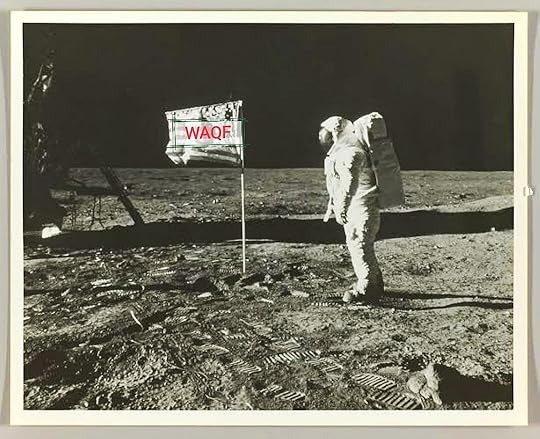
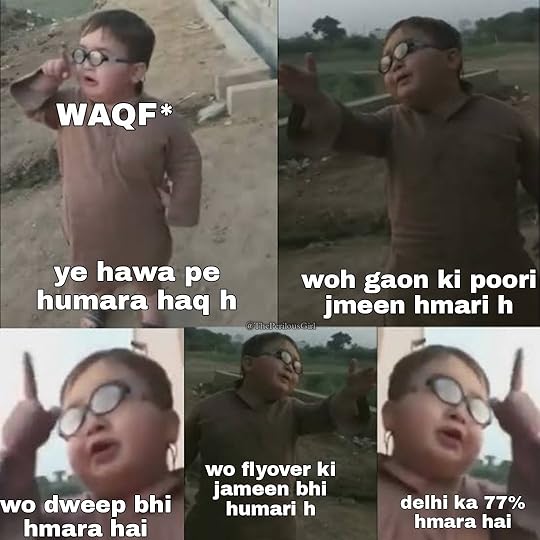
And finally, there is a scariest part of the nitty gritties of the functioning and the power of Waqf board which can be best captured in the below meme -
and one more -
A must read for all the Sanatanis and finally, we are seeing blockbuster books which are written by the cultural right wing of India.
This book delves into the issue of discrimination against Hindus in a nation where they constitute the majority. It explores how the four pillars of democracy - namely, the Legislature, Executive, Judiciary, and the Media - most of the times contribute to this discrimination. The book sheds light on the differential treatment faced by Hindus, with numerous rules and restrictions applicable only to them, while minority communities often enjoy various benefits. Reading this book can evoke a sense of frustration, compelling you to raise awareness about these issues as much as possible.
The writing is crisp, and you can finish it in one go. Must Read
As informative as it is, I think the book is pretty aggressive for someone who is conveying his narrative through plain facts. 1st half seemed logical but eventually it seemed like Mr Anand was forcibly trying to pull out half information from sources just to prove his point and that too in a very rightist tone. Even this might seem okay but for a person claiming that he is a Darwinian atheist,certain verses in the book seem hypocritical. I tried researching everything present in the book and I figured there were a lot of half truths and biased facts leaning towards his rightist opinions.
This book is just a long rant with unrealible sources (and half of the links don’t work). Very sloppy writing and very poor effort into writing this book.
"Hindus in Hindu Rashtra" by Anand Ranganathan has received commendable reviews, highlighting its depth, research, and critical insights into the plight of Hindus in a majority Hindu nation.
Ranganathan tackles complex issues such as the state control of Hindu temples, the biased formulation of the Right To Education Act, and the judiciary's interference in Hindu customs. The book is noted for bringing to light the systematic erasure of Hindu identity and pride and the discrimination against Hindus through various laws and judicial verdicts. The narrative of the book is straightforward and accessible, devoid of academic jargon, making it a suitable read for a wide audience. It's considered a good starting point for those interested in understanding the civilizational issues in Bharat and the range of issues concerning Hindus. The book also discusses the concept of 'apartheid' in the context of state-sponsored discrimination against Hindus, a theme that resonates throughout its eight chapters. These chapters list laws and instances of discrimination, providing an analytical perspective on these issues. Critics note that while the book is not an exhaustive list of discriminations faced by the Hindu community, it does a commendable job of highlighting urgent issues and suggesting solutions.
Ranganathan's approach is seen as empowering for readers, encouraging them to develop their analytical and critical thinking skills.
In summary, "Hindus in Hindu Rashtra" is regarded as a must-read, offering insightful and well-researched perspectives on the challenges faced by Hindus in India. It's a book that not only documents the current state of affairs but also serves as an introduction to deeper research and understanding of the complex dynamics of Hindu identity and civilizational values in contemporary society.
The book, though concise with around 100 pages, is praised for its comprehensive coverage and the amount of research that has gone into it, making it a treasure trove of information often overlooked by mainstream media.
Hindus in Hindu Rashtra is a powerful and eye-opening book that every Hindu should read. This book serves as a reality check, highlighting where we currently stand and the direction we are headed. It provides a well-documented account of the systemic discrimination and victimization that Hindus face in Bharat, shedding light on the numerous ways the state apparatus undermines the rights and dignity of its native inhabitants.
It is important that we never forget our ancestors, who have endured indescribable suffering, waded through genocides, ethnic cleansing, and were victims of unforgivable crimes. We must remember the courage and sacrifices they made to preserve our faith and culture against invaders and oppressors, ensuring that Hinduism survived through centuries of turmoil. It is imperative that the current generation does not let these sacrifices go in vain. We are at a critical juncture in history where the future of Hinduism depends on our collective resolve to stand up against persecution and injustice. If we allow the current state of affairs to continue, what will happen to future generations? What will they think of us?
Will they remember us as the generation that allowed Hinduism to succumb to external pressures and internal apathy? Or will they remember us as the ones who revived and protected our faith against all odds?
In conclusion, Hindus in Hindu Rashtra is a must-read for anyone who cares about the future of Hindus and Hinduism. It is a compelling, well-researched account that challenges us to act before it is too late. Reading this book is a step towards understanding the gravity of the situation and contemplating the role each of us must play in changing the course from the demise of Hinduism to its revival.
So, what kind of decisions and actions must we take in our personal lives to counter persecution?