For two thousand years the disparate groups that now reside in Zomia (a mountainous region the size of Europe that consists of portions of seven Asian countries) have fled the projects of the organized state societies that surround them—slavery, conscription, taxes, corvée labor, epidemics, and warfare. This book, essentially an “anarchist history,” is the first-ever examination of the huge literature on state-making whose author evaluates why people would deliberately and reactively remain stateless. Among the strategies employed by the people of Zomia to remain stateless are physical dispersion in rugged terrain; agricultural practices that enhance mobility; pliable ethnic identities; devotion to prophetic, millenarian leaders; and maintenance of a largely oral culture that allows them to reinvent their histories and genealogies as they move between and around states.
In accessible language, James Scott, recognized worldwide as an eminent authority in Southeast Asian, peasant, and agrarian studies, tells the story of the peoples of Zomia and their unlikely odyssey in search of self-determination. He redefines our views on Asian politics, history, demographics, and even our fundamental ideas about what constitutes civilization, and challenges us with a radically different approach to history that presents events from the perspective of stateless peoples and redefines state-making as a form of “internal colonialism.” This new perspective requires a radical reevaluation of the civilizational narratives of the lowland states. Scott’s work on Zomia represents a new way to think of area studies that will be applicable to other runaway, fugitive, and marooned communities, be they Gypsies, Cossacks, tribes fleeing slave raiders, Marsh Arabs, or San-Bushmen.
James C. Scott was an American political scientist and anthropologist specializing in comparative politics. He was a comparative scholar of agrarian and non-state societies, subaltern politics, and anarchism.
Masterful, and even though I've been studying many aspects of history for forty years, for me it lives up to the front cover blurb by one reviewer who said it would "change the way readers think about human history - and about themselves." It's dry in places, and it took me a while to get into it, but once I did it kept me up at night reading it.
The author's theme is that in many places, peoples who have historically eked out subsistence livings in isolated and rugged environments have not been unfortunate, backward, uncivilized semi-savages, as they've been portrayed by neighboring civilizations in terms like 'our living ancestors', but rather people who've chosen to make themselves hard-to-reach and unappealing targets for control, taxation, involuntary military service, slave raiders, and so on; that they've more often than not lived contentedly and lived longer, healthier, freer lives than most people - typically poor farmers - in the 'civilized' lands they've avoided or fled; and that despite the scorn with which the farming societies in the valleys below their mountains have written about them, the two have almost always been trading partners, with the hill peoples having the upper hand in those trading relationships.
Scott focuses on highland Southeast Asia, but notes parallels in many other places. He makes his case with an incredible amount of supporting data from cultural history to linguistics to botany to trade records. He concludes, sadly, with the fact that this kind of life is rapidly becoming impossible as technology has made the hard-to-reach places accessible and population growth has kept pushing more people into areas that had always been thinly settled.
This book has been an eye-opener for me, and I'm very glad the title caught my eye. I enthusiastically recommend it for anyone interested in history, sociology, economics, and/or anthropology.
Just as promised, the book changed my understanding of human history indeed. At least of the history of "Zomia", the mountainous region stretching all over continental Southeast Asia. And also other commentators here were right: The author *is* very repetitive. So repetitive in fact, that I now wish I hadn't spend all that time reading through every chapter. The introduction and the conclusion chapters might have been sufficient to get the general idea Scott wanted to bring across: namely that the people living in the hilly areas in Burma, Thailand, Laos, Vietnam, Yunnan aren't actually pre-civilized and not as highly developed (agri-)culturally and politically as the large and relatively rich lowland states, but in fact chose to live in this way - far away from the reach of the states with their taxes, slave raids, military services etc. They fled there or stayedin the region voluntarily, escaping thus the power the state has on them. James C. Scott describes why this is the case, how it came about, and what measures the inhabitant of Zomia (Kachin, Chin, Karen, Akha, Lisu, Kinh and many more) took to be able to live off the radar. He also references Leach's work and describes in what ways the peoples in that area shift their ethnicity, culture, affiliations with smaller "statelets" and sometimes language (although I wished he would have mentioned more on language). It's a very interesting perspective and sounds very convincing to me, however, I prefer books with more inner structure, perhaps some more conclusions inbetween and less repetition of the same facts.
So. I've always been an anarchist in principle (didn't Merlin say in The Once and Future King, every decent person is?) and I come to this, not with a special interest in upland SE Asia, but after this on hunter-gatherers Hierarchy in the Forest: The Evolution of Egalitarian Behavior and after this on pastoral nomads Pastoralists: Equality, Hierarchy, And The State, and after a brave foray into the classic Pierre Clastres too. Wherein I've learnt statelessness is common, and clung to stubbornly, which gives me hope for the species.
This one is about defections from civilization, that are much more common than our ‘civilizational discourse’ has allowed us to see. As such, its relevance is far wider than SE Asia. He draws in others' work from other areas, ethnographers' examinations of cultures wherever they have found these political strategies. At the close he says: “I have come to see this study of Zomia, or the massif, not so much as a study of hill peoples per se but as a fragment of what might properly be considered a global history of populations trying to avoid, or having been extruded by, the state.” My own area of study is steppe history, for which I have found this of the most fantastic use. I'll declare it a need-to-read, in another geography altogether.
It covers far too much to try to sum up. I found the most thought-provoking chapters to be the three last. Though in fact he calls one of them chapter 6 ½, because he's just feeling his way: it's on 'Orality, Writing and Texts', and talks about possible attitudes to writing that go dead against civilized assumptions. Might a people reject writing, the orthodoxy of a text, that is a foundation-stone of states, and feel they are better off with oral history? That was fascinating, and the next chapter is 'Ethnogenesis: A Radical Constructionist Case' on the artificiality or fictionality of tribes. He comes at this from two sides. Administrators have to order populations into tribes that weren't there beforehand; but the peoples themselves have uses for a fictional ethnicity – several uses that Scott explores. This chapter includes the why of state mimicry, or what he calls 'cosmological bluster' – where tribal peoples take on the trappings of states, in ways that may be more subversive than subservient. Lastly, 'Prophets of Renewal', on the question of how and why (and what type of) religion has served in revolts of the marginal and the dispossessed. This is a terrific chapter, that does begin on explanations, and those might not be what you thought.
In the end, even though my eye was caught by that title, I wonder whether we have to call this an anarchist history? It’s a history – a neglected history, one we have been blind to, exciting to discover.
I'd read Scott's Seeing Like a State and had absolutely loved it - in my review, I'd described my experience reading it "as if someone's opened a window to let the light in". I wanted to love The Art of Not Being Governed and ten pages in, I had high hopes for the book - just as Seeing Like a State sought to provide a new lens with which to understand how our landscape/operating context is shaped and managed, The Art of Not Being Governed seeks to provide a new lens with which to view the relationship between the "civilised" and the "uncivilised", through the example of Zomia (a mountainous region the size of Europe that consists of portions of seven Asian countries).
Scott argues that the conventional view - that those who live in the rice-growing valleys are the civilised, while those who live in the higher altitudes, who subsist by foraging and growing crops in swiddens, have yet to be touched by civilising influences - is misguided. It is inaccurate to view the two groups as opposite ends of an evolutionary spectrum that dovetails nicely with "social Dawinism". Rather, the latter are those who have chosen to live beyond the controlling grip of the state and their social organisation (small, highly mobile groups that were highly egalitarian), agricultural practices (which emphasised mobility e.g. swiddens and crops that were easy to grow but hard for the state to appropriate e.g. root vegetables), and use of oral traditions rather than writing as a medium for transmitting knowledge are designed to evade state detection and capture. To regard the "civilised" e.g. the Hans, the Shan, the Tai, etc and the "uncivilised" e.g. the Karen, the Cossacks, the Hmong, the Miao, as monolithic entities is also misguided; both the civilised and the uncivilised were amalgamations of many different ethnic groups that were either captured or absorbed to swell the ranks, or who had chosen one side or the other for political or economic reasons. Indeed, terms for such "ethnic" groups e.g. the Miao, was often less meaningful as a term to designate a group of people who shared some common genealogy, culture or language, than it was as a term to designate "the other", in this case "not under Han control". So while we might regard the Great Wall(s) and the anti-Miao walls of Hunan as barriers to barbarism, Scott points out that "they were built just as surely to hold a taxpaying, sedentary cultivating population within the ambit of state power".
So far so brilliant? The problem was that in many ways, The Art of Not Being Governed felt like a rehash of Seeing Like a State. The context might be slightly different - Scott argues that in the European context, it is the size of a ruler's dominions that gives a sense of his power and importance. But in the Asian context, it is the manpower one could summon, than the sovereignty over land that had no value in terms of labour - that determined a ruler's effective power. But how the tension between the civilised and uncivilised was framed - the state's preference for padi, which had a predictable growing cycle and was easily valued, taxable and appropriable vs the preference of fugitive communities for swidden agriculture; the use of writing in states to shape and control the narrative and hence conception of the state, vs the pre/post-literacy of fugitive communities that preferred to use the more flexible and mutable oral tradition - was very much in the same vein as the arguments and examples in Seeing Like a State.
Moreover, I felt that that in the first few chapters of the book, Scott was essentially making the same point ad nauseum. Things picked up slightly in chapters 6 and 61/2 on "State Evasion, State Prevention: The Culture and Agriculture of Escape" and "Orality, Writing and Texts" respectively. In Chapter 6, Scott explains how "a society that cultivates roots and tubers can disperse more widely and cooperate less than grain growers, thereby encouraging a social structure more resistant to incorporation, and perhaps to hierarchy and subordination". What was interesting was his comment that it is not necessarily the case that it is in the valleys that the "civilised" dwell, while those seeking to escape the reach of the state had to flee to higher altitudes. This really depends on the characteristics of the crops that support/hinder resistance to incorporation and the altitudes at which they flourish best. The Incans for instance, lived at high altitudes while those seeking to escape their control fled to the lowlands. In Chapter 61/2, Scott argues that the lack of literacy in fugitive communities should not be seen as an indictment of their "uncivilised state"; literacy simply had no role in such societies, unlike in a state where literacy was used to codify law, for record keeping, for taxes and other economic transactions and to document the "official narrative" of the state. (Indeed, Scott reminds us that we should be wary of the version of history that we receive from the historical records, since this represents only one version, and not necessarily the most authentic version, of history).
"There is no place in any of the standard civilisational narratives for the loss or abandonment of literacy. The acquisition of literacy is envisaged as a one-way trip in just the same fashion as is the transition from shifting agriculture to wet-rice cultivation and from forest bands to villages, towns, and cities. And yet lieracy in pre-modern societies was, under the best of circumstances, confined to a minuscule portion of the population...It was the social property of scribes, accomplished religious figures, and a very thin stratum of scholar gentry in the case of the Han. To assert, in this context, that a whole society or people is literate is incorrect; in all pre-modern societies the vast majority of the population was illiterate and lived in an oral culture, inflected though it was by texts. To say that, demographically speaking, literacy hung by a thread would in many cases be no exaggeration. Not only was it confined to a tiny elite, but the social value of literacy, in turn, depended on a state bureaucracy, an organised clergy, and a social pyramid, where literacy was was a means of advancement and a mark of status. Any event that threatened these institutional structures threatened literacy itself.
Overall, there were some lovely bits in the book but these mainly came early on in the book as Scott was framing his thesis and as I mentioned, in Chapters 6 and 61/2. Perhaps if I'd have liked this book better had this been the first book of Scott's that I'd read. But coming after Seeing Like a State, it was a bit of a disappointment.
A fairly interesting read on a region I knew little about, but this book has several problems. It feels pretty repetitive—Scott tends to make the same points over and over again. He also relies on a concept of political "choice" that is never really defined, but allows him to view pretty much all aspects of SE Asian hill societies as aligning with his own anarchist politics. Although (because?) I'm an anarchist myself, it doesn't make for a convincing or enlightening read. In many ways this book belongs to a long history of leftist idealization of societies outside civilization's reach. Oh, and don't expect a nuanced analysis of gender. However, the sections on ethnogenesis and the historical relationship between hill and valley societies were fascinating.
Homo Sapiens have been existing for 200,000 years and the vast majority of that time was living outside of state structures. Contrary to what we were told, foragers and hunters stayed in one area, it is grain agriculture that was nomadic and aggressive. As late as the 18th century, the greatest portion of the earth’s land mass was still occupied by non-state people. They lived in the least accessible parts of the planet beyond state control. “It is difficult or inaccessible terrain, regardless of elevation, that presents great obstacles to state control.” Historically, while states were saying they had a barbarian/tribe problem, barbarians/tribes were saying that they had a state problem. “Tribes are not prior to states. Tribes are, rather, a social formation defined by its relation to the state.” If you can grow “concentrated grain production” at a location, then it will probably become state space. Back then when the state gazed in your direction, it looked not at the number of your Instagram followers, or at your fly sneakers or your ride, but at your “suitability for appropriation and subordination.”
James wants you to see Southeast Asia’s rugged mountainous area overlayed against eight nations as one place called Zomia. “The innumerable peoples of Zomia …have been avoiding states for more than a millennium.” Its history is highly informative because it illuminates the initial conflict between state and non-state people at the rise of agriculture. Zomia is roughly the size of Europe. Water joins people, mountains divide people. Even in Europe, Fernand Braudel noted that “the steepest places have always been the asylum of liberty.” China’s expert Owen Lattimore noted the same thing in China where formal civilization avoided “the higher latitudes.” “As late as 1740, it took more time to sail from Southampton to the Cape of Good Hope than to travel by stagecoach from London to Edinburgh”. You can’t understand the history of Asian valley states unless you know the history also of Zomia. Women have a higher status in Zomia. Hill people were largely animist, now they are also Christian. In Zomia, some uppity chiefs found themselves killed as a cautionary sign to others, and many districts have a tradition of revolt. The whole area of Zomia, James says, has seen thousands of rebellions. “The stories the Lisu tell of murdered assertive and autocratic headmen are legion. Similar stories circulate among the Lahu.” “As recently as 1973, many Lahu left Kengtung Burma, for the hills, following a failed revolt against taxation and corvee imposed by the Burmese regime.” I spent time with the Lahu in the Burmese triangle in 1979 just after college, as a photographer. They were opium harvesters and my team was delivering them voluntary birth control injections from the Thai government. Hill people are known for “the utter plasticity of social structure.” Think of Hill peoples having a Maroon element (runaways from state-making).
Pre-colonial wars in Asia were not about land theft, but were about slave raiding. The fierce Cossacks started out as runaway serfs. Roma and Sinti were slave raided and became nomadic and that is why they became outlaws from the state. The Berber have a slogan, “Divide that ye be not ruled.” Surinam has the largest maroon population in the hemisphere. James wants you to see also “marshes, swamps and deltas”, as other perfect historical refuges from the state. The Ottoman Empire actually came from the Osman, a “motley” collection of different peoples and religions.
“Political control sweeps readily over a flat terrain. Once it confronts the friction of distance, abrupt changes in altitude, ruggedness of terrain, and the political obstacle of population dispersion and mixed cultivation, it runs out of political breath.” In addition, monsoon rains would make roads impassable between May through October. Thus, war became like fire, “a dry-season phenomenon”. “Slaving expeditions were a regular, dry-season commercial venture in much of the mainland.” “Whole regions were largely stripped of their inhabitants.” “State formation creates, in its wake, a barbarian frontier of tribal peoples to which it is the pole of comparison and, at the same time, the antidote.” State making = weather + geography. Colonial rule demanded “concentration of population and sedentary agriculture”. Travel was 15 miles a day on the flat, less than that as a porter, and far less than that in hilly areas. Asian hills often meant footpaths only which meant you couldn’t use a bullock cart (which let you move seven to ten times the weight a single porter). European rulers knew how insanely expensive it was to transport goods inland without the help of water. The waterways of the Netherlands gave it great advantage. When China took over Tibet in 1951, getting there was so hard that delegates had to get back to Tibet via the sea through Calcutta and then overland north via train and horseback. Thucydides, Peloponnesian War shows however that maritime states (Athens) could be undone by agrarian states (Sparta and Syracuse).
You only found concentrated manpower where you already had sedentary agriculture. In 1600, China was seven times more populated than the rest of Southeast Asia. And so, in sparsely populated Southeast Asia they controlled people to control the land, while in populated China, they controlled land to control people. Control of people was the main source of pre-colonial post-agriculture wealth. What the state wanted from the hills and forest the most was less forest products and more just the people to be used as slaves. In China and India, manuals of statecraft “urged the king to prohibit subsistence activities in the mountains and wetlands in order to increase the involvement of the people in the production of grain.” Did you know English and French courts in the 13th century had to keep moving once they exhausted either the food supply or goodwill of the local population? States thus needed access to food, fodder, and firewood. They also needed monoculture for tax collecting reasons. Otherwise, collecting taxes was hard because you collected stuff like “millet, sesamum, cattle, fishing, coconut palms, and handicrafts” that were harder to collect and brought less income to the state.
Swidden agriculture is slash and burn or “shifting cultivation/agriculture”. It became stigmatized by the state because it produced more for the producer and less for the state. In history there were actually many times where it was more common to see people leaving state space than entering it. “Barbarians are then a state effect.” “Only conquest produced real knowledge of the barbarian world, but then it ceased to be barbarian.” Celts in Gaul were stateless, had fortified towns and agriculture, yet were considered barbarians by Rome. Beltran in his “Regions of Refuge” noted that the same Zomia effect happened in Latin America where “a preconquest society remained in remote, inaccessible regions far from the centers of Spanish control.” Beltran saw that in Latin America the best places to hide for the indigenous became deserts, jungles and mountains. Key was also the fact the Spanish had no economic interest in those areas. Incas reversed things by being up high and to evade them you went low. Peru has more arable land above 2,700 meters.
On islands people would live inland to escape slavers arriving by boat. Those living on the coast built watchtowers. Think of Northern Luzon historically as a small-scale Zomia. Today, think Hmong/Miao 9,000,000, Lahu 650,000, and Karen 4,000,000 people. “Islam was the faith of the sedentary elite. Bedouins were regarded as wild men.” “In civilizational terms, nomadism was to the Arab State what elevation was to the padi state.” Brilliant. From 1450 to 1650, pepper was king of commodities among traders.
The peopling of Zomia was largely a state effect. Think of Zomia as “a catchment area” and an asylum for banned religious sects and ideas that were the “casualties of state-making”. Many hill people are descendants of valley people. “The term savages, used by so many authors to denote all the hill tribes of Indo-China, is very inaccurate and misleading, as many of these tribes are more civilized and humane than the tax-ridden inhabitants of the plain country, and indeed merely the remains of the once mighty empires.” -Archibald Ross Colquhoun, Amongst the Shans, 1885.
As James points out, the state kills diversity: “the pluralism expelled from the valleys can be found in profusion in the hills.” “The Alps generally were seen as the cradle of heresy by the Vatican.” The Reformation splintered in Switzerland Geneva going Calvinist and Basel going Zwinglian. The first historical advertisement was a billboard of a Geneva priest and his choirboys with the tag line “Nothing comes between me and my Calvins.”
It didn’t matter whether the army passing through your area was friendly or not, you and everyone local had to provision it. Let’s say you had a European army of 60,000. Impressive. For that you’d need 40,000 horses, 100 carts of provisions, and, I forgot, you’ll need almost a million pounds of food per day. And sacking the landscape to take people’s shit is going to make a lot of new friends. Isn’t Civilization fun? “The first aim of a civilian is to evade conscription.” The easiest way was to move away from the state core. Protecting your mountain hideaway successfully from the state and bandits is called “encapsulation”. Most of the deadliest epidemic diseases are zoonotic, coming from domestication post-agriculture.
“Nothing is more difficult than to conquer a people [the Igorats] who have no needs and whose ramparts are the forests, mountains, impenetrable wildernesses, and high precipices.” – Spanish official, 18th century Philippines
“We know that some of the border Chinese began to follow the same line of divergent evolution [pastoral nomadism] and that it was to retain the Chinese within China as well as to keep the new style barbarians out of China that the Great Wall was built”. – Owen Lattimore, “The Frontier in History”.
Runaway slaves knew to plant root crops (manioc, cassava, yams and sweet potatoes) which were hard to find. No maroon community could be self-sufficient. Wet rice is better with lots of people but swidden is better for less work per calorie. Coercion was needed to make shifting-cultivators go down and become work-intensive padi-farmers (who could also be taxed). Tax collectors did not want short-lived foods like vegetables or fruits. Roots and tubers became “nearly appropriation-proof” or “an escape crop” and growing them became known as “escape agriculture”. The Irish also grew potatoes because they were hard for the tax collector to find. Prussia rose because of the potato. Fredrick William and Fredrick II pushed growing potatoes to give it “unique invulnerability to foreign invasion.” You could get their grain, fodder crops, and livestock but the potato stayed hidden under ground. Normally a defeated population had to disperse or starve, but this way you could return home and dig up “a meal at a time.” The sweet potato was a high value escape crop, had a high caloric yield, and could be grown at higher elevations than yams or taro. Maize showed up in the 15th century in South East Asia was a big hit, including as escape agriculture. Where hill rice stops (1,000 meters) growing, the opium poppy thrives. The Hmong found that maize also grew in that niche and so they could live. Bad guys could burn your cassava plants and they’d survive underground. Cassava is the champion of being the least labor for the greatest return. Nomads could plant it, leave and come back years later. “Hacienda owners in Central America claimed that with a cassava, all a peasant needed was a shotgun and a fishhook and he could cease to work regularly for wages.”
Use “orality” or “non-literacy” instead of “illiteracy”. Around 750 B.C. the Greeks regained literacy after their Dark Ages (which lasted from 1100 BCE to 700) with an alphabet borrowed from the Phoenicians. Orang Laut are Sea Gypsies and their non-state option was to take to the water. Still confused about non-state? Think Berbers, Gypsies, Cossacks, and Mongols. Fernand Braudel wrote that mountain people think their “history is to have none, always on the fringes of the great waves of civilization.” To picture World History picture first: a stateless era lasting over 90% of human history, second: an era of small states encircled by non-states, and third: full-on (screw nature and your neighbor) Western Civilization. “Tribes and ethnicity begin, in practice, where sovereignty and taxes stop.”
This is one of the most important books I’ve have ever read, easily in the top 50. I love books that say what almost no one else is saying. My second James C. Scott book reviewed, I must continue reading him, he’s just too damned good, everyone should read him.
An honest attempt at an anarchist history, well-written, and full of detail about the highlands of Southeast Asia, a place I love deeply. It presents any number of radical theories about how supposedly “primitive” peoples came to be through intention rather than any kind of putative underdevelopment. Is this an interesting theory, and one with serious potential? Absolutely. Is it something that merits further, data-driven research? Totally. Is there much in the way of data? Not so much. For a series of claims this bold, Scott plays it awfully fast-and-loose, and while a lot of the information is necessarily going to be qualitative, there's a lot that could be backed up by more quantitative information. Furthermore, he seems bogged down in a rather romantic vision of these mountain peoples as idealized, indigenous anarchist formations. Readable, engrossing, should be taken with a grain of salt (or a drop of fish sauce).
James Scott is a political scientist at Yale University, an advocate of anarchy lite — not “smash the state” but “make the state more wise and fair.” Originally, the ancestors of all humans were wild folks living in sweet freedom on open lands owned by no one. Then came agriculture, private property, inequality, and the rise of creepy states, in which well-fed rulers exploited mobs of unlucky subjects and slaves. The Art of Not Being Governed examines the power dramas between free folks and states in Southeast Asia.
In this region, states first arose in the valleys and lowlands, especially in locations suitable for growing rice in flooded paddies. Rice produces high yields, but is labor intensive. Land that is ideal for raising crops only generates wealth when there is an adequate workforce of fairly obedient taxpayers and slaves. Alas, wading in paddies, in clouds of mosquitoes, baking in the heat, constantly bent over, was not everyone’s idea of a good time. Persistent misery inspired many non-elites to envision a beautiful alternative — escape!!!
Most of the landscape surrounding the valley states was mountainous and rugged, unsuited for conventional agriculture, but ideal terrain for state-evading sanctuaries of freedom. So, the higher elevations were home to small groups of hill people who preferred autonomy to subservience. They hunted, foraged, and grew food in scattered locations. Root and tuber foods, like yams, cassava, potatoes, and sweet potatoes, did not ripen at once, or require storage. They could be left in the ground up to two years, and dug up as needed. Scattered amidst the natural vegetation, they were not easy for outsiders to discover.
These scattered communities of hill people often had little, if any, contact with outsiders. Their primary desire was to live in freedom. All of them were refugees, coming from a diverse mixture of cultural, ethnic, and religious traditions. Hill folks had no official name, so a scholar invented one. He called them Zomians, the people of Zomia (highlands). The numerous remote hill communities that comprised Zomia were widely dispersed across an area the size of Europe. Zomian groups inhabited a region that spanned across five nations, and four Chinese provinces. [MAP]
Down in the valleys, the rice producing states were often disrupted by ongoing conflicts and instability. Scott noted that these states “tended to be remarkably short-lived.” The lives of subjects and slaves were miserable, which is why they never stopped running off into the hills. From most rice paddies, the hills of Zomia were always visible. In a prison without cages or walls, freedom was just a walk away. Physical flight was the primary check on state power. It was usually less dangerous than revolt.
The constant loss of manpower was a serious challenge that required constant efforts to snatch fresh replacements. Military campaigns brought home prisoners who were forced to begin exciting new careers in slavery. States often sent slave raiders into the hills of Zomia, in efforts to find free folks and drag them back to the rice paddies.
Classroom history books focus on stuff like wars, empires, heroes, and progress. Slavery gets slight mention, if any. Students will read about classical Greek intellect, art, and architecture; not slavery. There were times when the population in Athens had five times as many slaves as full citizens. Around the world, slavery was a standard component of most agriculture-based civilizations, until recently, when mechanization sharply reduced the need for two-legged farm implements. Your extended family tree likely contains more than a few slaves. Visit Wikipedia’s article on slavery. [HERE]
Clive Ponting published an excellent history that focused much attention on how the hungry dirty commoners actually lived, suffered, and died. He wrote, “Until about the last two centuries in every part of the world nearly everyone lived on the edge of starvation.” J. R. McNeill noted that in preindustrial times, horses and oxen were often luxuries that were too expensive for poor farmers. Humans were far more energy efficient than draft animals, and they were capable of performing clever tricks, like digging up spuds, or planting rice. Having a gang of slaves boosted the net profits for their masters. Lords adored hoards of gold.
In the hills, Zomians were wizards at utilizing “geographical friction” to make it harder for slave raiders to find them. Rather than courteously providing their pursuers with smooth well-marked paths, they deliberately preferred to reside in locations that were not highly visible, or easily accessible. Some locations were perfect for defensive warfare, because they enabled a small number of guardians to block or ambush a larger force of aggressors. The most secure refuges were places “only accessible to monkeys.”
Geographical friction is an interesting idea. Our wild ancestors lived in lands where free movement originally had many natural obstacles. Friction was provided by rugged mountains, swamps, dense jungles, vast deserts, rivers, seas, etc. Friction hampered the expansion of early states. It wasn’t quick or easy to suppress a revolt ten miles away. Friction could be reduced by roads, bridges, boats, beasts of burden, and contraptions with wheels. Today, far less geographical friction remains. We have long distance travel via highways, railroads, air travel, and cargo ships. We can instantly send info anywhere. Scott refers to these as “distance demolishing technologies.” With great pride, we have dumped trash on the moon.
Scott was fascinated by the deep human desire to live in freedom. Genetically, we are alert and intelligent wild omnivores, not dimwitted feedlot critters, or hive insects. His discussion of Zomia revealed patterns that parallel a similar downward spiral of trends around the world. Folks went from nomadic to sedentary, which led to plant and animal domestication, slavery, patriarchy, population growth, perpetual conflict, civilization, industrialization, and our remarkably victorious world war on everything.
For almost the entire human saga, our ancestors enjoyed the freedom of living in small nomadic groups. Our mental equipment is fine-tuned for this way of life. The hill people of Zomia focused on equality, autonomy, and mobility. For them, the concept of “chief” was incomprehensible. Lads who got too assertive sometimes had to be ethically euthanized, in order to maintain the coherence of the group. Smooth cooperation worked far better than compulsory obedience to sharp orders from big daddy buttheads.
Societies took a sharp turn for the worse with the shift toward private property, when the open commons got chopped into chunks of exclusive, inheritable, real estate. Equality was displaced by hierarchies based on wealth, class, and status. Social rank was based on wealth. More was always better. Strive to climb the social pyramid. Primary emphasis shifted from “we” to “me.” It’s like a silly goofy bratty children’s game.
When our wild ancestors evolved in the tropics, food was available year round, nobody owned it, and it was acquired when needed. Later, when folks colonized temperate regions, food storage was required for winter survival. This eventually inspired plant and animal domestication, which created food that was owned, and held in concentrated locations — granaries and enslaved herds. These treasure chests of valuable grain, meat, and muscle power were “appropriable and raidable.” They provided irresistible temptation to ruthless geeks who were allergic to hard work and honesty.
Indeed, this led to the creation of a new career path. Stealing food required far less labor than producing it, and raiding was far more adventurous and exciting for adults who had testicles. At this point, the need to eradicate looters led to the emergence of armed defenders, a military class. These warriors could also serve as armed aggressors, looting the treasure chests of other communities. Since then, the military sphere has never stopped growing in size and power.
With the transition to hierarchy, the old fashioned tradition of mutual support took the back seat to a competition-based, winner take all culture. When you’re a slave in a rice paddy, and your master is a cruel bastard, and your foreseeable future is perpetual misery, you begin to contemplate the meaning of life. You can go crazy, you can flee into the hills, or you can float away into magical thinking.
The hill people were primarily animists. They enjoyed a life of freedom in places of healthy wild nature. They developed intimate relationships with the surrounding flora, fauna, and landscape — here and now reality that you could see, touch, and smell. For them, the living world was spiritually alive. Directly experiencing this profound coherence did not require imagination or belief. It was deeply meaningful.
The stressed and oppressed valley people were more inclined to seek solace in salvation religions, primarily Buddhism and Islam. Christianity arrived more recently. Slavery was an institution with deep roots in many cultures around the world. Until recently, salvation religions treated it as normal. Slaves must be obedient. What these religions promised was that the sucky life you have today will pass, and your soul will continue its journey forever via reincarnation, or admittance to a beautiful eternal paradise (if you weren’t too naughty). Religion provided something to hope for, a better future.
Multinational salvation religions can be practiced anywhere on Earth. They are highly portable because their focus is on great mysteries. Worship often takes place inside buildings, shut away from the family of life. Paradise is somewhere unseen, a faraway realm. Some preach millenarian visions of a new and enduring era of peace, justice, and prosperity — a miraculous transition that is inevitable, and may arrive soon. Wickedness will be destroyed, and the righteous will receive their just rewards.
Even though the hill people enjoyed some advantages over the valley slaves, nobody in the realm of Zomia enjoyed a life of bliss. Hill folks were frequently pursued by hostile outsiders, and valley slaves were frequently abused by their masters. Many folks passionately dreamed that their painful way of life would somehow someday be completely turned upside down, and then move in a new and better direction.
Prophets and messiahs often fell out of the sky, describing their divine revelations, fanning the flames of resentment, and triggering thousands of uprisings and rebellions. Make Zomia great again! Folks desperate for any possibility of emancipation were vulnerable to the tempting promises of ambitious, slick talking, charismatic blowhards.
Sadly, a better tomorrow missed the bus somewhere down the road. States got bigger and more powerful, and then they got blindsided by steamroller colonizers from outer space, like the empire-building British, French, and Japanese. By 1945 it was pretty much bedtime for Zomian freedom. Variations of this tragic drama took place around much of the world. Today, virtually all humans are subjects of states. Fleeing to zones of refuge is nearly impossible. Tyrants now have fighter jets, helicopters, tanks, missiles, cluster bombs, land mines, drones, satellites. Good luck with that rebellion.
Scott laments the outcome. “The future of our freedom lies in the daunting task of taming Leviathan, not evading it.” He says that our best tool for the challenge is representative democracy. Good luck conjuring virtuous government. He was writing in 2009, back in the happy days when there were a billion fewer primates on the ark. More recently, hopping mad, power-hungry, nationalist psychopaths have been popping up in nations all over the place, like mushrooms after an autumn shower.
Oh wow! Look! A pair of 800 pound gorillas has jumped into the brawl — the climate crisis and resource limits — two invincible giants spawned by the unintended consequences of our obsession with idiotic cleverness. Their plan is to act like bulls in a china shop, and smash up Fantasyland. This should be interesting.
An extensive description of ‘Zomia’, the highlands of South East Asia, spread across countries like Vietnam, Laos, Thailand, India and China. On the fringe, ungoverned, considered barbaric, but, as the author successfully argues, purposefully so.
The hills of South East Asia, like fringe societies everywhere, are regions of political resistance and cultural refusal. Not being remnants of the past, nor a homogenous ethnicity or tribe, they consist of individuals who actively avoided being taken in by state control, leaving the governed lowlands for the ungoverned highlands.
Then, the author keeps on reiterating his central point until he’s beaten the reader to near-death with it.
Thankfully, there are several interesting little tidbits to keep turning the pages, most of the time.
+ “Ethnicity and tribe begin exactly where taxes and sovereignty end." + Rice farming is efficient for its yield and the concentrated populations it requires, and that the hills of South East Asia make travel difficult, and that land empires trump sea empires, essentially for the manpower they are able to muster. + Where in Europe wealth begat power, in South East Asia, manpower begat power, hence, South East Asia's poorer modern states were based on both rice farming and slavery. + "Far more egalitarian settlements were founded by runaways then by revolutionaries." + Cassava is an easy crop to maintain, requiring virtually no attention, while it can be left to grow for years, underground, and while its leaves can also be consumed. Perfect to grow in many little plots over a large area, when you’re forced to move around a lot. + The interesting point that the lack of writing and the shorter scope of history (of hill tribes), maintained through oral traditions, are possibly a coping mechanism to fight hierarchy and to facilitate societal fluidity.
Do not cultivate the vineyard, you'll be bound Do not cultivate grains, you'll be ground Pull the camel, herd the sheep A day will come, you'll be crowned
Much of our histories is narratives, stories that have been spun together from the works of historians, archeologists, anthropologists and so on. Much of that history, is the history of kings and nobles, of states, kingdoms and grand rulers, of civilizations against barbarians and so on. Scott offers a radical look at how we perceive the notion of civilized, what that means and how much of that is simply the assimilation or lack thereof into state structures.
Basing his studies in the area of S-E Asia, in a vast area designated as Zomia, Scott explores through the economic, social and political lives and relations of an extremely varied peoples ,ranging from the Naga in India to the Hmong in Vietnam, of the hills and mountains with their valley dwelling counterparts, the type of relations and dynamics that have led to such a varied people's who have lived historically outside the grasp of the ancient(and modern) states.
Scott essentially offers a 'people's history' of a vast ethnic tapestry of people without a written history, whom, he eloquently argues, have chosen to actively live outside of the grasp of the state, have organized themselves and their lifestyles so as to escape said grasp and have actively resisted assimilation. Exploring facets ranging from economic life such as choice of agricultural practices like slash and burn as opposed to wet-field rice growing, trade, raiding, dispersal and mobility, fluidity of ethnic and religious identities, he constructs a history of an intricate system of resistance, that has consistently thwarted the incorporation into the role of tax-paying subjects of states and all the coercive and destructive outcomes of this: war, epidemics and exploitation.
Furthermore, Scott outlines the limitations of state projects in the area in their ability to both extend their rule above a certain altitude or geographical terrain, their inherent fragility and dependence on low land rice cultivation and attraction of populations, the vicious infighting between said states and the complex relationship between these entities and their hill counterparts in terms of cultural, economic and political relations, exchange and mutual dependency.
The book is extremely well researched and although Scott presents hypotheses that can be debated or critiqued by virtue of taking leaps of faith in for example presenting the vast tapestry of resistance to hierarchical entities, one cannot disagree with the inherent logic of these fluctuations over time and in opposition to states, that, have historically been extremely coercive and hegemonic and against whom various peoples, not limited to Zomia, i.e Cossacks, Rroma etc. have fought to maintain their freedom and autonomy and which said struggle against state entities and their coercive institutions, continues both from the liminal spaces such as the Zapatistas all the way to the cores of the most tightly wound Western countries.
I took me a whole month to finish this book, not because it was boring or too voluminous... it is just a book that you have to digest sentence by sentence, page by page, and that demands your full concentration. I had the same issue with Scott's great book Seeing Like a State: How Certain Schemes to Improve the Human Condition Have Failed.
If you want to take the effort, the book is amazingly insightful. And does not just apply to Zomia or South-East Asia, but to many areas in the world, although increasingly less and less as state power consolidates and extends to every inch of the earth... I read the book with the West-African Sahel in mind, and did have several aha-moments while reading.
The basic idea that people throughout history have tried to prevent, avoid, evade and escape state control and appropriation (with its taxes, slavery, corvé labor and recruitment for wars) is a true paradigm shift: looking to human history through this lens, puts everything in a different perspective, especially for westerners having a completely biased view of the state.
I especially liked the discussion of the concept of "barbarians" (how backwardness is actually just being unintelligible for the state), the chapter on ethnogenesis (how fungible and fluid identities have always been), how people deliberately stopped using written records (to adapt more easily to changing circumstances), and the role of religious revolutions (and prophets) as attempts to reinvent social order.
As I compare with the current "terrorist" crisis in the Sahel, the following lines are very inspiring (p. 298 in my edition): (...) peasant communities already incorporated into a state-based order are prone to support radical prophetic movements whenever their relatively autonomous village order (local dispute settlement, managing grazing rights and common land, selecting their own leaders) is threatened by an intrusive centralizing state. Again it appears to be less a question of income and food supply than one of autonomy.
And oh yes, I only discovered at the end that the book provides a glossary situating the tens of peoples of South-East Asia continuously discussed in the book. I should have known that from the start...
A really thought-provoking book on the people who live in the hills of Southeast Asia and the ways that they have been evading states for millennia, up into the present day. Although it’s mainly descriptive and doesn’t make normative claims, it does have an anarchist angle (hence the subtitle) – it opened my eyes to what it means to live outside a state and made me think about how the ways people carry out their lives are influenced by states.
James C Scott died halfway through my reading this excellent book (correlation, not causation). RIP to the good professor. This book is deeply researched, provocative, incredibly well written, and often quite funny.
His argument is convincing — southeast Asian hill peoples have developed all sorts of methods from mobile agriculture to fluid ethnic identity all to help resist incorporation in oppressive states.
Scott also proves that the description“academic tome” need not be preceded by “dry”. He writes with so much voice & wit that it’s easy to forget how esoteric his subject matter sometimes is.
He has some really interesting things to say but basically just keeps repeating himself over and over. If this was something like a hundred pages it would be a lot easier for me to recommend it.
The Art Of Not Being Governed: An Anarchist History Of Upland Southeast Asia, by James C. Scott
Far more than most people, I have a deep and abiding interest in the people of upland Southeast Asia. I have spent some time in my life in the region, and for some time taught and got to know people from tribes like the Kachin, Lahu, and Karen, whose well-being I was deeply interested in. To these students, I was an agent of Western civilization, someone who provided them with an education that could help better their lives, and there were some people who eagerly sought after that knowledge. Sometimes, though, the behavior of students under a great deal of stress struck me as anarchic, and this book does a good job at explaining the nature of anarchy with regards to hill peoples when one compares them to the settled people of the valleys who have long sought to dominate them. I myself come from a background of the hill people of Northern Appalachia, and this gives me a further degree of sympathy and understanding for those who dwell at the periphery of dominating states with whom ordinary people have at best an ambivalent relationship. This book is a worthwhile exploration of a period where for a large part of human history people have sought to escape from lowland domination and have sought, in some way, to live their lives in freedom while also picking and choosing what they want from the settled societies around them.
This book is a bit less than 350 pages and is divided into a variety of thematic chapters. After beginning with a preface, the book then continues to an introduction to Zomia, the author's term for upland Southeast Asia, specifically its hills, valleys, and states (especially Han, Tai, and Burmese states) (1). This is followed by a discussion of the state space of governance and appropriation of labor and resources and people (2). After this comes a discussion of the role of irrigated rice and systems of bondage like slavery as a means of concentrating food and people under state control (3). The author then discusses the tangled relationship of civilization and the unruly (4). This is followed by a look at the peopling of the hills by those who wish to keep the state at a distance (5). The author then talks about evading and preventing the state in the culture and agriculture of escapist hill societies (6). A digression follows on orality, writing, and texts, and their political involvement in state legitimacy (6.5). The author offers a somewhat radical constructionist case for the ethnogenesis of hill societies (7), after which a significant amount of space is sent talking about the fondness of hill peoples and other oppressed groups for millenarian prophets of renewal (8). The book ends with a conclusion, notes, glossary, and an index.
To be sure, this book is not really a matter of proving particular theories of which people are descended from where, but it does indicate that far from being merely ancestral, hill peoples have had a complex relationship with the lowland societies, including as a source of captives to be turned into agricultural laborers as well as a refuge for people seeking to escape from systems of domination and control or collapsing valley societies. If this book is by no means perfect, it is highly evocative in demonstrating that the anarchy of hill tribes is not an accident of history but a deliberate choice on the part of the people who live there. Not everyone wants to live under the control of lowland elites as unfree laborers with their culture wiped out, their autonomy taken away from them, and turned into drudges engaged in boring and frustrating agricultural and other forms of labor. Indeed, not everyone in contemporary societies want to live under the surveillance of governments or businesses or want their behavior to be controlled by governments. Not everyone wants to pay ruinous taxation or be regularly exploited by others like greedy landlords and cheating company stores designed to put and keep people in debt. The presence of spaces outside of central control allow people to be free, and present a check upon the rapacity of elites in the core of states. The knowledge that people can escape from intolerable tyranny and go to a more tolerable situation, whether that be another society or free territory where one can survive by foraging or hunting or different forms of agriculture, ought to be a check on the tendency of states to seek total domination of those people under their misrule.
Scott makes a fascinating and persuasive contra-historical argument, which is unfortunately let down by repetitive writing. The subject is the peoples of upland South-East Asia, the dense jungle massif between Eastern India, Southern China, and the Indochinese Peninsula. The diverse peoples of this area, which Scott deems Zomia, have been portrayed a primitive barbarians, living relics who have not yet been 'cooked' into civilized people, but who will inevitably being incorporated into the state. Against this view, Scott argues that Zomians are people who have explicitly rejected state control and power in favor of choosing their own lives, and that apparent primitiveness is a sophistical system of not being governed.
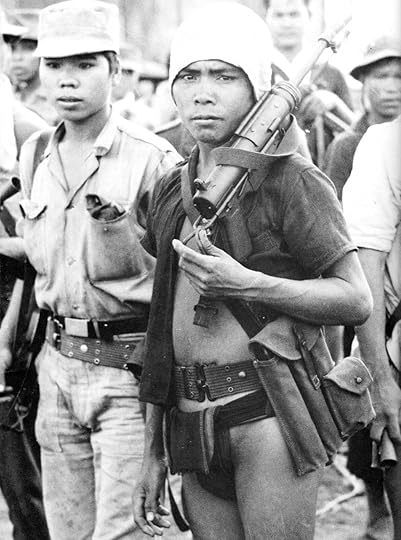
A Montagnard tribesman during training in 1962. Traditional loincloth and M3 submachinegun. Wikimedia
The lowlands around Zomia offer some of the best terrain for state formation, as wet rice padi agriculture is labor intensive but incredibly productive. However, due to the limitations of transportation and communication technology, state power can only extend a few hundred kilometers from the capitol, and this reach is curtailed when plains switch to mountains, jungles, or swamps.
The basic problem is one of control. The State needs labor for public works, for conscription, and indirectly as taxes. But as these taxes become too onerous, or drought and plague wreck havoc, or marauding armies loot on their path, the peasantry always the option to quit and take to the hills. At which point, the state increases taxes to make up their deficit, more people flee, and the state collapses.
Scott makes some good points about how since written history is almost by definition a matter for literate elites: priests, kinds, and the apparatus of state bureaucracy, we must fill in the gaps ourselves. Barbarians and tribes are illusions the state reifies to make sense of its frontier. Oral history over written history offers advantages of a fluid social identity and lineage. Ethnicity is a matter of politics, not bloodlines. Yet I'm not entirely persuaded of the easiness of the choice to abandon the only kind of life you've known and take to the tiger haunted hills, away from oppression but also social context.
The chapters are self-contained, which adds redundancy, but also makes it possible to assign individual ones easily in seminar (I think I just caught on to Scott's aim with the structure. I doubt he'd deliberately write a redundant book). While the history of a people without history is always challenging, The Art of Not Being Governed is a fascinating view of the vanishing areas where the power of the state fails.
I wanted to LOVE this book so much, but it’s all based on the authors personal theories, not necessarily facts.
The biggest issue that I have (and you’ll read about early on) is that he generalizes numerous tribes that share no relation to one another, together. Also, he refers to the land(s) they occupy as “Zomia”, which isn’t a real thing; let me clarify, it’s a termed coined by a Dutch Historian in 2002.
He doesn’t examine the individual histories nor origins of the peoples he’s writing about. He only speculates why they are where they are.
While tedious, if you’re interested in the ethnic tribes of Asia/upland Asia, I’d suggest doing your research elsewhere; unless it works in your favor to loosely group the Asian tribal communities together in a broad sense. In that case, no harm no foul.
"The composition of vast books is a laborious and impoverishing extravagance -- setting out in five hundred pages an idea that can be perfectly related orally in five minutes." -- Borges
I lied when I clicked "I'm finished" but I had the book for two full borrowing periods and someone else requested it so I couldn't renew it anymore. The idea is interesting, but reading the book is punishingly boring, especially early on. It's just the same handful of sentences, rewritten, over and over and over and over and over again. Hundreds of pages of exactly the same paragraph. Read the introduction and you have read it all. Read the dust jacket and you have!
The last two chapters, on ethnogenesis and on religion, seemed much more interesting, but I had to skim because I knew someone was waiting for the book and it was overdue.
A comprehensively argued case for cultural fluidity and “simplification” as a political response of state-evasion. This is enormously helpful in looking at history with fewer state-friendly assumptions, even if it can be a little overwhelming to a reader unfamiliar with Southeast Asia. It doesn't pretend to ring true today, but it's enlightening in creating more complete histories. So good. So good and so needed.
“what, after all, is the history bearing social unit? [...] The relationship of a people, a kinship group, and a community to its history is diagnostic of its relationship to stateness.”
Scott presents to us a history of Zomia: a contiguous region in southeast Asia, spanning Vietnam, Laos, Thailand, northern Myanmar, and southwest China (Yunnan, etc) whose topography and climate has made largely ungovernable. Only the book isn't really a history -- it's an anthropology. And Scott is not just talking about Zomia, but really lots of different places like the Tigris-Euphrates marshes, the American west, the Teutoburg Forest, the Darien Gap, the metaphorical woods in A Midsummer Night's Dream, the internet... OK, probably went too far on those last two but you get the idea.
The argument Scott is making is something like this: - There has historically been a notion of state space and non-state space. State spaces are defined by a monopoly on coercive force within a geographic region (11). - As time has gone the state space to non-state space ratio approaches infinity (Bir Tawil is still up for grabs!!!) - The non-state to state transition is viewed as a sort of natural step on a continuum of human evolution. The Romans absorb the barbarians. Miao join the Han state. Etc. - But -- and here's the real crux of the book -- this view of non-state people as pre-state people is totally wrong (337). It is an easy criticism to level given that many prefer oral to written history, practice swiddening agriculture if not hunting and gathering, lack dense cities, etc. But many of these humans are reacting to the state, forming a "purposeful statelessness". It's a choice. There is nothing that says humans have to organize into these weird, artificial state things and grow wheat in these nice rows and so forth. Civilization VI is a story written by the victors. The correct way to see these tribes is as in dialogue with the state, not suboordinate to it or andecedent on the Great Timeline of Man.
Scott talks a lot about the features of these "hill peoples" (c.f. the civilized "valley peoples"). They tend to be more egalitarian (157) -- acephalous groups are harder to co-opt into some state corvee scheme (208). Common property is the norm vs. enclosures. They prefer oral to written histories. They forage for a varied diet and practice polycropping vs. the predictable cereals of civilization. Etc. I think this goes on in a bit too much detail at a bit too much length. The important take away was that these features are so frequently cast as primitive or barbaric or pre-civilized. But what is inherently "barbaric" about oral history? What's wrong with anarchism? Enslaving ourselves to grain (Yuval Harari has a good passage about this) is arguably one of the worst things that humanity has ever done.
This point becomes even clearer when we consider that most of the non-state tribes are really just ... ethnic majorities who have fled the state. Not some long-separate and genetically distinct people. The Great Wall to some degree was in some part a program of the state to keep tax-paying citizens in the state so that their property could be more easily appropriated (173).
The frontier is actually a sort of check on state power and a place for experimentation. It should probably be a bit worrying that states have carved up the entire world. This is definitely a historical anomaly.
This work, while engaging and doubtlessly well researched, bugs me on a few levels. The argument is a classic Graeberian premise: looking at case studies to forumlate a theory of history which is counter to traditional Marxian cosmologies, and other derivative schools of sociology. Utilizing groups in upland South & Southeast Asia (most heavily concentrated in Burma), Scott argues that (taking heavily from Khaldun) the tyranny innate in sedentary civilization is observable in the valley civilization - meanwhile, those in the hills represent people who formulate their own destinies, far out of arms’ reach of the state. Those who choose to live this way come from a variety of origins, as their dress, language, religion and mythology show. All of them, though, for whatever reason, whether it be a runaway prince or people fleeing religious persecution, those who make their home in the hills leave indelible marks. In the highlands, the rougher terrain makes travel time more difficult, and therefore bureaucratic & military subjugation impossible, especially without modern vehicles. These people’s relationship with the states of their area becomes more evenly transactional, as some of them trade with the state (selling precious goods attained in the highlands, or slaves) or seeking tribute from lowland peoples, while raiding others. This argument here is where one of my bigger complaints comes in. Obviously, these peoples are for the most part not dependent on the state, yet there is a clear relationship that does, in some way show acquiescence to the state. Anarchist often becomes a problematic title here - as for one, many of the groups discussed dealt in slave trading, a clear hierarchical institution, irregardless of comparison to chattel slavery, and for two, many of them conceive of Kings and greater chieftains in their future. The latter part is of course more messianic than anything, and the question of ethnic identity is a less ingrained one in the groups discussed, but still the semantical use of anarchist indicates at the very least a society wherein slavery and slave trading is not practiced. Some of the more materialistic aspects of the work prove quite fascinating, as Scott looks to which crops are best to avoid subjugation to the state, and allow for more mobility. Another major complaint though is how he discusses the Han. It reeks of a certain loathing of Maoism, the Han are some borglike entity, creating these vast and horrible states which subjugate and absorb all those in their wake, when in reality Han, like any identity is an imposed one. The Han encompass a massive diversity of peoples and dialects, to refer to the Han as flippantly as Scott does recalls brash Ukrainian nationalists talking about Vatniks. But overall, an interesting read!
I haven't read james c scott's book itself, but a sort of summary by Jacques Berguerand.
"Zomia" is first and foremost a 2.5 million km² region of Southeast Asia, on the outskirts of 9 states. Zomia means "mountain people" and is a term common to several languages.
It's an experiment in political autonomy, a demonstration of the possibility of doing without state and government.
Because of its peripheral position in relation to all the states and empires that have sprung up, existed, collapsed or endured in this part of Asia over the last 2,000 years, and also because of the mountainous terrain that makes the region more difficult to access, life in this place has taken shape *outside* and *against* the state.
On the one hand, there's the state and its organization (taxes, military expeditions, slavery...), and on the other, a complex set of modes of resistance to escape state authority. Zomia is not simply outside the state, since the Zomia-state relationship is an important one: the area and its settlements have been structured according to the actions and exactions of the state.
For James C Scott, in a way, all their cultural and organizational choices can be understood as a desire to extricate themselves from the oppressive logic of the states that manage the plains around Zomia; nomadism, refusal of sedentary agriculture, oral culture, cultural chaos and identity, all of this is illegible for a power that seeks to fix, list and organize its subjects.
The book is about Zomia, a stretch of upland territory in Southeast Asia made up of a number of peripheral contiguous territories of different countries where the state authority of each country is largely absent. One major feature of Zomia is statelessness. James C. Scott, the author, discusses the emergence of such non-state space in relation to the emergence of state space in pre-modern and precolonial times in Southeast Asia. He argues that non-state space is not remnant of civilization, but in fact an effect of civilization which he calls 'state effect'. State formation in pre-modern pre-colonial era, according to him, happened when two conditions were met: 1) the possibility of wet-rice agriculture; 2) the concentration of manpower.
In the past, state formation entailed taxation, forceful extraction of labour power and prevalence of diseases, among others, for the population. It was therefore common for people to flee the state space for places with no state presence, which would be mostly hills. Migration to non-state spaces allowed people to escape the oppressive state structure. Scott thus emphasizes that the hill people were not uncivilized people who failed to evolve culturally. Rather, these people exercised their agency to keep valley civilization at bay as they found it contrary to their well-being and aspirations.
The demography of non-state space would be extremely diverse, as they drew its population from various valley states. The social structure in the hills was marked by egalitarian relations, fluidity of identities and high degree of mobility. Scott also mentions that the hill communities didn't have the incentive to maintain complex and long lineages, unlike the residents of the valley states. Owing to their lightness on lineages and history, combined with a range of flexible subsistence strategies, they were able to adapt to new circumstances readily and take up new identities as and when needed. This also prevented internally the formation of state structure.
It would be erroneous however to say that hill people avoided the valley states altogether. In fact, the book shows several instances of economic co-operation between people in the hills and those living in the periphery of the valley states. However, such relations were maintained only insofar as it didn't threaten the autonomy of the hill people. Valley residents and hill residents both benefitted from trade as one party was able to supply items which were not available in the ecological settings in which the other was located. Apart from places where such trade existed, the general relationship between valleys and hills was more of distrust and othering.
One key term in the book is 'oscillation', meaning that there was no finality attached to being a hill dweller or a valley dweller; as well as being of one ethnicity or another. People moved between the hills and valleys whenever it suited them. Similarly, it was common to switch ethnic identities in accordance with the changing context. As the state space expanded to include hitherto non-state people, these people would be assimilated into the ethnic identity and culture of the core valley state. Those who fled were usually able to preserve their distinct identity in the hills but individual members were not constrained to be loyal to anyone particular identity.
The book gives an interesting explanation of the spread of Christianity in the hills. Lacking institutionalized social and state structures, non-state people often had faith in prophet or a divine liberator who were able to bring people together for specific ends. These prophets were looked upon as divinely-ordained individuals who were able to deliver people from their sufferings. In fact, many rebellions against the state in pre-modern era were led by god-men. While the common mode of escaping the expanding state was migration, this route was not always available and the frustration would ultimately culminate in the form of open rebellion with a prophet at the helm.
Hill people also tended to maintain boundaries with the valley states and religions. However, some religious and ritual influences did make it to the hills. When this happened, the hill people would take heterodox and magical elements from the valley states but reformulate them to suit the context of the hills. Christianity, according to the author, was perceived as suitable to the pre-existing religious orientation and public disposition. Interpreting the elements of Christianity from their own cultural lens, non-state hill people were able to justify to themselves the embracing of this religion. Christianity also offered them a modern identity, literacy, health and education, among others, which they found further attractive.
Scott notes that non-space is becoming increasingly rare in today's world of nation-states. Previously, state simply didn't have the technology to administer their entire territory because of distance and friction of terrain (rugged terrain). Peripheries of the states would therefore always be devoid of government, which ipso facto became a sanctuary for those who wanted to flee the state. With the emergence of distance-demolishing technologies such as transportation and communication as well as modern bureaucracy backed up by increasingly sophisticated military capabilities, the fate of non-state people has already been sealed. They have largely been incorporated into state space and those remaining few, if any, are not going to survive the state juggernaut.
I recommend this book to anyone who is interested to learn about state formation and its implications in Southeast Asia or elsewhere.
It is quite long and redundant, but I love this book. This love should be contextualized by my complete lack of knowledge on Zomia, but a commitment to resisting the lack of imagination created by the institutional hegemony of the nation-state.
Es un libro increíblemente completo y exhaustivo en su análisis de las sociedades de Zomia y cómo evadían la captura por el Estado. Es una pena que no tuviera conocimiento previo sobre las etnias de las que habla, pues creo que hubiera entendido mejor partes del libro.