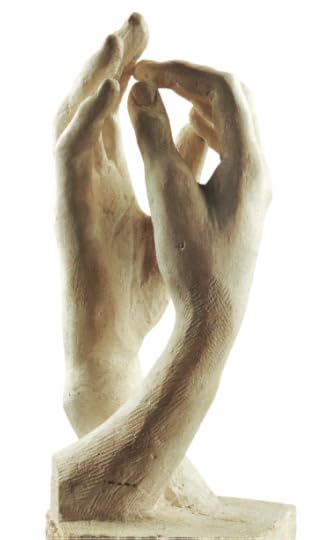
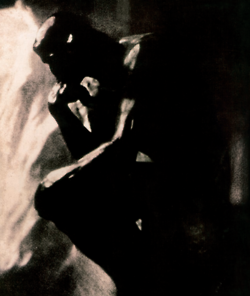
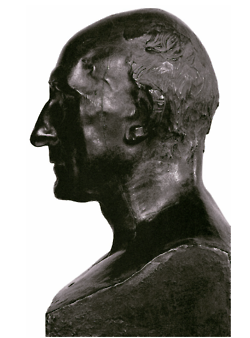
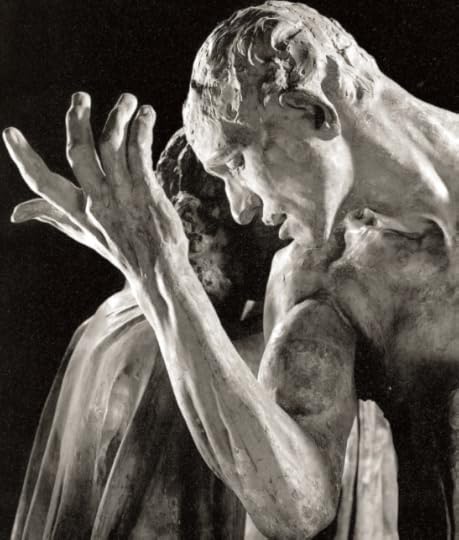
An extremely beautiful, dedicated homage to Rodin, Rilke's teacher in Art matters for quite a while —imagine the privilege. In this essay, Rilke tells us about Rodin's life while he analyzes the ways the sculptor has perceived nature, reality through the description of some of his works. If sometimes the exhaustive descriptions may become boring, there's always the counterpoint of beauty provided by Rilke genius coming up, sooner or later. And so, I think this is a great complement if one is trying to get a hold on Rodin —of course, Rodin himself has a couple of articles, so those are surely useful too. Some of the most beautiful paragraphs, cites:
"He pledged himself to a humble and difficult beauty that he could oversee, summon and direct. The other beauty, the great beauty, had to come when everything was prepared, as animals come to a drinking-place in the forest in the late night when nothing foreign is there."
"Here in the body Rodin found the world of his time as he had recognized the world of the Middle Ages in the cathedrals. A universe gathered about this veiled mystery - a world held together by an organism was adapted to this organism and made subject to it. Man had become church and there were thousands and thousands of churches, none similar to the other and each one alive. But the problem was to show that they were all of One God."
"He evolved one great simplification out of many confusions as Christ brought unity into the confusion of a guilty people by the revelation of a sublime parable. He fulfiled an intention of nature, completed something that was helpless in its growth. He disclosed the coherences as a clear evening following a misty day unveils the mountains which rise in great waves out of the far distance.Full of the vital abundance of his knowledge, he penetrated into the faces of those that lived about him, like a prophet of the future. This intuitive quality gives to his portraits the clear accuracy and at the same time the prophetic greatness which rises to such indescribable perfection in the figures of Victor Hugo and of Balzac.To create an image meant to Rodin to seek eternity in a countenance, that part of eternity with which the face was allied in the great course of things eternal. Each face that he has modeled he has lifted out of the bondage of the present into the freedom of the future, as one holds a thing up toward the light of the sky in order to understand its purer and simpler forms. Rodin's conception of Art was not to beautify or to give a characteristic expression, but to separate the lasting from the transitory, to sit in judgment, to be just."