Jump to ratings and reviews
Rate this book

Sam Plank #1

Fatal Forgery

Rate this book
It is 1824, and trust in the virtual money of the day – new paper financial instruments – is so fragile that anyone forging them is sent to the scaffold. So why would one of London’s most respected bankers start forging his clients’ signatures? Sent to arrest Henry Fauntleroy, Constable Samuel Plank is determined to find out why the banker has risked his reputation, his banking house and his neck – and why he is so determined to plead guilty. As the case makes its way through the Regency justice system, exercising the finest legal minds of their generation and dividing London society into the banker’s supporters and detractors, Plank races against time to find the answers that can save Fauntleroy’s life.

282 pages, Paperback

First published July 11, 2013

27 people are currently reading
661 people want to read

About the author

Susan Grossey

50 books28 followers
My name is Susan Grossey. I graduated from Cambridge University in 1987 with a degree in English, and then taught secondary English for two years before realising that the National Curriculum was designed primarily to extinguish every spark of creativity in its teachers. I then became a technical author, and reached the pinnacle of this profession when I was asked to document the workings of a choc-ice wrapping machine in Cardiff, while wearing a fetching blue hairnet (which I forgot to remove until it was pointed out by a cashier in a petrol station on the M4).

From this unbeatable high point I moved into technical training, and one day was asked to help with a staff manual on fraud prevention. As I wrote the chapter on money laundering, I realised that here was a topic that could keep my interest for years – and so it has proved. Since 1998, I have been self-employed as an anti-money laundering consultant, providing training and strategic advice and writing policies and procedures for clients in many countries. As part of my job, I have written several non-fiction books with exciting titles like “Money Laundering: A Training Strategy”, “The Money Laundering Officer’s Practical Handbook” and “Anti-Money Laundering: A Guide for the Non-Executive Director”.

However, even this is not enough financial crime for me, and in my spare evenings and weekends I write fiction – but always with financial crime at the heart of it.

Ratings & Reviews

What do you think?
Rate this book

Friends & Following

Create a free account to discover what your friends think of this book!

Community Reviews

5 stars
41 (30%)
4 stars
51 (38%)
3 stars
30 (22%)
2 stars
10 (7%)
1 star
2 (1%)
Displaying 1 - 21 of 21 reviews
Profile Image for Hobart.
2,702 reviews87 followers
September 14, 2022
★ ★ ★ 1/2 (rounded up)
This originally appeared at The Irresponsible Reader along with a Q&A with the author.
---
But the theft of that which represents money—of pieces of paper that can be exchanged for money—well, there we have something new. Mr Fauntleroy is not accused of going into his bank’s vaults and taking money belonging to others, but of changing pieces of paper to make it look as though their money belonged to him. We police officers will have to learn new skills to catch such people.


WHAT'S FATAL FORGERY ABOUT?
It's 1824, and Henry Fauntleroy is one of the leading bankers of London—it's a smaller bank, but it has a stellar reputation. Fauntleroy is the son of one of the founders, and while he's an utter and complete cad in his personal life, he earned both his position and reputation—it wasn't handed to him.

But then evidence comes to light that he's been forging documents and moving large sums of money around in some sort of complicated scheme. He's determined to plead guilty and avoid a trial. While the winds of reform are blowing, this type of offense is a capital crime. Fauntleroy knows this and is still ready to plead guilty and accept the sentence.

At least one magistrate involved wants to make sure that the investigation is handled properly and there isn't a rush to judgment/punishment. Sam Plank is a constable that works for him and has the same concerns--he is the one who arrested Fauntleroy and becomes somewhat invested in the investigation and his welfare (beyond what's called for in his duties). Plank is convinced that everyone is missing something vital in this case, but he's struggling to see what it is.

Will he be able to put the pieces together in time to save Fauntleroy's life?

FINANCIAL CRIMES
I get the impression that the monetary system was in a time of transition at the time the book was set, and the kind of crime at the center of this book was a new thing that the legal system wasn't quite prepared for. Much like we might be today with cryptocurrencies and we're still trying to figure out how to effectively police identify theft-type crimes. I've lost track of the number of books that I've read this year that include a discourse on cryptocurrencies (and I have a book to start this week that will likely feature a few of them), so it was nice to walk into a book about financial crimes that was sure not to include one—but behind all this is the equivalent, which is thankfully much easier to understand.

Now, I'm not a complete dunderhead when it comes to finance and economics, but (in both real life and fiction) things don't have to get too detailed before my mind checks out. I was a little daunted about trying to understand 1820s banking in the first place—much less any kind of scheme involving defrauding it. But Grossey's depiction of it was easy to follow—she wrote it in such a way that you don't have to come in knowing the nuts and bolts* of the machinery to follow Fauntleroy's crimes

* Nor will you walk out knowing them—it easily could've become a Tom Clancy-deep dive into Nineteenth Century monetary systems.

MARTHA PLANK
I think that Sam's wife, Martha, is going to turn out to be one of those supporting characters that turns out to be one of the MVPs of the series. At first glance, she seems to be simply a nice, supporting wife, who understands her husband's moods better than he does—and understands that she'll take a backseat to his job (at least from time to time). But at one point, she takes the reins for a bit and gets more information out of a witness than Sam would've been able to—and with far less fuss and bother.

I'm not saying she'll become the asset that Marybeth Pickett is to Joe's investigations, but I wouldn't be surprised if it turns into something in the same vein.

SO, WHAT DID I THINK ABOUT FATAL FORGERY?
While Plank was clearly drawn to the case, trying to understand what made Fauntleroy ticked, and was disturbed by some of his non-financial crime activity, there isn't the same kind of emotional investment that characterizes so much of Police Procedural/Detective Fiction today. Part of that has to do with the era, I'm sure—Plank caring the way that Renée Ballard or Malcolm Fox does about a case would be unseemly. Still, he spends personal time on the case—even using a date with his wife as a pretense to go track down someone associated with Fauntleroy—and will later go to great lengths to wrap things up.

I liked that feel to the character, and think it serves to help establish the setting. But that might say more about my preconceptions about the time—and how it's been depicted in the fiction I've read.

I wondered if the setting—and the type of crime—would end up being a hurdle to reading and/or enjoying the book. But neither proved to be the case, I was pleased to see how easy it was to get into the book. And the pages just melted away when I got past the first chapter or so, which felt more like a speed bump than a learning curve. In the end, the setting and subject made this a very pleasant change of pace.

Fatal Forgery isn't the kind of thing that would catch my eye when I browse, and ultimately, not it's exactly my cup of tea--but I'm shooting to read at least one more in the series because I enjoyed this and am curious about what else can be done with the character (and I can see that easily turning into me reading all of them). I do know one reader who will likely burn through the whole series as soon as I give her the first one—if you're like her and a Regency-era police procedural with a minimal amount of violence piques your interest at all (even if it makes you mildly curious)—give this a try.

Disclaimer: I received this book from the author in exchange for this post and my honest opinion.

Profile Image for Gordon Mcghie.
606 reviews95 followers
March 26, 2020
put out a shout on Twitter for audiobook recommendations and got a lot of excellent recommendations. Although I only had scope to pick up one or two of the suggestions at the time I was drawn to Susan Grossey’s Fatal Forgery (as the day-job is in financial services). The premise of a banker pleading guilty to fraud when the penalty of his actions led to the hangman’s noose was ticking all the right buttons.

The story begins in 1824 and we are in the company of Constable Samuel Plank. These are the days before a London police force was fully established but Plank and colleagues do maintain law and order and work with magistrates to keep the streets safe. Well that’s a relative measure but they maintained a degree of discipline. It is clear Plank is well respected, he can apply reason and sound decision making and he is not one to have his head turned by the offer of a coin or two.

Indeed it is coins which are at the heart of this story as Plank is caught up in the disturbing case of a banker (Fauntleroy) who has failed to properly act in the true interests of his customers and traded stock and dividends without their knowledge. The semantics and methods used by Fauntleroy are nicely explained by the author and although I have an awareness of most of the terminology used I am quite sure those outside financial circles would have no trouble understanding how the crimes had been committed. Forgery is a phrase which carries over many generations!

The story follows the investigation. The social unrest and outcry (bankers were most trusted in 1824). We also get a court case and there is a great social history aspect to the story too. Susan Grossey does a marvelous job in depicting Regency London and gives the reader a splendid insight into how life may have been.

Narration duties are handled by Guy Hanson and he was very listenable. I repeat it often but the narrator can make or break the audiobook experience and Mr Hanson very much made Fatal Forgery a most entertaining addition to my listening library. There are further titles in the series and I fully intend to pick them up over the coming weeks.
53 reviews1 follower
June 9, 2023
I enjoyed the core concept and characters -- but the pacing felt way off, with the good bits buried under a lot of procedural to-and-fro
Profile Image for Sarah.
25 reviews4 followers
March 15, 2014
Also posted at HOEW: http://www.hangingoneveryword.co.uk/2...

The year is 1824 and Constable Samuel Plank, works as a policeman attached to the the magistrates’ court in Great Marlborough Street, he has been set the task of arresting banker Henry Fauntleroy - a man charged with Forgery, which back then was a Capital Offense.

Sam Plank is a policeman of dignity, while many others of the time would take a bribe and turn a blind eye, he prides himself on upholding the law and while there is little doubt that Henry Fauntleroy is guilty the magistrate John Conan, asks Sam to look into it more. Because why would a gentleman of good stature and seemingly decent nature fall so far as to commit a hangable offense and with Sam having had a previous interest in a forgery case he is just the man for the job.

Henry Fauntleroy is adamant he wants to plead guilty, though with London split he could perhaps be saved from the noose this seems to be far from what he wants, but why would a man, with family want to leave this earth? What just is he hiding?

I have to say the answer to those questions surprised me - I was sure I knew what was going on from quite early on, but I was so far from the truth.
Profile Image for Emilija.
1,881 reviews30 followers
February 17, 2017
I received a free copy of this audio book in exchange for an honest review.

This is a great novel as it's looking into why a man committed a crime rather than who committed the crime. I thought that that was a very interesting take on a novel about financial crime, made ever greater by the fact that its set in Victorian London and financial forgery would get you hung.
The main character - Sam Plank - is great and you get a very Holmes and Watson feel from Plank and his wife. It was brilliant.
Profile Image for Lucienne Boyce.
Author 10 books50 followers
August 6, 2015
A very satisfying read. From the start it's never a 'whodunit', and as a 'whydunit' it's full of surprises - culminating in a quite unexpected twist at the end. Constable Sam Plank is a wonderful character, down to earth, unglamorous, steady - and all the more likeable for it! I've already bought the second Plank mystery and am looking forward to reading it.
Profile Image for Rebekah Giese Witherspoon.
268 reviews30 followers
April 5, 2019
“I begin to think that Mr Fauntleroy is not the straightforward, hard-working, God-fearing banker he claims to be, eh, Wilson? What a man does is always infinitely less interesting than why he does it, don’t you agree?”

This is the first “whyhedunnit” mystery that I’ve ever read, and it’s a fascinating psychological novel. Constable Sam Plank is the narrator, and what an awesome character he is; kind and smart and interested in true justice rather than the letter of the (often brutal and excessive) law in England during the Regency Era.

Working with criminals can turn a man one of two ways: either he becomes worse than the worst criminal himself, or he learns that there is nearly always a reason for a man to turn bad. Perhaps he has been treated harshly by others, or maybe he has too many mouths to feed and not enough skill to do it, or perhaps he cannot see that others are using him to do their dirty work. So you learn not to judge a person until you know why, as well as what, when and how.

I’m definitely continuing with this series!
8 reviews
February 16, 2023
An extremely readable novel with great attention to detail in terms of historical research. I really enjoyed learning about the justice and financial systems of the time in the context of a good mystery story. The cast of characters is memorable and entertaining, and the narrator, a magistrate's constable, is likeable and an excellent guide to all that is going on. It's more of a whydunnit than a whodunnit, which makes an interesting change. It wasn't the highest paced, most compulsive read, but sometimes it's nice not to have to rush through a book - I really enjoyed being able to take my time and explore the rich detail of 1820s London.
Profile Image for Jane Wilson-Howarth.
Author 22 books21 followers
August 3, 2022
I was thoroughly hooked by this book within the first few pages and thereafter wanted to rush on to the satisfying end yet I'm not especially a fan of crime fiction and couldn't imagine how anyone could pull off a dramatic novel about financial shenanigans but Grossey managed it magnificently.
This novel is clearly meticulously researched and quickly immerses the reader in the late Georgian era (1824 to be precise) and in many ways such a different time. Yet there are themes that resonate still.
Now I want to know how much was bested on real events.
Profile Image for Elliott Hay.
Author 5 books36 followers
July 19, 2019
An unpolished gem

The writing is at times awkward. The story takes some bizarre and frankly unnecessary twists and turns. The typesetting is abysmal.

But...

At its core, this is a gripping and believable tale. For those who like mysteries, finance, and historical fiction, it’s unmissable.

I almost put this book down after the first page. I’m so glad I didn’t. This is the author’s first foray into fiction. I’m certain her voice will begin to really sing in each new sequel.
Profile Image for Lawrence Verigin.
Author 5 books105 followers
June 6, 2019
A very well written story. It felt authentic to 1800's London and the descriptions took me back to the time. Great police mystery with a couple good twists and turns, especially at the end. Look forward to reading more books in the series.
116 reviews2 followers
July 5, 2022
What a great way to begin a new series. I found Fatal Forgery entertaining and challenging trying, alongside Sam Plank, to understand the banker's motivations. Only to be surprised at the end of the story. A good read and recommended.
21 reviews
October 24, 2019
First time I have read this author. Brilliant.
Profile Image for Debbie Young.
Author 44 books266 followers
April 24, 2014
This was an intriguing, beautifully written and presented book that perfectly captures the tone of the era in which it is set: 1824. The narrative, in the voice of a very likeable police constable Samuel Plank (a great solid and dependable name!), kicks off with the arrest of a senior banker, Henry Fauntleroy, who soon admits forgery, and the rest of the novel is largely spent investigating why he should have risked all to commit his crime. Although it seems like a straightforward case, there are twists that I didn't see coming that make this a very satisfying read.

It is also a fascinating portrait of a critical period of development in the banking industry, when the new "technology" of the banking industry is paper documents rather than money, viewed with suspicion by many. Shockingly, the punishment for forgery is death, which adds further weight to the reader's need to know just why on earth Fauntleroy would commit it and so readily admit his guilt.

The story reads as a compelling analagy to the age of 21st century banking and attitude to "fat cat" bankers, including the response of the popular press and the general public. Though we may not see crowds of thousands assembling in public to witness bankers' executions any more, the clamour of the public to read about any banker's fall from grace is close to that scenario in spirit.

The author is apparently a money-laundering expert in her day job - expert at preventing it, that is - which accounts for her ease and fascination with financial and legal detail. Sometimes the explanations in the book went a little over my head (or maybe that's just a reflection of my natural ostrich tendencies when it comes to financial considerations), but this still make for a very interesting read.

I loved the sense of place, with some surprising revelations about jail and courthouse conditions and operations, and an interesting change of setting at one point in the book, which I won't reveal her for fear of spoiling the plot. There was great attention to detail woven skilfully into the writing, so I felt I learned a lot about the era by osmosis, rather than having it thrust upon me.

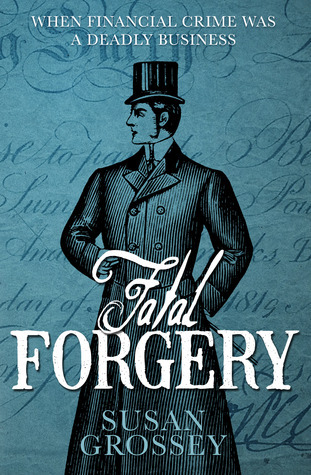
I also admired the cover and the interior design, which helped create the right atmosphere for the period narrative.

I really like Constable Plank and his amiable, supportive wife - Dr Watson to his Holmes - and I'd love to read more books about them.

All in all, a remarkable debut novel. While I won't be reading Ms Grossey's non-fiction books about money-laundering, I'll definitely be looking out for more of her fiction, and I'll be recommending this book to members of the local Historical Novel Society book group that I attend.

(Disclosure: the author sent me a free review copy of this book, having seen that I'd reviewed other historical novels on Amazon.)
Profile Image for Jaffareadstoo.
2,933 reviews
November 10, 2013
Was Henry Fauntleroy simply a common thief with a fine wardrobe and a good education?

Well, that’s what Constable Samuel Plank is determined to find out in this cleverly constructed financial crime story, which takes us on a journey though the complicated process of Regency justice. In 1824, methodical crime detecting is still in its infancy, and public trust in the burgeoning use of paper money is precarious. So much so, that anyone caught forging financial documents is sent to the scaffold. When Constable Plank is sent to arrest the banker, Henry Fauntleroy, who has been accused of financial fraud, Samuel has an inclination that there is more to this man’s crime than at first appears.

From the start of this story I felt as if I had been transported back in time to Regency London. Walking in Samuel’s footsteps, I could hear the same cacophony of sound, shared the same sense of disbelief in Fauntleroy’s modus operandi, and hung onto Constable Plank’s coat tails as he entered the squalid house of correction at Coldbath Fields.

I know absolutely nothing about bank fraud during the Regency era, but on reading Fatal Forgery, I was completely fascinated by the way the author has captured not just the spirit of the time, but also the minutiae of the financial world. The description of the people who inhabited this complicated world is exemplary, from the solid reliability of Constable Plank, to the irascible and curmudgeonly court dignitaries, and the fatally flawed perpetrator Henry Fauntleroy, all combine to form a fascinating insight into a very different criminal fraternity.

I am reassured that this is not the last we have seen of Samuel Plank. His steadfastness is so congenial that to spend time in his company in future books, is a treat worth savouring.


Profile Image for Colin Garrow.
Author 51 books143 followers
March 19, 2016
Long before the days of online banking, a big part of any banker's working life was trust - but not all bank employees were able to resist the lure of hard cash. In 1824, respectable banker Henry Fauntleroy is arrested on charges of forgery, leaving Constable Samuel Plank to find out exactly what's been going on, and why. However, Plank finds himself with an apparently impossible task, for even with the threat of the hangman's noose waiting for him, Fauntleroy is set on pleading guilty. With single-minded determination, the constable begins to pick away at the evidence and soon discovers the apparent forger's private life is not all it should be. Nevertheless, with all the evidence pointing in one direction, it's only a matter of time before Fauntleroy faces the ultimate sentence.

Inspired by the real-life arrest and court case surrounding banker Henry Fauntleroy, anti-money laundering expert Susan Grossey's first foray into fiction might well have been a little dry and lacking in the thrills department. But I'm happy to report that apart from leaving me a mite confused over some of the financial aspects of the case, I thoroughly enjoyed the first of Constable Plank's adventures. The attention to detail and realistic depictions of the prisons at Newgate and Coldbath Fields, as well as the trial itself at the Old Bailey, place the reader right down there in the thick of it.

Susan Grossey's writing is as sharp and clever in her portrayal of the world she's created, with a knowledge and feeling for her characters that brings them to life as clearly as if we were sitting down to tea with them. I'll definitely be grabbing a copy of her next book in the series - 'The Man in the Canary Waistcoat' - in the very near future.
Profile Image for Tracy S.
27 reviews
September 20, 2020
Had me gripped from first paragraph!

I stumbled upon this author by chance whilst researching Sir Robert Peel, and so pleased I did. I seem to gravitate towards novels based on Regency and Victorian London. This, however being the first regarding fraud. Maybe today our bankers would think differently if capital punishment was still in place for such crimes. However I deviate.... This was an expertly constructed novel. Susan knows her stuff of course. Constable Plank is a pillar of the community and his wife Martha, such a lovely character. You really get to know them both so well. The accused - Fauntleroy, well I felt sorry for him in part up to a certain point. But won't say any more than that, as it would spoil it for those who wish to read this novel. I struggled to put down my kindle, and found me contemplating over the plot in my head whilst nodding off. Very gripping read and now on to the next in the series.
15 reviews
September 14, 2016
Like a good radio drama.
I enjoyed Fatal Forgery. The storyline and narration were good. Guy Hanson as Constable Sam Plank brought the whole story to life and I was transported to Victorian London. I did like it when Sam got excited at the trial and with all the different character witnesses quite quick fire. Felt like a Sherlock Holmes in Part and a James McLevy but without the sidekick.

The main downside is that this is the first in the Sam Plank series to be made available through Audible and I would really like to listen to the next one now to follow the story. So can you please get on with this now.
Please note that this review was undertaken through The Good Reads audiobook programme.

Bill Scott
Edinburgh September 2016
Profile Image for Jodi.
272 reviews5 followers
September 30, 2016
I really enjoyed this audiobook. I loved Sam Plank, and look forward to reading more about him in this series. I thought the plot flowed nicely and the narrator did a wonderful job with all the different voices. Thank you Susan for letting me listen to this in exchange for my review. I really enjoyed it, and can't wait to read more!

Profile Image for Bookmuseuk.
477 reviews16 followers
Read
August 15, 2017
One of the best things about reviewing for Bookmuse is that you get to read books that would otherwise pass you by … and that is certainly the case with this author.

Although I do enjoy some historical fiction, this period wouldn’t have been my personal choice, and it would have been a real shame to miss out on the first book in this series. Crime fiction meets Regency London and it’s a real winner!
This is the first book featuring the sleuthing powers of Constable Samuel Plank. Here he is tasked with discovering why a wealthy, reputable banker would risk the gallows by forging customer’s signatures and stealing hundreds of thousands of pounds. Can Plank uncover the truth behind the actions and in doing so save a man’s life … or is there something even more sinister behind the trail of events?

The book was a real page turner. Not high in gore or drama as many modern day crime fiction tends to be, but still full of suspense and tension throughout. I liked the way the author wove in the details of the period, using her research cleverly to settle the reader into the story. And I also thought the pace and plotting were spot on – the twist at the end was very well thought out.
Characters were also very solid, believable enough to step from the page, and suited to the language and style of the writing. Constable Plank is a real asset, this author is a real find, and I look forward to reading more books in the series.
Displaying 1 - 21 of 21 reviews

Can't find what you're looking for?

Get help and learn more about the design.