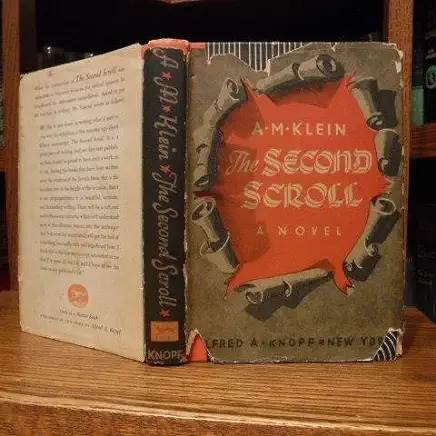
Written soon after the founding of the state of Israel, The Second Scroll is A.M. Klein’s most innovative and visionary work. The five “books” of the novel are a modern testament of Jewish experience to which are appended “glosses” or commentaries in the form of drama, epistle, poetry, and psalm. The action centres on a young writer from Montreal, whose search for his legendary Uncle Melech becomes a journey of revelation through Italy, Morocco, and the Holy Land. Dissident and exile, reformer and scholar, Melech is a messianic figure who enacts the destiny of his people and embodies the spiritual yearnings of everyman.
The Second Scroll , Klein’s only novel, combines the lyric genius of his poetic works with compelling reportage to create one of the most eloquent and original works in Canadian fiction.
This amazing little novel combines prose, poetry and drama to explore the phenomenon of being Jewish in the twentieth century. It is by turns philosophical, nostalgic, bitter, humorous, lyrical and prayerful. Written in 1951, it not only evokes the long history of Judaism but meditates on events which had occurred not long before: the Holocaust on the one hand and the declaration of Israel's independence on the other. It grapples with the problem of evil and the affirmation of an ancient faith. It also discusses Judaism's uneasy relationships with the other Abrahamic religions of Christianity and Islam. This is the aspect that gave me the most trouble as a non-Jewish reader. But I think it provides an eye-opener which might help us ponder how we might conduct interfaith discussions with a little more understanding and respect.
I read this book in January (2024), then went back through it at some later point. The chapters fell into place if I read each one and immediately reread it. While the first read tended toward the opaque, the chapters opened up on the second read.
The subject of this short book made me think of a Forrest Gump figure, although not one of limited intelligence, or maybe a Zelig figure whose picture is fluid. The book is a complex, at times, ecstatic reaction to the 1948 creation of the state of Israel, the point at which for many Jews and perhaps the author A. M. Klein, the precarity of their existence ended and they reentered history.
The protagonist first with his parents and then alone follows the career of his uncle Melech Davidson in the old country. The uncle starts out as a Talmudic prodigy whose status sheds honor on his North American (Canadian) relatives. The next thing you know, though, the uncle, traumatized by a devastating pogrom in his village, transmutes into a Bolshevik, as a result of which his name never again passes the lips of the protagonist's father. Then Melech reclaims his heritage; the protagonist pursues him to Europe, only to discover another near-transformation: possible conversion to Christianity by a Monsignor Piersanti.
The uncle escapes that fate; the protagonist pursues this ever-elusive figure through several more iterations, but never catches up.
The book is chock-full of allusions, as exemplified by the two names shown above, nor is it devoid of humor.
The book is short, including just 121 pages, although followed by 75 additional pages of poetry, "autobiographical" material and other texts, but those I've saved for later.
It's amazing to me how this book could become a classic in Canada. I find it hard to imagine a book this Jewish being widely read in the U.S. But of course it was a different time.
I came across this book because Ruth Wisse reviewed it in the Wall Street Journal, and also because I have a Canadian Christian friend on Goodreads who recommended it.
A Dantesque tour through the dreadful circles of that hell that's the 20th Century, chasing a Virgil that's gotten enough of the world. Should be way, way more widely read than it is.
Very interesting and complex book, partly prose narrative, partly poetry, with a smattering of other styles you may recognize. Klein's skill as a poet is on display, and guided by the then very recent events there is a passion that sometimes crescendoes into bitterness. You could say this book is modernist, and it definitely takes cues from Joyce et al., but mostly this is Klein making a more or less timeless statement in 1951. Klein's style isn't as iconoclastic or 'daring' as, say, W.C.W or anything, so the entire book can be followed and understood, often, at the quite literal level.
The entry about the Sistine Chapel is particularly excellent and forceful. The poetry is sharp, the prose tight and effective, the book very much worth the effort of finding and/or reading it.
This is a good book, it just comes from a literary tradition I am not familiar with. There are so many references unrecognizable to me. I liked the book, but I definitely do not understand it beyond the basic metaphors. It did open up a new world to me even if I can't enter.
A.M. Klein had a brilliant mastery of prose and there were plenty of words throughout this lovely Jewish spiritual journey to look-up in the dictionary. In The Second Scroll, the main character travels from Canada, to Italy, to Morroco and finally to Israel in search of his allusive Uncle Melech. This journey to find a lost uncle occurred in the shadow of the Holocaust. The rumors surrounding Uncle Melech had him adopting various common identities of Jews during the 1930s and 1940s. The rumors said Uncle Melech was a Communist, that he was a talmudic scholar, that he had converted to save his life, and finally that he may have been taken to a Nazi concentration camp. The magic key to this book was when I realized that Uncle Melech was an allegorical character - the ever morphing goal of searching for not only a Jewish identity but also a spiritual foundation.
Another interesting aspect of the book was how it showed the enthusiasm and hope the founding of Israel gave to diaspora Jews. The main character was thrilled to be in Israel despite the physical dangers, which was contrasted with the challenge of being Jewish in a moderately anti-Semitic world throughout his travels. This excitement about the founding of Israel in The Second Scroll cut into some of the timelessness of the allegory but it also made it a more interesting documentation of the journey.
The Jewish Canadian writer A.M. Klein went silent in 1955 at the height of his career. For reasons no one can explain, he hardly wrote a letter for the next 17 years. Whatever seized hold of him those final years, another demon had gripped him for the previous twenty, when poems, plays, essays, and fiction spilled from his pen.
Indeed, his masterpiece, The Second Scroll, rises to a pitch of intensity wholly characteristic of Klein but also perfectly attuned to his subject: a post-Holocaust odyssey of one man in search of his uncle, a survivor. In less than a hundred pages (plus extended glosses), the protagonists trip through half the world and every significant possibility open for the future of the Jewish people.
Who knows? Maybe in this novel Klein exhausted everything he had to say. Certainly, seven decades later, we have not exhausted all it has to say to us.
I read this in the context of an undergraduate seminar course in Canadian literature, so my reading is necessarily coloured by the information and opinion picked up there. I don't think I would ever have found or attempted this book if not for the course, and I'm sure that without the basic background provided by my class work on Klein, I wouldn't have been able to make heads or tails of the novel. Having just enough understanding of the author's biography and of some basics of Judaism, though, I found this book engrossing, moving, and rewarding. Certain portions unsettled me, as I am not Jewish and was alienated by some of the narrator's enthusiasms; other parts unsettled me for their frank descriptions of true-to-life horrors. I'm inclined to look indulgently on Klein's wordplay and gleeful allusiveness, and to marvel at the novel's unusual structure, but I would guess that most readers would find these stylistic aspects somewhat annoying. I think it's a beautiful and worthy read, but it does make demands of, or perhaps better to say has expectations of, the reader, such that it is simply not a casual read.
Also, the edition I had was the 1994 M&S NCL edition, and it has a disruptive printing error in Gloss Dalid where one page is repeated and the subsequent page is ommitted. I saw from my classmates' editions that the newer version doesn't have this error, and I'd say it's worth tracking down an alternate copy to get a look at that missing page. You can tell what's happened without it, but the play-script reads much better with it!
I liked it better than I thought I would, but I don't think I was really part of the intended audience. The ovens were hardly cold when Klein wrote about this pilgrimage to the newly-established Israel, so it's a mix of great ineffable sorrow mixed with eager anticipation for the future. It gave me some insight into the Jewish experience, especially as it relates to modern Israel. I did like the mix of formats, including the one act play and the poetry, and Klein's description of Casablanca was memorable.
A mind-blowing, virtuosic, genre-busting classic Canadian novel by a master of language and literary forms. It encompasses two-thousand years of history and cultural development, and in less than 200 pages presents a modern reenactment of the Israelite journey in the Torah, and updates rabbinical commentary through a multiplicity of genres including poetry, essay, correspondence, a play, and liturgy. This novel was post-modernist before the term was invented. One of the twentieth century's great novels.
I read this for my Canadian Jewish class and I'm disappointed in it, probably because my professor who usually chooses great novels, brought this highly uneventful novel into the course. I was bored throughout it, and didn't want to sit down and read it, or discuss it in lectures. I just fail to see the "work of art" I've had so many tell me it is.
An ok book. Too much explication of Judaic symbols, which made reading the novel a lot more difficult. Clearly a commentary on the Holocaust and reconnection with Judaic tradition.